
 Recruit
Employer of Record (EOR) in Greece
-
 Drew Donnelly
- Published
- September 21, 2026
RemotePeople’s employer of record in Greece lets you hire employees in Greece through the EFKA system. We handle 21.79% employer social security contributions, public pension contributions, and healthcare coverage.
Hire in Greece — book a free 30-minute demo
Tell us what you need. You'll get a tailored, transparent proposal within 24 hours, plus a free call to walk through it.
Tell us about your company
So we can match you with a specialist who knows your market — and unlock volume pricing tiers.
* All fields are required.
Where and when are you hiring?
Tell us the geography and timing and we'll quote each country line by line, with onboarding timelines.
* All fields are required.
Help us beat your current setup
We'll benchmark your current deal and send a line-by-line proposal in 24 hours — showing exactly where we cut cost, time, or risk. After you submit, you can book a call to walk through it together.
* All fields are required.
Thanks! Your proposal is on its way.
Expect a tailored, line-by-line proposal in your inbox within 24 hours. In the meantime…
Want to walk through it together?
Book a free 30-minute call with one of our specialists. We'll explain every line, answer your questions, and tailor the proposal further if you need.
No obligation. Pick a time that works for you.








- Hire in Greece — book a free 30-minute demo
- Tell us about your company
- Where and when are you hiring?
- Help us beat your current setup
- Thanks! Your proposal is on its way.
- How an Employer of Record Works in Greece
- Employment Laws and Regulations in Greece
- Work Permits and Visas in Greece
- Payroll, Taxes, and Social Security in Greece
- Cost of Hiring Through an EOR in Greece
- Benefits of Using an EOR in Greece
- Termination and Offboarding in Greece
- EOR vs. Other Hiring Models in Greece
- Public Holidays in Greece
- How to Get Started with an EOR in Greece
- Where companies hiring in Greece expand next
- Frequently Asked Questions
- Related EOR Destinations

Start hiring in Greece
Let RemotePeople handle payroll, compliance, and HR admin worldwide so you can focus on building your team.

Greece has a highly educated workforce, EU membership benefits, and a growing tech sector. But hiring employees here means dealing with Greek labour law, the EFKA social security system, and a mandatory bonus structure that adds two extra months of salary per year. An employer of record in Greece lets companies onboard Greek employees without setting up a local entity. The EOR handles payroll, contracts, tax withholding, and benefits administration while staying fully compliant with Greek regulations. RemotePeople provides EOR services in Greece, managing EFKA contributions, income tax filings, statutory leave, and mandatory bonuses on your behalf.
How an Employer of Record Works in Greece
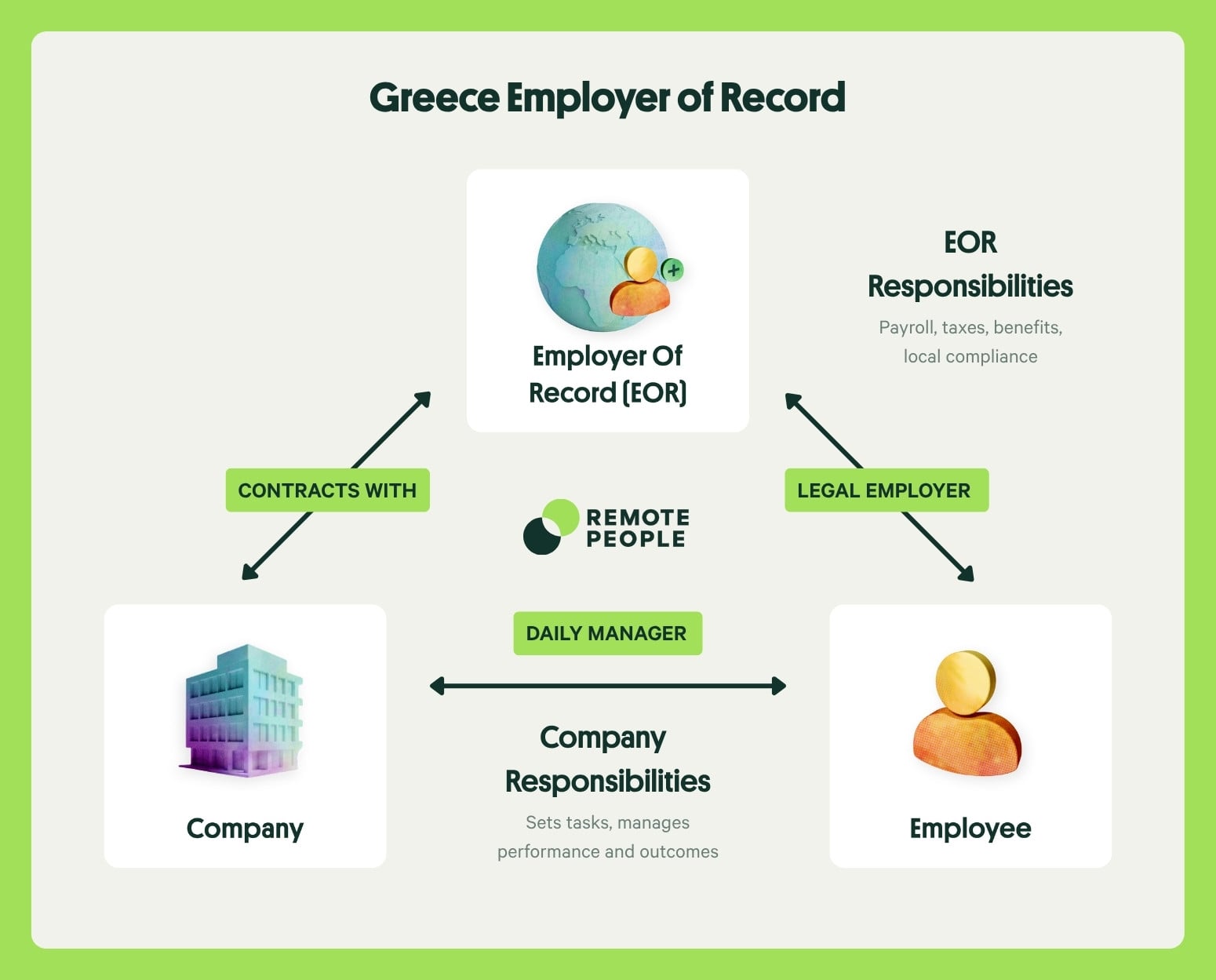
If you’d like to learn more about how Employer of Record (EOR) services work, read our What Is an Employer of Record (EOR)? guide for a complete overview of the model, its benefits, and when to use it.
If you’re comparing providers, our Best Employer of Record (EOR) Providers guide reviews the leading platforms to help you choose the right solution for your business.
Who Uses an EOR in Greece?
Companies at different stages use EOR services in Greece for different reasons.
Companies evaluating the Greek market often hire 1–5 employees through an EOR before committing to a local entity, limiting financial exposure while validating demand. Teams of up to 15 employees benefit from avoiding the EUR 15,000–30,000 cost and 3–6 month timeline of entity incorporation.
When hiring is urgent, an EOR can have employees working within 1–2 weeks, compared to months for entity setup. For non-EU workers who need work permits, the EOR manages the permit application process and sponsors employment legally in Greece.
Typical Onboarding Timeline
Here is what the typical onboarding process looks like when hiring through an EOR in Greece.
- First, EOR agreement and employee details (1–2 days): You provide the employee’s information, role specifications, and salary details. The EOR confirms service fees and compliance requirements.
- Second, employment contract drafting and review (2–3 days): The EOR prepares a Greek-language employment contract covering all statutory requirements. You and the employee review and sign.
- Third, EFKA and tax registration (3–7 days): The EOR registers the employee with e-EFKA for pension and social security, EOPYY for healthcare, and AADE for income tax withholding.
- Fourth, payroll setup and benefits enrolment (2–3 days): The EOR configures payroll, sets up bank transfers, and enrols the employee in all statutory benefit programmes.
- Fifth, employee onboarding and first day (1 day): The employee begins work under your operational direction while the EOR manages all employment administration.
Most EOR providers can onboard an employee in Greece within 1–2 weeks for EU/EEA citizens. Non-EU hires requiring work permits add 2–3 months to the timeline due to permit processing.
Hire in Greece
A 22.29% employer contribution rate, a highly educated workforce, and strategic access to EU and Southeast European markets make Greece a compelling destination for international hiring.
We handle employment contracts, payroll, tax withholding, and full Greece compliance.
No local entity needed. Your team can start in days.
Employment Laws and Regulations in Greece
Employment Contracts
Greek employment law requires written contracts for all employees. The Labour Code and Law 4808/2021 govern the key provisions. Contracts must be in Greek and specify the employee’s role, compensation, working hours, probation period, and termination conditions.
Fixed-term contracts need objective justification: project completion, temporary replacement, or seasonal work. They cannot be renewed more than three times within 36 months. Exceed that limit and the contract automatically converts to indefinite employment. Indefinite contracts are the default and come with stronger job protection, including notice periods and severance rules on termination.
Working Hours and Overtime
The standard working week in Greece is 40 hours across 5 days, with a maximum of 8 hours per day (Greek Ministry of Labour). Law 5239/2025 (“Fair Work for All”) increased the daily overtime limit to 4 hours, with a cap of 150 hours per year at a 40% wage premium. Overtime beyond 150 hours requires approval from the labour authority and carries a 60% premium.
Employees may refuse overtime in good faith without risk of termination or adverse treatment. As of November 2025, overtime premiums, night work premiums, and Sunday/holiday pay are exempt from social security contributions.
Overtime and Premium Pay Rates
Greek overtime and premium rates are set by Law 5239/2025 and vary depending on when the extra hours are worked. The following table summarises rates for weekday overtime, night shifts, Sunday work, and public holiday work, with the most significant premium (75%) applying to Sunday and public holiday hours.
Greece overtime and premium pay rates · Per Law 5239/2025 | |||
Hour Type | Rate Multiplier | Weekly/Daily Cap | Notes |
|---|---|---|---|
Legal overtime (first 150 hrs/year) | +40% of hourly rate | 4 hrs/day, 150 hrs/year | No labour authority approval required |
Overtime beyond 150 hrs/year | +60% of hourly rate | 4 hrs/day with approval | Requires Greek Ministry of Labour approval |
Night work (10 p.m.–6 a.m.) | +25% of hourly rate | No specific cap | Exempt from social security contributions since Nov 2025 |
Sunday work | +75% of hourly rate | Compensatory rest required | Rest day must be granted within the same week |
Public holiday work | +75% of hourly rate | Compensatory rest required | Applies to all 13 statutory public holidays |
Source: Greek Ministry of Labour and ICLG Greece Employment 2026 | |||
Employers who fail to follow overtime procedures face penalties. Each hour of illegal overtime (overtime not properly declared) is compensated at the hourly rate plus 120%. Annual caps on total overtime hours protect employees from excessive work demands.
Minimum Wage
Greece set the national minimum wage at EUR 880 per month effective January 1, 2026 (Eurofound). This amount increases to EUR 920 per month from April 1, 2026 (Eurofast). The daily rate for blue-collar workers is EUR 39.30. Collective bargaining agreements may set higher minimums for specific sectors.
Probation Period
The default probation period for indefinite contracts in Greece is 12 months, during which either party may terminate the employment with minimal notice and no severance obligation. Law 5053/2023 permits a written agreement between employer and employee to reduce probation to 6 months. Fixed-term contracts do not include a probation period unless explicitly agreed in writing.
Leave Entitlements
Greek law covers annual vacation, sick leave, family-related leave, and several additional categories. Entitlements vary by leave type, length of service, and employment arrangement.
Annual Leave
Employees on a 5-day week get 20 days of paid annual leave per year for the first two years. After 2 years of continuous service with the same employer, that goes up to 25 days. Leave accrues proportionally during the first year, and employers cannot replace it with monetary compensation except at termination.
Sick Leave
Sick leave entitlement in Greece depends on length of service. Employees with less than 4 years of service receive up to 1 month per year; those with 4–10 years receive 3 months; 10–15 years receive 4 months; and those with 15 or more years receive 6 months (ICLG Greece). For the first 3 days, the employer pays half salary while EFKA covers the other half. From day 4, EFKA provides the statutory sickness benefit directly. A medical certificate is required for absences exceeding 1 day.
Maternity Leave
Pregnant employees receive 119 days of paid maternity leave, split into 56 days before the expected delivery date and 63 days after birth. The employer pays full salary for the first month. For the remaining period, the cost is shared equally between the employer and EFKA. Job protection extends through the leave period and for 18 months after the child’s birth, during which termination is prohibited except in specific circumstances.
Paternity Leave
Fathers are entitled to 14 days of paid paternity leave, which may begin up to 2 days before the expected due date. The employer covers the full salary during this period. The leave must be taken in a continuous block within 30 days of the birth.
Other Statutory Leave
Parental leave of 4 months is available to each parent after 1 year of continuous service, for children under the age of 8. Two months of parental leave are paid by DYPA/OAED at the minimum wage rate. Bereavement leave provides 1–2 days of paid leave for the death of a close family member. Marriage leave grants 5 days of paid leave. Carer’s leave allows 5–6 days of unpaid absence per year to care for a seriously ill family member, increasing to 8–14 days for employees with multiple dependents.
Greece statutory leave entitlements · Per Labour Code | ||
Leave Type | Duration | Eligibility & Notes |
|---|---|---|
Annual leave (year 1–2) | 20 days | 5-day week; accrues proportionally in first year |
Annual leave (2+ years) | 25 days | After 2 years of continuous service with same employer |
Sick leave | 1–6 months per year | Duration varies by tenure: 1 month (<4 yrs), 3 months (4–10 yrs), 4 months (10–15 yrs), 6 months (15+ yrs) |
Maternity leave | 119 days | 56 days prenatal + 63 days postnatal; first month employer-paid, then 50/50 with EFKA |
Paternity leave | 14 days | Fully paid by employer; within 30 days of birth |
Parental leave | 4 months | After 1 year service; child under 8; 2 months paid at minimum wage by DYPA |
Marriage leave | 5 days | Paid leave for employee’s own wedding |
Bereavement leave | 1–2 days | Paid; for death of spouse, child, parent, or sibling |
Carer’s leave | 5–14 days/year | Unpaid; increases with number of dependents |
Source: ICLG Greece Employment 2026 and Greek Ministry of Labour | ||
Statutory Employee Benefits
All employees in Greece must be enrolled in mandatory social security through e-EFKA, which provides primary and supplementary pension coverage. EOPYY delivers national healthcare coverage, and DYPA/OAED manages unemployment insurance. Occupational risk insurance protects against workplace injuries and occupational diseases. Contribution rates are detailed in the payroll and tax section below.
On top of social security, Greek law mandates three statutory bonuses that add up to 2 extra months of salary per year: a Christmas bonus (1 month, paid by December 21), an Easter bonus (half month, paid before Easter), and a vacation bonus (half month, paid with annual leave). These are mandatory under Law 1082/1980. You cannot replace them with a higher monthly salary, and employers who miss the deadlines face fines from the Labour Inspectorate (SEPE).
Recent Regulatory Updates (2026)
Law 5239/2025 (“Fair Work for All”), enacted in October 2025, increased the daily overtime limit to 4 hours, introduced the right to refuse overtime in good faith, exempted overtime and premium pay from social security contributions, and abolished the obligation to maintain hard-copy personnel records at the workplace.
Law 5246/2025, effective January 1, 2026, reduced income tax rates by 2 percentage points across most brackets, introduced a new EUR 40,001–60,000 bracket at 39%, and provided tax exemptions for workers under 25. The national minimum wage increased to EUR 920 per month from April 2026. Greece must implement the EU Pay Transparency Directive (2023/970) by June 7, 2026, requiring salary range disclosure in job postings.
Work Permits and Visas in Greece
Work Permit Requirements
Who Needs a Work Permit
EU, EEA, and Swiss citizens have the right to work in Greece without a work permit under EU freedom of movement provisions. Non-EU/EEA citizens must obtain a work permit and residence authorization before starting employment (Greek Ministry of Labour). The employer, or the EOR acting on the employer’s behalf, is responsible for initiating the work permit application.
Eligibility and Required Documents
Employers must demonstrate that the position cannot be filled by an EU/EEA candidate through a labour market test. Required documents include the employment contract in Greek, proof of employer registration, the employee’s passport, qualifications and CV, a clean criminal record certificate, proof of health insurance, and evidence of adequate accommodation. The Decentralized Administration reviews applications to confirm the hire does not undermine local employment conditions.
Processing Time and Validity
The legal processing timeline is 40 days, but in practice permits typically take 2–3 months (EU Immigration Portal). Initial work permits are valid for up to 2 years, aligned with the employment contract duration. Employees may not begin work until the permit is issued.
Renewal Process
Renewal applications should be submitted at least 2 months before the current permit expires. Required documents include an updated employment contract, proof of continued employment and salary payment, and the original permit. Processing takes 4–8 weeks. Employees may continue working under the existing permit while the renewal is being processed, provided the application was filed before expiry.
Common Visa Types for Foreign Workers
Greece has several visa and permit categories for foreign workers. The Greek Ministry of Migration and Asylum administers all of them, and an EOR can sponsor most permit types on your behalf.
Greece work visa types for foreign workers · 2026 | ||||
Visa Type | Duration | Best For | Leads to APR? | Processing |
|---|---|---|---|---|
Standard work permit | Up to 2 years | Non-EU workers with a job offer from a Greek employer | Yes (after 5 years) | 2–3 months |
EU Blue Card | Up to 4 years | Highly skilled workers with university degree | Yes (after 5 years, portable across EU) | 4–8 weeks |
Intra-company transfer | Up to 3 years | Managers, specialists transferring from a parent company | No (tied to transfer period) | 4–6 weeks |
Digital nomad visa | 1 year (renewable) | Remote workers earning EUR 3,500+/month from non-Greek employer | No | 2–4 weeks |
Seasonal work visa | Up to 6 months | Agriculture, tourism, hospitality seasonal roles | No | 2–4 weeks |
Source: Greek Ministry of Labour and EU Immigration Portal | ||||
Tourist visas, student visas, and transit visas do not permit employment in Greece. Holders of these visa types who wish to work must apply for a separate work permit before starting any employment.
How an EOR Handles Work Permits
An EOR in Greece handles the entire work permit process for non-EU hires. That means document preparation, submission to the Greek Ministry of Migration, conducting the labour market test, preparing the employment contract in the right format, and tracking processing status. For EU/EEA citizens, the EOR confirms freedom-of-movement eligibility and moves straight to employment registration.
Work permit processing adds 2–3 months to the standard onboarding timeline. The EOR factors this into hiring plans and sets realistic start date expectations for non-EU hires.
Payroll, Taxes, and Social Security in Greece
Employer Contributions
Greek employers contribute 21.79% of each employee’s gross salary to social security funds, covering pension, healthcare, unemployment, and occupational risk (PwC Greece Tax Summaries). An additional EUR 20 per year per employee is charged for the EFKA summer camp programme. The monthly contribution cap applies to salaries above EUR 7,761.94 from January 2026 (EY Greece).
Greece employer social security contributions · 2026 rates | ||
Contribution | Rate | Notes |
|---|---|---|
Primary pension (e-EFKA) | 13.33% | Mandatory state pension; applied on gross salary up to EUR 7,761.94/month cap |
Supplementary pension (ETEAEP) | 3.25% | Second-tier occupational pension scheme |
Healthcare (EOPYY) | 3.80% | National healthcare coverage; reduced by 0.50% from January 2025 |
Unemployment (OAED) | 0.67% | Unemployment insurance fund |
Occupational risk | 0.74% | Workplace injury and occupational disease protection |
Total employer contribution | 21.79% | Plus EUR 20/year EFKA summer camp fee per employee |
Source: PwC Greece Tax Summaries and Greek Ministry of Labour | ||
Employee Deductions
Employees contribute 13.37% of gross salary to social security, deducted by the employer before paying net wages (PwC Greece). These deductions are made before income tax is calculated, reducing the taxable base.
Greece employee payroll deductions · 2026 monthly withholdings | ||
Deduction | Rate | Notes |
|---|---|---|
Primary pension (e-EFKA) | 6.67% | Employee share of state pension; deducted from each payroll |
Supplementary pension (ETEAEP) | 3.25% | Employee share of occupational pension |
Healthcare (EOPYY) | 2.15% | Employee share of national healthcare; reduced from January 2025 |
Unemployment (OAED) | 1.30% | Employee share of unemployment insurance |
Total employee deduction | 13.37% | Deducted before income tax calculation |
Source: PwC Greece Tax Summaries and Greek Ministry of Labour | ||
Income Tax
Greek income tax for 2026 follows progressive brackets established under Law 5246/2025, with rates ranging from 9% on the first EUR 10,000 to 44% on income exceeding EUR 60,000. A tax credit of EUR 777 applies to taxpayers without dependent children. Workers under 25 pay 0% on their first EUR 20,000 of annual employment income.
Greece income tax brackets · 2026 | |
Bracket | Tax Calculation |
|---|---|
Up to EUR 10,000 | 9% of income |
EUR 10,001 – EUR 20,000 | EUR 900 + 20% of amount above EUR 10,000 |
EUR 20,001 – EUR 30,000 | EUR 2,900 + 26% of amount above EUR 20,000 |
EUR 30,001 – EUR 40,000 | EUR 5,500 + 34% of amount above EUR 30,000 |
EUR 40,001 – EUR 60,000 | EUR 8,900 + 39% of amount above EUR 40,000 |
Over EUR 60,000 | EUR 16,700 + 44% of amount above EUR 60,000 |
Source: PwC Greece Tax Summaries and Greek Ministry of Finance | |
Payroll Cycle
Payroll in Greece operates on a monthly cycle, with salaries paid via bank transfer by the last business day of the month. Employers must provide itemized pay slips detailing gross salary, social security deductions, income tax withheld, and net pay. All tax withholdings must be filed with AADE (Hellenic Tax Authority), and social security contributions must be paid to EFKA by the 15th of the following month. All payments are in EUR.
13th Month Salary and Bonus Pay
Greek law mandates three statutory bonuses totalling 2 additional months of gross salary annually, under Law 1082/1980. The Christmas bonus equals one full month of salary and must be paid by December 21. The Easter bonus equals half a month of salary and must be paid before Easter. The vacation bonus equals half a month of salary and is paid when the employee takes annual leave.
For employees joining or leaving mid-year, bonuses are calculated pro-rata based on months of service during the relevant period (May 1–December 31 for Christmas, January 1–April 30 for Easter). All statutory bonuses are subject to income tax and social security contributions, increasing the employer’s effective annual cost by approximately 16.7%.
Cost of Hiring Through an EOR in Greece
EOR Service Fees
EOR providers in Greece typically charge $300–$600 per employee per month. That flat fee covers payroll processing, EFKA contributions, income tax withholding, statutory benefits administration, and compliance monitoring. Most providers do not charge a setup fee. The EOR fee is separate from the statutory employer contributions listed above.
Total Employment Cost Breakdown
The following table illustrates the total monthly cost for an employer hiring through an EOR in Greece, using a gross salary of EUR 2,000 per month as an example.
Greece employer cost example · $2,000 gross · 2026 | ||
Employer Cost | Amount (USD) | % of Gross |
|---|---|---|
Gross monthly salary | $2,000.00 | 100.00% |
Primary pension (e-EFKA) – 13.33% | $266.60 | 13.33% |
Supplementary pension (ETEAEP) – 3.25% | $65.00 | 3.25% |
Healthcare (EOPYY) – 3.80% | $76.00 | 3.80% |
Unemployment (OAED) – 0.67% | $13.40 | 0.67% |
Occupational risk – 0.74% | $14.80 | 0.74% |
EOR service fee (est.) | $450.00 | 22.50% |
Total monthly employer cost | $2,885.80 | 144.29% |
Source: PwC Greece Tax Summaries and RemotePeople Pricing | ||
The total employer cost for a $2,000 gross salary is approximately $2,885.80 per month, or about 44.29% above the gross salary. This includes all mandatory social security contributions and the EOR service fee, but excludes statutory bonuses (which add approximately 16.7% annually) and the EUR 20/year EFKA summer camp fee.
Ready to hire in Greece? RemotePeople handles employment contracts, payroll, tax withholding, and full Greek compliance. No local entity needed. Your team can start in days, not months.
Benefits of Using an EOR in Greece
Using an Employer of Record in Greece gives foreign companies a practical way to hire without getting bogged down in compliance. Greek labour law is detailed and the penalty regime is real. An EOR handles the regulatory side while your company focuses on what the employees actually do.
You can have employees working in Greece within 1–2 weeks, no entity required. Compare that to the 3–6 months it takes to incorporate a Greek company. For teams testing a new market or chasing a time-sensitive hire, the difference matters.
The EOR stays on top of Law 2848/2000 (Greek Labour Code), EFKA social insurance rules, and working time regulations under Law 3863/2010. Misclassifying workers or miscalculating contributions triggers serious fines in Greece, and the EOR takes that liability off your plate. Setting up a Greek entity costs $15,000–$30,000 upfront, plus annual maintenance. An EOR charges $300–$600 per employee per month. For small teams, the math is straightforward.
EFKA contributions, mandatory holiday pay, severance calculations: Greek employment law has a lot of moving parts. An EOR stays current on regulatory changes, court rulings, and Ministry of Labour requirements so you do not have to. You can add or remove employees without restructuring an entity or going through legal dissolution.
Greek authorities closely scrutinize contractor-to-employee misclassification. An EOR establishes a clear employment relationship with full statutory protections, which avoids penalties under Law 3899/2010. Employees get their statutory 13th and 14th month bonuses, legal holiday pay, and EFKA social security coverage from day one. That helps with retention, and you do not have to manage the complex calculations yourself.
Want to start hiring in Greece without the entity setup? Contact RemotePeople to talk through your options.
Termination and Offboarding in Greece
Notice Periods
Greek labour law prescribes strict notice periods that vary by tenure and must be followed to avoid legal liability. Employers and employees have different notice obligations, and the notice period must be expressed in calendar months, not business days. Failure to provide adequate notice entitles the employee to compensation equivalent to the unworked portion of the notice period.
Greece statutory notice periods by tenure · Per Labour Code | |||
Tenure Level | Employer Notice Period | During Probation | Notes |
|---|---|---|---|
Less than 1 year | No notice required | No notice required | Probation period only; no minimum tenure obligation |
1–2 years | 1 month | Not applicable | Calendar months counted from date of notice |
2–5 years | 2 months | Not applicable | Calendar months; applies to all industries |
5–10 years | 3 months | Not applicable | Calendar months; longer tenure requires extended notice |
10+ years | 4 months | Not applicable | Calendar months; maximum statutory notice period |
Employee notice (all tenures) | Half of employer’s notice period | Not applicable | Employees owe less notice than employers; applies to same tenure bracket |
Notice must be provided in writing and become effective on the first day of the calendar month following the notice date. Collective layoffs (dismissal of more than one employee for economic reasons) trigger additional procedural requirements under Law 2644/1998, including consultation with employee representatives and notification to the Greek Ministry of Labour.
Severance Pay
Severance (indemnity) is a statutory entitlement in Greece owed to most employees upon termination without just cause. The amount depends on years of service and the employee’s last regular monthly salary. Severance is mandatory unless the employee resigns, is terminated for just cause, or is in a probationary period. The EOR calculates and pays severance in compliance with Law 2848/2000.
Greece severance pay schedule by years of service · Per Labour Code | |||
Years of Service | Severance Amount | Base Salary Reference | Notes |
|---|---|---|---|
1 year | 2 months | Last month’s regular pay | Minimum entitlement for any termination |
4 years | 3 months | Last month’s regular pay | Includes all regular allowances and base wage |
6 years | 4 months | Last month’s regular pay | Progressive increase with tenure |
8 years | 5 months | Last month’s regular pay | Mid-career severance milestone |
10 years | 6 months | Last month’s regular pay | Long-service recognition |
12 years | 8 months | Last month’s regular pay | Accelerated increase near statutory cap |
16+ years | 12 months | Last month’s regular pay | Statutory maximum cap (Law 2848/2000) |
Source: ICLG Greece Employment Law 2026 and Eurofound Greece | |||
Calculation Method
Severance is calculated as: (Years of Service × Monthly Severance Rate) × Last Month’s Regular Salary. The last month’s regular salary includes the base wage plus all regular allowances (shift premiums, transportation allowances, fixed bonuses) but excludes overtime, commissions, or one-time payments. If an employee receives the 13th and 14th month bonuses, only the actual monthly average is used in the severance base.
Example: An employee with 6 years of service earning EUR 2,500 per month in regular pay receives 4 months of severance = EUR 10,000. If notice is provided, severance is halved to EUR 5,000. The EOR withholds income tax on severance in accordance with Greek tax law (currently 10% reduced rate on severance for eligible terminations).
Caps and Exceptions
Severance is capped at 12 months of the employee’s last regular monthly salary, regardless of tenure. This cap applies under Law 2848/2000 and cannot be exceeded even for employees with 20+ years of service. However, terminations for just cause (gross negligence, theft, violence, breach of duty) eliminate severance entitlement entirely. Probationary period terminations and fixed-term contract conclusions also carry no severance obligation.
Collective layoffs (redundancies affecting multiple employees) may entitle employees to additional severance increases under Law 2644/1998, depending on the number of workers affected and the company’s financial circumstances. An EOR ensures these exceptions are correctly applied and documented.
Grounds for Termination
Greek law recognizes two categories of termination: termination for just cause (justified cause) and termination without just cause (simple dismissal). Just cause includes serious breach of contract (theft, violence, repeated insubordination), gross negligence affecting company operations, or criminal conviction. Termination without just cause requires only compliance with notice periods and severance obligations. Protected categories (pregnant employees, union representatives, persons with disabilities under Law 3906/2011) cannot be terminated except under narrow circumstances requiring special procedures and Ministry of Labour approval.
Terminations based on race, religion, national origin, age, disability, or sexual orientation are prohibited under Greek constitutional law and EU directives and expose the employer to substantial liability. An EOR ensures termination is properly documented, complies with notice requirements, and avoids protected category violations. The employer (through the EOR) bears the burden of proving just cause if an employee disputes the dismissal in Greek labour court.
EOR vs. Other Hiring Models in Greece
EOR vs. Setting Up a Local Entity
The choice between an EOR and a Greek legal entity comes down to team size, how committed you are to the market, and how much control you need. An EOR is faster and cheaper for entry. A local entity makes sense for established operations, government contracts, and larger teams.
Greece EOR vs local entity comparison · Setup time, cost, risk and best-fit | ||
Comparison | Employer of Record | Own Legal Entity |
|---|---|---|
Setup time | 1–2 weeks | 3–6 months |
Upfront incorporation cost | EUR 0 | EUR 15,000–30,000 |
Ongoing annual cost | EUR 3,600–7,200 per employee (flat fee) | EUR 15,000–25,000 annual maintenance |
Local partner required | No; EOR is the local employer | Yes; legal and accounting advisors mandatory |
EFKA social insurance registration | EOR handles all registration and contributions | You manage or outsource to local advisor |
Payroll and tax filing | EOR manages complete payroll, withholding, filing | You manage (or outsource) all tax filings and compliance |
Best for team size | 1–15 employees; testing new markets | 15+ employees; long-term operations |
Scale down or exit | Easy; no legal entity to dissolve or wind down | Costly; requires legal dissolution process and final tax return |
Government contracts | Not eligible; EOR cannot bid on tenders | Eligible for Greek public procurement opportunities |
Source: RemotePeople EOR Services and ICLG Greece 2026 | ||
For startups, small remote teams, and companies testing the Greek market, an EOR removes the administrative overhead and entity costs. You keep operational control over hiring and management. And if the market does not develop as expected, you can wind down the EOR relationship without going through legal dissolution.
A local entity starts to make financial sense once you have 15 or more employees, especially if you need to bid on government contracts or want direct tax and regulatory control. It gives you brand presence, local credibility, and access to subsidised hiring programs. The trade-off is capital investment, ongoing compliance overhead, and dissolution costs if you later exit.
A common pattern: start with an EOR to build a team, then transition to a local entity once headcount and revenue justify the infrastructure. This staged approach keeps costs aligned with actual growth.
EOR vs. Hiring Independent Contractors
Greek law draws a hard line between employees and independent contractors. Misclassification carries real penalties. An EOR gives you a proper employment relationship with full statutory protections. Contractor arrangements work for short-term, project-based work with genuinely independent workers, but not much else.
Greece EOR vs independent contractors · Compliance, cost, and risk | ||
Comparison | EOR (Full-Time Employee) | Independent Contractor |
|---|---|---|
Legal relationship | Employee of the EOR; subordination and regular direction | Self-employed; no employment relationship or subordination |
Compliance risk | Low; EOR ensures labour law compliance and documentation | High; misclassification risk if work relationship resembles employment |
Payroll and tax obligations | EOR withholds income tax, EFKA contributions, IKA insurance; files all returns | Contractor invoices you; contractor files own taxes and social contributions |
Benefits and leave entitlements | Full statutory benefits: paid leave, sick leave, 13th–14th month bonuses, EFKA coverage | No employee benefits; contractor must fund own insurance and retirement |
Intellectual property protection | Stronger; employment contract assigns IP by default under Greek law | Weaker; requires explicit written IP assignment clause in contract |
Termination and severance | Subject to notice periods and severance entitlements under Law 2848/2000 | Engagement can be ended per contract terms; no severance owed |
Best use case | Long-term, core team roles; ongoing relationships; strategic work | Short-term projects, specialist consultants, ad hoc assignments |
Cost structure and budget impact | Salary + employer contributions (about 30% on top) + EOR fee ($300–600/month) | Contractor invoice (typically higher gross rate, lower total employer cost) |
Greek authorities actively investigate misclassification, particularly when workers have regular hours, receive direction from the company, or work on-site. Treating an employee as a contractor to avoid EFKA contributions or severance obligations is illegal under Law 3899/2010 and can result in back-payment of contributions, fines of EUR 3,000–10,000 per worker, and criminal prosecution. An EOR eliminates this risk by establishing a clear, documented employment relationship.
Contractors are appropriate for genuine independent work, such as consulting engagements, freelance design or writing projects, or specialized technical audits that do not involve ongoing supervision or integration into the company’s operations. However, once a contractor relationship becomes regular and dependent, the Greek labour authorities may reclassify it as employment, retroactively exposing the company to contribution arrears and penalties.
EOR vs. PEO
EOR and PEO get mixed up a lot, but they solve different problems. An EOR is the legal employer for workers in markets where you have no local entity. A PEO manages HR and payroll for employees of your existing Greek company. The question is simple: do you already have a Greek entity or not?
Greece EOR vs PEO comparison · Legal employer, liability, and setup | ||
Comparison | Employer of Record (EOR) | Professional Employer Organization (PEO) |
|---|---|---|
Legal employer status | EOR is the legal employer; you are the worksite employer | You remain legal employer; PEO co-employs under shared liability |
Local Greek entity required | No; EOR serves as your legal entity in Greece | Yes; you must have established your own Greek company first |
Best suited for | Companies entering Greece without an entity; remote hiring | Companies with existing Greek entity needing HR and payroll outsourcing |
Compliance liability | EOR assumes primary compliance responsibility and legal liability | Shared liability between your company and the PEO; you retain some responsibility |
Setup and activation time | 1–2 weeks; no entity registration needed | Weeks to months; depends on your existing entity setup and PEO onboarding |
Control over HR policies | EOR manages HR within Greek labour law framework; you direct work | More direct control; PEO advises and ensures compliance with policies you set |
Typical use case | Market entry, small remote teams, testing new markets, no local entity | Established local operations needing HR outsourcing, cost reduction, compliance support |
Source: RemotePeople EOR Services and ICLG Greece 2026 | ||
PEOs in Greece operate under Law 4052/2012 (implementing EU Directive 2008/104 on temporary agency work and co-employment arrangements) and must obtain a government license to provide HR outsourcing services. They handle payroll processing, benefits administration, and compliance advice but do not relieve you of legal liability for employment decisions. This shared liability model is appropriate for companies that already operate in Greece and want to reduce HR overhead without fully outsourcing employment relationships.
If you do not have a Greek entity, an EOR is the simpler option. The EOR holds full legal employer responsibility, so compliance risk sits with them. A PEO is better for companies that already have a Greek entity and want HR support without fully outsourcing employment. You can always start with an EOR and move to a local entity or PEO later as the business grows.
Public Holidays in Greece
Greece observes 13 public holidays in 2026, split between national secular holidays and Orthodox Christian religious holidays. Most employees are entitled to paid leave on these dates under Law 3175/2003. When a public holiday falls on a weekend, the subsequent weekday is usually treated as a holiday in lieu for private sector workers, though some sectors and collective bargaining agreements vary.
Greece public holidays · 2026 calendar year | ||
Date | Holiday | Type |
|---|---|---|
January 1 | New Year’s Day (Protohronia) | National |
January 6 | Epiphany (Theophania) | Religious |
February 23 | Clean Monday (Kathara Deftera) | Religious |
March 25 | Greek Independence Day | National |
April 10 | Good Friday | Religious |
April 12 | Easter Sunday | Religious |
April 13 | Easter Monday | Religious |
May 1 | Labour Day (Protomagia) | National |
June 1 | Whit Monday (Pentecost Monday) | Religious |
August 15 | Assumption of the Virgin Mary (Koimisis tis Theotokou) | Religious |
October 28 | Ochi Day (National Resistance Day) | National |
December 25 | Christmas Day (Christougenna) | Religious |
December 26 | Synaxis of the Theotokos (Day after Christmas) | Religious |
Source: Greece Holidays 2026 and Greek Government Gazette | ||
Many Greek public holidays follow the Orthodox Christian calendar, which differs from the Western calendar. Easter dates vary each year based on the Orthodox computation, affecting moveable holidays like Clean Monday, Good Friday, Easter Sunday, Easter Monday, and Whit Monday. Employees working on public holidays are entitled to paid leave or overtime compensation at 1.5x–2x regular wages depending on the employment contract and applicable collective agreement.
When working with an EOR in Greece, holiday pay is automatically calculated and included in payroll. The EOR ensures compliance with Law 3175/2003 and tracks holiday entitlements throughout the year. If employees work on a public holiday, the EOR coordinates the additional pay or compensatory leave in line with Greek labour standards.
How to Get Started with an EOR in Greece
Getting your first employee in Greece up and running through an EOR is simpler than most companies expect. Here is the process from start to first payroll.
- First, define your hiring needs and role specifications. Determine the position, salary range, start date, and key responsibilities for the employee(s) you want to hire. Have a clear job description and understand the Greek labour law requirements for the role (notice periods, probation eligibility, benefits structure). This clarity accelerates the hiring and contract drafting process.
- Second, partner with an EOR provider like RemotePeople. Contact RemotePeople to discuss your hiring requirements, confirm coverage in Greece, and request a cost estimate. RemotePeople will guide you through the EOR process, explain your obligations, and answer questions about Greek labour law, statutory benefits, and termination requirements.
- Third, collaborate on employment contract drafting. Work with the EOR to draft an employment contract that complies with Greek Labour Law 2848/2000, specifies salary, benefits, hours, and probation terms, and complies with EFKA registration requirements. The contract must be provided to the employee in Greek and any other language the employee requests.
- Fourth, complete EFKA social insurance registration. The EOR registers the employee with EFKA (Social Insurance Foundation) within one week of contract signature. This registration ensures the employee accrues pension rights, health insurance eligibility, and statutory benefit entitlements from day one. The EOR provides the EFKA registration documents to you and the employee.
- Fifth, onboard the employee and begin payroll processing. Once EFKA registration is confirmed, the employee can start work. The EOR handles all payroll processing, withholding, EFKA contributions, income tax, tax filings, and statutory reporting. You manage the employee’s work, set assignments, and direct performance, while the EOR manages all legal employment and compliance obligations.
Contact RemotePeople today to begin the EOR process and hire your first Greek team member confidently.
Where companies hiring in Greece expand next
Employers with operations in Greece often extend across Southern Europe, leveraging EU portability and overlapping business culture. Common expansion paths include hiring in Cyprus (EU-wide worker mobility and portable social security) and an EOR partner in Spain (shared EU compliance frameworks). Teams scaling further usually add Italy for EU-level labor law alignment, with a team in Portugal extending coverage through adjacent EU market with harmonized labor directives.
Frequently Asked Questions
EOR providers in Greece typically charge a flat monthly fee of $300–$600 per employee, depending on the provider and service level. This fee covers payroll processing, EFKA social insurance management, income tax withholding and filing, statutory benefits administration, and ongoing labour law compliance. There is no setup cost, no percentage-of-salary markup, and no hidden fees. The flat-fee model makes budgeting predictable and cost-effective for small teams.
An EOR can hire an employee and have them working within 1–2 weeks. This includes contract drafting, signature, EFKA registration, and payroll setup. The rapid timeline is one of the primary advantages of an EOR over setting up a local Greek entity, which takes 3–6 months. Speed to market is particularly valuable for companies responding to business opportunities, staffing new projects, or testing a market entry strategy.
Yes, using an EOR is fully legal in Greece. The EOR operates as a legitimate employer under Greek Labour Law 2848/2000 and is registered with EFKA and the Greek tax authorities. An EOR arrangement is recognized by the Greek Ministry of Labour and is commonly used by multinational companies, startups, and foreign investors entering the Greek market. All employees hired through an EOR receive full statutory protections, benefits, and labour law compliance.
Your company (the client) owns all intellectual property created by employees hired through the EOR. Greek law (Law 2848/2000) provides that IP created during employment belongs to the employer unless the employment contract specifies otherwise. The EOR’s role is legal employment only; the EOR does not claim ownership of work product, inventions, or creative output. The employment contract with the EOR should explicitly confirm that all IP created in the course of employment belongs to your company.
Some EORs can facilitate contractor engagement, but this is separate from their employment services. RemotePeople offers contractor solutions in Greece, allowing you to engage independent professionals for short-term projects or specialist work. However, contractor classification is strictly scrutinized in Greece, and misclassification can trigger penalties. If you need ongoing, regular work from someone, an employment relationship through an EOR is safer and more compliant. For genuine short-term or project-based work, RemotePeople’s contractor hiring solution can help you engage qualified professionals while maintaining proper legal classification.
Greek law mandates several core benefits for all employees: EFKA social insurance contributions (employer and employee share), paid annual leave (20 days minimum), paid sick leave (with medical certification), and 13th and 14th month bonuses (additional salary paid in June and December). Employees are also entitled to maternity leave, paternity leave, and unpaid parental leave. Private sector employees may also be covered by supplementary insurance schemes negotiated through collective agreements. An EOR automatically provides all statutory benefits and calculates bonuses correctly.
When terminating an employee through an EOR, the process follows Greek law: the employer (EOR) provides written notice according to the employee’s tenure (1–4 months, depending on years of service). The employee receives severance pay unless terminated for just cause, which is calculated as months of salary based on tenure and capped at 12 months. The EOR manages all notice delivery, severance calculation, final payroll, and EFKA closure. You direct the termination decision, and the EOR ensures compliance with notice periods, severance requirements, and all legal documentation.
Yes, an EOR can facilitate work permit and residence permit applications for non-EU and non-EEA employees. Greece requires non-EU workers to obtain a residence permit and work authorization before employment. The EOR (or a partner immigration law firm) manages the application process with the Greek Migration Directorate and relevant local authorities. Processing times are typically 4–8 weeks. EU and EEA citizens do not require work permits but must register with local authorities. The EOR will advise on the specific documentation and timeline required for your employee’s nationality and circumstances.
Employer of Record in
Employer of Record in
Employer of Record in
Employer of Record in
Employer of Record in
Employer of Record in
Employer of Record in
Employer of Record in