
 Recruit
Employer of Record (EOR) in Jersey
-
 Drew Donnelly
- Published
- September 22, 2026
RemotePeople’s employer of record in Jersey lets you hire employees in Jersey with social security compliance. We handle 6.5% primary contributions up to Standard Earnings Limit, 2.5% secondary contributions, and monthly submission requirements.
Hire in Jersey — book a free 30-minute demo
Tell us what you need. You'll get a tailored, transparent proposal within 24 hours, plus a free call to walk through it.
Tell us about your company
So we can match you with a specialist who knows your market — and unlock volume pricing tiers.
* All fields are required.
Where and when are you hiring?
Tell us the geography and timing and we'll quote each country line by line, with onboarding timelines.
* All fields are required.
Help us beat your current setup
We'll benchmark your current deal and send a line-by-line proposal in 24 hours — showing exactly where we cut cost, time, or risk. After you submit, you can book a call to walk through it together.
* All fields are required.
Thanks! Your proposal is on its way.
Expect a tailored, line-by-line proposal in your inbox within 24 hours. In the meantime…
Want to walk through it together?
Book a free 30-minute call with one of our specialists. We'll explain every line, answer your questions, and tailor the proposal further if you need.
No obligation. Pick a time that works for you.








- Hire in Jersey — book a free 30-minute demo
- Tell us about your company
- Where and when are you hiring?
- Help us beat your current setup
- Thanks! Your proposal is on its way.
- How an Employer of Record Works in Jersey
- Employment Laws and Regulations in Jersey
- Work Permits and Visas in Jersey
- Payroll, Taxes, and Social Security in Jersey
- Cost of Hiring Through an EOR in Jersey
- Benefits of Using an EOR in Jersey
- Termination and Offboarding in Jersey
- EOR vs. Other Hiring Models in Jersey
- Public Holidays in Jersey
- How to Get Started with an EOR in Jersey
- Where companies hiring in Jersey expand next
- Frequently Asked Questions
- Related EOR Destinations

Start hiring in Jersey
Let RemotePeople handle payroll, compliance, and HR admin worldwide so you can focus on building your team.

Jersey (Channel Islands Crown Dependency) is not part of the United Kingdom, though it maintains a Crown dependency relationship with the British monarch. The island operates its own independent legal, tax, and employment systems.
For companies looking to hire on the island of Jersey, establishing a local operation involves navigating distinct employment law, payroll obligations, and work permit requirements. An employer of record in Jersey can simplify this process by handling hiring, compliance, and payroll while you focus on building your team. With competitive tax rates and a skilled workforce, Jersey attracts international employers seeking expansion in the Channel Islands.
Most companies can hire their first Jersey employee through an EOR service starting at approximately $199 per month. RemotePeople offers employer of record solutions tailored to Jersey’s regulatory environment.
How an Employer of Record Works in Jersey
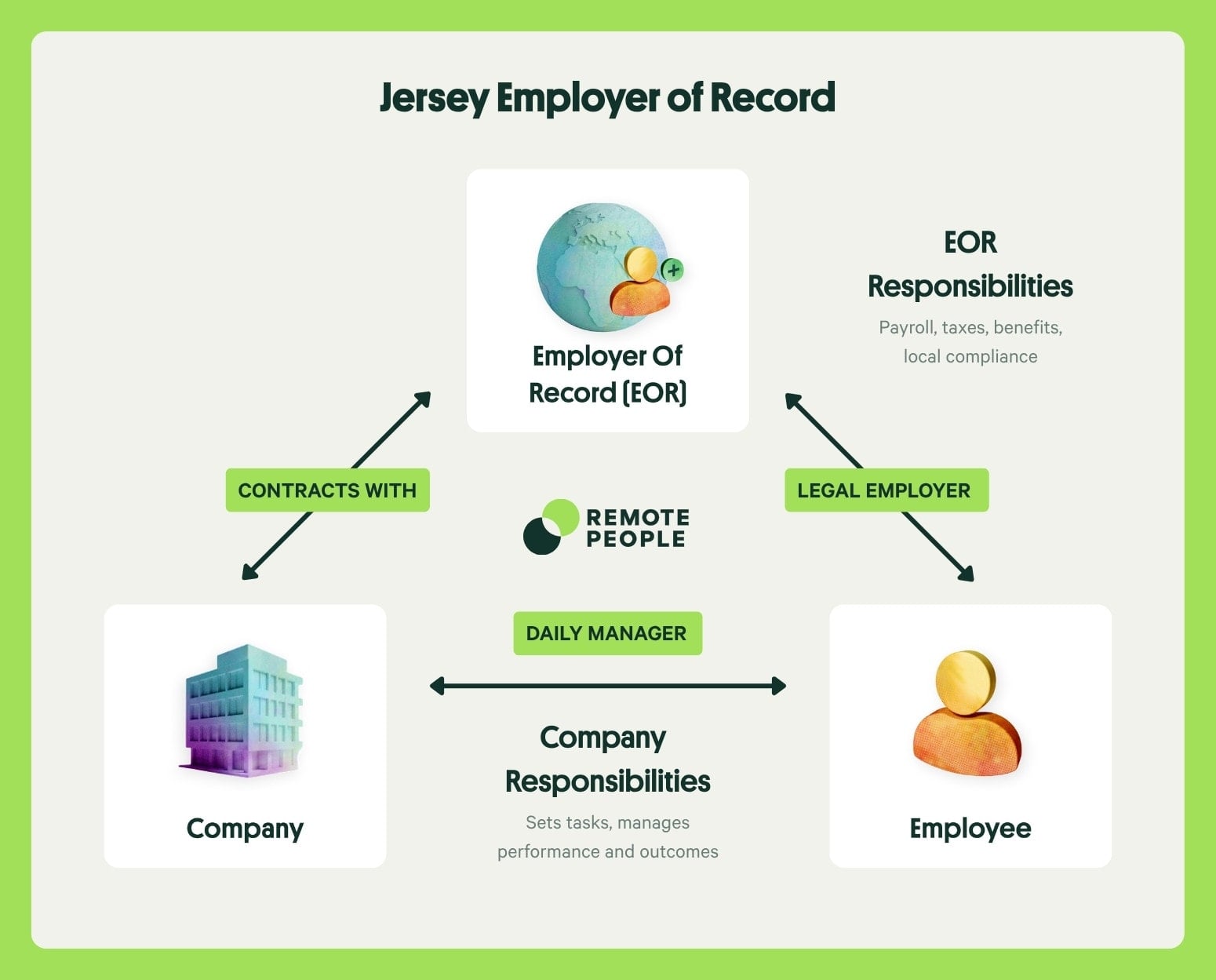
If you’d like to learn more about how Employer of Record (EOR) services work, read our What Is an Employer of Record (EOR)? guide for a complete overview of the model, its benefits, and when to use it.
If you’re comparing providers, our Best Employer of Record (EOR) Providers guide reviews the leading platforms to help you choose the right solution for your business.
Who Uses an EOR in Jersey?
Companies use Jersey EORs to enter and expand the market without setting up a full local operation. Early-stage expansion is common. Businesses test market entry before committing to a permanent Jersey presence.
Others build distributed teams by hiring remotely on the island without establishing a local office. Specialized hiring is another driver, particularly for companies seeking financial services or legal talent that may not be available at home. Cost optimization rounds out the picture: firms manage employment costs while keeping full operational control over their teams.
Timeline for Onboarding
Jersey EOR onboarding typically follows these steps:
The process begins with an initial consultation (1–2 business days) to confirm service scope and review employee details. The EOR then prepares employment documentation including contract drafts and tax forms, which typically takes 3–5 business days.
If a work permit is required, the application is submitted at this stage with processing times of 3–4 weeks for standard applications. Once the permit is approved (or immediately for UK/Ireland nationals), the employee signs the contract and employment formally commences. Payroll setup and the first salary payment are processed through employer banking in the next available pay cycle.
Hire in Jersey
Jersey offers competitive tax rates, a skilled English-speaking workforce, and a business-friendly regulatory environment that make it an attractive base for international teams.
We handle employment contracts, payroll, ITIS tax withholding, social security, and full Jersey compliance.
No local entity needed. Your team can start in days.
Employment Laws and Regulations in Jersey
Employment Contracts
Jersey employment law requires a written statement of the terms and conditions of employment within four weeks of the employee’s start date.
This obligation is established under the Employment (Jersey) Law 2003. The statement must include job title, salary, working hours, leave entitlements, notice periods, and any other agreed terms. While verbal agreements may exist, the written statement provides legal protection for both employer and employee and serves as the binding employment contract. An EOR handles documentation creation and storage in compliance with Jersey law.
Contractor arrangements suit genuinely independent professionals who set their own schedules, supply their own equipment, and serve multiple clients. If the worker reports to your manager daily, uses your systems exclusively, and cannot take other work, Jersey authorities will likely reclassify the relationship as employment. RemotePeople’s contractor management solution helps companies structure compliant contractor engagements in Jersey.
Working Hours and Overtime
Jersey doesn’t set a maximum working week, but employees are entitled to specific rest periods: at least 11 consecutive hours daily and 24 consecutive hours weekly. Employees must receive rest breaks during the working day as set out in their contracts or collective agreements.
Overtime rates are entirely contractual in Jersey – there is no statutory premium for hours worked beyond a standard week. This flexibility allows employers to negotiate overtime arrangements directly with employees, though common practice often includes a 1.5x or 2x multiplier for additional hours.
Here’s how overtime and additional hours work in Jersey:
Jersey Overtime and Premium Pay Rates 2026 | |||
Hour Type |
Rate Multiplier |
Weekly/Daily Cap |
Notes |
|---|---|---|---|
Weekday overtime (contractual) |
1.5x – 2x (agreed) |
No statutory limit |
Negotiated directly with employee; no mandatory premium |
Night hours (post 10 PM) |
1.25x – 2x (contractual) |
No statutory limit |
Agreed terms in contract; commonly higher rate |
Weekly rest day premium |
1.5x – 2x (contractual) |
No statutory limit |
Compensation for working the required 24-hour rest period |
Public holiday work |
1.5x – 2x (contractual) |
No statutory limit |
Alternative day off typically provided; rates negotiated |
Senior managers, armed forces members, and workers in certain industries may have exemptions from standard rest requirements. Any exemption must be documented in the employment contract and meet the conditions set out in Jersey employment regulations.
Minimum Wage
Jersey’s minimum wage is £13.00 per hour as of 1 September 2025. Trainees and first-year apprentices are entitled to a lower rate of £10.50 per hour.
The States of Jersey has proposed an increase to £13.59 per hour effective April 2026, pending parliamentary approval. All wage rates must be reviewed and paid accurately to comply with Jersey’s minimum wage requirements, and an EOR maintains correct rates across all pay cycles.
Probation Period
Probation periods in Jersey are typically agreed between employer and employee at the time of hiring. While the law does not prescribe a maximum probation duration, three to six months is standard practice.
During probation, an employee retains most statutory rights including the right to notice, minimum wage, rest periods, and leave entitlements. However, the notice period required to terminate employment during probation may be shorter (often one week) as specified in the employment contract.
Leave Entitlements
Annual Leave
Employees in Jersey are entitled to a minimum of 15 days of annual paid leave per calendar year under the Employment (Jersey) Law 2003. This entitlement is separate from public holidays, which Jersey recognizes in addition to annual leave.
For employees who commence employment partway through a year, annual leave is calculated pro-rata using the formula: 15 days × (number of months employed) ÷ 12. Leave must be taken and paid, and unused leave cannot be carried over into the following year except where specific agreement exists.
Sick Leave
Jersey does not provide a statutory right to paid sick leave. However, employees absent from work due to illness may be entitled to Social Security Temporary Inability to Work (STIA) benefit administered by the Social Security Fund.
This benefit is paid at £295.75 per week and covers periods of incapacity up to 364 days. Employers may choose to provide enhanced sick leave provisions in the employment contract, but this is not a legal requirement.
Maternity Leave
Mothers in Jersey are entitled to 52 weeks of parental leave, with the first six weeks paid at 100% by the employer. The remaining 26 weeks are covered by the Parental Allowance paid by the government. This provides strong coverage for new parents, and employers must continue to recognize the employee’s employment status throughout the leave period.
Paternity Leave
Fathers and non-birthing partners follow the same parental leave framework as mothers: 52 weeks total parental leave, with the first six weeks paid at 100% by the employer and the remaining 26 weeks covered by government Parental Allowance. Both parents may access this leave independently, allowing flexible sharing of responsibilities following birth.
Other Statutory Leave
Jersey employees are entitled to additional time off for specific circumstances including bereavement leave (typically two weeks following a close family death), jury service, and public duties. Requests for flexible working arrangements are recognized under Jersey law, though approval is subject to business operational needs.
The following table summarizes Jersey’s statutory leave entitlements:
Jersey Statutory Leave Entitlements 2026 | ||
Leave Type |
Duration |
Eligibility & Notes |
|---|---|---|
Annual leave |
15 days minimum per year |
All employees; pro-rata for part-year service; separate from public holidays |
Maternity leave |
52 weeks parental leave |
6 weeks paid by employer at 100%; 26 weeks government Parental Allowance; status continues |
Paternity leave |
52 weeks parental leave |
6 weeks paid by employer at 100%; 26 weeks government Parental Allowance; available to all parents |
Sick leave |
Not statutory; STIA benefit available |
No paid entitlement; Social Security STIA covers up to 364 days at £295.75/week; employer may provide contractual sick pay |
Bereavement leave |
2 weeks (typical) |
Recognized for close family death; employer discretion on duration; often unpaid unless contractually specified |
Jury service |
Duration of service |
Employee must be released; compensation paid by court, not employer |
Parental bereavement leave |
2 weeks (from March 2024) |
New entitlement for employees who lose a child; applies to employees in role for 12+ months |
Statutory Employee Benefits
Jersey does not mandate employer-provided health insurance or dental coverage. Employees may purchase private health insurance, but this is not an employer obligation. Pension auto-enrollment is required: employers must enroll eligible employees into a workplace pension scheme and make minimum contributions.
Life insurance and disability insurance are not statutorily mandated. Meal allowances, transport subsidies, and other benefits are entirely discretionary and negotiated individually.
Recent Regulatory Updates (2026)
Jersey employment law continues to evolve. Key recent and proposed changes include:
The States of Jersey proposed raising the minimum wage to £13.59 per hour effective April 2026, subject to parliamentary approval. Unfair dismissal reforms that changed the qualifying period and compensation frameworks took effect in April 2025.
A new parental bereavement leave entitlement of two weeks was introduced in March 2024 for employees who experience child loss. The government is also conducting an ongoing review of standard probation durations and procedural requirements. From January 2026, spouses and civil partners are taxed independently under the revised ITIS framework, affecting household tax calculations and payroll deductions.
Work Permits and Visas in Jersey
Work Permit Requirements
Who Needs a Work Permit
Employees from the United Kingdom and Ireland are exempt from Jersey work permit requirements under the Common Travel Area (CTA) agreement and may work freely on the island. All other foreign nationals, including European Union citizens (post-Brexit), must obtain a work permit prior to commencing employment. Work permits are specific to the employer and cannot be transferred between companies without a new application.
Eligibility and Required Documents
To qualify for a Jersey work permit, the employee must meet minimum qualification requirements and the employer must provide supporting documentation. The general threshold is RQF 3 (Regulated Qualifications Framework Level 3) or equivalent, demonstrating professional competency or recognized vocational training.
Employers must submit employment contracts, role descriptions, job advertisements showing Jersey recruitment attempts, and evidence of salary at or above the minimum wage. Employees must provide passport documentation, proof of qualifications, and background checks if required. The Jersey Government work permits portal provides the complete documentation checklist.
Processing Time and Validity
Standard work permit applications are processed within 3–4 weeks of submission. Complex cases, cases involving sponsorship verification, or applications that require additional investigation may take longer.
Once approved, a work permit is typically valid for up to three years, at which point renewal is required if employment continues. The permit is tied to the specific employer and role; changing employers requires a new permit application.
Renewal Process
Work permit renewals are submitted before the permit expires. The renewal application is similar to the initial application and includes updated employment contracts, proof of continued employment, and confirmation of ongoing qualification eligibility. Renewal processing times are typically shorter than initial applications, often taking 2–3 weeks if no complications arise.
Common Visa Types for Foreign Workers
Jersey offers several work permit categories designed for different employment circumstances. Each category has distinct eligibility criteria, processing times, and pathways to longer-term residence. The following table outlines the main work permit options available to foreign employees:
Jersey Work Permit Categories 2026 | ||||
Visa Type |
Duration |
Best For |
Leads to APT? |
Processing |
|---|---|---|---|---|
General Employment Permit |
Up to 3 years |
Professional and skilled roles; most common category |
Yes (after 5 years) |
3–4 weeks standard |
Intra-Company Transfer |
Up to 3 years |
Employees relocating within multinational organizations |
Yes (after 5 years) |
3–4 weeks standard |
Seasonal Permit |
Up to 6 months |
Tourism, agriculture, hospitality roles in peak seasons |
No |
2–3 weeks expedited |
Medical Professional Permit |
Up to 3 years |
Healthcare specialists and senior medical roles |
Yes (after 5 years) |
3–4 weeks standard |
Source: Jersey Government Work Permits and Mourant Employment Law |
||||
Visa categories not covered by standard employment permits include tourist visas, which do not permit work, and student visas, which allow limited part-time employment only during study periods. Family reunion and long-term residence visas exist but fall outside employment sponsorship pathways.
How an EOR Handles Work Permits
An EOR in Jersey manages the work permit application process on behalf of both employer and employee, significantly reducing administrative complexity. The EOR prepares all required documentation, submits the application to the Jersey Government, and tracks approval status through the completion timeline. Since the EOR serves as the legal employer, it assumes responsibility for maintaining permit compliance, including timely renewal and reporting of employment changes.
Payroll, Taxes, and Social Security in Jersey
Employer Contributions
Employers in Jersey must remit social security contributions to the Social Security Department based on employee earnings. Jersey’s employer social security system consists of two main components: the standard Social Security Class 1 contributions and the Upper Band contributions for earnings above the standard earnings limit.
Revenue Jersey and the Social Security Department administer collection and compliance. Understanding these obligations is critical for accurate payroll processing and legal compliance.
Jersey Employer Social Security Contributions 2026 | ||
Contribution Type |
Rate |
Notes |
|---|---|---|
Social Security Class 1 |
6.5% up to SEL |
Applied to earnings up to £5,800/month (Standard Earnings Limit); maximum monthly contribution ~£377 |
Social Security Upper Band |
2.5% on UEL excess |
Applied to earnings between 5,800 and Upper Earnings Limit (approximately £56,500); contribution scales with high-earner payroll |
Total Employer Social Security |
Up to ~9% |
Combined effective rate varies by earnings band; all statutory contributions mandatory and non-negotiable |
Employee Contributions
Jersey employees have social security contributions and income tax withheld from their salary. The Social Security Department collects Class 1 and Long-Term Care contributions, while the Jersey Income Tax Office administers income tax under the Impôt sur le Revenu des Îles (ITIS) system.
These deductions are mandatory and must be accurately calculated and remitted monthly. Employee net pay is the gross salary minus all statutory withholdings.
Jersey Employee Tax and Social Security Deductions 2026 | ||
Deduction Type |
Rate |
Notes |
|---|---|---|
Social Security Class 1 |
6% up to SEL |
Applied to earnings up to £5,800/month; capped at ~£348/month |
Long-Term Care Contribution |
1.5% on gross income |
Applied to all earnings; annual cap £4,974; supports long-term care fund |
Income Tax (ITIS) |
20% standard rate |
Applied to assessable income after allowances and standard deductions; highest marginal rate is 26% |
Total Employee Withholding |
~7.5–27.5% |
Combined rate depends on income band; higher earners subject to marginal income tax rate plus social security |
Income Tax
Jersey’s income tax system is governed by the Impôt sur le Revenu des Îles (ITIS), a progressive two-tier calculation method that determines which formula yields the lower tax liability for each taxpayer. Residents are taxed on worldwide income, while non-residents are taxed only on Jersey-source income.
The system includes a personal allowance, which is the amount of income exempt from tax, and provides flexibility for planning annual tax liabilities. Tax is withheld from employment income monthly and reconciled annually.
Jersey Income Tax System (ITIS) 2026 | |
Bracket |
Tax Calculation |
|---|---|
Standard Rate |
20% of net income after allowances and standard deductions |
Marginal Rate |
26% of total income less allowances and standard deductions |
Tax Payable |
Lower of standard rate calculation or marginal rate calculation; ensures tax is not punitive at higher income levels |
Personal Allowance (2026) |
£21,250 per year for residents; reduces assessable income |
Non-Resident Taxation |
20% flat rate on Jersey-source income only; limited personal allowances apply |
Source: Revenue Jersey and PwC Jersey Employment & Payroll Guide |
|
Payroll Cycle
Jersey employers operate on a monthly payroll cycle. Salary payments are processed through employer bank accounts directly to employee bank accounts. Combined Employer Returns are submitted to Revenue Jersey monthly, detailing all payroll transactions, income tax withholding, and social security contributions.
ITIS income tax withholding is calculated and remitted monthly based on cumulative earnings. Social security contributions from both employer and employee are remitted by the 15th of the month following the pay period. An EOR automates these monthly submissions, meeting all deadlines to avoid penalties.
13th Month Salary and Bonus Pay
Jersey does not mandate a 13th month salary or annual bonus payment. Any bonus or additional compensation is contractual or discretionary and must be explicitly agreed in the employment contract.
When bonuses or 13th month payments are paid, they are taxed and subject to social security contributions under the same ITIS and social security rules as regular monthly income. The timing of bonus payments does not affect statutory benefit eligibility or notice period calculations.
Cost of Hiring Through an EOR in Jersey
EOR Service Fees
EOR service fees in Jersey typically range from $199 to $600 per employee per month depending on service scope and provider. RemotePeople’s Jersey offering starts at $199 per employee per month and includes core payroll, tax withholding, compliance documentation, and work permit support.
Additional services such as specialized HR consulting, benefits administration, or multi-country management may incur higher fees. The fee structure is transparent and does not include hidden charges.
Total Employment Cost Breakdown
The total cost of hiring an employee through an EOR in Jersey includes the gross salary, employer social security contributions, pension contributions, and the EOR service fee. The following table illustrates the complete cost structure for a typical employee earning $5,000 per month in gross salary, converted to USD for comparison. All costs are illustrative and may vary based on individual circumstances, benefits selections, and employer preferences.
Jersey EOR Total Employment Cost Example 2026 | ||
Cost Category |
Amount (USD) |
% of Gross |
|---|---|---|
Gross Salary |
$5,000 |
100% |
Employer Social Security (6.5%) |
$325 |
6.5% |
Employer Social Security Upper Band |
$0 (below UEL) |
0% |
Estimated Pension Contribution (5%) |
$250 |
5% |
EOR Service Fee |
$399 |
8% |
Total Monthly Cost to Employer |
$5,974 |
119.5% |
Note: Figures converted at 1 USD ≈ 0.79 GBP, April 2026. Employee social security and income tax are deducted from gross salary and do not increase employer cost. Source: Jersey Government employer contributions and RemotePeople pricing |
||
Ready to hire in Jersey? Get started with RemotePeople, and we handle employment contracts, payroll, tax withholding, and full Jersey compliance. No local entity needed.
Benefits of Using an EOR in Jersey
An EOR eliminates the complexity of direct employment in Jersey by assuming legal employer status and managing all statutory obligations. For organizations expanding to Jersey without a local presence, an EOR reduces time to market, minimizes compliance risk, and provides access to local expertise in taxation, social security, and employment law. The following are the key advantages of using an EOR when hiring in Jersey.
- Speed to market: Hire your first employee in 1–2 weeks instead of 4–8 weeks required to establish a local legal entity through JFSC registration and company setup. An EOR has all infrastructure in place and can begin payroll immediately upon contract execution.
- Compliance assurance: An EOR automatically handles Employment (Jersey) Law 2003 compliance, social security reporting, ITIS income tax withholding, work permit processing, and statutory leave administration. This eliminates the risk of costly penalties or procedural violations.
- Cost efficiency versus local entity setup: Setting up a Jersey company through JFSC costs £5,000–15,000 upfront and £3,000–8,000 annually in compliance and accounting costs. An EOR service at $199–$600/month provides comparable coverage without the capital investment or ongoing overhead.
- Local expertise on ITIS and social security: Jersey’s tax system is distinct and requires specialized knowledge of the two-tier ITIS calculation, personal allowances, Upper Band contributions, and resident vs. non-resident status. An EOR’s payroll team maintains current expertise and reduces your internal learning curve.
- Flexibility to scale: Hire one employee or ten without infrastructure changes. An EOR scales with you, letting you adjust workforce size without long-term commitment or complex contract negotiations.
- Risk mitigation: An EOR assumes legal employer liability, employment law compliance, and statutory withholding responsibilities. Your organization retains operational control and management of the employee while the EOR handles administrative and legal risk.
- Enhanced employee experience: Employees receive professional payroll processing, on-time wage payments, accurate tax and social security handling, and support for leave administration. Professional payroll administration improves retention and employee satisfaction compared to informal or manual payment systems.
An EOR is particularly valuable for organizations in their first 6–12 months of Jersey market entry, when the cost of learning local regulations and establishing infrastructure outweighs the benefits of direct employment. As your Jersey operation matures, you can transition to a local entity setup while maintaining continuity with existing employees and operations.
Termination and Offboarding in Jersey
Notice Periods
Notice period requirements in Jersey are established under the Employment (Jersey) Law 2003 and are determined by length of continuous service. Employers and employees must comply with statutory minimum notice periods; providing less notice may constitute wrongful termination and expose the employer to claims. Notice requirements apply equally to employer-initiated and employee-initiated separations, unless both parties agree to accelerated departure or mutual agreement to terminate without notice.
Jersey Statutory Notice Periods – Employment (Jersey) Law 2003 | |||
Position Level / Service |
Notice Period |
During Probation |
Notes |
|---|---|---|---|
Less than 26 weeks |
1 week |
1 week (or contract term) |
Statutory minimum; may be shorter if probation specifies shorter period |
26 weeks to 2 years |
2 weeks |
1 week (typical) |
Applies once 26 weeks continuous service achieved; probation notice may be specified separately |
2 to 3 years |
2 weeks |
N/A |
Notice does not increase further until 3-year milestone |
3 to 12 years |
1 week per year (3–12 weeks) |
N/A |
Scales with tenure; employee with 5 years service requires 5 weeks notice |
12 years or more |
12 weeks maximum |
N/A |
Capped at 12 weeks regardless of tenure beyond 12 years |
Exceptions to standard notice periods include termination for just cause (gross misconduct, willful disobedience, serious breach of contract), which permits immediate dismissal without notice. Mutual agreement between employer and employee can also waive notice periods entirely. In cases of redundancy, statutory severance is due in addition to notice, and notice requirements cannot be reduced.
Severance Pay
Severance pay in Jersey is mandatory for employees terminated without just cause after completing two years of continuous service, as required by the Employment (Jersey) Law 2003. The severance amount is calculated based on years of service and weekly pay (capped at £1,040 per week as of 2026).
Severance is intended to compensate employees for loss of employment and long-service relationships with the employer. An EOR handles severance calculations and statutory compliance with caps and exemptions.
Jersey Severance Pay by Length of Service 2026 | |||
Years of Service |
Severance Amount |
Base Salary Calc |
Notes |
|---|---|---|---|
2 years |
2 weeks’ pay |
£2,080 (2 weeks × £1,040) |
Statutory minimum; first severance trigger point |
5 years |
5 weeks’ pay |
£5,200 (5 weeks × £1,040) |
1 week per year of service formula |
10 years |
10 weeks’ pay |
£10,400 (10 weeks × £1,040) |
Scales proportionally with tenure |
15 years |
15 weeks’ pay |
£15,600 (15 weeks × £1,040) |
Maximum severity threshold for most roles |
Source: Employment (Jersey) Law 2003 and Viberts LLP Jersey Employment Law Guide |
|||
Calculation Method
Severance is calculated using the formula: number of years of service × 1 week of pay. Weekly pay is determined by dividing annual salary by 52 weeks.
For employees paid on variable or bonus structures, average weekly pay over the previous 12 months is used. The weekly pay amount is capped at £1,040 per week, regardless of actual salary, meaning high-earning employees do not receive severance beyond the statutory cap.
Caps and Exceptions
Severance is not payable to employees terminated for just cause (gross misconduct or willful breach of contract). Employees who resign voluntarily do not receive severance unless agreed contractually.
Fixed-term contract employees do not qualify for severance upon contract expiration unless they have been continuously employed and the contract is terminated early. Employees under 26 weeks of service do not qualify for severance under any circumstance.
Grounds for Termination
Jersey employment law recognizes two primary grounds for termination: termination for just cause (dismissal for gross misconduct or serious breach) and termination without cause (redundancy, reorganization, or at-will separation). Just cause dismissal permits immediate termination without notice or severance. Termination without cause requires statutory notice and severance pay (after two years service).
Unfair dismissal claims may be raised if the employer lacks objective justification for the termination decision. The qualifying period for unfair dismissal is 52 weeks; employees must complete 52 weeks of continuous service to pursue a claim. Automatically unfair dismissal claims (no qualifying period) include dismissal for jury service, public duties, family reasons, or protected disclosure (whistleblowing). An EOR ensures termination procedures comply with these requirements and documentation is properly maintained.
EOR vs. Other Hiring Models in Jersey
EOR vs. Setting Up a Local Entity
Setting up a local legal entity in Jersey (a private company registered through the Jersey Financial Services Commission) offers ownership and control but requires significant upfront investment and ongoing compliance. The timeline for entity setup is 4–8 weeks, with upfront costs of £5,000–15,000 and annual maintenance costs of £3,000–8,000 for accounting, legal, and corporate compliance.
A local entity may require appointment of a Jersey resident director, adding complexity to governance. An EOR provides legal employer status without these requirements and is ideal for companies testing market entry or maintaining a small, remote team.
Jersey EOR vs. Local Entity Comparison 2026 | ||
Comparison Area |
EOR |
Local Entity |
|---|---|---|
Setup time |
1–2 weeks |
4–8 weeks through JFSC |
Upfront cost |
$0–$500 (setup fee only) |
£5,000–15,000 |
Monthly/annual cost |
$199–$600/employee/month |
£3,000–8,000/year + accountant + legal |
Local director required |
No |
Often yes; increases governance overhead |
Payroll and tax compliance |
Managed by EOR |
Your responsibility or outsourced to third-party |
Scalability |
Quick and easy; add/remove employees at will |
Limited by director time and company capacity |
Ideal use case |
Market testing, 1–10 remote employees, short-term presence |
Long-term presence, 20+ employees, office location needed |
Employee perception
| Transparent; EOR handles administration |
Direct employment under your company name |
Exit strategy |
Simple; no entity to dissolve |
Requires formal company dissolution; 3–6 months |
Source: Jersey Government, JFSC, and RemotePeople EOR services |
||
The choice between an EOR and a local entity depends on your growth trajectory and timeline. If you plan to hire 15+ employees and maintain a long-term office presence in Jersey, a local entity offers better economics and brand presence. If you’re testing market demand or maintaining a small remote team, an EOR eliminates unnecessary overhead and risk.
Transitioning from an EOR to a local entity is feasible: the EOR transfers employee records, payroll history, and compliance documentation to your new company, and employees are re-hired under the local entity’s employment agreements. This staged approach lets you validate market fit before committing to fixed infrastructure costs.
EOR vs. Hiring Independent Contractors
Some companies consider hiring independent contractors as an alternative to EOR employment, thinking it offers cost savings and flexibility. However, Jersey employment law imposes strict tests for contractor classification, and misclassification can result in liability, penalties, and claims by workers for unpaid benefits. The Jersey courts and JACS apply the “control test” and economic dependence test to determine true employment status, not merely the label in a contract.
Jersey EOR Employee vs. Independent Contractor 2026 | ||
Comparison Area |
EOR Employee |
Independent Contractor |
|---|---|---|
Legal relationship |
Statutory employment under law |
Commercial contract; no statutory protections |
Control by employer |
Employer controls hours, methods, tools |
Contractor has autonomy over method and schedule |
Minimum wage obligation |
Yes; 13.00/hour (as of 2025) |
No; contractor sets own rates |
Statutory leave entitlements |
15 days annual leave minimum; maternity/paternity; sick leave access |
None; all negotiated in contract |
Social security contributions |
Employer pays 6.5–9% contributions |
Contractor self-insures; no employer liability |
Tax withholding |
Employer withholds income tax and social security |
Contractor responsible for own tax liability |
Misclassification risk |
Low; legal structure is clear |
High; JACS and courts challenge false contractor status |
Cost per hire |
$199–$600/month via EOR |
Appears lower initially; hidden cost if reclassified |
Source: Employment (Jersey) Law 2003 and JACS guidance |
||
Jersey’s JACS regularly investigates contractor misclassification claims, particularly in cases where a “contractor” works exclusively for one client, follows the client’s procedures, and is economically dependent on that client’s work. If JACS or a tribunal determines that a contractor relationship was misclassified, the company becomes liable for back taxes, social security contributions, statutory leave, and potential penalties. An EOR eliminates this risk by establishing clear, legal employment relationships with statutory compliance from the first day.
EOR vs. PEO
A Professional Employer Organization (PEO) is a co-employment model where the PEO and your company share employment responsibilities, with the PEO handling payroll and compliance while your company retains strategic control. PEOs are common in the United States and Australia but are less established in Jersey.
Jersey has no formal PEO regulatory framework or statutory recognition of co-employment relationships. For practical purposes, Jersey PEO arrangements function similarly to EOR arrangements in that a third party assumes legal employer status and handles payroll and compliance. However, the lack of formal legal structure means PEO agreements in Jersey rely on contractual terms rather than statutory definitions.
Jersey EOR vs. PEO Comparison 2026 | ||
Comparison Area |
EOR |
PEO |
|---|---|---|
Legal structure |
EOR is sole legal employer |
Co-employment (client + PEO share liability) |
Regulatory framework |
Statutory definition under most jurisdictions |
Jersey has no formal PEO framework |
Payroll responsibility |
Entirely EOR’s responsibility |
Shared; defined in PEO service agreement |
Compliance liability |
EOR assumes all statutory liability |
Shared; both parties liable for violations |
Control over HR policy |
Your company directs operations; EOR administers |
PEO policies apply to all co-employed staff |
Best for |
Remote teams; flexible hiring; market testing |
Larger teams; access to PEO benefits and HR infrastructure (if available) |
Availability in Jersey |
Yes; RemotePeople and competitors offer EOR |
Limited; not a recognized statutory model in Jersey |
Source: Employment (Jersey) Law 2003, RemotePeople, and NAPEO (North American PEO Association) guidance |
||
In Jersey, an EOR is the clearer and more legally established model. If you encounter a provider claiming to offer PEO services in Jersey, verify that the service agreement clearly establishes who bears ultimate employer liability and ensure that statutory compliance responsibilities are explicitly assigned. For most organizations entering Jersey, an EOR provides simpler legal certainty and better alignment with Jersey’s employment law framework.
The practical difference for your team is minimal. Under an EOR, your employees receive the same statutory protections, pension enrolment, and leave entitlements as any locally hired worker. The EOR simply handles the legal and administrative side while you retain full operational control of your team’s day-to-day work.
Public Holidays in Jersey
Jersey recognizes nine public holidays annually, which are days when most employees are entitled to time off with pay. Public holidays are distinct from annual leave entitlements; employees receive both statutory annual leave (15 days minimum) and public holidays.
If an employee is required to work on a public holiday, the employer typically provides an alternative day off or premium pay (contractually negotiated). The following table lists all nine public holidays observed in Jersey for 2026.
Jersey Public Holidays 2026 | ||
Date (2026) |
Holiday |
Type |
|---|---|---|
Thursday, 1 January |
New Year’s Day |
Fixed annual |
Friday, 3 April |
Good Friday |
Religious/moveable |
Monday, 6 April |
Easter Monday |
Religious/moveable |
Monday, 4 May |
Early May Bank Holiday |
Fixed statutory |
Saturday, 9 May |
Liberation Day |
Unique to Jersey; commemorates 1945 liberation from German occupation |
Monday, 25 May |
Spring Bank Holiday |
Fixed statutory |
Monday, 31 August |
Summer Bank Holiday |
Fixed statutory |
Friday, 25 December |
Christmas Day |
Fixed annual |
Saturday, 26 December |
Boxing Day |
Fixed annual |
Source: Jersey Government and TimeandDate.com Jersey Holidays |
||
Liberation Day (9 May) is unique to Jersey and commemorates the island’s liberation from German occupation on 9 May 1945. This day is celebrated across Jersey with parades, civic ceremonies, and official recognition. For payroll purposes, Liberation Day is treated as a standard public holiday, and employees are entitled to paid time off. If Liberation Day falls on a weekend, the following Monday is typically recognized as the holiday.
Public holidays impact payroll planning: employees absent on public holidays are paid their standard daily or weekly wage with no deduction (assuming normal contractual working hours). If an employee is required to work on a public holiday, overtime or alternative compensation is negotiated contractually. An EOR tracks all public holidays and adjusts payroll accordingly to ensure no deduction from employee pay on these dates.
How to Get Started with an EOR in Jersey
Hiring your first employee in Jersey through an EOR is straightforward and requires no prior experience with Jersey employment law or payroll systems. The following steps outline the typical process from initial consultation through the first salary payment.
- First: Select your EOR provider and schedule a consultation. Contact RemotePeople or another EOR specializing in Jersey employment. Share your hiring needs, employee profile, role description, and timeline. The EOR will confirm service scope, pricing, and answer questions about Jersey regulations. This step typically takes 1–2 business days.
- Second: Prepare employment documentation. Provide the EOR with employee details, job title, salary, start date, and any special contractual requirements. The EOR prepares an employment contract (statement of terms and conditions) compliant with Jersey law. You review and approve the contract before it is sent to the employee for signature. This typically takes 3–5 business days.
- Third: Initiate work permit application (if required). If the employee is not a UK or Ireland national, the EOR submits the work permit application to the Jersey Government with all required documentation: passport, qualifications, employment contract, and job advertisement evidence. Processing typically takes 3–4 weeks. The employee cannot start work until the permit is approved. UK and Ireland nationals do not require a permit and can start immediately.
- Fourth: Execute the employment contract. Once the work permit is approved (or immediately for UK/Ireland nationals), the employee signs the contract and formally commences employment. The EOR sends a welcome package, employee handbook, and payroll setup forms to the employee. Employment officially begins on the agreed start date.
- Fifth: Set up payroll and process the first payment. The EOR configures the employee in the payroll system, collects banking details, and arranges payment. The first salary is processed in the next available pay cycle (typically the next month-end or on your specified pay date). The EOR generates payslips, submits social security contributions, and prepares the Combined Employer Return for Revenue Jersey.
Ready to hire your first employee in Jersey? Get in touch with RemotePeople to schedule a consultation and start your onboarding process today.
Where companies hiring in Jersey expand next
Employers hiring in Jersey frequently expand into adjacent English-speaking European hubs as a natural next step. Teams frequently add Luxembourg for shared EU compliance frameworks; hiring in Switzerland often follows for EU-level labor law alignment; an EOR partner in the United Kingdom is a common next step, offering shared payroll, compliance and regulatory rules; and Ireland rounds out the regional footprint with the transatlantic English-first business corridor.
Frequently Asked Questions
EOR service fees in Jersey typically range from $199 to $600 per employee per month, depending on the provider and service scope. RemotePeople’s Jersey offering starts at $199 per employee per month and includes payroll, tax withholding, compliance documentation, and work permit support. The total cost to the employer also includes the employee’s gross salary, employer social security contributions of approximately 6.5% up to the Standard Earnings Limit (Government of Jersey Social Security), and any optional pension or benefits.
Timeline depends on whether a work permit is required. For UK or Ireland nationals (who do not need a permit), onboarding typically takes 1–2 weeks from initial consultation to first salary payment. For employees from other countries, the work permit application adds 3–4 weeks, making the total timeline 4–6 weeks (Government of Jersey Work Permits). During the work permit waiting period, employment documentation is prepared and the employee can begin training or familiarization tasks, though formal employment starts upon permit approval.
No. The EOR, as the legal employer, assumes responsibility for employment law compliance under the Employment (Jersey) Law 2003. This includes statutory notice periods, leave administration, severance calculations, social security contributions, and income tax withholding. Your company retains operational management of the employee but is not liable for statutory employment violations. The EOR carries compliance liability and professional indemnity insurance to cover errors or oversights.
IP ownership depends on the employment contract terms. The EOR prepares the contract based on your specifications, but you must explicitly include IP assignment clauses if you want the client company (you), not the EOR, to own work product, inventions, or creative output. Jersey employment law does not automatically assign IP to the employer; this must be contractually specified (Intellectual Property (Jersey) Law 2000). RemotePeople can draft IP assignment clauses aligned with your company’s policies. Inventions created outside the scope of employment and on the employee’s own time are typically not owned by the company unless the contract explicitly provides otherwise.
Employees experience professional, transparent employment. The EOR appears as the legal employer on employment contracts and payslips, but employees understand they are working for your company operationally. Payslips clearly show employer and employee social security contributions, tax withholding, and net pay (Government of Jersey Social Security). The employee receives timely, accurate salary payments, leave administration, and access to statutory benefits including maternity leave, paternity leave, redundancy pay, and pension auto-enrolment.
Yes. Contracts can be modified, including changes to salary, job title, benefits, probation period, or working arrangements. Any contract change must follow Jersey employment law procedures under the Employment (Jersey) Law 2003: the employer must propose the change in writing, give the employee time to review and respond, and document the agreement. Material contract changes typically require the employee’s written consent. The EOR manages the amendment process and handles compliance with notification and documentation requirements.
Yes. All employees hired through an EOR in Jersey are entitled to statutory benefits regardless of employer structure. These include pension auto-enrolment with a minimum 5% employer contribution (Government of Jersey Pensions), maternity leave of 52 weeks with 6 weeks paid by the employer, annual leave of 15 days minimum, and access to Temporary Inability to Work benefit for sick leave. Redundancy and severance entitlements apply after two years of continuous service under the Employment (Jersey) Law 2003.
EORs typically offer standard employment contracts compliant with Jersey law, including fixed-term, indefinite term, part-time, and probationary arrangements. Contracts can be customized to include specific job responsibilities, reporting lines, compensation structure, benefits, confidentiality clauses, non-compete clauses (if enforceable under Jersey law), IP assignment, and termination provisions. RemotePeople works with clients to tailor contracts to business requirements while ensuring compliance with the Employment (Jersey) Law 2003. Any contract term must be reasonable and not violate statutory minimums for notice periods, leave, or minimum wage.
Employer of Record in
Employer of Record in
Employer of Record in
Employer of Record in
Employer of Record in
Employer of Record in
Employer of Record in
Employer of Record in