
 Recruit
Employer of Record in Sweden
-
 Drew Donnelly
- Published
- September 22, 2026
RemotePeople’s employer of record in Sweden lets you hire employees in Sweden with comprehensive social security coverage. We handle employer contributions at 31.42 percent, old-age pension contributions, health insurance, and work injury insurance.
Hire in Sweden — book a free 30-minute demo
Tell us what you need. You'll get a tailored, transparent proposal within 24 hours, plus a free call to walk through it.
Tell us about your company
So we can match you with a specialist who knows your market — and unlock volume pricing tiers.
* All fields are required.
Where and when are you hiring?
Tell us the geography and timing and we'll quote each country line by line, with onboarding timelines.
* All fields are required.
Help us beat your current setup
We'll benchmark your current deal and send a line-by-line proposal in 24 hours — showing exactly where we cut cost, time, or risk. After you submit, you can book a call to walk through it together.
* All fields are required.
Thanks! Your proposal is on its way.
Expect a tailored, line-by-line proposal in your inbox within 24 hours. In the meantime…
Want to walk through it together?
Book a free 30-minute call with one of our specialists. We'll explain every line, answer your questions, and tailor the proposal further if you need.
No obligation. Pick a time that works for you.








- Hire in Sweden — book a free 30-minute demo
- Tell us about your company
- Where and when are you hiring?
- Help us beat your current setup
- Thanks! Your proposal is on its way.
- How an Employer of Record Works in Sweden
- Employment Laws and Regulations in Sweden
- Work Permits and Visas in Sweden
- Payroll, Taxes, and Social Security in Sweden
- Cost of Hiring Through an EOR in Sweden
- Benefits of Using an EOR in Sweden
- Termination and Offboarding in Sweden
- EOR vs. Other Hiring Models in Sweden
- Public Holidays in Sweden
- How to Get Started with an EOR in Sweden
- Where companies hiring in Sweden expand next
- Frequently Asked Questions About Employer of Record in Sweden
- Related EOR Destinations

Start hiring in Sweden
Let RemotePeople handle payroll, compliance, and HR admin worldwide so you can focus on building your team.

Sweden offers one of the world’s most skilled, English-fluent, and digitally mature workforces, backed by a consensus-driven labour market where collective agreements set the terms that statutes leave open. For companies looking to hire employees in Sweden, the challenge is a layered system: the Employment Protection Act (Lag om anställningsskydd, 1982:80), a collective-bargaining framework covering roughly 90% of the workforce, and a payroll regime that charges 31.42% in employer social contributions on top of gross pay. An employer of record in Sweden lets you onboard talent in 1–2 weeks without incorporating a Swedish aktiebolag, while a local EOR runs payroll through Skatteverket, registers the worker with Försäkringskassan, manages parental-benefit reporting, and keeps contracts aligned with the applicable collective agreement.
This guide walks through how an employer of record works in Sweden, the employment laws you need to know, work permit options for non-EU hires under the revised 2026 rules, payroll and tax mechanics, total hiring cost, termination procedures, and how an EOR compares with setting up a Swedish AB, using contractors, or partnering with a PEO.
How an Employer of Record Works in Sweden
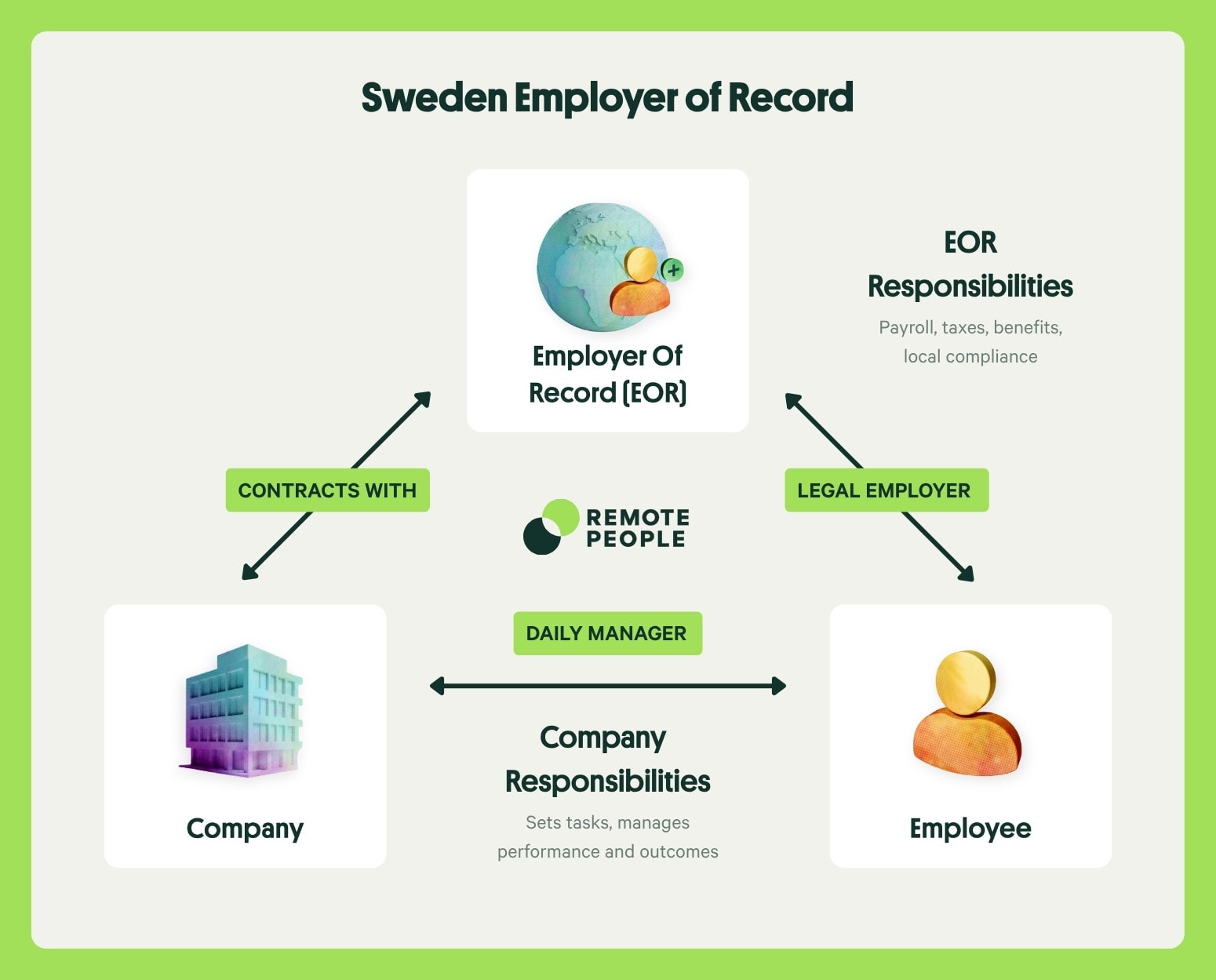
If you’d like to learn more about how Employer of Record (EOR) services work, read our What Is an Employer of Record (EOR)? guide for a complete overview of the model, its benefits, and when to use it.
If you’re comparing providers, our Best Employer of Record (EOR) Providers guide reviews the leading platforms to help you choose the right solution for your business.
Who Uses an EOR in Sweden?
Companies use a Swedish EOR when they want to hire in Sweden without going through the two to three month process of incorporating a Swedish aktiebolag (AB), registering with the Bolagsverket (Swedish Companies Registration Office), opening a local bank account, and setting up payroll through a Swedish provider. The EOR model is built for small teams, fast market entry, and cross-border arrangements where incorporating would cost more than the hires would generate.
- Market entry tests: Companies evaluating the Swedish market with one or two initial hires before committing to a long-term presence use an EOR to avoid incorporation costs that can exceed the first year of payroll.
- Small teams of 1–15: Organizations building a Swedish presence of fewer than fifteen employees typically find the annual maintenance cost of a local AB (accounting, audit thresholds, corporate tax filings) outweighs the EOR service fee.
- Fast onboarding: Businesses that need a new hire productive within one to two weeks turn to an EOR rather than waiting months for entity formation, VAT registration, and bank onboarding.
- Work permit sponsorship: Companies hiring non-EU specialists through the Migrationsverket work permit process use the EOR as the legal employer that files the permit, meets the 2026 salary threshold, and handles electronic notification.
- Nordic expansion plans: Firms rolling out presence across Sweden, Denmark, Norway, and Finland often use a single multi-country EOR to harmonize contracts and payroll rather than opening four separate entities.
The common thread is that an EOR converts a six-figure entity-setup project into a monthly service fee, which makes the economics work for teams below the break-even point of direct incorporation.
Typical Onboarding Timeline
Most EOR providers can onboard an employee in Sweden within 1–2 weeks, assuming the worker already has the right to work in Sweden. The timeline extends to 4–8 weeks for non-EU work permit sponsorship depending on the permit category and Migrationsverket’s current queue.
- Day 1–2: Sign the EOR service agreement and share the employee’s personal details, salary, start date, and role description.
- Day 2–4: The EOR drafts a Swedish-compliant employment contract covering probation, notice, working hours, applicable collective agreement, and leave entitlements, then sends it for signature.
- Day 3–7: The EOR registers the employee with Skatteverket for preliminary tax (A-skatt), sets the SGI with Försäkringskassan, and enrolls the worker in the applicable occupational pension (such as ITP for white-collar or SAF-LO for blue-collar).
- Day 5–10: Payroll is configured in the EOR’s system, collective-agreement insurances (AGS, TGL, TFA) are activated, and the first monthly employer declaration is prepared.
- Day 10–14: The employee starts work on the agreed date, and the EOR runs the first monthly payroll with full tax, pension, and social security withholdings.
Factors that extend the timeline include non-EU work permit sponsorship (add 4–8 weeks), collective agreement verification for specialist sectors, and background or professional qualification checks where required.
Hire in Sweden
Collective agreements shape nearly every employment term, plus AP pension, LAS employment protection, and Swedish co-determination rights.
We handle employment contracts, payroll, social contributions, and full Swedish compliance.
No local entity needed. Your team can start in days.
Employment Laws and Regulations in Sweden
Employment Contracts
Swedish employment law sits on three core statutes: the Employment Protection Act 1982:80 (LAS), the Working Hours Act 1982:673 (Arbetstidslagen), and the Annual Leave Act 1977:480 (Semesterlagen). The October 2022 LAS reform was the most significant update in a generation, reducing the maximum duration of general fixed-term work (allmän visstidsanställning) from 24 months to 12, expanding the redundancy exemption from two to three key employees, and introducing a conversion right to permanent employment for agency workers after 24 months at the same user enterprise.
Employment contracts in Sweden are typically indefinite. Fixed-term contracts remain available for a genuine reason such as a substitute, a specific project, or seasonal work, but consecutive fixed-term arrangements that exceed 12 months within a five-year window convert to indefinite employment by operation of law. Written terms must be delivered within seven days of the start date and must cover the parties, the workplace, the employee’s main duties, the applicable collective agreement, salary, working hours, annual leave, probation, and notice periods (Employment Protection Act 1982:80, as amended by 2022:835). Swedish is the standard contract language, but English contracts are enforceable and common for international hires.
Working Hours and Overtime
The standard workweek in Sweden is 40 hours, typically arranged as 8 hours per day Monday through Friday, under the Working Hours Act 1982:673. Average weekly working time including overtime cannot exceed 48 hours over a four-month reference period, employees are entitled to 11 consecutive hours of daily rest, and the Act requires at least 36 consecutive hours of weekly rest. Overtime is capped at 200 hours per calendar year as general overtime (allmän övertid), with up to 150 additional hours of extra overtime (extra övertid) permitted for genuinely unforeseen events. Managing executives and autonomously organized roles may be exempt from the Act’s working-time limits where the employment contract confirms the exemption.
Overtime premiums are not set by statute. The Working Hours Act lets collective agreements set the rates, and the large sector agreements typically require a 50% premium on weekday overtime up to a threshold and a 100% premium on overtime worked at night, on weekends, or on public holidays. Managerial staff and employees with autonomous working-time arrangements are usually exempt from overtime pay under their individual contracts.
Sweden overtime and premium pay rates · Per the Working Hours Act 1982:673 |
|||
Hour Type |
Rate Multiplier |
Weekly / Daily Cap |
Notes |
|---|---|---|---|
Weekday overtime (first tier) |
150% (CBA-typical) |
Up to 48h per 4 weeks |
Statute sets the cap; collective agreements set the premium |
Weekday overtime (second tier / after first 2 hours) |
200% (CBA-typical) |
Counts toward 200h annual cap |
Most sector agreements lift the premium after the first 2 hours |
Night work (21:00–06:00) |
200% (CBA-typical) |
8h nightly average cap |
Night workers must be offered a health check; premium set by CBA |
Weekly rest day / weekend work |
200% (CBA-typical) |
36h unbroken weekly rest required |
Premium applies when the rest period is broken |
Public holiday work |
200% (CBA-typical) |
Most CBAs add time-off in lieu |
Applies to the statutory holidays listed in Section 9 |
Extra overtime (extra övertid) |
As per applicable CBA |
Up to 150h/year on top of the 200h cap |
Reserved for unforeseen events under Working Hours Act §8b |
The Working Hours Act is dispositive, meaning collective agreements can replace almost every provision including the 200-hour overtime cap and the nightly rest rules. Employers bound by a collective agreement follow the agreed rules; those outside a collective agreement follow the statutory floor. Overtime pay is treated as ordinary earned income for tax and pension purposes, so premium pay increases both income tax and the 31.42% employer social contribution base.
Minimum Wage
Sweden has no statutory minimum wage. Wage floors are set entirely through sectoral collective agreements (kollektivavtal) negotiated between the major union confederations (LO, TCO, SACO) and the employer federation Svenskt Näringsliv. According to the Eurofound country profile, collective-agreement coverage is roughly 90% overall, with 92% of blue-collar workers and 84% of white-collar workers covered by a sector agreement. Sweden meets the EU Minimum Wage Directive’s 80% collective-bargaining coverage threshold without introducing a statutory floor.
Outside sectors with universal collective-agreement reach, wages must still reflect the customary pay for comparable work. When sponsoring a non-EU work permit, Migrationsverket enforces a salary floor anchored to the median wage: from 1 June 2026, the minimum monthly salary for a standard work permit is SEK 33,390 (approximately $3,622), equal to 90% of the Statistics Sweden (SCB) median wage of SEK 37,100 (approximately $4,024). Highly qualified hires applying for an EU Blue Card must earn at least SEK 52,000 per month (approximately $5,640). Sweden implements the EU Minimum Wage Directive through strengthened collective bargaining rather than a national statutory floor.
Probation Period
The probation period in Sweden is capped at 6 months under LAS §6 and must be agreed in writing. The clause is known as provanställning and applies only to indefinite employment. If neither party ends the relationship before the 6-month mark, the probation converts automatically to indefinite employment by operation of law. During probation, either side may end the employment without stating a reason, subject to a 2-week notice period and a consultation obligation where the employee is a union member. The termination cannot be based on discriminatory or otherwise protected grounds even during probation.
Leave Entitlements
Sweden’s statutory leave framework is anchored in the Annual Leave Act 1977:480, the Parental Leave Act 1995:584, and the Sick Pay Act 1991:1047, and it sits within one of Europe’s most generous earnings-based social insurance systems. All employees accrue 25 paid working days of annual leave, receive employer-paid sick pay for the first 14 days of illness, and share 480 days of income-replacing parental benefit under the gender-neutral Parental Leave Act. Several entitlements are reserved for each parent (the non-transferable “mommy/daddy quota” days), which drove Sweden’s dual-earner model and remains one of its defining labour-market features.
Annual Leave
Every employee in Sweden is entitled to 25 paid working days of annual leave per holiday year under the Annual Leave Act 1977:480. The holiday year runs from 1 April to 31 March, and the right to take at least 4 consecutive weeks between June and August is a default rule. Holiday pay is typically calculated as either the employee’s current salary during leave plus a holiday supplement (semesterlönetillägg), or as 12% of the prior year’s earnings (semesterersättning) where the worker is paid on an hourly or variable basis. New employees have the right to 25 days of leave from year one, but only days earned during the prior holiday year are paid; unearned leave is taken unpaid. Many collective agreements expand the entitlement to 30–32 working days for long-tenure employees.
Sick Leave
The Sick Pay Act 1991:1047 requires the employer to pay sick pay (sjuklön) at approximately 80% of salary from day 2 to day 14 of illness. Day 1 is a qualifying day (karensavdrag), for which the employee receives no pay up to a deduction capped at 20% of the average weekly sick pay. From day 15 onward, Försäkringskassan takes over with sickness benefit (sjukpenning) at roughly 80% of SGI, capped at the 10× prisbasbelopp ceiling of SEK 592,000 per year (approximately $64,208), which translates to a maximum monthly sickness benefit of about SEK 49,333 (approximately $5,351). Many collective agreements extend the employer-paid period with a sickness top-up (sjuklönetillägg) that brings total pay closer to 90% for a further period of 90 days or more.
Maternity Leave
Sweden does not treat maternity as a separate leave category. Expectant mothers may take up to 7 weeks of pregnancy leave before the expected due date and at least 7 weeks after birth under the Parental Leave Act, with income replacement drawn from the unified 480-day parental benefit (föräldrapenning). Pregnancy cash benefit (graviditetspenning) is available to workers in physically demanding roles who cannot be reassigned, paid by Försäkringskassan at roughly 80% of SGI for up to 50 working days before the due date. Job protection during pregnancy and parental leave is strong: dismissal that is motivated by pregnancy or leave is reversed under the Parental Leave Act §16 and the Discrimination Act 2008:567.
Paternity Leave
Fathers and non-birthing parents are entitled to 10 days of leave (de tio pappadagarna) around the birth, paid by Försäkringskassan at roughly 80% of SGI. Beyond these 10 days, each parent has 240 days of the 480-day parental benefit, of which 90 days are non-transferable and must be used personally. The remaining 150 days can be transferred to the other parent. Parents may take leave simultaneously for up to 30 days during the child’s first year (double-days reform). The full 480 days can be used in flexible blocks until the child turns 12, although at least 384 must be taken before the child turns 4.
Other Statutory Leave
Beyond annual leave, sickness, and the parental leave system, Swedish employees are entitled to several additional statutory leaves under the Parental Leave Act, the Educational Leave Act 1974:981, and related statutes.
- Temporary parental benefit (vård av barn, or VAB) for care of a sick child under 12, paid by Försäkringskassan at roughly 80% of SGI for up to 120 days per child per year. From 1 January 2026, the scope expanded to cover meetings with schools and preschools and participation in social services’ assessments, although the final 60 days remain reserved for actual child illness.
- Educational leave (studieledighet) under the Educational Leave Act 1974:981 for employees with at least 6 months’ tenure or 12 months’ service within the last 2 years. Leave is unpaid by the employer, but funding may be available from the Swedish Board of Student Finance (CSN).
- Care of a close relative (närståendepenning), paid by Försäkringskassan at roughly 80% of SGI for up to 100 days across the lifetime of the relative, plus an additional 240 days where the relative has HIV or is receiving end-of-life care.
- Trade union leave under the Union Representative Act 1974:358 for elected union representatives carrying out workplace negotiations and training.
- Leave to establish a business, up to 6 months, for employees with at least 6 months’ tenure, allowing them to test a self-employment venture without losing the right to return.
Under the Annual Leave Act 1977:480 and the Parental Leave Act 1995:584, every Swedish employee earns a baseline set of leave entitlements that are fully compatible with the EOR model. The single most important takeaway for planning purposes is that annual leave accrues from day one, while paid holiday pay depends on earnings during the prior holiday year, so first-year hires will accumulate their first fully paid 25 days only in the second holiday year.
Sweden statutory leave entitlements · Per the Annual Leave Act and Parental Leave Act | ||
Leave Type | Duration | Eligibility & Notes |
|---|---|---|
Annual leave (statutory minimum) | 25 working days/year | Holiday year 1 April–31 March; 12% semesterersättning on gross pay |
Sick pay (employer period) | Day 2 to day 14 | 80% of salary; karensavdrag on day 1 capped at 20% of weekly sick pay |
Sickness benefit (Försäkringskassan) | From day 15 onward | 80% of SGI capped at ~$5,351/month (SEK 49,333); paid by Försäkringskassan |
Parental benefit (per family) | 480 days (split 240/240) | 390 days at 80% SGI; 90 days at flat SEK 180/day (~$19.52) |
Non-transferable quota per parent | 90 days each | Use-it-or-lose-it under the Parental Leave Act §3 |
Father’s 10 days (pappadagar) | 10 working days | At birth; paid at ~80% SGI by Försäkringskassan |
Temporary parental benefit (VAB) | Up to 120 days/year per child <12 | ~80% SGI; 2026 reform expanded scope to school meetings and social services |
Care of a close relative | Up to 100 days lifetime | Extended to 240 days where relative has HIV or is in end-of-life care |
Educational leave | No fixed maximum | Unpaid; requires 6 months tenure or 12 months within 2 years |
Statutory Employee Benefits
Swedish workers are covered by a tax-funded public welfare system and a collective-agreement layer that is often confused with statutory benefits. The core mandatory employee benefits in Sweden flow from the 31.42% employer social contribution, which funds old-age pension, survivors’ pension, sickness insurance, parental insurance, work-injury insurance, and general labour-market contributions. Healthcare is publicly provided through the regions (regionerna) and is funded largely from municipal and regional income tax rather than employer payroll. The collective-agreement layer adds occupational pension and ancillary insurances on top of the statutory base.
- Old-age pension: The 10.21% employer pension contribution funds the Swedish general pension system (inkomstpension and premiepension), with the 7% employee pension fee offset by a full tax credit.
- Sickness and work-injury insurance: The 3.55% sickness and 0.10% work-injury contributions fund Försäkringskassan’s sickness benefit, rehabilitation support, and work-injury compensation programs.
- Parental insurance: The 2.00% parental insurance contribution funds the 480-day parental benefit and the 120-day temporary parental benefit (VAB).
- Occupational pension (CBA-based): Employers bound by a collective agreement must also contribute to a sectoral occupational pension scheme such as ITP (white-collar, typically 4.5% on salary up to 7.5 income base amounts plus 30% above), SAF-LO (blue-collar, 4.5% flat), or KAP-KL (public sector). These are in addition to the 31.42% statutory contribution.
- Ancillary group insurances (CBA-based): Collective agreements typically require AGS (sickness supplement), TGL (group life), and TFA (work-injury top-up), funded through the employer’s payroll costs and administered by sector insurers such as Fora or Collectum.
Every employer must register with Skatteverket and Försäkringskassan, and employers signing a collective agreement must register with the relevant sector administrator (Fora for blue-collar, Collectum for white-collar) to pay occupational pension and ancillary insurance premiums. See the contribution tables in the next section for exact 2026 rates and the cost example for a typical monthly total.
Recent Regulatory Updates (2026)
Sweden’s most consequential 2026 change is the new 1 June 2026 salary threshold for non-EU work permits. Migrationsverket raised the minimum monthly gross salary from SEK 29,680 to SEK 33,390, equal to 90% of the SCB median wage of SEK 37,100 (approximately $3,622 per month at the April 2026 exchange rate). The rule applies to first-time applicants whose decisions are issued on or after 1 June 2026; extensions decided between 1 June and 1 December 2026 continue to use the prior threshold. The EU Blue Card salary floor remains at SEK 52,000 per month, and the EU Blue Card validity period increased from 2 years to 4 years effective 1 June 2026.
On the parental benefit side, the 1 January 2026 expansion of the temporary parental benefit (VAB) broadened the qualifying grounds beyond a sick child. Parents may now claim VAB when attending school and preschool meetings that involve staff training on a child’s special care needs, when attending meetings linked to the child’s illness or disability, and when participating in social services’ assessments. The final 60 days of the 120-day annual allowance remain reserved for care of an ill child, but the first 60 days can be used for the expanded purposes.
The 2022 LAS reform continues to shape 2026 hiring practices. Fixed-term employment (allmän visstidsanställning) now converts to indefinite employment after 12 months within a five-year window rather than 24 months, the redundancy exemption from the last-in-first-out rule increased from two to three key employees, and agency workers gain a right to permanent employment at the user enterprise after 24 months of continuous assignment. Skatteverket also implemented the 2026 employer contribution rebalancing, keeping the total at 31.42% while shifting the parental insurance contribution from 2.60% to 2.00% and raising the general payroll tax (allmän löneavgift) from 11.62% to 12.62%.
Work Permits and Visas in Sweden
Work Permit Requirements
Who Needs a Work Permit
EU, EEA, and Swiss citizens do not need a Swedish work permit under the principle of free movement and may start work immediately upon arrival. They should register with Skatteverket within three months to obtain a personal identity number (personnummer). Nordic citizens (Denmark, Finland, Iceland, Norway) can live and work in Sweden without registration under the Nordic Convention on a Common Labour Market. All other nationals, including UK citizens post-Brexit, need a residence permit for employment (uppehållstillstånd för arbete) before they can legally take up a job, with the permit issued by Migrationsverket.
Eligibility and Required Documents
Non-EU applicants must submit a signed employment offer that meets the salary floor, a valid passport, proof of qualifications, and evidence that the terms of employment match the applicable collective agreement or customary sector conditions. From 1 June 2026, the minimum monthly gross salary is SEK 33,390 (approximately $3,622) for a standard work permit, equal to 90% of the SCB median wage (Migrationsverket). Highly qualified hires applying for an EU Blue Card must earn at least SEK 52,000 per month (approximately $5,640) and hold a higher education degree. The employer must also provide written confirmation that terms are consistent with the relevant collective agreement, and must advertise the position through EURES for at least 10 days (with limited exceptions).
Processing Time and Validity
Migrationsverket publishes processing-time statistics that show roughly 75% of standard work permit cases decided within 1–3 months, with complete employer-filed applications moving through the fastest. EU Blue Card applications decided under the certified-employer scheme are usually processed within 4 weeks. A first work permit is issued for the length of the employment offer, up to a maximum of 2 years for standard work permits and up to 4 years for EU Blue Cards issued on or after 1 June 2026. Permits are extended from inside Sweden when the employment continues, and the employee may continue working while an extension application is pending, provided it was filed before the current permit expired.
Renewal Process
Renewals are filed through Migrationsverket’s online portal, and the employer confirms ongoing employment at the same or better terms. The salary threshold in force at the time of the renewal decision applies, so employees whose extensions are decided after 1 December 2026 will be tested against the SEK 33,390 floor. Permanent residence becomes available after 4 years of continuous residence on a work permit, or after 21 months for holders of an EU Blue Card who have used it to work in Sweden. Family members accompanying the primary worker receive residence permits of the same duration and have the right to work without a separate permit.
Common Visa Types for Foreign Workers
Swedish work permits are issued by Migrationsverket, which runs several streams depending on the worker’s qualifications and the employer’s relationship to Sweden. An EOR can sponsor most employment-based permits because the EOR is the legal employer for Swedish law, although special categories (ICT transfers within a multinational group, self-employment, and startup permits) have stricter entity requirements. The table below summarizes the most common work-authorizing permits available in Sweden in 2026.
Sweden work visa types for foreign workers · 2026 | ||||
Visa Type | Duration | Best For | Leads to PR? | Processing |
|---|---|---|---|---|
Standard work permit | Up to 2 years (first issue) | Non-EU hires meeting the SEK 33,390 salary floor | Yes, after 4 years | 1–3 months typical |
EU Blue Card (EU-blåkort) | Up to 4 years (from 1 June 2026) | Highly qualified hires earning ≥SEK 52,000/month | Yes, after 21 months in Sweden | 4 weeks under certified employer scheme |
Intra-company transfer (ICT) | Up to 3 years (managers/specialists) | Multinational transfers between a parent and a Swedish group entity | No (separate work permit required for PR) | 1–3 months |
Self-employment permit | Up to 2 years | Entrepreneurs with at least 200,000 SEK in capital and a viable business plan | Yes, after 2 years of self-employment | 3–6 months |
Startup permit | Up to 2 years | Founders of an innovative business with agency endorsement | Yes, after 2 years | 3–6 months |
- Visitor visa (Schengen short-stay): up to 90 days, does not permit employment.
- Student residence permit: for enrolled higher-education students; work is allowed without hour limits during the permit period.
- Working-holiday agreements: available for nationals of specific partner countries (Australia, New Zealand, Canada, South Korea, Argentina, Chile, Uruguay, Hong Kong) up to age 30; limited work allowed.
How an EOR Handles Work Permits
A registered Swedish EOR can sponsor standard work permits, EU Blue Cards, and most employment-based renewal categories as the legal employer of record. The EOR files the employer declaration in Migrationsverket’s online portal, provides the signed employment contract, documents that the salary meets the 1 June 2026 threshold of SEK 33,390 (or SEK 52,000 for an EU Blue Card), and confirms that the terms align with the applicable collective agreement. The employee completes the visa interview at the Swedish embassy and pays the application fee of SEK 2,200. Standard work permit sponsorship typically extends onboarding by 4–8 weeks on top of the regular 1–2 week EOR setup, while EU Blue Card cases under the certified employer scheme can close in 4 weeks.
Payroll, Taxes, and Social Security in Sweden
Employer Contributions
Swedish payroll tax on the employer side totals 31.42% of gross compensation in 2026, collected as a single line item (arbetsgivaravgifter) on the monthly employer declaration and split among seven statutory components. The largest element is the general payroll tax (allmän löneavgift) at 12.62%, followed by the old-age pension contribution at 10.21% and the sickness insurance contribution at 3.55%. Employers of workers aged 67 or older pay only the 10.21% pension contribution, and a temporary reduction to 20.81% applies for workers aged 18–23 on compensation up to SEK 25,000 per month from 1 April 2026 to 30 September 2027.
Sweden employer social security contributions · 2026 rates |
||
Contribution |
Rate |
Notes |
|---|---|---|
Old-age pension (ålderspensionsavgift) |
10.21% |
Funds the general pension system (inkomstpension + premiepension) |
Survivors’ pension (efterlevandepensionsavgift) |
0.30% |
Funds survivor benefits through Försäkringskassan |
Sickness insurance (sjukförsäkringsavgift) |
3.55% |
Funds Försäkringskassan sickness benefit from day 15 onward |
Parental insurance (föräldraförsäkringsavgift) |
2.00% |
Funds the 480-day parental benefit and 120-day VAB; rate lowered from 2.60% in 2026 |
Labour market contribution (arbetsmarknadsavgift) |
2.64% |
Funds unemployment insurance and activation programs |
Work-injury insurance (arbetsskadeavgift) |
0.10% |
Funds work-injury compensation; rate lowered from 0.20% in 2026 |
General payroll tax (allmän löneavgift) |
12.62% |
Goes to the general budget; rate raised from 11.62% in 2026 |
Total employer burden |
31.42% |
Sum of all seven components; unchanged vs 2025 headline total |
Employee Contributions
Employee-side deductions in Sweden are dominated by municipal and state income tax rather than social security. The only statutory employee social contribution is the 7% general pension fee (allmän pensionsavgift), and that 7% is fully offset by an equal tax credit against municipal tax, so it has no net cost to the employee. The real employee-side load is the municipal income tax (averaging 32.38% in 2026) plus the 20% state income tax that kicks in above the 2026 threshold.
Sweden employee payroll deductions · 2026 monthly withholdings |
||
Deduction |
Rate |
Notes |
|---|---|---|
General pension fee (allmän pensionsavgift) |
7.00% |
Capped at SEK 47,100/year; fully offset by a tax credit, so net cost is 0% |
Municipal income tax (kommunalskatt) |
28.93% – 35.65% (avg 32.38%) |
Flat rate set by each kommun; Stockholm is ~29.82%, Dorotea is 35.65% |
State income tax (statlig skatt) |
20% |
Applies to taxable income above SEK 643,100/year (~$69,750); single flat bracket |
Basic deduction (grundavdrag) |
SEK 17,400 – 45,600/year |
Reduces the tax base; higher for low incomes and for workers 66+ |
Employment tax credit (jobbskatteavdrag) |
Up to ~SEK 36,000/year |
Reduces municipal tax on earned income; phased in and out by income level |
Net employee social burden |
0% |
The 7% pension fee is refunded via the jobbskatteavdrag credit |
Source: PwC Sweden individual taxes and SCB local taxes 2026 |
||
Income Tax
Sweden’s personal income tax on earned income combines a flat municipal tax (averaging 32.38% in 2026) with a 20% state tax on income above the skiktgränsen. The 2026 statutory state-tax threshold is SEK 643,100 of taxable income, and after the basic deduction (grundavdrag) the effective kickoff point is SEK 660,400 of gross employment income for workers under age 66 (SEK 751,100 for workers aged 66+, who benefit from a larger grundavdrag). Capital income is taxed separately at a flat 30%, and investment-vehicle (ISK) and pension accounts have their own regimes.
Sweden income tax brackets · 2026 |
|
Annual Taxable Income (SEK) |
Tax Calculation |
|---|---|
Up to SEK 643,100 |
Municipal tax only (28.93% – 35.65%, avg 32.38%) |
Above SEK 643,100 |
Municipal tax + 20% state tax (combined marginal ~52–55%) |
Effective threshold (under 66) after grundavdrag |
Gross income above SEK 660,400 triggers state tax |
Effective threshold (66+) after grundavdrag |
Gross income above SEK 751,100 triggers state tax |
Capital income (flat) |
30% on dividends, interest, and capital gains |
Source: PwC Sweden individual taxes and SCB local taxes 2026 |
|
Payroll Cycle
Sweden operates a monthly payroll cycle, with salaries paid by bank transfer on the 25th of each month in most sectors, or the last banking day of the month in some collective agreements. The employer files an employer declaration at the individual level (arbetsgivardeklaration på individnivå, AGI) with Skatteverket by the 12th of the following month, reporting each employee’s gross pay, benefits in kind, preliminary income tax, and the 31.42% employer social contribution. Payslips must identify the employee, the gross salary, deductions, and the net payout. Final annual reconciliation is handled through the individual’s tax return the following spring, and employees receive a pre-filled form (inkomstdeklaration) from Skatteverket in March.
13th Month Salary and Bonus Pay
Sweden does not require a statutory 13th month salary. The functional equivalent is the 12% semesterersättning (holiday pay) that accrues on gross earnings under the Annual Leave Act and is paid either as a salary supplement during leave or as a lump sum at year-end or upon termination. Collective agreements may add a small holiday bonus (semesterlönetillägg) of around 0.8% of monthly salary per taken day, which raises the effective holiday payout above the statutory floor. Performance bonuses, sales commissions, and profit-sharing are discretionary and set by individual contract or collective agreement. Bonuses are taxed as ordinary earned income, are subject to the 31.42% employer social contribution, and are reported to Skatteverket through the monthly AGI filing.
Cost of Hiring Through an EOR in Sweden
EOR Service Fees
EOR service fees in Sweden typically run $300 to $600 per employee per month, well below the overhead a local entity would carry, depending on the provider, contract complexity, and whether work permit sponsorship is included. The fee covers employment contract drafting, monthly payroll through Skatteverket’s individual-level employer declaration, Försäkringskassan registration, collective-agreement compliance, sick pay and parental leave administration, and termination processing under LAS.
Total Employment Cost Breakdown
Total cost to employ a salaried worker in Sweden lands at roughly 31.42% above gross salary once statutory employer contributions are added, plus any occupational pension (ITP, SAF-LO, or KAP-KL) and ancillary insurance premiums required by a collective agreement, plus the EOR service fee. The worked example below uses a $5,000 monthly gross salary (approximately SEK 46,100 at the April 2026 rate of $1 = SEK 9.22) and shows a representative total employer cost without sector-specific CBA pension on top.
Sweden employer cost example · USD 5,000 gross · 2026 |
||
Employer Cost |
Amount (USD) |
% of Gross |
|---|---|---|
Gross monthly salary |
$5,000 |
100.00% |
Old-age pension (10.21%) |
$511 |
10.21% |
Survivors’ pension (0.30%) |
$15 |
0.30% |
Sickness insurance (3.55%) |
$178 |
3.55% |
Parental insurance (2.00%) |
$100 |
2.00% |
Labour market contribution (2.64%) |
$132 |
2.64% |
Work-injury insurance (0.10%) |
$5 |
0.10% |
General payroll tax (12.62%) |
$631 |
12.62% |
EOR service fee (estimate) |
$400 |
8.00% |
Total monthly employer cost |
$6,972 |
139.42% |
All USD amounts are approximate conversions at $1 = SEK 9.22 (April 2026 rate). At a $5,000 monthly gross salary, total mandatory employer burden adds 31.42% on top of gross, which sits at the higher end of the European range. The $1,972 difference between gross and total cost above represents the 31.42% mandatory contributions plus the $400 EOR service fee, for an all-in markup of 39.42% above gross. Occupational pension (ITP at roughly 4.5% for most salary bands) and collective-agreement insurances would add a further 5–7% in sectors with a CBA.
Ready to hire in Sweden? Contact our team to get started with RemotePeople. We handle employment contracts, payroll, tax compliance, Försäkringskassan reporting, and full Swedish compliance so you can onboard your first hire in 1–2 weeks without setting up a Swedish AB.
Benefits of Using an EOR in Sweden
Hiring through an EOR is the fastest compliant path into the Swedish labour market for companies that do not yet have a local entity. The model converts a multi-month incorporation project into a monthly service fee and absorbs the compliance complexity that comes with a collective-agreement system layered on top of the Employment Protection Act. For teams below 15 employees, the cost and risk advantages typically compound over the first 24 months.
- Speed to market: A Swedish EOR onboards a new hire in 1–2 weeks, versus 2–3 months to incorporate a Swedish aktiebolag, register with Bolagsverket, open a business bank account, and set up Skatteverket payroll access. For competitive hires, that time-to-offer advantage often decides whether the candidate signs.
- Compliance assurance: The EOR carries primary responsibility for LAS, the Working Hours Act, the Annual Leave Act, and the applicable collective agreement. It maintains the AGI filing schedule, pays occupational pension through Fora or Collectum where required, and keeps the employment contract aligned with the current CBA terms.
- Cost efficiency: Maintaining a Swedish AB carries roughly SEK 125,000–230,000 (approximately $13,500–$25,000) per year in accounting, audit (for larger companies), and tax-filing costs, plus SEK 25,000 minimum share capital and incorporation fees. For teams under 15 employees, the EOR fee is typically a fraction of that annual overhead.
- Local expertise: A registered Swedish EOR navigates the union-employer framework, the 2026 work permit salary thresholds, the 480-day parental benefit system, and the 14-day employer sick pay window without you having to build that knowledge internally.
- Flexibility to scale up or down: Adding or removing headcount through an EOR is a contract amendment, not an entity restructuring. If the Swedish experiment does not work out, you end the EOR agreement and walk away. Winding up a Swedish AB requires a formal liquidation through Bolagsverket that can take 6–12 months.
- Risk mitigation: The EOR assumes liability for mis-classification, contract breaches, wrongful dismissal claims under LAS §38–39, and Försäkringskassan reporting errors. Your exposure is limited to the commercial contract with the EOR, not the underlying employment claim in a Swedish labour court.
- Employee experience: Workers receive a locally compliant Swedish contract, monthly payroll in SEK through a Swedish bank account, valid Swedish payslips (which are required to rent housing, open a credit facility, or file a tax return), and access to the full social insurance package through Försäkringskassan.
For market entry, small remote teams, hires that support a broader Nordic strategy, or cases where a work permit is required, these advantages typically outweigh the EOR fee premium compared with running payroll yourself through a Swedish subsidiary.
Termination and Offboarding in Sweden
Notice Periods
Notice periods in Sweden are set by LAS §11 and scale with the length of continuous employment. The employer’s notice is tenure-based and ranges from 1 month for workers with less than 2 years of service to 6 months for workers with 10 or more years. The employee’s notice is a flat 1 month regardless of tenure, although collective agreements often extend this floor. Notice must be delivered in writing and is effective from the date the employee receives it. Payment in lieu of notice is generally not permitted; the employee remains entitled to full pay and benefits during the notice period.
Sweden statutory notice periods by position level · Per the Employment Protection Act 1982:80 | |||
Length of Service | Notice Period (Employer) | During Probation | Notes |
|---|---|---|---|
Less than 2 years | 1 month | 2 weeks | Employee notice is 1 month; CBAs may enhance |
2 to less than 4 years | 2 months | Not applicable | Continuous service measured in calendar months |
4 to less than 6 years | 3 months | Not applicable | Notice is calendar months; runs from the date of delivery |
6 to less than 8 years | 4 months | Not applicable | Many CBAs match the statutory floor |
8 to less than 10 years | 5 months | Not applicable | Full pay continues through the notice period |
10 years and above | 6 months | Not applicable | Statutory maximum under LAS §11 |
Probationary employment | 2 weeks | Yes | Applies to a written provanställning under LAS §6 |
Exceptions to the statutory schedule include summary dismissal for gross misconduct (avsked) under LAS §18, which takes effect immediately without notice, and mutual-agreement separations (överenskommelse) that set their own end date. Fixed-term contracts run to the agreed end date and do not require notice, subject to a 1-month heads-up obligation where the contract has lasted more than 12 months within a 5-year window.
Severance Pay
Sweden has no statutory severance pay. Instead, LAS protects employees through strict grounds-for-dismissal rules under §7, full pay during the tenure-based notice period under §11, and damages for wrongful termination under §38–39. Collective agreements layered on top of LAS often add transition benefits such as Omställningsavtal-funded career coaching, retraining allowances, and sector-specific compensation (for example, the TRR programme for white-collar workers and the TSL programme for blue-collar workers). The table below illustrates the typical compensation a terminated employee receives, built on notice-period salary rather than a lump-sum severance.
Sweden severance pay schedule by years of service · Per the Employment Protection Act 1982:80 | |||
Years of Service | Termination Compensation | Base Salary | Notes |
|---|---|---|---|
1 year | 1 month notice pay + unused holiday pay | Regular monthly salary during notice | No statutory severance; full pay continues through the notice period |
3 years | 2 months notice pay + unused holiday pay | Regular monthly salary during notice | TRR or TSL may add transition support on top if CBA applies |
5 years | 3 months notice pay + unused holiday pay | Regular monthly salary during notice | Compensation during notice is the primary protection |
10 years | 6 months notice pay + unused holiday pay | Regular monthly salary during notice | Statutory maximum notice; CBAs often add top-up benefits |
Unfair dismissal | Additional 16–32 months of salary | Labour court award under LAS §38–39 | General damages plus economic damages; not a severance entitlement |
Calculation Method
Swedish termination compensation is built on full pay during the statutory notice period under LAS §11, plus any unused annual leave compensated at 12% of gross earnings under the Annual Leave Act §30. The base for notice pay is the employee’s regular monthly salary plus any fixed allowances and averaged variable components where the collective agreement requires it. For worked examples by tenure, see Table 13 above. Unpaid holidays are paid out as semesterersättning in the final payslip, and the EOR files the offboarding report to Skatteverket within 30 days of the end date.
Caps and Exceptions
There is no statutory cap on notice pay beyond the 6-month maximum in LAS §11. Damages for wrongful termination under LAS §38–39 are set by the labour court on a case-by-case basis and typically range from 16 to 32 months of salary (general damages up to 16 months plus economic damages for lost income). Summary dismissal for gross misconduct under LAS §18 ends the employment without any notice pay. Fixed-term contracts do not receive notice pay at the agreed end date unless the contract has lasted more than 12 months within a 5-year window, in which case the employer must provide a 1-month heads-up. Workers with 5+ years of service who are dismissed for operational reasons may also be entitled to preferential re-employment (företrädesrätt) for 9 months after the notice ends under LAS §25.
Grounds for Termination
Sweden requires objective grounds (saklig grund) for every indefinite-contract dismissal under LAS §7. Grounds based on the employee fall into two categories: misconduct or significant incapacity, both of which must be documented and generally require a prior warning and an opportunity to improve. Grounds based on operational needs require that the work has genuinely and permanently decreased and that the employee cannot reasonably be reassigned within the organization. For redundancy cases, the order of dismissal follows the last-in-first-out rule in LAS §22, with a 2022 amendment allowing employers to exempt up to three key employees from the LIFO order (increased from two under the reform).
Protected categories include pregnancy, family leave, trade union activity, and the grounds covered by the Discrimination Act 2008:567. Summary dismissal (avsked) without notice is reserved for “grossly neglected” obligations under LAS §18, and the employer bears the burden of proof. The EOR handles the termination letter, the required consultation with the local union (förhandling) where applicable, the final-pay calculation, and the offboarding report to Skatteverket. Mutual-agreement separations through a settlement agreement (överenskommelse) remain the most common path for cases where both sides want to avoid a labour-court dispute.
EOR vs. Other Hiring Models in Sweden
EOR vs. Setting Up a Local Entity
The alternative to an EOR is incorporating a Swedish aktiebolag (AB), registering with Bolagsverket, and running payroll yourself. For small teams, the EOR model usually wins on both timeline and cost; for teams above 15 employees with a committed multi-year presence, a local entity typically becomes the more efficient option. The comparison table below summarizes the structural differences.
Sweden EOR vs local entity comparison · Setup time, cost, risk and best-fit | ||
Comparison Dimension | Employer of Record | Own Entity (AB) |
|---|---|---|
Setup time | 1–2 weeks | 2–3 months |
Upfront cost | $0 | $5,000–$15,000 plus SEK 25,000 minimum share capital |
Ongoing cost | $300–$600/employee/month | $13,500–$25,000/year in accounting, audit, and tax filings |
Local partner required | No (EOR is the local entity) | No, but a Swedish board member or registered address is required |
Social insurance registration | Handled by EOR | You manage Skatteverket, Försäkringskassan, Fora/Collectum |
Payroll & tax filing | Handled by EOR | You manage Skatteverket AGI, VAT, corporate tax |
Best for team size | 1–15 employees | 15+ employees |
Scale down / exit | Easy; no entity to unwind | Costly; formal liquidation through Bolagsverket |
Government contracts | Not eligible | Eligible with a Swedish organization number (organisationsnummer) |
Incorporating an AB makes sense when the Swedish team is a core part of the business, exceeds 15 employees, or needs to bid for Swedish public sector contracts (which require a Swedish organization number). Below that threshold, the EOR keeps ongoing cost lower, removes the corporate tax, VAT, and statutory audit obligations (the audit threshold is triggered at 3 million SEK in revenue or 1.5 million SEK in assets for medium-sized companies), and gives you a clean exit if the market entry does not meet its targets.
EOR vs. Hiring Independent Contractors
Engaging workers as independent contractors (enskild firma or F-skatt) looks simpler on paper but runs a high misclassification risk in Sweden. Skatteverket and the Swedish labour courts apply a multi-factor test that looks at control, subordination, exclusivity, tools, and economic dependence, and will reclassify a contractor relationship as employment if the reality resembles an employee in substance. Reclassification can trigger back-dated employer social contributions (31.42%), income tax adjustments, unpaid vacation pay at 12%, and penalties.
Sweden EOR vs independent contractors · Compliance, cost, and risk | ||
Comparison Dimension | EOR (Full-Time Employee) | Independent Contractor |
|---|---|---|
Legal relationship | Employee of the EOR | Self-employed with F-skatt certificate, no employment relationship |
Compliance risk | Low; EOR ensures local labour law compliance | High; misclassification by Skatteverket or labour court is common |
Payroll & tax | EOR handles withholding, contributions, filings | Contractor invoices you; they handle their own income tax and contributions |
Benefits & leave | 25 days leave, sick pay, parental benefit, occupational pension | No entitlement to employee benefits; must self-fund social insurance |
IP protection | Stronger; employment contract assigns IP by default | Weaker; requires explicit IP assignment clause in the service agreement |
Termination | Subject to LAS notice periods and saklig grund | Contract can be ended per agreement terms |
Best for | Long-term, core team roles | Short-term projects, specialized tasks |
Cost structure | Salary + 31.42% contributions + EOR fee | Contractor fee (typically higher gross, lower total cost) |
The practical rule is that a contractor works for multiple clients, sets their own hours, uses their own equipment, and carries business risk. If the relationship looks more like employment (fixed hours, integration into the company’s reporting lines, exclusivity, company-provided equipment), a Swedish court will treat the worker as an employee regardless of what the contract says. For core roles that need ongoing commitment, the EOR route is the safer choice; for genuine short-term project work with an independent operator, the contractor route is appropriate when paired with a robust IP assignment clause.
EOR vs. PEO (Professional Employer Organization)
Sweden does not have a formal PEO regulatory framework. The term is sometimes used informally by HR outsourcing providers, but the co-employment model that characterizes US PEOs is not recognized under Swedish employment law. The practical choice in Sweden is between an EOR (which becomes the legal employer) and running payroll yourself through a Swedish subsidiary with HR outsourcing on top. The comparison table below uses the PEO concept in its international sense so the structural distinction is clear.
Sweden EOR vs PEO comparison · Legal employer, liability, and setup | ||
Comparison Dimension | Employer of Record (EOR) | PEO |
|---|---|---|
Legal employer | EOR is the legal employer | You remain the legal employer (co-employment) |
Local entity required | No; the EOR is the local entity | Yes; you must have your own Swedish AB |
Best for | Companies without a local entity | Companies that already have a Swedish entity |
Compliance liability | EOR assumes compliance responsibility | Shared liability between you and the PEO (informal in Sweden) |
Setup time | 1–2 weeks | Depends on your entity setup (weeks to months) |
Control over HR policies | EOR manages within Swedish law and CBA framework | You retain direct control, PEO advises |
Typical use case | Market entry, small remote teams, testing new markets | Established Swedish operations needing HR outsourcing |
The key difference is that an EOR replaces the need for a Swedish entity, while a PEO-style HR outsourcing arrangement sits on top of one you already run. Because Sweden has no statutory co-employment framework, any “PEO” offering in Sweden is in effect an HR and payroll outsourcing service. Companies choosing between the two should start with whether they already have (or intend to maintain) a Swedish AB: if yes, HR outsourcing is the right layer; if no, the EOR replaces the entity entirely.
Public Holidays in Sweden
Sweden observes roughly 13 public holidays (röda dagar) each year. Most workers get paid time off on all statutory holidays, and collective agreements typically add Midsummer’s Eve, Christmas Eve, and New Year’s Eve as de facto holidays or half-days. Movable Christian holidays (Good Friday, Easter Monday, Ascension, Whit Sunday) follow the Gregorian Easter calendar and shift annually.
Sweden public holidays · 2026 calendar year | ||
Date | Holiday | Type |
|---|---|---|
1 January 2026 | New Year’s Day (Nyårsdagen) | Statutory holiday |
6 January 2026 | Epiphany (Trettondedag jul) | Statutory holiday |
3 April 2026 | Good Friday (Långfredagen) | Statutory holiday |
5 April 2026 | Easter Sunday (Påskdagen) | Statutory holiday |
6 April 2026 | Easter Monday (Annandag påsk) | Statutory holiday |
1 May 2026 | Labour Day (Första maj) | Statutory holiday |
14 May 2026 | Ascension Day (Kristi himmelsfärdsdag) | Statutory holiday |
24 May 2026 | Whit Sunday (Pingstdagen) | Statutory holiday |
6 June 2026 | National Day (Sveriges nationaldag) | Statutory holiday |
19 June 2026 | Midsummer’s Eve (Midsommarafton) | De facto holiday (half-day) |
20 June 2026 | Midsummer’s Day (Midsommardagen) | Statutory holiday |
31 October 2026 | All Saints’ Day (Alla helgons dag) | Statutory holiday |
24 December 2026 | Christmas Eve (Julafton) | De facto holiday |
25 December 2026 | Christmas Day (Juldagen) | Statutory holiday |
26 December 2026 | Boxing Day (Annandag jul) | Statutory holiday |
31 December 2026 | New Year’s Eve (Nyårsafton) | De facto holiday (half-day) |
Source: Time and Date Sweden 2026 and Sweden.se official holidays | ||
Employees who work on a statutory holiday are typically entitled to a premium of 100% under most collective agreements, paid as additional compensation or as time off in lieu. Payroll schedules generally shift the 25th pay date forward when it falls on a weekend or holiday, and monthly employer declarations to Skatteverket remain due on the 12th of the following month regardless of holiday timing.
How to Get Started with an EOR in Sweden
Engaging a Swedish EOR follows a predictable sequence from shortlist to first payroll. The five steps below summarize the practical path from initial discussion to a compliant Swedish hire working under your business direction.
- Step 1: Assess your Swedish hiring need. Define the role, salary, start date, and whether the candidate has the right to work in Sweden. If the hire is a non-EU national, confirm the offer meets the 1 June 2026 SEK 33,390 salary floor for a standard work permit or SEK 52,000 for an EU Blue Card.
- Step 2: Select an EOR provider. Compare providers on their Swedish entity credentials, collective-agreement coverage, work permit sponsorship capability, service fee, and references in Sweden. A registered local EOR is preferable to a broker, because the EOR must be the legal employer that Skatteverket and Försäkringskassan recognize.
- Step 3: Sign the EOR agreement and onboard the employee. Provide the role description, salary, benefits, and start date. The EOR drafts a Swedish-compliant employment contract within 2–3 business days, registers the worker with Skatteverket and Försäkringskassan, and enrolls them in the applicable occupational pension (ITP, SAF-LO, or KAP-KL).
- Step 4: Run payroll and manage the day-to-day. The EOR runs monthly payroll, files the individual-level employer declaration (AGI) to Skatteverket, tracks leave and absences, and reports to Försäkringskassan for sick pay and parental leave. You direct the employee’s work; the EOR handles the compliance plumbing.
- Step 5: Scale, transition, or terminate as needed. Add more hires through the same EOR, transition to a local AB once the team grows above 15 employees, or end the engagement with the statutory notice period if the Swedish market does not deliver. The EOR handles the offboarding, final payslip, holiday pay settlement, and Skatteverket reporting.
Ready to hire your first Swedish employee? Contact RemotePeople to set up an EOR engagement for Sweden. We handle employment contracts under the Employment Protection Act, monthly payroll through Skatteverket, social insurance with Försäkringskassan, occupational pension via Fora or Collectum, and full compliance with the applicable collective agreement.
Where companies hiring in Sweden expand next
Companies building a Nordic presence frequently expand across the region, drawing on Nordic Council mobility and shared labor frameworks. Common expansion paths include a team in Denmark (seamless cross-border Nordic workforce flows) and operations in Finland (aligned Nordic benefits and compensation standards). Teams scaling further usually add Iceland for Nordic Council mobility and aligned labor norms, with hiring in Norway extending coverage through shared Nordic labor frameworks.
Frequently Asked Questions About Employer of Record in Sweden
EOR service fees in Sweden typically run $300 to $600 per employee per month, on top of gross salary and the 31.42% employer social contribution (Skatteverket employer contributions 2026). At a $5,000 monthly gross salary, total all-in employer cost is roughly $7,000 per month including a $400 EOR fee and statutory contributions.
Most EOR providers can onboard an EU/EEA employee in Sweden within 1–2 weeks. Non-EU hires requiring work permit sponsorship through Migrationsverket add 4–8 weeks for a standard work permit, or 4 weeks under the EU Blue Card certified-employer scheme. The EOR registers the worker with Skatteverket, sets the SGI with Försäkringskassan, and configures payroll during the onboarding window.
Sweden has no statutory minimum wage. Pay floors are set by sectoral collective agreements that cover roughly 90% of the workforce. For non-EU work permit hires, Migrationsverket enforces a salary floor of SEK 33,390 per month from 1 June 2026, equal to 90% of the SCB median wage under the Aliens Ordinance 2008:97 amendments.
The EOR signs the Swedish employment contract with the worker, including a standard IP assignment clause that transfers inventions and work product to your business. You receive the legal benefit of the IP through a back-to-back clause in the EOR service agreement, so the chain of title reaches your company without an entity in Sweden.
Yes. A registered Swedish EOR sponsors standard work permits, EU Blue Cards, and most employment-based renewal categories through Migrationsverket as the legal employer. The EOR files the employer declaration, provides salary evidence that meets the 2026 thresholds (SEK 33,390 per month), and confirms collective-agreement alignment.
Every EOR employee receives the Swedish statutory package under the Annual Leave Act 1977:480: 25 working days of annual leave, employer-paid sick pay for days 2–14, Försäkringskassan sickness benefit from day 15, 480 days of parental benefit shared between parents, up to 120 days of temporary parental benefit (VAB), and occupational pension through the relevant collective agreement (ITP for white-collar, SAF-LO for blue-collar).
The EOR applies the statutory notice period under LAS §11 (Employment Protection Act 1982:80), which ranges from 1 month for under-2-year tenure to 6 months for 10+ years. The employee receives full pay during the notice period plus 12% holiday pay on unused leave. You can replace the EOR, transition the hire to a new Swedish AB you set up, or end the employment relationship entirely.
No. A Swedish EOR makes the worker a full employee of the EOR, with all statutory protections and benefits. A contractor arrangement pays a self-employed person through an invoice with no employment relationship. Swedish courts apply a strict substance test and will reclassify a contractor as an employee if the relationship resembles employment, triggering back-dated social contributions, vacation pay, and penalties (Skatteverket sole trader guidance). For compliant contractor arrangements, RemotePeople's contractor management solution handles invoicing, tax compliance, and classification risk.
No. An employer of record in Sweden acts as the legal employer on your behalf, so you can hire Swedish staff without incorporating a Swedish aktiebolag (AB) or registering with Bolagsverket. The EOR holds the employment contract, runs monthly payroll through Skatteverket, remits the 31.42% employer social contribution, and handles Försäkringskassan reporting. Incorporating an AB usually only makes sense once your Swedish team exceeds roughly 15 employees or you need to bid for Swedish public sector contracts that require a local organisation number.
The best Swedish EOR is one that operates a directly owned Swedish legal entity, holds the Skatteverket employer registration required for arbetsgivardeklaration på individnivå (AGI), is aligned with the relevant sectoral collective agreement, and can sponsor Migrationsverket work permits in-house. RemotePeople runs its own Swedish entity, files monthly employer declarations directly with Skatteverket, registers employees with Fora or Collectum for occupational pension, and sponsors work permits under the 2026 SEK 33,390 salary floor. Quoted EOR fees typically sit between $300 and $600 per employee per month — anyone quoting materially less is likely reselling a partner entity.
Employer of Record in
Employer of Record in
Employer of Record in
Employer of Record in
Employer of Record in
Employer of Record in
Employer of Record in
Employer of Record in