
 Recruit
Employer of Record (EOR) in Iceland
-
 Drew Donnelly
- Published
- August 12, 2026
RemotePeople’s employer of record in Iceland lets you hire employees in Iceland with tax-financed benefits. We handle 6.35% social security contributions, 11.5% pension fund payments, and unemployment benefit coverage.
Hire in Iceland — book a free 30-minute demo
Tell us what you need. You'll get a tailored, transparent proposal within 24 hours, plus a free call to walk through it.
Tell us about your company
So we can match you with a specialist who knows your market — and unlock volume pricing tiers.
* All fields are required.
Where and when are you hiring?
Tell us the geography and timing and we'll quote each country line by line, with onboarding timelines.
* All fields are required.
Help us beat your current setup
We'll benchmark your current deal and send a line-by-line proposal in 24 hours — showing exactly where we cut cost, time, or risk. After you submit, you can book a call to walk through it together.
* All fields are required.
Thanks! Your proposal is on its way.
Expect a tailored, line-by-line proposal in your inbox within 24 hours. In the meantime…
Want to walk through it together?
Book a free 30-minute call with one of our specialists. We'll explain every line, answer your questions, and tailor the proposal further if you need.
No obligation. Pick a time that works for you.








- Hire in Iceland — book a free 30-minute demo
- Tell us about your company
- Where and when are you hiring?
- Help us beat your current setup
- Thanks! Your proposal is on its way.
- How an Employer of Record Works in Iceland
- Employment Laws and Regulations in Iceland
- Work Permits and Visas in Iceland
- Payroll, Taxes, and Social Security in Iceland
- Cost of Hiring Through an EOR in Iceland
- Benefits of Using an EOR in Iceland
- Termination and Offboarding in Iceland
- EOR vs. Other Hiring Models in Iceland
- Public Holidays in Iceland
- How to Get Started with an EOR in Iceland
- Where companies hiring in Iceland expand next
- Frequently Asked Questions
- Related EOR Destinations

Start hiring in Iceland
Let RemotePeople handle payroll, compliance, and HR admin worldwide so you can focus on building your team.
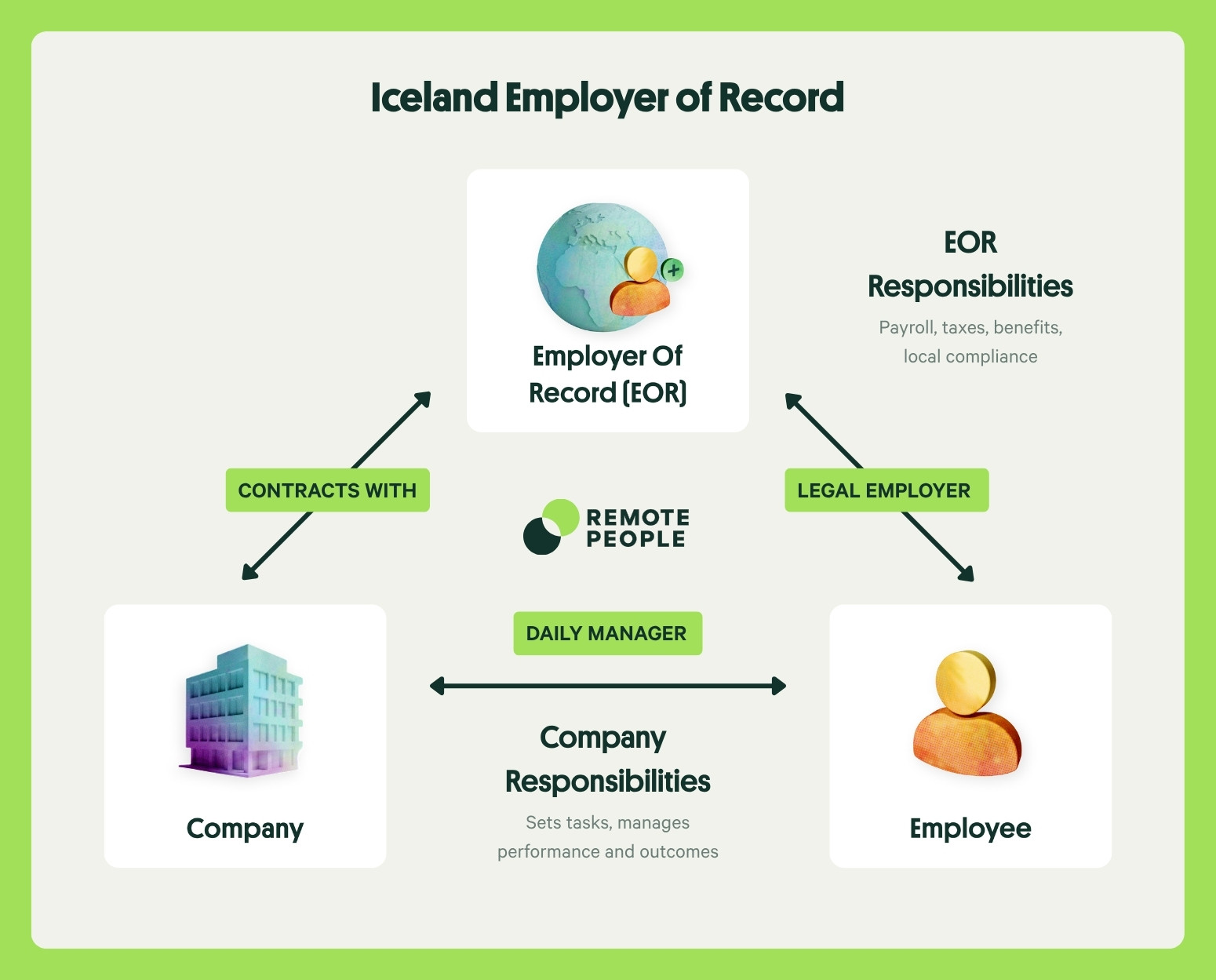
Iceland combines a highly educated workforce with a transparent regulatory environment, making it an appealing destination for international hiring. For companies looking to hire employees in Iceland without setting up a local entity, the process involves registration with the Directorate of Internal Revenue, mandatory pension fund enrollment, and compliance with collective bargaining agreements that cover the vast majority of the workforce. An employer of record in Iceland handles these obligations on behalf of the client company, acting as the legal employer while the client directs the employee’s day-to-day work.
EOR services in Iceland typically cost between $300 and $600 per employee per month, covering payroll processing, tax withholding, pension contributions, and full compliance with Icelandic labour legislation. This guide covers everything from employer contribution rates and income tax brackets to leave entitlements, termination rules, and work permit requirements for 2026.
How an Employer of Record Works in Iceland
The employer of record model in Iceland is built on a tripartite relationship: the client company, the employee, and the EOR provider that acts as the legal employer under Icelandic law.
What Is an EOR?
Who Uses an EOR in Iceland?
Several types of organizations find that an EOR arrangement is the most practical way to hire in Iceland without establishing a local legal entity. Common use cases range from market testing to work permit sponsorship.
Companies evaluating Iceland as a potential market often hire one or two employees through an EOR to assess demand, build local relationships, and understand the regulatory environment before committing to a full entity setup that takes months and costs upward of $15,000. Organizations that need a few specialized professionals, such as geothermal engineers, data center specialists, or Nordic-market sales representatives, also prefer an EOR rather than bearing the overhead of a subsidiary for a small headcount.
Speed is another common driver. An EOR can complete the onboarding process in one to two weeks, compared to the three to six months required to register a local entity, open bank accounts, and set up payroll infrastructure. For non-EEA nationals who require a work permit, the employer must be a registered Icelandic entity, and an EOR fulfills this requirement without the client company needing its own legal presence in the country.
In each of these scenarios, an employer of record in Iceland removes the need for the client company to incorporate, register with the Directorate of Internal Revenue, or manage ongoing statutory reporting.
Typical Onboarding Timeline
Most employer of record providers can onboard an employee in Iceland within one to two weeks. The process follows a standard sequence, though timelines can extend if a work permit is required.
First, the client company signs the EOR service agreement and provides employee information including role, salary, start date, and benefits, which typically takes one to two days. Second, the EOR drafts a contract compliant with Icelandic labour law and the applicable collective bargaining agreement, with both parties reviewing and signing over two to three days.
Third, the EOR registers the employee with the Directorate of Internal Revenue for income tax withholding and payroll tax, and enrolls the employee in an approved pension fund, taking three to five days. Fourth, payroll calculations are configured, the pension contribution split (11.5% employer, 4% employee) is set up, and any additional collective agreement benefits are registered over two to three days. Fifth, the employee begins work under the direction of the client company.
If the employee is a non-EEA national requiring a work permit, the Directorate of Labour processes applications in approximately 4–12 weeks, which extends the total onboarding timeline accordingly. Background checks and credential verification can add another 1–2 weeks.
Hire in Iceland
A small but wealthy Nordic economy with mandatory pension fund contributions above 12%, union-driven collective agreements, and Icelandic labor protections.
We handle employment contracts, payroll, social contributions, and full Icelandic compliance.
No local entity needed. Your team can start in days.
Employment Laws and Regulations in Iceland
Employment Contracts
Icelandic employment law requires all employers to provide a written employment contract within two months of the start date, as stipulated by the Act on Working Terms and Pension Rights Insurance No. 55/1980 (Government of Iceland). The contract must specify the identities of both parties, workplace location, job title and description, start date, expected duration for fixed-term contracts, annual leave entitlement, notice periods, salary and pay frequency, standard working hours, and the applicable collective bargaining agreement.
Iceland recognizes both indefinite and fixed-term employment contracts. Indefinite contracts are the default and offer the strongest protections for employees.
Fixed-term contracts are permitted but cannot be renewed more than twice consecutively, and a total duration beyond two years triggers automatic conversion to an indefinite contract. Contracts must be provided in a language the employee understands, and any terms less favorable than the applicable collective agreement are automatically void and replaced by the collective agreement’s provisions.
Working Hours and Overtime
The standard workweek in Iceland is 40 hours, typically spread across five days from Monday to Friday. Daily working time is generally eight hours, with a minimum 15-minute rest break for every six consecutive hours worked.
Employees are entitled to at least 11 consecutive hours of rest in each 24-hour period and one full rest day per week, which is usually Sunday. These provisions are governed by the Act on Working Environment, Health and Safety in Workplaces No. 46/1980 and reinforced by most collective bargaining agreements (WIPO Lex).
Overtime in Iceland is calculated based on a percentage of the employee’s monthly salary. The standard overtime rate is 1.0385% of the monthly salary per overtime hour, though specific rates can vary by collective agreement. The table below summarizes the overtime and premium pay structure under Icelandic labour legislation.
Iceland overtime and premium pay rates · Per Icelandic collective bargaining agreements | |||
Hour Type | Rate Multiplier | Weekly/Daily Cap | Notes |
|---|---|---|---|
Weekday overtime (first tier) | 1.0385% of monthly salary per hour | No statutory cap | Standard rate for hours beyond 40/week or 8/day |
Weekday overtime (extended hours) | 1.375% of monthly salary per hour | No statutory cap | Applies in some collective agreements after first 2–4 overtime hours |
Night work (23:00–06:00) | 1.375% of monthly salary per hour | No statutory cap | Higher rate applied to shifts between 23:00 and 06:00 |
Weekly rest day work | 1.375% of monthly salary per hour | Full shift | Work on the designated weekly rest day (typically Sunday) |
Public holiday work | 1.375% of monthly salary per hour | Full shift | Work on one of Iceland’s 14 full national holidays |
Major public holidays (Dec 24 PM, Dec 31 PM, May 1) | 1.5–1.75% of monthly salary per hour | Full shift | Premium rates for major holidays; exact rate varies by collective agreement |
Iceland does not impose a statutory cap on total overtime hours per month or year, but collective agreements often include provisions that limit excessive overtime or require employer-union consultation when overtime becomes routine. Overtime pay is calculated on the base monthly salary and does not include bonuses, commissions, or pension contributions. Managerial employees in senior positions may have different overtime arrangements, often with overtime compensation built into their base salary.
Minimum Wage
Iceland does not have a statutory minimum wage set by law. Instead, minimum pay rates are established through collective bargaining agreements between trade unions and employer associations. These agreements cover approximately 90% of the Icelandic workforce, making them effectively universal.
As of early 2026, the general minimum monthly salary for unskilled workers under the main collective agreements (such as the SGS and VR agreements) is approximately ISK 432,000 per month (Government of Iceland). Employers operating through an EOR must comply with the minimum rates in the applicable collective agreement for the employee’s occupation and union membership.
Probation Period
Most collective bargaining agreements in Iceland allow for a probation period of up to three months for new employees. During probation, the notice period is typically shorter, often one week for the first month and then one month for the remainder of the probation period.
The probation period must be expressly stated in the written employment contract to be enforceable. During probation, employees retain their rights to pension fund enrollment, holiday pay accrual, and sick leave, though specific entitlements may be reduced compared to post-probation levels.
Leave Entitlements
Iceland’s statutory leave entitlements are defined by three main acts: the Holiday Allowance Act No. 30/1987 for annual leave, Act No. 19/1979 for sick leave, and the Act on Maternity/Paternity Leave and Parental Leave No. 95/2000 for parental leave. These are statutory minimums; many collective agreements provide more generous entitlements.
Annual Leave
Under the Holiday Allowance Act No. 30/1987, all employees are entitled to a minimum of 24 working days (approximately 4.8 weeks) of paid annual leave per year. Leave accrues during a “holiday year” that runs from May 1 to April 30, and the accrued leave is taken during the “leave year” that follows from May 1 to April 30. Many collective agreements extend the minimum to 25–30 days, particularly for employees with longer tenure.
Holiday pay (orlofsfé) is calculated at 10.17% of total wages earned during the holiday year. Annual leave begins accruing from the first day of employment, including during any probation period.
Sick Leave
Sick leave entitlements in Iceland are governed by Act No. 19/1979 and vary based on the employee’s length of service. During the first year of employment, employees accrue two paid sick days per month of service. After one year, the entitlement increases significantly, and after five years of continuous employment, employees typically have access to several months of paid sick leave depending on the applicable collective agreement.
For the first portion of sick leave, the employer pays the employee’s full salary. After that period, the Social Insurance Administration (Tryggingastofnun) provides sickness benefits. A medical certificate is required for absences exceeding two consecutive days.
Maternity Leave
Under the Act on Maternity/Paternity Leave and Parental Leave No. 95/2000 (as amended), mothers are entitled to six months of leave. Of these, one month must be taken before the expected due date (or as close to the date as possible).
During maternity leave, the Maternity/Paternity Leave Fund (Fæðingarorlofssjóður) pays 80% of the parent’s average total salary, up to a monthly ceiling of ISK 600,000 per month (Ísland.is). The mother’s job is protected throughout the leave period, and she has the right to return to the same or an equivalent position.
Paternity Leave
Fathers are entitled to six months of independent, non-transferable paternity leave under the same Act. The payment rate is identical to maternity leave: 80% of average total salary, up to the ISK 600,000 monthly ceiling.
Additionally, parents receive six weeks of transferable shared leave, which either parent can take. Paternity leave must be used before the child reaches 18 months of age.
Other Statutory Leave
Icelandic labour law and collective agreements provide for several additional types of leave:
- Bereavement leave: Typically 3–5 days of paid leave for the death of a close family member, depending on the applicable collective agreement.
- Marriage leave: Most collective agreements grant 1–3 days of paid leave for the employee’s own marriage.
- Parental leave for child illness: Parents of children under 13 are entitled to time off to care for a sick child, typically at full pay for a limited number of days per year as specified in the collective agreement.
- Trade union activities: Employees elected as trade union representatives are entitled to reasonable time off for union duties.
Under Icelandic labour legislation, the table below consolidates every statutory leave entitlement. The most notable aspect of Iceland’s leave framework is the generous parental leave system, which provides each parent with six independent months plus six additional shared weeks, totaling up to 13.5 months of leave per family.
Iceland statutory leave entitlements · Per Icelandic labour legislation | ||
Leave Type | Duration | Eligibility & Notes |
|---|---|---|
Annual leave | 24 working days minimum | All employees from day one. Holiday pay at 10.17% of wages. Many collective agreements provide 25–30 days. |
Sick leave (year 1) | 2 days per month of service | Employer-paid at full salary. Medical certificate required after 2 days. |
Sick leave (after 1 year) | 1–3 months at full pay | Duration increases with tenure per collective agreement. Social insurance covers extended absences. |
Maternity leave | 6 months | Paid at 80% of average salary (cap ISK 600,000/month). 1 month must be taken before due date. |
Paternity leave | 6 months | Paid at 80% of average salary (cap ISK 600,000/month). Non-transferable, independent right. |
Shared parental leave | 6 weeks | Transferable between parents. Same 80% pay rate and cap. Must be used before child is 18 months. |
Bereavement leave | 3–5 days | Paid leave for death of close family member. Duration per collective agreement. |
Marriage leave | 1–3 days | Paid leave for employee’s own marriage. Per collective agreement. |
Child illness leave | Varies (typically 10–12 days/year) | For parents of children under 13. Paid at full salary per collective agreement. |
Statutory Employee Benefits
Employers must also provide mandatory employee benefits beyond payroll taxes and pensions. These come from both statute and collective agreements.
Occupational pension is the most significant: employers must contribute 11.5% of the employee’s gross salary to an approved pension fund, while employees contribute 4%. This is mandatory for all employees aged 16 to 70. Employees may also make additional voluntary contributions of up to 4%, which are tax-deductible (PwC Iceland).
Iceland operates a universal public healthcare system funded through general taxation. All residents registered with the national registry and who have lived in Iceland for six consecutive months are covered. Employers do not need to provide private health insurance, though some choose to offer supplementary coverage as a recruitment incentive.
Collective agreements mandate two annual bonuses. The vacation bonus (orlofsuppétt) of approximately ISK 58,000 per year is paid in June, and the December bonus (desemberuppétt) of approximately ISK 100,000 per year is paid before the holiday season.
Both amounts are adjusted periodically through collective bargaining. Employers must also provide full salary during the employee’s accrued sick leave entitlement, after which payments transfer to the relevant union sick pay fund.
For exact contribution rates, see the employer and employee contribution tables in the Iceland payroll and tax section below.
Recent Regulatory Updates (2026)
Iceland’s employment framework saw several notable changes in 2025 and early 2026. The most significant development was the conclusion of new collective bargaining agreements in late 2024 and early 2025, which raised minimum wages across multiple sectors and increased both the vacation bonus and December bonus amounts. The Directorate of Internal Revenue confirmed the 2026 income tax brackets with thresholds of ISK 498,122 and ISK 1,398,450 per month, representing modest inflation adjustments from the prior year (Skatturinn – Key Rates 2026).
The employer payroll tax (tryggingagjald) remains at 6.35% for 2026, unchanged since 2022. Iceland also continued to refine its digital nomad visa program, introduced in 2022, which allows remote workers employed by foreign companies to live in Iceland for up to six months. Additionally, new amendments to the Act on Maternity/Paternity Leave extended the shared parental leave component from the original framework, reinforcing Iceland’s position as one of the most progressive countries globally for parental leave.
Work Permits and Visas in Iceland
Work Permit Requirements
Who Needs a Work Permit
Iceland is a member of the European Economic Area (EEA), which means nationals of EEA member states (all EU countries plus Norway, Liechtenstein, and Iceland itself) and Swiss nationals have the right to live and work in Iceland without a work permit. They must register with the Registers Iceland (Þjóðskrá) if staying longer than three months, but no work authorization is needed. Citizens of the Nordic countries (Denmark, Finland, Norway, Sweden) have additional free movement rights under the Nordic Passport Union and do not need to register for stays under six months.
Non-EEA nationals must obtain a work permit before they can legally work in Iceland. The work permit is issued by the Directorate of Labour (Vinnumálastofnun) and is tied to a specific employer and position. A residence permit, issued by the Directorate of Immigration (Útlendingastofnun), is also required and is typically applied for simultaneously (Foreign Nationals’ Right to Work Act No. 97/2002).
Eligibility and Required Documents
To apply for a work permit in Iceland, the employer (or EOR) must demonstrate that no suitable EEA candidate is available for the position, known as a labour market test. Required documents typically include:
- A valid passport with at least 6 months remaining validity
- A signed employment contract specifying role, salary, and working conditions
- Proof of the employer’s registration in Iceland (or the EOR’s legal entity status)
- Evidence of professional qualifications or educational credentials, with apostille or authentication
- A clean criminal background check from the applicant’s home country
- Proof of accommodation in Iceland
- Health insurance coverage for the initial period before national health coverage activates
Processing Time and Validity
Standard processing time for work permits is 4–12 weeks, depending on the complexity of the application and the volume of applications at the Directorate of Labour. Initial work permits are typically valid for one year and are tied to the specific employer and job.
Some categories, such as highly skilled workers, may receive permits valid for up to two years. Delays can occur if the labour market test reveals potential EEA candidates, or if additional documentation is requested.
Renewal Process
Work permit renewals must be submitted at least one month before the current permit expires. The renewal application requires updated employment documentation, proof of continued employment, and confirmation that the employee has been paying taxes and pension contributions.
After four years of continuous lawful residence and employment, non-EEA nationals may apply for a permanent residence permit, which removes the need for a separate work permit. Employees may continue working during the renewal processing period provided the application was submitted on time.
Common Visa Types for Foreign Workers
Iceland’s immigration framework is managed by the Directorate of Immigration (Útlendingastofnun), which issues residence permits linked to the type of employment or activity. The EOR can sponsor the standard work permit and intra-company transfer categories, while other visa types may require specific conditions. The table below outlines the main visa categories available to foreign workers in Iceland.
Iceland work visa types for foreign workers · 2026 | ||||
Visa Type | Duration | Best For | Leads to APT? | Processing |
|---|---|---|---|---|
Standard work permit | 1 year (renewable) | Non-EEA employees hired by an Icelandic employer or EOR | Yes (after 4 years) | 4–12 weeks |
Intra-company transfer | Up to 2 years | Employees transferred from a foreign parent/subsidiary company | No | 4–8 weeks |
Specialist / highly skilled worker | Up to 2 years (renewable) | Professionals with specialized skills in shortage occupations | Yes (after 4 years) | 4–8 weeks |
Digital nomad / remote work visa | Up to 6 months | Remote workers employed by non-Icelandic companies earning above ISK 1,000,000/month | No | 2–4 weeks |
Self-employment permit | 1 year (renewable) | Freelancers and independent business operators | Yes (after 4 years) | 8–12 weeks |
Visa types that do not permit employment in Iceland include:
- Tourist visa (Schengen C visa): Allows stays up to 90 days within a 180-day period. No employment permitted.
- Student visa: Allows full-time study at an Icelandic institution. Limited part-time work may be permitted alongside studies.
- Transit visa: For airport transit only, no entry into Iceland.
How an EOR Handles Work Permits
An EOR in Iceland acts as the sponsoring employer for work permit applications, which is a significant advantage for companies without a local entity. The EOR files the work permit application with the Directorate of Labour, provides the required employer documentation (including proof of entity registration, the employment contract, and the labour market test results), and manages correspondence with immigration authorities throughout the process.
The employee remains responsible for providing personal documents such as their passport, background check, and educational credentials. Once the permit is approved, the EOR ensures ongoing compliance by tracking permit validity, initiating renewals before expiry, and updating the Directorate of Labour if there are any changes to the employment terms. For EEA nationals, the EOR handles the simpler registration process with Registers Iceland (Þjóðskrá), which typically takes just a few days.
When a work permit is required, the onboarding timeline extends from 1–2 weeks to 6–14 weeks, depending on the permit category and processing times.
Payroll, Taxes, and Social Security in Iceland
Employer Contributions
Employers in Iceland are required to make two major contributions on top of the employee’s gross salary: the payroll tax (tryggingagjald) at 6.35% and the mandatory occupational pension contribution at 11.5%. Together, these bring the total employer burden to 17.85% of gross salary. Both contributions are administered by the Directorate of Internal Revenue (Skatturinn) and are payable monthly alongside the employee’s income tax withholding (Skatturinn – Key Rates 2026).
Iceland employer social security contributions · 2026 rates | ||
Contribution | Rate | Notes |
|---|---|---|
Payroll tax (tryggingagjald) | 6.35% | Social insurance contribution paid to Skatturinn. Unchanged since 2022. |
Occupational pension fund | 11.5% | Mandatory contribution to an approved pension fund for employees aged 16–70. |
Total employer contributions | 17.85% | Combined employer burden on gross salary. |
Employee Contributions
Employees in Iceland contribute 4% of their gross salary to their chosen occupational pension fund. This is the primary mandatory payroll deduction beyond income tax.
Additionally, all taxable individuals aged 16–69 are subject to two small fixed annual levies: the Senior Citizens’ Construction Fund fee (ISK 14,614 for 2026) and the Icelandic National Broadcasting Service fee (ISK 22,200 for 2026). These are assessed annually through the tax return, not deducted monthly from payroll.
Iceland employee payroll deductions · 2026 monthly withholdings | ||
Deduction | Rate | Notes |
|---|---|---|
Occupational pension fund | 4% | Mandatory for employees aged 16–70. Tax-deductible from gross income. |
Additional voluntary pension | Up to 4% | Optional. Tax-deductible. Used to increase pension rights. |
Senior Citizens’ Construction Fund | ISK 14,614/year | Fixed annual levy assessed through tax return. Ages 16–69. |
National Broadcasting Service fee | ISK 22,200/year | Fixed annual levy assessed through tax return. Ages 16–69. |
Total mandatory employee contribution | 4% + ISK 36,814/year | Pension is percentage-based; levies are fixed amounts. |
Income Tax
Iceland uses a progressive income tax system with three brackets for 2026. The rates include both the national income tax and the average municipal tax (which varies slightly by municipality but averages approximately 14.94% in 2026).
Every tax-resident individual receives a personal tax credit of ISK 72,492 per month (ISK 869,898 per year), which reduces their tax liability. Unused personal tax credits can be transferred between spouses (Skatturinn – Tax Brackets 2026).
Iceland income tax brackets · 2026 | |
Bracket | Tax Calculation |
|---|---|
ISK 0 – ISK 498,122 per month | 31.49% (includes national + average municipal tax) |
ISK 498,123 – ISK 1,398,450 per month | 37.99% on amount exceeding ISK 498,122 |
Above ISK 1,398,450 per month | 46.29% on amount exceeding ISK 1,398,450 |
Payroll Cycle
The standard payroll frequency in Iceland is monthly, with salaries typically paid on the first business day of the following month. Employers must provide a detailed pay slip showing gross salary, all deductions (income tax, pension contributions), employer contributions, and net pay. All salary payments must be made in Icelandic króna (ISK) via bank transfer to the employee’s Icelandic bank account, though the employment contract may reference a salary amount in a foreign currency for convenience.
Income tax withholding and social security contributions are remitted monthly to the Directorate of Internal Revenue. Pension fund contributions are paid directly to the employee’s chosen pension fund on the same monthly schedule.
The annual tax return filing deadline is typically in March, with the tax assessment completed by June or July. Employers must submit an annual report of all wages paid and taxes withheld (RSK 2.01 form) to the Directorate of Internal Revenue by January 20 of the following year.
13th Month Salary and Bonus Pay
Iceland does not have a statutory 13th month salary. However, collective bargaining agreements mandate two additional bonus payments that serve a similar function. The vacation bonus (orlofsuppbót) is paid annually in June, typically around ISK 55,000–62,000 for a full-time employee who worked the entire preceding year.
The December bonus (desemberuppbót) is paid in November or December, typically around ISK 102,000–114,000. Both bonuses are prorated for employees who worked part of the year.
These bonuses are taxable income and subject to income tax withholding at the applicable rate. There is no statutory requirement for profit-sharing, a 14th month salary, or performance bonuses, though individual employment contracts or company policies may include such arrangements.
Cost of Hiring Through an EOR in Iceland
EOR Service Fees
EOR providers in Iceland typically charge a flat monthly fee of $300–$600 per employee. This fee covers the full scope of employment administration: drafting and maintaining compliant employment contracts, processing monthly payroll, withholding and remitting income tax and social security contributions, managing pension fund enrollment and payments, administering leave entitlements, and handling termination procedures.
The fee does not include the employee’s salary, employer contributions (17.85% of gross), or any mandatory bonuses (vacation bonus, December bonus). Some providers may charge additional fees for one-time services such as work permit processing, contract amendments, or employee offboarding.
Total Employment Cost Breakdown
The table below shows a worked example of the total monthly cost to employ someone in Iceland through an EOR, using a gross salary of $5,000 per month. Employer contributions are calculated at 17.85% of gross salary, and the EOR service fee is set at $499 per month (mid-range). Figures are converted at 1 USD ≈ 137 ISK, April 2026.
Iceland employer cost example · USD 5,000 gross · 2026 | ||
Cost Component | Amount (USD) | % of Gross |
|---|---|---|
Gross monthly salary | $5,000 | 100% |
Payroll tax (tryggingagjald) – 6.35% | $318 | 6.35% |
Pension fund (employer share) – 11.5% | $575 | 11.5% |
EOR service fee | $499 | 9.98% |
Total monthly employer cost | $6,392 | 127.83% |
Source: Skatturinn – Key Rates 2026 and RemotePeople – Pricing | ||
Ready to hire in Iceland? Get started with RemotePeople – we handle employment contracts, payroll, tax withholding, and full Iceland compliance. No local entity needed.
Benefits of Using an EOR in Iceland
Hiring through an EOR in Iceland offers several practical advantages over setting up a local entity, particularly for companies with small teams or those entering the market for the first time.
The most immediate benefit is speed. An EOR can onboard an employee in Iceland within one to two weeks, compared to the three to six months required for entity registration, bank account setup, payroll system configuration, and pension fund registration. Iceland’s collective bargaining framework, which covers over 90% of the workforce, adds compliance complexity that an EOR manages from day one.
Cost savings are significant. Setting up a local subsidiary in Iceland involves ISK 500,000 in minimum share capital, registration fees, legal costs, and ongoing maintenance including accounting, auditing, and a registered office. For teams under 15 employees, the EOR fee of $300–$600 per employee per month is considerably more affordable.
Iceland’s pension system (11.5% employer contribution, 4% employee contribution, multiple pension fund options) and payroll tax obligations require accurate monthly filings to Skatturinn. An EOR handles these calculations and payments, reducing the risk of penalties for late or incorrect contributions.
An EOR arrangement allows you to add or reduce headcount without the overhead of managing a local entity. The EOR assumes the legal employer role and associated liability for payroll errors, tax compliance, and employment disputes. For companies hiring non-EEA nationals, the EOR’s status as a registered Icelandic entity satisfies the requirement for work permit sponsorship.
Termination and Offboarding in Iceland
Notice Periods
Notice periods in Iceland are governed by Act No. 19/1979 (Act Respecting Labourers’ Right to Advance Notice of Termination and Wages on Account of Absence through Illness and Accidents). Both employers and employees must provide the same statutory notice.
Notice can be paid in lieu if both parties agree, but the default is working notice. The statutory notice periods increase with the employee’s length of continuous service with the same employer (Lexology – Iceland Termination).
Iceland statutory notice periods by position level · Per Act No. 19/1979 | |||
Length of Service | Notice Period | During Probation | Notes |
|---|---|---|---|
0–3 months (probation) | 1 week – 1 month | Yes | Per collective agreement. Typically 1 week in first month, 1 month thereafter. |
3 months – 1 year | 1 month | No | Statutory minimum under Act 19/1979. Calendar months. |
1–3 years | 1 month | No | Same statutory minimum. Collective agreements may provide longer notice. |
3–5 years | 2 months | No | Increases after 3 years of continuous employment. |
5–10 years | 3 months | No | Maximum statutory notice under Act 19/1979. |
10+ years | 3–6 months | No | Collective agreements may extend notice to 6 months for long-tenured employees. |
Exceptions to the standard notice requirements include termination for just cause (gross misconduct), where the employer may dismiss the employee immediately without notice. Mutual agreement between the parties can also result in shorter notice periods or immediate separation. For fixed-term contracts, the contract ends automatically on the agreed date without notice, unless otherwise specified in the contract.
Severance Pay
Iceland does not have a statutory severance pay requirement. Under Icelandic law, employees who are terminated are entitled to their salary during the notice period, plus payment for any accrued but unused annual leave, but there is no additional severance payment mandated by statute. This distinguishes Iceland from many other European countries where severance is calculated as a multiple of months’ salary per year of service (Lexology – Iceland Termination).
However, some collective agreements and individual employment contracts do include severance provisions, particularly for managerial positions or employees with long tenure. The table below illustrates the typical severance landscape in Iceland, showing that the primary financial protection for terminated employees comes through the notice period salary rather than a separate severance payment.
Iceland severance pay schedule by years of service · Per Icelandic labour legislation | |||
Years of Service | Severance Amount | Base Salary | Notes |
|---|---|---|---|
1 year | No statutory severance | N/A | Employee receives 1-month notice period salary only. |
3 years | No statutory severance | N/A | Employee receives 2-month notice period salary only. |
5 years | No statutory severance | N/A | Employee receives 3-month notice period salary. Some collective agreements add 1–3 months extra. |
10 years | No statutory severance | N/A | Employee receives 3–6 month notice period salary per collective agreement. Senior roles may negotiate contractual severance. |
Calculation Method
Since Iceland has no statutory severance formula, the calculation for a terminated employee’s final payment focuses on the notice period salary plus accrued benefits. The employer must pay the employee’s regular gross monthly salary for the full duration of the notice period (1–3 months under Act 19/1979, or longer per the collective agreement). In addition, any accrued but untaken annual leave must be paid out at the employee’s regular rate, using the 10.17% holiday pay calculation.
The vacation bonus (orlofsuppbót) and December bonus (desemberuppbót) are prorated based on the months worked in the applicable period. See Table 12 above for the notice period schedule by tenure.
Caps and Exceptions
Because there is no statutory severance entitlement, there are no statutory caps. For contractual or collective-agreement-based severance, the terms of the specific agreement govern the calculation and any maximums. Employees terminated for just cause (gross misconduct, theft, serious breach of duty) are not entitled to notice period salary.
During the probation period, shortened notice applies per the contract terms. Fixed-term contract employees whose contracts expire on the agreed date receive no notice period payment or severance unless the contract specifies otherwise.
Grounds for Termination
Both employers and employees can terminate under Icelandic law. Without cause, the employer must provide the applicable notice period and pay the employee through it. No specific reason is required, but the dismissal must not be discriminatory or retaliatory.
Termination for just cause allows the employer to dismiss the employee immediately without notice. Grounds for just cause include serious breach of the employment contract, theft or fraud, violent behavior in the workplace, repeated insubordination after written warnings, or intoxication on duty. In practice, courts scrutinize just-cause dismissals closely, and employers should document the grounds thoroughly.
Protected categories under Icelandic anti-discrimination law include pregnancy, parental leave status, union membership, gender, age, disability, sexual orientation, and religious belief. Dismissals that appear to be motivated by these protected characteristics may be deemed unlawful, resulting in reinstatement or damages.
EOR vs. Other Hiring Models in Iceland
EOR vs. Setting Up a Local Entity
Setting up a local entity in Iceland, typically a private limited company (einkahlutafélag, ehf.), involves registration with the Registers Iceland (Fyrirtækjaskrá), a minimum share capital of ISK 500,000, appointment of a local director, and registration with the Directorate of Internal Revenue for tax purposes. The process takes 3–6 months and costs $15,000–$25,000 in legal, accounting, and registration fees. The table below compares this approach with hiring through an EOR.
Iceland EOR vs local entity comparison · Setup time, cost, risk and best-fit | ||
Factor | Employer of Record | Own Entity |
|---|---|---|
Setup time | 1–2 weeks | 3–6 months |
Upfront cost | $0 | $15,000–$25,000 |
Ongoing cost | $300–$600/employee/month | $8,000–$15,000/year maintenance |
Local partner required | No (EOR is the local entity) | Yes (local director or registered agent) |
Social insurance registration | Handled by EOR | You manage it |
Payroll & tax filing | Handled by EOR | You manage it (or outsource) |
Best for team size | 1–15 employees | 15+ employees |
Scale down / exit | Easy – no entity to unwind | Costly – legal dissolution required |
Government contracts | Not eligible | Eligible (requires local entity) |
For most companies hiring 1–15 employees in Iceland, the employer of record model is more cost-effective and faster. The break-even point typically occurs when the team exceeds 15 employees, at which point the cumulative monthly EOR fees approach the cost of maintaining a local entity with in-house or outsourced payroll. Companies bidding on Icelandic government contracts should note that these typically require a locally registered entity, which an EOR arrangement does not provide.
Beyond payroll, an EOR eliminates the corporate tax return (20% rate), auditing, and registry filings that come with a local entity.
EOR vs. Hiring Independent Contractors
Hiring independent contractors in Iceland requires caution. Tax authorities apply a substance-over-form test to determine whether a working relationship is genuinely independent or actually an employment relationship. If a contractor works exclusively for one client, follows the client’s instructions, uses the client’s equipment, and has no ability to profit from their own business decisions, the relationship may be reclassified as employment.
Iceland EOR vs independent contractors · Compliance, cost, and risk | ||
Factor | EOR (Full-Time Employee) | Independent Contractor |
|---|---|---|
Legal relationship | Employee of the EOR | Self-employed, no employment relationship |
Compliance risk | Low – EOR ensures local labor law compliance | High – misclassification risk if relationship resembles employment |
Payroll & tax | EOR handles withholding, contributions, filings | Contractor invoices you; they handle their own taxes |
Benefits & leave | Statutory benefits, paid leave, social security | No entitlement to employee benefits |
IP protection | Stronger – employment contract assigns IP by default | Weaker – requires explicit IP assignment clause |
Termination | Subject to local notice periods and severance | Contract can be ended per agreement terms |
Best for | Long-term, core team roles | Short-term projects, specialized tasks |
Cost structure | Salary + employer contributions + EOR fee | Contractor fee (typically higher gross, lower total cost) |
The consequences of contractor misclassification in Iceland can be significant. If the Directorate of Internal Revenue reclassifies a contractor as an employee, the hiring company (or its EOR) becomes liable for back payment of all employer contributions (6.35% payroll tax + 11.5% pension), unpaid income tax withholding, accrued annual leave and holiday pay, and any applicable bonuses.
Penalties and interest charges are added to the outstanding amounts. In serious cases, fines of up to ISK 5,000,000 can apply.
For companies hiring someone for ongoing, full-time work in Iceland, the EOR model eliminates misclassification risk entirely by establishing a proper employment relationship from day one. For genuinely independent project work, the contractor of record model offers a compliant alternative.
EOR vs. PEO (Professional Employer Organization)
A Professional Employer Organization (PEO) operates under a co-employment model where the client company remains the legal employer and the PEO provides HR services, payroll processing, and benefits administration. In Iceland, there is no specific regulatory framework governing PEOs, and the co-employment model is not widely used. The key difference is that a PEO requires the client company to have its own registered entity in Iceland, while an EOR does not.
Iceland EOR vs PEO comparison · Legal employer, liability, and setup | ||
Factor | Employer of Record (EOR) | PEO |
|---|---|---|
Legal employer | EOR is the legal employer | You remain the legal employer (co-employment) |
Local entity required | No – the EOR is the local entity | Yes – you must have your own entity in Iceland |
Best for | Companies without a local entity | Companies that already have a local entity |
Compliance liability | EOR assumes compliance responsibility | Shared liability between you and the PEO |
Setup time | 1–2 weeks | Depends on your entity setup (weeks to months) |
Control over HR policies | EOR manages within local law framework | More direct control, PEO advises |
Typical use case | Market entry, small remote teams, testing new markets | Established local operations needing HR outsourcing |
Source: RemotePeople – EOR Solutions and RemotePeople – Best EOR | ||
For companies entering Iceland without an existing entity, the employer of record is the only viable option between the two. The PEO model only makes sense for organizations that already have a registered Icelandic entity and want to outsource day-to-day HR administration while retaining the legal employer status. Since Iceland lacks a formal PEO regulatory framework, companies using a PEO should ensure the arrangement is structured to comply with all applicable employment and tax obligations.
The compliance liability distinction is particularly important in Iceland’s union-heavy environment. With an EOR, the EOR assumes responsibility for ensuring that all collective agreement terms are met. With a PEO, that responsibility remains shared, which means the client company needs in-house expertise on Icelandic collective agreements.
Public Holidays in Iceland
Iceland observes 14 full national holidays and 2 half-day holidays (Christmas Eve and New Year’s Eve) in 2026. Public holidays affect payroll scheduling because employees who work on these days are entitled to premium pay rates, typically 1.375% of monthly salary per hour (or higher for major holidays).
The EOR manages these calculations automatically as part of the monthly payroll cycle. The following table lists all official public holidays for 2026, sorted chronologically (timeanddate.com – Iceland Holidays 2026).
Iceland public holidays · 2026 calendar year | ||
Date | Holiday | Type |
|---|---|---|
January 1 | New Year’s Day (Nýársdagur) | National holiday |
April 2 | Maundy Thursday (Skírdagur) | National holiday |
April 3 | Good Friday (Föstudagurinn langi) | National holiday |
April 5 | Easter Sunday (Páskadagur) | National holiday |
April 6 | Easter Monday (Annar í páskum) | National holiday |
April 23 | First Day of Summer (Sumardagurinn fyrsti) | National holiday |
May 1 | Labour Day (Verkalýðsdagurinn) | National holiday |
May 14 | Ascension Day (Uppstigningardagur) | National holiday |
May 24 | Whit Sunday (Hvítasunnudagur) | National holiday |
May 25 | Whit Monday (Annar í hvítasunnu) | National holiday |
June 17 | Icelandic Republic Day (Þjóðhátíðardagurinn) | National holiday |
August 3 | Commerce Day (Frídagur verslunarmanna) | National holiday |
December 24 | Christmas Eve (Aðfangadagur) – from 13:00 | Half-day holiday |
December 25 | Christmas Day (Jóladagur) | National holiday |
December 26 | Second Day of Christmas (Annar í jólum) | National holiday |
December 31 | New Year’s Eve (Gamlársdagur) – from 13:00 | Half-day holiday |
Source: Government of Iceland and timeanddate.com – Iceland 2026 | ||
The Easter period (Maundy Thursday through Easter Monday) and Christmas period (December 24–26) each create multi-day closures that affect payroll timing and business operations. Employers should plan payroll processing around these blocks, particularly the December period when the desemberuppbót (December bonus) must also be disbursed. The First Day of Summer (Sumardagurinn fyrsti) is a uniquely Icelandic holiday that falls on the first Thursday after April 18 each year.
How to Get Started with an EOR in Iceland
Getting started with an employer of record in Iceland is a straightforward process that typically takes one to two weeks from initial engagement to the employee’s first day.
First, define the role and compensation. Determine the position, responsibilities, working hours, and salary. Your EOR provider will advise on competitive pay ranges and confirm that the proposed terms comply with the applicable collective agreement.
Second, choose an EOR provider with a local presence in Iceland and verified experience managing Icelandic payroll, pension fund enrollment, and collective agreement compliance. Get a free proposal from RemotePeople to compare costs and timelines.
Third, the EOR drafts an employment contract that complies with Icelandic labour law and the relevant collective agreement, including all mandatory terms under Act No. 55/1980. Both the client company and the employee review and sign the contract.
Fourth, the EOR registers the employee with Skatturinn for tax withholding, enrolls them in an approved pension fund, and configures payroll. Fifth, the employee begins work under the client company’s day-to-day direction while the EOR manages all ongoing employer obligations including payroll runs, tax filings, and benefits administration.
Ready to hire in Iceland? Contact RemotePeople to get started. We handle employment contracts, payroll, tax withholding, pension contributions, and full compliance with Icelandic labour law, so you can focus on building your team.
Where companies hiring in Iceland expand next
Companies building a Nordic presence frequently expand across the region, drawing on Nordic Council mobility and shared labor frameworks. After building a team in Iceland, employers often look to a team in Sweden for shared Nordic labor frameworks, then operations in Norway for seamless cross-border Nordic workforce flows. Denmark follows with aligned Nordic benefits and compensation standards, and hiring in Finland typically closes the regional footprint via Nordic Council mobility and aligned labor norms.
Frequently Asked Questions
EOR services in Iceland typically cost $300–$600 per employee per month as a flat service fee. On top of this, you pay the employee’s gross salary and employer contributions of 17.85% (6.35% payroll tax plus 11.5% pension). For a $5,000/month gross salary, the total monthly cost is approximately $6,392 including the EOR fee (RemotePeople – Pricing).
Most EOR providers can onboard an employee in Iceland within 1–2 weeks for EEA nationals. For non-EEA nationals who require a work permit, the process takes 6–14 weeks due to the 4–12 week work permit processing time at the Directorate of Labour (island.is).
Iceland does not have a statutory minimum wage set by law. Instead, minimum pay rates are established through collective bargaining agreements that cover approximately 90% of the workforce. As of early 2026, the general minimum for unskilled workers is approximately ISK 432,000 per month under the main collective agreements (Government of Iceland).
Employers in Iceland pay two mandatory contributions: a 6.35% payroll tax (tryggingagjald) and an 11.5% occupational pension fund contribution, totalling 17.85% of the employee’s gross salary. These rates are unchanged for 2026 and are paid monthly to the Directorate of Internal Revenue and the employee’s pension fund, respectively (Skatturinn).
No. An employer of record allows you to hire employees in Iceland without setting up your own legal entity. The EOR acts as the registered local employer, handling all payroll, tax, pension, and compliance obligations on your behalf. This is typically faster and more cost-effective than entity setup for teams under 15 employees.
Iceland has one of the most generous parental leave systems in the world. Each parent is entitled to 6 months of independent, non-transferable leave, plus 6 weeks of shared leave that can be allocated to either parent. Leave is paid at 80% of average salary, up to a cap of ISK 600,000 per month, funded by the Maternity/Paternity Leave Fund (island.is).
Yes, but with caution. Iceland’s tax authorities apply a substance-over-form test to contractor relationships. If the working arrangement resembles employment (exclusive client, fixed hours, client equipment), the relationship may be reclassified, resulting in back taxes, pension contributions, and fines up to ISK 5,000,000. For ongoing, full-time roles, an EOR is the compliant option. If you do need to engage genuine independent contractors in Iceland, RemotePeople’s contractor management service handles compliant contracts, payments, and tax documentation (Government of Iceland).
Iceland has no statutory severance pay. Terminated employees are entitled to salary during the notice period, which ranges from 1 month (under 3 years’ service) to 3 months (5+ years), with some collective agreements extending this to 6 months for long-tenured employees. The employer must also pay out accrued annual leave, prorated vacation bonus, and prorated December bonus (Government of Iceland).
Employer of Record in
Employer of Record in
Employer of Record in
Employer of Record in
Employer of Record in
Employer of Record in
Employer of Record in
Employer of Record in




