
 Recruit
Employer of Record in Massachusetts
-
 Drew Donnelly
- Published
- September 22, 2026
Massachusetts’ employment law includes paid family leave, strict non-compete rules, and earned sick time, and a Massachusetts EOR handles full compliance with no local entity needed.
Hire in Massachusetts — book a free 30-minute demo
Tell us what you need. You'll get a tailored, transparent proposal within 24 hours, plus a free call to walk through it.
Tell us about your company
So we can match you with a specialist who knows your market — and unlock volume pricing tiers.
* All fields are required.
Where and when are you hiring?
Tell us the geography and timing and we'll quote each country line by line, with onboarding timelines.
* All fields are required.
Help us beat your current setup
We'll benchmark your current deal and send a line-by-line proposal in 24 hours — showing exactly where we cut cost, time, or risk. After you submit, you can book a call to walk through it together.
* All fields are required.
Thanks! Your proposal is on its way.
Expect a tailored, line-by-line proposal in your inbox within 24 hours. In the meantime…
Want to walk through it together?
Book a free 30-minute call with one of our specialists. We'll explain every line, answer your questions, and tailor the proposal further if you need.
No obligation. Pick a time that works for you.








- Hire in Massachusetts — book a free 30-minute demo
- Tell us about your company
- Where and when are you hiring?
- Help us beat your current setup
- Thanks! Your proposal is on its way.
- Massachusetts EOR
- What Is the Difference Between a Massachusetts EOR and a Massachusetts PEO?
- How Does a Massachusetts Employer of Record Work?
- How Do Labor Laws Affect Hiring in Massachusetts?
- Payroll Taxes and Employer Cost in Massachusetts
- Employee Classification Rules in Massachusetts
- What Makes Hiring in Massachusetts Unique?
- What Are the Benefits of a Massachusetts Employer of Record Service?
- What Are the Downsides of a Massachusetts Employer of Record Service?
- How to Choose a Massachusetts Employer of Record
- Engage a MassachusettsEmployer of Record with RemotePeople
- Related EOR Destinations

Let RemotePeople handle payroll, compliance, and HR admin worldwide so you can focus on building your team.
Key Takeaways
- Massachusetts is a high-regulation, high-cost state for business.
- This state’s skilled workforce is concentrated in high-tech industries.
- Employer costs are higher than average, and penalties for non-compliance are some of the highest in the country.
- EORs take on responsibility for legal compliance, making hiring in the state easy.
Massachusetts is a somewhat higher-than-average state, both in terms of population and GDP. With around 7.1 million residents, it’s the 16th most-populous state, while its GDP of 780 billion ranks it 12th. Combined, this gives the residents of the state the third-highest per capita GDP in the country, but also pushes the cost of living and doing business up significantly. In 2025, Massachusetts was ranked as the 20th-best state to do business in, with this mid-range ranking reflecting high costs and regulation balanced by technology and innovation.
Massachusetts is one of the country’s main science and technology hubs. Renowned educational institutions like Harvard and MIT (Massachusetts Institute of Technology) are on the cutting edge of research and development, creating a favorable environment for these types of businesses and supplying expert professionals. Industries like biotech, aerospace, IT, financial services, and high-end manufacturing thrive in this state.
As in any state, however, hiring and managing employees in Massachusetts can be challenging, especially when working with top-performing talent. If you want to tap into this state’s advanced labor market and offer top-level HR services, partnering with a Massachusetts EOR might just be the best choice for your business.
Massachusetts EOR
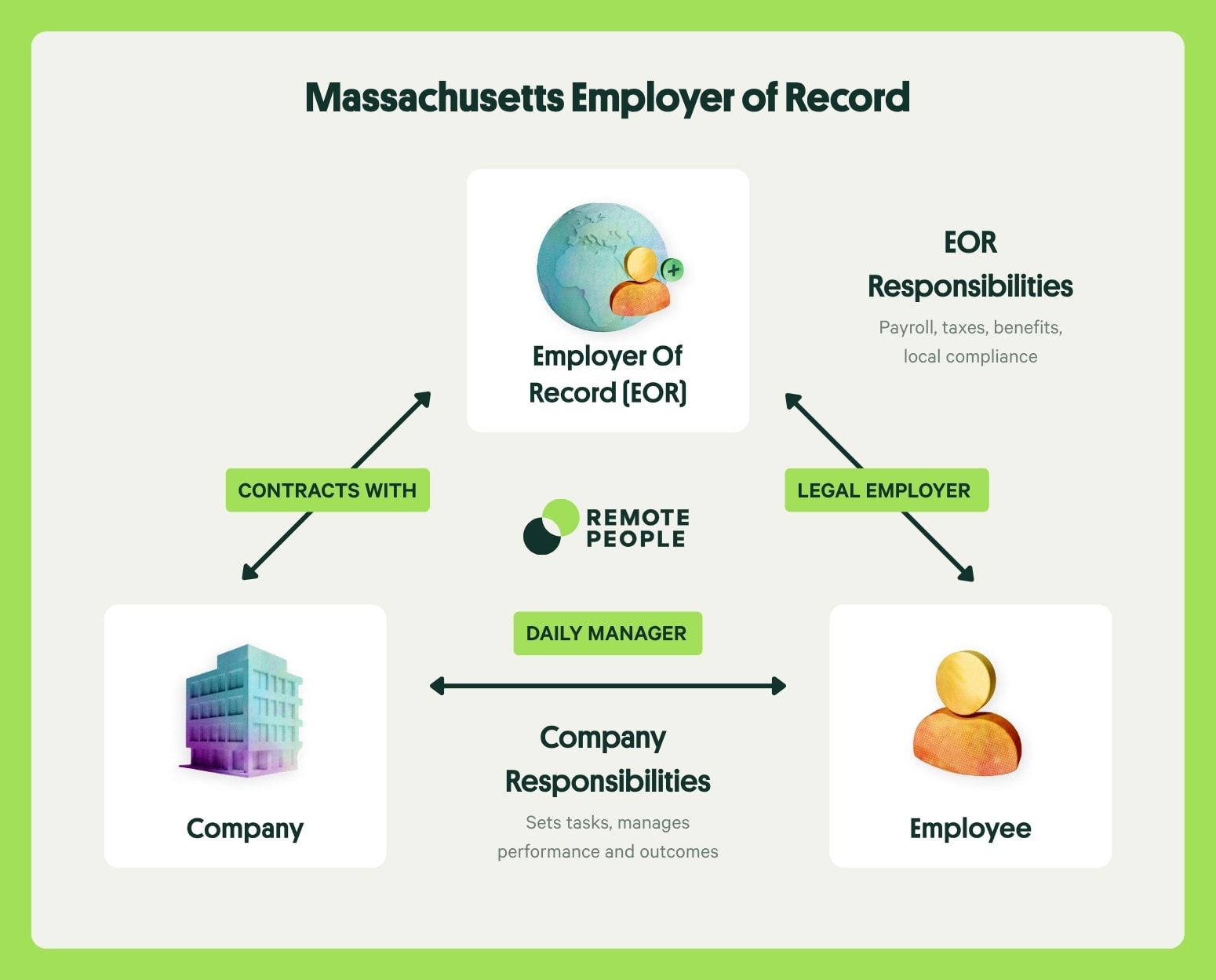
An EOR, or Employer of Record, is a type of service provider that helps its clients hire employees in Massachusetts, even if they don’t own entities in the state or even in the US. They do so by hiring the employees directly on behalf of their clients, becoming their legal employer in Massachusetts and the party responsible for complying with all state and federal employment laws. Employers from other states or even companies registered abroad can work with EORs to access talent in Massachusetts, especially skilled workers who can’t be sourced elsewhere.
What is an EOR can help explain how this employment model works in more detail.
EORs don’t simply act as legal employers for their clients’ employees. They also handle all HR responsibilities for them, including managing paid time off entitlements, calculating payroll, administering benefits, and paying employees directly. They also handle employee tax filings, issue employees’ W-2 forms, and report to both the state and federal tax authorities as required. This helps to shift liability for the employees away from the client and onto the shoulders of the EOR.
Nearly all modern EORs provide their services through advanced, cloud-based platforms that give you access to employee information from anywhere in the world. While these platforms focus on core HR services like payroll and benefits administration, most offer many other features for functions like employee engagement, talent management, performance management, strategic planning, and more. Most platforms also offer employee portals through which employees can manage their personal information, make time off requests, and keep track of their pay and benefits.
While EORs handle hiring, HR, and compliance, clients still have some responsibilities left. They set their employees’ schedules, manage their daily tasks, and monitor the quality of their work. They still maintain direct control over their employees’ work, while relieving themselves of most of the related administrative burden by outsourcing to EORs. They also gain a major advantage by partnering with EORs. Compared with setting up an entity in the state and hiring employees directly, clients can hire people through already-established EORs, dramatically increasing the speed at which they can access skilled Massachusetts workers.
What Is the Difference Between a Massachusetts EOR and a Massachusetts PEO?
If you’ve heard of a PEO, or a Professional Employer Organization, you may be wondering how Massachusetts EORs differ from these somewhat similar service providers. While many of their services are the same, including HR management, the key differences between them include:
PEO
- The client and PEO share legal responsibility for the employees through a co-employment arrangement. PEOs may handle employee taxes for their clients.
- To work with a PEO, you need to have your own legal entity registered in Massachusetts or elsewhere in the US. PEOs don’t unilaterally hire employees on behalf of their clients.
- PEOs typically work with domestic companies, providing them with outsourcing solutions to help them manage their employees more efficiently.
EOR
- Clients don’t need to own registered entities in Massachusetts or even in the US to hire employees.
- EORs assume legal responsibility for employees, maintain compliance with state and federal laws, and shield their clients from liability
- EORs are usually used by international companies looking to hire skilled workers quickly and easily in the United States.
Start hiring with a Massachusetts EOR
Let us handle the complexities of hiring, compliance, and payroll in Massachusetts while you focus on growing your team.
- Hire employees in Massachusetts with a Massachusetts EOR
- No local entity is needed
- Pricing starts at USD 199 per employee
- RemotePeople can also help you find the best talent in Massachusetts
How Does a Massachusetts Employer of Record Work?
Working with a Massachusetts EOR can be an easy and cost-effective way of managing your employees’ needs and providing them with top-quality HR services. Your partnership with the EOR of your choice will typically include the following steps:
Compliant Employment Contract
Most EORs will assist you in setting salary bands and creating benefits packages that are appropriate for the Massachusetts labor market. They also help you negotiate terms with the candidate you choose to hire. Once these terms are agreed upon, the EOR will generate a contract for the employee and enter into it directly with them, becoming their legal employer. It ensures that each contract is fully compliant with all state and federal employment and labor laws. The EOR will also manage employee commitments and contract storage for you.
Payroll Setup with Correct State Registrations
To bring a new employee on board, your EOR partner will collect their personal and banking information and add them to the payroll it manages for you. It will set up their automatic pay calculations based on their salary, benefits, and deductions, as well as prepare to send them salary payments by bank transfer or other selected methods. The EOR will also register your employees with the IRS for taxes, Social Security, and Medicare, as well as mandatory state programs that include Unemployment Insurance, Paid Family and Medical Leave, and Workers’ Compensation. The EOR uses its own EIN (employer identification number) for these registrations as the legal employer of your workers, which shifts liability away from you and onto its shoulders.
Tax Withholding and Remittance
Included in the payroll processing it performs, the EOR will calculate the worker’s tax obligations for both federal and state taxes. It will withhold these funds from each paycheck and remit them to the IRS and the Massachusetts Department of Revenue monthly or quarterly. It also reports to these authorities regularly to keep you compliant.
Benefits Administration
As with taxes, the EOR will calculate the employee and employer contributions that you have to make to federal (Social Security, Medicare) and state programs. Again, it will withhold the appropriate contributions and remit them to the correct programs. If you choose to offer your employee supplementary benefits like health insurance and pension plans, your EOR partner will usually be able to provide access to appropriate plans that are either managed by the EOR itself or private providers. It will then administer these benefits for you for an additional fee.
Ongoing Compliance Management
Your EOR partner will keep up to date with legal changes in Massachusetts and help you adjust working conditions and benefits accordingly. It will also maintain reporting schedules with the authorities to ensure constant compliance.
Recruitment
A small number of EORs retain professional recruiters and provide active recruitment services in Massachusetts. These recruiters assess your hiring needs and use their local talent pools and external advertising to help you find the top talent you need in this state. Other EORs provide you with tools to help you recruit more effectively on your own, including things like links to popular job boards and applicant tracking systems (ATSs). Many EORs don’t help with this function, however, leaving talent sourcing up to you.
How Do Labor Laws Affect Hiring in Massachusetts?
While many countries have unified laws across their entire territories, each state in the US has its own set of labor and employment regulations. The main rules to be aware of when hiring in Massachusetts include:
Minimum Wage & Overtime
While the federal minimum wage in the US is just $7.25/hour, the minimum wage in Massachusetts is $15.00/hour for most workers. Even if the federal wage changes, Massachusetts workers must be paid at least $0.50/hour more than the federal minimum.
Workers who make at least $20/month in tips can be paid as little as $6.75/hour by their employers, as long as their tips and wages combine to meet or exceed $15.00/hour.
Massachusetts employees typically work a 40-hour workweek, and any hours performed in excess must be paid at 1.5 times their normal rate, or “time-and-a-half”, in line with federal regulations. There are no state limits on overtime hours. However, executives, administrators, professionals, and other workers who make more than $684/week are currently not entitled to overtime pay, following the federal Fair Labor Standards Act (FLSA).
Income Tax
Employees who earn $8,000/year or more need to file state tax returns. Massachusetts assesses a flat 5.0% tax on earnings, as well as an additional 4.0% “millionaire’s tax” on income in excess of $1,000,000/year. Employers are required to calculate their employees’ tax obligations, withhold state taxes from their paychecks, and remit those funds to the Department of Revenue.
State Unemployment Insurance (SUI)
The Massachusetts Department of Unemployment Assistance (DUA) manages unemployment insurance in the state. Employers must pay into this scheme if they have one or more employees and pay at least $1,500 per quarter in wages. New employers who’ve been registered for less than three years contribute 2.42% of each employee’s wages to SUI to a wage base limit of their first $15,000/year. New employers in the construction industry pay 6.08%. Other employers pay between 0.56-18.55%, depending on their experience ratings. Employers are required to submit wage payment reports and remit contributions to the DUA quarterly.
Paid Leave
While many states don’t require employers to provide sick leave, Massachusetts has a mandatory earned sick time program. Employers with more than ten employees have to provide these employees with up to 40 days of paid sick leave each year. Employers with 10 or fewer employees provide up to 40 days of unpaid leave. Employees earn one hour of sick leave for every 30 hours they work.
If they’ve earned at least $6,300 in the previous year, most employees in Massachusetts are entitled to Paid Family and Medical Leave (PFML), a program separate from the federal Family and Medical Leave Act (FMLA). Through the PFML, eligible employees can take up to 26 weeks of leave to care for a seriously ill family member, 20 weeks for self-care for a serious condition, and 12 weeks to care for or bond with a child. Employers with 25 or more employees pay 0.42% of each employee’s earnings, and the employee contributes 0.46% for a total of 0.88%, up to a wage base cap of $176,100. Employers with fewer than 25 employees don’t need to make contributions, but do need to withhold and remit their employees’ 0.46% contributions. Employers are also allowed to provide this coverage through private plans, as long as the benefits are equal to or greater than those provided by the PFML.
Workers’ Compensation
Nearly all employers in Massachusetts are required to carry workers’ compensation insurance to support employees who are injured or made ill on the job. Employers typically take out this coverage through private insurers or self-insure, as there is no state insurance fund, though claims are made through the Massachusetts Department of Industrial Accidents (DIA). Contributions vary, with employers in high-risk industries paying higher premiums, but the state average is around 1% of payroll.
Termination and Final Pay
Like most states, employment in Massachusetts is “at-will”, meaning that, in general, employers and employees can terminate their contracts for any reason and at any time. However, collective agreements and individual employment contracts may require employers and employees to provide notice or for employers to pay severance. Though not required, most employers and employees try to provide the other party with at least two weeks’ notice as a professional courtesy.
When employees are terminated, they must, by law, be paid all of their earned pay on their next regular pay day. This includes any unused annual vacation time, which must also be converted into pay. Massachusetts has some of the highest wage penalties in the US, with employers having to pay triple for any late payments or mistaken deductions.
Payroll Taxes and Employer Cost in Massachusetts
If you’re going to hire employees in Massachusetts, it’s important to know how much you’ll need to pay for employees in addition to their salaries. Payroll costs in Massachusetts include:
Category | Cost |
|---|---|
Federal payroll taxes | 1.45% Medicare contribution, 6.2% Social Security contribution to a maximum of $184,500, 0.6% FUTA tax on their first $7,000 of earnings. |
SUI contributions | Between 0.56–18.55% on the employee’s first $15,000 of earnings. |
Workers’ compensation premiums | 1% of payroll, on average. |
PFML contributions | 0.42% for employers with 25+ employees. |
Mandatory health insurance contributions | Around $2,000/employee/year. |
Example Cost Breakdown
To illustrate the true cost of employment, take a Massachusetts-based employee earning $75,000 per year as a base salary. The figures below show what an employer can expect to pay beyond that figure once statutory contributions and payroll obligations are factored in.
Category | Cost |
|---|---|
Medicare | $1,087.50 |
Social Security | $4,650 |
FUTA | $450 |
SUI | $84 – $2,782.50 |
Workers’ compensation | $750 |
PFML | $315 |
Health insurance | $2,000 |
TOTAL | $9,336.50 – $12,035.00 |
Estimated employer burden range: 12.45% – 16.05%
Employee Classification Rules in Massachusetts
It’s not always clear who is an employee and who’s an independent contractor, but it’s very important to classify workers correctly so that they’re properly treated, and you’re protected as an employer. Partnering with an EOR reduces risk exposure as the EOR takes on the responsibility for classification for you.
In Massachusetts, employers must pass a three-part test to show that workers are independent contractors and not employees. They must demonstrate that:
- The worker is not under the direct control of the employer.
- The work is performed outside the course of the employer’s normal business.
- The worker has their own business or trade doing the type of work they perform for the employer.
If a worker is found to have been misclassified as an independent contractor, the employer is considered to have cheated the worker out of the benefits and protections they’re entitled to and can face stiff penalties and even jail time. In Massachusetts, fines can reach $25,000, and employers need to pay back triple the wages, overtime pay, and benefits that their employees missed out on. EORs should test your workers and help you determine if they’re properly classified to protect you from any penalties.
What Makes Hiring in Massachusetts Unique?
Massachusetts is a dynamic state with a unique set of conditions that make hiring here special. To start with the negatives, this state has some of the strictest wage and misclassification penalties in the US, and this forces employers to be extremely careful in their operations and calculations. The state also assesses a flat 8.0% corporate income tax (CIT) rate, which is one of the highest in the country. Finally, wages in the state are also some of the highest in the country, with a minimum wage of $15.00/hour and an average hourly wage of over $40. Combined, these factors can make it both risky and expensive to set up a business in Massachusetts.
On the other hand, however, there are some excellent reasons to hire in Massachusetts, starting with the state’s workers. The workforce in this state is highly diverse and well educated, with 45% of residents 25 and older holding at least a bachelor’s degree. Some of the country’s top educational institutions are found in Massachusetts, and nearly 400,000 post-secondary students are registered in the state. With an industry mix of education, health, financial services, manufacturing, IT, and biotech, this state hosts both talented workers and critical infrastructure for many growing businesses.
All told, hiring in Massachusetts can be challenging and relatively costly, but it can give you access to expertise found nowhere else in the country.
What Are the Benefits of a Massachusetts Employer of Record Service?
When you choose to partner with an EOR for hiring in Massachusetts, you can gain several advantages over going it alone, including:
- You don’t need to waste time, money, and resources on setting up a legal entity in the state.
- You can onboard workers in just days, much faster than you could on your own.
- Centralized compliance is handled by the EOR’s legal and HR experts.
- You have a reduced risk exposure because the EOR acts as the legal employer.
- You can expand your business by instantly hiring in other states, again without new entity registrations necessary.
What Are the Downsides of a Massachusetts Employer of Record Service?
As with any business decision, there are also downsides to consider when deciding to partner with an EOR, including:
- Service fees can add up for larger staff teams hired over extended periods.
- You have less direct control over your workers, which can introduce communication challenges and confusion over pay and benefits if you choose a less-professional EOR to partner with.
How to Choose a Massachusetts Employer of Record
With hundreds of EOR providers operating in Massachusetts, choosing the right partner comes down to more than price. Look for a provider that offers transparent pricing, direct EOR services without layered third-party partners, proven multi-state expertise across the US, dedicated account support, and a strong compliance track record in Massachusetts and beyond.
Engage a MassachusettsEmployer of Record with RemotePeople
Massachusetts is home to some of the best-educated, most highly-skilled workers in America, but hiring them and managing HR can be a real challenge in the state’s highly regulated business environment. Instead of setting up your own entity, having to learn the state’s regulations inside and out, and risking penalties for non-compliance, working with a Massachusetts EOR can be an excellent alternative. To learn more about how EORs in Massachusetts can work for you, contact RemotePeople today.
Employer of Record in
Employer of Record in
Employer of Record in
Employer of Record in
Employer of Record in
Employer of Record in
Employer of Record in
Employer of Record in