
 Recruit
Employer of Record in New York
-
 Drew Donnelly
- Published
- September 22, 2026
New York’s employment law includes city-level salary transparency, HERO Act compliance, and paid family leave, and a New York EOR handles full compliance with no local entity needed.
Hire in New York — book a free 30-minute demo
Tell us what you need. You'll get a tailored, transparent proposal within 24 hours, plus a free call to walk through it.
Tell us about your company
So we can match you with a specialist who knows your market — and unlock volume pricing tiers.
* All fields are required.
Where and when are you hiring?
Tell us the geography and timing and we'll quote each country line by line, with onboarding timelines.
* All fields are required.
Help us beat your current setup
We'll benchmark your current deal and send a line-by-line proposal in 24 hours — showing exactly where we cut cost, time, or risk. After you submit, you can book a call to walk through it together.
* All fields are required.
Thanks! Your proposal is on its way.
Expect a tailored, line-by-line proposal in your inbox within 24 hours. In the meantime…
Want to walk through it together?
Book a free 30-minute call with one of our specialists. We'll explain every line, answer your questions, and tailor the proposal further if you need.
No obligation. Pick a time that works for you.








- Hire in New York — book a free 30-minute demo
- Tell us about your company
- Where and when are you hiring?
- Help us beat your current setup
- Thanks! Your proposal is on its way.
- New York Employer of Record
- What Is the Difference Between a New York Employer of Record and a New York PEO?
- How Does a New York EOR Work?
- How Labor Laws Affect Hiring in New York?
- Payroll Taxes and Employer Cost in New York
- Employee Classification Rules in New York
- What Makes Hiring in New York Unique?
- What Are the Benefits of a New York Employer of Record Service?
- What Are the Downsides of a New York Employer of Record Service?
- How to Choose a New York Employer of Record
- Engage a New York Employer of Record with RemotePeople
- Related EOR Destinations

Let RemotePeople handle payroll, compliance, and HR admin worldwide so you can focus on building your team.
Key Takeaways
- The minimum wage for 2026 is $17.00 per hour in NYC, Long Island, and Westchester, and $16.00 per hour for the rest of the State.
- State UI wage base is $17,600, standard contribution rate is 4.1% for new employers.
- PFL Employee Contribution Rate is 0.432% of gross wages up to a maximum annual wage of $411.91.
- The New York City Human Rights Law requires annual independent bias audits for automated hiring tools and expands safe and sick time requirements.
- The Department of Labor has increased enforcement and penalties for misclassification of workers under a strict control-based test.
As of 2026, New York’s business environment is still one of the most tightly regulated in the nation, with one of the most expensive labor markets, in part due to large employer minimum wage increases and other worker mandates. However, the state continues to attract international capital investment in the technology, finance, and healthcare sectors, the last of which has been the largest driver of new job growth.
The state’s economic growth has stabilized at 1.0% to 1.5%. Employers continue to deal with high overhead and a shortage of available housing. Administrative burdens on employers are high, but the New York market is deep and resilient with supportive public infrastructure and climate-related spending. Precision and compliance with the legal environment are necessary for success, but so are lean and efficient operations.
New York Employer of Record
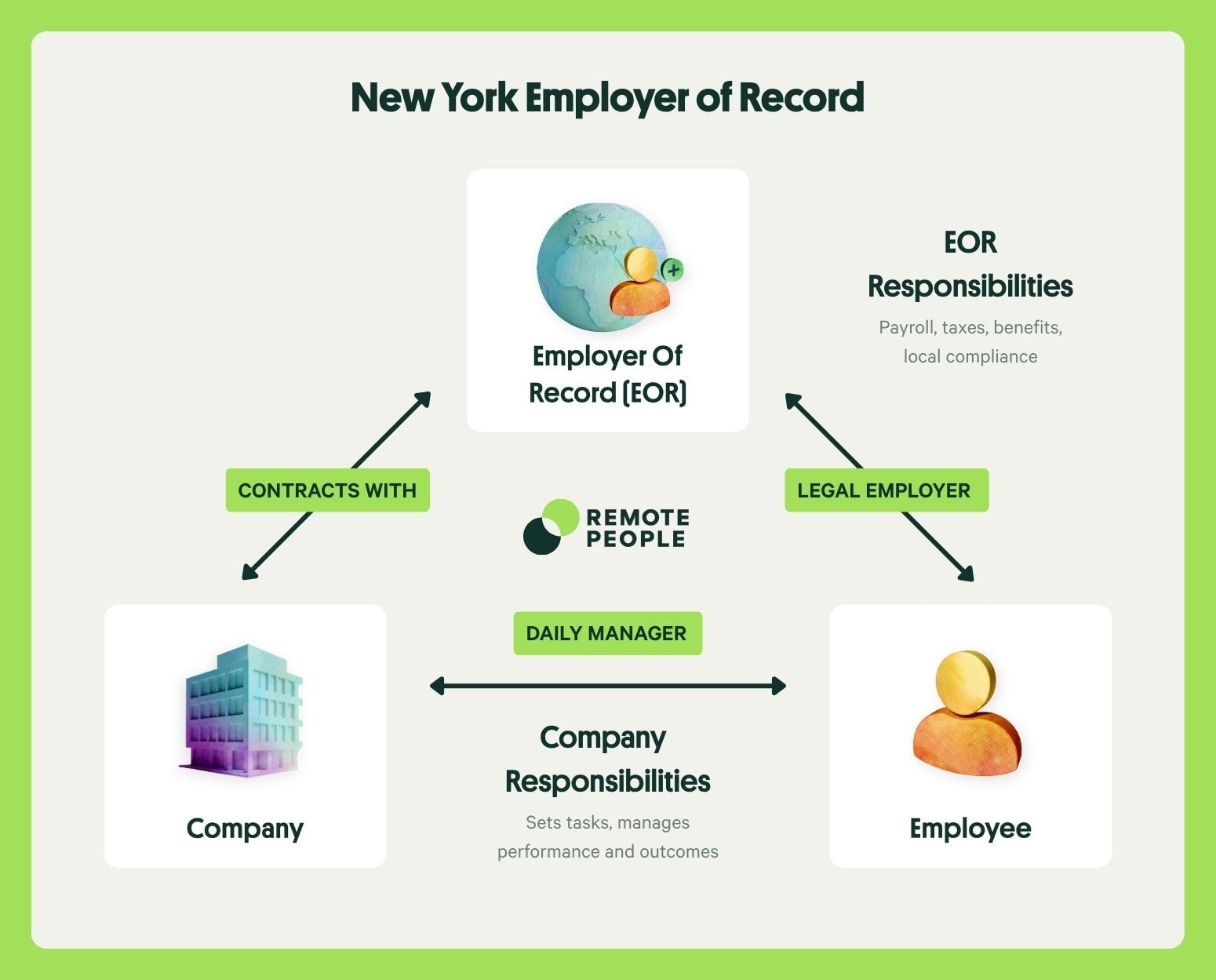
A New York Employer of Record (EOR) is a third party that legally and administratively takes on the responsibilities of an employer of a specific workforce in that state. Under such an agreement, the third-party EOR is listed as the legal employer on paper, while the client company retains full control over daily work, staff performance evaluations, and job assignments. In this case, an organization can hire New York talent without having to first create a local legal entity or register with the Secretary of State, a process that is time-consuming and expensive in itself.
What is an EOR can help explain how this employment model works in more detail.
The primary benefit of a New York EOR is a fast speed to hire and a total liability shift to the provider. The EOR takes on the full list of local filings that are onerous and ever-changing, such as the filing of New York State income tax and Paid Family Leave contributions, and ensuring workers’ compensation and disability insurance are in place as they are required by law. In addition, they take on the risk of non-compliance in case they are not compliant with the New York Labor Law, such as the “Wage Theft Prevention Act” or specific Industry Wage Orders.
What Is the Difference Between a New York Employer of Record and a New York PEO?
PEO
A PEO is an employer that forms a co-employment relationship with its client, meaning that the PEO and the client are both legally responsible for their co-employed workforce. The client company must already have its own registered legal entity in the State of New York and is usually the “default” employer for many tax and legal purposes.
A PEO may perform administrative tasks such as enrolling employees in benefits and processing payroll; however, the client remains liable for compliance and employment disputes.
The co-employment model is standard for most existing businesses when utilizing a PEO. The typical reason for a company to join a PEO’s co-employment group is to take advantage of the PEO’s large employee pool to obtain better insurance rates or to outsource administrative, basic HR tasks.
EOR
An EOR is the sole legal employer, so the client company does not have to own or maintain a business entity in New York. The EOR provides the entire employment infrastructure, using its own tax IDs, insurance policies, and so on, to hire employees on the client’s behalf.
This has a subtle but significant advantage in positioning, enabling fast market testing and expansion without the overhead of long-term entity maintenance.
When the client has a remote or interstate workforce, the EOR is often the more scalable model, as it offloads 100% of the legal risk (classification and wage-and-hour), which the PEO model still shares.
Start hiring with a New York EOR
Let us handle the complexities of hiring, compliance, and payroll in New York while you focus on growing your team.
- Hire employees in New York with a New York EOR
- No local entity is needed
- Pricing starts at USD 199 per employee
- RemotePeople can also help you find the best talent in New York
How Does a New York EOR Work?
A New York Employer of Record’s (EOR) services start with the creation and signing of a locally compliant employment contract. The EOR EOL form must reflect New York’s at-will employment status and include the required Wage Theft Prevention Act notices.
The EOR can then onboard the employee and set up payroll, which must be registered at the state level as well as at the city and local levels if applicable. The EOR will set the employee up under their New York State Employer Registration Number for Unemployment Insurance purposes. They will also need to set up and verify all relevant tax withholding accounts with the Department of Taxation and Finance are active.
An EOR will continue to calculate and remit all payroll-related taxes and withholdings on an ongoing basis, including employer and employee state income tax (New York), and the New York City and Yonkers local taxes if applicable. If the employee is in the Metropolitan Commuter Transportation Mobility Tax (MCTMT) commuter district, the EOR will also need to collect and pay this.
The EOR will also manage and calculate statutory benefits like Paid Family Leave deductions, Workers’ Compensation, and Disability insurance.
How Labor Laws Affect Hiring in New York?
Minimum Wage & Overtime
New York’s minimum wage depends on where the work is. The minimum wage in New York City, Nassau, Suffolk and Westchester counties is $17 per hour, while it’s $16 per hour in all other locations in the state.
Non-exempt employees should be paid at least 1.5 times their regular rate of pay for hours worked over 40 in a workweek. The minimum overtime pay rate for 2026 is $25.5 (downstate) and $24 (upstate).
Tip credits in New York are only available in the hospitality industry. Minimum cash wages for food service workers in 2026 will be $11.35 per hour downstate and $10.70 per hour upstate, when a credit of $5.65 and $5.30 per hour, respectively, is allowed against tips received.
Income Tax
New York State Income tax is a progressive tax. 2026 rates range from 4% on the lowest taxable incomes to a top marginal rate of 10.9% on high-income earners. Employers withhold this tax on resident employees and nonresident employees who work in New York.
If the employee lives in New York City or Yonkers, they are also subject to the local city income taxes. In this case, the employer also withholds these local income taxes from the employee’s salary. The supplemental wages withholding rate for New York is a flat 11.7% state rate plus an additional 4.25% for NYC.
State Unemployment Insurance (SUI)
New York State Unemployment Insurance (SUI) is entirely employer-paid and assessed on an individual employee basis. The 2026 taxable wage base per employee is $17,600. The standard (new employer) contribution rate with no experience rating is 4.1%.
This is comprised of a 3.4% normal rate, a subsidiary rate, and a 0.075% Re-employment Service Fund (RSF) surcharge. Experience-rated employers have a range from 1.7% to 9.5% depending on their history with the unemployment system. The report and payment are submitted quarterly using Form NYS-45.
Paid Leave
New York Paid Leave Laws cover both sick leave and family leave. New York’s Paid Sick Leave rules state that employers with 100+ employees must provide paid leave up to 56 hours per year. Paid leave is required for employers with 5-99 workers up to 40 hours per year.
Small businesses with fewer than 5 employees must provide unpaid leave, unless the employer earned more than $1 million in net income in the previous tax year. Employees who work for someone who made more than $1 million in net income are entitled to paid leave. Employees accrue sick leave by working 30 hours and are eligible for their first hour of leave on day 1 of employment.
New York State Paid Family Leave (PFL) is up to 12 weeks of partially paid leave on a job-protected basis to bond with your child, care for a loved one, or active military member. For 2026, the PFL deduction is .432% of gross wages. The annual maximum that can be deducted is $411.91.
The maximum weekly benefit for employees taking leave in 2026 is $1,228.53. NYC employers must provide the following in addition to the New York Paid Leave Law: The Earned Safe and Sick Time Act requires employers to provide 32 hours of unpaid safe and sick time to employees immediately upon hire.
Workers’ Compensation
Every private company in New York has to carry workers’ compensation insurance, even if the team is small. This coverage is there to handle medical bills and replace lost wages if someone gets hurt or sick because of their work, no matter how the accident happened.
Businesses can get this insurance through the New York State Insurance Fund, a private provider, or by being approved to self-insure. For 2026, the assessment rate is set at 7.0% of the standard premium.
Failure to carry workers’ compensation insurance is a first-level violation and is strictly enforced. The fines are substantial and include criminal penalties. The employer may be personally liable for damages resulting from an accident.
Termination and Final Pay
New York is an “at-will employment jurisdiction,” so that the employer and employee may terminate the employment relationship at any time and for any legal reason. The employer may not fire the employee for a discriminatory or retaliatory reason, such as requesting a reasonable accommodation under the Human Rights Law.
It is now also illegal to require repayment of training costs as a condition of leaving employment, under the new “Trapped at Work Act.”
Final pay is strictly regulated. On termination or resignation, the final paycheck must be paid by the next regularly scheduled payday. The paycheck must contain all earned wages. New York law also requires a payout for unused vacation time at termination, unless the employer has an established written policy that clearly states the time is forfeited upon separation under certain conditions.
The written policy must have been communicated to the employee at the time of hire. Failure to comply with final paycheck regulations may result in huge penalties.
Payroll Taxes and Employer Cost in New York
In 2026, the cost of that employee isn’t just their salary. To calculate the true cost of an employee, employers need to add the cost of federal, state, and local taxes, as well as mandatory insurance and regional differentials.
Category | Cost |
|---|---|
Federal Payroll Taxes | Social Security (currently 6.2% up to the 2026 wage base) and Medicare (currently 1.45% on all wages). |
Federal Unemployment Tax (FUTA) | 0.6% on the first $7,000 of wages. |
State Unemployment Insurance (SUI) | As a new employer in 2026, they would pay 4.1% on the first $17,600 of an employee’s wages. |
Metropolitan Commuter Transportation Mobility Tax (MCTMT) | Employers with payrolls in NYC and certain collar counties that exceed $312,500 annually and pay quarterly are subject to this tax. For 2026, large employers in Zone 1 (NYC) will pay 0.895%. |
Workers’ Compensation & Disability (DB) | Premiums depend on the industry. All employers are required to cover disability benefits, but NYSIF will charge a flat DB rate of $0.10 per $100 of payroll (maxes out at $17.68 per year). |
Example Cost Breakdown
In New York, a worker who is paid $100,000 in gross annual pay in 2026 will need a number of add-ons on top of the base pay from their employer.
Category | Cost |
|---|---|
Social Security (Employer share) | The federal payroll taxes are $6,200. |
Medicare (Employer share) | $1,450 |
Federal Unemployment (FUTA) | $42 |
State Unemployment (SUI) | Assuming a new employer rate, the state-level payroll taxes would be $238 |
Employment Training Tax (ETT) | $7 |
Workers’ Compensation Insurance | Representative clerical rate of 0.8% is $800 annually |
All of these statutory requirements together total $8,737, an employer burden of 8.74% on top of the base salary. This does not include EOR service fees or voluntary health, dental, and retirement benefits typically required to compete for workers in California.
Employee Classification Rules in New York
New York has stringent employee classification laws intended to combat “wage theft” by the improper classification of employees as independent contractors. New York uses the “supervision, direction, and control” test.
When a company has the right to control the what, how, when, and where of the work being performed, then the worker is considered an employee under the law. For classification purposes in the construction industry, New York applies a 12-part test found in the Construction Industry Fair Play Act, which looks at the realities of the business relationship to determine whether the worker is a true business or simply an employee.
The penalties for misclassification in New York are steep. An employer can be liable for back overtime wages and back taxes. There are statutory fines ranging from $1,000 – $5,000 per misclassified employee.
New York recently increased the enforcement arm by updating the Department of Labor’s ability to assess liens and garnish bank accounts for employers who willfully fail to comply beginning in 2026.
Working with an EOR completely eliminates this exposure as the EOR becomes responsible for the W-2 classification of all employees.
What Makes Hiring in New York Unique?
New York is a state with high regulation intensity and unique, localized legislation. Here’s what makes hiring in the Empire State stand out in 2026:
- Regional Labor Market Mosaic – New York City dominates in financial services and tech, but there’s also a strong healthcare and educational services sector in the upstate regions.
- NYC AI Bias Law (LL 144) – NYC employers will need to carry out independent annual bias audits of any automated hiring/promotion tools and make the results public.
- The MCTMT – Employers with a significant footprint in the New York City metro area will need to navigate the unique transit-funding payroll tax assessed in the NYC metropolitan commuter district.
- Credit History Ban – As of April 18, 2026, New York State has followed NYC’s lead and essentially prohibited consumer credit histories from being used for most employment decisions.
- Wage Growth – Nominal wage growth in 2026 is projected at 3.0% to 3.5% largely as a result of a tight supply of critical jobs in healthcare and skilled trades.
What Are the Benefits of a New York Employer of Record Service?
- No Entity Setup – Skip months of red tape and high costs of registering a legal business entity in the State of New York.
- Faster Onboarding – Legally hire and onboard talent in days rather than weeks, and beat other employers to top candidates.
- Centralized Compliance – The EOR tracks and automatically enforces state-level changes like the minimum wage increases going into effect in 2026 and annual PFL rate changes.
- Reduced Legal Risk – Classifying workers as W-2 employees shifts the risk of misclassification and wage-and-hour burden to the EOR.
- Scalable Across States – With an EOR, a company can scale across multiple states, like New York and others, through one administrative partner.
What Are the Downsides of a New York Employer of Record Service?
- Service Fees – Fees charged by an EOR for each employee may add up to more than what it costs to internally administer those employees, especially for companies with significant local operations.
- Decreased Payroll Control – Employers become subject to the EOR’s payroll systems, software, and payroll cycles.
- Standardized Benefits – EORs have set benefits packages that they offer to maintain compliance. This might not include unique company perks or represent its culture.
- Regulatory Reliance – Clients are dependent on the EOR’s expertise to properly interpret complex New York City mandates.
An EOR can still be more efficient than rolling the business’s own compliance, however. It’s time-consuming and legally risky for businesses to stay on top of New York’s frequent legislative changes and onerous mandates themselves. EORs can help scale quickly by absorbing the administrative burden and liability internally.
How to Choose a New York Employer of Record
Here are some critical questions an organization should consider when vetting potential EORs in the New York 2026 compliance environment:
Transparent Pricing
The provider should give you a clear pricing breakdown of the state taxes, MCTMT, and insurance premiums, with no hidden fees.
Direct EOR Model
Provider with their own legal entities directly in NY is safer than a network of sub-partners.
US Multi-State Expertise
With bordering states like NJ and CT, the provider should be adept at managing multi-state remote work complexities.
Dedicated Support
Partner with a team that provides access to real-time human experts who know NY’s Wage Orders and NYC-local laws inside and out.
Strong Compliance Track Record
A good EOR will be audit-proof and have an existing framework to manage and maintain the new 2026 AI Bias and Credit Check regulations.
Engage a New York Employer of Record with RemotePeople
RemotePeople’s Employer of Record service is the shortcut to operating in New York, a highly regulated state. We become the legal employer to take care of the employment in New York, from compliant contracts to state-specific payroll setup to administering the state-mandated benefits and 2026 tax withholdings.
RemotePeople’s Employer of Record service begins at only $199/employee/month, starting you off at a fraction of the cost of setting up your own entity and registration. Additionally, we provide integrated recruitment services to help you find and attract top talent in the NY market.
Contact RemotePeople today to make hiring in New York faster and compliant with the 2026 New York Labor Law.
Employer of Record in
Employer of Record in
Employer of Record in
Employer of Record in
Employer of Record in
Employer of Record in
Employer of Record in
Employer of Record in