
 Recruit
Employer of Record in Rhode Island
-
 Drew Donnelly
- Published
- September 22, 2026
Rhode Island’s employment law includes TDI, paid family leave, and mandatory sick leave requirements, and a Rhode Island EOR handles payroll and state compliance with no local entity needed.
Hire in Rhode Island — book a free 30-minute demo
Tell us what you need. You'll get a tailored, transparent proposal within 24 hours, plus a free call to walk through it.
Tell us about your company
So we can match you with a specialist who knows your market — and unlock volume pricing tiers.
* All fields are required.
Where and when are you hiring?
Tell us the geography and timing and we'll quote each country line by line, with onboarding timelines.
* All fields are required.
Help us beat your current setup
We'll benchmark your current deal and send a line-by-line proposal in 24 hours — showing exactly where we cut cost, time, or risk. After you submit, you can book a call to walk through it together.
* All fields are required.
Thanks! Your proposal is on its way.
Expect a tailored, line-by-line proposal in your inbox within 24 hours. In the meantime…
Want to walk through it together?
Book a free 30-minute call with one of our specialists. We'll explain every line, answer your questions, and tailor the proposal further if you need.
No obligation. Pick a time that works for you.








- Hire in Rhode Island — book a free 30-minute demo
- Tell us about your company
- Where and when are you hiring?
- Help us beat your current setup
- Thanks! Your proposal is on its way.
- Rhode Island Employer of Record
- What Is the Difference Between a Rhode Island Employer of Record and a Rhode Island PEO?
- How Does a Rhode Island Employer of Record Work?
- How Do Labor Laws Affect Hiring in Rhode Island?
- Payroll Taxes and Employer Cost in Rhode Island
- Employee Classification Rules in Rhode Island
- Termination and Final Pay Laws in Rhode Island
- What Makes Hiring in Rhode Island Unique?
- What Are the Benefits of a Rhode Island Employer of Record?
- What Are the Downsides of a Rhode Island Employer of Record?
- How to Choose a Rhode Island Employer of Record?
- Engage RemotePeople as Your Rhode Island EOR
- Related EOR Destinations

Let RemotePeople handle payroll, compliance, and HR admin worldwide so you can focus on building your team.
Key Takeaways:
- Rhode Island is a higher-regulation state with stronger employee protections than many southern states.
- The state minimum wage exceeds the federal rate and is increasing over time.
- Rhode Island requires paid sick leave, adding compliance obligations for employers.
- Employer payroll costs typically range between 11% and 17% above base salary.
- A Rhode Island Employer of Record helps manage compliance in a more regulated environment and reduces administrative complexity.
Rhode Island is a small but economically diverse state, with key industries including healthcare, education, manufacturing, tourism, and financial services. Its proximity to major markets like Boston and New York makes it an attractive location for companies seeking access to talent in the Northeast without the higher costs of larger cities.
From an employment perspective, Rhode Island is more regulated than many US states. Employers must comply with higher minimum wages, paid sick leave requirements, and clearly defined wage and hour rules.
The state also places a strong emphasis on employee protections, which increases the need for accurate payroll processing and proper documentation. While the regulatory framework is structured, it requires consistent management to ensure compliance.
For companies expanding into Rhode Island, particularly those without an existing US entity, handling payroll and compliance internally can be time-consuming. An Employer of Record provides a more efficient way to hire while ensuring all legal obligations are met.
Rhode Island Employer of Record
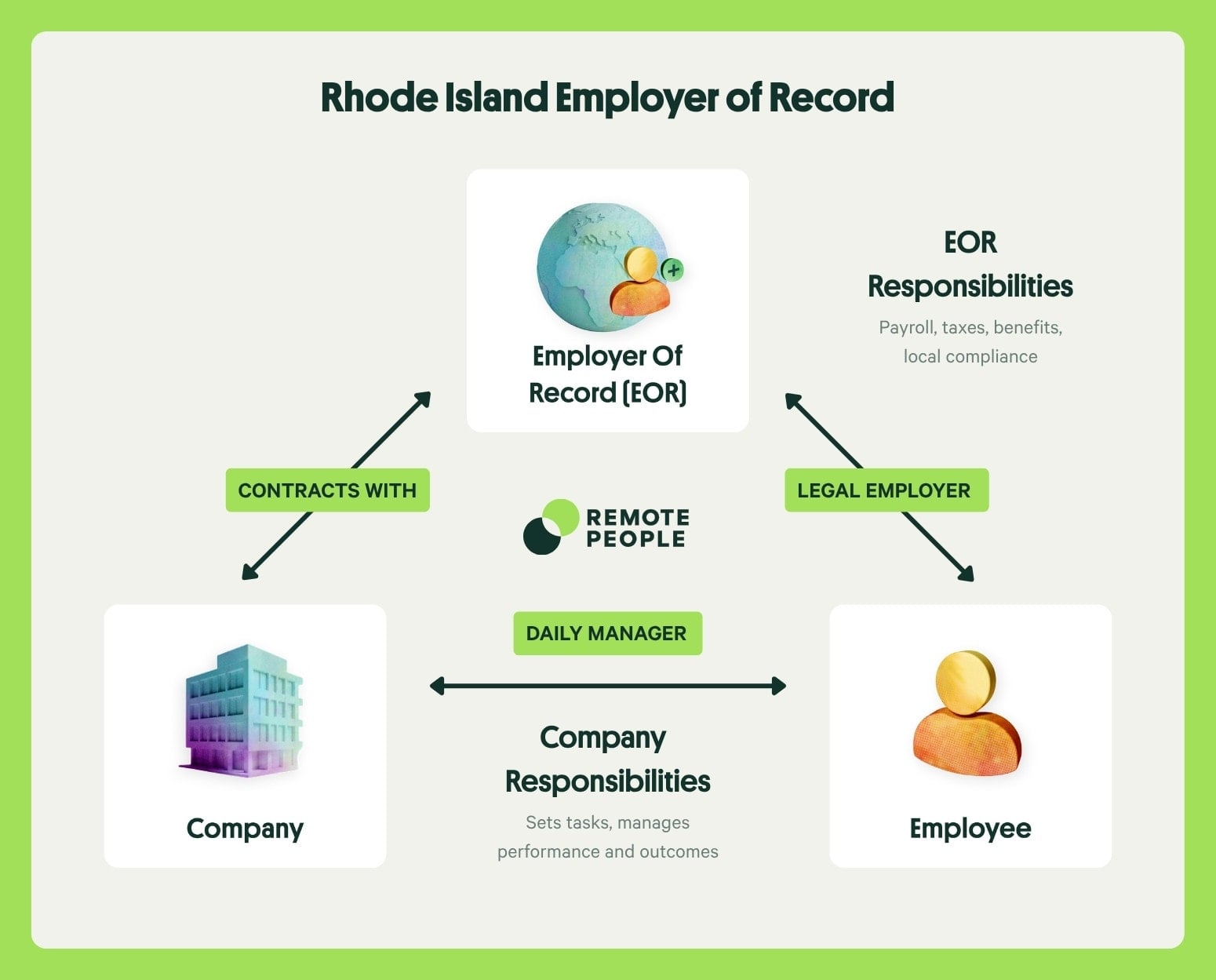
A Rhode Island Employer of Record is a third-party organisation that legally employs workers on your behalf within the state.
What is an EOR can help explain how this employment model works in more detail.
The EOR takes responsibility for payroll processing, tax withholding, unemployment insurance registration, workers’ compensation coverage, and compliance with federal and Rhode Island labour laws.
This includes managing filings with agencies such as the Internal Revenue Service and the Rhode Island Division of Taxation. Your company retains control over daily operations, performance management, and employee responsibilities.
The key advantage in Rhode Island is compliance management. The state’s labour laws require careful handling of wages, leave, and employee rights. An EOR ensures these requirements are met, reducing the risk of errors or penalties.
Using an EOR also removes the need to establish a legal entity in Rhode Island before hiring.
What Is the Difference Between a Rhode Island Employer of Record and a Rhode Island PEO?
Although both models support HR and payroll functions, they differ in structure.
Rhode Island PEO
A PEO operates under a co-employment model. Your company must already have a registered entity in Rhode Island, and liability is shared between both parties. This is typically used by US companies with an existing presence in the state.
Rhode Island EOR
An EOR becomes the legal employer and assumes primary responsibility for compliance. No local entity is required.
For companies entering Rhode Island for the first time, the EOR model simplifies hiring and reduces setup requirements.
Start hiring with a Rhode Island EOR
Let us handle the complexities of hiring, compliance, and payroll in Rhode Island while you focus on growing your team.
- Hire employees in Rhode Island with a Rhode Island EOR
- No local entity is needed
- Pricing starts at USD 199 per employee
- RemotePeople can also help you find the best talent in Rhode Island
How Does a Rhode Island Employer of Record Work?
A Rhode Island EOR setup typically includes several key steps that allow businesses to hire compliantly without setting up a local entity. While the process is structured, each stage involves detailed legal and administrative work.
Employment Agreement
The EOR prepares a compliant employment contract aligned with state and federal requirements. This includes salary, benefits, working hours, and termination terms.
Contracts must also reflect Rhode Island-specific rules, such as wage payment and leave entitlements. A clear agreement helps avoid disputes and sets expectations from the start.
Payroll Registration
The EOR handles registration with the IRS and the Rhode Island Division of Taxation. They also register with the state unemployment insurance system.
Without proper registration, employers cannot legally run payroll or make required contributions. This step is essential for compliance from day one.
Payroll Processing
The EOR calculates wages and applies all required deductions. This includes federal and state income taxes, as well as Social Security and Medicare. Payroll must be accurate and processed on time. The EOR also maintains records for reporting and audits.
Paid Leave Tracking
Rhode Island requires paid sick leave under state law. Employees accrue leave based on hours worked. The EOR tracks accrual, usage, and balances. This reduces the risk of errors and ensures employees receive the correct entitlements.
Ongoing Compliance
Employment laws can change at both the state and federal levels. The EOR monitors these changes and updates processes when needed.
This includes filings, documentation, and employee record management. It helps businesses avoid penalties and stay compliant over time.
How Do Labor Laws Affect Hiring in Rhode Island?
Hiring in Rhode Island is shaped by both federal and state employment laws. Employers must understand these rules to avoid compliance issues.
Minimum Wage and Overtime
Rhode Island’s minimum wage is higher than the federal rate and increases periodically. Overtime is paid at 1.5 times the regular rate for hours worked over 40 per week. Miscalculations are a common issue for new employers.
State Income Tax
Rhode Island uses a progressive income tax system, ranging from around 3.75% to 5.99%. Employers must withhold and remit the correct amounts. This requires accurate payroll systems and timely reporting.
State Unemployment Insurance (SUI)
Employers contribute to unemployment insurance at state level. New employer rates typically range from 1.1% to 1.5%, depending on the business profile.
Paid Sick Leave
Employees accrue paid sick leave based on hours worked. Employers must track this carefully and allow usage in line with legal requirements.
Workers’ Compensation
Workers’ compensation insurance is mandatory. Coverage must be active at all times to protect employees and avoid penalties.
Payroll Taxes and Employer Cost in Rhode Island
| Category | Estimated Cost |
|---|---|
| Base Salary | $100,000 |
| FICA | $7,650 |
| FUTA | Up to $420 |
| SUI | $150 – $225 |
| Workers’ Compensation | $1,000 – $1,500 |
| Total Additional Cost | $11,000 – $17,000 |
Actual costs vary depending on industry, risk level, and benefits offered.
Employee Classification Rules in Rhode Island
Rhode Island follows federal classification rules but enforces them strictly. Employers must correctly classify workers as employees or independent contractors. They must also determine exempt vs non-exempt status.
Misclassification can lead to penalties, back taxes, and legal claims. An EOR helps reduce this risk by ensuring correct classification.
Termination and Final Pay Laws in Rhode Island
Rhode Island follows at-will employment, meaning either party can end the relationship at any time.
However, final wages must be paid promptly, usually by the next payday. Employers must also follow any contractual obligations, such as notice periods or accrued leave and severence payouts.
What Makes Hiring in Rhode Island Unique?
Rhode Island has a smaller labour market compared to larger states. At the same time, it offers strong employee protections and clear labour laws. This means employers must balance compliance with competitive hiring practices. Offering attractive compensation and benefits is often key to attracting talent.
What Are the Benefits of a Rhode Island Employer of Record?
- An EOR removes the need to establish a local entity.
- It simplifies compliance by managing employment laws, payroll, and tax obligations.
- It also allows faster hiring and reduces administrative workload.
What Are the Downsides of a Rhode Island Employer of Record?
- EOR services come with additional fees.
- There is also less direct control over payroll processes.
- For some companies, this trade-off is worth it for reduced risk and simplicity.
How to Choose a Rhode Island Employer of Record?
Look for a provider with strong compliance expertise and US experience.
- Pricing should be transparent, with no hidden fees.
- Reliable support is also important, especially for payroll or HR issues.
Engage RemotePeople as Your Rhode Island EOR
RemotePeople provides Employer of Record services across Rhode Island. We manage payroll, tax filings, paid leave compliance, and employment requirements while you focus on growing your team. Our service is designed to remove the complexity of hiring in a new state. Instead of dealing with multiple registrations, legal requirements, and ongoing reporting, you have a single partner handling everything on your behalf.
This is particularly valuable if you are hiring remotely or testing a new market. You can onboard employees quickly, remain compliant, and scale your team without committing to a full legal setup. Over time, this approach can also reduce risk. With employment laws constantly evolving, having a dedicated partner helps ensure nothing is missed.
If you are looking for a practical and compliant way to hire in Rhode Island, RemotePeople offers a reliable solution that supports both short-term hiring needs and long-term growth.
Employer of Record in
Employer of Record in
Employer of Record in
Employer of Record in
Employer of Record in
Employer of Record in
Employer of Record in
Employer of Record in