
 Recruit
Employer of Record in Pennsylvania
-
 Drew Donnelly
- Published
- September 22, 2026
Pennsylvania’s employment law includes state unemployment tax, workers’ comp, and specific wage rules, and a Pennsylvania EOR handles full state compliance with no local entity needed.
Hire in Pennsylvania — book a free 30-minute demo
Tell us what you need. You'll get a tailored, transparent proposal within 24 hours, plus a free call to walk through it.
Tell us about your company
So we can match you with a specialist who knows your market — and unlock volume pricing tiers.
* All fields are required.
Where and when are you hiring?
Tell us the geography and timing and we'll quote each country line by line, with onboarding timelines.
* All fields are required.
Help us beat your current setup
We'll benchmark your current deal and send a line-by-line proposal in 24 hours — showing exactly where we cut cost, time, or risk. After you submit, you can book a call to walk through it together.
* All fields are required.
Thanks! Your proposal is on its way.
Expect a tailored, line-by-line proposal in your inbox within 24 hours. In the meantime…
Want to walk through it together?
Book a free 30-minute call with one of our specialists. We'll explain every line, answer your questions, and tailor the proposal further if you need.
No obligation. Pick a time that works for you.








- Hire in Pennsylvania — book a free 30-minute demo
- Tell us about your company
- Where and when are you hiring?
- Help us beat your current setup
- Thanks! Your proposal is on its way.
- Pennsylvania Employer of Record
- What Is the Difference Between a Pennsylvania Employer of Record and a Pennsylvania Professional Employer Organization?
- How Does a Pennsylvania Employer of Record Work?
- How Labor Laws Affect Hiring in Pennsylvania?
- Payroll Taxes and Employer Cost in Pennsylvania
- Employee Classification Rules in Pennsylvania
- What Makes Hiring in Pennsylvania Unique?
- What Are the Benefits of a Pennsylvania Employer of Record?
- What Are the Downsides of a Pennsylvania Employer of Record?
- How to Choose a Pennsylvania Employer of Record
- Engage a Pennsylvania Employer of Record with RemotePeople
- Related EOR Destinations

Let RemotePeople handle payroll, compliance, and HR admin worldwide so you can focus on building your team.
- Pennsylvania’s income tax rate is a flat 3.07%, and employers must withhold taxes for over 2,500 local taxing districts.
- Pennsylvania’s minimum wage is $7.25, and it mandates detailed overtime calculations that do not allow for the fluctuating workweek method.
- Businesses are subject to growing 2026 sick leave laws in Philadelphia and Pittsburgh in the absence of a state requirement.
- Workers’ compensation is required of all employers and is provided by private carriers or the State Workers’ Insurance Fund.
Pennsylvania’s economy is one of the largest and most diverse in the United States, with significant employment across healthcare, financial services, manufacturing, and a rapidly growing technology sector. The Philadelphia metro area is home to major financial institutions, life sciences companies, and a thriving startup ecosystem, while Pittsburgh has transformed from a steel industry hub into a recognized center for robotics, artificial intelligence, and advanced manufacturing research.
The state’s workforce is large, highly educated, and geographically diverse. Pennsylvania consistently ranks among the top states for healthcare employment, anchored by world-class hospital systems and a strong pharmaceutical presence. Access to talent from institutions such as the University of Pennsylvania, Carnegie Mellon, and Penn State adds further depth to the labour pool.
The overall business environment is stable, with a well-established legal and regulatory framework. However, employers should be aware that Pennsylvania’s layered tax structure, including state income tax, local earned income taxes, and municipal levies, adds administrative complexity compared to many other states. Labor costs are competitive relative to the Northeast, though demand for skilled workers in high-growth sectors continues to push compensation expectations upward.
Pennsylvania Employer of Record
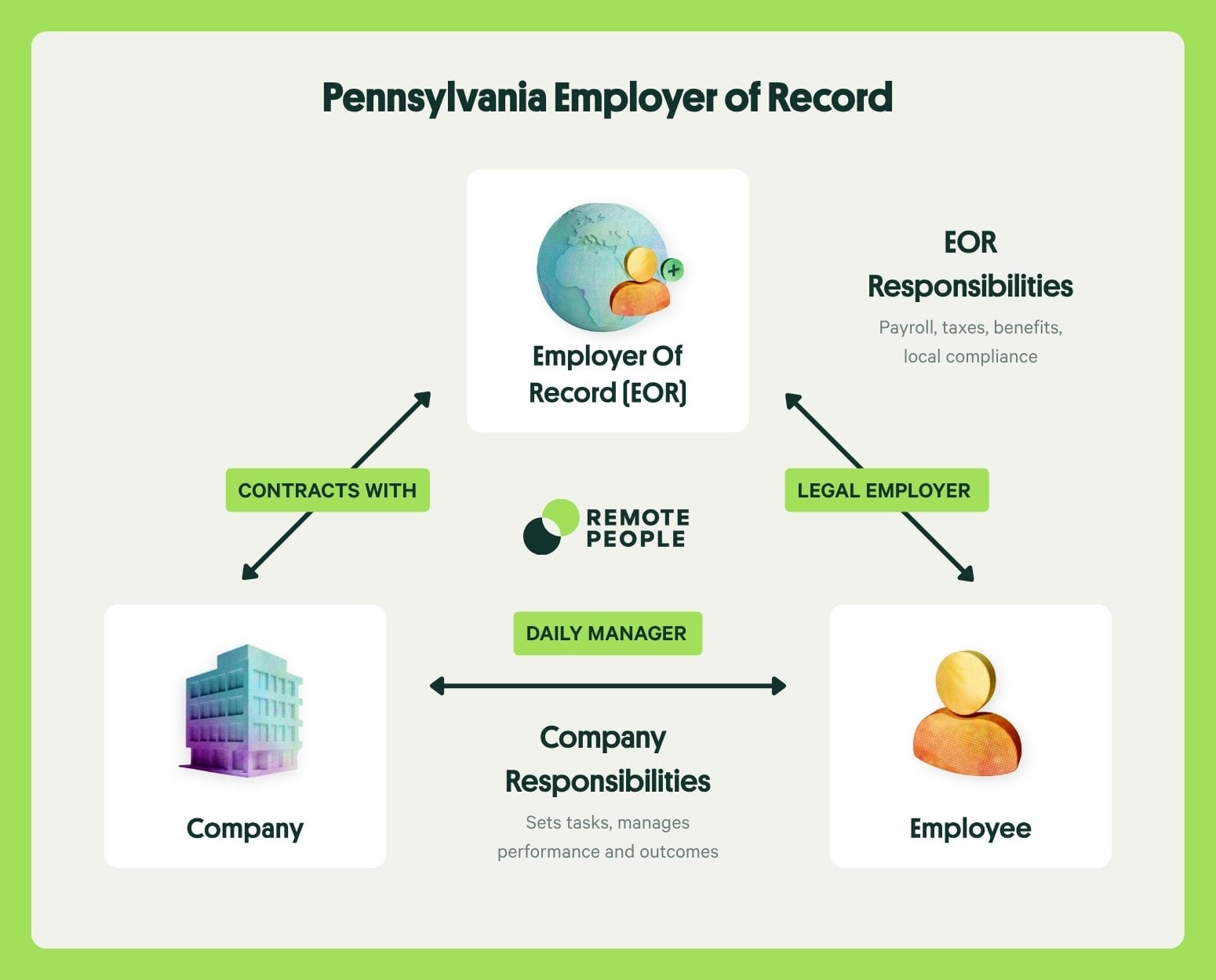
A Pennsylvania Employer of Record (EOR) is a third-party professional employer organization that legally employs a company’s employees in the Commonwealth. The EOR handles all employment administration and legal responsibilities. This includes payroll, state and local tax filings, and employment benefits and workers’ compensation.
What is an EOR can help explain how this employment model works in more detail.
The EOR is the legal employer for tax and regulatory purposes. However, the client maintains direct control of the worker’s assignments, performance, and all other core business activities.
The most common use of a Pennsylvania EOR is to eliminate the need for a client company to form its own local entity. Pennsylvania company registration can be an involved process, with filings made with the Department of Revenue, the Department of Labor and Industry, and local Act 32.
An EOR can hire workers in Pennsylvania for a company in days, not months. The EOR assumes all compliance requirements and legal liabilities. An EOR is ideal for remote companies or international businesses that want to enter the Pennsylvania market quickly without the overhead of a long-term commitment to corporate registration and localized human resources administration.
What Is the Difference Between a Pennsylvania Employer of Record and a Pennsylvania Professional Employer Organization?
PEO
A Professional Employer Organization (PEO) works on a co-employment relationship basis and, therefore, requires the client to have a registered entity. A PEO will take over all HR and payroll responsibilities for the client, but they maintain significant legal liability and risk with regard to regulatory compliance. This type of model is great for more established business that wants to outsource the administrative burden or to gain access to better benefits rates.
EOR
An Employer of Record (EOR), on the other hand, is the only legal employer. The EOR model does not require the client to have a registered entity, and also completely shifts 100% of the liability to the EOR, including any tax audits, labor disputes, or regulatory compliance issues.
This option is better for fast and compliant growth without having to manage the details of local tax registrations.
Start hiring with a Pennsylvania EOR
Let us handle the complexities of hiring, compliance, and payroll in Pennsylvania while you focus on growing your team.
- Hire employees in Pennsylvania with a Pennsylvania EOR
- No local entity is needed
- Pricing starts at USD 199 per employee
- RemotePeople can also help you find the best talent in Pennsylvania
How Does a Pennsylvania Employer of Record Work?
As the first step of the EOR process, an employment agreement is prepared, meeting the requirements of the Pennsylvania at-will doctrine and Pennsylvania wage payment and collection laws. After the employee has signed the agreement, the employee is added to the EOR’s payroll system, which is already registered with the state.
To protect the tax accounts, the EOR must file the PA-100 Enterprise Registration form on the myPATH portal. They should also research the Political Subdivision (PSD) codes for both the home and work address to properly withhold and report local Earned Income Tax (EIT) and Local Services Tax (LST).
The EOR also manages the administration of health and 401(k) benefits as well as mandatory workers’ compensation. They deliver continuous monitoring for changes, such as Pittsburgh and Philadelphia’s 2026 sick leave expansions, to insulate the client from new compliance mandates.
How Labor Laws Affect Hiring in Pennsylvania?
Minimum Wage & Overtime
Pennsylvania’s minimum wage in 2026 will be $7.25 per hour, according to the Minimum Wage Act of 1968. It is in line with the Federal Minimum Wage of $7.25. In the service and hospitality industry, an employer can pay a base pay of $2.83 per hour in wages for tipped employees if they make up the difference if the employee’s total earnings do not reach $7.25 per hour.
The employer can only claim the tip credit if the “80/20 rule” is in effect. The employee needs to spend at least 80% of their work time performing tip-eligible work; otherwise, the employer must pay the employee at least the state minimum wage for that time worked.
Pennsylvania also requires the payment of overtime wages in the amount of 1.5x the “regular rate” for hours worked over 40 during a workweek. Pennsylvania generally does not require daily overtime, but Act 102 establishes exceptions for health care workers.
In contrast to the federal standard, Pennsylvania law does not allow for the “fluctuating workweek” method of paying a 0.5x overtime premium. Instead, the state prescribes that for salaried non-exempt workers, the regular rate must be the weekly salary divided by 40 hours. (Overtime will be paid at the 1.5x premium even if the workweek only has 35 hours worked.)
Income Tax
Pennsylvania’s 3.07% flat income tax rate applies to resident and non-resident state-source income earners alike. This differs from federal or other states’ income taxes, which have progressive brackets, standard deductions, and personal exemptions. Pennsylvania income tax rates are assessed against the taxpayer’s gross compensation and are divided among eight income classes.
This tax must be withheld by the employer each pay period and deposited with the Department of Revenue from quarterly to semi-weekly. Pennsylvania has reciprocal tax agreements with Indiana, Maryland, New Jersey, Ohio, Virginia and West Virginia.
Reciprocal agreements for these states allow residents working in Pennsylvania to be subject to only their home state’s income tax. An employee may remain subject to only one state’s income tax by filing a non-residency certificate with his or her employer.
State Unemployment Insurance (SUI)
Pennsylvania unemployment compensation is a shared cost between the employer and the employee. The taxable wage base of the employer is the first $10,000 of annual earnings of each employee. The standard contribution rate for new, non-construction employers is 3.822%. New construction employers are automatically assigned to the higher-risk construction group with a contribution rate of 10.5924%.
Pennsylvania is one of the few states that has an employee-paid unemployment tax. The current rate is 0.07% of the employee’s total gross wages (unlimited and not subject to the $10,000 wage base that the employer portion is calculated against). This amount must be withheld by the employer and reported to the Office of Unemployment Compensation Tax Services (UC) on a quarterly basis.
Paid Leave
At the state level, there is no requirement in Pennsylvania for private-sector employers to provide paid or unpaid sick leave or family leave. In most instances, employers are free to include such benefits as part of a competitive compensation package, but are not required to provide them by operation of state law. The one notable exception to this is the state’s concurrent adoption of the federal Family and Medical Leave Act (FMLA).
At the local level, however, the regulatory landscape is more complex. Employers must be sure to comply with both Philadelphia’s and Pittsburgh’s comprehensive local sick leave ordinances.
In Philadelphia, employers with 10 or more employees must provide up to 40 hours of paid sick leave per year. For employers with fewer than 10 employees, unpaid leave must be provided. On the other hand, in Pittsburgh, the Paid Sick Days Act will be amended effective January 1, 2026.
The new Pittsburgh law also includes an increased accrual rate of one hour per 30 hours worked (up from 35 hours worked), and mandates a minimum total usage allowance of up to 72 hours per year for employers with 15 or more employees. The local requirements are enforced strictly and have separate notice and record-keeping requirements from state law.
Workers’ Compensation
The Pennsylvania Workers’ Compensation Act mandates that most employers in the Commonwealth provide insurance coverage for their employees. All businesses, regardless of size and including part-time and seasonal workers, must have insurance to provide wage-loss benefits and medical care for employees who are injured or become ill as a result of their job.
Coverage may be purchased through a variety of avenues. The majority of businesses acquire coverage through the private market, where over 300 insurance carriers compete to provide policies. In those instances where an employer is unable to purchase insurance in the private market due to experience or presumed high risk, the Commonwealth has chartered the State Workers’ Insurance Fund (SWIF) to provide insurance of last resort.
Although SWIF will ensure every employer, its premiums are generally 20% to 35% higher than privately placed insurance, and it does not have the dividend programs and flexible service options available in the private market. Large, financially stable employers can also petition the Bureau of Workers’ Compensation for the ability to self-insure; this process requires significant security deposits and is very thorough.
Termination and Final Pay
Pennsylvania is an at-will employment state. As such, an employer may terminate an employee for any or no reason at any time. Similarly, an employee may quit a job for any or no reason at any time. A termination for an illegal reason (such as a discriminatory reason) or for a reason violating public policy is not permitted.
Among the established exceptions to the at-will employment doctrine are termination for filing a workers’ compensation claim, serving on a jury, or refusing to engage in an illegal act. Pennsylvania does not have a required notice period for termination. However, if the employer fires an employee, the employer must pay the employee the final wages in a timely manner as prescribed by law.
In Pennsylvania, the Wage Payment and Collection Law says, if an employee is fired from a job or voluntarily leaves a job, final wages are due on the next regularly scheduled payday. With regard to unused vacation/PTO, is there a requirement to pay out an employee when they leave? There is no PTO payment statute in Pennsylvania. The employer’s written policy or the employment contract governs whether PTO must be paid out.
If the employer’s policy is that unused vacation time will not be paid out, then Pennsylvania courts will enforce that policy. On the other hand, if the policy is silent on the issue or makes a promise of payment, then the employer must honor that promise or face liability for statutory damages and attorney’s fees.
Payroll Taxes and Employer Cost in Pennsylvania
The actual cost of an employee in the state of Pennsylvania includes federal as well as state statutory requirements. The following sections will provide the employer with the required information on taxes and insurance to be included when calculating annual expenses.
| Category | Cost |
|---|---|
| Social Security | 6.2% up to $176,100 (2025) |
| Medicare | 1.45% of all gross wages |
| Federal Unemployment (FUTA) | 0.6% on the first $7,000 in wages |
| PA SIT Withholding | 3.07% of all taxable income (employee-paid) |
| PA SUI (New Employer) | 3.822% of the first $10,000 in wages |
| PA Employee SUI | 0.07% of all gross wages (employee-paid) |
| Workers’ Compensation | 0.5% to 5.0% (depends on job classification code) |
| Local Taxes (EIT/LST) | 1.0% to 3.924% (varies by municipality) |
The local tax withholding is by far the most variable cost of employment in Pennsylvania. The employer withholds the greater of the employee’s resident tax rate or the worksite tax rate and pays it to a single local collector under Act 32.
An employee who works in Philadelphia will have a resident wage tax of 3.75%, which adds a considerable amount to the total withholding compared to an employee who lives and works in a municipality with a rate of 1%.
Example Cost Breakdown
Let’s pick an example of a $75,000 salary for a non-construction employee working in a typical office environment. At 2025/2026 rates, the mandatory employer paid portion would include $4,650 (6.2% of salary) for Federal Social Security and $1,087.5 (1.45% of salary) for Federal Medicare. FUTA is $42.00 (0.6% of the first $7,000 of salary), and PA SUI is $382.2 (3.822% of the first $10,000 of salary). If Workers’ Compensation is estimated at 0.8% of salary, the total statutory cost would be $6,761.70.
The employer’s total cost is now about $81,761.7, or a statutory burden of about 9.0% above the salary itself. Note that this calculation did not include the 3.07% state income tax or local taxes, since these are deducted from the employee’s salary. Once elective benefits are included, such as health insurance ($10,000-$15,000 or more) and 401(k) matching, the total employer burden is usually between 18% and 28%.
Employee Classification Rules in Pennsylvania
Pennsylvania has a strong legal presumption that a worker is an employee, rather than an independent contractor. The reason for the legal presumption is to make sure the Commonwealth gets its full share of payroll taxes and to make sure that workers are covered by unemployment and workers’ compensation insurance.
The employer can overcome this presumption by showing that the worker is an independent contractor. They must prove that the worker is free from the employer’s control and direction in the performance of their services and customarily engaged in an independently established trade, occupation, or business.
The law is even more restrictive in the construction industry. The Construction Workplace Misclassification Act (Act 72) imposes strict requirements on construction workers to qualify as contractors. Contractors must have a written contract with the business that is their client. They must maintain their own liability insurance and perform work that is outside the usual course of business of the person who is hiring the worker.
There are penalties for misclassification, including civil fines of up to $2,500 for subsequent violations for each worker who is misclassified. There can even be criminal misdemeanor charges for willful violations. For this reason, as well as because the Pennsylvania Department of Labor and Industry aggressively enforces the law, use of an EOR is a very effective method of compliance. The EOR takes on the responsibility for the legal classification of the worker.
What Makes Hiring in Pennsylvania Unique?
The biggest distinction in the Pennsylvania labor market, in terms of hiring, is the complete decentralization of its tax and regulatory structure. This in itself is unique among the states in which compensation is not administered at a state level. Act 32 requires administrative access to literally thousands of individual municipalities to correctly administer tax withholding and remittance.
This requires a higher level of technological and administrative acumen in order to correctly track an employee’s residency and worksite to the exact Political Subdivision (PSD) code, in order to target tax payments to the correct locality. Mistakes in PSD identification can cause tax payments to be sent to the wrong locality and can also incur administrative penalties from local tax collectors.
Pennsylvania also features high worker mobility and is highly integrated with the major labor markets of the Northeast region. The commonwealth’s reciprocal tax agreements with six bordering states is a huge benefit for cross-border hiring as it allows employers to source talent from New Jersey, Maryland, and Ohio without double-taxing employees in those states.
There are also unique industry-specific hiring laws, such as Act 102, which bans the use of mandatory overtime for most healthcare employees providing direct patient care. The regulatory intensity in these industries, as well as workforce concentration in Education and Medicine, makes Pennsylvania a hotbed of specialized professional talent if employers are willing to negotiate the localized compliance gauntlet.
What Are the Benefits of a Pennsylvania Employer of Record?
- Instant Hiring – Bring talent from Pennsylvania on board without the wait of entity registration and tax account setup that can take months.
- Act 32 Management – Leverages a proprietary data platform to reduce the highest complexity levels in the country for local tax withholding across 2,500+ jurisdictions to determine PSD codes.
- Risk Transfer – Eliminates client liability for worker classification, unemployment, and workers’ compensation by transferring 100% to the EOR.
- Automated Compliance – Tracks and reports on local sick leave ordinances, including the upcoming 2026 accrual changes in Pittsburgh (up to 72 hours) and Philadelphia.
- Scalability – Hire one, or a large number of employees throughout the Commonwealth and in other states through a single centralized administrative platform.
What Are the Downsides of a Pennsylvania Employer of Record?
The main cost is the service fee, which can exceed the cost of self-administered payroll for organizations that already have a significant local presence and entity structure.
The client organization has less granular control over the choice of benefit providers and the timing of payroll cycles, since these will be defined by the EOR’s master service agreement.
Compared to the risk of Pennsylvania’s special overtime rules being misapplied, or $2,500 classification fines, the EOR service fee is typically considered to be a very good value form of “compliance insurance”.
How to Choose a Pennsylvania Employer of Record
Employers in Pennsylvania trying to choose an EOR should follow the following steps:
Flat Rate Pricing
Look for providers that charge a flat rate per employee without additional costs for local taxes or registrations with the state of Pennsylvania.
Direct EOR Model
Choose providers that have their own legal entity in Pennsylvania and are not reliant on sub-partners, as they will be better equipped to swiftly handle any payroll or tax issues.
US Multi-State Expertise
Select an EOR with expertise in US multi-state payroll requirements with a keen understanding of the Pennsylvania-specific complexities, such as Act 32 and “regular rate” overtime calculation.
Dedicated Support
Look for a provider with access to dedicated compliance experts who are versed in the ever-changing landscape of sick leave and fair-chance hiring laws in cities like Philadelphia.
Robust Compliance Track Record
Assess the provider’s experience with high-stakes compliance matters like the Construction Workplace Misclassification Act and state workers’ compensation.
Engage a Pennsylvania Employer of Record with RemotePeople
Dealing with a flat income tax rate, 21 sales and use tax rates, or Act 32 local withholdings when expanding into Pennsylvania can be tricky. RemotePeople is an Employer of Record that can make it simple to find, hire, and manage talent in the Keystone State without setting up an entity.
We take on all legal liability and take care of 100% of your compliance with local and state labor laws, taxes, and insurance requirements. Let us worry about the nuts and bolts of the Commonwealth of Pennsylvania so your team can focus on building your business.
Get a Proposal from RemotePeople today to learn how we can assist with your Pennsylvania operations.
Employer of Record in
Employer of Record in
Employer of Record in
Employer of Record in
Employer of Record in
Employer of Record in
Employer of Record in
Employer of Record in