
 Recruit
Employer of Record in Peru
-
 Drew Donnelly
- Published
- September 22, 2026
RemotePeople’s employer of record in Peru lets you hire employees in Peru without complex pension system navigation. We handle EsSalud health insurance contributions of 9% from employers, AFP or SNP pension system enrollment, and mandatory employee benefit registrations within first month.
Hire in Peru — book a free 30-minute demo
Tell us what you need. You'll get a tailored, transparent proposal within 24 hours, plus a free call to walk through it.
Tell us about your company
So we can match you with a specialist who knows your market — and unlock volume pricing tiers.
* All fields are required.
Where and when are you hiring?
Tell us the geography and timing and we'll quote each country line by line, with onboarding timelines.
* All fields are required.
Help us beat your current setup
We'll benchmark your current deal and send a line-by-line proposal in 24 hours — showing exactly where we cut cost, time, or risk. After you submit, you can book a call to walk through it together.
* All fields are required.
Thanks! Your proposal is on its way.
Expect a tailored, line-by-line proposal in your inbox within 24 hours. In the meantime…
Want to walk through it together?
Book a free 30-minute call with one of our specialists. We'll explain every line, answer your questions, and tailor the proposal further if you need.
No obligation. Pick a time that works for you.








- Hire in Peru — book a free 30-minute demo
- Tell us about your company
- Where and when are you hiring?
- Help us beat your current setup
- Thanks! Your proposal is on its way.
- How an Employer of Record Works in Peru
- Employment Laws and Regulations in Peru
- Work Permits and Visas in Peru
- Payroll, Taxes, and Social Security in Peru
- Cost of Hiring Through an EOR in Peru
- Benefits of Using an EOR in Peru
- Termination and Offboarding in Peru
- EOR vs. Other Hiring Models in Peru
- Public Holidays in Peru
- How to Get Started with an EOR in Peru
- Where companies hiring in Peru expand next
- Frequently Asked Questions
- Related EOR Destinations

Start hiring in Peru
Let RemotePeople handle payroll, compliance, and HR admin worldwide so you can focus on building your team.

Peru offers one of Latin America’s most competitive nearshore talent pools, anchored by Lima, Arequipa, and Trujillo and backed by a labour force of roughly 18 million workers in mining, finance, technology, agribusiness, and shared services. The country keeps a stable Andean time zone with the US Central time zone, a flexible private-sector labour regime under the Ley de Productividad y Competitividad Laboral (Decreto Supremo 003-97-TR), and a January 2025 minimum wage increase to PEN 1,130 under Decreto Supremo 006-2024-TR that still sets the baseline for 2026. For any business looking to hire employees in Peru, compliance means registering each worker with EsSalud, withholding income tax through SUNAT, enrolling the worker in either the public ONP or a private AFP pension fund, and applying every stage of the Peruvian labour code from probation through severance.
An employer of record in Peru removes the need to incorporate a local company while keeping every hire fully compliant with Peruvian labour law. The EOR acts as the legal employer on paper, issuing Spanish-language employment contracts, running monthly payroll, funding the mandatory gratificación in July and December, depositing the semi-annual CTS, withholding income tax under the UIT-based progressive bracket table, and sponsoring work visas through Migraciones where required. You retain full operational control over the employee’s day-to-day work, deliverables, and performance.
How an Employer of Record Works in Peru
An EOR in Peru is the fastest way for a foreign company to hire local talent without setting up a sociedad anónima, opening a soles-denominated bank account, or registering independently with SUNAT, EsSalud, and the Ministerio de Trabajo. This section explains what an employer of record is, the specific Peruvian functions the EOR absorbs, the companies that use the model, and the typical one-to-two-week onboarding timeline.
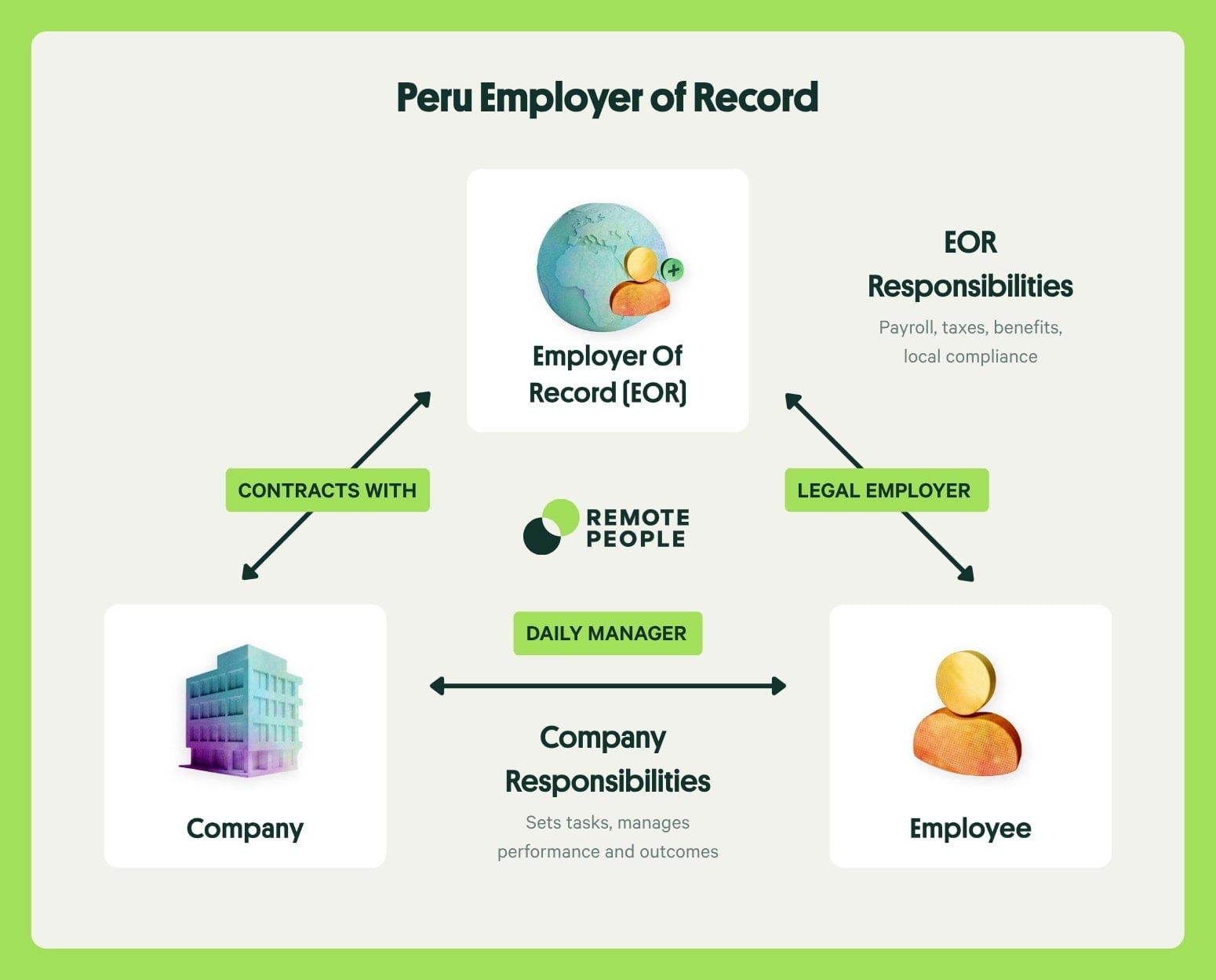
If you’d like to learn more about how Employer of Record (EOR) services work, read our What Is an Employer of Record (EOR)? guide for a complete overview of the model, its benefits, and when to use it.
If you’re comparing providers, our Best Employer of Record (EOR) Providers guide reviews the leading platforms to help you choose the right solution for your business.
Who Uses an EOR in Peru?
An employer of record is the practical route for any foreign company that wants to hire in Peru without the 8-to-12-week process of incorporating a sociedad anónima or sociedad comercial de responsabilidad limitada, opening a local bank account, and registering with SUNAT, EsSalud, and the Ministerio de Trabajo.
- Testing the Peruvian market: Companies exploring demand in Lima or the regions can hire one to five employees through an EOR and build a commercial case before committing to a local entity, with the option to unwind the arrangement in days rather than the months a formal liquidation would take.
- Hiring a small team without entity overhead: For teams of one to fifteen people, running monthly payroll and compliance through an EOR is usually cheaper than maintaining a local finance, HR, and legal function, and it shifts statutory liability onto the EOR’s Peruvian entity.
- Onboarding quickly: Any business that needs a Peruvian employee productive within one to two weeks rather than the two to three months a full entity setup would take can use the EOR as its fast lane.
- Hiring foreign nationals needing work permits: Foreign hires require a Ministerio de Trabajo-approved contract and a Migraciones residence visa; the EOR sponsors both and manages the 20%-headcount and 30%-payroll foreign-worker caps under Decreto Legislativo 689.
- Converting contractors to employees: Organisations with existing Peruvian independent contractors who meet the subordination, personal service, or economic-dependence tests of Article 4 of Decreto Supremo 003-97-TR can move them onto the EOR’s payroll to eliminate misclassification exposure.
The model is particularly attractive to North American employers taking advantage of Peru’s full English-Spanish bilingual talent base, stable exchange-rate regime under the Banco Central de Reserva, and wage levels that are 30 to 50 percent below comparable roles in Chile, Colombia, or Costa Rica.
Typical Onboarding Timeline
The onboarding process typically takes one to two weeks for Peruvian nationals, broken into five clear stages.
- First, sign the EOR service agreement and share the employee’s details, including full name, DNI or CE number, salary, start date, and dependants (1-2 days).
- Second, the EOR drafts a compliant Spanish-language employment contract and sends it for signature (2-3 days).
- Third, EsSalud registration is completed through the T-Registro system from day one of employment, alongside ONP or AFP pension enrolment and mandatory Seguro de Vida Ley activation (2-3 days).
- Fourth, payroll configuration in PLAME, bank account verification, and benefits enrolment are finalised (1-2 days).
- Fifth, the employee officially starts work and receives their first paycheck on the next monthly payroll cycle.
If the hire is a foreign national requiring a Visa de Residente – Trabajador, add 6 to 12 weeks for Ministerio de Trabajo contract approval and Migraciones residence visa processing. Background checks, medical exams, and EsSalud contribution-credit windows can add a further week in specific cases.
Hire in Peru
Peru offers one of Latin America’s most competitive nearshore talent pools, a flexible private-sector labour regime under Decreto Supremo 003-97-TR, PEN 1,130 minimum wage, and a bilingual Spanish-English workforce that makes Peru a standout for North American and European employers.
We handle employment contracts, payroll, tax withholding, and full Peru compliance.
No local entity needed. Your team can start in days.
Employment Laws and Regulations in Peru
Peruvian private-sector employment is governed by the Texto Único Ordenado del Decreto Legislativo 728 (Decreto Supremo 003-97-TR), the Constitution’s labour chapter, and a network of sector-specific rules administered by the Ministerio de Trabajo y Promoción del Empleo, SUNAT, and EsSalud. The subsections below cover contracts, working hours, minimum wage, leave, benefits, and the Ley 32123 pension reform that is phasing in through 2028.
Employment Contracts
The Texto Único Ordenado of Decreto Legislativo 728, approved by Decreto Supremo 003-97-TR, is the core private-sector labour statute in Peru and is administered by the Ministerio de Trabajo y Promoción del Empleo (MTPE). The default contract type for ongoing roles is the indefinite-term contract (contrato a plazo indeterminado); fixed-term contracts (contratos modales) are only permitted under the specific categories listed in Articles 53 to 83 of the law, such as market needs, business launch, accidental or substitution contracts, and must be registered with the MTPE within 15 calendar days of signature.
Employment contracts must be in Spanish and must specify job title, workplace, base salary, working hours, probation clause if any, and termination terms. Written contracts are mandatory for fixed-term, part-time, intermittent, seasonal, foreign-national, and apprenticeship arrangements. Indefinite contracts can technically be verbal, but verbal agreements create significant evidentiary risk in any subsequent labour dispute and are strongly discouraged. Foreign-national contracts additionally require prior MTPE approval under Decreto Legislativo 689.
Working Hours and Overtime
The standard workweek in Peru is 48 hours, typically arranged as 8 hours per day over 6 days under Article 25 of the Constitution and the Ley de Jornada de Trabajo (Decreto Supremo 007-2002-TR). Employees are entitled to at least 45 minutes of rest during any workday longer than 4 hours and to a 24-hour weekly rest period, ordinarily on Sundays, under Decreto Legislativo 713. Managerial staff, directors, and workers without direct supervision (trabajadores no sujetos a fiscalización) are excluded from the working-hours cap but retain every other statutory protection.
Overtime is compensated at a minimum premium of 25% of the regular hourly rate for the first two hours and 35% for every additional hour, calculated against the worker’s ordinary wage under Article 10 of Decreto Supremo 007-2002-TR. Work performed on the weekly rest day or on a national public holiday is paid at 100% premium (double pay) plus the day’s ordinary wage, and night work performed between 10:00 p.m. and 6:00 a.m. cannot be paid below 135% of the monthly minimum wage, or PEN 1,525.50 in 2026.
Peru overtime and premium pay rates · Per Decreto Supremo 007-2002-TR | |||
Hour Type | Rate Multiplier | Weekly/Daily Cap | Notes |
|---|---|---|---|
Overtime, first 2 hours | +25% of hourly wage | Beyond 48 hr/week | Minimum premium; collective agreements may raise it. Article 10. |
Overtime, from 3rd hour onward | +35% of hourly wage | Beyond 48 hr/week | Applies to every hour after the first two. Article 10. |
Night work (10 p.m. – 6 a.m.) | Minimum 135% of RMV | Per monthly wage floor | Night-shift floor cannot fall below PEN 1,525.50/month in 2026. Article 8. |
Weekly rest day work | +100% (double pay) | Per Sunday or rest day | Paid in addition to the ordinary day’s wage. Decreto Legislativo 713, Art. 3. |
Public holiday work | +100% (double pay) | Per feriado | Employer may grant a substitute rest day instead of premium pay. |
Overtime is voluntary under Peruvian law and cannot be imposed unilaterally, except in cases of imminent risk or force majeure. There is no statutory monthly cap, but the International Labour Organization’s eight-hour rest rule applies and the employer must record every extra hour on the monthly payroll sheet. Overtime hours count toward gratificación calculations only if they are paid on a regular, non-occasional basis.
Minimum Wage
The Remuneración Mínima Vital (RMV) in Peru is PEN 1,130 per month, set by Decreto Supremo 006-2024-TR effective 1 January 2025 and still in force for 2026. See our dedicated Peru minimum wage guide for sectoral detail. The 2025 increase raised the RMV from PEN 1,025 (the level set in May 2022) by PEN 105, following a Consejo Nacional de Trabajo y Promoción del Empleo recommendation adopted by the executive at the end of 2024.
Part-time workers who work fewer than 4 hours per day receive a proportional minimum wage. Night-shift workers are entitled to a floor of 135% of the RMV, or PEN 1,525.50 per month in 2026, under Article 8 of Decreto Supremo 007-2002-TR. Peru uses a single national minimum wage for private-sector employees; there are no sector- or region-specific minimums, which makes payroll straightforward to administer across the country. For more detail on how the RMV interacts with gratificación and CTS, see the Peru payroll and tax guide.
Probation Period
The statutory Peru probation period lasts 3 months under Article 10 of Decreto Supremo 003-97-TR, during which either party may terminate without cause or severance. The parties may extend probation in writing up to a maximum of 6 months for qualified or specialised workers (trabajadores calificados), and up to 12 months for trust positions and management roles (personal de dirección), provided the extension is recorded in the contract and justified by the nature of the role. Any probation clause that is not explicitly written into the contract is unenforceable, and the employee is treated as permanent from day one. The probation period does not interrupt statutory benefits accrual: the employee still earns CTS, gratificación pro rata, vacation days, and EsSalud coverage during probation.
Leave Entitlements
Peruvian labour law sets a comprehensive statutory leave framework under Decreto Legislativo 713, Decreto Supremo 003-97-TR, and a cluster of specific statutes covering maternity, paternity, adoption, and family events. Most parental leave is funded by EsSalud after minimum contribution credits are met, while annual vacation and the first 20 days of sick leave remain the employer’s cost.
Annual Leave
Paid annual leave in Peru is 30 calendar days per year of service under Decreto Legislativo 713, earned after each full year of continuous work with the same employer. The employee must take at least 15 consecutive days within the year; the remaining 15 days may be split into smaller blocks of no fewer than 7 consecutive days, or sold back to the employer for the corresponding cash amount (compensación por vacaciones no gozadas). Untaken vacation beyond the deadline creates a statutory penalty equal to another month’s pay (triple vacation rule), so Peruvian employers typically enforce vacation calendars strictly.
Sick Leave
Sick leave in Peru is funded jointly by the employer and EsSalud. The employer pays 100% of salary for the first 20 days of incapacity in the calendar year, and EsSalud pays a subsidy equal to the worker’s average contributory remuneration (capped at the EsSalud ceiling) from day 21 onward, for up to 11 months and 10 days of continuous incapacity under Ley 26790 and its regulations. Eligibility for the EsSalud subsidy requires at least 3 consecutive months or 4 non-consecutive months of contributions in the prior 6 months. A medical certificate (CITT) from an EsSalud-affiliated provider is required for any absence longer than 3 days.
Maternity Leave
Maternity leave in Peru is 98 calendar days under Ley 30367, split as 49 days before the expected delivery date and 49 days after birth. The employee may defer up to 49 of the pre-natal days to the post-natal period with a medical certificate. Multiple births or births of disabled children extend the leave by 30 additional calendar days, for a total of 128 days. The leave is funded 100% by EsSalud, paid as a subsidy equal to the worker’s average contributory remuneration of the four months prior to the subsidy start, provided the employee holds the minimum 3-month contribution credit. Ley 30367 also prohibits dismissal from the start of pregnancy through 90 days after the leave ends.
Paternity Leave
Paternity leave in Peru is 10 consecutive calendar days of fully paid leave for the birth of a child under Ley 30807, with the cost borne entirely by the employer. The leave is extended to 20 days for premature or multiple births, 30 days if the newborn has a serious or congenital condition, and 30 days in the event of the mother’s death during childbirth. The father must take the leave within the first 30 days following the birth, and the entitlement applies to biological and adoptive fathers alike.
Other Statutory Leave
Peruvian law provides additional paid leave for specific life events under Decreto Legislativo 713 and related statutes.
- Bereavement leave of up to 5 calendar days for the death of a spouse, parent, child, or sibling under Decreto Legislativo 713 Article 22.
- Marriage leave of 3 calendar days, commonly granted by collective agreement or company policy (not strictly statutory but widely observed).
- Voting leave for the time strictly required to cast a vote in national, regional, or local elections.
- Adoption leave of 30 calendar days under Ley 27409 when the adopted child is under 12 years of age, paid by the employer.
- Breastfeeding leave of 1 hour per day until the child turns 1 year old, under Ley 27240, which may be split into two 30-minute blocks.
Under the combined framework of Decreto Legislativo 713 and the specific maternity, paternity, adoption, and breastfeeding statutes, the table below summarises every statutory leave entitlement available to a Peruvian employee. The single most important takeaway is that annual leave accrues only after a full year of service and must be taken within the following year, or the employer owes a penalty payment equal to an additional month’s salary.
Peru statutory leave entitlements · Per Decreto Legislativo 713 and Ley 30367 | ||
Leave Type | Duration | Eligibility & Notes |
|---|---|---|
Annual leave | 30 calendar days | After 1 year of service. Must be taken within the next year or triple-pay penalty applies. |
Sick leave | Up to 11 months 10 days | Employer pays first 20 days at 100%; EsSalud subsidy from day 21 up to 340 days. |
Maternity leave | 98 calendar days | 49 days pre-natal + 49 post-natal; extended by 30 days for multiple or disabled births. Funded 100% by EsSalud (Ley 30367). |
Paternity leave | 10-30 calendar days | 10 standard, 20 for multiple or premature births, 30 for serious condition or mother’s death (Ley 30807). Paid by employer. |
Adoption leave | 30 calendar days | For adopted children under 12 (Ley 27409). Paid by employer. |
Bereavement leave | Up to 5 calendar days | Death of spouse, parent, child, or sibling. Fully paid by employer (D. Leg. 713 Art. 22). |
Breastfeeding leave | 1 hour/day until age 1 | May be split into two 30-minute breaks. Ley 27240. |
Voting leave | Time strictly required | Paid leave for national, regional, or municipal elections. |
Statutory Employee Benefits
Beyond paid leave and pension contributions, Peruvian employers must provide a specific catalogue of statutory benefits that do not exist in most other Latin American jurisdictions. The EOR funds, calculates, and remits each of them on your behalf so you do not need to build a local payroll function.
- EsSalud health insurance: Employer-funded contribution of 9% of monthly remuneration covers public health care through EsSalud hospitals and clinics; the employee can redirect part of the contribution to a private EPS if the employer offers one.
- Pension (ONP or AFP): The employee chooses between the public ONP system (13% flat employee contribution) and a private AFP (10% fund contribution plus flow commission of roughly 0.38-1.69% and a disability/survivor insurance premium of 1.37% in 2026). Employers in Peru do not contribute to pensions; the full cost is deducted from the employee’s salary.
- Seguro de Vida Ley (mandatory life insurance): Under Decreto Legislativo 688 and Decreto de Urgencia 044-2019, employers must contract group life insurance for every employee from day one, covering 16 monthly salaries for natural death, 32 for accidental death, and 32 for total and permanent disability. Premiums are paid by the employer and typically cost 0.4-0.5% of monthly payroll.
- Gratificaciones (mandatory bonuses): Two annual bonuses of one month’s salary each, paid in the first half of July and December under Ley 27735, plus a 9% “bono extraordinario” paid alongside each gratificación in lieu of the EsSalud withholding that would otherwise apply to the bonus.
- CTS (Compensación por Tiempo de Servicios): A severance-savings fund equal to approximately one month’s salary per year of service, deposited in the employee’s designated bank account twice a year (15 May and 15 November) under Decreto Supremo 001-97-TR.
- Asignación familiar: A monthly family allowance equal to 10% of the RMV (PEN 113 in 2026) paid to employees with one or more dependent children under 18 (or up to 24 if in higher education).
- Profit sharing (utilidades): Companies with more than 20 employees that generate third-category income must distribute 5-10% of net profits to employees, depending on sector, under Decreto Legislativo 892. The cap per worker is 18 monthly salaries.
- SCTR high-risk insurance: Mandatory supplementary insurance for mining, construction, manufacturing, and other high-risk industries listed in Ley 26790 and its regulations.
Contribution rates are detailed in the employer and employee contribution tables in the Payroll, Taxes, and Social Security section below.
Recent Regulatory Updates (2026)
The most significant employment-law change entering 2026 is the phased implementation of Ley 32123 – Ley de Modernización del Sistema Previsional Peruano, published in September 2024 and regulated through executive orders issued in 2025. Law 32123 creates a minimum pension of PEN 600 for AFP affiliates and PEN 1,000 for ONP affiliates, requires 20 years of contributions, and introduces “special consumption accounts” to be opened by the AFPs in December 2026. From June 2027, every Peruvian turning 18 will have 12 months to choose between the public ONP and the private AFP systems before automatic enrolment in SNP kicks in. In 2028, mandatory contributions will extend to independent workers issuing professional service receipts.
On the tax side, the 2026 Unidad Impositiva Tributaria (UIT) was set at PEN 5,500 by Decreto Supremo of the Ministerio de Economía y Finanzas, up from PEN 5,350 in 2025. The UIT increase raises every threshold that references it, including the 7 UIT tax-free deduction for fifth-category income (now PEN 38,500), the bracket boundaries, and the annual caps for CTS-exempt deposits.
The national minimum wage remains PEN 1,130 as set by Decreto Supremo 006-2024-TR in December 2024, with no scheduled review announced for 2026. Peru has not introduced a digital nomad visa to date: the Ley de Inmigración Emergente passed in November 2023 authorised the category but no implementing regulation has been published, so remote workers continue to rely on the existing worker and investor visas.
Work Permits and Visas in Peru
Foreign hires in Peru require a Ministerio de Trabajo-approved employment contract plus a residence visa from the Superintendencia Nacional de Migraciones before payroll can be activated. Peru applies the 80/20 headcount cap and 70/30 payroll-share cap under Decreto Legislativo 689, and it does not yet have a functioning digital nomad route. The sections that follow cover work-permit eligibility, the main visa categories, processing times, and typical documentation.
Work Permit Requirements
The Visa de Residente – Trabajador is the standard route for any non-Mercosur foreign hire. The subsections below explain who needs a work permit, the supporting documents, and the processing window you should build into your onboarding plan.
Who Needs a Work Permit
Peruvian nationals and permanent residents (calidad migratoria residente permanente) do not need a work permit. Foreign nationals from any country must hold a residence visa with work authorisation, most commonly the Visa de Residente – Trabajador, before starting work. Citizens of Mercosur states (Argentina, Bolivia, Brazil, Chile, Colombia, Ecuador, Paraguay, Uruguay, and Venezuela) can apply for a Mercosur Residence Visa under the 2002 Residence Agreement, which simplifies the documentation but still requires formal registration with Migraciones. There is no visa-free work regime for any nationality in Peru, so every foreign hire requires a permit before payroll can be activated.
Eligibility and Required Documents
Eligibility for the Worker Residence Visa requires a signed employment contract approved by the Ministerio de Trabajo, a valid passport with at least 6 months of remaining validity, INTERPOL criminal-record clearance, a medical certificate, proof that the employer meets the 80/20 Peruvian-to-foreign headcount rule and the 70/30 payroll-share rule under Decreto Legislativo 689, and the PEN 165 (temporary) or PEN 250 (long-term) Migraciones fee. The foreign-worker contract must name a duration, assign the position, state the total remuneration, and include a repatriation clause.
Processing Time and Validity
Processing typically takes 30 to 60 calendar days from the point of Ministerio de Trabajo contract approval to Migraciones residence-card issuance. The initial worker residence visa is valid for up to one year and can be renewed annually as long as the employment relationship continues. Delays are most often caused by INTERPOL clearance backlogs, medical-record translation, or incomplete contract documentation. Migraciones announced that, from April 2026, Lima biometric appointments are only taken at the Breña headquarters, which has lengthened the scheduling window for first-time applicants.
Renewal Process
Renewals must be filed through the Migraciones online platform no later than 30 days before the residence card expires. Required documents include the updated employment contract, the most recent MTPE contract approval, proof of EsSalud contributions for the last 12 months, and the renewal fee. The employee can continue working during the renewal window as long as the application is filed before expiry and the fee is paid, under the in-transit provision of Decreto Supremo 007-2017-IN.
Common Visa Types for Foreign Workers
Migraciones, the national immigration authority, issues every work-enabling visa under Decreto Legislativo 1350 and its regulations. An employer of record can sponsor each of the worker categories below; tourist, business, student, and transit visas do not authorise employment and cannot be converted while the foreign national is inside Peru.
Peru work visa types for foreign workers · 2026 | ||||
Visa Type | Duration | Best For | Leads to APT? | Processing |
|---|---|---|---|---|
Visa de Residente – Trabajador | 1 year, renewable | Foreign nationals with a Peruvian employer and approved MTPE contract | Yes (after 3 years) | 30-60 days |
Visa de Trabajador Designado | Up to 1 year, renewable | Employees posted to Peru by a foreign company for a specific project or assignment | No | 30-45 days |
Visa de Residente – Inversionista | 2 years, renewable | Foreign investors with minimum PEN 500,000 invested in a Peruvian company | Yes | 60-90 days |
Visa Andina or Mercosur | 2 years, convertible to permanent | Citizens of Mercosur member states under the 2002 Residence Agreement | Yes | 30-45 days |
Visa de Profesional Independiente | 1 year, renewable | Self-employed professionals providing services to Peruvian clients | Yes (after 3 years) | 30-60 days |
Other categories do not authorise employment and cannot be converted to a worker visa from inside Peru.
- Tourist visa (up to 183 days per year, no work rights).
- Business visa (short-term negotiations or training, no local payroll).
- Student visa (study-only, limited internship rights).
- Transit visa (airport transfer only).
How an EOR Handles Work Permits
When the hire is a foreign national, the EOR sponsors the Visa de Residente – Trabajador end to end. The EOR prepares the Spanish-language foreign-worker contract, submits it to MTPE for approval under Decreto Legislativo 689, files the residence-visa application with Migraciones, tracks the INTERPOL clearance, coordinates the biometric appointment at Breña, and manages annual renewal. The employee provides personal documents, sits for biometrics, and signs the contract. Timing adds 6 to 12 weeks to the onboarding timeline described in H3 1.4 above. In Peru the EOR can fully sponsor every worker visa category because it is the local employer of record; there is no additional requirement that the client build its own entity.
Payroll, Taxes, and Social Security in Peru
Peruvian payroll runs on a monthly cycle with electronic filing through SUNAT’s PLAME and T-Registro systems. Employers contribute to EsSalud and mandatory life insurance, withhold employee pension contributions (ONP or AFP) and fifth-category income tax, and fund the two gratificaciones and semi-annual CTS deposits. The tables that follow lay out the 2026 employer cost stack, employee withholdings, and income-tax brackets.
Employer Contributions
Employer social security contributions in Peru are relatively light by Latin American standards because there is no mandatory employer pension contribution. The core burden is the 9% EsSalud payment, plus small premiums for mandatory life insurance and, for industrial employers, a SENATI vocational-training levy. The table below lists every line item a Peruvian employer must fund on top of gross salary.
Peru employer social security contributions · 2026 rates | ||
Contribution | Rate | Notes |
|---|---|---|
EsSalud health insurance | 9.00% | On gross monthly remuneration. Floor: RMV (PEN 1,130). |
Seguro de Vida Ley | ~0.50% | Group life insurance from day one. Decreto Legislativo 688 and D.U. 044-2019. |
SENATI (industrial employers only) | 0.75% | Applies only to manufacturers with 20+ employees under Ley 26272. |
SCTR (high-risk industries) | ~1.00-1.50% | Mining, construction, manufacturing, and similar. Rate depends on risk class. |
Total (typical office role) | ~9.50% | EsSalud + Vida Ley for most white-collar hires. |
EsSalud is deposited with SUNAT alongside the monthly PLAME declaration by the 12th business day of the following month. Seguro de Vida Ley is paid to the employer’s chosen insurer under a group policy, not to SUNAT. SENATI applies only to industrial employers registered with the Servicio Nacional de Adiestramiento en Trabajo Industrial.
Employee Contributions
Employees in Peru fund their own pension contributions in full. The ONP public system charges a flat 13% of gross salary, while AFP affiliates pay the 10% retirement contribution plus a flow commission (0.38-1.69% depending on the AFP) and a disability/survivor insurance premium fixed at 1.37% in 2026 by the Superintendencia de Banca, Seguros y AFP. There is no employee EsSalud contribution; health care is entirely employer-funded.
Peru employee payroll deductions · 2026 monthly withholdings | ||
Deduction | Rate | Notes |
|---|---|---|
ONP (public pension) | 13.00% | Flat rate on gross salary. Option for employees who choose the public system. |
AFP – retirement fund | 10.00% | Goes to the individual retirement account at the chosen AFP. |
AFP – flow commission | 0.38-1.69% | Varies by AFP: Habitat ≈ 0.38%, Integra ≈ 1.55%, Profuturo ≈ 1.69%. |
AFP – disability/survivor premium | 1.37% | Set by SBS for January-June 2026. Paid to the insurance pool. |
Fifth-category income tax | 0-30% | Progressive brackets on annual income above 7 UIT (PEN 38,500). See next table. |
Typical AFP total (before income tax) | ~11.75-13.06% | 10% + flow commission + insurance premium. |
Income Tax
Peruvian fifth-category income tax (Impuesto a la Renta de Quinta Categoría) is progressive and calculated after a 7 UIT tax-free deduction. With the 2026 UIT set at PEN 5,500, the annual tax-free threshold is PEN 38,500. Income above that threshold is taxed at the rates in the table below, applied cumulatively. SUNAT requires employers to withhold on a monthly basis using an annualised projection, then true up at year-end when the worker files the annual return (Declaración Jurada Anual).
Peru income tax brackets · 2026 | |
Annual Taxable Income (PEN) | Tax Calculation |
|---|---|
0 – 38,500 (first 7 UIT, tax-free) | 0% |
38,500 – 66,000 (next 5 UIT) | 8% |
66,000 – 148,500 (next 15 UIT) | 14% |
148,500 – 231,000 (next 15 UIT) | 17% |
231,000 – 286,000 (next 10 UIT) | 20% |
286,000 and above | 30% |
Payroll Cycle
Peruvian payroll is monthly and must be paid in Peruvian soles through an electronic deposit to a bank account in the employee’s name, unless the employee explicitly requests cash and the employer’s payroll records document the choice. The payday is set in the contract but cannot fall later than the first 5 business days of the following month for most sectors. The employer files the monthly Planilla Electrónica (PLAME) with SUNAT by the 12th business day of the following month, declaring every employee’s gross salary, EsSalud contribution, pension deduction, income tax withholding, and any bonus or commission. Payslips (boletas de pago) must be issued electronically and retained for 5 years. The gratificación deadlines are 15 July and 15 December under Ley 27735, and CTS must be deposited in the employee’s CTS bank account by 15 May and 15 November under Decreto Supremo 001-97-TR. Late gratificación or CTS payment triggers a SUNAT-enforced penalty plus default interest.
13th Month Salary and Bonus Pay
Peru is one of a handful of Latin American countries with both a mandatory 13th-month and 14th-month salary, paid as two separate gratificaciones under Ley 27735. The July gratificación covers the January-June period and is paid by 15 July; the December gratificación covers July-December and is paid by 15 December. Each bonus equals one month’s basic salary plus the regular supplements received by the worker over the six-month reference period. In addition, Ley 29351 requires a bono extraordinario of 9% of each gratificación, paid directly to the employee to replace the EsSalud withholding that would otherwise apply to the bonus. Employees who start or leave mid-semester receive a pro-rata gratificación calculated by month worked; fractions of a month worked are not counted unless they exceed 15 days, in which case they count as a full month. Gratificación is subject to fifth-category income tax but exempt from pension contributions and EsSalud withholding.
Separately, companies with more than 20 employees that generate third-category income must distribute 5-10% of annual net profits to employees under Decreto Legislativo 892, with the percentage set by sector: 10% for fishing, telecommunications, and industry; 8% for mining, commerce, and restaurants; and 5% for all other activities. The distribution is paid within 30 days of the annual corporate tax return and is capped at 18 monthly salaries per worker.
Cost of Hiring Through an EOR in Peru
The total employer cost in Peru typically lands between 145% and 160% of gross salary once gratificaciones, CTS, vacation, EsSalud, and the EOR service fee are added. The breakdown below covers the EOR service fee, the statutory on-costs the EOR passes through, and a worked example at USD 2,500 gross monthly salary.
EOR Service Fees
RemotePeople charges a flat monthly EOR service fee between $300 and $600 per employee per month in Peru, depending on salary level, benefits complexity, and whether the employee is a foreign national requiring visa sponsorship. The fee covers Spanish-language contract drafting, monthly PLAME payroll processing, EsSalud and pension remittance, income tax withholding, gratificación and CTS administration, leave tracking, and ongoing labour-law compliance. Additional charges apply only to one-off services such as work visa sponsorship, background checks, or private health insurance upgrades. There are no setup fees and no minimum contract length.
Total Employment Cost Breakdown
The table below walks through the fully loaded monthly cost of hiring a typical mid-level professional in Peru on a USD 2,500 gross monthly salary, converted from PEN using the Banco Central de Reserva del Perú reference rate of 1 USD ≈ 3.75 PEN for April 2026. Figures are illustrative and reflect the 9% EsSalud contribution, a typical Seguro de Vida Ley premium, and the flat EOR service fee; SENATI and SCTR are excluded because they do not apply to most white-collar roles.
Peru employer cost example · USD 2,500 gross · 2026 | ||
Employer Cost | Amount (USD) | % of Gross |
|---|---|---|
Gross monthly salary | $2,500.00 | 100.00% |
EsSalud (9%) | $225.00 | 9.00% |
Seguro de Vida Ley (~0.5%) | $12.50 | 0.50% |
Gratificación accrual (1/6 of month, July + December) | $416.67 | 16.67% |
9% bono extraordinario on gratificación | $37.50 | 1.50% |
CTS accrual (~1 month/year) | $208.33 | 8.33% |
EsSalud on gratificación (accrued) | $37.50 | 1.50% |
EOR service fee (est.) | $500.00 | 20.00% |
Total monthly employer cost | $3,937.50 | 157.50% |
Figures converted at 1 USD ≈ 3.75 PEN, April 2026 reference rate. Actual monthly outflow varies because gratificación and CTS are paid in specific months, not spread evenly.
Ready to hire in Peru? Get started with RemotePeople: we handle employment contracts, payroll, tax withholding, and full Peru compliance. No local entity needed. Speak to our team through the RemotePeople contact page.
Benefits of Using an EOR in Peru
Hiring through an employer of record in Peru produces measurable advantages over building your own sociedad anónima, especially for foreign companies that want to move quickly, stay compliant, and keep flexibility.
- Speed to market: The EOR can onboard a Peruvian employee in one to two weeks versus the 8 to 12 weeks a new entity typically needs for SUNAT, EsSalud, and MTPE registration, notarised statutes, and capital account opening.
- Compliance assurance: The EOR carries the full liability for Decreto Supremo 003-97-TR compliance, including gratificación deadlines, CTS deposits, Vida Ley coverage, PLAME filing, and work-permit sponsorship, so your finance team does not need to learn Peruvian payroll.
- Cost efficiency vs local entity: A typical local entity costs $15,000-$25,000 to set up and $12,000-$20,000 per year to maintain in accounting, audit, and legal fees, compared to a flat $300-$600 per employee per month through the EOR.
- Local expertise: The EOR’s in-country team handles every contact with SUNAT, MTPE, Migraciones, and the AFP regulator, and drafts documents in Spanish so the employee-facing experience is native and professional.
- Flexibility to scale: You can add or remove Peruvian employees without liquidating a local company, which makes the EOR the right tool for pilot programmes, seasonal teams, and phased market entry.
- Risk mitigation: The EOR absorbs misclassification risk under Article 4 of Decreto Supremo 003-97-TR, manages the foreign-worker quota rules, and is the named employer in any MTPE labour inspection.
- Employee experience: Your hire gets a compliant Peruvian contract with full statutory benefits, a Peruvian payslip, CTS deposits in their own bank account, and EsSalud coverage from day one, which is the baseline Peruvian professionals expect from any formal employer.
For any foreign company comparing entity setup against an EOR for Peruvian hires, the EOR wins on every dimension except long-term headcount above roughly 20 employees, where the economics of a local entity begin to compete.
Termination and Offboarding in Peru
Peruvian dismissal law is protective: the employer must evidence either serious misconduct under Article 25 of Decreto Supremo 003-97-TR or an objective capacity-based ground, follow the statutory notice and disciplinary procedure, and pay severance equal to 1.5 monthly wages per year of service (capped at 12 monthly wages) whenever a court finds the dismissal arbitrary. The sections below cover notice periods, statutory severance, and a step-by-step offboarding process.
Notice Periods
Peru separates notice requirements for employer-initiated termination by the cause of dismissal. Under Decreto Supremo 003-97-TR, an employer dismissing for misconduct (causa justa de despido relacionada con la conducta) must deliver a written pre-dismissal letter giving the employee at least 6 calendar days to respond; an employer dismissing for capacity-related grounds (causa justa relacionada con la capacidad) must provide at least 30 calendar days of written notice and allow the employee to correct the deficiency. Employees who resign must give 30 calendar days of written notice, which the employer may waive in writing within 3 days. No notice is required during the probation period.
Peru statutory notice periods by position level · Per Decreto Supremo 003-97-TR | |||
Termination Scenario | Notice Period | During Probation | Notes |
|---|---|---|---|
Dismissal for misconduct | Minimum 6 calendar days | Not required | Pre-dismissal letter; employee must have chance to respond. Article 31. |
Dismissal for capacity/performance | Minimum 30 calendar days | Not required | Employee must be allowed to demonstrate capacity. Article 31. |
Employee resignation | 30 calendar days | Not required | Employer may waive in writing within 3 days. Article 18. |
Collective dismissal (objective reasons) | 30+ calendar days + MTPE approval | Not applicable | Requires MTPE authorisation and applies to 10%+ of headcount. Article 46. |
Managerial / trust positions | Same as above by cause | Not required | May be dismissed for withdrawal of trust but severance treatment differs. |
Notice can be paid in lieu (indemnización sustitutoria) in some cases, but the employee must agree in writing. Fixed-term contracts that end at their natural expiry do not require notice. Collective dismissals under Article 46 require MTPE authorisation and are only available where structural, economic, technological, or force-majeure reasons are proved.
Severance Pay
Peruvian severance distinguishes between the CTS savings fund, which accrues continuously whether the employee is dismissed or not, and the arbitrary dismissal indemnity (indemnización por despido arbitrario), which is only owed when the employer terminates without just cause. Severance is mandatory for indefinite-contract employees past the probation period; fixed-term employees dismissed before the natural end of their contract receive 1.5 monthly salaries per remaining month, capped at 12 months.
Peru severance pay schedule by years of service · Per Decreto Supremo 003-97-TR | |||
Years of Service | Severance Amount | Base Salary | Notes |
|---|---|---|---|
1 year | 1.5 months | Last monthly remuneration | 1.5 × monthly salary. Plus CTS already deposited. |
3 years | 4.5 months | Last monthly remuneration | 3 × 1.5 = 4.5 months. Plus CTS for 3 years. |
5 years | 7.5 months | Last monthly remuneration | 5 × 1.5 = 7.5 months. Plus CTS for 5 years. |
8 years or more (statutory cap) | 12 months (cap) | Last monthly remuneration | 1.5 months × years capped at 12 months total. Article 38. |
Fixed-term contract (early termination) | 1.5 × remaining months | Last monthly remuneration | Also capped at 12 months. Article 76. |
Calculation Method
Arbitrary dismissal indemnity is calculated as 1.5 times the employee’s last monthly remuneration multiplied by each full year of service, plus 1/12 per complete month of partial service and 1/30 per complete day, capped at 12 total monthly salaries. The base salary for the calculation is the remuneración computable: the gross monthly wage plus any regular supplementary payments (commissions, production bonuses, family allowance). Gratificaciones, CTS, and occasional bonuses are excluded from the base. The worked examples in the table above show how the formula scales; for the specific figures by tenure, refer to Table 13.
Caps and Exceptions
The 12-month cap under Article 38 limits the total indemnity even for very long tenures. No severance indemnity is due when the employer proves just cause of dismissal, whether for conduct (Article 24) or capacity (Article 23). Severance is also not due during the probation period, on expiry of a fixed-term contract, or on mutual agreement. Employees who believe they were arbitrarily dismissed can alternatively sue for reinstatement (reposición) before the Constitutional Tribunal or the Labour Court instead of accepting the indemnity, which has been the Peruvian courts’ approach since Constitutional Tribunal ruling STC 1124-2001-AA/TC.
Grounds for Termination
Peru distinguishes between just-cause termination and arbitrary dismissal. Just-cause termination is available for serious misconduct listed in Article 25 (fraud, repeated unjustified absence, intoxication at work, violence, breach of duty of loyalty), for capacity-related reasons in Article 23 (loss of physical or mental capacity, poor performance verified by an objective standard), or for objective reasons in Article 46 (force majeure, economic restructuring, technological modernisation, business dissolution). Protected categories include pregnant and recently postpartum employees (Ley 30367), union representatives, and employees on medical leave. Dismissal during these protections is void (despido nulo) and triggers reinstatement with back pay.
EOR vs. Other Hiring Models in Peru
Three models dominate the Peru hiring conversation: the EOR, setting up your own local entity, and engaging independent contractors through SUNAT’s fourth-category recibo por honorarios. Each carries a different cost, speed, and compliance profile. The comparisons below line up the EOR against each alternative so you can pick the right structure for your team size and time horizon.
EOR vs. Setting Up a Local Entity
Setting up a sociedad anónima in Peru takes 8 to 12 weeks and carries meaningful fixed costs; an EOR replaces that timeline with 1-2 weeks and replaces fixed costs with a predictable per-employee fee.
Peru EOR vs local entity comparison · Setup time, cost, risk and best-fit | ||
Comparison | Employer of Record | Own Entity |
|---|---|---|
Setup time | 1-2 weeks | 8-12 weeks |
Upfront cost | $0 | $15,000-$25,000 |
Ongoing cost | $300-$600/employee/month | $12,000-$20,000/year maintenance |
Local partner required | No (EOR is the local entity) | No, but local registered address and legal representative required |
Social insurance registration | Handled by EOR | You manage it with EsSalud, SUNAT, and MTPE |
Payroll & tax filing | Handled by EOR | You manage PLAME, CTS, gratificación, and tax filings |
Best for team size | 1-15 employees | 15+ employees |
Scale down / exit | Easy, no entity to unwind | Costly, legal dissolution required |
Government contracts | Not eligible | Eligible (requires local entity) |
For teams under 15 employees, the EOR model is almost always more economical because the cost of SUNAT, audit, and legal fees for a Peruvian entity rarely falls below $12,000 per year regardless of headcount. Local entity setup becomes attractive when headcount exceeds 20 employees, when the company intends to pursue Peruvian government contracts (which typically require a local RUC tax identifier and public procurement registration), or when there is a strategic reason to hold Peruvian fixed assets in-country.
An EOR also shifts several statutory risks onto the provider: the EOR is the named employer on every payroll sheet filed with SUNAT, the respondent in any MTPE inspection or labour-court claim, and the holder of the Seguro de Vida Ley policy. That risk transfer is particularly valuable for first-time foreign investors.
EOR vs. Hiring Independent Contractors
Peruvian law draws a clear line between employees and contractors, and misclassification has become an active focus of MTPE inspections since 2022. The principio de primacía de la realidad means the legal relationship is determined by the facts, not by the label on the contract.
Peru EOR vs independent contractors · Compliance, cost, and risk | ||
Comparison | EOR (Full-Time Employee) | Independent Contractor |
|---|---|---|
Legal relationship | Employee of the EOR | Self-employed, no employment relationship |
Compliance risk | Low, EOR ensures local labor law compliance | Higher, misclassification risk if relationship resembles employment |
Payroll & tax | EOR handles withholding, contributions, filings | Contractor invoices you; they handle their own taxes |
Benefits & leave | Statutory benefits, paid leave, social security | No entitlement to employee benefits |
IP protection | Stronger, employment contract assigns IP by default | Weaker, requires explicit IP assignment clause |
Termination | Subject to local notice periods and severance | Contract can be ended per agreement terms |
Best for | Long-term, core team roles | Short-term projects, specialized tasks |
Cost structure | Salary + employer contributions + EOR fee | Contractor fee (typically higher gross, lower total cost) |
Peru applies the test of subordinación (subordination), personal service, and remuneration to distinguish employment from contracting. If SUNAT or MTPE find that a contractor actually works under your direction, at your premises, and on an ongoing basis, they can reclassify the relationship as employment and charge 100% of back-pay contributions (EsSalud, pension, gratificación, CTS, and vacation) plus fines of up to 200 UIT (PEN 1.1 million in 2026) per affected worker. For ongoing roles, the EOR model removes that exposure while still giving you commercial control. Contractors are only appropriate for genuinely project-based, time-bound work where the worker retains independence and serves multiple clients. RemotePeople’s contractor management solution is the right choice when the relationship is genuinely independent.
EOR vs. PEO (Professional Employer Organization)
A Professional Employer Organization is a co-employment model where you keep your own Peruvian entity and outsource HR administration. An EOR, by contrast, is the legal employer itself. Peru does not have a formal PEO licensing regime, but several global payroll providers market co-employment services to companies that already hold a Peruvian RUC.
Peru EOR vs PEO comparison · Legal employer, liability, and setup | ||
Comparison | Employer of Record (EOR) | PEO |
|---|---|---|
Legal employer | EOR is the legal employer | You remain the legal employer (co-employment) |
Local entity required | No, the EOR is the local entity | Yes, you must have your own entity in Peru |
Best for | Companies without a local entity | Companies that already have a local entity |
Compliance liability | EOR assumes compliance responsibility | Shared liability between you and the PEO |
Setup time | 1-2 weeks | Depends on your entity setup (weeks to months) |
Control over HR policies | EOR manages within local law framework | More direct control, PEO advises |
Typical use case | Market entry, small remote teams, testing new markets | Established local operations needing HR outsourcing |
The practical rule is simple: if you do not have a Peruvian entity, the EOR model is the only compliant route. If you already hold a RUC and run local operations, a PEO or direct HR outsourcing arrangement can make sense for specific functions like payroll or benefits administration, but the liability still sits with you as the legal employer. Most foreign companies hiring 1-15 employees in Peru prefer the EOR model because it eliminates the entity entirely.
Public Holidays in Peru
Peru observes 15 national public holidays in 2026 under the Código Civil and various supplementary statutes. Public holidays are paid time off; employees who work on a holiday are entitled to triple pay (ordinary wage plus 100% premium, or a substitute day off) unless the holiday falls on the employee’s regular day off.
Peru public holidays · 2026 calendar year | ||
Date | Holiday | Type |
|---|---|---|
January 1 (Thu) | Año Nuevo (New Year’s Day) | National |
April 2 (Thu) | Jueves Santo (Maundy Thursday) | Religious |
April 3 (Fri) | Viernes Santo (Good Friday) | Religious |
May 1 (Fri) | Día del Trabajo (Labour Day) | National |
June 7 (Sun) | Batalla de Arica y Día de la Bandera | National |
June 29 (Mon) | San Pedro y San Pablo | Religious |
July 23 (Thu) | Día de la Fuerza Aérea del Perú | National |
July 28 (Tue) | Día de la Independencia | National |
July 29 (Wed) | Gran Parada y Desfile Cívico Militar | National |
August 6 (Thu) | Batalla de Junín | National |
August 30 (Sun) | Santa Rosa de Lima | Religious |
October 8 (Thu) | Combate de Angamos | National |
November 1 (Sun) | Todos los Santos | Religious |
December 8 (Tue) | Inmaculada Concepción | Religious |
December 9 (Wed) | Batalla de Ayacucho | National |
December 25 (Fri) | Navidad (Christmas Day) | Religious |
The Peruvian executive sometimes declares additional non-working days (días no laborables compensables) for the public sector around national holidays, particularly the Fiestas Patrias week at the end of July. Private-sector employers may or may not observe these supplementary days, and any agreed absence must be recovered with compensatory time or paid leave under a written policy.
How to Get Started with an EOR in Peru
Moving from a first call with RemotePeople to a productive Peruvian hire typically takes seven to ten business days and follows a repeatable five-step process.
- First, share the role details. Send us the job title, base salary in USD or PEN, start date, work location, and whether the candidate is Peruvian or a foreign national. We review the information against Peru-specific limits such as the 80/20 foreign-worker rule and confirm feasibility within one business day.
- Second, sign the EOR service agreement. RemotePeople prepares the master services agreement plus the Peru-specific order form covering salary, benefits, EOR fee, and service scope. Both documents are executed electronically within one to two business days.
- Third, draft and sign the local employment contract. Our Peruvian counsel drafts the Spanish-language contract, registers any fixed-term variant with MTPE, and sends it to the employee for electronic signature alongside the Seguro de Vida Ley beneficiary form.
- Fourth, complete registrations. We register the employee with EsSalud through the T-Registro system, activate ONP or AFP enrolment based on the employee’s choice, and configure PLAME payroll with SUNAT. If the hire is a foreign national, we parallel-track the MTPE contract approval and Migraciones visa application.
- Fifth, launch payroll. The employee begins work on the agreed start date. The first monthly payroll runs at the end of the month, with gratificación and CTS deposits scheduled into the correct accounting periods, and PLAME filings submitted by the 12th business day of the following month.
Most Peruvian hires are operational on day one, with full EsSalud coverage, life insurance, and access to all statutory benefits from the start. To begin, contact RemotePeople and a Peru specialist will respond within one business day.
Where companies hiring in Peru expand next
Companies hiring in Peru commonly expand across South America, leveraging Spanish and Portuguese talent pools and regional trade frameworks. Common expansion paths include a team in Colombia (the Andean corridor’s Spanish-speaking talent) and operations in Ecuador (aligned Andean-region cost and talent profile). Teams scaling further usually add Brazil for shared Andean-market workforce norms, with hiring in Chile extending coverage through overlapping Andean hiring and cost tier.
Frequently Asked Questions
EOR services in Peru typically cost between $300 and $600 per employee per month, charged as a flat fee that includes employment contracts, monthly PLAME payroll, EsSalud and pension remittance, SUNAT withholding, gratificación administration, CTS deposits, and Seguro de Vida Ley. Employer social security contributions of approximately 9.5% of gross salary (9% EsSalud plus life insurance) are billed through at cost on top of the service fee (PwC Peru Other Taxes).
Most Peruvian nationals are onboarded in one to two weeks, from the day the EOR service agreement is signed to the first payroll run. Foreign nationals requiring a Visa de Residente - Trabajador add 6 to 12 weeks for MTPE contract approval and Migraciones visa processing (Superintendencia Nacional de Migraciones).
IP ownership follows the employment contract. By default, inventions and creative output generated in the course of employment assign to the client company (you), not the EOR, provided the employment contract includes a standard IP assignment clause. RemotePeople's Peruvian contracts include work-for-hire and assignment language compliant with Decreto Legislativo 822 (Copyright Law) and Decreto Legislativo 823 (Industrial Property Law).
Yes, Peru has both a 13th and a 14th month salary, paid as two separate gratificaciones in July and December under Ley 27735. Each equals one month's base salary plus a 9% bono extraordinario under Ley 29351. Employers must pay by 15 July and 15 December, and pro-rate for partial semesters. Late payment triggers SUNAT penalties and default interest.
CTS (Compensación por Tiempo de Servicios) is a mandatory severance-savings fund regulated by Decreto Supremo 001-97-TR. The employer deposits approximately one month's salary per year of service into the employee's designated bank account, split into two deposits: by 15 May (covering November-April) and by 15 November (covering May-October). The formula is (monthly salary + 1/6 of the July and December gratificaciones) ÷ 12, multiplied by the months worked in the period.
Yes, the EOR sponsors the Visa de Residente - Trabajador, the Visa de Trabajador Designado, and the Mercosur Residence Visa end to end, including the required MTPE contract approval under Decreto Legislativo 689 and the Migraciones residence application. Processing typically takes 30 to 60 calendar days after MTPE approval (Migraciones – Peruvian Immigration Authority).
Independent contracting is permitted in Peru but the relationship must be genuinely independent: the contractor must invoice through a RUC, retain control over how the work is performed, serve multiple clients, and set their own schedule. If the relationship looks like employment (subordination, personal service, fixed schedule), SUNAT and MTPE can reclassify under Article 4 of Decreto Supremo 003-97-TR and charge back-pay contributions plus fines of up to 200 UIT. For ongoing roles, RemotePeople's contractor management solution or full EOR employment is the compliant route.
Indefinite-contract employees past the probation period can only be dismissed for just cause listed in Articles 23-25 of Decreto Supremo 003-97-TR; dismissal for conduct requires a 6-day pre-dismissal letter, and dismissal for capacity requires 30 days of written notice plus a correction period. Arbitrary dismissal triggers severance of 1.5 monthly salaries per year of service, capped at 12 months. CTS already deposited and any accrued gratificación and vacation are paid on top of the indemnity.