
 Recruit
Employer of Record (EOR) in Ecuador
-
 Drew Donnelly
- Published
- September 21, 2026
Discover how partnering with a Ecuador employer of record can simplify the hiring process and help you save on employment costs.
Hire in Ecuador — book a free 30-minute demo
Tell us what you need. You'll get a tailored, transparent proposal within 24 hours, plus a free call to walk through it.
Tell us about your company
So we can match you with a specialist who knows your market — and unlock volume pricing tiers.
* All fields are required.
Where and when are you hiring?
Tell us the geography and timing and we'll quote each country line by line, with onboarding timelines.
* All fields are required.
Help us beat your current setup
We'll benchmark your current deal and send a line-by-line proposal in 24 hours — showing exactly where we cut cost, time, or risk. After you submit, you can book a call to walk through it together.
* All fields are required.
Thanks! Your proposal is on its way.
Expect a tailored, line-by-line proposal in your inbox within 24 hours. In the meantime…
Want to walk through it together?
Book a free 30-minute call with one of our specialists. We'll explain every line, answer your questions, and tailor the proposal further if you need.
No obligation. Pick a time that works for you.








- Hire in Ecuador — book a free 30-minute demo
- Tell us about your company
- Where and when are you hiring?
- Help us beat your current setup
- Thanks! Your proposal is on its way.
- How an Employer of Record Works in Ecuador
- Hire in Ecuador Without Setting Up a Local Entity
- Employment Laws and Regulations in Ecuador
- Work Permits and Visas in Ecuador
- Payroll, Taxes, and Social Security in Ecuador
- Cost of Hiring Through an EOR in Ecuador
- Benefits of Using an EOR in Ecuador
- Termination and Offboarding in Ecuador
- EOR vs. Other Hiring Models in Ecuador
- Public Holidays in Ecuador
- How to Get Started with an EOR in Ecuador
- Where companies hiring in Ecuador expand next
- Frequently Asked Questions

Start hiring in Ecuador
Let RemotePeople handle payroll, compliance, and HR admin worldwide so you can focus on building your team.

Ecuador offers one of Latin America’s most cost-effective bilingual talent pools, anchored by major hubs in Quito, Guayaquil, and Cuenca and supported by a labor force of more than 8 million workers in services, technology, agribusiness, and finance. The country’s full dollarization since January 2000 removes currency risk for North American employers, while the January 2026 minimum wage increase to USD 482 under Ministerial Agreement MDT-2025-195 keeps total employment costs predictable. For any business looking to hire employees in Ecuador, compliance means registering each worker with the Instituto Ecuatoriano de Seguridad Social, withholding income tax through the Servicio de Rentas Internas, and applying the Código del Trabajo across every stage of the employment relationship.
An employer of record in Ecuador removes the need to incorporate a local company while keeping every hire fully compliant with Ecuadorian labor law. The EOR acts as the legal employer on paper, managing Spanish-language employment contracts, IESS enrolment, the mandatory décimo tercer and décimo cuarto salaries, income tax withholding, and work visa sponsorship. You retain full operational control over the employee’s day-to-day work, performance, and deliverables.
How an Employer of Record Works in Ecuador
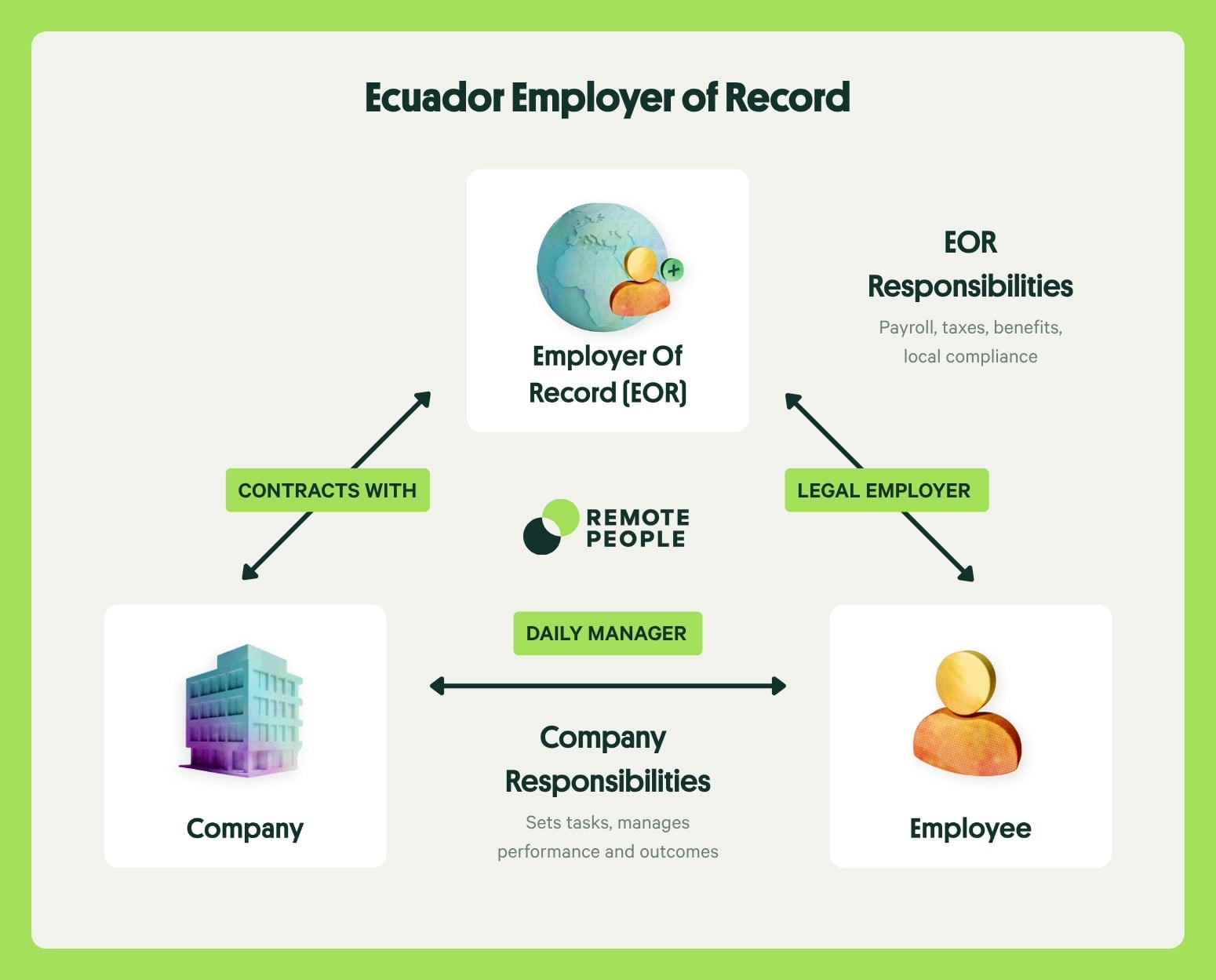
If you’d like to learn more about how Employer of Record (EOR) services work, read our What Is an Employer of Record (EOR)? guide for a complete overview of the model, its benefits, and when to use it.
If you’re comparing providers, our Best Employer of Record (EOR) Providers guide reviews the leading platforms to help you choose the right solution for your business.
Who Uses an EOR in Ecuador?
Companies typically use an employer of record in Ecuador to test the Andean market before committing to a full entity, to hire a small team of one to fifteen people without the cost and timeline of incorporation, or to onboard a single high-value hire in one to two weeks rather than the two to four months a local entity setup would take. The model is particularly useful for North American employers benefiting from Ecuador’s same-time-zone position with the US Central time zone, full USD currency, and competitive wages relative to Colombia, Chile, and Costa Rica.
An EOR is also the right fit for foreign companies that need local compliance without a permanent establishment, for employers converting existing Ecuadorian contractors into full employees to reduce misclassification exposure under Mandato Constituyente 8, and for organizations that need to offer statutory benefits quickly to attract senior talent in a competitive nearshore market.
Typical Onboarding Timeline
The onboarding process typically takes one to two weeks for Ecuadorian nationals, broken into five clear stages.
- First, sign the EOR service agreement and share the employee’s details, including full name, cédula de identidad, salary, and start date (1-2 days).
- Second, the EOR drafts a compliant Spanish-language employment contract and sends it for signature (2-3 days).
- Third, IESS registration is completed through the Sistema de Historia Laboral within the first 15 days of employment, alongside SRI tax enrolment if required (3-5 business days).
- Fourth, payroll configuration, benefits enrolment, and bank account verification are finalised (1-2 days).
- Fifth, the employee officially starts work and receives their first paycheck on the next monthly payroll cycle.
If the hire is a foreign national requiring a 12-VI work visa, add 4 to 12 weeks for processing through the E-Visa portal of the Ministry of Foreign Affairs and Human Mobility. As of 2026, all visa applications must be submitted online through Ecuador’s E-Visa system, replacing the previous in-person consular process.
Hire in Ecuador Without Setting Up a Local Entity
RemotePeople handles Ecuadorian employment contracts, IESS registration, payroll, and compliance so you can focus on your business.
Employment Laws and Regulations in Ecuador
Employment Contracts
The Código del Trabajo, originally codified in 1938 and updated through multiple reforms, governs every employment relationship in Ecuador and is administered by the Ministerio del Trabajo. Written contracts are mandatory for fixed-term, part-time, apprenticeship, and foreign worker arrangements, and strongly recommended for indefinite-term hires. The default contract type for ongoing roles is the indefinite-term contract (contrato indefinido); fixed-term contracts (contrato a plazo fijo) are restricted to specific permitted use cases such as project work, seasonal operations, or replacements for absent employees.
Employment contracts must be written in Spanish and must specify job title, workplace, salary, working hours, leave entitlement, probation clause if any, and termination terms. Contracts are typically registered with the Sistema Único de Trabajo (SUT) of the Ministerio del Trabajo within 30 days of signature. Verbal agreements are technically permitted for indefinite contracts but create significant evidentiary risk in any subsequent labor dispute.
Working Hours and Overtime
The standard workweek in Ecuador is 40 hours, typically arranged as 8 hours per day over 5 days under Article 47 of the Código del Trabajo. The maximum daily working time is 8 ordinary hours, and the workweek may be distributed over five or six days as long as the weekly cap of 40 hours and the daily cap of 8 ordinary hours are respected.
Overtime is compensated at 150% of the regular hourly rate for daytime work performed between 6:00 a.m. and midnight, and at 200% of the regular rate for night work performed between midnight and 6:00 a.m. Work performed on Saturdays, Sundays, or public holidays is paid at 200% of the regular rate, regardless of the time of day. Overtime is capped at 4 hours per day and 12 hours per week under Article 55 of the Código del Trabajo, and any overtime arrangement requires the employee’s prior agreement.
Minimum Wage
The Salario Básico Unificado (SBU) in Ecuador is USD 482 per month, effective 1 January 2026 under Ministerial Agreement MDT-2025-195. See our dedicated Ecuador minimum wage guide for full sectoral detail. The 2026 SBU represents a USD 12 increase from the 2025 figure of USD 470 and was set by consensus between the Ecuadorian government, employer associations, and worker unions through the Consejo Nacional del Trabajo y Salarios. Because Ecuador adopted the US dollar as its official currency in January 2000, the SBU is denominated in USD natively, with no exchange rate conversion required.
For more detail on the 2026 SBU, including how it interacts with the décimo cuarto salary and sector minimums, see the Ecuador payroll and tax guide. Some industries also operate under sectoral minimums (Salarios Sectoriales) negotiated annually by the Comisiones Sectoriales for specific occupations such as construction, manufacturing, agriculture, and hospitality, which may exceed the SBU.
Probation Period
The Ecuador probation period may last up to 90 calendar days under Article 15 of the Código del Trabajo. Probation must be expressly included in the written employment contract to be enforceable; if the contract does not mention probation, the employee is considered permanent from day one. During the probation period, either party may terminate the employment relationship without prior notice and without paying severance, provided the termination is not discriminatory. The Código del Trabajo also limits the share of an employer’s workforce that may be on probation at any given time to 15% of total headcount.
Leave Entitlements
Ecuadorian law provides a comprehensive set of statutory leave entitlements under the Código del Trabajo and the IESS regulations, covering paid annual leave, sick leave funded jointly by the employer and the IESS, fully paid maternity and paternity leave, and specific family event leave. The IESS funds most medical and parental leave after the initial employer-covered period.
Annual Leave
Paid annual leave in Ecuador is 15 calendar days per year of service under Article 69 of the Código del Trabajo. After the fifth year of continuous service with the same employer, employees earn one additional day of leave per year, capped at 30 calendar days total. Annual leave accrues from the first day of employment and becomes available after the first complete year of service. Unused leave may be accumulated for up to three years and taken in the fourth year, but any accrued and untaken leave must be paid out in cash upon termination.
Sick Leave
Sick leave in Ecuador is funded jointly by the employer and the IESS. The employer pays the first three days of incapacity at 50% of the employee’s salary, and the IESS subsidizes the absence from day four onward at approximately 75% of the contribution base for common illness, for up to 180 days. After day 181, the IESS subsidy may be extended in case of long-term incapacity. Eligibility for IESS sick benefits requires at least 180 days of contributions in the six months prior to the absence. A medical certificate from an IESS-affiliated physician is required for any incapacity longer than two days.
Maternity Leave
Maternity leave in Ecuador is 12 weeks of fully paid leave under Article 152 of the Código del Trabajo, distributed as 2 weeks before the expected delivery date and 10 weeks after birth. The leave is funded jointly by the IESS, which pays 75% of the contribution base, and the employer, which tops up the remaining 25% to ensure 100% replacement of the employee’s salary. Multiple births and adoptions follow the same baseline of 12 weeks. Job protection during pregnancy and for 12 months after delivery means the employee cannot be dismissed without prior administrative authorization, under the protection set out in Article 154 of the Código del Trabajo.
Paternity Leave
Paternity leave in Ecuador is 10 calendar days of fully paid leave for the birth of a child under Article 152.1 of the Código del Trabajo, extended to 15 days for births by caesarean section or for multiple births. Premature births or births of children with special needs entitle the father to 23 days of paid leave, and births of children with severe or terminal illness entitle the father to up to 25 days. The leave is funded by the employer in full, and applies to both biological and adoptive fathers.
Other Statutory Leave
Ecuadorian law provides additional paid leave for specific life events under the Código del Trabajo and special regulations.
- Bereavement leave of 3 calendar days for the death of a spouse, common-law partner, parent, child, sibling, or in-law.
- Marriage leave of 3 calendar days for the employee’s own civil marriage.
- Voting leave for the time strictly required to exercise the right to vote in national, provincial, or local elections.
- Study leave for employees enrolled in formal education, subject to negotiation with the employer.
- Calamidad doméstica leave for serious household emergencies, granted at the discretion of the employer based on the circumstances.
Ecuador statutory leave entitlements · Per Código del Trabajo | ||
Leave Type | Duration | Eligibility & Notes |
|---|---|---|
Annual leave | 15 calendar days | After 1 year of service. +1 day per year after the 5th year, capped at 30 days. Article 69. |
Sick leave | Up to 180 days | Employer pays first 3 days at 50%; IESS pays from day 4 at ~75% of contribution base. |
Maternity leave | 12 weeks (84 days) | 2 weeks pre-natal + 10 weeks post-natal. IESS pays 75%, employer tops up to 100%. Article 152. |
Paternity leave | 10-25 days | 10 days standard, 15 days for caesarean or multiple births, up to 25 days for serious medical conditions. Article 152.1. |
Bereavement leave | 3 calendar days | Death of spouse, parent, child, sibling, or in-law. Fully paid by employer. |
Marriage leave | 3 calendar days | Employee’s own civil marriage. Fully paid by employer. |
Voting leave | Time required | Sufficient time off to exercise voting rights. Proof of voting may be required. |
Statutory Employee Benefits
Beyond paid leave and IESS contributions, Ecuadorian employee benefits include several mandatory items that materially shape the total cost of employment. Health insurance is provided through the IESS Seguro General de Salud Individual y Familiar, financed by the combined 21.60% contribution rate, and covers medical, hospital, maternity, and dependent care. The pension system (Seguro de Invalidez, Vejez y Muerte) operates on the same IESS contribution base and entitles employees to retirement, disability, and survivor pensions managed by the Instituto Ecuatoriano de Seguridad Social.
Three mandatory cash benefits stand out as Ecuadorian particularities. The thirteenth-month salary (décimo tercer sueldo) is equivalent to one month of total remuneration earned over the year and is payable by 24 December. The fourteenth-month salary (décimo cuarto sueldo) is fixed at the SBU (USD 482 in 2026) and is payable by 15 March in the Costa and Galápagos region or by 15 August in the Sierra and Amazon region. The reserve fund (fondos de reserva) of 8.33% of monthly remuneration becomes payable from the thirteenth month of continuous service onward and may be paid monthly with salary or accumulated in the worker’s IESS account. Finally, statutory profit sharing (utilidades) of 15% of company net profits must be distributed to all employees by 15 April each year, with 10% allocated proportionally by days worked and 5% by family burden, under Article 97 of the Código del Trabajo.
Recent Regulatory Updates (2026)
The most significant 2026 update is the SBU increase to USD 482 per month under Ministerial Agreement MDT-2025-195, the first consensus-based wage agreement reached in nearly a decade between the Government, employers, and worker unions. The increase took effect on 1 January 2026 and automatically adjusts the décimo cuarto salary (fixed at the SBU) and the contribution floor for IESS.
A second important change is Ministerial Agreement MDT-2025-006, which requires every employer in Ecuador to provide a minimum of 40 hours of annual training per employee on labor rights, gender equality, and workplace harassment prevention. Compliance must be reported annually to the Ministerio del Trabajo, and administrative sanctions apply for non-compliance. Visa processing also moved fully online in 2026, with all work visa applications now submitted through the E-Visa portal of the Ministry of Foreign Affairs and Human Mobility, replacing in-person submissions at consulates.
Work Permits and Visas in Ecuador
Work Permit Requirements
Who Needs a Work Permit
Foreign nationals other than citizens of fellow Comunidad Andina (CAN) and Mercosur member states generally require an Ecuador work visa to take up paid employment in Ecuador. Citizens of Bolivia, Colombia, Peru, Argentina, Brazil, Chile, Paraguay, and Uruguay benefit from the regional Mercosur and CAN visa, which simplifies the path to residency and the right to work. All other foreign nationals must apply for the Visa de Residencia Temporal 12-VI (work visa), the Visa de Residencia Permanente, or one of the special visa categories such as the Digital Nomad visa or the professional visa for highly qualified workers.
Eligibility and Required Documents
Eligibility for the 12-VI work visa requires a valid signed employment contract with an Ecuadorian employer, proof of the employer’s good standing with IESS, and clean criminal records from the applicant’s country of origin. Required documents include a passport valid for at least six months beyond the application date, a notarized criminal background check apostilled or legalized for use in Ecuador, the original employment contract, IESS clearance from the employer, and an official application letter from the employer’s legal representative addressed to the Ministry of Foreign Affairs and Human Mobility. Documents in languages other than Spanish must be accompanied by certified Spanish translations.
Processing Time and Validity
Standard processing time for the 12-VI work visa is 4 to 12 weeks once a complete application is submitted through the E-Visa portal. The visa is initially valid for up to two years and may be converted into a permanent residency visa after 21 months of continuous lawful residence in Ecuador. Delays are common when documents arrive without the required apostille, with translation errors, or when the employer’s IESS account shows outstanding debts.
Renewal Process
Temporary residence visas may be renewed once for an additional period of up to two years, after which the holder may apply for permanent residency. Renewal applications must be submitted before the current visa expires and require updated employment contracts, proof of continued IESS enrolment, and current criminal background checks. The employee may continue working during the renewal review period, provided the renewal application was filed before the original visa expiry date.
Common Visa Types for Foreign Workers
- Visa de Residencia Temporal 12-VI: standard work visa tied to a local employment contract, valid up to 2 years and renewable.
- Visa Profesional: for foreign professionals with university degrees registered in Ecuador, granting temporary residence and the right to work.
- Visa Mercosur / CAN: simplified path for nationals of Comunidad Andina and Mercosur countries to obtain residence and work rights.
- Digital Nomad Visa (Rentista): introduced in 2022 for remote workers earning at least three times the SBU from foreign sources, valid for 2 years.
- Visa de Residencia Permanente: available after 21 months of continuous temporary residence and grants indefinite right to work.
How an EOR Handles Work Permits
An employer of record sponsors the 12-VI work visa for foreign hires by issuing the local employment contract and providing the IESS clearance and employer letters required by the Ministry of Foreign Affairs and Human Mobility. The EOR coordinates document collection, certified translations, and apostille checks, and submits the file through the E-Visa portal on behalf of the employee. The employee remains responsible for providing personal documents such as the passport, criminal record, and any educational diplomas, and must attend the in-Ecuador biometric capture appointment after approval. Sponsoring through an EOR extends the standard onboarding timeline by 4 to 12 weeks for non-Mercosur foreign hires, on top of the 1 to 2 weeks needed for Ecuadorian nationals.
Payroll, Taxes, and Social Security in Ecuador
Employer Contributions
Ecuador employer social security contributions · 2026 rates | ||
Contribution | Rate | Notes |
|---|---|---|
IESS employer contribution | 11.15% | Covers pension (IVM), health (Seguro General de Salud), and occupational risk insurance. |
IECE training levy | 0.50% | Funds the Instituto Ecuatoriano de Crédito Educativo for student credits. |
SECAP training levy | 0.50% | Funds the Servicio Ecuatoriano de Capacitación Profesional for vocational training. |
Reserve fund (after 12 months) | 8.33% | Mandatory from the 13th month of continuous service. May be paid monthly or accumulated. |
Total employer burden (year 1) | 12.15% | Year 2 onward: 20.48% including reserve fund. |
Employee Contributions
Ecuador employee payroll deductions · 2026 monthly withholdings | ||
Deduction | Rate | Notes |
|---|---|---|
IESS personal contribution | 9.45% | Covers pension, health, occupational risk, and unemployment insurance. |
Income tax (Impuesto a la Renta) | 0%-35% | Progressive rate per SRI brackets. First USD 12,208 of annual income is exempt. |
Total social contribution | 9.45% | Income tax depends on annual taxable income above the exempt threshold. |
Source: IESS and Servicio de Rentas Internas (SRI) | ||
Income Tax
Ecuador income tax brackets · 2026 | |
Annual Taxable Income (USD) | Tax Calculation |
|---|---|
$0 – $12,208 | 0% (exempt) |
$12,208 – $15,549 | 5% on excess over $12,208 |
$15,549 – $20,188 | $167 + 10% on excess over $15,549 |
$20,188 – $26,700 | $631 + 12% on excess over $20,188 |
$26,700 – $35,136 | $1,412 + 15% on excess over $26,700 |
$35,136 – $46,852 | $2,677 + 20% on excess over $35,136 |
$46,852 – $62,468 | $5,021 + 25% on excess over $46,852 |
$62,468 – $93,231 | $8,925 + 30% on excess over $62,468 |
Over $93,231 | $18,154 + 35% on excess over $93,231 |
Source: SRI – Impuesto a la Renta and PwC Tax Summaries Ecuador | |
Payroll Cycle
Payroll in Ecuador runs on a monthly cycle, with salaries typically paid on the last working day of the month or within the first five business days of the following month. Payment must be made by direct bank transfer to the employee’s nominated Ecuadorian bank account, and a written or electronic pay slip (rol de pagos) detailing gross salary, IESS deductions, income tax withholding, and net pay must be issued each month. IESS contributions for the prior month are due by the 15th of the following month, and personal income tax withholdings are remitted to the SRI through the Anexo Relación de Dependencia and the monthly RDEP filings.
13th Month Salary and Bonus Pay
The thirteenth-month salary (décimo tercer sueldo) is mandatory in Ecuador for every dependent worker under Article 111 of the Código del Trabajo. The amount equals one twelfth of the total remuneration received between 1 December of the previous year and 30 November of the current year, including base salary, overtime, commissions, and habitual bonuses. The default payment date is on or before 24 December each year, although employees may request to receive it monthly with their regular salary by submitting a written election before 15 January.
The fourteenth-month salary (décimo cuarto sueldo) is also mandatory under Article 113 of the Código del Trabajo and equals the SBU (USD 482 in 2026) for any employee who has worked the full reference year. The reference period and payment deadline depend on region: 1 August to 31 July, paid on or before 15 August in the Sierra and Amazon, and 1 March to 28 February, paid on or before 15 March in the Costa and Galápagos. Both décimos are exempt from IESS contributions and income tax withholding, and partial-year workers receive proportional amounts based on actual time worked. In addition, statutory profit sharing of 15% of net company profits must be distributed by 15 April each year to all employees who worked during the prior fiscal year.
Cost of Hiring Through an EOR in Ecuador
EOR Service Fees
EOR service fees in Ecuador typically range from USD 300 to USD 600 per employee per month, with the exact amount depending on the provider, the seniority of the role, and the complexity of the local benefits package. The fee covers contract drafting, IESS registration, monthly payroll processing, tax filings, statutory benefit administration, and ongoing compliance support. Visa sponsorship for foreign hires is often billed separately as a one-time setup cost.
Total Employment Cost Breakdown
Ecuador employer cost example · $1,200/month gross · 2026 | ||
Employer Cost | Amount (USD) | % of Gross |
|---|---|---|
Gross monthly salary | $1,200.00 | 100.00% |
IESS employer contribution (11.15%) | $133.80 | 11.15% |
IECE training levy (0.50%) | $6.00 | 0.50% |
SECAP training levy (0.50%) | $6.00 | 0.50% |
Décimo tercer sueldo accrual (1/12) | $100.00 | 8.33% |
Décimo cuarto sueldo accrual (SBU/12) | $40.17 | 3.35% |
Reserve fund (8.33%, year 2 onward) | $99.96 | 8.33% |
EOR service fee | $400.00 | 33.33% |
Total monthly employer cost | $1,985.93 | 165.49% |
Source: IESS and PwC Tax Summaries – Ecuador | ||
The mandatory employer contributions in Ecuador add roughly 32% on top of gross salary in year two of employment, broken down as 12.15% in IESS and training levies, 8.33% in décimo tercer accrual, 3.35% in décimo cuarto accrual, and 8.33% in reserve fund. Adding the EOR service fee brings the total monthly cost on a USD 1,200 gross salary to approximately USD 1,985.93, or 65% above gross. Because Ecuador adopted the US dollar as its sole legal tender in January 2000, no currency conversion is required: every figure in this article is denominated in USD natively.
Ready to hire in Ecuador? Get started with RemotePeople and we will handle employment contracts, IESS enrolment, payroll, income tax withholding, and full Ecuadorian compliance. No local entity needed.
Benefits of Using an EOR in Ecuador
The biggest advantage of using an employer of record in Ecuador is speed. A new hire can be onboarded, registered with IESS, and on payroll within one to two weeks, compared with the two to four months it usually takes to incorporate a sociedad anónima, open a corporate bank account, and build an in-house payroll function. Compliance assurance is the second major benefit: the EOR carries the legal employer status under the Código del Trabajo, manages every IESS, SRI, and Ministerio del Trabajo filing, and absorbs the day-to-day risk of falling foul of the décimo tercer, décimo cuarto, reserve fund, and profit-sharing requirements that catch many foreign employers off guard.
Cost efficiency is the third reason most foreign companies choose the EOR model in Ecuador. With no incorporation fees, no notary or registration costs, and no need to maintain a local accountant, lawyer, or HR manager, the EOR fee of USD 300 to USD 600 per employee per month covers everything that a small Ecuadorian operation would otherwise need to build in-house. Local expertise from a partner who understands sectoral minimums, the regional split between Sierra and Costa décimo cuarto deadlines, and the nuances of Mandato Constituyente 8 protects the employer from misclassification, payroll error, and labor inspection risk in a way that no playbook can replicate.
Flexibility to scale up or down without legal exit costs is the fourth benefit, and the cleanest argument for the model. Closing an Ecuadorian sociedad anónima can take 12 to 18 months and involves liquidation, tax clearance, and worker settlement procedures, while ending an EOR engagement is as simple as serving notice and settling the final payroll. The combined effect of speed, compliance, cost, expertise, and flexibility is that an EOR is by far the lowest-friction way for a foreign company to test or scale a team in Ecuador without committing capital to an entity it may not need long-term.
Termination and Offboarding in Ecuador
Notice Periods
Ecuadorian law treats notice differently depending on which party initiates the termination. When the employee resigns through desahucio, the worker must give the employer at least 15 days’ written notice under Article 184 of the Código del Trabajo and is entitled to a desahucio bonus equal to 25% of the last monthly remuneration multiplied by every complete year of service. When the employer initiates termination without just cause, no statutory notice period applies, but the dismissal is treated as despido intempestivo and triggers the indemnification formula set out in Article 188. Employers may also pursue termination for just cause through the visto bueno procedure before a labor inspector, which requires no notice and no severance if the inspector confirms one of the grounds listed in Article 172.
Severance Pay
Calculation Method
Severance for despido intempestivo (unlawful or no-fault dismissal) is calculated under Article 188 of the Código del Trabajo. Employees with up to three years of service are entitled to three months of remuneration, and employees with more than three years of service receive one month of remuneration per complete year, with any fraction of a year counted as a full year. The base for the calculation is the last monthly remuneration the employee was earning at the time of termination. In addition to the indemnification, the employer must pay the desahucio bonus of 25% of the last monthly salary multiplied by years of service, plus all proportional accrued amounts for vacation, décimo tercer sueldo, and décimo cuarto sueldo.
Caps and Exceptions
The maximum statutory severance under Article 188 is 25 months of remuneration, regardless of total tenure. No severance is owed when the employer terminates with just cause through the visto bueno process before a labor inspector and the inspector confirms one of the grounds listed in Article 172, such as repeated unjustified absences, gross misconduct, or material breach of contract. No severance is owed when the employee resigns voluntarily without invoking desahucio, although accrued benefits must still be paid out. Employees on probation may be terminated without severance, provided the dismissal is not discriminatory.
Grounds for Termination
The Código del Trabajo recognizes three main termination pathways. Termination by mutual agreement requires both parties to sign a finiquito document settling all outstanding amounts. Termination for just cause through visto bueno requires the employer to file a request with a labor inspector, who reviews evidence and issues a binding decision; recognized grounds include repeated unjustified absences, gross insubordination, theft, and serious breach of contract under Article 172. Termination without just cause (despido intempestivo) is permitted but always triggers the full Article 188 severance formula. Pregnant workers, union officers, and worker representatives benefit from additional fuero protection that requires prior administrative authorization before termination is allowed.
EOR vs. Other Hiring Models in Ecuador
EOR vs. Setting Up a Local Entity
Ecuador EOR vs local entity comparison · Setup time, cost, risk and best-fit | ||
Comparison | Employer of Record | Own Entity (S.A. or S.A.S.) |
|---|---|---|
Setup time | 1-2 weeks | 2-4 months |
Upfront cost | $0 | $3,000-$8,000 |
Ongoing cost | $300-$600/employee/month | $8,000-$20,000/year maintenance |
Local partner required | No (EOR is the local entity) | No, but local legal representative recommended |
Social insurance registration | Handled by EOR | You manage IESS enrolment |
Payroll & tax filing | Handled by EOR | You manage SRI & IESS filings (or outsource) |
Best for team size | 1-15 employees | 15+ employees |
Scale down / exit | Easy – no entity to unwind | Costly – 12-18 month liquidation process |
Government contracts | Not eligible | Eligible (requires local entity) |
Setting up an Ecuadorian sociedad anónima or sociedad por acciones simplificada (S.A.S.) takes between 2 and 4 months once you account for name reservation with the Superintendencia de Compañías, notarization of the constitutive deed, registration with the Registro Mercantil, RUC issuance with the SRI, IESS enrolment, municipal patente registration, and the opening of a local bank account. The legal and accounting fees alone typically range from USD 3,000 to USD 8,000, before any operating expenses.
Ongoing maintenance for an Ecuadorian entity covers monthly accounting, annual financial statements filed with the Superintendencia de Compañías, corporate tax returns, IESS reporting, and a registered legal representative, totaling USD 8,000 to USD 20,000 per year for a small operation. By contrast, an EOR carries all of those obligations through its own existing entity for a flat per-employee fee that scales linearly with headcount.
The break-even between an EOR and a local entity typically falls around 15 to 20 employees. Below that threshold, the EOR is materially cheaper and dramatically faster to deploy; above it, the fixed costs of an entity become easier to justify, especially when the local team is large enough to need a permanent country manager and HR function. Companies aiming to bid on government tenders or establish a long-term commercial presence in Ecuador will eventually need their own entity, but few benefit from incorporating before they have validated the market.
EOR vs. Hiring Independent Contractors
Ecuador EOR vs independent contractors · Compliance, cost, and risk | ||
Comparison | EOR (Full-Time Employee) | Independent Contractor |
|---|---|---|
Legal relationship | Employee of the EOR under Código del Trabajo | Self-employed civil contract, no labor relationship |
Compliance risk | Low – EOR ensures full Código del Trabajo compliance | High – misclassification risk under Mandato Constituyente 8 |
Payroll & tax | EOR handles IESS, SRI, and all withholdings | Contractor invoices you; they handle their own RUC and tax |
Benefits & leave | Statutory leave, décimos, IESS, reserve fund, utilidades | No entitlement to employee benefits |
IP protection | Stronger – employment contract assigns IP by default | Weaker – requires explicit IP assignment clause |
Termination | Subject to notice and Article 188 severance | Contract may be ended per agreement terms |
Best for | Long-term, core team roles | Short-term projects, specialized tasks |
Cost structure | Salary + employer contributions + EOR fee | Contractor fee (typically higher gross, lower total cost) |
Hiring independent contractors in Ecuador is only appropriate in some cases, such as short-term project work, specialized consulting engagements, or roles with genuine professional autonomy. The contractor must invoice the client through their own RUC, manage their own IESS contributions as voluntary affiliates, and file their own income tax returns with the SRI. Done properly, this is a clean commercial arrangement.
The risk arises when the working relationship looks and feels like employment. If the contractor works fixed hours, uses company equipment, follows the client’s instructions on day-to-day tasks, and serves a single client over an extended period, the SRI or a labor inspector may reclassify the relationship as a disguised employment relationship. Reclassification triggers retroactive IESS contributions, income tax, décimo tercer and décimo cuarto, and the full Article 188 severance, plus administrative fines.
For ongoing roles where misclassification risk is high, an EOR is the cleaner option because it converts the relationship into a properly registered employment with all statutory protections in place. RemotePeople also offers a dedicated contractor management solution for situations where independent contracting is genuinely the right fit.
EOR vs. PEO (Professional Employer Organization)
Ecuador EOR vs PEO comparison · Legal employer, liability, and setup | ||
Comparison | Employer of Record (EOR) | PEO |
|---|---|---|
Legal employer | EOR is the legal employer | Not formally recognized in Ecuador |
Local entity required | No – the EOR is the local entity | Not applicable – PEO model is prohibited |
Best for | Companies without a local entity | Not available as a hiring model in Ecuador |
Compliance liability | EOR assumes compliance responsibility | Tercerización prohibited under Mandato 8 |
Setup time | 1-2 weeks | N/A – employers must use direct employment or EOR |
Control over HR policies | EOR manages within Código del Trabajo | N/A |
Typical use case | Market entry, small remote teams, testing new markets | N/A in Ecuador |
The standard PEO co-employment model that exists in the United States does not exist in Ecuador. Mandato Constituyente 8 of April 2008 explicitly eliminated and prohibited tercerización (labor outsourcing) and intermediación laboral (labor intermediation), establishing that all employment relationships in Ecuador must be direct and bilateral between worker and employer. Only complementary services such as cleaning and security may be contracted through specialized service companies.
For foreign companies looking to hire in Ecuador, the practical implication is that the choice is between incorporating a local entity and hiring directly, or using an EOR that acts as the registered local employer. There is no middle path through a PEO that lets the foreign parent remain the legal employer of record.
The EOR therefore plays the role that a PEO would play in markets where co-employment is permitted: it is the locally registered employer of record, takes on every Código del Trabajo obligation, and shields the foreign client from any direct employment liability while letting the client retain full operational control over the work performed.
Public Holidays in Ecuador
Ecuador public holidays · 2026 calendar year | ||
Date | Holiday | Type |
|---|---|---|
January 1 | Año Nuevo (New Year’s Day) | National |
February 16 | Lunes de Carnaval | National |
February 17 | Martes de Carnaval | National |
April 3 | Viernes Santo (Good Friday) | National |
May 1 | Día del Trabajo (Labor Day) | National |
May 25 | Batalla de Pichincha | National (observed) |
August 10 | Primer Grito de la Independencia | National |
October 9 | Independencia de Guayaquil | National |
November 2 | Día de los Difuntos | National |
November 3 | Independencia de Cuenca | Regional (Cuenca) |
December 25 | Navidad (Christmas) | National |
Source: Ministerio del Trabajo and timeanddate.com – Ecuador 2026 | ||
Holidays that fall on a Tuesday or Thursday are commonly moved to the nearest Monday or Friday under the Ley Orgánica para la Optimización y Eficiencia de Trámites Administrativos to create long weekends, so payroll teams should monitor official Ministerio del Trabajo announcements each year. Cities such as Quito, Guayaquil, Cuenca, and Loja also observe additional foundation-day holidays for their own residents, which payroll providers should configure on a per-city basis.
How to Get Started with an EOR in Ecuador
Getting started with an employer of record in Ecuador is a structured five-step process that takes about one to two weeks for Ecuadorian nationals.
- First, share the role details with RemotePeople, including job title, target salary, location, and start date.
- Second, sign the EOR service agreement and provide the employee’s personal details and identification.
- Third, the EOR drafts a compliant Spanish-language employment contract and registers the employee with IESS within the first 15 days of work.
- Fourth, payroll, tax withholding, décimos accruals, and benefits enrolment are configured on the platform.
- Fifth, the employee starts work and is paid through the next monthly payroll cycle.
Contact RemotePeople to start hiring in Ecuador without setting up a local entity. We handle every step from contract drafting to IESS, SRI, and Ministerio del Trabajo compliance, and we tell you exactly what your fully loaded employer cost will be before you commit to a hire.
Where companies hiring in Ecuador expand next
Companies hiring in Ecuador commonly expand across South America, leveraging Spanish and Portuguese talent pools and regional trade frameworks. After building a team in Ecuador, employers often look to Peru for overlapping Andean hiring and cost tier, then a team in Brazil for the Andean corridor’s Spanish-speaking talent. Operations in Chile follows with aligned Andean-region cost and talent profile, and Colombia typically closes the regional footprint via shared Andean-market workforce norms.
Frequently Asked Questions
Beyond the employer contributions of around 12.15% in IESS and training levies plus the décimo tercer (8.33%), décimo cuarto, and reserve fund accruals, you will pay an EOR service fee of $300 to $600 per employee per month. The exact amount depends on your provider and the complexity of the role. For a $1,200/month gross salary, total monthly cost from year two onward lands at roughly $1,985, with the EOR fee included.
Onboarding an Ecuadorian national typically takes 1 to 2 weeks from EOR agreement signature to first day of work. Foreign hires requiring a 12-VI work visa add another 4 to 12 weeks, processed entirely through the new E-Visa portal of the Ministry of Foreign Affairs and Human Mobility.
Yes. Both the décimo tercer sueldo (one extra month of salary, payable by 24 December) and the décimo cuarto sueldo (equal to the SBU of $482 in 2026, payable by 15 March in the Costa or 15 August in the Sierra) are mandatory under Articles 111 and 113 of the Código del Trabajo. They apply to every dependent worker, regardless of contract type, and partial-year workers receive proportional amounts.
Independent contracting is legally possible in Ecuador for genuinely autonomous service providers, but the misclassification risk under Mandato Constituyente 8 is high if the relationship resembles employment. For ongoing roles, an EOR is the cleaner solution. RemotePeople also offers a dedicated contractor management solution that handles compliant payments, contracts, and classification screening for situations where independent contracting is the right fit.
The employment contract assigns IP to the client company (you), not the EOR. RemotePeople drafts every Ecuadorian contract with full IP assignment and confidentiality language so all intellectual property and work product flows directly to your business, even though the EOR is the legal employer on paper.
The 2026 SBU is USD 482 per month, effective 1 January 2026 under Ministerial Agreement MDT-2025-195. For more detail, see the Ecuador payroll and tax guide.
Ecuador adopted the US dollar as its sole legal tender in January 2000, so all salaries, contributions, taxes, and benefits are denominated in USD natively, with no exchange rate risk for North American employers.
Employer-initiated termination without just cause (despido intempestivo) triggers indemnification under Article 188 of the Código del Trabajo: 3 months of salary for up to 3 years of service, then 1 month per year beyond that, capped at 25 months. The desahucio bonus of 25% of last salary multiplied by years of service is also payable. Termination for just cause through visto bueno before a labor inspector requires no severance.