Recruit
Employer of Record in Connecticut
-
 Drew Donnelly
- Published
- July 22, 2026
Connecticut’s employment law includes paid family leave, mandatory sick leave, and pay equity rules, and a Connecticut EOR handles payroll and full state compliance with no local entity needed.
Hire in Connecticut — book a free 30-minute demo
No sales call required. Free 30-minute expert call if you want one.
Tell us about your company
So we can match you with a specialist who knows your market — and unlock volume pricing tiers.
* All fields are required.
Where and when are you hiring?
Tell us the geography and timing and we'll quote each country line by line, with onboarding timelines.
* All fields are required.
Help us beat your current setup
We'll benchmark your current deal and send a line-by-line proposal in 24 hours — showing exactly where we cut cost, time, or risk. After you submit, you can book a call to walk through it together.
* All fields are required.
Thanks! Your proposal is on its way.
Expect a tailored, line-by-line proposal in your inbox within 24 hours. In the meantime…
Want to walk through it together?
Book a free 30-minute call with one of our specialists. We'll explain every line, answer your questions, and tailor the proposal further if you need.
No obligation. Pick a time that works for you.








- Hire in Connecticut — book a free 30-minute demo
- Tell us about your company
- Where and when are you hiring?
- Help us beat your current setup
- Thanks! Your proposal is on its way.
- Connecticut Employer of Record
- What Is the Difference Between a Connecticut Employer of Record and a Connecticut PEO?
- How Does a Connecticut Employer of Record Work?
- How Labor Laws Affect Hiring in Connecticut?
- Payroll Taxes and Employer Cost in Connecticut
- Employee Classification Rules in Connecticut
- What Makes Hiring in Connecticut Unique?
- What Are the Benefits of a Connecticut Employer of Record?
- What Are the Downsides of a Connecticut EOR?
- How to Choose a Connecticut Employer of Record?
- Engage a Connecticut Employer of Record with RemotePeople
- Related EOR Destinations

Let RemotePeople handle payroll, compliance, and HR admin worldwide so you can focus on building your team.
Key Takeaways
- Connecticut is a high-cost, highly regulated hiring environment compared to most U.S. states.
- The state minimum wage is $16.94 per hour with mandatory overtime under federal standards.
- Employers must comply with state income tax withholding, unemployment insurance, paid sick leave, and paid family leave contributions.
- Workers’ compensation coverage is required for all employers, regardless of size.
- A Connecticut Employer of Record allows companies to hire quickly without forming a local entity while managing complex compliance obligations.
Connecticut offers access to a highly skilled workforce, particularly in finance, insurance, healthcare, advanced manufacturing, and professional services. With an optimal location within the broader Northeast economic corridor, it is super attractive to companies that need proximity to New York and Boston, without operating directly in those higher-cost markets. Essentially, doing business in Connecticut is one of the best decisions you can make.
Nonetheless, Connecticut is not, by any stretch, a low-regulation environment. Employers face higher wage levels, mandatory paid leave programs, and more extensive payroll compliance requirements than in many other states. Employment costs are also above the national average due to wage expectations, insurance premiums, and unemployment tax structures.
From a workforce perspective, the state has strong talent in corporate operations, financial services, healthcare administration, and technical roles. However, the combination of higher costs and regulatory complexity means employers need a clear compliance strategy before hiring.
Because companies must register for multiple state programs, including tax withholding, unemployment insurance, paid leave, and workers’ compensation, an Employer of Record is the lowest hanging fruit often used to simplify entry and reduce administrative risk.
Connecticut Employer of Record
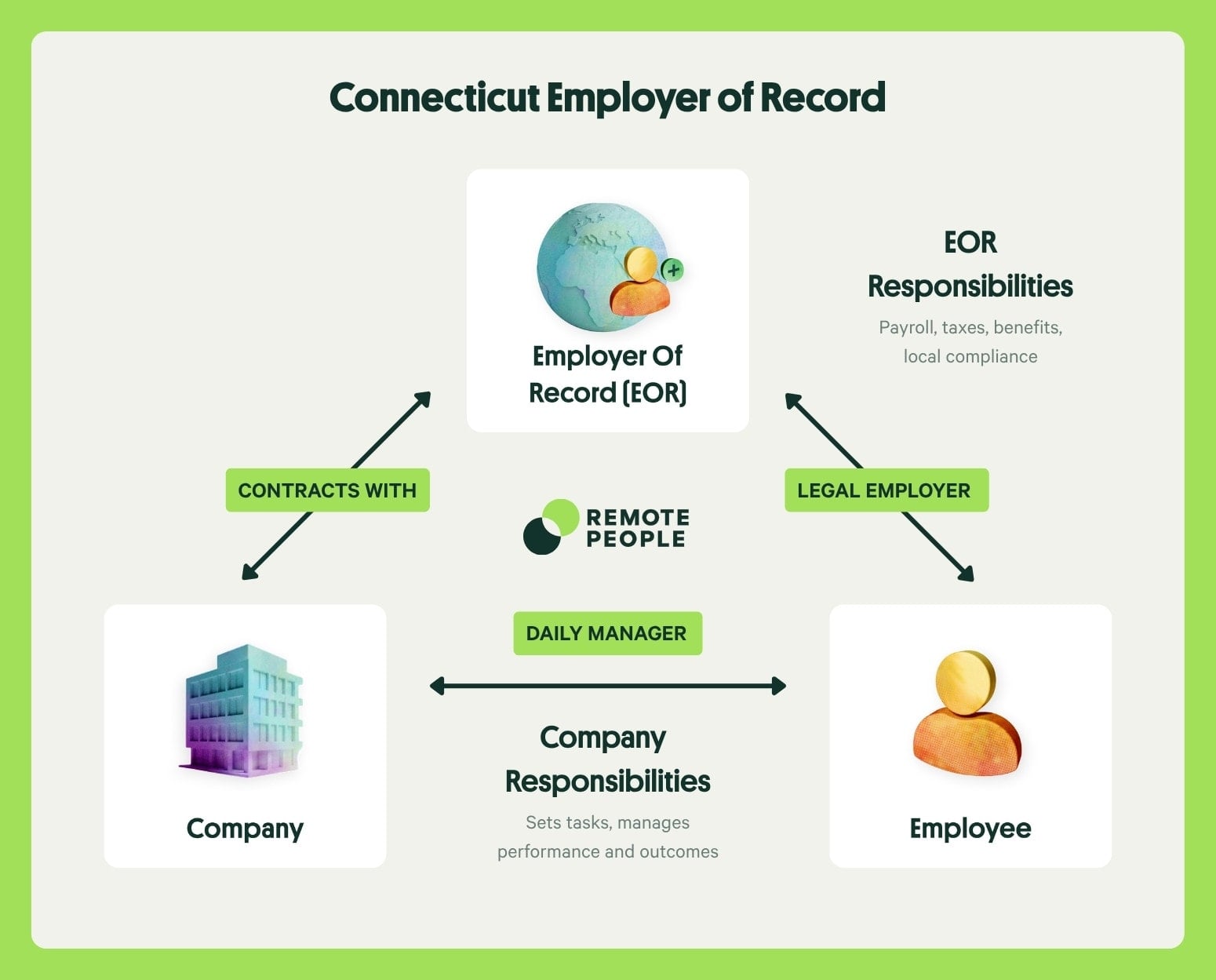
A Connecticut Employer of Record (EOR) is a third-party organization that legally employs workers on your behalf within the state.
What is an EOR can help explain how this employment model works in more detail.
The EOR becomes the official employer for payroll and compliance purposes, and among other functions, manages:
- Payroll processing and wage payments
- Federal and Connecticut tax withholding and filings
- State unemployment insurance reporting
- Paid leave program administration
- Workers’ compensation coverage
- Benefits administration and employment records
The EOR essentially handles all administrative and legal issues, while your company continues to direct the employee’s day-to-day responsibilities, performance expectations, and business priorities.
Because the EOR assumes legal employment responsibility, it also takes on much of the regulatory burden associated with Connecticut’s more complex employment environment. This allows companies to hire without forming a local entity or building internal state-specific compliance infrastructure.
Start hiring with a Connecticut EOR
Let us handle the complexities of hiring, compliance, and payroll in Connecticut while you focus on growing your team.
- Hire employees in Connecticut with a Connecticut EOR
- No local entity is needed
- Pricing starts at USD 199 per employee
- RemotePeople can also help you find the best talent in Connecticut
What Is the Difference Between a Connecticut Employer of Record and a Connecticut PEO?
Both Employer of Record (EOR) providers and Professional Employer Organizations (PEOs) help companies manage payroll, benefits, and HR administration, but the key difference is in who legally employs the worker and who carries the compliance risk.
A PEO operates under a co-employment model. Before working with a PEO, your company must establish and maintain a legal entity in Connecticut and complete all required employer registrations. This includes setting up accounts for state income tax withholding, unemployment insurance, the Connecticut Paid Leave program, and workers’ compensation coverage. The PEO then supports payroll processing, benefits administration, and certain HR functions.
However, your organization remains the legal employer, with the bulk of employer responsibility still resting on you. In practice, a PEO provides administrative support but does not remove the underlying legal obligations or risk.
An EOR takes a different approach. A better one.
The provider becomes the legal employer of record, allowing your company to hire in Connecticut without forming a local entity or managing state registrations. The EOR assumes responsibility for payroll processing, tax filings, unemployment reporting, paid leave administration, workers’ compensation coverage, and ongoing compliance with state and federal employment requirements.
While your company continues to manage the employee’s day-to-day work, performance expectations, and business objectives, the EOR handles the employment infrastructure and regulatory burden.
While EORs provide a faster and lower-risk path for international companies to build a workforce, organizations already operating in the U.S may find PEOs more suitable.
How Does a Connecticut Employer of Record Work?
Hiring through an EOR allows companies to enter the Connecticut market without setting up their own employer accounts or compliance processes.
After you select a candidate, the EOR prepares a compliant employment agreement that reflects federal and Connecticut labor requirements. The provider then completes onboarding, including tax documentation, paid leave enrollment, and work eligibility verification, and places the employee on its payroll.
The EOR maintains required employer registrations with key legislative bodies, including the Connecticut Department of Revenue Services for income tax withholding, the Connecticut Department of Labor for unemployment insurance, and the Connecticut Paid Leave Authority for the family and medical leave program.
Each payroll cycle includes accurate federal and state withholding, employer tax contributions, paid leave deductions, and required filings. The EOR also secures workers’ compensation coverage, administers benefits, and maintains employment records.
Because Connecticut frequently updates wage thresholds and contribution rates, ongoing monitoring of regulatory changes is a critical part of the EOR’s role.
How Labor Laws Affect Hiring in Connecticut?
Minimum Wage & Overtime
As of January 1, 2026, Connecticut’s minimum wage is $16.94 per hour. The state’s wage floor is automatically indexed to the U.S. Department of Labor’s Employment Cost Index, meaning it adjusts annually based on changes in labor costs. The rate increased from $16.35 in 2025 following a rise in the index.
Tipped employees may be paid a lower direct wage, provided their tips bring total earnings up to at least the full minimum wage. The 2026 cash wage requirements are:
Employee Type | Hourly Rate (USD) |
|---|---|
Hotel and Restaurant Service Employees | $6.38 per hour |
Bartenders | $8.23 per hour |
If tips do not make up the difference, the employer must cover the shortfall.
Employees under the age of 18 may be paid 85% of the minimum wage during their first 90 days of employment.
Connecticut follows federal Fair Labor Standards Act (FLSA) rules for overtime. Non-exempt employees must receive 1.5 times their regular rate for hours worked beyond 40 in a workweek. Given the state’s higher wage base and annual indexing, accurate time tracking and payroll adjustments are important for maintaining compliance.
Income Tax
Connecticut applies a progressive personal income tax system with multiple brackets based on income level. For the 2025 tax year, rates range from 2.0% to 6.99%, with the top marginal rate of 6.99% applying to higher-income earners.
Tax Rate | Taxable Income Range |
|---|---|
2% | First $10,000 |
3% | Next $40,000 |
4.5% | Next $50,000 |
5% | Next $50,000 |
5.5% | Next $50,000 |
6% | Next $50,000 |
6.5% | Next $150,000 |
6.9% | Next $200,000 |
6.99% | Income over $500,000 |
State tax calculations are based on federal taxable income, with certain Connecticut-specific adjustments where applicable. Unlike some states in the Northeast, Connecticut does not impose local income taxes, so employers only need to manage state-level withholding.
Employers hiring in Connecticut must:
- Register for withholding with the Connecticut Department of Revenue Services
- Withhold state income tax from employee wages according to the progressive rate structure
- File withholding returns based on the assigned frequency
- Issue annual Forms W-2 reporting state wages and taxes withheld
Because the state uses multiple tax brackets, accurate payroll calculations are important to avoid under-withholding. Most full-time employees fall within the middle to upper brackets.
Employees are required to file Connecticut income tax returns if their gross income exceeds state filing thresholds based on filing status. For employers, the key compliance responsibility is ensuring proper withholding and timely remittance, as the progressive structure increases the risk of calculation errors compared to flat-tax states.
State Unemployment Insurance (SUI)
Connecticut employers are required to contribute to State Unemployment Insurance (SUI), an employer-funded program administered by the Connecticut Department of Labor (CTDOL). The program provides temporary income support to workers who lose their jobs through no fault of their own. SUI contributions are paid entirely by the employer and fund the state’s Unemployment Insurance Trust Fund.
For the 2026 calendar year, Connecticut has implemented several updates to strengthen fund stability:
Contribution Component | Rate |
|---|---|
Taxable wage base | Increased to $27,000 per employee |
New employer rate | 1.9% |
Experience-Rated Employer Rates | 1.1% to 9.9% (including a 1.0% fund solvency assessment) |
Maximum charged rate | Capped at 8.9% for 2026 |
Employers must file quarterly wage reports and make payments electronically through the ReEmployCT system. Contribution rates are adjusted annually based on the employer’s claims history and overall trust fund conditions.
Because Connecticut’s unemployment wage base is significantly higher than in many states, SUI represents a more substantial payroll cost. Accurate reporting, proper separation documentation, and workforce stability are important factors in managing long-term unemployment tax rates.
Paid Leave
Connecticut has one of the more comprehensive leave frameworks in the U.S., combining a statewide paid family and medical leave program with separate sick leave requirements for certain workers.
Under the Connecticut Paid Family and Medical Leave (CT PFML) program, eligible employees may receive up to 12 weeks of income-replacement benefits in 12 months, with an additional two weeks available for pregnancy-related incapacity. The program is funded through a 0.5% employee payroll contribution, which employers must withhold and remit to the Connecticut Paid Leave Authority. It applies to nearly all employers with at least one employee.
Employees may use CT PFML benefits for their own serious health condition, caring for a family member, bonding with a new child, certain military-related needs, and “Safe leave” related to family violence.
CT PFML provides wage replacement but does not itself guarantee job protection. However, leave often runs concurrently with the federal FMLA or the Connecticut FMLA, which provide job protection for eligible employees.
Separately, Connecticut also requires employers with 11 or more employees to provide paid sick leave to certain defined service workers. Leave is accrued based on hours worked and must be provided in accordance with state rules.
Because Connecticut’s leave system involves employee contributions, eligibility tracking, and coordination with job-protection laws, accurate payroll setup and ongoing administration are critical for compliance.
Workers' Compensation
Workers’ compensation is mandatory for Connecticut employers, regardless of company size. The system is governed by the Connecticut Workers’ Compensation Act and administered by the Connecticut Workers’ Compensation Commission (WCC). Employers must maintain coverage through a private insurance carrier or an approved self-insurance arrangement.
The program protects employees who experience work-related injuries or occupational illnesses. Covered benefits may include:
- Payment for necessary medical treatment
- Wage replacement for time missed from work (temporary total or partial disability)
- Compensation for permanent partial disability or long-term impairment
- Additional support, such as vocational rehabilitation or job retraining, where applicable
Employees are required to report workplace injuries to their employer immediately. A formal injury report is then submitted, and the insurer or third-party administrator reviews the claim to determine eligibility. If a claim is disputed, either party may request a hearing before the Workers’ Compensation Commission, which oversees dispute resolution.
Because failure to maintain insurance can result in significant penalties and liability for medical and wage costs, workers’ compensation represents a critical compliance and cost consideration for employers hiring in Connecticut.
Termination and Final Pay
Connecticut has some of the strictest final pay requirements in the United States.
For involuntary terminations, including dismissals, employers must pay all final wages no later than the next business day. For employees who resign, are laid off, or leave due to a labor dispute, final payment is due by the next regularly scheduled payday.
Final pay must include all earned wages and any accrued, unused vacation or PTO if the employer’s written policy, contract, or established practice provides for payout. If the employer’s policy does not address vacation payout, payment may not be required. Employers are also expected to provide employees with written notice of their wage and leave policies at the time of hire.
Payment may be made through the employer’s normal method, such as direct deposit or a mailed check. If there is a dispute over wages, the employer must still pay any undisputed amounts by the statutory deadline.
Failure to comply with Connecticut’s final pay rules can result in significant liability, including double damages, attorney’s fees, and court costs. These requirements apply to all employees working in Connecticut, including remote workers based in the state.
Payroll Taxes and Employer Cost in Connecticut
Employment costs in Connecticut are generally higher than the national average, reflecting the state’s wage levels, unemployment structure, and mandatory leave programs. Employers must account for federal payroll taxes as well as several state-specific obligations when budgeting for new hires.
At the federal level, standard employer taxes apply:
Tax Type | Employer Contribution Details |
|---|---|
Social Security | 6.2% of wages |
Medicare | 1.45% of wages |
FUTA | Up to 0.6% on the first $7,000 of wages after credits |
At the state level, employer responsibilities include:
- Withholding Connecticut income tax based on the state’s progressive rates (2% to 6.99%)
- Paying State Unemployment Insurance (SUI) on the first $27,000 of wages per employee, with rates ranging from 1.1% to 9.9% depending on experience
- Withholding and remitting the 0.5% employee contribution for the Connecticut Paid Family and Medical Leave program
- Maintaining workers’ compensation coverage for all employees
While employees fund the paid leave contribution, employers remain responsible for proper withholding, reporting, and program administration.
For an employee on a $100,000 salary, here’s what the employer costs look like:
Cost Component | Employer Cost |
|---|---|
Social Security and Medicare | $7,650 |
FUTA (effective) | Up to $42 |
Connecticut SUI | Approximately $300 to $2,700, depending on assigned rate |
Workers’ compensation | Roughly $500 to $2,000, depending on industry risk |
This way, the total estimated employer burden is around 9-14% for professional and low-risk roles.
Because Connecticut’s unemployment wage base is significantly higher than in most states and rates are experience-driven, workforce stability and accurate payroll administration play an important role in managing long-term employment costs.
Employee Classification Rules in Connecticut
Employee classification follows federal FLSA standards. Employers must determine whether workers are employees or independent contractors and whether employees qualify as exempt or non-exempt from overtime.
The distinction between employee and contractor is based on the degree of control and economic dependence, not simply job titles or contract language. Independent contractors are in business for themselves and are not covered by minimum wage, overtime, unemployment insurance, or workers’ compensation.
Misclassification can result in liability for unpaid wages, taxes, unemployment contributions, and penalties. Given Connecticut’s strong enforcement environment, careful classification review is especially important.
What Makes Hiring in Connecticut Unique?
Hiring in Connecticut requires a more structured approach than in many other states, particularly when it comes to payroll administration and employment planning. Several state-specific requirements, such as indexed minimum wage increases and mandatory employee contributions for paid family leave, create a compliance environment that leaves little room for error.
Cost predictability is another distinguishing factor. Wage expectations are higher than the national average, and employment expenses can fluctuate due to annual wage indexing and experience-based unemployment rates. This makes accurate workforce budgeting and payroll management especially important for employers entering the state.
At the same time, Connecticut offers access to a stable, experienced workforce suited for professional, operational, and specialized roles. For companies building a Northeast presence or supporting remote professionals, the state provides strong talent availability, provided employers are prepared for a more hands-on compliance and cost management environment.
What Are the Benefits of a Connecticut Employer of Record?
In a state like Connecticut, where employment requirements are more complex, using an Employer of Record is non-negotiable.
Since an EOR allows companies to employ workers without forming a local entity, new hires can be onboarded quickly without delays related to tax registration or program setup.
The model also brings structure to ongoing compliance, with payroll processing, income tax withholding, unemployment reporting, paid leave contributions, workers’ compensation coverage, and year-end filings managed through a unified system. This reduces the risk of errors or missed obligations in a state where compliance requirements are more detailed than average.
For organizations expanding across multiple states, an EOR also creates consistency.
Teams in Connecticut can be managed under the same employment framework as workers in other locations, making it easier to scale without building separate compliance processes for each jurisdiction.
What Are the Downsides of a Connecticut EOR?
For most employers, the primary consideration is cost. In addition to Connecticut’s already higher employment expenses, the management fees of EOR services can put a significant strain on limited operating costs. For companies planning a large or long-term presence in the state, direct employment may become more economical over time.
There is also less flexibility around certain administrative decisions. Payroll timing, benefits structures, and some employment terms must align with the provider’s systems and compliance standards, which may limit customization for organizations with specialized requirements.
For businesses that already maintain a registered Connecticut entity and internal HR and payroll capabilities, managing employment directly may offer greater control and efficiency. Meanwhile, for international businesses entering Connecticut for the first time, the advantages EOR services afford often heavily outweigh the operational tradeoffs and additional costs.
How to Choose a Connecticut Employer of Record?
When selecting an EOR for Connecticut, compliance capability should be a top priority. The state’s higher wage thresholds, paid leave program, and stricter payroll rules require a provider with strong experience handling complex state environments.
Look for transparent pricing, a direct employment model rather than layered partner arrangements, and proven expertise managing multi-state U.S. payroll. Reliable payroll accuracy, timely tax and contribution filings, and responsive support are critical for avoiding penalties and maintaining a positive employee experience.
It is also worth evaluating operational depth, including onboarding efficiency, benefits administration, and the provider’s ability to manage unemployment claims and final pay requirements. For companies planning broader U.S. expansion, multi-state coverage ensures continuity as hiring grows beyond Connecticut.
Engage a Connecticut Employer of Record with RemotePeople
RemotePeople enables companies to hire employees in Connecticut quickly and compliantly without establishing a local entity. The service covers the full employment lifecycle, including payroll processing, tax filings, unemployment reporting, paid leave administration, workers’ compensation coverage, and ongoing compliance monitoring.
By acting as the legal employer of record, RemotePeople helps reduce administrative complexity and manage the higher regulatory demands of Connecticut employment. This allows your organization to focus on operations and growth while ensuring employees are supported under a fully compliant framework.
With infrastructure across all U.S. states, RemotePeople provides a scalable solution for companies building distributed teams or expanding into the Northeast with confidence.
Schedule a consultation session with us today.
Employer of Record in
Employer of Record in
Employer of Record in
Employer of Record in
Employer of Record in
Employer of Record in
Employer of Record in
Employer of Record in