
 Recruit
Employer of Record in Bhutan
-
 Drew Donnelly
- Published
- September 27, 2026
RemotePeople’s employer of record in Bhutan lets you hire employees in Bhutan with National Pension and Provident Fund contributions. We handle mandatory employer contributions of 5% matched equally by employees, monthly submissions by the 15th, and pension accumulation compliance.
Hire in Bhutan — book a free 30-minute demo
Tell us what you need. You'll get a tailored, transparent proposal within 24 hours, plus a free call to walk through it.
Tell us about your company
So we can match you with a specialist who knows your market — and unlock volume pricing tiers.
* All fields are required.
Where and when are you hiring?
Tell us the geography and timing and we'll quote each country line by line, with onboarding timelines.
* All fields are required.
Help us beat your current setup
We'll benchmark your current deal and send a line-by-line proposal in 24 hours — showing exactly where we cut cost, time, or risk. After you submit, you can book a call to walk through it together.
* All fields are required.
Thanks! Your proposal is on its way.
Expect a tailored, line-by-line proposal in your inbox within 24 hours. In the meantime…
Want to walk through it together?
Book a free 30-minute call with one of our specialists. We'll explain every line, answer your questions, and tailor the proposal further if you need.
No obligation. Pick a time that works for you.








- Hire in Bhutan — book a free 30-minute demo
- Tell us about your company
- Where and when are you hiring?
- Help us beat your current setup
- Thanks! Your proposal is on its way.
- How an Employer of Record Works in Bhutan
- Employment Laws and Regulations in Bhutan
- Work Permits and Visas in Bhutan
- Payroll, Taxes, and Social Security in Bhutan
- Cost of Hiring Through an EOR in Bhutan
- Benefits of Using an EOR in Bhutan
- Termination and Offboarding in Bhutan
- EOR vs. Other Hiring Models in Bhutan
- Public Holidays in Bhutan
- How to Get Started with an EOR in Bhutan
- Frequently Asked Questions
- Related EOR Destinations
Start hiring in Bhutan
Let RemotePeople handle payroll, compliance, and HR admin worldwide so you can focus on building your team.

Bhutan offers a young, English-proficient workforce and a stable policy environment shaped by the country’s Gross National Happiness framework. The hydropower, tourism, IT services, and financial sectors have produced a pool of university-educated professionals comfortable with international business standards.
However, hiring in Bhutan requires navigating the Labour and Employment Act 2007, the new Income Tax Act 2025, National Pension and Provident Fund registration, work permits for non-citizens, and statutory benefit obligations. An employer of record in Bhutan removes the need to establish a local company while ensuring every hire stays fully compliant with Bhutanese labour law.
An employer of record acts as the legal employer on paper, handling employment contracts, NPPF registration, payroll processing, tax withholding, statutory benefits, and terminations. You retain full operational control over the employee’s work and performance.
The EOR model is especially valuable in Bhutan because it eliminates months of company incorporation, local bank account setup, and HR infrastructure investment. You can onboard compliant employees in days rather than months.
How an Employer of Record Works in Bhutan
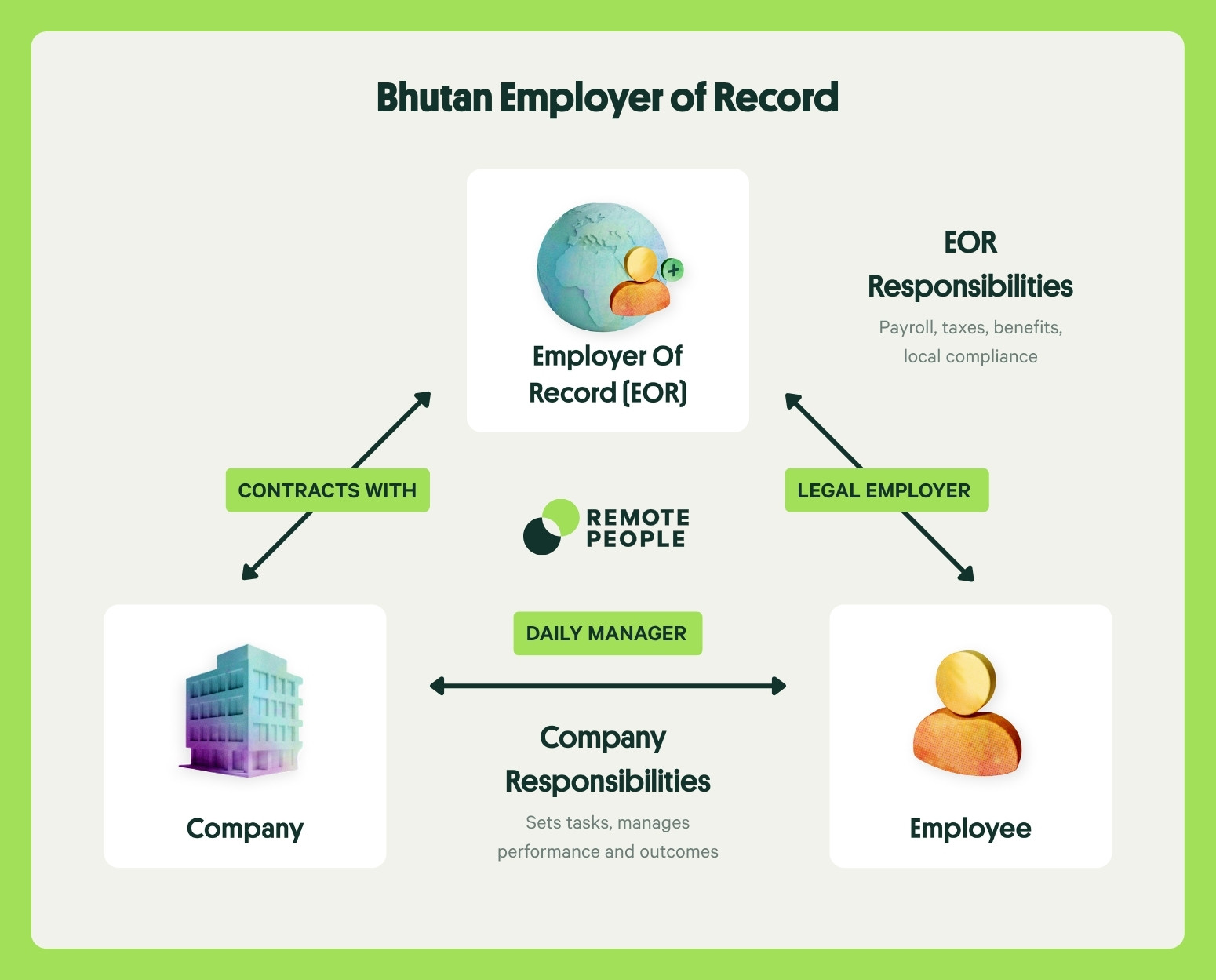
If you’d like to learn more about how Employer of Record (EOR) services work, read our What Is an Employer of Record (EOR)? guide for a complete overview of the model, its benefits, and when to use it.
If you’re comparing providers, our Best Employer of Record (EOR) Providers guide reviews the leading platforms to help you choose the right solution for your business.
Who Uses an EOR in Bhutan?
Companies typically use an EOR in Bhutan to test market expansion before committing to a full legal entity, to hire small teams of one to 15 people without the cost and time of incorporation, or to onboard a single high-value hire in days. The model suits businesses in IT and software development, tourism services, hydropower consulting, customer support, and international development where Bhutan offers cost-competitive English-speaking talent. Startups entering South Asia, NGOs building local teams, and multinational firms piloting regional operations all use EORs to avoid 3–6 months of entity setup and $10,000–$25,000 in upfront incorporation costs.
Typical Onboarding Timeline
Onboarding a Bhutanese employee through an EOR typically takes one to two weeks:
- First, you sign the EOR service agreement and provide the employee’s personal details and banking information (1–2 days).
- Second, the EOR drafts a compliant employment contract and sends it to you and the employee for signature (2–3 days).
- Third, the EOR registers the employee with the National Pension and Provident Fund and sets up payroll in their banking system (2–5 days).
- Fourth, benefits are enrolled, tax withholding is configured, and the payroll schedule is finalised (1–2 days).
- Fifth, the employee begins work and receives their first pay on the next monthly payroll cycle.
If the hire is a non-Bhutanese national requiring a work permit, add 6–12 weeks for processing. Bhutan’s work permit regime is among the more restrictive in South Asia, so early planning is essential. For detailed guidance, see the Bhutan work permit guide.
Hire in Bhutan
One of the world’s most exclusive employment markets with NPPF pension, Bhutanese Labour and Employment Act, and GNH-aligned regulations.
We handle employment contracts, payroll, social contributions, and full Bhutanese compliance.
No local entity needed. Your team can start in days.
Employment Laws and Regulations in Bhutan
Employment Contracts
All employment relationships in Bhutan are governed by the Labour and Employment Act 2007, administered by the Department of Labour under the Ministry of Industry, Commerce and Employment. Written employment contracts are required for every hire and must specify job title, compensation, working hours, leave entitlements, notice periods, and termination conditions.
Contracts may be written in English or Dzongkha, though English is standard practice for international employers. The Act recognises both indefinite contracts and fixed-term contracts, with fixed-term agreements typically used for project or seasonal work.
Working Hours and Overtime
The standard workweek in Bhutan is 48 hours, distributed as 8 hours per day over 6 days, under the Labour and Employment Act 2007. Employees are entitled to at least one rest day per week, typically Sunday.
Work beyond 8 hours per day or 48 hours per week constitutes overtime, which is capped at 12 additional hours per week for a statutory maximum of 60 hours. Overtime between 10:00 pm and 8:00 am is compensated at 1.5 times the ordinary rate, and work performed on rest days or public holidays is compensated at 2.0 times the ordinary rate.
Overtime rules in Bhutan are set by Chapter 8 of the Labour and Employment Act 2007, which caps standard hours at 48 per week and requires additional work to be paid at a premium rate. Employers must secure written consent before assigning overtime, and managerial staff are exempt from overtime pay under the same chapter.
Bhutan overtime and premium pay rates · Per Labour and Employment Act 2007 | |||
Hour Type | Rate Multiplier | Weekly or Daily Cap | Notes |
|---|---|---|---|
Standard working hours | 1.0× (base wage) | 8 hours/day; 48 hours/week | Six-day workweek under Chapter 8 of the Labour and Employment Act |
Weekday overtime | 1.5× hourly wage | Maximum 2 hours/day beyond standard hours | Employer must obtain employee consent; paid at the next payroll cycle |
Weekly rest day work | 2.0× hourly wage or compensatory rest day | One rest day per week required | Compensatory day off may substitute for premium pay by mutual agreement |
Public holiday work | 2.0× hourly wage or compensatory day off | Applies to government-gazetted public holidays | Work on national holidays triggers double pay or a replacement day |
Managerial and supervisory staff | Not entitled to overtime pay | n/a | Exempted under Chapter 8; compensated via fixed monthly salary |
Minimum Wage
Bhutan’s National Workforce Wage Rates were revised by the Ministry of Finance in November 2023, replacing the previous 2014 schedule. The revised rates range from approximately Nu 400 per day (around $4.55 USD) for unskilled workers to Nu 600 per day (around $6.82 USD) for skilled workers.
Most private-sector wages exceed these floors, and professional salaries in Thimphu are typically many multiples of the statutory minimum. For a detailed breakdown of current wage levels by sector, see the Bhutan minimum wage guide.
Probation Period
The Labour and Employment Act 2007 permits a probation period of up to 6-month probation period at the start of employment. During probation, either party may terminate the contract by giving 7 days’ written notice.
NPPF contributions and statutory leave accrue from day one, so probation does not suspend the employer’s contribution obligations. For more detail on how probation periods operate in practice, see the Bhutan probation period guide.
Leave Entitlements
Bhutanese law provides a baseline of statutory leave entitlements under the Labour and Employment Act 2007, covering paid annual leave, sick leave, casual leave, maternity leave, and paternity leave. Civil service leave rules are often extended to private-sector employees through employer policy, particularly for maternity provisions.
Annual Leave
Employees are entitled to 1.5 days per month of service, equivalent to 18 working days per year. Leave accrues monthly from the first day of employment and can typically be carried forward for one year with employer approval. Employees can take annual leave after completing 3 months of continuous service, subject to operational requirements.
Sick Leave
The Labour and Employment Act provides 5 days paid sick leave per calendar year. Employers may require a valid medical certificate for absences of more than two consecutive days.
Sick leave does not roll over into the next year. Additional sick leave beyond the statutory minimum is at the employer’s discretion and is common in larger private-sector firms.
Casual Leave
Private-sector employees are generally entitled to 10 days of paid casual leave per calendar year, which can be used for personal emergencies, family matters, or short absences without a formal reason. Casual leave is separate from annual and sick leave and does not carry forward.
Maternity Leave
Female employees are entitled to 6 months paid maternity leave for the first two children and 3 months for subsequent children, consistent with the policy extended from Bhutan’s civil service rules and widely adopted in the private sector. Leave may be taken before or after delivery.
Eligibility requires confirmation of employment at the time of delivery. Employees cannot be dismissed on grounds of pregnancy.
Paternity Leave
Male employees are entitled to 10 days of paid paternity leave for the first two children and 5 days for subsequent children. Paternity leave is typically taken within the first month after birth and must be requested in writing. This provision originated in Bhutan’s civil service rules and has been widely adopted by private employers as a market standard.
Other Statutory Leave
- Public holiday leave: 9 paid national public holidays per year, with additional regional and religious observances recognised in practice (see the public holidays table below).
- Bereavement leave: Not statutorily mandated, though 3 days are customarily granted on the death of an immediate family member.
- Marriage leave: Not statutorily mandated; 3–7 days are commonly granted at the employer’s discretion.
Leave Entitlements Summary
Bhutan’s labour code codifies every statutory leave type employers must grant, from annual leave to maternity, sick, and other protected absences (Labour and Employment Act 2007). The table below summarises each statutory leave category with duration and eligibility so payroll and HR can plan accruals and cover without missing a mandatory entitlement.
Bhutan statutory leave entitlements · Per Labour and Employment Act 2007 | ||
Leave Type | Entitlement | Eligibility |
|---|---|---|
Annual Leave | 18 days per year (1.5 days/month) | After 3 months of service |
Sick Leave | 5 days per calendar year | All employees from day one |
Casual Leave | 10 days per calendar year | All employees (customary) |
Maternity Leave | 6 months (first 2 children); 3 months (subsequent) | Confirmed pregnancy; paid |
Paternity Leave | 10 days (first 2 children); 5 days (subsequent) | At time of child’s birth |
Public Holidays | 9+ national holidays per year | All employees |
Statutory Employee Benefits
Bhutan law mandates participation in the Pension and Provident Fund (NPPF), funded equally by employer and employee contributions. The NPPF provides retirement pensions, provident fund savings, invalidity benefits, and survivor benefits. Private-sector employers and employees each contribute 10% of basic salary, for a combined rate of 20%.
Public health services in Bhutan are free at the point of use for citizens through the government healthcare system, so there is no separate statutory health insurance premium. Private health insurance is optional and is often arranged by employers as a voluntary benefit for senior staff. For more information on how statutory benefits apply to your hires, see the Bhutan employee benefits guide.
Recent Regulatory Updates 2026
Bhutan enacted its most significant tax reform in decades with the Income Tax Act 2025, effective 1 January 2026. The Act raises the tax-free threshold from Nu 200,000 to Nu 300,000, introduces a flat 15% standard deduction on employment income (capped at Nu 150,000), merges the Business Income Tax with Personal Income Tax, removes all surcharge taxes, and sets a flat 22% Corporate Income Tax rate. The reform is designed to increase take-home pay for wage earners and simplify compliance for businesses.
The National Workforce Wage Rates were also revised in November 2023 to a range of Nu 400–600 per day, nearly doubling the previous floor. The NPPF contribution structure for the private sector remains at 10% employer plus 10% employee, with remittance due by the 10th of the following month. For the latest cost and compliance details, see the Bhutan payroll tax guide.
Work Permits and Visas in Bhutan
Work Permit Requirements
Who Needs a Work Permit
All non-Bhutanese citizens require a work permit to be legally employed in Bhutan. Unlike regional neighbours, Bhutan does not grant automatic work rights to citizens of any other country, including India, despite the close bilateral relationship.
Work permits are sponsored by the employer and issued through the Department of Labour. The government prioritises Bhutanese citizens for employment under the National Employment Policy, so employers must demonstrate that no suitable Bhutanese candidate is available before sponsoring a foreign worker.
Eligibility and Required Documents
Work permit applications are submitted by the employer on behalf of the prospective employee. The employer must provide a labour market test, a signed employment contract, the employee’s passport copy and photograph, proof of qualifications, police clearance, a medical certificate, and the statutory application fee.
Foreign workers in hydropower, construction, and technical services are the most common recipients of Bhutanese work permits. Applications are submitted to the Department of Labour under the Ministry of Industry, Commerce and Employment.
Processing Time and Validity
Standard work permit processing takes 6–12 weeks from submission to issue. Permits are typically issued for 1 year and are renewable annually.
Longer-term permits of up to 3 years are granted in specific sectors such as hydropower and managed under bilateral agreements. Permit holders must also obtain a residence permit from the Department of Immigration.
Renewal Process
Work permits may be renewed before expiry with updated employment documentation, a fresh medical certificate, and a renewal fee. Renewal applications should be submitted at least 60 days before the permit expires.
The renewal process typically takes 4–6 weeks. Employees should apply early to avoid any lapse in legal employment status and residence rights.
Common Visa Types for Foreign Workers
Bhutan offers several visa pathways for foreign nationals. The employment visa is issued alongside a valid work permit and allows the holder to reside in Bhutan for the duration of employment. Indian nationals may enter Bhutan on a permit issued at the border but still require a separate work permit to take up employment.
Business visas support short-term commercial visits of up to 30 days and do not authorise paid employment. Tourist visas are issued through registered Bhutanese tour operators and strictly prohibit any form of work. All foreign workers must also register with the Department of Immigration upon arrival and secure a residence permit that matches the duration of their employment.
Foreign workers enter Bhutan under one of five main visa categories administered by the Department of Immigration, with the employment visa being the primary route for EOR hires. Each category has distinct duration limits, sponsorship requirements, and work authorisation rules, and none of them currently leads to permanent residency under Bhutanese law.
Bhutan work visa types for foreign workers · 2026 | ||||
Visa Type | Duration | Best For | Leads to APT? | Processing |
|---|---|---|---|---|
Employment Visa (with Work Permit) | 1–2 years, renewable | Non-Bhutanese employees sponsored by a Bhutan-registered employer | No. Bhutan has no statutory pathway to permanent residency | 6–12 weeks |
Indian National Entry Permit | Up to 1 year, renewable | Indian citizens entering Bhutan for employment, study, or long stay | No. separate work permit still required for paid employment | 1–2 weeks at border or ICP |
Business Visa | Up to 30 days per entry | Short-term commercial visits, meetings, site inspections | No. does not authorise paid employment | 2–4 weeks via licensed tour operator or agent |
Tourist Visa | Length of pre-paid itinerary (typically 7–14 days) | Leisure visitors booked through licensed Bhutanese tour operators | No. does not authorise any paid work | 7–14 days via tour operator |
Official / Diplomatic Visa | Duration of posting or mission | Accredited foreign government officials and diplomatic staff | No. tied to assignment | Per diplomatic protocol via MFA |
How an EOR Handles Work Permits
When you hire through an EOR in Bhutan, the EOR manages the entire work permit and residence permit process on your behalf. The EOR prepares the labour market test, gathers and notarises all documentation, submits the application to the Department of Labour, and tracks processing.
Renewals are handled before expiry so employment stays legal without interruption. For Bhutanese national hires, no permit is required and onboarding completes within 1–2 weeks. This eliminates the compliance burden from your HR team.
Payroll, Taxes, and Social Security in Bhutan
Employer Contributions
Employers hiring in Bhutan owe mandatory contributions on top of gross salary, funding social security, health, pensions, and other statutory schemes (National Pension and Provident Fund). The table below lists the employer-side contribution rates so you can calculate the true all-in cost of each hire.
Bhutan employer social security contributions · 2026 rates | ||
Contribution | Rate | Basis |
|---|---|---|
NPPF Pension (Employer) | 5.00% | Basic salary |
NPPF Provident Fund (Employer) | 5.00% | Basic salary |
Total Employer Contributions | 10.00% | Basic salary |
Employee Contributions
Alongside income tax, employees in Bhutan pay statutory payroll deductions that fund social security, health cover, and other state schemes (National Pension and Provident Fund). The table below summarises the employee-side contribution rates payroll must withhold from gross pay each month.
Bhutan employee payroll deductions · 2026 monthly withholdings | ||
Deduction | Rate | Basis |
|---|---|---|
NPPF Pension (Employee) | 5.00% | Basic salary |
NPPF Provident Fund (Employee) | 5.00% | Basic salary |
Total Employee Deductions | 10.00% | Basic salary (plus PIT) |
Personal income tax (PIT) is withheld separately at progressive rates. Source: National Pension and Provident Fund and Department of Revenue and Customs | ||
Income Tax
Personal income tax in Bhutan is levied on a progressive basis, with the rate rising as taxable income crosses statutory thresholds (Income Tax Act 2025). The table below sets out the current income-tax brackets that apply to resident employees so you can model net-of-tax compensation before making an offer.
Bhutan personal income tax brackets · Income Tax Act 2025, effective 2026 | |
Annual Taxable Income (USD) | Tax Rate |
|---|---|
Up to $3,400 | 0% |
$3,400 – $5,700 | 5% |
$5,700 – $8,000 | 10% |
$8,000 – $13,600 | 15% |
$13,600 – $22,700 | 20% |
$22,700 – $39,800 | 25% |
Above $39,800 | 30% |
Standard deduction: 15% of gross employment income (capped at approximately $1,700). USD amounts converted at Nu 88 per USD (April 2026). Source: Income Tax Act 2025 and The Bhutanese Tax Reform Coverage | |
Payroll Cycle
Employers run payroll monthly in Bhutan, typically on the last working day of the month. Pay is transferred to employee bank accounts by electronic transfer, with Bank of Bhutan and Bhutan National Bank handling most salary payments.
Employers must remit NPPF contributions and withheld personal income tax to the relevant authorities by the 10th of the following month. Late remittance incurs interest charges and penalties. An EOR handles all monthly payroll processing, withholding, and statutory remittance on your behalf.
13th Month Salary and Bonus Pay
A 13th-month bonus is not legally required under Bhutanese labour law. Civil servants receive annual performance-based bonuses under the Royal Civil Service Commission framework, and many larger private-sector employers voluntarily match this practice with Losar (Bhutanese New Year) bonuses or year-end performance pay.
These payments are discretionary unless explicitly written into the employment contract, in which case they become a contractual entitlement. Employees have no automatic right to a 13th-month salary unless the contract specifies one.
Cost of Hiring Through an EOR in Bhutan
EOR Service Fees
$300 to $600 per month, depending on the complexity of the hire, benefits package, and EOR provider. Fees cover employment contract drafting, payroll administration, statutory remittances, benefits coordination, work permit sponsorship where applicable, and compliance support.
Some providers charge flat monthly fees; others use tiered pricing based on salary. An EOR fee replaces the cost of hiring in-house HR staff, accountants, and immigration specialists, which is typically a much larger investment for small teams.
Total Employment Cost Breakdown
The all-in cost of employing someone in Bhutan goes well beyond gross salary. The table below walks through a realistic cost build-up for a typical hire, layering mandatory employer social contributions, statutory benefits, and payroll taxes on top of base pay so finance teams can budget accurately before an offer goes out.
Bhutan employer cost example · $1,000/month gross · 2026 | ||
Employer Cost | Rate | Monthly Amount (USD) |
|---|---|---|
Employee Gross Salary | 100% | $1,000.00 |
Employer NPPF Pension | 5.00% | $50.00 |
Employer NPPF Provident Fund | 5.00% | $50.00 |
Subtotal: Employer Contributions | 10.00% | $100.00 |
EOR Service Fee | Flat monthly | $400.00 |
Total Monthly Cost to Employer | 150.00% | $1,500.00 |
All USD amounts converted at approximately Nu 88 per USD (April 2026). Ngultrum is pegged 1:1 to the Indian Rupee. Source: NPPF contribution schedule and RemotePeople EOR pricing | ||
In this example, the total employer cost is $1,500 per month, approximately 50% above the gross salary of $1,000. The employer contribution to the NPPF is $100 (10% of basic salary).
The EOR service fee of $400 covers all administrative, compliance, payroll processing, and statutory remittance obligations. Contact us to discuss your specific hiring needs and exact costs.
Benefits of Using an EOR in Bhutan
An EOR eliminates the 3–6 month incorporation timeline and $10,000–$25,000 upfront cost of establishing a local legal entity in Bhutan. You hire your first employee in days rather than months.
The EOR bears all legal employment obligations, from contract compliance to statutory remittance deadlines, reducing your exposure to penalties and labour disputes. Changes to Bhutanese tax law and NPPF regulations are managed by compliance specialists at the EOR, not by your finance or HR team.
Using an EOR also provides cost efficiency through shared infrastructure. Instead of hiring dedicated payroll and HR staff or paying accountants to manage PIT and NPPF filings, you pay a fixed monthly fee that covers everything.
For companies with fewer than 15 employees in Bhutan, this model is far cheaper than in-house administration. An EOR also gives you flexibility to scale: if you decide to exit the market, you wind down employment cleanly without dissolving a local entity.
Finally, an EOR handles all work permit sponsorship and immigration compliance, navigating the Department of Labour on your behalf. If you later decide to transition to a local subsidiary, the EOR can support the handoff, or you can continue using the EOR model as your team grows. RemotePeople specialises in guiding new entrants through Bhutan’s unique regulatory environment.
Termination and Offboarding in Bhutan
Notice Periods
Notice periods in Bhutan depend on the employee’s length of service, as set out in the Labour and Employment Act 2007. Employees with less than 6 months of service require 1 week of notice. Those with 6–12 months require 2 weeks.
Employees with 1–3 years of service require 1 month, and employees with more than 3 years of service require 2 months. Notice must be given in writing, and during the notice period the employee continues to work and receive full pay. Payment in lieu of notice is permitted if agreed between the parties.
Statutory notice periods in Bhutan scale with tenure under Chapter 12 of the Labour and Employment Act 2007. During probation (capped at 6 months) either party may terminate with 24 hours notice, and pay in lieu of notice is permitted after probation if both parties agree in writing.
Bhutan statutory notice periods by position level · Per Labour and Employment Act 2007 | |||
Position Level (by tenure) | Notice Period | During Probation | Notes |
|---|---|---|---|
Less than 6 months (post-probation) | 1 week written notice | Either party may terminate with 24 hours notice during probation | Applies to both employer-initiated and employee-initiated termination |
6 months to 1 year of service | 2 weeks written notice | Probation capped at 6 months under the Act | Pay in lieu of notice is permitted if mutually agreed |
1 to 5 years of service | 1 month written notice | n/a (beyond probation) | Chapter 12 of the Labour and Employment Act governs termination procedure |
More than 5 years of service | 2 months written notice | n/a (beyond probation) | Longer notice reflects accrued seniority and severance entitlement |
Summary dismissal for just cause | No notice required | Same under probation | Employer must document grounds under Section 123 of the Act |
Severance Pay
Severance in Bhutan follows a simple formula: one month of basic salary for each completed year of service, payable from the completion of the first year onward. The base figure excludes allowances, overtime, and bonuses, and summary dismissal for just cause under Section 123 forfeits the entitlement entirely.
Bhutan severance pay schedule by years of service · Per Labour and Employment Act 2007 | |||
Years of Service | Severance Amount | Base Salary | Notes |
|---|---|---|---|
Less than 1 year | No statutory severance | n/a | Severance entitlement triggers only after 1 year of completed service |
1 year | 1 month of basic salary | Basic monthly salary (excludes allowances, overtime, and bonuses) | Pro-rata for partial final year |
3 years | 3 months of basic salary | Basic monthly salary as per contract | One month basic salary per completed year of service |
5 years | 5 months of basic salary | Basic monthly salary as per contract | Redundancy, retrenchment, and non-renewal of fixed-term contracts all trigger payment |
10 years | 10 months of basic salary | Basic monthly salary as per contract | No statutory cap on the total severance amount |
Any tenure (just-cause dismissal) | No severance payable | n/a | Termination for gross misconduct under Section 123 forfeits severance |
Calculation Method
Severance pay under the Labour and Employment Act 2007 is calculated as one month of basic salary for each completed year of service, payable to employees terminated without cause after at least 1 year of continuous employment. There is no statutory cap on the number of years counted. Severance is calculated on the basic monthly wage at the time of termination, excluding allowances and bonuses unless the contract specifies otherwise.
Caps and Exceptions
Severance is not payable if the employee is terminated for gross misconduct, voluntarily resigns, or completes a fixed-term contract on its scheduled end date. In cases of collective redundancy, the employer must notify the Department of Labour in advance and may be required to consult with employees before issuing termination notices. NPPF withdrawals are handled separately and depend on the employee’s contribution history with the fund.
Grounds for Termination
Employers may terminate for cause (breach of contract, serious misconduct, absenteeism, insubordination) or without cause (redundancy, restructuring, business closure). Terminations for cause do not trigger severance obligations but must be documented with written warnings and evidence to withstand Department of Labour scrutiny.
Terminations without cause require notice and, if the employee has 1 or more years of service, severance pay. Summary dismissal without notice is only permissible for gross misconduct such as theft, violence, or serious breach of confidentiality, and must be well documented to defend against wrongful termination claims.
EOR vs. Other Hiring Models in Bhutan
EOR vs. Setting Up a Local Entity
Choosing between an Employer of Record and setting up your own legal entity in Bhutan comes down to timeline, upfront cost, ongoing administrative burden, and how quickly you can scale up or wind down. The table below lays out both paths side by side across setup time, cost, compliance risk, and flexibility so you can match the right model to the size and duration of your Bhutan hiring plan.
Bhutan EOR vs local entity comparison · Setup time, cost, risk and best-fit | ||
Comparison | EOR | Local Entity (Pvt. Ltd.) |
|---|---|---|
Setup Time | 1–2 weeks | 3–6 months |
Upfront Cost | Minimal ($0–$500) | $10,000–$25,000 |
Ongoing Annual Cost (5 employees) | $18,000–$36,000 (EOR fees) | $8,000–$15,000 (annual compliance, audit) |
Local Bank Account | EOR maintains account | You open and manage |
Payroll & NPPF | EOR handles all | You manage or hire accountant |
Legal Employer Status | EOR is legal employer | You are legal employer |
Work Permit Sponsorship | EOR sponsors | You sponsor |
Exit/Winding Down | Simple; no dissolution | Costly; formal dissolution required |
FDI Approval Required | No (EOR is local) | Yes (Dept. of Industry review) |
Best For | Startups, pilots, 1–15 employees | 15+ employees, long-term commitment |
Source: EOR operational experience and Ministry of Industry and Commerce. All costs in USD. | ||
An EOR is ideal for companies testing the Bhutanese market, hiring fewer than 15 employees, or wanting to avoid months of incorporation. You pay higher per-employee costs but avoid large upfront capital and the Foreign Direct Investment approval process required for a local entity.
A local entity is better suited for long-term operations with 15+ employees, companies planning to bid for government contracts, or businesses investing in hydropower or infrastructure projects. For most startups and remote hiring pilots, an EOR delivers faster time-to-hire and significantly lower risk.
EOR vs. Hiring Independent Contractors
Classifying a Bhutan-based worker as an independent contractor rather than an employee can expose you to back-taxes, unpaid social contributions, and reclassification penalties if the working relationship looks like employment in practice. The table below contrasts EOR employment with contractor engagement across legal relationship, tax and benefits treatment, IP ownership, and misclassification risk so you can pick the right model role by role.
Bhutan EOR vs independent contractors · Compliance, cost, and risk | ||
Comparison | EOR (Employee) | Independent Contractor |
|---|---|---|
Legal Status | Employee; employer obligations apply | Self-employed; responsible for own taxes |
Statutory Benefits | Annual leave, sick leave, maternity/paternity, NPPF | None required by law |
Work Hours | 48/week standard; overtime rules apply | Flexible; no legal hour limits |
Employer NPPF Cost | 10% of basic salary | None (contractor manages own) |
Control & Direction | Employer directs work, methods, hours | Contractor sets own methods and schedule |
Contract Duration | Indefinite or fixed-term; notice required | Project-based; per agreement terms |
Misclassification Risk | None if properly structured | High; Dept. of Labour may reclassify |
Monthly Cost ($1,000 gross) | $1,500 (with EOR fee) | $1,000–$1,200 (contractor invoices) |
Best For | Core team, ongoing roles | Project work, specialist consulting |
Contractors appear cheaper upfront because you avoid NPPF contributions and statutory benefits. Independent contracting is only appropriate in some cases, such as genuinely project-based work, short-term specialist engagements, or consulting relationships where the contractor retains control over methods and schedule.
When a contractor is integrated into your team, supervised, assigned regular hours, or treated like an employee, the Department of Labour may reclassify the relationship as employment and assess back NPPF contributions and penalties. For ongoing, role-based hiring, an EOR is the safer path. For true project-based contracting, RemotePeople contractor solutions with proper structuring and compliance documentation.
EOR vs. PEO
EORs and PEOs both simplify international hiring, but only an EOR becomes the legal employer of record in Bhutan — a critical distinction when you don’t have a local entity of your own. The table below maps the practical differences across legal employer status, entity requirement, liability allocation, and scope of coverage.
Bhutan EOR vs PEO comparison · Legal employer, liability, and setup | ||
Comparison | EOR | PEO (Professional Employer Org) |
|---|---|---|
Legal Employer | EOR is sole legal employer | Co-employment; PEO and client share |
Liability | EOR bears all employment liability | Shared liability between PEO and client |
Regulatory Framework (Bhutan) | Operates under Labour Act 2007 | No formal PEO framework in Bhutan |
Setup Complexity | Simple; EOR already registered | Complex; PEO model uncommon in region |
Control over Employee | You maintain full operational control | Shared control with PEO partner |
Cost | $300–$600/employee/month | Typically higher; rare in Bhutan |
Best For | Clear-cut hiring in Bhutan | Not recommended in Bhutan |
Source: Bhutan labour law research, EOR/PEO operational models, and Labour and Employment Act 2007. See also RemotePeople EOR solution. | ||
A Professional Employer Organisation (PEO) is a rare model in Bhutan because there is no formal regulatory framework for co-employment. PEOs work well in mature markets with established liability rules and insurance structures, but Bhutanese labour law does not recognise co-employment arrangements.
An EOR is the clear, legal model for outsourced employment in Bhutan. The EOR is the sole legal employer, bearing all obligations and liability, and you maintain full control over the work and performance of the employee.
Public Holidays in Bhutan
Bhutan observes a defined set of official public holidays on which most private-sector employers must give staff a paid day off (Office Holidays Bhutan 2026). The table below lists the statutory holidays employers need to build into payroll calendars and leave planning for the year, along with the date rule for each.
Bhutan public holidays · 2026 calendar year | ||
Holiday | Date 2026 | Day of Week |
|---|---|---|
Winter Solstice (Nyilo) | January 2 | Friday |
Traditional Day of Offering | January 19 | Monday |
Losar (Bhutanese New Year) | February 18 | Wednesday |
Losar Holiday | February 19 | Thursday |
Birth Anniversary of the King | February 21 | Saturday |
Birth Anniversary (Holiday 2) | February 22 | Sunday |
Birth Anniversary (Holiday 3) | February 23 | Monday |
Death Anniversary of Zhabdrung | April 26 | Sunday |
Birth of the 3rd Druk Gyalpo | May 2 | Saturday |
Lord Buddha’s Parinirvana | May 31 | Sunday |
Birth Anniversary of Guru Rinpoche | June 24 | Wednesday |
First Sermon of Lord Buddha | July 18 | Saturday |
Blessed Rainy Day (Thruebab) | September 23 | Wednesday |
Dassain | October 21 | Wednesday |
Descending Day of Lord Buddha | November 1 | Sunday |
Coronation Day of the King | November 1 | Sunday |
Birth of the 4th Druk Gyalpo | November 11 | Wednesday |
National Day | December 17 | Thursday |
Bhutan observes a mix of fixed and lunar-calendar holidays, with most religious and cultural observances tied to the Bhutanese lunar calendar. Employees are entitled to paid leave on all statutory holidays.
Work performed on a public holiday is compensated at double the ordinary rate (2.0 times). An EOR automatically tracks public holidays and ensures correct payroll coding and scheduling so that employees are paid correctly on these days. For cultural context, Losar (Bhutanese New Year) in February is one of the most important festivals and many businesses close for several days around the celebration.
How to Get Started with an EOR in Bhutan
Getting started with an EOR in Bhutan takes just a few straightforward steps:
- First, contact your EOR provider and request a service agreement. Share your hiring timeline, the number of employees you plan to hire, salary expectations, and any specific roles or skill requirements.
- Second, once the agreement is signed, provide your employee’s personal information, including full name, date of birth, email, phone number, home address, banking details for payroll, and a copy of their Citizenship Identity Card or passport.
- Third, the EOR drafts a compliant employment contract, reviews it with you, and sends it to the employee for signature. This typically takes 2–3 days.
- Fourth, the EOR registers the employee with the National Pension and Provident Fund and configures payroll in their banking system. They also enrol the employee in any benefits programmes and set up tax withholding (2–5 days).
- Fifth, the employee officially starts work on the agreed date and receives their first salary on the next monthly payroll cycle, typically within 30 days of onboarding.
If you are hiring a non-Bhutanese national, add 6–12 weeks for work permit and residence permit processing. Contact RemotePeople today to start your Bhutan hiring journey.
Frequently Asked Questions
EOR services in Bhutan typically cost between $300 and $600 per employee per month, depending on the complexity of the hire and the EOR provider. In addition to the service fee, you pay the employee's gross salary plus employer NPPF contributions of 10% of basic salary. For a $1,000/month gross salary, total monthly cost to the employer is approximately $1,500 (salary + contributions + EOR fee).
For a Bhutanese citizen, onboarding typically takes 1–2 weeks from agreement signature to the employee's start date. If the hire is a non-citizen requiring a work permit, add 6–12 weeks for permit and residence processing. The EOR manages all the documentation on your behalf.
Contractor engagements are only appropriate in some cases, such as genuine project work, short-term specialist assignments, or consulting relationships where the contractor retains control over their methods and schedule. If a contractor is supervised, assigned regular hours, or integrated into your team, the Department of Labour may reclassify the relationship as employment and assess back NPPF contributions and penalties.
For ongoing, role-based work, hiring through an EOR is safer. For true project-based contracting, RemotePeople offers compliant contractor solutions in Bhutan.
Bhutan's National Workforce Wage Rates range from approximately Nu 400 to Nu 600 per day (around $4.55 to $6.82 USD) based on skill category, as revised in November 2023 by the Ministry of Finance. Most private-sector and professional salaries in Thimphu are substantially higher than these statutory floors.
Yes, maternity leave is paid by the employer. Female employees are entitled to 6 months of paid maternity leave for the first two children and 3 months for subsequent children, consistent with the policy extended from civil service rules and widely adopted in the private sector. The employer pays the full salary during the leave period, and an EOR administers this entitlement and tracks eligibility on your behalf.
The EOR handles all aspects of termination, including notice period compliance, severance calculation, final pay processing, and clearances. Notice periods range from 1 week to 2 months depending on tenure.
Employees with 1 or more years of service are entitled to severance of one month's basic salary per year of completed service. The EOR calculates severance correctly, remits it on time, and ensures the separation is compliant with the Labour and Employment Act 2007.
The employment contract drafted by the EOR includes standard intellectual property assignment clauses that assign IP created in the course of employment to the client company (you), not the EOR. The EOR is the legal employer for compliance purposes only; commercial rights in work product flow directly to you. It is important that the contract is explicit on this point, and a reputable EOR will always include these clauses in every agreement.
The Income Tax Act 2025, effective 1 January 2026, raises the tax-free threshold to Nu 300,000, introduces a flat 15% standard deduction on employment income (capped at Nu 150,000), merges the Business Income Tax with Personal Income Tax, removes surcharge taxes, and sets a flat 22% Corporate Income Tax rate. The reform is designed to increase take-home pay for employees and simplify compliance for employers.
Yes. Many companies start with an EOR to test the market, then transition to a local Private Limited company as they scale beyond 15 employees or plan to bid for government contracts.
Establishing a local entity in Bhutan also requires Foreign Direct Investment approval, so the EOR model lets you hire and operate while your FDI application progresses. The EOR can support a handoff by transferring employee records and providing continuity documentation.
Employer of Record in
Employer of Record in
Employer of Record in
Employer of Record in
Employer of Record in
Employer of Record in
Employer of Record in
Employer of Record in