Key Takeaways

  1. Employers must follow the Labor Code 2019, register employees for social insurance, health, and unemployment funds, and manage detailed payroll and tax filings.
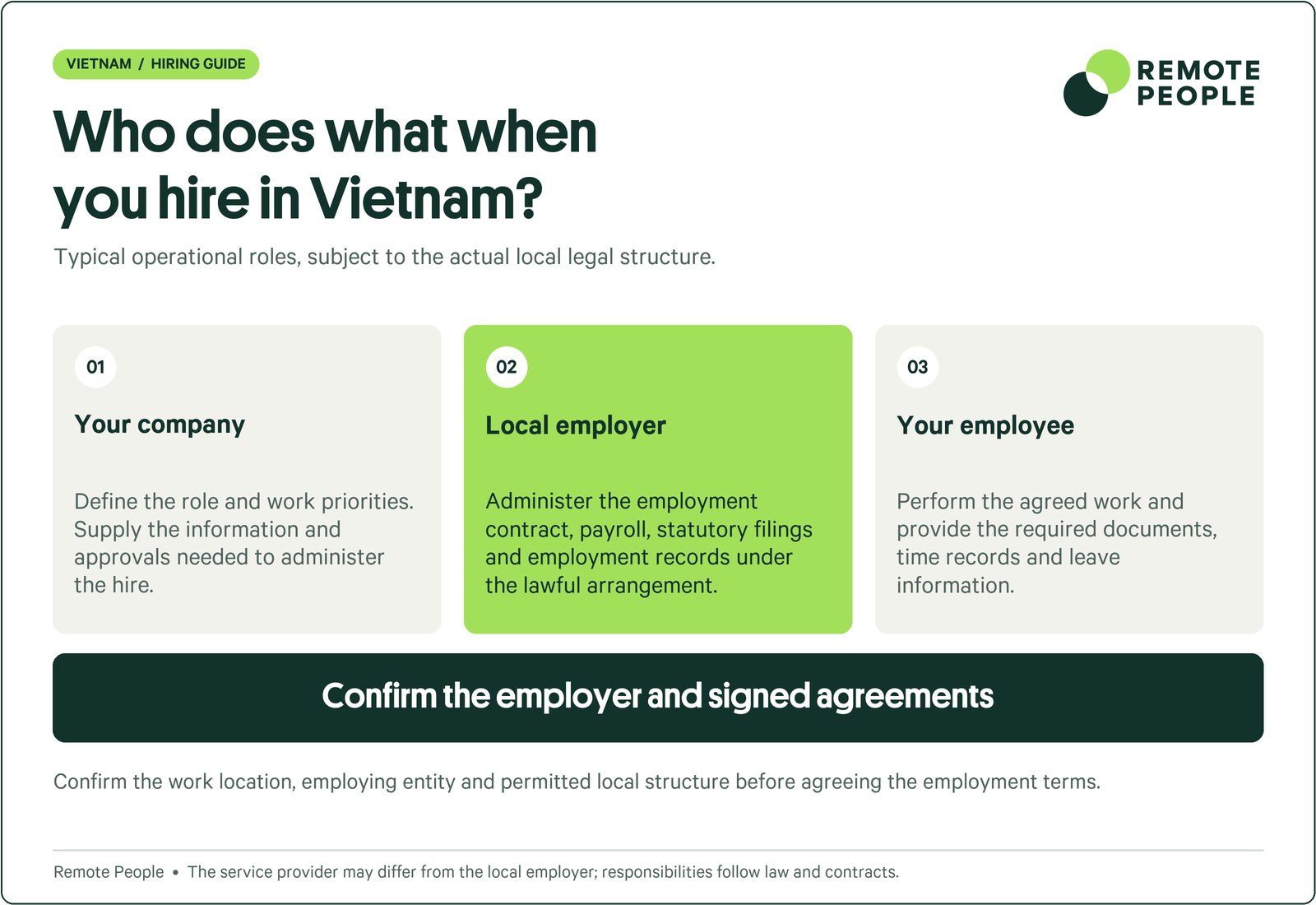
  2. An Employer of Record acts as the legal employer, handling contracts, payroll, tax submissions, and HR administration while your company directs the employee’s daily work. It’s a fast, compliant solution for entering the Vietnamese market.
  3. Vietnam offers access to a cost-efficient labor pool, especially in manufacturing, customer service, and IT.
  4. Remote People connects you with vetted, in-country EOR providers that specialize in Vietnamese labor compliance, contract management, and payroll delivery, ensuring smooth onboarding and full legal protection for your business.

Vietnam is one of Southeast Asia’s fastest-growing economies, with a GDP of $490.07 billion and projected annual growth of 5.8% in 2025. Its workforce of more than 51 million is young, increasingly skilled, and highly adaptable, especially in manufacturing, IT, and professional services. Cities like Ho Chi Minh City, Hanoi, and Da Nang have become regional hubs for foreign investment and business process outsourcing.

While Vietnam offers great hiring potential, employers must comply with local labor codes, register with tax and social insurance authorities, and adhere to strict standards for employment contracts, payroll, and employee benefits. For companies looking to hire quickly or operate without setting up a local business, an Employer of Record (EOR) in Vietnam offers a compliant and cost-effective solution. With an EOR, your business can legally hire Vietnamese employees without forming a local entity, thereby saving time, reducing costs, and eliminating compliance risks.

How to Hire Employees in Vietnam

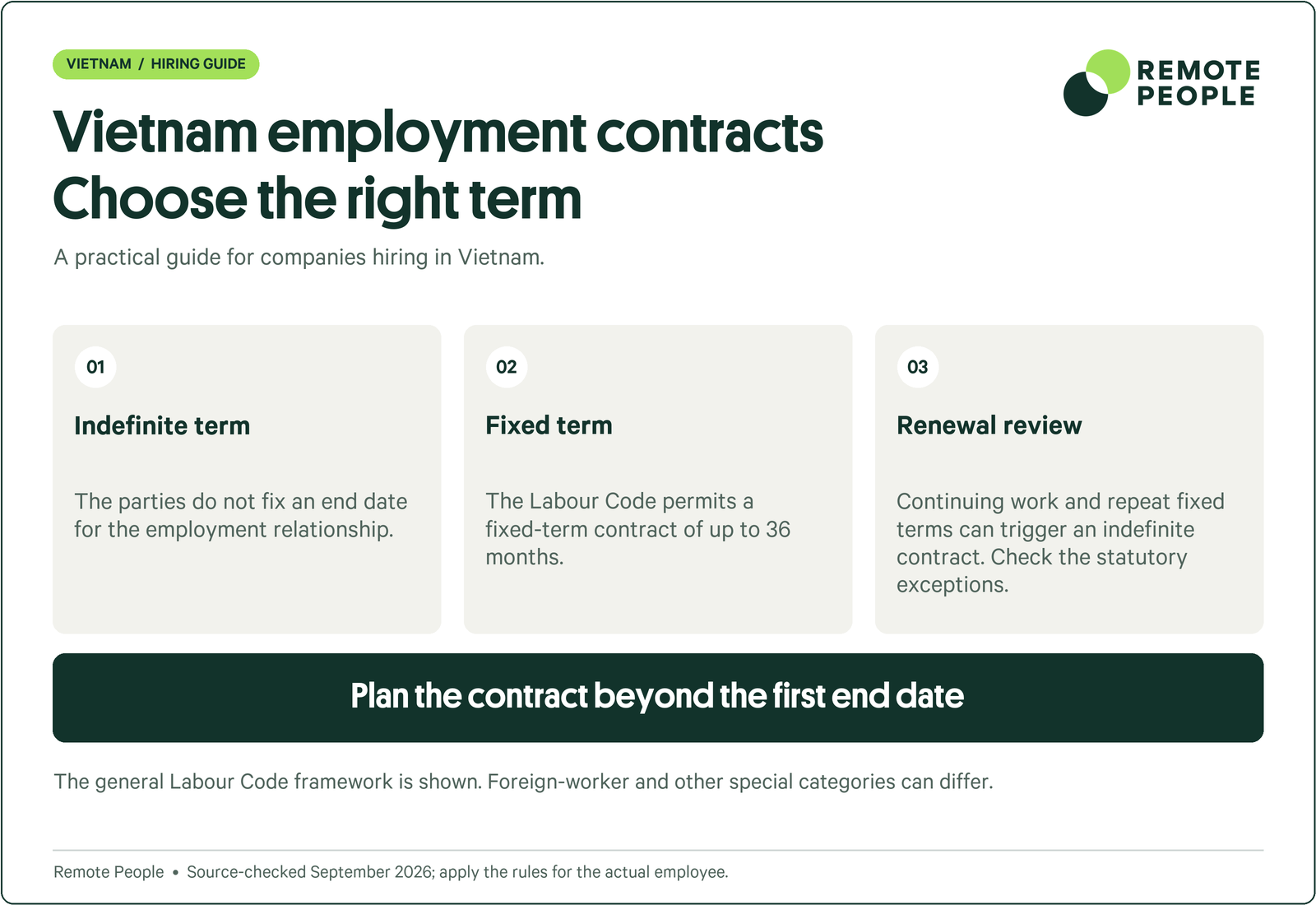
Vietnamese labor law requires that most employment relationships be formalized through written contracts and full registration with social security systems. Fixed-term and indefinite-term employment contracts are permitted, but the Labor Code favors long-term job security and places a high burden on employers for compliance.

According to the Ministry of Labor, Invalids and Social Affairs (MOLISA), failure to comply with onboarding or benefit registration requirements may result in penalties ranging from VND 20 million to 75 million (USD $800–$3,200) per violation.

Incorporating an Entity

Setting up a legal entity in Vietnam is a multi-step process that can take between 6 to 8 weeks. The most common legal structure for foreign investors is the Limited Liability Company (LLC), which allows for full foreign ownership and flexible profit distribution.

The steps to incorporate an entity in Vietnam are:

  1. Reserving a business name and registering with the Department of Planning and Investment (DPI)
  2. Applying for an Enterprise Registration Certificate (ERC)
  3. Registering for taxes with the General Department of Taxation
  4. Opening a local corporate bank account
  5. Signing a lease agreement for office premises
  6. Registering employees for social security, health, and unemployment insurance

Companies must also comply with Vietnam’s accounting regulations, including the use of the Vietnamese Accounting Standards (VAS), and maintain licensed accounting software approved by the Ministry of Finance. Failure to comply may result in tax audits or administrative sanctions.

Working with an Employer of Record (EOR)

An Employer of Record in Vietnam serves as the legal employer for your workforce while you retain operational control. The EOR signs employment contracts, registers employees for mandatory benefits, processes payroll, and ensures all reporting obligations are met with Vietnamese authorities.

This model is ideal for companies:

  • Expanding regionally without forming a local entity
  • Running short-term or pilot projects
  • Hiring one or more remote employees
  • Participating in donor-funded or government-linked projects that require local compliance

Vietnam’s labor regulations require strict adherence to rules on probation, working hours, severance pay, and holiday entitlements.

An EOR ensures every employee is hired in full compliance, including:

  • Registering with the SI, HI, and UI funds
  • Filing tax declarations and payroll reports with local authorities
  • Managing contracts, amendments, and terminations according to the Labor Code

EOR services typically include bilingual HR support, contract management, local dispute handling, and regular payroll processing. Most employees can be onboarded within 10 business days.

For foreign employers, using an EOR provides peace of mind, cost predictability, and full compliance with Vietnam’s increasingly sophisticated labor environment.

Hiring Independent Contractors

Vietnamese law permits the use of independent contractors, but the boundaries between employment and contract work are closely regulated. If a contractor performs tasks under the direction and supervision of the client, the arrangement may be considered de facto employment.

The tax rate for non-resident contractors is generally 20% on Vietnam-sourced income, and contracts must follow guidelines from the Law on Personal Income Tax. Misclassification of contractors can lead to retroactive tax liabilities and employee benefit claims.

Start hiring with a Vietnam EOR

Let us handle the complexities of hiring, compliance, and payroll in Vietnam while you focus on growing your team.

  • Hire employees in Vietnam with a Vietnam EOR
  • No local entity is needed
  • Pricing starts at USD 199 per employee
  • Remote People can also help you find the best talent in Vietnam

Using an Employer of Record in Vietnam

When engaging an Employer of Record in Vietnam, the EOR becomes the legal employer registered with local authorities, while your company supervises the employee’s tasks, performance, and integration into your team. The EOR ensures compliance with Vietnam’s Labor Code (Bộ luật Lao động) and fulfills all mandatory obligations around tax filings, social insurance, and employment documentation.

This includes drafting compliant labor contracts in Vietnamese, enrolling the employee in social insurance (Bảo hiểm xã hội – BHXH), health insurance (Bảo hiểm y tế – BHYT), and unemployment insurance (Bảo hiểm thất nghiệp – BHTN). The EOR is also responsible for managing the employee’s tax reporting with the General Department of Taxation (Tổng cục Thuế).

The EOR maintains HR records in accordance with Decree No. 145/2020/NĐ-CP, including timekeeping logs, leave records, and payroll documentation. In case of labor inspections or audits by the Ministry of Labour, Invalids and Social Affairs (Bộ Lao động – Thương binh và Xã hội), the EOR responds directly on behalf of the legal employer.

This arrangement allows foreign companies to hire compliantly in Vietnam without setting up a local entity, while gaining access to local HR expertise and a reliable administrative partner.

Employment and Labor Laws in Vietnam

Vietnamese employment is regulated under the Labor Code 2019 (Bộ luật Lao động 2019), which came into effect on January 1, 2021. This legislation governs employee rights, employer obligations, contract structures, working conditions, wages, leave entitlements, and termination rules.

The law applies to both Vietnamese and foreign employees working in Vietnam, and it mandates that all employment relationships be formalized in writing. The Labor Code emphasizes fair treatment, workplace safety, gender equality, and protection from unlawful dismissal.

Employers must comply with administrative obligations under Circular 10/2020/TT-BLĐTBXH and Decision 595/QĐ-BHXH, which govern labor registration and social insurance contributions. Businesses are also required to follow specific dispute resolution procedures via mediation or labor courts in case of conflict.

All labor-related documents must be maintained in Vietnamese and available for audit. Failure to meet labor standards can result in administrative fines ranging from VND 10 million to over VND 100 million (~USD $400 to $4,200), depending on the violation.

Employment Contract Requirements

The Labor Code mandates that all employment contracts in Vietnam be written in Vietnamese, even if a bilingual version is used. Contracts must be executed before the employee’s first day of work and must clearly outline terms and conditions as stipulated under Article 14 of the Labor Code 2019.

The key components of a compliant employment contract include:

  • Full names and contact details of both the employer and employee
  • Job title and detailed job description
  • Location of work
  • Term of contract
  • Salary information
  • Working hours and rest periods
  • Leave entitlements
  • Social insurance and tax obligations
  • Probation terms
  • Dispute resolution and termination clauses

Employers must retain a signed copy of the contract and issue one to the employee. Amendments to any contract terms require a formal addendum signed by both parties.

Standard Working Hours

According to Article 105 of the Labor Code 2019, standard working hours in Vietnam are capped at 8 hours per day and 48 hours per week. Employers are encouraged by the Ministry of Labour to adopt a 40-hour workweek, particularly in service-oriented sectors.

Working hours can be distributed across five or six days per week, depending on the employer’s operational needs. Flexible arrangements, such as compressed schedules or shift rotations, are permitted but must be outlined in the employment contract and comply with Article 107.

Overtime

Overtime in Vietnam is strictly regulated under Article 107 of the Labor Code. It must be mutually agreed upon in writing between the employer and employee, and cannot exceed:

TimeframeMaximum Overtime Allowed
Per Day12 hours
Per Month40 hours
Per Year200 hours (up to 300 hours for certain industries)

Overtime compensation rates are:

Day TypeOvertime Pay Rate
Weekdays150% of hourly wage
Weekends200% of hourly wage
Public Holidays300% of hourly wage

All overtime must be tracked, recorded, and included in payroll reports. Non-compliance with overtime rules can result in penalties under Decree 28/2020/NĐ-CP.

Probation Period

Article 25 of the Labor Code 2019 allows for a probation period, provided it is specified in the employment contract. The duration depends on the level of the role:

Role TypeMaximum Probation Period
Managerial and Executive RolesUp to 180 days
Positions Requiring a College Degree or HigherUp to 60 days
Roles Requiring Vocational or Intermediate-Level SkillsUp to 30 days
Unskilled LaborUp to 6 working days

During probation, either party may terminate the contract without notice or severance pay. However, employees must still be paid at least 85% of the agreed salary, and employers must document any dismissal decisions carefully.

Payroll and Employment Taxes in Vietnam

Fiscal Year

Vietnam follows a calendar-year fiscal cycle, running from January 1 to December 31. Employers must align their payroll reporting, tax declarations, and annual labor reports with this timeframe. Annual Personal Income Tax (PIT) finalization for employees is generally due by March 31 of the following year.

Payroll Cycles

In Vietnam, payroll is typically processed on a monthly basis, with salaries paid no later than the last working day of each month, as required by Article 96 of the Labor Code. Employers must clearly state the salary payment date in the employment contract. It is standard practice to pay employees via bank transfer in Vietnamese dong (VND), and pay slips must be provided showing gross salary, deductions, and net pay.

Minimum Wage

Vietnam’s minimum wage is set by region and reviewed annually by the National Wage Council. As of July 2024, the updated monthly minimum wages are:

RegionMonthly Minimum Wage
Region I (e.g., Hanoi, Ho Chi Minh City)VND 4,960,000 (~USD 203)
Region IIVND 4,410,000 (~USD 180)
Region IIIVND 3,860,000 (~USD 157)
Region IVVND 3,450,000 (~USD 140)

These minimums serve as the baseline for social insurance contributions and are used to calculate wages, allowances, and benefits. Employers must ensure that the agreed salary is at least equal to the regional minimum and complies with Decision 1926/QĐ-TTg.

Bonus Payments

While not mandated by law, the 13th-month salary, referred to as the “Tết Bonus”, is a widely observed practice in Vietnam. It is usually paid before the Lunar New Year (Tết Holiday) as a form of gratitude and retention incentive. Some companies also offer a 14th-month bonus based on performance.

Employer Tax Contributions

Employers and employees in Vietnam contribute to three key funds: Social Insurance (SI), Health Insurance (HI), and Unemployment Insurance (UI).

Contributions are calculated based on the employee’s monthly gross salary but capped at 20 times the regional minimum wage for SI and HI, and at 20 times the national minimum wage for UI.

Contribution TypeEmployer RateNotes
Social Insurance (SI)17.5% 
Health Insurance (HI)3.0% 
Unemployment Insurance (UI)1.0%Mandatory for Vietnamese employees with labor contracts
Trade Union Fee2.0%Paid to the local trade union branch (compulsory for entities with unions)

Employee Payroll Contributions

Employees are responsible for contributing to the same social insurance funds. Rates are deducted from gross monthly salary as follows:

Contribution TypeEmployee Rate
Social Insurance (SI)8%
Health Insurance (HI)1.5%
Unemployment Insurance (UI)1%

Individual Income Tax Contributions

In addition, employees pay Personal Income Tax (PIT) based on their taxable income. Tax residents (those living in Vietnam ≥183 days/year) are taxed on worldwide income; non-residents are taxed only on Vietnam-sourced income.

Taxable Income (VND)Rate
Up to 5,000,0005%
5,000,001 – 10,000,00010%
10,000,001 – 18,000,00015%
18,000,001 – 32,000,00020%
32,000,001 – 52,000,00025%
52,000,001 – 80,000,00030%
Above 80,000,00035%

Non-residents are subject to a flat PIT rate of 20% on income earned in Vietnam.

Time Off and Leave in Vietnam

Mandatory Leave Entitlements

Under Article 113 of Vietnam’s Labor Code 2019, employees who have worked for 12 consecutive months are entitled to a minimum of 12 days of paid annual leave. This entitlement increases by one additional day for every five years of service with the same employer.

Employees working in hazardous, dangerous, or physically demanding jobs, as well as those under 18 years of age, are entitled to 14 to 16 days of annual leave depending on the risk classification of the role.

Unused annual leave can be carried over to the next year if not used due to operational needs. If an employee terminates their employment before using their leave, the employer must pay compensation equivalent to the unused leave days.

Public Holidays

Vietnam observes 11 official public holidays each year, with paid time off granted to all employees. When a public holiday falls on a weekend, employees are entitled to a compensatory day off on the following weekday. During Tết, many businesses close for up to 7–10 days. Employers must notify employees of holiday schedules in advance, especially for operations that require shift work or continuous production.

Employees working on public holidays are entitled to 300% of their normal wage, excluding base salary if it falls under a rest day agreement.

Sick Leave

Sick leave entitlements in Vietnam are governed by the Law on Social Insurance. Employees who suffer from illness or accidents unrelated to work may claim paid sick leave, funded by the Social Insurance Fund. Entitlement depends on years of social insurance contribution:

Years of ContributionAnnual Paid Leave
Under 15 years30 working days per year
15–30 years40 working days per year
Over 30 years60 working days per year

The benefit is typically 75% of the employee’s average salary for the previous 6 months and must be certified by a licensed medical facility. Employers must submit claims to the Social Insurance Authority for reimbursement.

Parental Leave

Vietnam provides generous parental leave benefits as outlined in the Social Insurance Law (Law No. 58/2014/QH13):

  • Maternity Leave: Female employees are entitled to 6 months of paid maternity leave. In cases of multiple births, an additional 1 month is granted per additional child. The benefit is paid at 100% of the employee’s average salary, funded by social insurance.
  • Paternity Leave: Male employees receive between 5 to 14 days of paid paternity leave, depending on the number of children and whether the birth is natural or via cesarean.

To receive these benefits, both the employee and the employer must have contributed to social insurance for at least six consecutive months prior to the leave.

Bereavement Leave

Employees are entitled to 3 paid days off in the event of the death of an immediate family member, including parents (biological or adoptive), spouse, or children. This is mandated under Article 115 of the Labor Code.

Terminations and Severance in Vietnam

Employing a Vietnam Employer of Record provides numerous advantages for companies that are looking to establish a presence in the country without the difficulty and cost of setting up their legal entity. Here are some of the main benefits:

Termination

Employment in Vietnam may be terminated through mutual agreement, expiration of a definite-term contract, or unilateral termination by either party for reasons permitted under the Labor Code.

Employers must provide clear documentation and follow due process, including consultation with the trade union (if applicable). Terminations without a legal basis may result in reinstatement or compensation equal to at least two months’ salary.

Notice Periods

Under Article 35 of the Labor Code, employees and employers must observe the following notice periods for unilateral termination:

Contract TypeMinimum Notice Period
Indefinite-Term Contracts45 days
Definite-Term Contracts (12–36 months)30 days
Seasonal or Project-Based Contracts (under 12 months)3 working days

Failure to comply with notice periods may result in the party at fault being required to compensate the other party. Exceptions apply in cases of gross misconduct or breach of contract terms.

Employees are entitled to receive all due compensation, unused leave, and severance pay upon termination. These must be paid no later than 14 working days after the termination date, as mandated by Article 48 of the Labor Code.

Why Hire in Vietnam with an EOR?

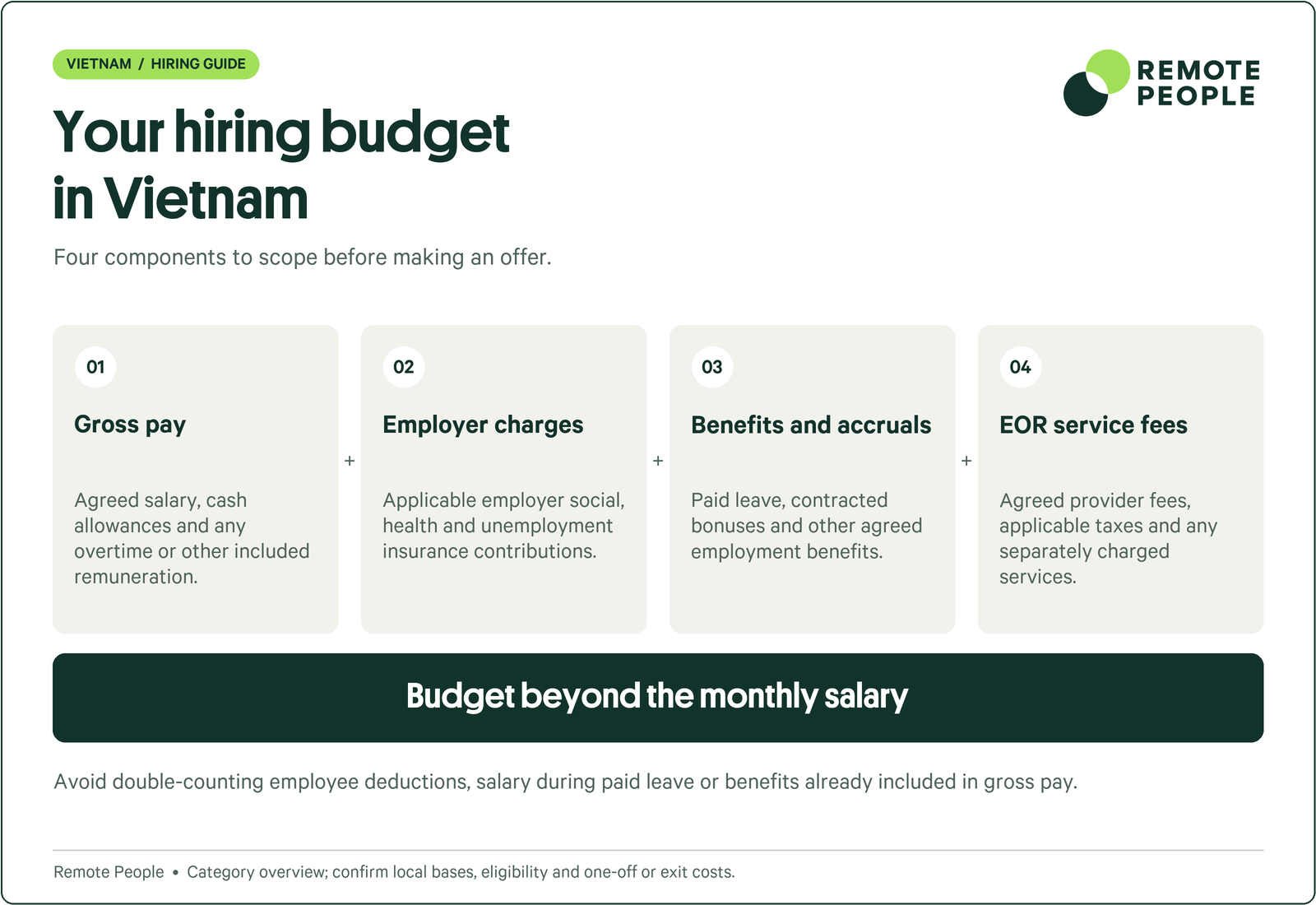
Using an Employer of Record (EOR) allows companies to hire legally in Vietnam without establishing a local entity. The EOR becomes the legal employer and handles all labor-related responsibilities, including employment contracts, payroll processing, tax declarations, insurance enrollment, and severance procedures. This is particularly valuable in Vietnam, where contributions alone account for over 20.5% of the gross salary on the employer side, and violations of the Labor Code can result in audits or fines.

An EOR provides fast access to talent, onboarding employees in as little as 7 to 10 business days, while ensuring compliance with Vietnamese labor law, including regulations on working hours, leave entitlements, and employment termination. It’s a flexible, risk-free solution for entering the Vietnamese market or managing distributed teams across APAC without building in-house HR or legal infrastructure.

How to Choose an EOR in Vietnam

Choosing the right EOR in Vietnam is essential for ensuring both compliance and operational efficiency. Here are some things to look for when choosing an EOR:

Vietnam-Specific Legal Expertise

The EOR should have in-house legal professionals fluent in Vietnamese labor law, including the Labor Code 2019, Decree 145/2020/NĐ-CP, and social insurance regulations. 

Fully Compliant Payroll Infrastructure

Look for providers who can handle full statutory compliance, such as contributing to social insurance (BHXH), health insurance (BHYT), and unemployment insurance (BHTN).

Local Entity Registration

Ensure your EOR partner operates a fully registered Vietnamese company capable of acting as the legal employer for tax and labor authorities. 

Transparent HR Support and Benefits Management

A reliable EOR should handle all aspects of HR administration, including onboarding, leave tracking, 13th-month bonus management, sick leave claims, and severance pay, all in accordance with national laws and local norms.

Expand into Vietnam Easily with Remote People’s Employer of Record in Vietnam

Expanding into Vietnam? You don’t need to navigate the local legal maze on your own. Partnering with a Vietnam Employer of Record (EOR) takes the weight of HR, compliance, and payroll off your shoulders, so you can stay focused on growth.

An EOR acts as your local employment expert, managing contracts, benefits, tax obligations, and labor law compliance from end to end. It’s a smart, low-risk way to enter the Vietnamese market without setting up a legal entity.

By streamlining the hiring process and reducing operational headaches, an EOR helps you move faster, stay compliant, and make the most of Vietnam’s growing talent pool and business opportunities.

An EOR handles complex legalities and HR tasks, ensuring that your business complies with local laws while minimizing any operational risks. By taking advantage of the expertise of an EOR, companies can more effectively tap into Vietnam’s promising market, which can make the most of both time and resources to enhance their competitive edge and success in the Vietnamese market.

Remote People provides tailored EOR solutions in Vietnam to help you expand with confidence. We assess your hiring needs, ensure compliance, and deliver support aligned with your industry and budget—so you can focus on growing your team, not navigating regulations.