Recruit
Employer of Record (EOR) in the Maldives
-
 Drew Donnelly
- Published
- July 21, 2026
RemotePeople’s employer of record in Maldives lets you hire employees in Maldives without complex statutory burden. We handle mandatory Retirement Pension Scheme enrollment with 7% employer contribution and 7% employee contribution, plus 30 days annual paid leave and 60 days maternity leave.
Hire in Maldives — book a free 30-minute demo
No sales call required. Free 30-minute expert call if you want one.
Tell us about your company
So we can match you with a specialist who knows your market — and unlock volume pricing tiers.
* All fields are required.
Where and when are you hiring?
Tell us the geography and timing and we'll quote each country line by line, with onboarding timelines.
* All fields are required.
Help us beat your current setup
We'll benchmark your current deal and send a line-by-line proposal in 24 hours — showing exactly where we cut cost, time, or risk. After you submit, you can book a call to walk through it together.
* All fields are required.
Thanks! Your proposal is on its way.
Expect a tailored, line-by-line proposal in your inbox within 24 hours. In the meantime…
Want to walk through it together?
Book a free 30-minute call with one of our specialists. We'll explain every line, answer your questions, and tailor the proposal further if you need.
No obligation. Pick a time that works for you.








- Hire in Maldives — book a free 30-minute demo
- Tell us about your company
- Where and when are you hiring?
- Help us beat your current setup
- Thanks! Your proposal is on its way.
- How an Employer of Record Works in the Maldives
- Employment Laws and Regulations in the Maldives
- Work Permits and Visas in the Maldives
- Payroll, Taxes, and Social Security in the Maldives
- Cost of Hiring Through an EOR in the Maldives
- Benefits of Using an EOR in the Maldives
- Termination and Offboarding in the Maldives
- EOR vs. Other Hiring Models in the Maldives
- Public Holidays in the Maldives
- How to Get Started with an EOR in the Maldives
- Where companies hiring in the Maldives expand next
- Frequently Asked Questions
- Related EOR Destinations

Start hiring in Maldives
Let RemotePeople handle payroll, compliance, and HR admin worldwide so you can focus on building your team.

The Maldives presents unique opportunities for companies seeking to expand into South Asia. With a stable business environment and a growing economy centered on tourism and financial services, many organizations are eager to establish operations there. For companies looking to hire employees in the Maldives, navigating the employment regulatory framework, work permit requirements, and tax obligations can present significant challenges.
An employer of record in the Maldives can handle these complexities on your behalf, enabling you to focus on building your team while ensuring full compliance with local labor laws.
How an Employer of Record Works in the Maldives
What Is an EOR?
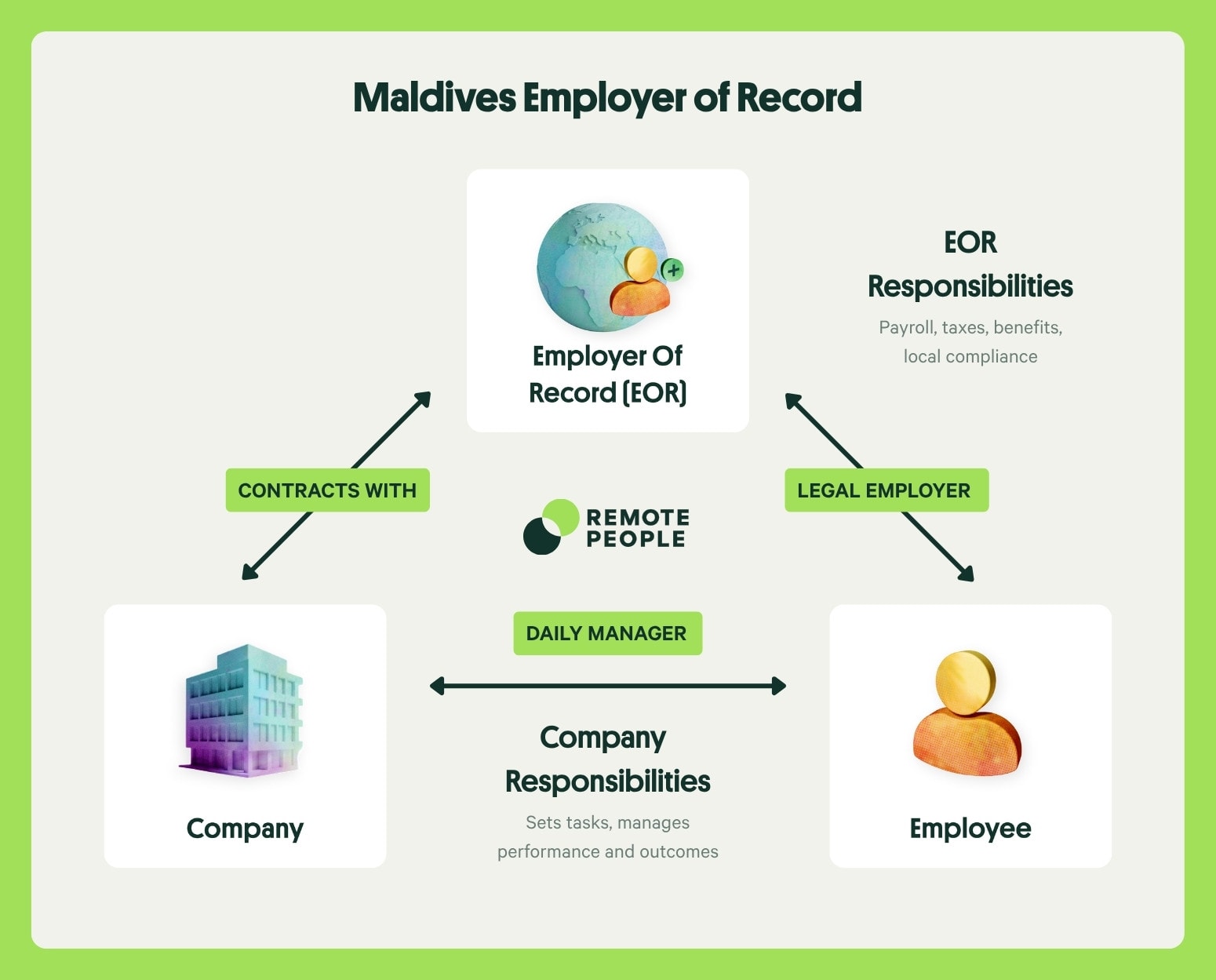
Who Uses an EOR in the Maldives?
Companies of all sizes and industries leverage EORs to establish or expand operations in the Maldives. Specific use cases where an EOR becomes particularly valuable include:
- Startups and scale-ups expanding into the Maldives for the first time, seeking to avoid the overhead and complexity of setting up a local legal entity while building an initial team.
- Remote-first and technology companies hiring distributed talent in the Maldives without establishing a physical office or corporate presence in the country.
- Professional services firms (consulting, accounting, legal) that need localized employment arrangements for client-facing staff while maintaining operational headquarters elsewhere.
- Tourism and hospitality businesses requiring rapid onboarding of seasonal or project-based employees across multiple locations without managing individual employment relationships directly.
Typical Onboarding Timeline
Hiring your first employee through an EOR in the Maldives typically follows this sequence:
- Initial consultation and contract review with the EOR (1–2 business days).
- Job description finalization and employee selection by your organization (timeline varies based on your hiring process).
- Work permit and visa application submission to immigration authorities (7 business days for commercial category visas under standard processing).
- Employment contract preparation, translation to Dhivehi if necessary, and employee signature collection (3–5 business days).
- MIRA registration and tax withholding setup once employment commences (completed before first payroll).
- Payroll system enrollment and first salary payment processing (within your defined payroll cycle).
- Pension scheme enrollment if applicable, and benefits administration activation (concurrent with payroll setup).
Hire in the Maldives
Low employer contributions (7% pension only), a streamlined digital visa system, no unemployment insurance burden, and a growing talent pool in tourism and professional services make the Maldives a cost-effective expansion market.
We handle employment contracts, payroll, tax withholding, and full Maldives compliance.
No local entity needed. Your team can start in days.
Employment Laws and Regulations in the Maldives
Employment Contracts
The Maldives requires employment relationships to be formalized through written contracts that comply with the Employment Act (Law No. 2/2008, as amended in 2024). These contracts form the legal foundation for the employment relationship and must be provided to the employee within one month of commencing work, though best practice is to execute the agreement before the first day.
All employment contracts must be in Maldivian Dhivehi language and specify compensation amounts in Maldivian Rufiyaa (MVR). Required contract elements include: the employee’s name and identification number, employment status (whether full-time, part-time, or fixed-term), start date, compensation structure and payment frequency, detailed job description, working hours, and any agreed overtime arrangements. Foreign workers typically have contracts in both English and Dhivehi for clarity, though the Dhivehi version is the legally binding document.
The contract should clearly outline the notice period applicable to the employee based on service length under Section 22 of the Employment Act. Employers may also include non-compete and confidentiality clauses, provided they align with permissible post-employment restrictions agreed to by both parties. Any probationary period must be explicitly stated, with a maximum duration of three months as per Section 14 of the Employment Act.
Working Hours and Overtime
The standard working week in the Maldives is 48 hours across no more than 6 days, with employees entitled to a minimum of one rest day per week. Daily working hours typically do not exceed 8 hours, though employers may structure the 48-hour weekly total across fewer or more days if agreed in writing. Employees are entitled to a 30-minute meal break after five consecutive hours of work, and a 15-minute prayer break is also standard practice in observance of Islamic practices.
Overtime compensation is mandatory when work exceeds the standard 48-hour week or 8-hour day, and rates vary depending on when the overtime is performed. The following table outlines overtime rates and applicable limits under Section 33 of the Employment Act:
Maldives overtime and premium pay rates · Per Employment Act (Law No. 2/2008) |
|||
Hour Type |
Rate Multiplier |
Weekly/Daily Cap |
Notes |
|---|---|---|---|
Weekday overtime |
1.25x base wage |
No statutory limit |
Hours worked beyond 8 per day or 48 per week on Monday–Thursday |
Friday overtime |
1.5x base wage |
No statutory limit |
Friday is typically a rest day; work on Friday triggers premium rate |
Rest day work |
1.5x base wage |
No statutory limit |
Any work performed on the employee’s designated weekly rest day |
Public holiday work |
1.5x base wage |
No statutory limit |
Work on gazetted public holidays, including Islamic and national observances |
Overtime compensation must be paid in full during the pay period in which it is earned or, by written agreement, added to the following payroll period. Employers cannot offset overtime pay with compensatory time off without explicit written consent from the employee.
Minimum Wage
The Maldives established its first statutory minimum wage in Maldives effective January 1, 2022, through the Minimum Wage Order issued under Sections 59–61 of the Employment Act. The minimum wage structure is tiered based on employer size and sector, and applies exclusively to Maldivian workers; foreign workers may be paid according to market rates or contractual agreements provided they meet or exceed local minimum standards.
The four-tier minimum wage framework is as follows: large businesses with 100 or more employees and annual revenue exceeding MVR 20 million must pay at least MVR 8,000 per month; medium-sized businesses and civil service employees receive MVR 7,000 per month; small businesses are required to pay MVR 4,500 per month; and the tourism sector is mandated to pay MVR 7,000 per month. A Minimum Wage Advisory Board was established in July 2024 to review and adjust these rates, with a review expected by the end of 2025 (Ministry of Economic Development).
For foreign workers, compensation is negotiated directly with the employer subject to market conditions and individual qualifications. However, offering significantly lower wages to foreign nationals than to Maldivian workers in equivalent roles may trigger regulatory scrutiny, particularly as part of quota and employment equity reviews. An EOR can advise on competitively aligned compensation packages that comply with local norms.
Probation Period
The Employment Act permits employers to establish probation period rules for new employees, but this period is limited to a maximum of three months from the start date. During probation, either the employer or the employee may terminate the employment relationship without providing notice, creating maximum flexibility for both parties to assess fit. However, any termination during probation must still comply with non-discrimination requirements and cannot be based on protected characteristics.
Probationary terms must be explicitly stated in the employment contract before work commences. If no probation clause is included in the contract, the employment is deemed permanent from day one, and standard notice periods under Section 22 apply immediately. Employers should be cautious about extending probation beyond three months or attempting to apply probationary terms retroactively, as this violates the Employment Act and can result in regulatory sanctions.
Employees on probation remain entitled to all statutory entitlements including minimum wage, working hour limits, and rest days. The only substantive difference is the flexibility in termination without notice; all other employment rights and obligations apply equally. An EOR ensures that probationary arrangements are properly documented and that probationary employees are not subject to reduced benefits or wage treatment that would violate labor standards.
Leave Entitlements
The Maldives offers a generous statutory leave framework with annual leave, sick leave, maternity and paternity leave, family responsibility leave, pilgrimage leave, and bereavement leave. All leave entitlements are calculated based on service period and individual circumstances, and you’ll need to track accrual and usage carefully. Here’s what each category covers:
Annual Leave
Employees are entitled to 30 days of paid annual leave per calendar year, provided they have completed at least one year of continuous service with the employer. Annual leave accrues at a rate of 2.5 days per month (30 ÷ 12), allowing employees to take leave proportionally throughout the year if management approves. Employees who have completed less than one year of service typically accrue leave on a pro-rata basis but may not take the leave until the first anniversary date, unless the employer permits early usage.
Annual leave that accrues but is not taken by the end of the calendar year carries forward to the following year; however, employers may limit carryover to prevent indefinite accumulation. If employment terminates, the employer must pay out all accrued and unused annual leave at the employee’s regular wage rate, pro-rated if the employee has not completed a full year. Annual leave is distinct from the employee’s regular weekly rest days and is granted in addition to statutory rest days.
Sick Leave
Employees are entitled to 30 days of sick leave per calendar year. The first 15 days of sick leave are paid at 100 percent of the employee’s regular wage, while the subsequent 15 days are paid at 50 percent of the regular wage. Sick leave must be supported by medical certification if the absence exceeds three consecutive days, and the employer may request a medical examination conducted by a government-approved physician if there is reasonable doubt about the validity of the claim.
Sick leave does not carry over to the following year; any unused portion is forfeited at the end of the calendar year. However, if an employee uses only part of their 100-percent-paid sick leave allowance, the remainder of those first 15 days does not reduce the allowance in future years. Employers cannot require employees to use annual leave or other leave types in place of sick leave, even if sick leave is exhausted.
Maternity Leave
Female employees are entitled to 60 days of paid maternity leave, consisting of 30 days before the expected delivery date and 30 days after actual delivery. An additional 28 days of maternity leave may be granted if medically certified by a physician as necessary for recovery from complications or medical conditions related to pregnancy or childbirth. Maternity leave is counted from the actual date of delivery, not the expected date, and the 30 pre-delivery days begin from a date specified by the employer or agreed upon by the employee.
Employees must notify the employer of their intent to take maternity leave and provide medical documentation of the expected delivery date and any post-delivery medical requirements. The employer remains responsible for holding the employee’s job or offering suitable alternative work on return from maternity leave. Maternity leave is fully paid and does not reduce the employee’s accrued annual leave entitlements.
Paternity Leave
Male employees are entitled to three days of paid paternity leave from the date of birth of their child. This leave must be taken within a reasonable period after the birth, typically within one to two weeks, though the employer and employee may agree on the specific timing. Paternity leave is a statutory right and cannot be substituted with other leave types or deferred to a later date.
Other Statutory Leave
Family responsibility leave allows employees up to 10 days of paid leave per calendar year to attend to family matters, such as caring for a sick family member or attending funerals. Hajj leave (pilgrimage to Mecca) is granted once during an employee’s tenure and is paid; the exact duration is typically agreed between employer and employee but is customarily one to two weeks. Bereavement leave for the death of close family members is provided for a period determined by employer policy and individual circumstances, though it is typically three to five working days.
Leave entitlements in the Maldives are structured to support employee well-being and religious observance. The following table summarizes all statutory leave types, durations, and eligibility criteria:
Maldives statutory leave entitlements · Per Employment Act (Law No. 2/2008) |
||
Leave Type |
Duration |
Eligibility & Notes |
|---|---|---|
Annual Leave |
30 days/year |
Requires 1 year service; accrues 2.5 days/month; unused leave paid out on termination |
Sick Leave |
30 days/year (15 days @ 100%, 15 days @ 50%) |
First 15 days paid in full; balance at 50% wage; medical certification required if >3 days |
Maternity Leave |
60 days (30 pre + 30 post) + 28 additional days if medically certified |
Female employees; fully paid; job held on return; must provide delivery date documentation |
Paternity Leave |
3 days |
Male employees from date of child birth; paid; must be taken within reasonable period of delivery |
Family Responsibility Leave |
10 days/year |
Paid leave for family care or emergencies; timing agreed with employer |
Hajj/Pilgrimage Leave |
Negotiated (typically 1–2 weeks) |
Paid; granted once during employment; timing coordinated with employer |
Bereavement Leave |
3–5 working days (per policy) |
Paid; for death of close family members; duration per employer policy or contract |
Statutory Employee Benefits
Beyond wage and leave entitlements, the Maldives requires employers to provide or contribute to several statutory benefits that form part of the total compensation package. The Maldives Retirement Pension Scheme (MRPS) is the primary retirement benefit system, to which both employers and employees contribute. Employees contribute 8 percent of gross salary, while employers contribute 7 percent, making the combined rate 15 percent.
Contributions commence from the first day of employment and are mandatory for all employees, regardless of employment status or contract duration (Maldives Retirement Pension Scheme).
Employers must also provide workplace safety and health protections in compliance with occupational safety standards, and provide medical insurance or access to healthcare for employees. While the Maldives does not mandate a single national health insurance scheme, most employers either provide group health insurance or reimburse employees for private healthcare costs. Some employers offer additional voluntary benefits such as life insurance, disability coverage, or housing allowances, which are negotiated individually or through collective agreements.
End-of-service benefits are not separately mandated in the Employment Act; however, employers should clarify whether severance or gratuity payments are part of the individual employment contract or any applicable collective agreement. Annual leave payout upon termination is mandatory and non-negotiable, calculated at the employee’s regular wage rate for all accrued and unused days. These statutory and customary benefits are factored into total cost-of-employment calculations when budgeting for Maldivian operations.
Recent Regulatory Updates (2026)
Maldivian employment regulation has undergone significant regulatory changes in 2024–2025 that affect foreign worker employment and compliance. In 2024, the 8th Amendment to the Employment Act introduced new employer registration requirements for foreign workers, imposing an MVR 50,000 penalty per foreign employee for employers who fail to meet registration obligations or are found to be negligent in compliance (Presidency of Maldives).
Regulation 2025/R-120 (issued December 14, 2025) by the Ministry of Economic Development and Trade introduced a phased five-year elimination of foreign worker quotas across 15 professions, aiming to prioritize Maldivian employment in sectors such as hospitality, construction, and service industries. However, micro, small, and medium enterprises (MSMEs) are granted 20 free quota slots per year to support their hiring flexibility. The regulation also expanded inspection powers, allowing authorities to conduct unannounced workplace audits to verify compliance with employment terms and quota restrictions.
The Maldives also launched a digital work visa system through the Xpat Portal in 2025. As of November 23, 2025, all work visa processing happens exclusively through the digital portal; paper applications are no longer accepted. The e-Visa system cuts processing time to 48 hours and provides automated status tracking, but you need to submit documents accurately through the portal to avoid delays.
These changes make it critical to partner with an EOR or immigration specialist who stays current with regulations and keeps you compliant.
Work Permits and Visas in the Maldives
Work Permit Requirements
Who Needs a Work Permit
All foreign nationals seeking to work in the Maldives must obtain a valid work permit and employment visa. This requirement applies regardless of employment duration, whether the role is full-time, part-time, project-based, or temporary. Even remote workers who are physically located in the Maldives and earning income within the country are required to hold a valid work visa and work permit.
Tourist visas do not authorize any form of paid employment, and violations can result in deportation and employment bans.
Maldivian citizens do not require work permits to work domestically; however, employers must still register Maldivian employees with the Labour Relations Authority and ensure compliance with all employment contract and benefit requirements. The distinction between domestic and foreign worker permits affects the quota allocation system and employer registration obligations.
Eligibility and Required Documents
To obtain a work permit in the Maldives, a foreign worker must be sponsored by a registered employer who has applied for the permit on their behalf. The employer must be registered with the Labour Relations Authority and in good standing with tax obligations to MIRA. Required documentation typically includes: a completed work permit application form; a valid passport with at least six months validity remaining; a medical clearance certificate from an approved clinic confirming the absence of communicable diseases; a clean criminal record or police clearance certificate from the employee’s country of origin; educational qualifications and professional credentials relevant to the position; and an employment contract in English and Dhivehi specifying the terms of employment.
The employer must also provide documentation demonstrating business registration, proof of financial capacity to pay the employee’s salary, and a detailed job description outlining the role and justification for hiring a foreign worker (particularly relevant under Regulation 2025/R-120’s quota restrictions). In cases where the employer is hiring a worker in a sector subject to quota limitations, the employer must confirm availability of free quota slots or demonstrate that the hire qualifies for an exemption (such as MSME status).
Processing Time and Validity
Processing timelines vary depending on the visa category. The Commercial Category EA visa, which is the most common work permit type for general employment, is processed within 7 business days through standard procedures. Once approved, the work permit itself is typically valid for up to 90 days, during which the employer must complete visa renewal paperwork.
The renewed work visa allows the employee to reside and work in the Maldives for up to one year from issuance.
The new Xpat Portal system processes e-Visa applications within 48 hours of submission, conditional on all required documents being complete and accurate. Employers must submit applications through the portal rather than through paper-based channels. The faster processing timeline means that initial planning and document preparation are critical; incomplete applications may be rejected or returned with requests for corrections, extending the timeline beyond the stated 48 hours.
Renewal Process
Work visas must be renewed annually, and the renewal process typically commences 60 days before the current visa expires. The employer submits a renewal application through the Xpat Portal, providing an updated employment contract if there have been changes to job duties or compensation, a medical clearance certificate (renewed annually), and confirmation that the employee continues to meet eligibility criteria. During the renewal period, the employee may continue working provided the employer has submitted a timely renewal application and the work is substantially unchanged from the prior year.
If a work visa expires without renewal, the employee enters unlawful status and must cease work immediately. Any continued employment after expiration exposes the employer to significant penalties, including fines per employee and potential work visa suspension. Employers should implement calendar reminders and coordinate with their EOR or immigration partner to ensure renewals are initiated well before expiration dates.
Common Visa Types for Foreign Workers
Work visa categories in the Maldives vary by employment type and business structure. Here’s a breakdown of the main visa types, how long they last, when to use them, and processing times:
Maldives work visa types for foreign workers · 2026 |
||||
Visa Type |
Duration |
Best For |
Renewal |
Processing |
|---|---|---|---|---|
Commercial Category EA |
Up to 1 year |
Standard employment in private sector; tourism, hospitality, professional services |
Annual renewal; subject to quota availability |
7 business days (standard); 48 hours via e-Visa |
Government Category EA |
Up to 1 year |
Employment with government agencies, ministries, or state-owned enterprises |
Annual renewal; subject to government staffing quotas |
7–14 business days |
Domestic Category EA |
Up to 2 years |
Domestic workers (housekeeping, childcare, elderly care) employed by private households |
Renewal every 2 years; separate quota track |
14 business days |
Business Visa |
Up to 30 days (extendable to 60 days) |
Business visitors, consultants, project managers; does not authorize employment below 50% Maldivian staff in employer firm |
Not a work authorization; separate visa from employment permit |
2–3 business days |
Golden Visa/Investor Visa (from July 1, 2025) |
5 years (renewable) |
Foreign investors with minimum USD 250,000 investment; allows work and residence |
5-year renewal; investment requirement maintained |
15–30 business days |
Source: Maldives Immigration Work Visa and Quota Information |
||||
Commercial Category EA visas are the most widely used for standard employment relationships. Government Category visas are restricted to roles within public sector entities and follow separate quota allocations. Domestic Category visas are designed specifically for household workers and benefit from longer validity periods (up to two years) and separate quota tracking.
The Business Visa category allows foreign nationals to engage in business development activities but does not authorize employment unless the sponsoring business maintains a Maldivian staff composition of 50 percent or higher.
The recently introduced Golden Visa (effective July 1, 2025) targets high-net-worth individuals and strategic investors seeking long-term residence and work authorization. With a minimum investment of USD 250,000, this visa category offers five-year validity with automatic renewal rights, making it attractive for entrepreneurs and senior executives establishing operations in the Maldives. However, the visa requires proof of continued investment and compliance with Maldivian business law.
How an EOR Handles Work Permits
Work permits and visas are among the most complex and time-sensitive parts of hiring in the Maldives, and this is where an EOR proves its real worth. The EOR handles work permit applications, document collection, liaison with immigration authorities, status tracking through the Xpat Portal, and keeps you in the loop on timelines and outcomes.
The EOR makes sure all documents meet current standards, translations are accurate and notarized where needed, and submissions go through the right channels. Since regulations and quota rules change frequently (2024 Amendment, 2025 Regulation), an EOR stays current on what you need to do and advises on the right visa category for your employee’s role. If an application gets rejected or needs more info, the EOR handles the resubmission.
An EOR also manages visa renewals proactively, keeping a calendar of expiration dates and submitting renewal applications well in advance so your employees stay legal. They track quota availability and advise on hiring restrictions under Regulation 2025/R-120, so you know which roles have quota caps and which (like MSME exemptions) have easier approval. This proactive approach prevents compliance gaps and keeps your team’s work authorization uninterrupted.
Payroll, Taxes, and Social Security in the Maldives
Payroll and tax in the Maldives is straightforward: moderate employer contributions and progressive income taxation. Employer pension contributions and employee withholding both go to the Maldives Inland Revenue Authority (MIRA) and the Maldives Retirement Pension Scheme (MRPS) by the 15th of the following month.
Employer Contributions
Maldivian employers contribute primarily through the mandatory Maldives Retirement Pension Scheme (MRPS), which represents the country’s main social security obligation. Unlike many regional jurisdictions, the Maldives has no separate unemployment insurance, health insurance, or workers’ compensation withholding requirements for employers, significantly simplifying payroll compliance.
Maldives employer social security contributions · 2026 rates |
||
Contribution |
Rate |
Notes |
|---|---|---|
Maldives Retirement Pension Scheme (MRPS) |
7% of pensionable wage |
Mandatory for all employees; calculated on monthly salary excluding bonuses |
Total Employer Contribution |
7% |
Lowest regional burden; no additional mandatory contributions |
Employee Contributions
Employees in the Maldives contribute to the MRPS at the same 7% rate as employers, plus progressive income tax withheld by the employer. The pension contribution is calculated on the monthly base salary and is deducted before income tax calculation, reducing the taxable income base for employees in higher brackets.
Maldives employee payroll deductions · 2026 monthly withholdings |
||
Deduction |
Rate |
Notes |
|---|---|---|
Maldives Retirement Pension Scheme (MRPS) |
7% of pensionable wage |
Deducted before income tax; reduces taxable income base |
Income Tax Withholding |
0–15% (progressive) |
Applied to income after pension deduction; see tax brackets below |
Total Employee Deduction (minimum) |
7% + progressive tax |
Combined withholding for payroll compliance |
Sources: MIRA Employer Withholding Guide; MRPS |
||
Income Tax
Income tax in the Maldives is progressive across five brackets (0–15%). It’s calculated on annualized income after the 7% MRPS pension deduction, so employees earning below MVR 60,000 per month (approximately USD 3,890) pay no income tax. Lower earners get genuine tax relief.
Maldives income tax brackets · 2026 |
|
Annual Taxable Income (MVR) |
Tax Rate |
|---|---|
Up to MVR 720,000 (MVR 60,000/month) |
0% |
MVR 720,001–1,200,000 (MVR 60,001–100,000/month) |
5.5% |
MVR 1,200,001–1,800,000 (MVR 100,001–150,000/month) |
8% |
MVR 1,800,001–2,400,000 (MVR 150,001–200,000/month) |
12% |
Above MVR 2,400,000 (above MVR 200,000/month) |
15% |
Payroll Cycle
Maldivian payroll must be processed and remitted monthly. Both pension contributions (MRPS) and income tax withholding are due to MIRA by the 15th of the month following the pay period. This aligns with most regional payroll schedules and allows employers a two-week window to complete compliance filings after the end of the calendar month.
13th Month Salary and Bonus Pay
The Maldives does not mandate a 13th month salary or year-end bonus in the general sense. However, the Employment Act (as amended in 2015) requires employers to pay a mandatory Ramadan bonus of MVR 3,000 (approximately USD 195) to all Maldivian Muslim employees. This annual bonus is not discretionary and must be paid during the Islamic month of Ramadan, effectively adding approximately USD 16 per month to the cost of employing Maldivian staff in this faith category.
Cost of Hiring Through an EOR in the Maldives
Engaging an Employer of Record in the Maldives combines the employer’s 7% pension contribution, mandatory bonuses, and EOR service fees into a predictable all-in cost. Using a realistic salary example demonstrates the total financial commitment and operational savings of outsourcing employment compliance to a specialist provider.
EOR Service Fees
EOR service fees in the Maldives typically range from USD 300–600 per month per employee, depending on service scope and provider size. This fee covers payroll processing, tax filing, pension contributions, compliance, and employee administration. For employers hiring small teams (1–10 staff), this cost is substantially lower than establishing and maintaining a legal entity with local HR infrastructure.
Total Employment Cost Breakdown
The total cost of employment through an EOR includes the gross salary, employer pension contributions, statutory bonuses, and EOR fees. Below is a detailed cost example using a representative USD 5,000 monthly gross salary, illustrating the percentage markup above base salary when all obligations are factored in. For transparent EOR pricing, review our pricing structure directly.
Maldives employer cost example · USD 5,000 gross · 2026 |
||
Employer Cost |
Amount (USD) |
% of Gross |
|---|---|---|
Gross monthly salary |
$5,000.00 |
100% |
Employer MRPS pension contribution (7%) |
$350.00 |
7% |
Ramadan bonus (monthly equivalent) |
$16.00 |
0.3% |
EOR monthly fee |
$399.00 |
8% |
Total monthly cost |
$5,765.00 |
15.3% |
Exchange rate: 1 USD ≈ MVR 15.42 (April 2026). EOR fee is representative of mid-market provider; may vary by vendor and service level.
This cost structure makes the Maldives an efficient market for remote hiring. The 15.3% markup is competitive with regional alternatives and significantly lower than the cost of establishing a legal entity, which requires local registration, compliance infrastructure, and ongoing administrative overhead.
For growing teams, an EOR remains cost-effective up to approximately 15–20 employees. Beyond that threshold, some employers evaluate establishing a local subsidiary to reduce per-employee costs, though the upfront investment of USD 15,000–30,000 and 4–8 months of setup time must be weighed against the payroll savings.
Ready to hire in the Maldives? Get started with RemotePeople, we handle employment contracts, payroll, tax withholding, and full Maldives compliance. No local entity needed.
Benefits of Using an EOR in the Maldives
An Employer of Record cuts through the complexity of Maldivian employment law, tax compliance, and social security administration. You focus on managing talent while the EOR handles statutory obligations, keeping your company’s risk and operational burden to a minimum.
- Instant legal compliance: The EOR becomes the statutory employer and manages all filings with MIRA, MRPS, and the Ministry of Labour. Your team avoids penalties for missed tax deadlines or incorrect pension contributions, which can exceed 20% of unpaid amounts plus administrative fees.
- Rapid hiring and onboarding: Employees are hired under the EOR’s legal structure, eliminating the 4–8 month entity setup timeline. Teams can onboard within 1–2 weeks, allowing you to respond to market opportunities without regulatory delays.
- Simplified payroll administration: Multi-currency payroll, tax withholding calculations, and statutory bonus management are handled centrally. This is especially valuable if you employ mixed-nationality teams with varying tax residency or Ramadan bonus eligibility.
- Employment law expertise: Maldivian employment law, including notice periods, severance calculations, and termination grounds, is managed by specialists. Your HR team is freed from learning evolving regulatory requirements and maintaining local compliance calendars.
- Scalable cost structure: Unlike owning an entity, there are no fixed overhead costs. EOR fees scale with headcount, so hiring 5 employees costs less than hiring 50, with no office lease, HR staff, or infrastructure burden.
- Reduced employment dispute risk: The EOR assumes liability for employment claims, workers’ compensation disputes, and improper termination suits. Your company is shielded from exposure to Maldivian employment tribunals and potential damages.
- Exit flexibility: Offboarding is straightforward; the EOR manages final payroll, severance calculations, and unused leave payouts. If a market proves unsuccessful, you can exit with minimal administrative or financial entanglement.
Termination and Offboarding in the Maldives
Employment termination in the Maldives breaks down into two categories: with cause and without cause, each with different notice periods and severance requirements. The Employment Act (Section 22–23) spells out a clear framework that protects both parties when procedures are followed.
Notice Periods
Notice periods scale with tenure. Probationary employees can be terminated without notice, but permanent staff need 2 weeks to 2 months’ advance notice depending on how long they’ve worked for you. These apply to without-cause termination; for just cause (serious misconduct), you can dismiss immediately.
Maldives statutory notice periods by position level · Per Employment Act (Law No. 2/2008) |
|||
Years of Service |
Notice Period |
During Probation |
Notes |
|---|---|---|---|
Probation (up to 6 months) |
0 days |
Not applicable |
Either party may terminate immediately without cause |
6 months to less than 1 year |
2 weeks |
Not applicable |
Applies post-probation to early-tenure staff |
1 to less than 5 years |
1 month |
Not applicable |
Standard mid-tenure notice period |
5 years or more |
2 months |
Not applicable |
Longest notice period for long-service employees |
Severance Pay
Severance is mandatory when you terminate an indefinite-term contract without cause. The amount depends on how long the employee has worked for you: 1 month’s salary for under 1 year of service, 3 months’ salary for 1–4 years, and 3 months for 5+ years. The maximum cap is 3 months’ salary.
Maldives severance pay schedule by years of service · Per Employment Act (Law No. 2/2008) |
|||
Years of Service |
Severance Multiple |
Base Calculation |
Notes |
|---|---|---|---|
Less than 1 year |
1 month’s salary |
Monthly base wage |
Applies to employees terminated before completing first year |
1 to less than 5 years |
3 months’ salary |
Monthly base wage |
Standard mid-tenure severance; linear across the 1–5 year band |
5 years or more |
3 months’ salary |
Monthly base wage |
No additional multiplier beyond 5 years; severance capped at 3 months |
Calculation Method
Severance is calculated on the employee’s monthly base wage, excluding bonuses, commissions, or variable compensation. For example, an employee earning USD 5,000 gross monthly with 2 years of service would receive 3 months × USD 5,000 = USD 15,000 in severance. This amount is paid as a lump sum at the time of termination or final payroll, alongside any outstanding salary, unused leave, and other accrued benefits.
Caps and Exceptions
The maximum severance is capped at 3 months’ salary regardless of tenure beyond 5 years. Severance is not payable if the employee terminates voluntarily or is dismissed for just cause (serious misconduct as defined in Section 23). Unused annual leave is always paid out separately and must be calculated concurrently with severance to meet total offboarding obligations.
Grounds for Termination
The Employment Act recognizes four termination categories: just cause (immediate dismissal for serious misconduct), without cause (requires notice and severance), redundancy or restructuring, and fixed-term contract expiry. Just cause requires documented evidence of serious breaches (theft, violence, gross insubordination, or willful misconduct). Without-cause terminations are allowed but trigger notice and severance.
An EOR handles the documentation and compliance process to protect your termination against labor tribunal challenges.
EOR vs. Other Hiring Models in the Maldives
You have several options when hiring in the Maldives, and each comes with different tradeoffs on cost, compliance, control, and scalability. Let’s walk through how they compare so you can pick the right fit for your scale, commitment level, and risk tolerance.
EOR vs. Setting Up a Local Entity
Setting up a local entity gives you direct control and access to government contracts, but it takes significant upfront money and ongoing management. An EOR gets you to market faster with lower fixed costs, perfect for small teams or testing the market. Here’s a detailed breakdown of setup time, costs, compliance burden, and when to use each approach.
Maldives EOR vs local entity comparison · Setup time, cost, risk and best-fit |
||
Comparison |
Employer of Record |
Own Local Entity |
|---|---|---|
Setup time |
1–2 weeks |
4–8 months (business registration, tax ID, bank account, social security enrollment) |
Upfront cost |
$0 (no setup fee) |
$15,000–$30,000 (legal registration, office space, initial compliance infrastructure) |
Ongoing cost per employee |
$300–$600/month |
$10,000–$25,000/year (fixed HR staff, accounting, office, compliance) |
Local partner required |
No |
Yes (for registration and ongoing business operations) |
Social insurance registration |
EOR handles all MRPS and MIRA enrollment |
You manage MRPS/MIRA registration and ongoing compliance |
Payroll and tax filing |
EOR processes payroll, calculates withholding, files with MIRA/MRPS by 15th of month |
You process payroll in-house or hire accountant; full liability for filing accuracy |
Best for team size |
1–15 employees (cost-effective scaling without fixed overhead) |
15+ employees (per-employee cost becomes competitive; local presence may be required) |
Scale down or exit |
Easy; offboard employee, EOR handles final payroll and severance |
Costly; entity wind-down, asset disposal, tax closeout, potentially 2–3 months |
Government contracts and public tenders |
Not eligible (only registered entities can bid) |
Eligible if registered with sufficient track record and local licensing |
An EOR is optimal if you are hiring 1–15 employees, entering a new market, or evaluating Maldives expansion. The 1–2 week onboarding timeline lets you validate market fit and team performance before committing to entity setup. An EOR also eliminates the need for local business partnerships, which can introduce compliance risk and reduce operational autonomy.
A local entity becomes financially justified around 15–20 employees, where the per-employee EOR fee (approximately 8–10% of salary) exceeds the blended cost of in-house payroll and HR administration. However, this break-even point assumes your company is large enough to sustain full-time local HR and accounting staff. Smaller or remote-first organizations typically remain with an EOR even at 20+ headcount due to flexibility and reduced overhead.
Government contracts and public tenders in the Maldives are restricted to registered legal entities. If your business model depends on bidding for government work, entity setup is mandatory regardless of team size or cost considerations.
EOR vs. Hiring Independent Contractors
Independent contractor models reduce employer obligations and provide hiring flexibility but introduce classification risk and limit control. An EOR-based full-time model offers stronger IP protection, clearer legal relationships, and lower misclassification exposure. The choice depends on work type, duration, and your tolerance for regulatory risk.
Maldives EOR vs independent contractors · Compliance, cost, and risk |
||
Comparison |
EOR (Full-Time Employee) |
Independent Contractor |
|---|---|---|
Legal relationship |
Employer–employee with statutory protections (notice, severance, leave) |
Service provider with minimal protections; contract-driven terms |
Compliance risk |
Low; EOR manages all statutory obligations and filings |
High; misclassification penalties if authorities deem them employees |
Payroll and tax |
EOR withholds MRPS (7%), income tax, and files with MIRA monthly |
Contractor invoices; you pay gross and contractor handles own tax; no withholding required |
Benefits and leave |
Statutory paid leave (30 days/year), public holidays, sick leave |
None; contractor not entitled to paid leave or benefits |
Intellectual property (IP) |
Default work-for-hire; EOR contract specifies all IP vests in you as employer |
Contractor retains IP unless contract explicitly assigns it; higher dispute risk |
Termination |
Requires notice (2 weeks to 2 months based on tenure) and severance (1–3 months) |
Per contract terms; typically 0 severance obligation |
Best for |
Core, ongoing roles requiring control, IP ownership, and stability |
Project-based or short-term work (under 12 months) with defined scope |
Cost structure |
Fixed monthly salary + 7% pension + EOR fee + statutory bonuses |
Per-project or hourly rate (typically 20–40% higher than equivalent salary due to contractor overhead) |
The key risk with contractors in the Maldives is misclassification. If the relationship exhibits hallmarks of employment (daily direction, exclusivity, benefit provision, or fixed hours), MIRA may reclassify the contractor as an employee and assess back payroll taxes, pension contributions, and penalties retroactively. This exposure is particularly acute for remote software developers, designers, and support staff hired on long-term contracts.
An EOR-based employment model eliminates this risk by establishing a clear, statutory employer–employee relationship. Your costs are predictable month to month, and IP ownership is automatic. Save contractor models for genuinely short-term, project-based work (under 12 months) with specific deliverables and no ongoing management involvement.
EOR vs. PEO
Professional Employer Organizations (PEOs) and Employers of Record are often confused but operate under different legal frameworks. A PEO functions as a co-employer and requires a local legal entity; an EOR is the sole legal employer. The Maldives has no formal PEO framework, making true co-employment arrangements unavailable.
Clarifying this distinction helps you avoid vendor misrepresentation.
Maldives EOR vs PEO comparison · Legal employer, liability, and setup |
||
Comparison |
EOR |
PEO |
|---|---|---|
Legal employer |
EOR is sole legal employer; you manage day-to-day and strategy |
PEO and client co-own employer status; shared compliance liability |
Local entity required |
No; EOR’s entity is the legal employer |
Yes; must establish or leverage PEO’s subsidiary |
Best for |
Remote teams, market entry, scaling without entity setup |
Local offices, HR control, and integration with existing entity (where available) |
Compliance liability |
EOR bears full responsibility for payroll, tax, social security, and statutory compliance |
Shared between PEO and client; client may retain HR policy liability |
Setup time |
1–2 weeks |
2–4 weeks (assumes PEO already operates in jurisdiction) |
Control over HR policies |
Limited to contractual scope; EOR manages statutory compliance |
Shared; PEO and client collaborate on policies within statutory bounds |
Typical use case |
Hire remote talent in new market, 1–20 employees, no local presence |
Relocate existing team to new country, leverage HR systems across entity |
The Maldives doesn’t have a formal PEO regulatory framework, so true co-employment arrangements aren’t legally recognized. Any vendor calling themselves a PEO in the Maldives is actually operating as an EOR under local law. This matters for liability: the EOR takes full compliance responsibility, whereas a traditional PEO would split it with you.
For Maldives hiring, prefer vendors explicitly structured as EORs. They offer clearer legal accountability, simpler setup, and lower cost than the PEO model. If you require co-employment features (such as shared HR policy control), those should be negotiated as contractual add-ons rather than relying on a PEO structure that doesn’t exist in Maldivian law.
Public Holidays in the Maldives
The Maldives combines fixed national holidays with Islamic holidays that shift annually. Employees get paid time off for all public holidays, and work on a holiday is usually compensated at premium rates per your policy. Here’s the full 2026 holiday calendar for payroll and resource planning.
Maldives public holidays · 2026 calendar year |
||
Date |
Holiday |
Type |
|---|---|---|
January 1 |
New Year’s Day |
Fixed national |
February 18 |
Beginning of Ramadan |
Islamic (lunar, dates shift annually) |
March 20 |
Eid-ul-Fitr |
Islamic; marks end of Ramadan fasting month |
March 21–22 |
Eid-ul-Fitr Holiday |
Islamic; extended holiday period (2 days) |
May 1 |
Labour Day |
Fixed national |
May 27 |
Eid-ul-Adha |
Islamic; Festival of Sacrifice |
July 26 |
Independence Day |
Fixed national |
July 27 |
Independence Day Holiday |
Fixed national; observance day |
August 15 |
National Day |
Fixed national |
August 26 |
Mawlid (Prophet’s Birthday) |
Islamic; celebrates Prophet Muhammad’s birth |
September 14 |
Day Maldives Embraced Islam |
Fixed national; religious and historical significance |
November 3 |
Victory Day |
Fixed national |
Source: Time and Date: Maldives Public Holidays 2026 | Presidency of Maldives. Islamic holidays shift approximately 11 days earlier each solar year; dates shown are for 2026 based on lunar calendar predictions. |
||
Public holidays in the Maldives are paid days off, and employees are not required to work unless the employer and employee agree to work and premium compensation (typically 1.5–2x base rate) applies. The Islamic holidays are particularly important for planning, as they depend on lunar calendar observations and are announced in advance by authorities. An EOR typically manages holiday calendars and ensures payroll correctly reflects paid days off.
How to Get Started with an EOR in the Maldives
Hiring your first employee in the Maldives through an EOR is straightforward and can be completed in as little as 1–2 weeks. Follow these five steps to establish your remote team and ensure full compliance with local employment and tax law.
- First, assess your hiring needs and budget: Determine the role, seniority level, and monthly salary based on local market rates and your budget. Use the cost example above (USD 5,000 gross + 15.3% overhead) to estimate total employment cost. Verify that the EOR’s service fee structure aligns with your headcount and growth plans.
- Second, select an EOR provider with Maldives expertise: Evaluate vendors on their experience with Maldivian payroll, tax compliance, and employment law. Confirm they handle MIRA withholding, MRPS pension contributions, and Ramadan bonus compliance. Request references from other clients hiring in the Maldives.
- Third, prepare employment documentation: Gather the prospective employee’s personal information (full name, date of birth, national ID or passport, address), employment terms (job title, salary, start date, contract type), and any role-specific compliance requirements (background checks, visa eligibility). Provide this to the EOR at least 1 week before the intended start date.
- Fourth, execute the employment contract and onboard: The EOR will draft and execute an employment agreement in compliance with the Maldivian Employment Act. Once signed, the employee is legally hired under the EOR’s entity. Coordinate with your internal team to provide access, equipment, and role-specific onboarding materials.
- Fifth, establish payroll and tax reporting routines: Confirm the payroll cutoff dates, payment method (bank transfer preferred), and tax reporting schedule with the EOR. Most providers require salary confirmation by the 25th of the month to process timely payment and MIRA filing by the 15th. Set calendar reminders for monthly invoicing and approve payroll reports before each pay cycle.
Throughout the hiring process, your EOR partner handles all the compliance work: tax registration with MIRA, pension enrollment with MRPS, employment contracts, and benefits administration. You focus on finding talent, managing performance, and building your team. After your first hire, each subsequent employee follows the same process, cutting friction and time to productivity.
Ready to expand to the Maldives? Contact our EOR specialists for a personalized hiring consultation and a cost estimate based on your team size and role profile.
Where companies hiring in the Maldives expand next
Companies hiring in the Maldives commonly expand across South Asia, drawing on shared English proficiency and deep tech talent pools. Common expansion paths include Bangladesh (deep Asian tech and services talent) and a team in Sri Lanka (Asia-Pacific connectivity and English-proficient hires). Teams scaling further usually add operations in India for the Asia-Pacific gateway with multilingual workforce, with Pakistan extending coverage through access to pan-Asian talent and supply-chain clusters.
Frequently Asked Questions
The total cost includes gross salary, employer pension (7% MRPS), Ramadan bonus (approximately USD 16/month for Maldivian Muslim employees), and EOR fees (typically USD 300–600/month). For a USD 5,000 monthly salary, the total monthly cost is approximately USD 5,765, representing a 15.3% markup above base salary. This is substantially lower than establishing and maintaining a local legal entity, which carries fixed overhead costs of USD 10,000–25,000 annually.
Hiring can be completed in 1–2 weeks. The EOR handles employee tax registration with MIRA, pension enrollment with MRPS, employment contract execution, and bank account setup. This is significantly faster than establishing a local entity, which typically requires 4–8 months for business registration, tax ID acquisition, office space arrangement, and compliance setup. An EOR is ideal for rapid scaling or market entry.
Employers must withhold 7% for MRPS pension contributions and progressive income tax (0–15%) on income above MVR 60,000 per month. The pension is deducted before income tax, reducing the taxable base. Both withholdings must be remitted to MIRA and MRPS by the 15th of the month following the pay period. An EOR automates these calculations and filings, eliminating manual compliance risk.
Yes. Under the EOR employment model, all work product created by the employee in the scope of their role is automatically owned by the EOR as the legal employer, which then assigns all IP to the client company (you), not the EOR, via contractual agreement. This provides clearer IP protection than contractor or freelancer arrangements, where the contractor may retain IP unless explicitly assigned. Confirm IP assignment language in your EOR contract to ensure coverage for software, designs, content, and other deliverables.
Termination without cause requires notice (2 weeks to 2 months based on tenure) and severance (1–3 months' salary based on years of service). For example, a 2-year employee receives 1 month's notice and 3 months' severance. The EOR calculates severance, processes final payroll, pays out unused leave, and handles all MIRA and MRPS closeout filings. Termination for just cause (serious misconduct) may allow immediate dismissal without severance. An EOR manages the full offboarding process to ensure legal compliance and minimize dispute risk.
Contractors are available for genuinely short-term, project-based work (under 12 months) with discrete deliverables. However, misclassification is a material risk. If MIRA determines the contractor exhibits employment hallmarks (daily direction, exclusivity, benefit entitlements), they may be reclassified as an employee retroactively, triggering back payroll taxes, penalties, and social security liabilities. For ongoing, core roles, an EOR-based full-time employment model is safer and more cost-effective when all obligations are factored in. Use contractor models for truly independent project work only.
Yes. The Employment Act (as amended in 2015) mandates a Ramadan bonus of MVR 3,000 (approximately USD 195 annually) for all Maldivian Muslim employees. This is paid during Ramadan and is not discretionary. An EOR automatically tracks employee religious eligibility and ensures timely Ramadan bonus payment to avoid non-compliance penalties. For mixed-nationality teams, the EOR confirms eligibility criteria on an individual basis.
An EOR is the sole legal employer and bears full compliance responsibility. A PEO is a co-employer model where the PEO and client share employer status and liability. The Maldives has no formal PEO regulatory framework, so true co-employment is not available. Any vendor offering "PEO" services in the Maldives is effectively operating as an EOR under local law. For clarity, confirm your provider's legal structure and ensure they assume full payroll, tax, and employment law compliance responsibility.
Employees must have legal work authorization. The Maldives offers work visas through the Immigration Authority, typically tied to employer sponsorship. An EOR can assist with work visa requirements, though visa processing is ultimately managed by the employee and Maldivian Immigration. Confirm visa eligibility and timelines with the EOR before hiring to avoid employment delays.
Employees are entitled to a minimum of 30 days of paid annual leave per year. Leave accrues at 2.5 days per month and must be approved by the employer. Unused leave can be carried over or paid out upon termination, depending on company policy and individual agreement. An EOR tracks leave accrual, ensures statutory minimums are met, and calculates leave payouts during offboarding to ensure legal compliance.
Employer of Record in
Employer of Record in
Employer of Record in
Employer of Record in
Employer of Record in
Employer of Record in
Employer of Record in
Employer of Record in