
 Recruit
Employer of Record in Singapore
-
 Drew Donnelly
- Published
- September 22, 2026
RemotePeople’s employer of record in Singapore lets you hire employees in Singapore with mandatory CPF compliance. We handle Central Provident Fund contributions at 17 percent, employee CPF deductions, and monthly CPF Board submissions.
Hire in Singapore — book a free 30-minute demo
Tell us what you need. You'll get a tailored, transparent proposal within 24 hours, plus a free call to walk through it.
Tell us about your company
So we can match you with a specialist who knows your market — and unlock volume pricing tiers.
* All fields are required.
Where and when are you hiring?
Tell us the geography and timing and we'll quote each country line by line, with onboarding timelines.
* All fields are required.
Help us beat your current setup
We'll benchmark your current deal and send a line-by-line proposal in 24 hours — showing exactly where we cut cost, time, or risk. After you submit, you can book a call to walk through it together.
* All fields are required.
Thanks! Your proposal is on its way.
Expect a tailored, line-by-line proposal in your inbox within 24 hours. In the meantime…
Want to walk through it together?
Book a free 30-minute call with one of our specialists. We'll explain every line, answer your questions, and tailor the proposal further if you need.
No obligation. Pick a time that works for you.








- Hire in Singapore — book a free 30-minute demo
- Tell us about your company
- Where and when are you hiring?
- Help us beat your current setup
- Thanks! Your proposal is on its way.
- How an Employer of Record Works in Singapore
- Employment Laws and Regulations in Singapore
- Work Permits and Visas in Singapore
- Payroll, Taxes, and Social Security in Singapore
- Cost of Hiring Through an EOR in Singapore
- Benefits of Using an EOR in Singapore
- Termination and Offboarding in Singapore
- EOR vs. Other Hiring Models in Singapore
- Public Holidays in Singapore
- How to Get Started with an EOR in Singapore
- Where companies hiring in Singapore expand next
- Frequently Asked Questions About EOR in Singapore
- Related EOR Destinations

Start hiring in Singapore
Let RemotePeople handle payroll, compliance, and HR admin worldwide so you can focus on building your team.

Singapore sits at the intersection of East and West, offering access to a highly skilled, multilingual workforce in one of Asia’s most business-friendly environments. With four official languages – English, Malay, Mandarin Chinese, and Tamil – and a reputation for political stability, strong rule of law, and a pro-business regulatory environment, it is a natural gateway for companies looking to establish or expand their presence in the Asia-Pacific region.
Whether you are bringing on a single remote employee or building a regional team, hiring in Singapore requires careful compliance with the city-state’s employment laws, immigration rules, and tax obligations. Companies can do this through one of three main approaches:
An employer of record in Singapore lets you hire full-time employees without setting up a local entity, with total costs typically running USD 500-800 per employee per month on top of salary and CPF contributions. RemotePeople’s Singapore EOR service handles CPF filings, IRAS tax withholding, work passes, and Employment Act compliance so you can onboard talent in 1-2 weeks instead of the 3-6 months needed to incorporate a Pte Ltd. This guide covers every cost, contribution rate, leave entitlement, and work pass rule you need to hire compliantly in Singapore in 2026.
How an Employer of Record Works in Singapore
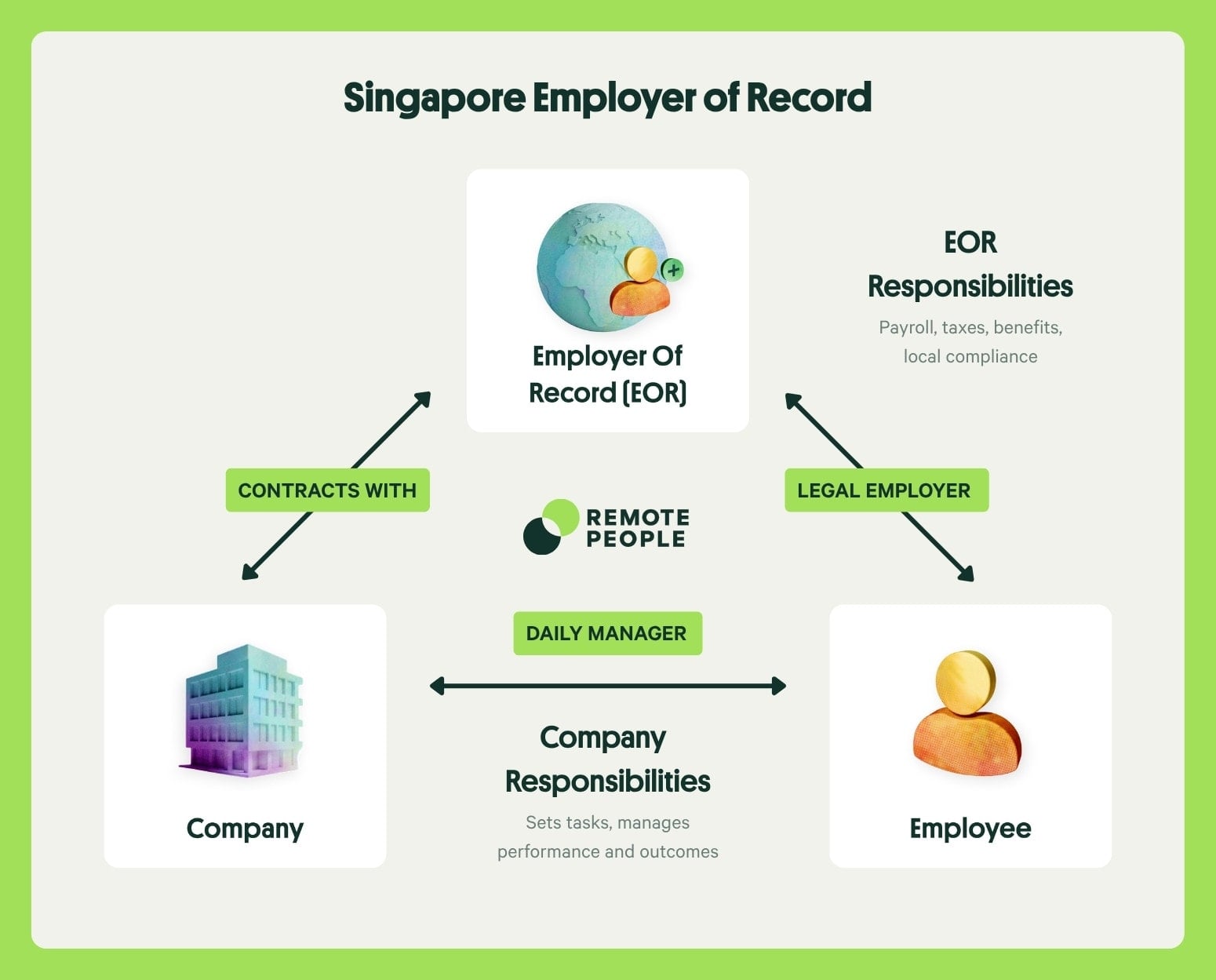
An Employer of Record (EOR) in Singapore is the official employer for your international hires, takes on all compliance, payroll, and statutory duties. This arrangement lets you hire talent in Singapore without establishing a local entity, reducing time and administrative burden. EORs handle everything from employment contracts to CPF filings, allowing you to scale quickly in new markets.

Who Uses an Employer of Record in Singapore?
Multinational firms, startups, and mid-sized companies use a Singapore employer of record to hire in-country without a local subsidiary. Companies entering Singapore benefit from outsourcing compliance, especially with CPF ceiling increases (SGD 8,000/month effective 2026), new paternity leave entitlements, and expanded Shared Parental Leave. Tech firms, consulting companies, and service providers commonly use EOR services in Singapore to rapidly expand headcount, test the market, or relocate regional operations from higher-cost hubs.
Companies testing the market before full incorporation find an EOR cost-effective. Larger enterprises also use EORs for flexible staffing, scaling roles without subsidiary overhead.
Typical Onboarding Timeline
- First, you submit employee information, job descriptions, and proposed salary. This takes 2-3 business days.
- Second, the EOR drafts the employment contract compliant with Singapore’s Key Employment Terms (KETs) requirements, then gets employee sign-off. This takes 3-5 business days.
- Third, the EOR registers the employee with CPF Board, IRAS, and MOM (if work pass required). Registration takes 5-10 business days, depending on work pass complexity.
- Fourth, the first payroll cycle begins, with payment processed typically on the last working day of the month for the prior month’s work. The employee gets their first paycheck with all statutory CPF and tax deductions.
- Fifth, the EOR sends you a monthly portal dashboard with payroll summaries, CPF contributions, taxes, and compliance status. You stay in touch with the EOR account team for ongoing adjustments.
Hire in Singapore with RemotePeople
Skip the entity setup. RemotePeople handles CPF filings, IRAS tax, work passes, and Employment Act compliance so you can hire talent in Singapore in 1 – 2 weeks.
Employment Laws and Regulations in Singapore
Singapore’s employment framework follows the Employment Act and recent amendments including the Workplace Fairness Act 2025 and paternity leave enhancements effective April 1, 2025. Understanding these regulations is important for any company using an employer of record in Singapore, as non-compliance carries penalties up to SGD 50,000 for first offences and SGD 250,000 for repeat violations under the Workplace Fairness Act. The law applies to all employment relationships in Singapore regardless of employee nationality.
Employment Contracts
Singapore’s Employment Act requires all employment relationships to be documented in a written contract signed by both employer and employee. The contract must specify job title, location, compensation, working hours, notice periods, and duration (fixed-term or indefinite). Key Employment Terms (KETs) must be provided within 14 days of employment start, with penalties up to SGD 400 per employee for non-compliance.
Working Hours and Overtime
The standard workweek in Singapore is 44 hours spread across five or six days. Any hours beyond 44 per week are classified as overtime and must be compensated at 1.5 times the basic hourly rate.
Work can be compressed to 9 hours per day if the total weekly hours remain 44 or less. Monthly overtime is capped at 72 hours. Employees cannot be required to work more than 8 hours per day without overtime compensation. These rules apply to employees earning SGD 4,500 or less (workmen) and non-workmen earning SGD 2,600 or less.
Overtime and working hours rules in Singapore (2026) | |||
Provision | Standard | Overtime/Premium | Notes |
|---|---|---|---|
Weekly Hours | 44 hours/week max | Any excess is overtime | Applies to Part IV employees |
Daily Hours | 8 hours/day max | 1.5x basic rate for excess | Can compress to 9/day if weekly cap met |
Overtime Compensation | – | 1.5x basic hourly rate | Payable within 14 days of pay period |
Monthly OT Cap | 72 hours/month max | Cannot exceed this limit | Protects employee from excessive hours |
Eligibility | Workmen ≤SGD 4,500; Non-workmen ≤SGD 2,600 | Part IV of Employment Act applies | Senior staff may not be covered |
Minimum Wage
Singapore has no national minimum wage; instead, the Progressive Wage Model (PWM) applies by sector. The PWM establishes sector-specific entry-level wages including SGD 1,910 for cleaning (effective July 2025), SGD 2,305 for retail (rising to SGD 2,435 in 2026), and SGD 1,750-1,850 for food services. Employers must ensure salaries meet or exceed the relevant PWM baseline for the employee’s sector and role to remain compliant.
Probation Period
Singapore law does not mandate a specific probation period. However, it’s customary practice to include a 3-6 month probation period in employment contracts. During probation, employees are entitled to all statutory benefits and protections including leave, CPF contributions, and overtime compensation. Either party may terminate during probation with notice, but statutory notice periods still apply.
Leave Entitlements
Annual Leave
Employees in Singapore accrue annual leave that increases with tenure. After 3 months of employment, employees receive 7 days of paid annual leave, rising incrementally to 14 days after 8 years of service. Annual leave must be taken within the calendar year or can be carried over into the next year for one year only, after which unused days are forfeited unless employment continues.
Sick Leave
Employees receive paid sick leave after 6 months of employment. Outpatient sick leave is 14 days per year, while hospitalization leave is 60 days per year cumulative. Medical certification must be provided within 48 hours of notification. Employees can use sick leave immediately for urgent medical needs and recover certification later if necessary.
Maternity Leave
Female employees are entitled to 16 weeks of paid maternity leave for Singapore citizen children. The first and second child receive 8 weeks employer-paid and 8 weeks government-paid (capped at SGD 20,000 total). From the third child onwards, all 16 weeks are government-paid (capped at SGD 40,000 total). Employees must provide 4 weeks’ notice and the child must be a Singapore citizen to qualify.
Paternity Leave
Male employees now receive 4 weeks of mandatory paid paternity leave for fathers of Singapore citizen children born on or after April 1, 2025. This represents a significant increase from the prior 2-week requirement. Paternity leave must be taken within a reasonable timeframe of the child’s birth, and employers cannot dismiss or give notice to an employee during paternity leave.
Shared Parental and Other Family Leave
New Shared Parental Leave allows parents to reallocate leave between themselves. Phase 1 (April 2025) provides 6 weeks shareable between parents; Phase 2 (April 2026) expands to 10 weeks. Childcare leave provides 6 days per year for children under 7 years old, plus 2 additional days for children aged 7-12. Infant Care Leave (unpaid) provides 12 days per year for children under 2 years old. Adoption leave provides 12 weeks paid for adoptive mothers of children under 12 months old.
Leave entitlements in Singapore (2026) | |||
Leave Type | Duration | Compensation | Notes |
|---|---|---|---|
Annual Leave (Year 1) | 7 days after 3 months | 100% salary | Statutory minimum; incremental increase with tenure |
Annual Leave (Year 8+) | 14 days | 100% salary | Caps at 14 days; carry-over 1 year only |
Sick Leave (Outpatient) | 14 days/year | 100% salary | After 6 months employment; medical cert required |
Sick Leave (Hospitalization) | 60 days cumulative/year | 100% salary | Separate from outpatient entitlement |
Maternity Leave (1st/2nd child) | 16 weeks total | 8 weeks employer + 8 weeks govt-paid | Child must be Singapore citizen |
Maternity Leave (3rd+ child) | 16 weeks total | All government-paid | Capped SGD 40,000 total |
Paternity Leave | 4 weeks mandatory | 100% salary | Effective Apr 1, 2025 for citizen children born after this date |
Shared Parental Leave (Phase 1) | 6 weeks total | 100% salary | Shareable between parents; Apr 2025 onwards |
Shared Parental Leave (Phase 2) | 10 weeks total | 100% salary | Apr 2026 onwards |
Childcare Leave (<7 years) | 6 days/year | 100% salary | For Singapore citizen children |
Childcare Leave (7-12 years) | 2 additional days/year | 100% salary | Extends benefit for older children |
Infant Care Leave (unpaid) | 12 days/year | Unpaid | Children under 2 years old |
Adoption Leave | 12 weeks | 100% salary | For adoptive mothers; child must be <12 months |
Statutory Employee Benefits
Singapore requires employers to contribute to the Central Provident Fund (CPF), the national social security system, which provides retirement, disability, survivor, and healthcare benefits. CPF is mandatory for all employees earning SGD 750 or more per month. Contribution rates vary by employee age, with employees under 55 requiring 17% employer contribution and 20% employee contribution (37% total). These rates are set by the CPF Board and adjusted annually.
The CPF Ordinary Wage (OW) ceiling is SGD 8,000 per month (effective January 1, 2026), with an annual wage ceiling of SGD 102,000. Maximum annual CPF contribution per employee is SGD 37,740. Additionally, employers must pay the Skills Development Levy (SDL) at 0.25% of monthly wages, with a minimum of SGD 2 and maximum of SGD 11.25 per employee per month.
The Skills Development Levy funds training programs and is paid directly to the CPF Board by the 14th of the following month. Healthcare is integrated into CPF through the MediSave account, allowing employees to access subsidized medical services at public healthcare facilities. Employees retire at age 65 and receive monthly CPF Life annuity payments based on their contribution history.

Recent Regulatory Updates (2025-2026)
The Workplace Fairness Act 2025, passed January 8, 2025, introduces comprehensive anti-discrimination protections covering 11 protected characteristics including age, nationality, sex, marital status, pregnancy, caregiving responsibilities, race, religion, language ability, disability, and mental health condition. Full compliance applies to firms with 25 or more employees, with a 5-year grace period for smaller firms. Penalties range from SGD 50,000 for first offences to SGD 250,000 for serious or repeat violations.
The Platform Workers Act 2024 took effect January 1, 2025, establishing mandatory CPF contributions for gig economy workers. Paternity leave doubled to 4 weeks mandatory effective April 1, 2025. The retirement age increases from 63 to 64 and re-employment age from 68 to 69 effective July 1, 2026, tracking toward eventual 65 and 70 respectively.
Work Permits and Visas in Singapore
Non-Singaporean employees hired through an employer of record in Singapore require work passes to legally work in the country. The work pass system follows the Ministry of Manpower (MOM) framework and involves salary minimums, qualification requirements, and quota systems depending on the pass type.
Processing times vary by pass type, though MOM aims to process most applications within 5-10 working days. Understanding pass categories, eligibility requirements, and salary minimums is important for international hires.
Work Permit Requirements
Who Needs a Work Pass
All non-Singaporean citizens and non-permanent residents need a work pass before starting work in Singapore. The pass ties the employee to a specific employer and position, and changing employers requires a new application. Foreign permanent residents are exempt from work pass requirements.
Eligibility and Required Documents
Employers need the employee’s educational qualifications (certified or official copies), passport, job offer letter showing position and salary, and employment contract. The employee must pass security and background clearances. Medical examination results may be required depending on the pass type. All documents must be original, certified, or officially translated into English.
Processing Time and Validity
Employment Pass and S Pass applications typically process within 5-10 working days. Work Permits may take 2-4 weeks. Once granted, passes are valid for 1-2 years depending on the type, after which renewal applications must be filed at least 3 months before expiration.
Renewal Process
Renew work passes by submitting the same basic documents plus updated medical examinations and employment verification. Start renewal at least 3 months before expiration to avoid gaps in eligibility. If an employee changes employers, the new employer must file a new application.
Common Pass Types
- Employment Pass (EP): Professional, manager, or executive roles earning SGD 5,600/month (general) or SGD 6,200/month (financial services) minimum.
- S Pass: Skilled workers earning SGD 3,150/month (general) or SGD 3,650/month (financial services) minimum; subject to quota.
- Work Permit (WP): Unskilled or semi-skilled workers; includes R1 (higher-skilled) and R2 (basic-skilled) categories with sector-specific requirements.
- Tech.Pass: Tech workers and engineers; 2-year validity with 1 renewal option; no minimum salary requirement; allows simultaneous startup work.
- ONE Pass: Premium pass for high-earners (SGD 30,000/month minimum); 5-year validity with renewable terms; flexible sector switching.
- Personalised Employment Pass (PEP): Employer-independent pass allowing job mobility; designed for senior managers and executives.
- EntrePass: For foreign founders and entrepreneurs; no salary requirement; focuses on innovation and business establishment.
Singapore work pass types comparison (2026) | |||||
Pass Type | Min. Salary (SGD) | Validity | Renewals | Quota/Limit | Best For |
|---|---|---|---|---|---|
Employment Pass (EP) | 5,600 (general), 6,200 (finance) | 1-2 years | Multiple | No quota | Professionals, managers, executives |
S Pass | 3,150 (general), 3,650 (finance) | 1-2 years | Multiple | Yes (sector-specific) | Skilled workers, technicians |
Work Permit (R1/R2) | Sector-specific (typically 1,200-2,500) | 1-2 years | Multiple | Yes (sector & company quotas) | Semi-skilled & unskilled workers |
Tech.Pass | No minimum | 2 years | 1 renewal (+2 yr) | No quota | Tech talent, engineers |
ONE Pass | 30,000/month | 5 years | Multiple 5-yr renewals | No quota | Premium high-earners |
Personalised Employment Pass (PEP) | No fixed minimum | Variable | Multiple | No quota | Employer-independent senior staff |
EntrePass | No minimum | Variable | Variable | No quota | Founders, entrepreneurs |
How an EOR Handles Work Passes
An EOR manages the entire work pass application process, compiling documentation and coordinating with the Ministry of Manpower. They track application status and ensure salary requirements are met for each pass type. If denied, the EOR advises on alternatives or reapplication strategies. They proactively start renewal processes before expiration to prevent gaps in work eligibility.
The EOR manages salary increments to ensure they don’t inadvertently create pass eligibility issues, and updates payroll and compliance records to reflect pass status and any quotas affecting staffing decisions.
Payroll, Taxes, and Social Security in Singapore
Singapore’s payroll system, managed by the employer of record on your behalf, combines employer and employee CPF contributions, progressive income tax, and the Skills Development Levy. The system is monthly, with salaries typically paid by bank transfer on the last working day of the month. Understanding CPF contribution rates, tax brackets, and compliance requirements is important for accurate payroll management.
Employer Contributions
Employers must contribute to the Central Provident Fund (CPF) based on the employee’s age. For employees aged 55 and below, the employer contribution rate is 17% of ordinary wages up to the SGD 8,000 monthly ceiling. Contribution rates decrease for older workers, falling to 16.5% for ages 55-60, 12.5% for ages 60-65, and even lower for workers over 65.
Additionally, employers pay the Skills Development Levy (SDL) at 0.25% of total monthly wages, with a minimum of SGD 2 and maximum of SGD 11.25 per employee per month. These contributions are non-negotiable and must be paid to the CPF Board by the 14th of the following month.
Singapore employer contribution rates (2026) | |||
Contribution Type | Rate | Calculation Basis | Notes |
|---|---|---|---|
CPF (Employee ≤55 years) | 17% | OW up to SGD 8,000/mo | Citizens & PRs year 3+; Annual cap SGD 37,740 |
CPF (Age 55-60) | 16.5% | OW up to SGD 8,000/mo | Contribution redirects toward Retirement Account |
CPF (Age 60-65) | 12.5% | OW up to SGD 8,000/mo | Applies if employee earns >SGD 750/mo |
CPF (Age 65-70) | – | 16.5% total contribution (variable split) | Reduced contribution for senior workers |
CPF (Age 70+) | – | 12.5% total contribution (variable split) | Minimal contribution post-70 |
Skills Development Levy (SDL) | 0.25% | Total monthly wages | Min SGD 2, max SGD 11.25/employee/month |
Employee Contributions
Employees contribute to CPF at rates matching their age band. For employees aged 55 and below, the employee contribution is 20% of ordinary wages, paired with the 17% employer contribution for a total of 37%. This is deducted directly from the employee’s salary each month. Income tax is calculated separately on chargeable income after CPF deductions.
Singapore employee deductions (2026) | |||
Deduction Type | Rate | Calculation Basis | Example (Monthly Salary SGD 5,500) |
|---|---|---|---|
CPF (Employee ≤55 years) | 20% | OW up to SGD 8,000/mo | SGD 1,100 |
CPF (Age 55-60) | 17.5% | OW up to SGD 8,000/mo | SGD 962.50 |
CPF (Age 60-65) | 12.5% | OW up to SGD 8,000/mo | SGD 687.50 |
Income Tax | 0-24% by bracket | YA 2026 chargeable income | Varies by annual income (see tax brackets table) |
Total Employee Deductions | CPF + IT | Combined mandatory deductions | SGD 1,100+ depending on IT bracket |
Income Tax
Singapore’s income tax system uses progressive annual brackets that apply to YA 2026 (Year of Assessment 2026). Tax is calculated on chargeable income (after CPF deductions) using rates ranging from 0% on the first SGD 20,000 to a top rate of 24% on income exceeding SGD 1,000,000. A Personal Income Tax Rebate of 60% applies, capped at SGD 200, and is automatically applied by IRAS.
Singapore income tax brackets YA 2026 | ||
Chargeable Income (SGD) | Tax Rate | Notes |
|---|---|---|
0 – 20,000 | 0% | No tax payable |
20,001 – 30,000 | 2% | Low entry rate for working professionals |
30,001 – 40,000 | 3.5% | – |
40,001 – 80,000 | 7% | Middle-income bracket |
80,001 – 120,000 | 11.5% | Upper-middle income |
120,001 – 160,000 | 15% | – |
160,001 – 200,000 | 18% | – |
200,001 – 320,000 | 19% | High income |
320,001 – 500,000 | 20.5% | – |
500,001 – 1,000,000 | 22% | – |
Above 1,000,000 | 24% | Top marginal rate applies |
Tax calculations work as follows: for an employee earning SGD 60,000 chargeable income annually, the tax owed is 0% on the first SGD 20,000 (SGD 0), 2% on the next SGD 10,000 (SGD 200), and 3.5% on the remaining SGD 30,000 (SGD 1,050), for a total tax of SGD 1,250. After the 60% Personal Income Tax Rebate (capped SGD 200), the net tax becomes SGD 1,050.
Payroll Cycle
Payroll in Singapore is processed on a monthly basis, with salaries typically paid on the last working day of each month or as specified in the employment contract. Payments are made by bank transfer to the employee’s designated account in Singapore Dollars (SGD). An EOR manages all payroll processing, ensuring accurate CPF calculations, tax withholding, and timely payments.
The payslip provided to each employee must itemize gross salary, CPF contributions (employer and employee), income tax withheld, any allowances or deductions, and net pay. Employers retain payroll records for at least 3 years to support tax audits and CPF verification. If an employee leaves mid-month, final pay including any accrued leave must be processed within 7 days of departure.
13th Month Salary and Bonus Pay
Singapore does not mandate a 13th month salary by law. However, the Annual Wage Supplement (AWS) or year-end bonus is customary practice, with approximately 86% of Singapore firms offering AWS or equivalent variable pay. When included in an employment contract or company policy, the AWS becomes a binding obligation subject to the same CPF contribution limits and income tax treatment as regular salary.
The AWS is typically paid once annually, usually in December, and is calculated as a percentage of salary or a fixed amount as specified in the contract. The AWS counts toward the annual CPF contribution ceiling of SGD 102,000 and the maximum annual CPF contribution of SGD 37,740. If employment ends before the AWS is paid, the accrued amount must be included in the final paycheck.
Cost of Hiring Through an EOR in Singapore
EOR Service Fees
Employer of record service fees in Singapore typically range from SGD 500 to SGD 1,200 per employee per month (approximately USD 370-890), depending on the provider’s service level and the complexity of payroll administration. These fees cover CPF administration, tax compliance, payroll processing, benefits administration, and regulatory filings, eliminating the need for a local HR department. The exact fee structure varies by provider but is generally charged as a flat monthly cost rather than a percentage of salary.
Total Employment Cost Breakdown
The total cost of hiring through an EOR includes the gross salary, mandatory CPF contributions, Skills Development Levy, and the EOR service fee. Understanding this breakdown helps organizations budget accurately for remote hiring in Singapore.

Singapore employer cost example · USD 5,000/month gross · 2026 | ||
Employer Cost | Amount (USD) | % of Gross |
|---|---|---|
Gross Salary | $5,000 | 100% |
CPF Employer (17%, capped) | $850 | 17% |
SDL (0.25%, capped) | $8 | 0.2% |
EOR Service Fee | $500 | 10% |
Total Monthly Cost | $6,358 | 127.2% |
All USD amounts use conversion rate 1 USD = 1.35 SGD (April 2026). Source: RemotePeople Singapore Payroll & Tax and CPF Board Contribution Rates | ||
Ready to simplify your hiring costs in Singapore? Contact our team to receive a custom pricing proposal based on your team size and needs.
Benefits of Using an EOR in Singapore
Hiring through an employer of record eliminates the complexity of establishing a local legal entity while maintaining full employment compliance. Your organization gains immediate access to vetted talent without navigating Singapore’s multi-layered CPF system, income tax requirements, work pass regulations, or ongoing administrative overhead.
An employer of record provider handles all CPF calculations across multiple age bands, tax filings with IRAS, work pass applications with MOM, and benefits administration, reducing your operational burden and allowing your internal team to focus on core business activities. You retain full control over hiring decisions, work assignments, and team management while the EOR manages the legal employment relationship and regulatory obligations.
The flexibility to scale your team up or down without long-term financial commitments provides significant competitive advantage in the Asia-Pacific region. You can test the Singapore market, hire specialized talent for project work, or adjust headcount based on business needs without the time and expense required to close a local office. The rapid deployment (1-2 weeks) enables you to move quickly in a competitive talent market.
Termination and Offboarding in Singapore
Notice Periods
Singapore’s Employment Act specifies different notice periods depending on length of service. For employees with less than 26 weeks of service, either party must provide 1 day’s notice. For service of 26 weeks to 2 years, notice increases to 1 week. For service of 2 to 5 years, notice is 2 weeks, and for service exceeding 5 years, notice is 4 weeks.
The notice period begins from the date the employer or employee receives written notice and continues through the last working day of employment. During the notice period, the employee remains employed and entitled to full wages and benefits. Early termination (payment in lieu of notice) is permitted if both parties agree, but statutory notice periods cannot be waived unilaterally.
Notice periods by length of service in Singapore | ||
Length of Service | Notice Period | Applies To |
|---|---|---|
Less than 26 weeks | 1 day | Both employer & employee |
26 weeks to 2 years | 1 week | Bilateral obligation |
2 to 5 years | 2 weeks | – |
5 years or more | 4 weeks | Most protective standard |
Source: Employment Act Section 10 and MOM Notice Period | ||
Severance Pay
Calculation Method
Singapore law does not mandate statutory severance pay for terminations. However, the Tripartite Advisory on Managing Excess Manpower establishes a guideline norm of approximately 2 weeks to 1 month of salary per year of service, typically applied in retrenchment situations. The calculation uses the employee’s last gross monthly salary at the time of termination and applies to employees with at least 2 years of service.
Caps and Exceptions
No severance is required for termination during probation periods or for dismissal on disciplinary grounds. Employees who voluntarily resign are not entitled to severance pay unless the company provides it as part of its exit policy. Termination due to the employee’s own gross negligence may result in reduced or forfeited severance benefits. Payments are typically made on the final paycheck after deducting CPF contributions and income tax as required.
Retrenchment benefits framework in Singapore | |||
Scenario | Entitlement | Calculation | Notes |
|---|---|---|---|
Retrenchment (≥2 years service) | 2 weeks to 1 month/year | Last gross monthly salary × years of service × rate | Tripartite guideline (not statutory); depends on company ability |
Probation termination | None | – | No severance; notice still applies |
Dismissal for cause | None | – | Misconduct, theft, insubordination disqualify |
Voluntary resignation | None (unless company policy) | – | Employee-initiated; no statutory entitlement |
Gross negligence | May be waived/reduced | Employer discretion | Employee culpability can reduce entitlement |
MOM Notification | Required if ≥5 retrenched in 6 months | – | Regulatory obligation for larger retrenchments |
Grounds for Termination
Employers may terminate employees for just cause, including failure to meet job requirements despite warnings, serious violations of work rules, theft or fraud, or insubordination. Without-cause terminations are permitted but trigger notice period requirements and potential severance obligations. Singapore law prohibits termination based on the 11 protected characteristics under the Workplace Fairness Act 2025, including age, nationality, sex, marital status, pregnancy, caregiving responsibilities, race, religion, language ability, disability, and mental health condition. Violations can result in penalties up to SGD 250,000 for serious cases.
EOR vs. Other Hiring Models in Singapore
EOR vs. Setting Up a Local Entity
EOR versus establishing your own entity in Singapore · 2026 | ||
Comparison | Employer of Record | Own Entity |
|---|---|---|
Setup time | 1-2 weeks | 4-8 weeks |
Upfront cost | $0 | $8,000-$20,000 |
Ongoing cost (per employee) | $500-$1,200 SGD/month (~USD 370-890) | $3,000-$8,000/month |
Local office required | No | Yes |
CPF registration & admin | EOR handles | Company handles |
Payroll & tax filing | Included | Must hire locally |
Work pass sponsorship | EOR manages | Company sponsors |
Best for team size | 1-20 employees | 20+ employees |
Scale down/exit | Immediate | Weeks of wind-down |
Government contracts | Limited eligibility | Full eligibility |
Source: RemotePeople EOR Solutions and MOM Employment Practices | ||
The EOR model delivers substantial advantages for organizations testing the Singapore market or maintaining small to mid-sized remote teams. Setup occurs within 1-2 weeks compared to 4-8 weeks for entity registration, and requires zero upfront capital investment, making this approach significantly more accessible than establishing a legal subsidiary.
Ongoing operational costs through an EOR remain predictable and per-employee, whereas a local entity requires hiring an accountant, HR manager, and legal advisor, typically totaling SGD 4,000 to SGD 10,000 monthly in overhead. For teams of 20 or fewer employees, the EOR cost advantage becomes even more compelling.
The flexibility to exit the market without lengthy wind-down periods, entity dissolution, or asset liquidation processes provides substantial risk mitigation. However, organizations anticipating rapid growth beyond 20 employees or requiring government contract eligibility may eventually benefit from transitioning to a local entity structure.
EOR vs. Hiring Independent Contractors
EOR employment versus independent contractor engagement in Singapore · 2026 | ||
Comparison | EOR (Full-Time Employee) | Independent Contractor |
|---|---|---|
Legal relationship | Employer-employee | Self-employed service provider |
Compliance risk | Low (EOR handles) | High (misclassification risk) |
CPF & payroll | EOR withholds, submits to CPF Board | Contractor handles own obligations |
Benefits & leave | Annual leave, sick leave, paid holidays | None (not entitled) |
IP ownership | Work product owned by employer | Contractor retains IP unless assigned |
Termination | Notice period applies; severance norms apply | End contract per agreement terms |
Best for | Core team, ongoing roles | Project work, specialized tasks |
Cost structure | Predictable monthly cost | Variable (hourly/project rates) |
Source: RemotePeople Singapore Contractor Hiring and Singapore Employment Act | ||
The choice between EOR employment and independent contractor engagement hinges on control level, duration, and compliance tolerance. EOR provides the strongest legal foundation for ongoing work relationships where you direct daily activities and expect results within your organization’s processes. Contractors suit discrete projects, specialized expertise, and situations where the individual maintains their own client base.
Misclassification represents a significant compliance risk in Singapore. Regulators scrutinize contractor arrangements where the individual works exclusively for one client, maintains set hours, or receives benefits typical of employment, potentially resulting in reclassification and back-pay liability. The EOR model eliminates this exposure entirely by establishing proper employment relationships from the start.
For teams requiring long-term talent with investment in training and development, EOR employment delivers superior cost efficiency and reduces turnover risk. Contractor arrangements work best for specialized or project-based engagements where fixed deliverables replace ongoing management.
EOR vs. PEO
EOR versus PEO models in Singapore · 2026 | ||
Comparison | Employer of Record (EOR) | Professional Employer Organization (PEO) |
|---|---|---|
Legal employer | EOR company | PEO company (co-employment) |
Local entity required | No | Yes (typically) |
Best for | Cross-border remote hiring | Expanding existing operations |
Compliance liability | EOR assumes full liability | Shared between PEO and client |
Setup time | 1-2 weeks | 4-8 weeks |
Control over HR policies | Client sets policies | PEO-defined policies (limited customization) |
Typical use case | Start remote hiring immediately | Transition existing staff to professional management |
Source: RemotePeople EOR Solutions and Singapore Employment Act | ||
Singapore has PEO services available, primarily for organizations expanding existing local operations. The distinction becomes important when you’re managing mixed local and remote teams where co-employment could theoretically simplify administrative management.
For foreign organizations initiating Singapore hiring, the EOR model provides superior speed, cost efficiency, and compliance certainty. EOR assumes full legal employer liability, eliminating shared responsibility concerns and establishing clear accountability for regulatory compliance. You retain complete control over hiring policies, compensation, and work arrangements without PEO-imposed standardized policies.
The EOR’s rapid deployment (1-2 weeks) and absence of local entity requirements make it the practical default for cross-border Singapore hiring. PEO benefits would theoretically emerge only for organizations with existing Singapore subsidiaries seeking to professionalize their HR operations, a scenario uncommon among early-stage remote hiring initiatives.
Public Holidays in Singapore
Singapore public holidays · 2026 | ||
Date | Holiday | Day of Week |
|---|---|---|
January 1 | New Year’s Day | Thursday |
February 17-18 | Chinese New Year | Tuesday-Wednesday |
March 20 | Hari Raya Puasa | Friday |
April 3 | Good Friday | Friday |
May 1 | Labour Day | Friday |
June 17 | Vesak Day | Wednesday |
July 10 | Hari Raya Haji | Friday |
August 10 (observed) | National Day | Monday |
November 2 (observed) | Deepavali | Monday |
December 25 | Christmas Day | Friday |
Singapore observes 11 public holidays annually, requiring employers to pay employees their normal wage for work performed on these dates or provide compensatory days off. Holiday pay factors directly into payroll calculations and affects project timelines, particularly during the Chinese New Year period in February. Your EOR provider automatically adjusts payroll to comply with these statutory requirements.
How to Get Started with an EOR in Singapore
- First: Define your hiring needs by identifying the role, required skills, and desired start date. Clarify team size, expected growth, whether employees are Singapore citizens or require work passes, and any specialized talent requirements to help your EOR provider prepare accurate pricing and compliance documentation.
- Second: Partner with an EOR provider by reviewing capabilities, pricing structures, and Singapore-specific expertise. Confirm they handle CPF administration across all age bands, IRAS tax compliance, MOM work pass applications, and have established relationships with local agencies for visa processing if international relocation is involved.
- Third: Complete your provider’s client onboarding, which typically involves KYC verification, providing job descriptions, and setting compensation ranges. This process usually completes within 1-2 weeks and requires minimal back-and-forth documentation.
- Fourth: Begin recruitment either through your own networks or your EOR provider’s talent marketplace. Your EOR handles all employment contract creation with proper Key Employment Terms, ensures compliance with Singapore’s Employment Act, and establishes payroll processing from day one.
- Fifth: Onboard your first employee by providing work assignments, access credentials, and company policies. Your EOR provider manages the administrative setup including CPF registration, IRAS tax filing, and work pass sponsorship if needed, allowing the employee to begin work immediately.
Ready to hire your first team member in Singapore? Our EOR experts guide you through every step of the hiring and onboarding process. Schedule a consultation today at https://remotepeople.com/contact/ to receive customized guidance for your Singapore hiring strategy.
Where companies hiring in Singapore expand next
Teams hiring in Singapore typically expand across ASEAN, where cross-border mobility and diverse multilingual talent make regional coverage natural. After building a team in Singapore, employers often look to a team in Malaysia for ASEAN integration and cross-border mobility, then operations in Indonesia for the ASEAN single-market trade framework. Thailand follows with overlapping ASEAN labor and mobility rules, and hiring in Vietnam typically closes the regional footprint via ASEAN-wide talent flows and shared hiring norms.
Frequently Asked Questions About EOR in Singapore
EOR fees in Singapore range from SGD 500 to SGD 1,200 per employee per month (approximately USD 370-890), charged as a flat monthly fee rather than a percentage of salary. This fee covers CPF administration, payroll processing, tax compliance, benefits administration, and regulatory filings. The specific cost depends on the provider's service level and any additional features like work pass support or specialized reporting.
Yes, independent contractor arrangements are possible in Singapore, but they carry misclassification risk if the relationship resembles employment. Using a contractor platform specifically designed for Singapore ensures proper structuring and compliance with employment law. Contractors suit project work or specialized expertise, while EOR employment provides better protection for ongoing team roles.
Your client company (you) owns all work product and intellectual property created by EOR employees as part of their regular job duties. This ownership is established through the employment contract and applies automatically unless specific provisions assign IP to the employee. Your EOR provider ensures IP ownership clauses appear in all employment agreements.
The typical timeline from contract signature to employee start date ranges from 2 to 3 weeks. Initial setup with your EOR provider completes within 1-2 weeks, including KYC verification and contract preparation. Work pass applications (if required) add 1-2 weeks. Recruitment timing depends on your hiring process, but many organizations find qualified candidates within this window.
Singapore's Employment Act governs employment relationships, requiring written contracts, statutory benefits, notice periods, and compliance with the Workplace Fairness Act 2025. Your EOR provider handles all compliance requirements, but understanding CPF contributions, working hours rules, annual leave entitlements, and termination procedures remains valuable. Current Singapore wage regulations via the Progressive Wage Model apply to relevant sectors.
Employers must provide CPF contributions based on employee age (17% employer for ages ≤55), annual leave (7-14 days based on tenure), paid sick leave (14 days outpatient, 60 days hospitalization), public holidays, maternity leave (16 weeks), and paternity leave (4 weeks mandatory from April 2025). Singapore's statutory benefits framework is comprehensive, and your EOR provider ensures all mandated benefits are administered correctly.
Termination requires notice periods (1 day to 4 weeks depending on tenure) as specified in the Employment Act. Severance is not statutory but Tripartite guidelines recommend 2 weeks to 1 month per year of service for retrenchment situations. Your EOR provider manages the notice period, calculates any severance obligations, handles final pay including accrued leave, and manages all regulatory notifications required by MOM to ensure compliant separation.
No. An EOR in Singapore acts as the legal employer on your behalf, so you can hire full-time staff without registering a Pte Ltd, a branch office, or a representative office with ACRA. You skip the 3-6 months and SGD 15,000-40,000 typically needed to incorporate and run a local entity, and you avoid ongoing accounting, annual returns, and statutory audits. Once your Singapore headcount grows past 20 employees, it can become more cost-effective to transition from an EOR to your own entity.
Yes, a contractor of record (COR) engages a self-employed individual on your behalf and handles invoicing, tax documentation, and compliance with IRAS reporting. Singapore recognizes contractor relationships when the worker controls their hours, uses their own tools, and serves multiple clients, but misclassification risk is real if the role looks like employment. RemotePeople's Singapore contractor platform handles payments, tax forms, and compliance, while our EOR service is the safer choice for long-term, full-time roles with defined work hours and company-directed tasks.
A reliable Singapore EOR provider should hold a valid Employment Agency Licence from MOM, have in-country payroll specialists familiar with CPF, SDL, and IRAS filings, and offer transparent flat-fee pricing (not a percentage of salary). Look for Employment Pass and S Pass application experience under the COMPASS framework, service-level agreements on onboarding speed, and indemnity coverage that assumes full employer liability. RemotePeople's EOR service covers all Singapore employment obligations with predictable monthly pricing and dedicated account management.
---
Employer of Record in
Employer of Record in
Employer of Record in
Employer of Record in
Employer of Record in
Employer of Record in
Employer of Record in
Employer of Record in




