
 Recruit
Employer of Record in Pakistan
-
 Drew Donnelly
- Published
- September 22, 2026
RemotePeople’s employer of record in Pakistan lets you hire employees in Pakistan without navigating provincial social security systems. We handle EOBI contributions of 5% from employers and 1% from employees, provincial social security fund contributions at 6% (Punjab), and mandatory medical and disability coverage.
Hire in Pakistan — book a free 30-minute demo
Tell us what you need. You'll get a tailored, transparent proposal within 24 hours, plus a free call to walk through it.
Tell us about your company
So we can match you with a specialist who knows your market — and unlock volume pricing tiers.
* All fields are required.
Where and when are you hiring?
Tell us the geography and timing and we'll quote each country line by line, with onboarding timelines.
* All fields are required.
Help us beat your current setup
We'll benchmark your current deal and send a line-by-line proposal in 24 hours — showing exactly where we cut cost, time, or risk. After you submit, you can book a call to walk through it together.
* All fields are required.
Thanks! Your proposal is on its way.
Expect a tailored, line-by-line proposal in your inbox within 24 hours. In the meantime…
Want to walk through it together?
Book a free 30-minute call with one of our specialists. We'll explain every line, answer your questions, and tailor the proposal further if you need.
No obligation. Pick a time that works for you.








- Hire in Pakistan — book a free 30-minute demo
- Tell us about your company
- Where and when are you hiring?
- Help us beat your current setup
- Thanks! Your proposal is on its way.
- How an Employer of Record Works in Pakistan
- Employment Laws and Regulations in Pakistan
- Work Permits and Visas in Pakistan
- Payroll, Taxes, and Social Security in Pakistan
- Cost of Hiring Through an EOR in Pakistan
- Benefits of Using an EOR in Pakistan
- Termination and Offboarding in Pakistan
- EOR vs. Other Hiring Models in Pakistan
- Public Holidays in Pakistan
- How to Get Started with an EOR in Pakistan
- Where companies hiring in Pakistan expand next
- Frequently Asked Questions
- Related EOR Destinations

Start hiring in Pakistan
Let RemotePeople handle payroll, compliance, and HR admin worldwide so you can focus on building your team.

Pakistan is South Asia’s second-largest economy and fifth-most populous country, with a workforce concentrated around Karachi, Lahore, Islamabad-Rawalpindi, and Faisalabad, and a rapidly growing technology and business process outsourcing base. Provincial minimum wages moved to PKR 40,000 per month across Punjab, Sindh, Khyber Pakhtunkhwa, and Islamabad Capital Territory with effect from 1 July 2025, while Balochistan held at PKR 37,000. For companies looking to hire employees in Pakistan, the compliance layer is split across federal and provincial law: the Industrial and Commercial Employment (Standing Orders) Ordinance 1968, the Factories Act 1934, the Employees’ Old-Age Benefits Institution (EOBI) at the federal level, and four separate provincial social security institutions (PESSI, SESSI, KPESSI, and Balochistan ESSI). An employer of record in Pakistan takes on those obligations as the legal employer of your staff, so you can hire, pay, and manage a Pakistani team without setting up a local entity.
This guide walks through how an employer of record in Pakistan works, what the Standing Orders Ordinance requires in 2026, what hiring through an EOR actually costs, and how the model compares with incorporating your own Pakistani entity, engaging independent contractors, or partnering with a PEO. Every figure is verified against the Standing Orders Ordinance 1968, the Finance Act 2025-26, EOBI and provincial ESSI schedules, and the federal Cabinet Division public holiday notification for 2026.
How an Employer of Record Works in Pakistan
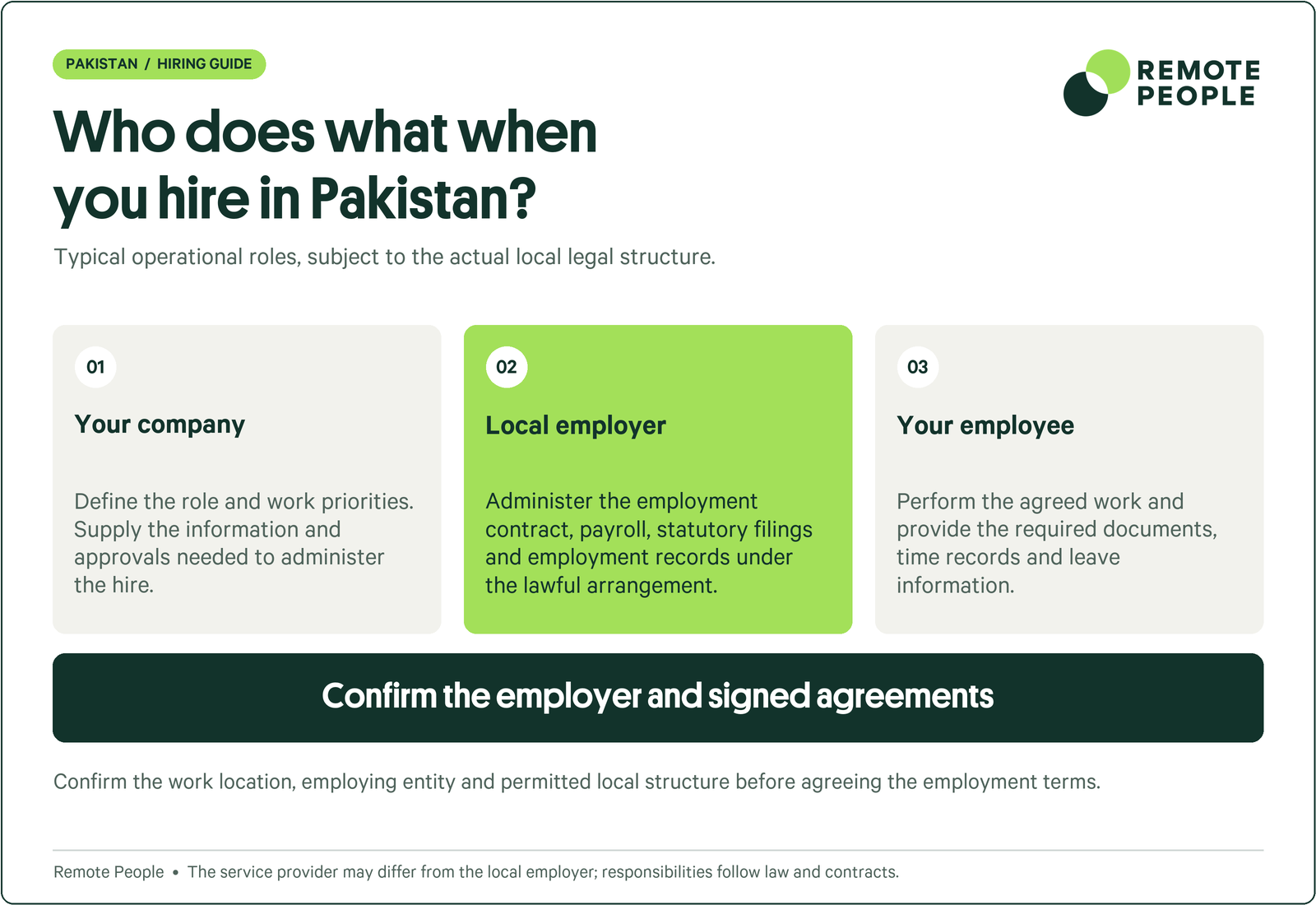
If you’d like to learn more about how Employer of Record (EOR) services work, read our What Is an Employer of Record (EOR)? guide for a complete overview of the model, its benefits, and when to use it.
If you’re comparing providers, our Best Employer of Record (EOR) Providers guide reviews the leading platforms to help you choose the right solution for your business.
Who Uses an EOR in Pakistan?
An employer of record in Pakistan is typically used by companies that want a compliant hire without committing to the setup and ongoing cost of a Pakistani private limited company or branch office. Common scenarios include:
- Market entry testing: a company hiring its first one to three employees in Pakistan to validate demand or test a remote engineering team before committing to an entity. The EOR lets you pilot for twelve to twenty-four months and scale down without a winding-up process at the Securities and Exchange Commission of Pakistan (SECP).
- Remote technology teams: global firms tapping Pakistan’s large pool of software developers, data engineers, and BPO professionals in Karachi, Lahore, and Islamabad without the SECP registration, bank account opening, and provincial labour filings that a local entity requires.
- Speed-sensitive hires: situations where a priority candidate needs to start within weeks rather than the two-to-four months it typically takes to incorporate a private limited company, open a Pakistani bank account, and register with EOBI and the relevant provincial ESSI.
- Foreign-national hires: where the employee is a non-Pakistani national who needs a work visa. The EOR, as a Pakistani legal employer, can sponsor the Board of Investment work visa application and handle the security clearance requirements without the client setting up a local subsidiary.
Companies that already operate a Pakistani subsidiary, or that plan to grow past twenty local employees, will usually find that their own entity makes more sense. The EOR model is purpose-built for small, distributed, or pilot-stage hiring in Pakistan.
Typical Onboarding Timeline
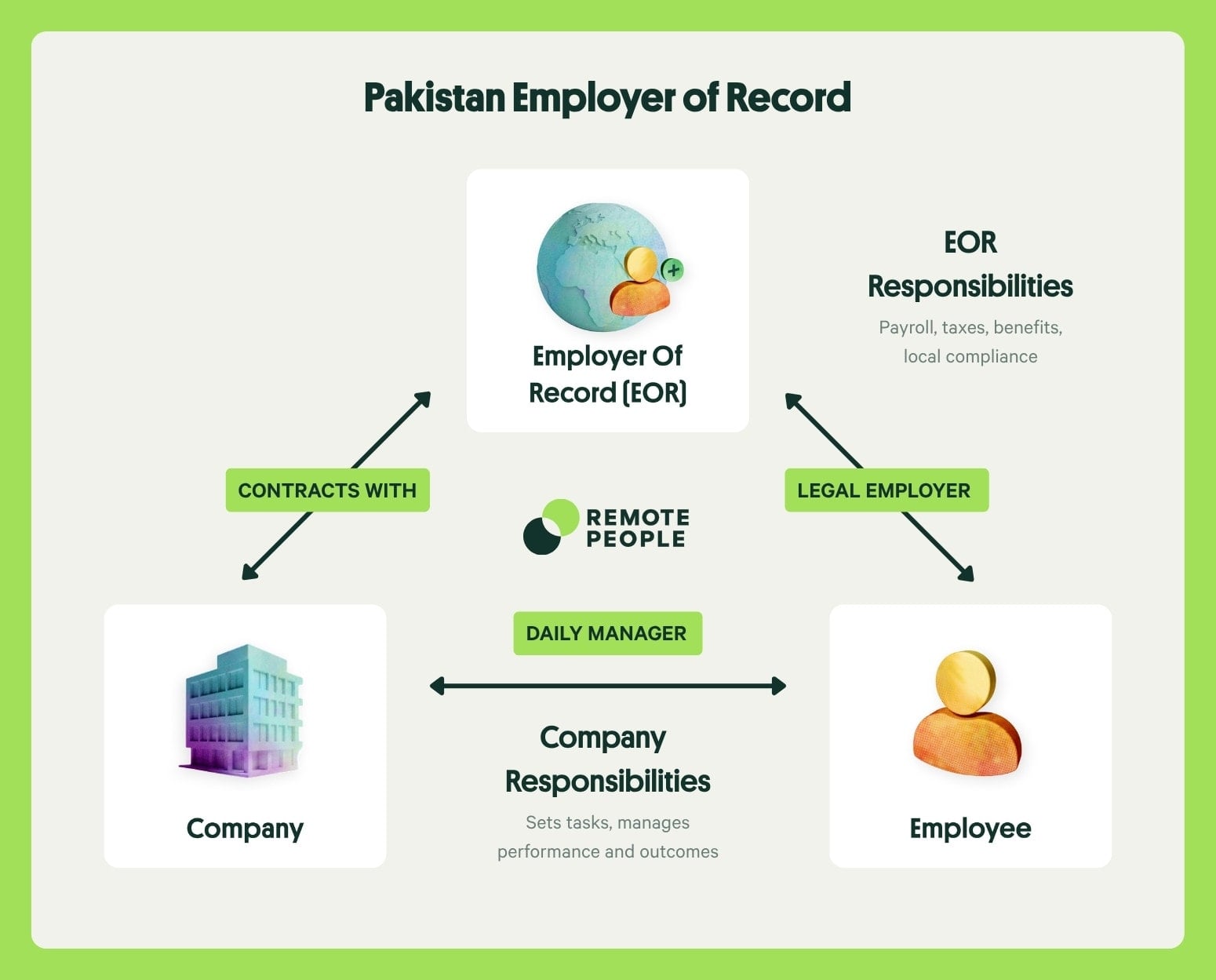
Most EOR providers can onboard a Pakistani national employee in one to two weeks when no work visa is required. The stages are sequential but short:
- First, sign the EOR service agreement and share the employee’s details, proposed salary, role, and start date (one to two days).
- Second, the EOR drafts a compliant appointment letter under the Standing Orders Ordinance 1968 and sends it for employer and employee signature (two to three days).
- Third, EOBI registration, provincial ESSI registration, and National Tax Number (NTN) verification run in parallel, along with bank account collection (three to seven days).
- Fourth, payroll is configured, provincial ESSI medical coverage is enrolled, and the employee is onboarded into your systems (two to three days).
- Fifth, the employee begins work on the agreed start date.
Timelines extend when a work visa is required (add four to eight weeks for Board of Investment processing and security clearance), when documents must be attested through the Ministry of Foreign Affairs and a Pakistani mission abroad, or when the role is regulated (medical, legal, and engineering professions require registration with the Pakistan Medical Commission, Pakistan Bar Council, or Pakistan Engineering Council).
Hire in Pakistan
A fast-growing tech sector with EOBI/SESSI contributions, provincial labor law variations, and Pakistani employment compliance requirements.
We handle employment contracts, payroll, social contributions, and full Pakistani compliance.
No local entity needed. Your team can start in days.
Employment Laws and Regulations in Pakistan
Employment Contracts
Employment relationships in Pakistan are governed primarily by the Industrial and Commercial Employment (Standing Orders) Ordinance 1968, supplemented by the Factories Act 1934, the Payment of Wages Act 1936, the Shops and Establishments Ordinance 1969, the Minimum Wages Ordinance 1961, and province-specific consolidated labour codes enacted after the 18th Amendment devolved labour to the provinces. Each provincial government (Punjab, Sindh, Khyber Pakhtunkhwa, Balochistan) applies the 1968 Ordinance with minor local amendments, while Islamabad Capital Territory remains under federal administration.
Under Standing Order 1, employees are classified as permanent, probationers, badlis (substitute), temporary, apprentices, or contract workers, and a written appointment letter is mandatory for every category other than daily-rated. The letter must specify the job category, wages, probation period, hours of work, place of work, and notice period. Permanent status is conferred automatically after nine months of continuous service (Standing Order 2). Fixed-term contracts are permitted but successive renewals can be reclassified as permanent employment by labour courts where the work is of a continuing nature.
Working Hours and Overtime
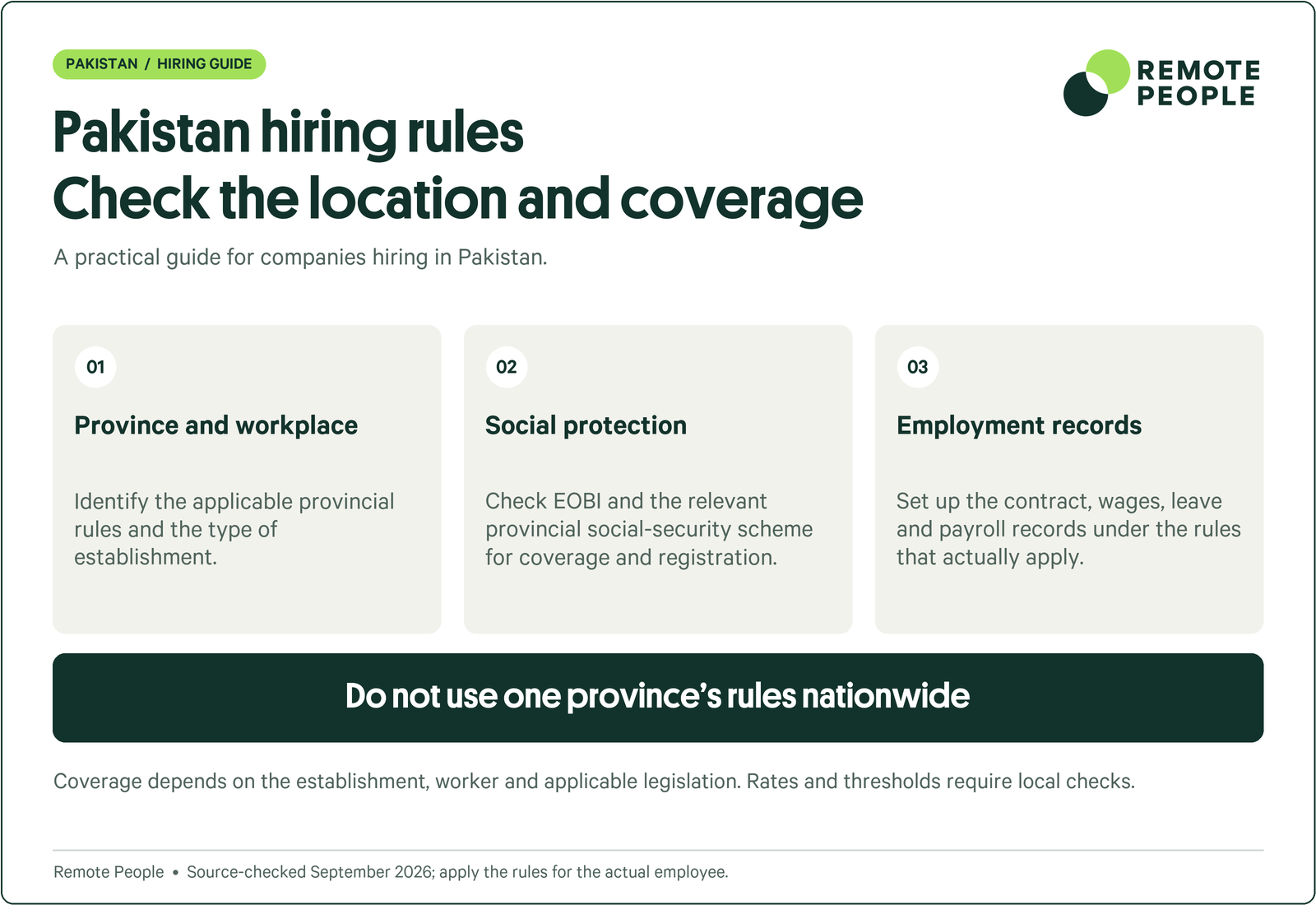
The standard working week in Pakistan is 48 hours, typically spread across six days of 8 hours or five days of around 9 hours, set by Section 34 of the Factories Act 1934 and Section 8 of the Shops and Establishments Ordinance 1969. Daily working time cannot exceed 9 hours, and employees are entitled to at least 30 minutes of rest after every 5 hours of continuous work (Section 35) and one full day of weekly rest (Section 35-A). Workers in seasonal factories may work up to 50 hours per week during peak periods. Women and adolescents face additional night-work restrictions under Section 45 of the Factories Act.
Overtime and Premium Pay Rates
Pakistan overtime and premium pay rates · Per Factories Act 1934 and Standing Orders Ordinance 1968 | |||
Hour Type | Rate Multiplier | Weekly/Daily Cap | Notes |
|---|---|---|---|
Overtime beyond 48 hours per week or 9 hours per day | 2× (200% of ordinary rate) | Max 12 hours per day including overtime (Section 36) | Section 47 Factories Act 1934 |
Work on weekly rest day (Sunday or substituted day) | 2× (double pay) | Substitute rest day must be granted within 3 days before or after | Section 35-A Factories Act 1934 |
Work on a gazetted public holiday | 2× (double pay) | In addition to the paid holiday | West Pakistan Holidays Act 1958 and provincial rules |
Shop and commercial establishment overtime | 2× (200% of ordinary rate) | Max 60 hours per week including overtime | Section 8 Shops and Establishments Ordinance 1969 |
Seasonal factory overtime | 2× (double pay) | 50-hour weekly cap in peak season | Applies to sugar, cotton ginning, rice milling and similar sectors |
Overtime is not optional once ordered, but an employer cannot require more than 12 hours of total work in a day or 624 hours of overtime in a year (Section 47). Overtime pay is calculated on the ordinary rate of wages, which includes basic pay and regular dearness allowance but excludes bonuses and housing allowances. The premium must appear as a separate line on the monthly pay slip so EOBI, provincial ESSI, and income tax are computed on the full wage.
Minimum Wage
The unskilled minimum wage in Pakistan is set provincially under the Minimum Wages Ordinance 1961, with provincial Minimum Wages Boards issuing annual notifications that typically take effect on 1 July (the start of the fiscal year). For fiscal year 2025-26 (1 July 2025 to 30 June 2026), the monthly minimum wage is PKR 40,000 in Punjab, Sindh, Khyber Pakhtunkhwa, and Islamabad Capital Territory, and PKR 37,000 in Balochistan. Provincial boards also publish minimum rates for skilled, semi-skilled, and highly skilled categories that can range from PKR 42,000 to PKR 75,000 depending on trade. Our minimum wage in Pakistan guide covers the full provincial matrix and effective dates in detail.
Probation Period
Under Standing Order 1 of the 1968 Ordinance, the probation period for a newly hired employee is three months. Probation can be extended once for a further three months if the employer records the extension in writing before the original probation expires. During probation, either party may terminate the contract without notice or severance provided the termination is not for an unlawful reason. Once the probation period ends and the employee is continued in service, they become a probationer (working toward permanent status after nine months total service under Standing Order 2). Fixed-term contracts may include a shorter probation so long as it does not exceed the statutory cap. Our probation period in Pakistan guide covers extension mechanics and the interaction with permanent status thresholds.
Leave Entitlements
Pakistan’s statutory leave framework sits in Standing Order 10 of the 1968 Ordinance and Sections 49 to 55 of the Factories Act 1934, with maternity and paternity governed by the federal Maternity and Paternity Leave Act 2023 for the Islamabad Capital Territory and parallel provincial enactments (most recently the Sindh Maternity Benefit Act 2018, the Punjab Maternity Benefit Ordinance 1958 as amended, and the Khyber Pakhtunkhwa Maternity Benefits Act 2013).
Annual Leave
Under Standing Order 10(1) and Section 49-B of the Factories Act, employees are entitled to 14 consecutive days of paid annual leave after 12 months of continuous service. Unused annual leave can be carried forward to the next year, with the total accumulated leave capped at 14 days at any given time (unused leave beyond the cap lapses). Accrued annual leave must be paid out at termination under Standing Order 10(5). Annual leave is in addition to weekly rest days, casual leave, sick leave, and public holidays.
Sick Leave
Standing Order 10(3) grants 16 days of sick leave per year on half average pay for certified illness, in addition to 10 days of casual leave on full pay (Standing Order 10(2)). A medical certificate from a registered practitioner is required for absences of more than two consecutive days. Provincial ESSI provides cash sickness benefit at roughly 75% of insured wages from the fourth day of illness for secured workers earning up to the ESSI wage ceiling (PKR 40,000 per month), provided the worker has paid contributions for at least 90 days in the preceding six months.
Maternity Leave
The federal Maternity and Paternity Leave Act 2023 applies to establishments in the Islamabad Capital Territory and to federal government employees, and grants 180 days of paid maternity leave for the first child, 120 days for the second child, and 90 days for the third child, all on full pay. For establishments in Sindh, the Sindh Maternity Benefit Act 2018 provides 16 weeks of paid leave (6 weeks before and 10 weeks after delivery). Punjab provides 12 weeks under the Maternity Benefit Ordinance 1958 as amended, and Khyber Pakhtunkhwa provides 12 weeks under the 2013 Act. Provincial ESSI funds maternity benefit at 100% of wages for secured workers who meet the contribution condition.
Paternity Leave
The federal Maternity and Paternity Leave Act 2023 grants 30 days of paid paternity leave for the first, second, and third child, to be taken within six months of the birth. Provincial coverage is narrower: Sindh grants 30 days under the 2018 Act, while Punjab, Khyber Pakhtunkhwa, and Balochistan have not yet enacted an equivalent statutory entitlement. Employers in those provinces typically offer 7 to 14 days as a contractual benefit.
Other Statutory Leave
In addition to annual, casual, and sick leave, the Standing Orders Ordinance and provincial codes recognise the following statutory leave categories:
- Casual leave: 10 days per year on full pay for unforeseen personal reasons (Standing Order 10(2)).
- Festival holidays: in addition to gazetted holidays, permanent employees may take two days of festival holiday for a religious festival of their choice (Standing Order 10(4)).
- Iddat leave: 130 days of leave for a Muslim widow following the death of her spouse, on full pay where service is at least 12 months (provincial practice).
- Hajj leave: up to 60 days of leave once in an employee’s career for performing Hajj, typically unpaid after the first 30 days (custom; codified in some collective agreements).
- Bereavement leave: not statutorily codified federally; commonly granted for 3 days on full pay through employment contracts or collective agreements.
The table below summarises every statutory leave entitlement for Pakistani employees in the Islamabad Capital Territory and the four provinces. The single most important takeaway for employers is that annual leave vests only after 12 months of continuous service, but sick and casual leave are available from the start of employment, so an EOR must track the 10-day casual and 16-day sick entitlements from day one.
Pakistan statutory leave entitlements · Per Standing Orders Ordinance 1968 and Maternity and Paternity Leave Act 2023 | ||
Leave Type | Duration | Eligibility & Notes |
|---|---|---|
Annual leave | 14 days | After 12 months of continuous service; accrued unused days cap at 14 (Standing Order 10(1), Factories Act Section 49-B) |
Casual leave | 10 days | Full pay; available from day one; cannot be carried over (Standing Order 10(2)) |
Sick leave | 16 days | Half average pay; medical certificate required for absences over 2 days (Standing Order 10(3)) |
Maternity leave (ICT, federal) | 180 / 120 / 90 days | Full pay for first, second, and third child respectively (Maternity and Paternity Leave Act 2023) |
Maternity leave (Sindh) | 16 weeks | 6 weeks pre-natal, 10 weeks post-natal; full pay (Sindh Maternity Benefit Act 2018) |
Maternity leave (Punjab, KP, Balochistan) | 12 weeks | Full pay; funded by provincial ESSI for secured workers |
Paternity leave (ICT) | 30 days | Full pay, first three children, within 6 months of birth (Maternity and Paternity Leave Act 2023) |
Paternity leave (Sindh) | 30 days | Full pay under Sindh 2018 Act; other provinces contractual |
Festival holidays | 2 days | On full pay, for a festival of the employee’s faith (Standing Order 10(4)) |
Public holidays | 14-16 paid days | Federal and provincial gazetted holidays (see Table 11) |
Statutory Employee Benefits
Beyond paid leave, Pakistani employers must provide several mandatory benefits funded through EOBI, provincial ESSI, and federal funds:
- EOBI pension insurance: the Employees’ Old-Age Benefits Institution provides an old-age pension, invalidity pension, and survivors’ pension under the EOBI Act 1976. Employer contribution is 5% of PKR 40,000 (PKR 2,000 per month) and employee contribution is 1% of PKR 40,000 (PKR 400 per month).
- Provincial social security (ESSI) medical coverage: PESSI in Punjab, SESSI in Sindh, KPESSI in Khyber Pakhtunkhwa, and Balochistan ESSI provide medical treatment, cash sickness, maternity benefit, and injury benefit to secured workers. Employer contribution is 6% in Punjab and KP, and 7% in Sindh, of wages up to the provincial ceiling of PKR 40,000 per month.
- Gratuity: Standing Order 12(6) entitles every employee with 12 months or more of continuous service to 30 days’ wages for every completed year of service (or part thereof over six months) on termination, death, or retirement. Gratuity is paid by the employer directly unless a provident fund is substituted.
- Workers’ Welfare Fund (WWF): 2% of taxable income above PKR 500,000 per year is payable by establishments under the Workers’ Welfare Fund Ordinance 1971; the fund supports housing, education, and social welfare for industrial workers.
- Workers’ Profit Participation Fund (WPPF): the Companies Profits (Workers’ Participation) Act 1968 requires industrial establishments employing 50 or more workers, or meeting capital/profit thresholds, to allocate 5% of annual net profits to workers, distributed via the fund.
- Group insurance: Provincial Employees’ Social Security Ordinance 1965 and provincial Standing Orders extensions require group life insurance for secured employees, with minimum sum assured equivalent to several months’ wages.
Voluntary benefits such as private group health insurance, provident fund top-ups (registered with the Commissioner of Income Tax), supplementary gratuity schemes, and fuel or mobile allowances are common at medium and large employers but are not legally required. See our employee benefits in Pakistan guide for a fuller breakdown. Exact contribution rates appear in Table 4 and Table 5.
Recent Regulatory Updates (2026)
Pakistan’s employment framework has moved in several meaningful ways in the past eighteen months. The Finance Act 2025-26 adjusted the personal income tax schedule with effect from 1 July 2025, reducing the rate for the first taxable slab (PKR 600,001 to PKR 1,200,000) from 5% to 1% on the excess, and lowering marginal rates in the PKR 1.2 million to PKR 3.2 million bands. A 9% surcharge applies to tax payable where taxable income exceeds PKR 10 million (PwC Pakistan individual income tax summary).
On 1 July 2025 the Punjab, Sindh, Khyber Pakhtunkhwa, and Islamabad Capital Territory minimum wages rose to PKR 40,000 per month, and Balochistan set PKR 37,000. The Maternity and Paternity Leave Act 2023 took full effect for the Islamabad Capital Territory, introducing the most generous statutory paternity benefit in Pakistan to date (30 days, first three children) and a staggered 180/120/90-day maternity schedule. Several provinces are drafting parallel legislation to align with the federal Act.
The Sindh government amended the Industrial Relations Act and the Sindh Terms of Employment (Standing Orders) Act 2015 to extend unionisation rights to technology and service-sector workplaces, and to tighten the definition of “workman” in a way that captures many lower-paid tech operations roles. Employers in Karachi and Hyderabad should expect increased labour inspections as a result.
Work Permits and Visas in Pakistan
Work Permit Requirements
Who Needs a Work Permit
Every non-Pakistani national working in Pakistan needs a work visa issued by the Board of Investment under the Foreign Nationals (Employment) Regulations. Pakistani citizens, Azad Jammu and Kashmir residents, and Gilgit-Baltistan permanent residents do not need a work visa. Dual nationals holding a Pakistani National Identity Card for Overseas Pakistanis (NICOP) do not require a work visa but should carry the NICOP for compliance with Standing Orders and tax registration. Citizens of India face significantly longer security clearance processes and additional restrictions.
Eligibility and Required Documents
The employer files the work visa application through the Board of Investment’s Pakistan Online Visa System (POVS). The core dossier includes the offer letter on company letterhead, the employee’s passport (valid for at least one year beyond the visa), CV and academic qualifications (apostilled and translated where necessary), a police clearance certificate from the home country, a medical certificate, and BOI registration documents if the sponsoring entity is newly incorporated. Certain professional roles require registration with Pakistan Engineering Council, Pakistan Medical Commission, or the Pakistan Bar Council before the visa is granted.
Processing Time and Validity
Standard processing time is four to six weeks once a complete dossier is submitted, including the Ministry of Interior security clearance, though applicants from countries on the sensitive nationalities list can wait twelve weeks or more. Initial work visas are typically granted for one year and can be renewed for further one-year periods up to a total of seven years. The visa fee is PKR 5,000 for the category A and category B work visa tracks under the 2022 visa policy.
Renewal Process
Renewals must be filed with the BOI at least four to six weeks before the existing visa expires. The employer submits an updated POVS application, proof of tax payments for the prior year, salary slips, and EOBI/ESSI payment confirmations. An employee may continue to work while a renewal is pending provided the application was filed before the expiry date. Fresh security clearance is required for most nationalities every time the visa category changes.
Common Visa Types for Foreign Workers
Pakistan’s immigration framework is administered jointly by the Ministry of Interior (entry visas, security clearance), the Board of Investment (work visa sponsorship and company registration), and the Federal Board of Revenue (tax residency and NTN). An EOR can sponsor each of the employment-linked categories below because it is a BOI-registered Pakistani employer. Tourist and family-reunion visas do not authorise employment and are outside EOR scope.
Pakistan work visa types for foreign workers · 2026 | ||||
Visa Type | Duration | Best For | Leads to Residency? | Processing |
|---|---|---|---|---|
Work visa (Category A) | 1 year renewable up to 7 years | Standard full-time employment with a BOI-registered employer | Yes, POC/NICOP after 5+ years | 4-6 weeks |
Work visa (Category B) | 1 year renewable up to 5 years | Nationalities requiring enhanced security clearance | Limited | 8-12 weeks |
Business visa | Up to 1 year multi-entry | Short-term business meetings, negotiations, audits | No | 1-2 weeks |
SEZ/SEZA work visa | Matches project duration up to 3 years | Investors and technical staff at Special Economic Zones | Yes | 3-5 weeks (fast-track) |
Tablighi or religious visa | Up to 30 days | Limited non-employment religious purposes | No | 1-3 weeks |
Other visa categories do not authorise paid employment and therefore fall outside EOR sponsorship:
- Tourist visa: up to 90 days, no employment rights.
- Student visa: tied to a Pakistani higher education institution; limited part-time work only with additional authorisation.
- Family visit visa: accompanying spouse or dependents; a separate work visa is required if the spouse wishes to take up paid employment.
- Journalist visa: restricted to media work on behalf of a foreign media organisation, subject to Ministry of Information approval.
How an EOR Handles Work Permits
As the Pakistani legal employer, the EOR owns every employer-side step of the work visa process. It files the Pakistan Online Visa System (POVS) application, submits the BOI sponsorship letter, lodges the employment contract, and coordinates the Ministry of Interior security clearance. The employee is responsible for in-person steps that cannot be delegated: the home-country police clearance certificate, the medical certificate from an approved provider, and any biometric enrolment at a Pakistani mission abroad. Work visa sponsorship extends the onboarding window referenced in H3 1.4 by four to eight weeks (twelve weeks or more for sensitive nationalities). RemotePeople’s Pakistan EOR covers every employment-linked category in the table above, including SEZ fast-track routes.
Payroll, Taxes, and Social Security in Pakistan
Employer Contributions
Employer-side contributions in Pakistan are split between federal EOBI (uniform across the country) and the provincial social security institution where the employee works. EOBI is 5% of PKR 40,000 (PKR 2,000 per month), and provincial ESSI ranges from 6% to 7% of wages up to the PKR 40,000 ceiling. There is no federal unemployment insurance; cash sickness, maternity, and injury benefits sit inside the provincial ESSI envelope. The Workers’ Welfare Fund and Workers’ Profit Participation Fund apply to industrial establishments based on profit thresholds.
Pakistan employer social security contributions · 2026 rates | ||
Contribution | Rate | Notes |
|---|---|---|
EOBI pension (federal) | 5% (capped at PKR 2,000/month) | Calculated on PKR 40,000 minimum wage base under EOBI Act 1976 |
PESSI (Punjab social security) | 6% on wages up to PKR 40,000 | Max PKR 2,400/month; funds medical, sickness, maternity, and injury benefits |
SESSI (Sindh social security) | 7% on wages up to PKR 40,000 | Max PKR 2,800/month; higher provincial rate |
KPESSI (Khyber Pakhtunkhwa social security) | 6% on wages up to PKR 40,000 | Max PKR 2,400/month; aligned with Punjab |
Balochistan ESSI | 6% on wages up to PKR 37,000 | Max PKR 2,220/month; provincial wage floor is lower |
Workers’ Welfare Fund (WWF) | 2% of taxable income | Applies to industrial establishments with taxable income above PKR 500,000/year |
Workers’ Profit Participation Fund (WPPF) | 5% of annual net profits | Applies to industrial firms employing 50+ workers or meeting capital/profit thresholds |
Gratuity accrual (Standing Order 12(6)) | 30 days’ wages per year of service | Accrued and paid at termination; employer-funded |
Employee Contributions
Employees contribute 1% of the PKR 40,000 EOBI base (PKR 400 per month) to the federal pension scheme, withheld by the employer and remitted monthly alongside the employer share. There is no statutory provincial ESSI employee contribution, no unemployment insurance, and no state health insurance employee contribution. Employees additionally pay progressive income tax through payroll withholding, plus the 9% tax surcharge where taxable income exceeds PKR 10 million per year (Finance Act 2025-26).
Pakistan employee payroll deductions · 2026 monthly withholdings | ||
Deduction | Rate | Notes |
|---|---|---|
EOBI pension contribution | 1% (capped at PKR 400/month) | Calculated on PKR 40,000 minimum wage base under EOBI Act 1976 |
Provincial ESSI contribution | 0% | No statutory employee contribution; funded entirely by employers |
Income tax (PAYE) | 0% to 35% | Progressive slabs, withheld monthly under Section 149 Income Tax Ordinance 2001 |
Surcharge on income tax | 9% of tax payable | Applies where taxable income exceeds PKR 10,000,000 per year |
Total employee EOBI | PKR 400/month | Excludes income tax and surcharge |
Income Tax
Pakistan levies progressive personal income tax on salary income under Section 149 of the Income Tax Ordinance 2001. The Finance Act 2025-26 kept the six-slab progressive structure but eased the lower and middle-income bands: the first slab stays tax-exempt up to PKR 600,000 per year, and the marginal rate on the PKR 600,001-1,200,000 band dropped from 5% to 1%. A 9% surcharge on tax payable applies to taxable income above PKR 10 million (PwC Pakistan individual income tax summary). The schedule below applies to tax year 2026 (1 July 2025 to 30 June 2026).
Pakistan salaried income tax brackets · Tax year 2026 | |
Annual Taxable Income (PKR) | Tax Calculation |
|---|---|
Up to PKR 600,000 | Exempt (0%) |
PKR 600,001 to PKR 1,200,000 | 1% on the amount exceeding PKR 600,000 |
PKR 1,200,001 to PKR 2,200,000 | PKR 6,000 + 11% on the amount exceeding PKR 1,200,000 |
PKR 2,200,001 to PKR 3,200,000 | PKR 116,000 + 23% on the amount exceeding PKR 2,200,000 |
PKR 3,200,001 to PKR 4,100,000 | PKR 346,000 + 30% on the amount exceeding PKR 3,200,000 |
Over PKR 4,100,000 | PKR 616,000 + 35% on the amount exceeding PKR 4,100,000 |
Surcharge (where taxable income > PKR 10,000,000) | 9% of the income tax calculated above |
Payroll Cycle
Pakistani payroll runs monthly, with salaries typically paid by the 7th of the following month under Section 5 of the Payment of Wages Act 1936 (establishments employing 1,000+) or the 10th of the following month (smaller establishments). Payment must be in cash or by bank transfer; electronic payment is by far the norm in the formal sector. Employers must produce a monthly salary slip showing gross wages, each statutory deduction, income tax withheld, net pay, and cumulative year-to-date totals. EOBI and provincial ESSI contributions are due by the 15th of the following month, filed monthly through the EOBI PR-03 return and the relevant provincial ESSI portal. Income tax withholding is remitted through the FBR’s IRIS portal by the 15th of the following month, and the employer’s annual reconciliation statement under Section 165 is filed by 31 August after year-end.
13th Month Salary and Bonus Pay
Pakistan does not mandate a 13th month salary for all private-sector employees. Industrial and commercial establishments covered by the Standing Orders Ordinance 1968 are required to pay a statutory bonus of one month’s wages per year where profits permit, under the Companies Profits (Workers’ Participation) Act 1968 scheme, but this is capped at the higher of 30 days’ wages or one-third of the WPPF distribution. Public sector and banking employees typically receive two annual bonuses (Eid-ul-Fitr and Eid-ul-Azha) equivalent to one month’s basic pay each under industry-wide agreements. Private-sector white-collar practice varies: many multinationals pay a performance bonus of one to three months’ salary in the first quarter of the calendar year, while technology firms often run quarterly or semi-annual variable pay cycles tied to individual or company metrics. Where an annual bonus has been paid consistently it can become an established term of employment that cannot be unilaterally withdrawn.
Cost of Hiring Through an EOR in Pakistan
EOR Service Fees
RemotePeople’s EOR fee in Pakistan sits in the $199 to $499 per employee per month band, depending on salary size, benefits complexity, and whether a work visa is sponsored. The fee covers employment contracting under the Standing Orders Ordinance 1968, monthly payroll and rupee disbursement, EOBI and provincial ESSI declarations, FBR income tax withholding, leave tracking, statutory reporting, and compliance monitoring against the Standing Orders, Factories Act, and Minimum Wages Ordinance. Supplementary health insurance, bonuses, provident fund registration, or specialist equity vesting administration may carry additional add-on charges, but are quoted transparently before onboarding.
Total Employment Cost Breakdown
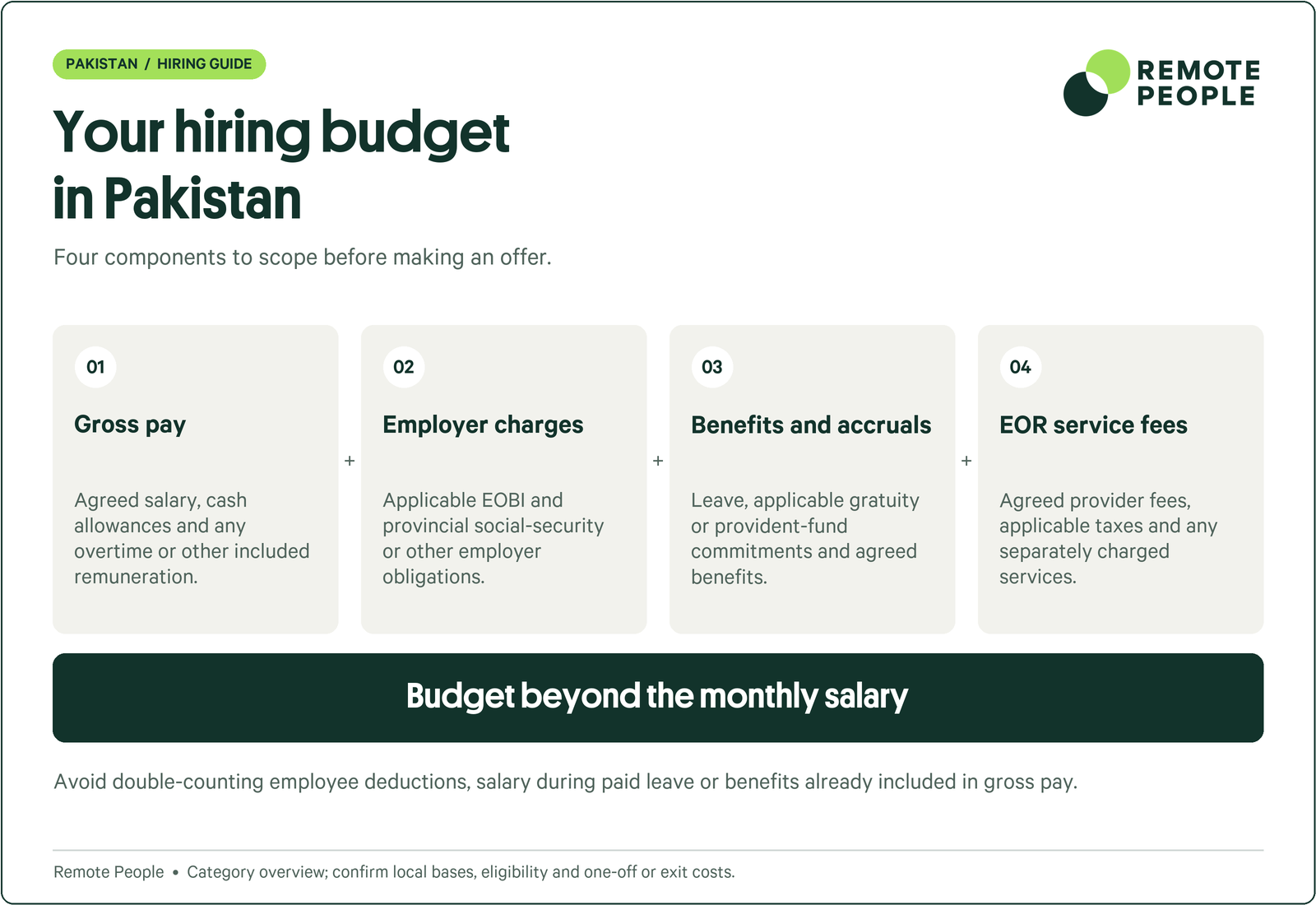
The table below models the total monthly employer cost in Pakistan for a mid-level hire on a USD 2,000 gross monthly salary (approximately PKR 560,000 at April 2026 exchange rates), showing each EOBI and PESSI contribution, the EOR fee, and the fully loaded cost. EOBI is capped at PKR 2,000 employer and PKR 400 employee regardless of salary, and provincial ESSI is capped at the PKR 40,000 wage ceiling, which is why those line items come in well below their headline rates on higher salaries.
Pakistan employer cost example · USD 2,000 gross · 2026 (Punjab worker) | ||
Employer Cost | Amount (USD) | % of Gross |
|---|---|---|
Gross salary | $2,000.00 | 100.00% |
EOBI pension (5% capped at PKR 2,000) | $7.14 | 0.36% |
PESSI (6% capped at PKR 40,000) | $8.57 | 0.43% |
Gratuity accrual (30 days/year = 8.33%) | $166.67 | 8.33% |
EOR service fee (est.) | $399.00 | 19.95% |
Total monthly cost | $2,581.38 | 129.07% |
Exchange rate: 1 USD ≈ PKR 280 (April 2026). Workers’ Welfare Fund (2% of taxable income) and WPPF (5% of net profits) are typically allocated at the corporate level for industrial establishments rather than per-employee and are quoted separately where applicable.
The fully loaded employer cost sits around 9% above gross once the EOR fee is excluded, reflecting Pakistan’s capped EOBI and ESSI design combined with the 8.33% gratuity accrual. In practice, EOBI and ESSI are almost trivial at mid and high salaries (both caps kick in well below USD 2,000), so the bulk of non-wage cost is gratuity. This makes Pakistan one of the lower statutory-overhead EOR markets in South Asia.
Ready to hire in Pakistan? Get started with RemotePeople, we handle employment contracts, payroll, EOBI and provincial ESSI declarations, income tax withholding, and full Standing Orders Ordinance 1968 compliance. No local entity needed.
Benefits of Using an EOR in Pakistan
The EOR model in Pakistan solves the practical obstacles to hiring in a market with a common-law legal system, four separate provincial labour regimes, and active EOBI and ESSI oversight. Companies choose an EOR because it compresses the timeline, removes the fixed cost of SECP incorporation, and pushes the compliance risk onto a specialised provider:
- Speed to market: an EOR in Pakistan can onboard a compliant employee in one to two weeks, compared to two to four months to incorporate a private limited company with the SECP, obtain a National Tax Number, open a Pakistani bank account, and register with EOBI and the provincial ESSI.
- Compliance assurance: the EOR tracks the Standing Orders Ordinance 1968, Factories Act 1934, Minimum Wages Ordinance 1961, Finance Act 2025-26, EOBI Act 1976, and four provincial ESSI regimes on your behalf, with the legal employer carrying primary liability for non-compliance.
- Cost efficiency vs entity: entity setup in Pakistan involves approximately USD 3,000 to USD 10,000 in SECP registration, legal, and stamp duty fees, plus ongoing annual compliance, statutory audit, and company secretary costs; an EOR avoids all of that with a flat per-employee monthly fee.
- Local expertise: RemotePeople’s in-country payroll team handles salary slips, EOBI PR-03 submissions, provincial ESSI filings, and FBR IRIS remittances that would otherwise need a local HR and finance function or an outsourced payroll firm.
- Flexibility to scale: adding a second or third Pakistani employee is a standard onboarding; removing one is a termination with statutory notice and gratuity. No SECP wind-down, bank account closure, or EOBI deregistration is required.
- Risk mitigation: misclassification as contractor, under-declared EOBI, or missed FBR remittances can trigger back contributions, Section 161 default orders, and late-payment additional tax at 12% per year. The EOR absorbs that exposure.
- Employee experience: employees get a compliant Pakistani appointment letter, EOBI and provincial ESSI registration, accurate rupee payroll, and access to RemotePeople’s HR support team for day-to-day questions.
Ready to evaluate the EOR model for your Pakistan hire? Talk to our team to map the specific timeline, cost, and compliance setup for your first employee.
Termination and Offboarding in Pakistan
Notice Periods
Under Standing Order 12 of the 1968 Ordinance, either party must give one month’s written notice (or one month’s wages in lieu) to terminate the employment of a permanent worker or a probationer who has completed the probation period. Notice is not required during the probation period itself (Standing Order 1). Notice is also dispensed with in cases of misconduct covered by Standing Order 15, which include wilful insubordination, theft, fraud, habitual absence without leave, and habitual late attendance. Pay in lieu of notice equal to one month’s basic wages plus dearness allowance is explicitly permitted.
Pakistan statutory notice periods by category · Per Standing Orders Ordinance 1968 | |||
Employee Category | Notice Period | During Probation | Notes |
|---|---|---|---|
Permanent workman | 1 month | Not applicable | Standing Order 12(1); pay in lieu permitted |
Probationer (within 3-month probation) | None | Termination without notice or severance | Standing Order 1; cannot be for an unlawful reason |
Probationer (after probation extension) | 1 month | Up to 3 months extension permitted | Standing Order 1 proviso |
Temporary employee (fixed term) | Per contract; typically 14-30 days | Per contract | Contract runs to its term unless terminated early |
Dismissal for misconduct (Standing Order 15) | None | Not applicable | Inquiry procedure under Standing Order 15(4) must be followed |
Badli (substitute) worker | None | Not applicable | Engagement ends automatically when substituted worker returns |
Notice is waived entirely in cases of proven misconduct listed in Standing Order 15, but the employer must hold a domestic inquiry with the worker’s right to represent themselves, cross-examine witnesses, and receive a reasoned order. Failure to follow the inquiry procedure will render the dismissal illegal and expose the employer to reinstatement with back wages through the provincial labour court or the National Industrial Relations Commission. Fixed-term contracts generally run to their term; early termination without cause triggers damages equal to the remaining contract value under common-law principles.
Severance Pay
Severance in Pakistan takes the form of statutory gratuity under Standing Order 12(6) of the 1968 Ordinance, supplemented by provident fund balances where an approved provident fund operates. Gratuity is owed to any employee with 12 months or more of continuous service who is terminated, retrenched, or retires (including death in service, where it is paid to the nominee). Dismissal for proven misconduct under Standing Order 15 can forfeit gratuity. The gratuity formula is 30 days of last-drawn wages per completed year of service, with any fraction over six months counted as a full year. “Wages” for gratuity purposes means basic pay plus dearness allowance; performance bonuses and one-off payments are excluded.
Pakistan gratuity schedule by years of service · Per Standing Orders Ordinance 1968 | |||
Years of Service | Gratuity Amount | Base Wage | Notes |
|---|---|---|---|
Under 1 year | Nil | Not applicable | Minimum 12 months service required (Standing Order 12(6)) |
1 year | 30 days’ wages | Last-drawn basic pay + dearness allowance | Approximately 1 month’s wages |
3 years | 90 days’ wages | 30 days × 3 | Approximately 3 months’ wages |
5 years | 150 days’ wages | 30 days × 5 | Approximately 5 months’ wages |
10 years | 300 days’ wages | 30 days × 10 | Approximately 10 months’ wages |
15 years | 450 days’ wages | 30 days × 15 | Approximately 15 months’ wages |
20 years | 600 days’ wages | 30 days × 20 | Approximately 20 months’ wages |
Calculation Method
The gratuity formula is straightforward: (last-drawn basic pay + dearness allowance) × 30 days × number of completed years of service, with any fraction exceeding six months rounded up to a full year. “Wages” for this purpose exclude overtime, bonuses, and ad hoc allowances; only the regular monthly components are counted. An employer may substitute a registered provident fund with employer contributions equal to or exceeding the gratuity liability, in which case the provident fund balance discharges the statutory obligation (Standing Order 12(6) proviso). Table 13 above shows worked examples for common tenure bands so payroll teams can verify their calculations against the statutory minima.
Caps and Exceptions
There is no statutory cap on gratuity itself under the Standing Orders Ordinance 1968; payments scale linearly with tenure and salary. However, income tax treatment of gratuity is capped at PKR 300,000 for private-sector employees (or higher for approved gratuity funds under the Sixth Schedule to the Income Tax Ordinance 2001), with excess amounts taxable as salary income. Employees dismissed for Standing Order 15 misconduct after a proper domestic inquiry lose their gratuity entitlement. Fixed-term contract employees who complete at least 12 months are entitled to gratuity; those with less than 12 months are not. Employees whose employer maintains an approved provident fund with matching contributions can elect gratuity or provident fund at termination, whichever is higher (common in larger corporates).
Grounds for Termination
Pakistan recognises several lawful termination paths. Termination with one month’s notice (or pay in lieu) under Standing Order 12 is the standard route for a performance, redundancy, or restructuring-based dismissal of a permanent worker. Dismissal with cause requires documented misconduct under Standing Order 15, including theft, wilful damage, habitual absence, insubordination, or riotous behaviour, and must follow the Standing Order 15(4) inquiry procedure with a charge sheet, inquiry officer, right of representation, and reasoned order. Redundancy (retrenchment) requires notice under Standing Order 12 plus gratuity under Standing Order 12(6); large retrenchments affecting 50 or more workers require prior intimation to the provincial labour department under the Industrial Relations Act. Mutual separation is commonly documented with a release and settlement agreement and is enforceable provided it is not signed under duress. Protected categories (pregnant employees during and immediately after maternity leave, union office bearers, and employees on approved medical leave) cannot be dismissed without approval from the labour court, and any dismissal during these periods is presumed unfair.
EOR vs. Other Hiring Models in Pakistan
EOR vs. Setting Up a Local Entity
Pakistan EOR vs local entity comparison · Setup time, cost, risk and best-fit | ||
Comparison | Employer of Record | Pakistani Private Limited (SECP) |
|---|---|---|
Setup time | 1-2 weeks | 2-4 months |
Upfront cost | $0 | $3,000-$10,000 including SECP fees, stamp duty, legal drafting, registered office |
Ongoing cost | $199-$499/employee/month | $8,000-$20,000/year in accounting, audit, company secretary, and SECP annual filings |
Local partner required | No (EOR is the local entity) | No for wholly owned subsidiaries, but a Pakistani director or resident representative is typical |
Social insurance registration | Handled by EOR via EOBI and provincial ESSI | You manage EOBI, PESSI/SESSI/KPESSI, and WWF filings |
Payroll & tax filing | Handled by EOR via FBR IRIS | You manage it (or outsource to a local payroll firm) |
Best for team size | 1-20 employees | 20+ employees |
Scale down / exit | Easy, no entity to unwind | Costly, SECP winding-up and EOBI deregistration required |
Government contracts | Not eligible | Eligible (requires local entity and PPRA registration) |
A private limited company registered with the Securities and Exchange Commission of Pakistan is the default vehicle for entity-based hiring. Setup involves reserving a company name through the SECP eServices portal, filing the memorandum and articles of association, paying registration fees and stamp duty (province-specific), obtaining a National Tax Number and Sales Tax Registration Number from FBR, opening a bank account, and registering as an employer with EOBI and the relevant provincial ESSI. Ongoing compliance carries corporate income tax at 29% plus a 10% super tax on profits above PKR 500 million, Sales Tax returns, WWF, WPPF (where applicable), annual audit above defined revenue thresholds, and annual SECP filings including the Form A and Form 29.
For pilot-stage hiring (one to three employees) or regional expansion (up to twenty employees), the EOR model is typically faster, cheaper, and lower-risk. Once Pakistan becomes a permanent headcount location with more than twenty staff, or if the company needs to bid on PPRA-listed public sector contracts, incorporating a private limited company or a branch office of a foreign company starts to make financial sense.
EOR vs. Hiring Independent Contractors
Pakistan EOR vs independent contractors · Compliance, cost, and risk | ||
Comparison | EOR (Full-Time Employee) | Independent Contractor |
|---|---|---|
Legal relationship | Employee of the EOR under Standing Orders Ordinance 1968 | Self-employed; contract for services under common law |
Compliance risk | Low, EOR ensures labour and tax law compliance | Moderate, misclassification risk if relationship resembles employment |
Payroll & tax | EOR handles Section 149 withholding, EOBI, and ESSI filings | Contractor invoices you and self-files their FBR return under Section 155 |
Benefits & leave | Statutory benefits, paid leave, EOBI, ESSI, gratuity | No entitlement to employee benefits |
IP protection | Stronger, employment contract assigns IP by default under the Copyright Ordinance 1962 | Weaker, requires explicit IP assignment clause in the services agreement |
Termination | Subject to Standing Order 12 notice and 12(6) gratuity | Contract can be ended per agreement terms |
Best for | Long-term, core team roles requiring integration | Short-term projects, specialised deliverables |
Cost structure | Salary + EOBI + ESSI + gratuity + EOR fee | Contractor fee (typically higher gross, lower total cost) |
Misclassification exposure in Pakistan is real and growing. Pakistani labour courts and the National Industrial Relations Commission apply a multi-factor control test drawn from Section 2 of the Industrial Relations Act and interpretive case law: degree of supervision, integration into the employer’s organisation, use of employer-provided tools and workspace, exclusivity, and the nature of remuneration. Where the worker is effectively treated as staff but labelled as a contractor, labour courts will reclassify the relationship and order back pay, EOBI and ESSI contributions, gratuity, and unpaid leave, with additional tax at 12% per year on unpaid FBR withholdings.
The contractor model is appropriate for short, clearly scoped projects (design briefs, legal opinions, one-off translations, software consulting work) delivered by self-employed individuals or registered sole proprietors who serve multiple clients, invoice through a business name, and control their own working methods. For ongoing, integrated work where the person looks, functions, and reports like a Pakistani employee, the EOR route removes the classification question entirely. RemotePeople’s contractor management service at RemotePeople’s contractor hiring solution handles onboarding, invoicing, and compliant payments for contractor engagements.
EOR vs. PEO (Professional Employer Organization)
Pakistan EOR vs PEO comparison · Legal employer, liability, and setup | ||
Comparison | Employer of Record (EOR) | PEO (HR outsourcing) |
|---|---|---|
Legal employer | EOR is the legal employer | You remain the legal employer |
Local entity required | No, the EOR is the local entity | Yes, you must have a Pakistani entity |
Best for | Companies without a local entity | Companies that already have a Pakistani private limited or branch |
Compliance liability | EOR assumes compliance responsibility | Liability stays with the client; PEO supports administration |
Setup time | 1-2 weeks | Depends on existing entity setup (weeks to months) |
Control over HR policies | EOR manages within Standing Orders framework | More direct control, PEO advises and files |
Typical use case | Market entry, small remote teams, testing new markets | Established local operations needing HR outsourcing |
Pakistan does not recognise a formal co-employment PEO framework in the same statutory way as the United States. A Pakistani provider that calls itself a PEO is typically offering payroll outsourcing, EOBI and ESSI filing, and HR administration, leaving the client company as the sole legal employer registered with EOBI and FBR. That distinction matters: the EOR model transfers the employment relationship to the provider; the PEO model keeps it with the client while delegating administrative tasks and advisory work.
If a company already operates a Pakistani private limited company or a branch office with registered employer status, a PEO-style outsourcer can be useful for monthly payroll, provincial ESSI enrolment, leave tracking, and FBR compliance, paired with local counsel for labour court and Industrial Relations Commission matters. If there is no Pakistani entity, the EOR is the only compliant way to hire employees without incorporating.
Public Holidays in Pakistan
Pakistan observes a mix of fixed national holidays notified by the Cabinet Division each November for the following year, and moveable Islamic holidays whose dates depend on lunar observation by the Ruet-e-Hilal Committee. Section 4 of the West Pakistan Holidays Act 1958 and the corresponding provincial rules require paid leave on every gazetted holiday; work performed on those days triggers the 200% premium set out in Table 10. The 2026 calendar-year notification issued by the federal Cabinet Division confirms the following nationally observed days.
Pakistan public holidays · 2026 calendar year | ||
Date | Holiday | Type |
|---|---|---|
5 February 2026 | Kashmir Solidarity Day | National |
23 March 2026 | Pakistan Day | National |
20-22 March 2026 | Eid-ul-Fitr (3 days) | Islamic (moveable, subject to moon sighting) |
1 May 2026 | Labour Day | National |
27-29 May 2026 | Eid-ul-Azha (3 days) | Islamic (moveable, subject to moon sighting) |
25-26 June 2026 | Ashura (9 & 10 Muharram) | Islamic (moveable) |
14 August 2026 | Independence Day | National |
25 August 2026 | Eid Milad-un-Nabi (12 Rabi al-Awwal) | Islamic (moveable) |
9 November 2026 | Iqbal Day | National (partial; province-specific) |
25 December 2026 | Quaid-e-Azam Day / Christmas Day | National |
Islamic dates shift each year with the lunar calendar; the Central Ruet-e-Hilal Committee confirms Eid-ul-Fitr, Eid-ul-Azha, Ashura, and Eid Milad-un-Nabi one or two days in advance based on moon sighting. Provincial governments can add further days: Sindh typically observes Benazir Bhutto’s martyrdom anniversary on 27 December, and Khyber Pakhtunkhwa has recognised additional religious minorities’ holidays. When a gazetted holiday falls on the weekly rest day, employers are not required to grant a substitute day unless a collective agreement provides otherwise. Employees who work on any of these days are entitled to the Table 10 premium.
How to Get Started with an EOR in Pakistan
Hiring through an EOR in Pakistan usually runs through five short stages from first conversation to the employee’s first payroll run:
- First, map the role and the compensation: share the job description, proposed gross salary in rupees or USD, location (Karachi, Lahore, Islamabad, or another city), start date, and benefits profile. The EOR calculates the fully loaded cost, flags any work visa requirement, and quotes the monthly fee.
- Second, sign the EOR service agreement: the service contract defines fees, liability, IP ownership, data processing (in line with the Personal Data Protection Bill framework), and termination. Most providers can turn it around in one to two business days.
- Third, finalise the appointment letter: the EOR drafts a Standing Orders Ordinance-compliant appointment letter specifying category, wages, probation, notice, and benefits. You and the employee review and sign; bilingual English/Urdu versions are available on request.
- Fourth, complete EOBI, ESSI, and bank setup: the EOR enrols the employee with EOBI, the relevant provincial ESSI, and the FBR for tax withholding, and collects banking details for rupee payroll. Provincial ESSI medical cards are issued within two to three weeks.
- Fifth, run the first payroll: the employee starts work, the EOR processes the first month’s payroll, withholds income tax under Section 149, remits EOBI and ESSI, and issues the salary slip. Ongoing administration continues monthly.
Ready to hire in Pakistan without the entity? Talk to RemotePeople for a full cost model, timeline, and contract template for your first Pakistani employee.
Where companies hiring in Pakistan expand next
Companies hiring in Pakistan commonly expand across South Asia, drawing on shared English proficiency and deep tech talent pools. Most teams start with Nepal — the Asia-Pacific gateway with multilingual workforce. Hiring in India typically follows, with access to pan-Asian talent and supply-chain clusters. An EOR partner in Bangladesh is a natural addition for deep Asian tech and services talent, and Sri Lanka completes the regional picture with Asia-Pacific connectivity and English-proficient hires.
Frequently Asked Questions
EOR services in Pakistan typically cost between $199 and $499 per employee per month, depending on salary size, benefits, and whether a work visa is sponsored. That flat USD fee covers appointment letters under the Standing Orders Ordinance 1968, monthly payroll in rupees, EOBI and provincial ESSI filings, FBR income tax withholding, and statutory reporting. On top of the service fee, the fully loaded employer cost adds approximately 9% in statutory contributions and gratuity accrual on a typical salary, because EOBI is capped at PKR 2,000 per month and provincial ESSI is capped at the PKR 40,000 wage ceiling (Employees' Old-Age Benefits Institution).
Onboarding typically takes one to two weeks for a Pakistani national who does not need a work visa, covering appointment letter drafting under the Standing Orders Ordinance 1968, EOBI and provincial ESSI registration, FBR tax registration, and payroll setup (EOBI). Foreign-national hires requiring Board of Investment work visa sponsorship add four to eight weeks of Ministry of Interior security clearance and visa processing. Applicants from sensitive nationalities can wait twelve weeks or more.
The highest-exposure risks are misclassifying an employee as a contractor, under-declaring EOBI or provincial ESSI contributions, missing the 15th-of-the-month EOBI payment deadline, and dismissing without following Standing Order 15 inquiry procedure or paying Standing Order 12(6) gratuity. Penalties include 12% annual additional tax on unpaid FBR withholdings, back EOBI and ESSI contributions with interest, reinstatement orders from provincial labour courts, and damages for unfair dismissal (Standing Orders Ordinance 1968, WIPO Lex). An EOR assumes primary compliance responsibility by acting as the legal employer.
Under the standard EOR service agreement, intellectual property created by the employee during the course of employment is assigned to the client company (you), not the EOR. The Pakistan Copyright Ordinance 1962 (Section 21) allows the employer to own copyright in works made in the course of employment, and the appointment letter includes an explicit IP assignment clause. Patents arising from the employee's work are assigned to the client under the Patents Ordinance 2000 where the IP clause is in place (Intellectual Property Organization of Pakistan).
Yes. The EOR acts as the Pakistani legal employer for visa and immigration purposes, files the Board of Investment work visa application through the Pakistan Online Visa System, lodges the appointment letter, and tracks the Ministry of Interior security clearance. Processing adds four to six weeks to the onboarding timeline (eight to twelve weeks for sensitive nationalities). Special Economic Zone investors benefit from the SEZ fast-track category (Board of Investment Pakistan).
The unskilled monthly minimum wage for fiscal year 2025-26 is PKR 40,000 in Punjab, Sindh, Khyber Pakhtunkhwa, and Islamabad Capital Territory, and PKR 37,000 in Balochistan, effective 1 July 2025. Provincial Minimum Wages Boards also set higher floors for skilled, semi-skilled, and highly skilled categories ranging from PKR 42,000 to PKR 75,000 depending on trade (minimum wage in Pakistan guide).
Not as a universal rule. There is no federally mandated 13th month salary for all employees. Industrial establishments subject to the Companies Profits (Workers' Participation) Act 1968 must pay a statutory bonus from the Workers' Profit Participation Fund where profits allow, and public sector and banking employees typically receive two Eid bonuses equivalent to one month's pay each under sectoral agreements. Private-sector white-collar practice varies: a discretionary performance bonus of one to three months is common, and where an annual bonus has been paid consistently it can become an established term of employment that cannot be unilaterally withdrawn (Standing Orders Ordinance 1968, WIPO Lex).
Gratuity under Standing Order 12(6) of the 1968 Ordinance is owed to any employee with 12 months or more of continuous service at termination, retirement, or death. The formula is 30 days of last-drawn wages (basic pay plus dearness allowance) per completed year of service, with any fraction exceeding six months rounded up to a full year. An employer may substitute an approved provident fund with matching contributions to discharge the gratuity obligation. Tax-free treatment is capped at PKR 300,000 for private-sector employees under the Sixth Schedule to the Income Tax Ordinance 2001 (PwC Pakistan tax summary).
Employer of Record in
Employer of Record in
Employer of Record in
Employer of Record in
Employer of Record in
Employer of Record in
Employer of Record in
Employer of Record in