Recruit
Employer of Record in Nepal
-
 Drew Donnelly
- Published
- September 22, 2026
RemotePeople’s employer of record in Nepal lets you hire employees in Nepal with full Social Security Fund compliance. We handle mandatory Contribution-Based Social Security Act registrations, employer contributions of 20% and employee contributions of 11% of basic salary, and monthly deposits within 15 days.
Hire in Nepal — book a free 30-minute demo
Tell us what you need. You'll get a tailored, transparent proposal within 24 hours, plus a free call to walk through it.
Tell us about your company
So we can match you with a specialist who knows your market — and unlock volume pricing tiers.
* All fields are required.
Where and when are you hiring?
Tell us the geography and timing and we'll quote each country line by line, with onboarding timelines.
* All fields are required.
Help us beat your current setup
We'll benchmark your current deal and send a line-by-line proposal in 24 hours — showing exactly where we cut cost, time, or risk. After you submit, you can book a call to walk through it together.
* All fields are required.
Thanks! Your proposal is on its way.
Expect a tailored, line-by-line proposal in your inbox within 24 hours. In the meantime…
Want to walk through it together?
Book a free 30-minute call with one of our specialists. We'll explain every line, answer your questions, and tailor the proposal further if you need.
No obligation. Pick a time that works for you.








- Hire in Nepal — book a free 30-minute demo
- Tell us about your company
- Where and when are you hiring?
- Help us beat your current setup
- Thanks! Your proposal is on its way.
- How an Employer of Record Works in Nepal
- Employment Laws and Regulations in Nepal
- Work Permits and Visas in Nepal
- Payroll, Taxes, and Social Security in Nepal
- Cost of Hiring Through an EOR in Nepal
- Benefits of Using an EOR in Nepal
- Termination and Offboarding in Nepal
- EOR vs. Other Hiring Models in Nepal
- Public Holidays in Nepal
- How to Get Started with an EOR in Nepal
- Where companies hiring in Nepal expand next
- Frequently Asked Questions
- Related EOR Destinations

Start hiring in Nepal
Let RemotePeople handle payroll, compliance, and HR admin worldwide so you can focus on building your team.

Key Takeaways
- Nepal’s private sector is governed by the Labour Act 2017, enforced by the Ministry of Labour, Employment and Social Security. An employer of record (EOR) lets you hire compliantly without registering a local entity.
- The statutory workweek is 48 hours with overtime capped at 4 hours per day and 24 hours per week, compensated at 1.5× the ordinary rate. The minimum monthly wage is NPR 19,550 (2026).
- Combined Social Security Fund (SSF) contributions total 31% of gross salary (20% employer + 11% employee), covering pension, gratuity, medical, maternity/paternity, and disability protection.
- Personal income tax is progressive from 1% up to 36%, with residents enjoying an NPR 500,000 basic exemption threshold for FY 2025-26. The EOR withholds and files monthly with the Inland Revenue Department.
- Foreign hires require Department of Labour work approval and a Non-Tourist visa from the Department of Immigration; Nepalese nationals can be onboarded by an EOR in 1–2 weeks, expatriates in 6–9 weeks.
An employer of record in Nepal lets you hire Nepalese employees in 1–2 weeks without setting up a local entity, with EOR service fees typically running $300–$600 per employee per month on top of salary and mandatory 20% employer Social Security Fund contributions. RemotePeople’s Nepal EOR handles contracts, payroll, income tax filings, SSF registration, work permits for foreign hires, and offboarding while your team reports directly to you.
Nepal offers a large, English-proficient workforce with expertise in technology, business process outsourcing, tourism, and development services, plus competitive salary levels and strong cultural alignment with international business.
However, hiring in Nepal requires navigating the Labour Act 2017, the Social Security Fund (SSF) Contribution-Based System, progressive personal income tax up to 36%, work permit applications through the Department of Labour and Department of Immigration, and statutory leave and benefit obligations. See how RemotePeople’s EOR solution operates across 150+ countries.
How an Employer of Record Works in Nepal
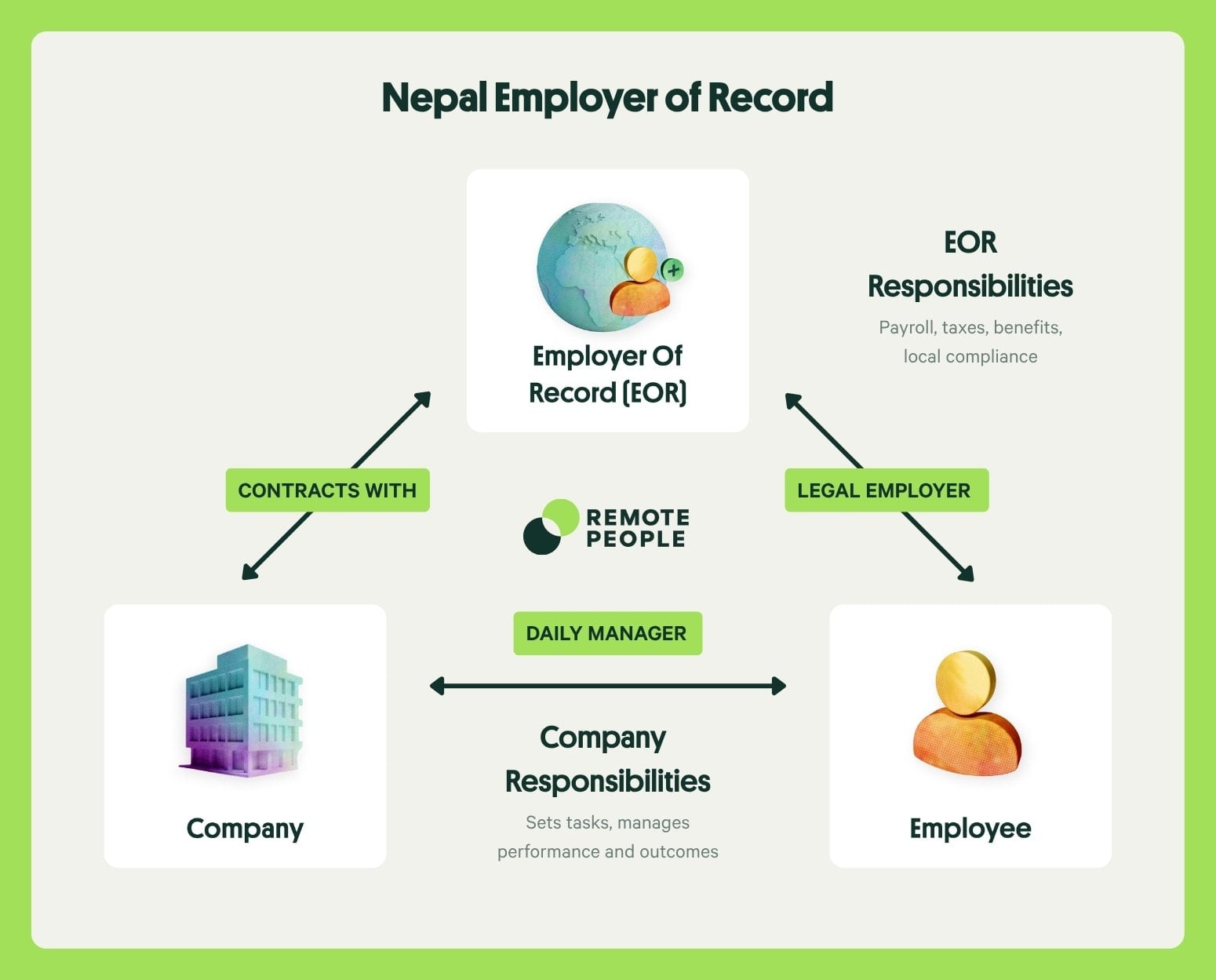
If you’d like to learn more about how Employer of Record (EOR) services work, read our What Is an Employer of Record (EOR)? guide for a complete overview of the model, its benefits, and when to use it.
If you’re comparing providers, our Best Employer of Record (EOR) Providers guide reviews the leading platforms to help you choose the right solution for your business.
Who Uses an EOR in Nepal?
EOR services in Nepal are typically used by companies that want a compliant hiring solution without committing to a Nepalese company registration and local bank account setup. Common scenarios include testing the South Asian market with one or two hires before opening an entity, hiring a regional engineering or support team in Kathmandu or Pokhara, bringing on remote developers and back-office staff to serve global clients, or retaining an existing employee who is relocating to Nepal. Teams hiring across South Asia often pair Nepal with an EOR in India or an EOR in Bangladesh to cover the wider region.
The EOR model is also a practical fit for organizations hiring between one and fifteen people in Nepal where entity setup would be slow and expensive, for companies that need to onboard in weeks rather than months, and for any business that wants to reduce the compliance burden of running its own payroll, IRD filings, SSF contributions, and work permit sponsorship.
Typical Onboarding Timeline
Most EOR providers can onboard an employee in Nepal within one to two weeks when the candidate is a Nepalese national. For expatriates hired from outside Nepal, the Department of Labour work approval and Department of Immigration Non-Tourist visa process adds roughly four to eight weeks because work approvals require advertising, labour market justification, and security clearance from the Ministry of Home Affairs. The typical sequence looks like this:
- First, the client signs the EOR agreement and provides employee details, job description, and compensation package (1–2 days).
- Second, the EOR drafts the English-language employment contract in line with the Labour Act 2017 and sends it for signature (2–3 days).
- Third, the EOR registers the employee with the Social Security Fund, registers them for payroll income tax with the IRD, and, for foreign hires, initiates the Department of Labour work approval application (3–5 days for nationals; 25–40 days for foreign hires).
- Fourth, payroll is configured in the local bank’s disbursement system and benefits enrollment is completed (1–2 days).
- Fifth, the employee signs the contract, submits KYC documents, and starts work on the agreed start date, fully payrolled.
Background checks, national ID verification, and security clearance for foreign workers can extend this timeline. A realistic planning assumption is two weeks for Nepalese nationals and six to nine weeks for expatriates arriving from abroad.
Hire in Nepal
A growing IT and services market with SSF contributions, Nepal Labour Act 2017 compliance, and mandatory gratuity and provident fund obligations.
We handle employment contracts, payroll, social contributions, and full Nepalese compliance.
No local entity needed. Your team can start in days.
Employment Laws and Regulations in Nepal
Employment Contracts
Employment in Nepal’s private sector is governed by the Labour Act 2017, administered by the Ministry of Labour, Employment and Social Security and the Department of Labour. Written contracts and an appointment letter are mandatory, and must set out the parties, job title, start date, wage, working hours, leave, probation, and the duration of the contract. Contracts are typically drafted in English or Nepali; English is standard for international employment.
Contracts can be for permanent, probationary, temporary, casual, or apprentice workers, each category defined in the Act. A worker who completes probation and is not formally terminated continues indefinitely as a permanent employee with all attendant statutory benefits.
Working Hours and Overtime
The standard private-sector workweek in Nepal is 48 hours, typically arranged as 8 hours per day over six days, with a rest break (minimum 30 minutes) required after 5 continuous hours of work under the Labour Act 2017. Overtime is permitted up to a maximum of 24 hours per week and 4 hours per day, compensated at 1.5 times the ordinary rate. Annual average working hours cannot exceed 48 hours per week as calculated across the year.
Under the Labour Act 2017 Section 31, overtime compensation is specified by work category and rest-day status. Weekday overtime is compensated at 1.5× the ordinary rate, while work on weekly rest days and public holidays commands higher premiums. The table below shows the complete overtime and premium pay rate schedule, including the weekly overtime cap and the base salary to which multipliers apply.
Nepal overtime and premium pay rates · Per Labour Act 2017 |
|||
Hour Type |
Rate Multiplier |
Weekly/Daily Cap |
Notes |
|---|---|---|---|
Weekday overtime |
1.5× |
4 hours/day; 24 hours/week |
Per Section 31. Ordinary remuneration basis. Calculated on hourly rate. |
Weekly rest day work |
1.5× |
As permitted by agreement |
Compensation for work on the weekly day off. Employee entitled to compensatory leave within 21 days or cash payment. |
Public holiday work |
2.0× |
Per public holiday calendar |
Double-time payment (200% of ordinary remuneration). Work on gazetted national and religious holidays. Employee also entitled to compensatory leave within 21 days. |
Monthly overtime cap |
N/A |
24 hours/week max (96 hours/month) |
Total overtime in any week cannot exceed 24 hours and 4 hours per day. Annual average working hours (including overtime) cannot exceed 48 hours per week. |
Source: Nepal Ministry of Labour and Labour Act 2017 Section 31 |
|||
Minimum Wage
Nepal’s national minimum wage was raised to NPR 19,550 per month effective 17 July 2025.
The rate comprises NPR 12,170 as basic pay and NPR 7,380 as dearness allowance (an inflation adjustment component). Tea estate workers receive a lower floor of NPR 13,893 per month. Most professional, technology, and white-collar roles in Kathmandu and other urban centres exceed these statutory floors significantly.
Probation Period
The probation period in Nepal under the Labour Act 2017 is set at a maximum of 6 months.
During probation, either party may terminate employment with notice or compensation as set out in the contract (commonly 7–15 days’ notice). A worker who continues in employment after probation expires becomes a permanent employee with automatic confirmation of service and full statutory entitlements including gratuity accrual from day one. Only one probation period is allowed per employee with the same employer.
Leave Entitlements
Nepal’s statutory leave framework is set out in Sections 37–51 of the Labour Act 2017 and covers annual, sick, casual, maternity, paternity, and public holiday leave. The rules apply to all workers and employees in establishments covered by the Act, regardless of nationality.
Annual Leave
Under the Labour Act, workers are entitled to 18 days of paid annual leave per calendar year. Leave accrues and must be granted within the same calendar year or the following calendar year with employer approval. Untaken annual leave can be encashed in cash at the employee’s basic wage rate at the time of termination.
Sick Leave
Section 39 provides 12 days of fully paid sick leave per calendar year.
Sick leave is employer-funded and does not require social insurance involvement because the SSF medical component is employer-financed. A medical certificate from a registered practitioner may be required for absences exceeding two consecutive days. Sick leave cannot be carried forward and is not encashable at termination.
Casual Leave
Employees are entitled to 12 days of paid casual leave per calendar year under customary practice, which may be contractually adjusted. Casual leave is designed for unforeseen short absences and cannot be accumulated or carried over from one year to the next.
Maternity Leave
Section 37 of the Labour Act provides 14 weeks (98 days) of maternity leave, with 60 days fully paid by the employer.
The benefit is available to female employees who have completed at least one year of continuous service at the time of delivery. Maternity leave is compulsory for 2 weeks before expected delivery and 6 weeks after actual delivery. The employee also cannot be dismissed during maternity leave under Section 49, and payment is calculated on the employee’s basic wage at the time notice of pregnancy is given.
Paternity Leave
Section 37 of the Labour Act also provides 15 days of fully paid paternity leave when a male employee’s wife delivers a baby. Paternity leave must be taken within one year of the child’s birth and is provided by the employer.
Nepal statutory leave entitlements · Per Labour Act 2017 |
||
Leave Type |
Duration |
Eligibility and Notes |
|---|---|---|
Annual leave |
18 days / year |
Per Labour Act Section 36. Encashable at basic wage rate on exit. Can be carried to next year with approval. |
Sick leave |
12 days / year |
Per Section 39. Fully paid, employer-funded. Medical certificate may be required for absences over 2 days. |
Casual leave |
12 days / year |
Customary entitlement. Full pay. Not accumulable, not carried forward. |
Maternity leave |
98 days (14 weeks) |
Per Section 37. 60 days fully paid. Compulsory from 2 weeks before to 6 weeks after delivery. Requires 1 year continuous service. |
Paternity leave |
15 days paid |
Per Section 37. Fully paid. Must be taken within 1 year of child’s birth. |
Public holiday leave |
13 days / year |
Fully paid. Dates vary by lunar calendar and government notification. Work on public holidays compensated at 1.5x ordinary rate. |
Source: Labour Act 2017 and Nepal tax compliance guides |
||
Statutory Employee Benefits
Mandatory employee benefits in Nepal are organised around the Social Security Fund (SSF) system and the Labour Act 2017. The SSF is a contribution-based system funded equally (combined 31% of basic salary) by employer and employee, split across multiple schemes: 20% to pension, 8.33% to gratuity (end-of-service severance equivalent), and the balance to medical, maternity, accident, and disability benefits. Private health insurance beyond the SSF medical component is optional and often offered by larger employers as a voluntary benefit.
All employees with an employment contract and at least one complete month of service must be registered with the SSF. Festival allowance (Dashain bonus) is also mandatory under Section 37 of the Labour Act for establishments with 10 or more workers and employees who have completed 6 months of continuous service: one month’s basic wage must be paid before the Dashain festival (typically September or October, date set by lunar calendar). Some employers extend festival allowance to other major festivals (Tihar, Nepali New Year) at their discretion or per employee request.
Recent Regulatory Updates 2026
The most significant recent change is the amendment to the Social Security Fund contribution remittance deadline. Effective from July 2025, employers now have 25 days (extended from 15 days) after the end of each month to deposit SSF contributions.
The Inland Revenue Department also raised the personal income tax exemption threshold from NPR 400,000 to NPR 500,000 for individuals (and NPR 600,000 for married couples) for fiscal year 2082-83 (July 2025–June 2026). The minimum wage was also increased to NPR 19,550 in July 2025, up from NPR 17,300 in 2023. Employers should monitor further IRD circulars and Department of Labour notices for 2026-27.
Work Permits and Visas in Nepal
Work Permit Requirements
Who Needs a Work Permit
All foreign nationals who intend to work in Nepal need a working visa and work permit before they can take up employment. Work permits for private-sector employees are issued by the Department of Labour under the Ministry of Labour, Employment and Social Security upon recommendation to the Department of Immigration. Nepalese nationals and citizens do not require a work permit.
Eligibility and Required Documents
To qualify, the sponsoring employer must conduct a labour market test (typically advertising the position in local newspapers for a specified period), demonstrate that no suitable local candidate is available, and provide an employment contract signed by both parties. The standard documentation bundle includes the signed contract, a copy of the employee’s passport valid for at least 6 months, academic and professional certificates, a recent passport photograph, a company resolution authorising the foreign hire, a declaration that local candidates were considered, proof of the employer’s business registration and tax status, and a statement of the employee’s job title and salary. The employer also typically requires police clearance and medical certificates for the candidate.
Processing Time and Validity
The Department of Labour typically processes work permit applications in 30 to 45 days from submission once the file is complete, though applications that raise security clearance questions or require additional Home Ministry review can take considerably longer. Work permits are initially issued for one year and are renewable annually. Foreign workers must also hold a valid Non-Tourist visa issued by the Department of Immigration, which is normally approved once the work permit is granted.
Renewal Process
Renewal applications should be filed at least 30 days before expiry and typically take 2–4 weeks to process. The employer must show continuing business activity, updated tax filings, and any changes to the employee’s role or salary. Late renewals expose the foreign worker to overstay penalties and can jeopardise future work permit applications and visa extensions.
Common Visa Types for Foreign Workers
Nepal’s Department of Immigration and Department of Labour administer several visa categories relevant to foreign workers. The Non-Tourist (NT) visa is the primary work visa, issued only upon labour market clearance from the Department of Labour and work permit approval. The table below summarizes the main work-eligible visa types, their validity periods, suitability for different employment scenarios, and whether they lead to long-term residency status.
Nepal work visa types for foreign workers · 2026 |
||||
Visa Type |
Duration |
Best For |
Leads to APT? |
Processing |
|---|---|---|---|---|
Non-Tourist (NT) Work Visa |
1 year (renewable) |
Full-time employment; department of Labour work permit approval required |
Potentially (after 5–10 years of continuous renewal and permanent residency application) |
30–45 days (Department of Labour approval + immigration visa issuance) |
Business Visa |
1 month – 5 years (renewable) |
Business owners, entrepreneurs, intra-company transfers; does not authorize direct paid employment without separate work permit |
Rarely; business visa alone does not lead to long-term residency without additional labour market approval |
7–14 days (embassy/consulate) |
Study Visa |
Duration of course + 1 year extension |
International students; limited work permitted (part-time, on-campus only) |
No (study visas do not lead to permanent residency; must switch to work visa post-graduation) |
5–10 days (with letter from recognized educational institution) |
Residential Visa (Long-term) |
2–3 years (renewable for long-term residency) |
Permanent or long-term residence; family reunification; retired persons |
Yes (eligible for permanent residency after defined tenure and continuous renewal) |
15–30 days (Ministry of Home Affairs clearance required) |
Source: Nepal Working Visa and Department of Labour Nepal. Processing times are typical and may vary with security clearance requirements. APT = Applicable Permanent Residency Track. |
||||
Most relevant categories for companies hiring through an employer of record are the Non-Tourist (NT) work visa, issued for sponsored foreign employees with Department of Labour work approval and valid for 1 year initially and renewable. Business visas are for short-term commercial visits not exceeding a specified duration and do not authorize paid employment without a separate labour permit. Dependents of sponsored workers can reside in Nepal under a dependent visa but need their own work permit and Non-Tourist visa if they later take up paid employment.
How an EOR Handles Work Permits
An employer of record in Nepal is the legal sponsor for work permit purposes, which means it conducts the labour market test, files the work approval application with the Department of Labour, coordinates with the Department of Immigration for visa issuance, and manages renewals.
The EOR handles employer-side steps including the labour market justification, contract drafting, documentation collection, and coordination with Home Ministry for security clearance. The employee still needs to provide personal documents, medical certificates, and complete any in-person immigration and biometric steps at the Department of Immigration. Because the Department of Labour application plus security clearance typically adds four to eight weeks for applicants outside Nepal, expatriate onboarding runs closer to six to nine weeks end to end rather than the one to two weeks quoted for Nepalese hires.
Payroll, Taxes, and Social Security in Nepal
Employer Contributions
Employer statutory costs in Nepal are determined by the Social Security Fund contribution system, which mandates a combined 31% of basic salary split 20% employer and 11% employee. The 31% is allocated across multiple schemes: 20% to pension (old age, survivor, disability), 8.33% equivalent to gratuity (end-of-service benefit), and the balance to medical, maternity, paternity, accident, and permanent disability schemes.
Nepal employer contributions · 2026 rates (% of basic salary) |
||
Contribution |
Rate |
Notes |
|---|---|---|
Social Security Fund – Pension |
10.0% |
Mandatory for all employees. Funds old age, survivor, and disability pensions. Deposited by 25th of following month. |
Social Security Fund – Other Schemes |
10.0% |
Covers gratuity (8.33%), medical, maternity, paternity, accident, and permanent disability. Deposited by 25th of following month. |
Festival Allowance (Dashain) provision |
~8.33% / year |
One month basic wage per year for employees with 6+ months service in establishments with 10+ workers. Paid before Dashain festival. |
Total employer load (formal sector) |
20.0% + festival accrual |
Applied to basic salary. Basic salary is typically 50–70% of gross in formal employment. Additional festival allowance payable annually. |
Source: Labour Act 2017 and Nepal IRD tax guides |
||
Employee Contributions
Employee-side deductions in Nepal come from two sources: the employee share of the Social Security Fund (11% of basic salary) and personal income tax withheld at source by the employer. There is no separate public pension, no health insurance withholding beyond the SSF medical component, and no unemployment insurance.
Nepal employee payroll deductions · 2026 monthly withholdings |
||
Deduction |
Rate |
Notes |
|---|---|---|
Social Security Fund – Pension |
5.5% |
Employee contribution to pension and disability schemes. Basic salary basis. |
Social Security Fund – Other Schemes |
5.5% |
Employee contribution to gratuity, medical, maternity, paternity, and accident schemes. Basic salary basis. |
Personal Income Tax (PIT) |
1%–39% (six slabs) |
Withheld monthly by employer. Threshold NPR 500,000/year for individuals (NPR 600,000 for married couples). Includes 1% Social Security Tax below threshold. |
Typical employee deduction |
11% SSF + applicable PIT |
Effective PIT depends on annual taxable income and available rebates. |
Source: Nepal IRD personal income tax and Labour Act 2017 |
||
Income Tax
Nepal taxes residents on worldwide income under a progressive slab system. For fiscal year 2082-83 (July 2025–June 2026), the tax-free threshold is NPR 500,000 for single taxpayers (NPR 600,000 for married couples), and rates rise progressively to 36% on income above NPR 2,000,000, with an additional 3% surtax on income above NPR 5,000,000 (bringing the top marginal rate to 39%). Non-resident foreign nationals are typically taxed at a flat 30% on all Nepal-sourced income unless a tax treaty applies.
A 1% Social Security Tax applies below the exemption threshold as a contribution to the Social Security Fund even if no regular income tax is due. Rebates are available for charitable donations and certain investment categories. Employers withhold tax monthly from gross salary and file quarterly and annual returns with the Inland Revenue Department by specified deadlines.
Nepal individual income tax brackets · Fiscal year 2082–83 (July 2025–June 2026) for residents |
|
Annual Taxable Income (NPR) |
Tax Rate |
|---|---|
Up to 500,000 |
1% (Social Security Tax) |
500,001 – 700,000 |
10% |
700,001 – 1,000,000 |
20% |
1,000,001 – 2,000,000 |
30% |
2,000,001 – 5,000,000 |
36% |
Above 5,000,000 |
39% (36% + 3% surtax) |
Source: Nepal IRD tax slabs 2025-26 and Nepal salary tax guides. Rates shown for resident individuals; married couples have NPR 600,000 threshold. Non-residents taxed at flat 30%. |
|
Payroll Cycle
Wages are paid monthly under Nepal’s payroll and income tax rules, no later than the final working day of the wage month under the Labour Act 2017. Payment is made in Nepalese rupees through a scheduled commercial bank, which is the standard channel for formal employment in Kathmandu and other centres.
Payslips must be provided and should show gross pay, SSF deductions (broken down by component), personal income tax withheld, any other deductions, and net pay. Income tax withheld during the month must be deposited with the IRD within a specified timeframe (usually monthly), and employers file annual salary certificates by 31 December covering the preceding fiscal year ending 30 June.
13th Month Salary and Festival Allowance
A single 13th-month salary is not a statutory requirement in Nepal, but the Dashain festival allowance (mandated under Section 37 of the Labour Act 2017 for establishments with 10 or more workers and employees with 6+ months service) serves as the closest equivalent: one month’s basic wage must be paid before Dashain (typically September or October, date set by lunar calendar). Employees in smaller establishments or with less than 6 months tenure do not qualify for the mandatory Dashain allowance, though some employers offer it as a matter of policy. Many employers also extend voluntary festival allowances to Tihar, Nepali New Year, or other religious observances at their discretion.
Discretionary performance bonuses, incentive pay, and annual bonuses are common in technology, finance, and commercial services. When bonuses are paid, they are generally included in taxable income and subject to income tax withholding under the regular slab schedule.
Cost of Hiring Through an EOR in Nepal
EOR Service Fees
Employer-of-record services in Nepal typically cost between $300 and $600 per employee per month in USD, depending on provider, complexity, headcount, and whether work permit sponsorship for foreign hires is included. The fee generally covers compliant contract drafting, monthly payroll administration, SSF contribution management and remittance, personal income tax withholding and IRD filing, leave administration, festival allowance handling, work permit sponsorship where applicable, benefits enrollment, and offboarding. Visa fees, work permit application costs, and medical insurance are usually passed through at cost.
Total Employment Cost Breakdown
The example below shows how a gross base salary of USD 1,000 per month translates into fully-loaded employer cost once Nepal’s mandatory SSF contributions and statutory allowances are added. Use it to benchmark offers and budget accurately when hiring in Nepal.
Nepal employer cost example · $1,000/month gross · 2026 |
||
Employer Cost |
Amount (USD) |
% of Gross |
|---|---|---|
Gross monthly salary |
$1,000.00 |
100.0% |
SSF Pension (employer share, 10% of basic) |
$63.00 |
6.3% |
SSF Other Schemes (employer share, 10% of basic) |
$63.00 |
6.3% |
Festival Allowance provision (1 month/year ÷ 12) |
$52.50 |
5.3% |
EOR service fee (estimate) |
$400.00 |
40.0% |
Total monthly cost to employer |
$1,578.50 |
157.9% |
Source: Labour Act 2017 and Nepal minimum wage guides. Basic salary assumed at 63% of gross. Personal income tax is withheld from employee pay and does not increase employer cost. USD amounts converted at 1 USD = 132 NPR (April 2026). |
||
At a $1,000 monthly gross salary for a formal-sector hire, the total employer cost works out to roughly $1,579 per month, or about 57.9% above gross once SSF contributions and festival allowance provision are included. Personal income tax is withheld from the employee’s pay rather than added on top, so it does not increase the employer’s cost line. All USD amounts are approximate conversions at 1 USD = 132 NPR (April 2026 rate).
Contact RemotePeople to get started with an employer of record in Nepal. We handle employment contracts, payroll, income tax withholding, SSF administration, festival allowance, work permits for foreign hires, and full Labour Act 2017 compliance, with no local entity needed.
Benefits of Using an EOR in Nepal
The strongest argument for an employer of record in Nepal is speed to market. A full business registration (company or sole proprietorship), bank account setup, Social Security Fund registration, Inland Revenue Department registration, and work permit sponsorship typically takes two to four months when coordinated through a local lawyer or company formation agent, whereas an EOR can onboard a first Nepalese hire in one to two weeks. That difference is often the deciding factor when a project has a narrow hiring window or uncertain market timeline.
Compliance assurance is the second big win. The Labour Act 2017, the Contribution-Based Social Security Act 2017, the Income Tax Act (updated annually), Department of Labour rules, and Department of Immigration visa policies all evolve on their own timelines, and every misstep carries administrative penalties, back-SSF assessments, income tax adjustments, labour court exposure, or visa cancellations. An EOR absorbs that regulatory maintenance, reducing the ongoing burden on the client’s legal and finance teams and removing the risk that payroll or work permit mistakes lead to fines, employee disputes, or visa complications.
Finally, EOR services scale cleanly in both directions. Adding a second or tenth hire follows the same onboarding path as the first, and scaling down requires nothing more than serving a compliant notice period and processing final settlement, rather than dissolving a local entity or dealing with company wind-down formalities. That flexibility, combined with local HR expertise, better employee experience through timely payments and correct benefits, and cost efficiency for small teams where entity overhead would dwarf salary budget, makes the EOR model the default choice for most companies testing Nepal for the first time.
Termination and Offboarding in Nepal
Notice Periods
Under Section 142 of the Labour Act 2017, either party must give 30 days’ written notice to terminate a permanent monthly-rated worker’s employment without cause. The notice period applies equally to both employer and employee. During the notice period, the employee remains on full pay and continues to accrue benefits including SSF contributions and leave.
The Labour Act 2017 specifies different notice periods based on tenure and employment status.
Section 142 sets the 30-day notice requirement for permanent workers with service exceeding one year. Probationary workers and those with shorter tenures have different notice requirements. The table below outlines the statutory notice periods by employee tenure and position level, with special provisions for disciplinary termination and collective dismissal.
Nepal statutory notice periods by position level · Per Labour Act 2017 |
|||
Position Level |
Notice Period |
During Probation |
Notes |
|---|---|---|---|
Probationary workers (all levels) |
7–15 days (per contract) |
7–15 days (contractual notice) |
Per Section 13. Notice period during probation is set in the employment contract. Shorter notice typical for non-compliance with job requirements. |
Less than 1 year service |
7 days |
7–15 days (if still on probation) |
Per Section 144. Written notice of 7 days for employment lasting 4 weeks to 1 year. |
1–3 years service |
30 days |
N/A |
Per Section 142. Permanent monthly-rated workers with 1+ year service. Notice applies equally to employer and employee. Full pay during notice period. |
3+ years service |
30 days |
N/A |
Per Section 142. Same 30-day notice as 1–3 years tenure. Notice period does not increase with additional years. Full pay and benefit accrual continue during notice period. |
Managerial staff |
30 days |
As per contract |
Same as permanent employees under Section 142. Management role does not alter notice periods. Managerial employees may be restricted from collective bargaining but have same termination notice rights. |
Collective dismissal |
30 days + consultation |
N/A |
Per Section 148. Bulk termination (5+ employees or 10% of workforce) requires 30 days’ notice to all affected workers PLUS prior written notice to trade union and Department of Labour (where applicable). |
Termination on disciplinary grounds under Section 140 follows a separate procedure and may not require a notice period if grounds are serious misconduct, provided the employer conducts a written charge, explanation, and inquiry in line with fair labour practices. Termination during probation can be effected with shorter notice (commonly 7–15 days) as specified in the employment contract.
Severance Pay
Under Section 145 of the Labour Act 2017, an employee terminated without cause is entitled to severance pay of one month’s basic wage for each completed year of service, calculated proportionately for incomplete years. The severance base is the basic wage (not gross salary, and excluding allowances and bonuses) at the time notice is given. Severance is paid in addition to accrued gratuity from the Social Security Fund and untaken leave encashment, together forming the final settlement owed on exit.
The table below shows worked examples of severance calculations based on years of service, illustrating how the one-month-per-year formula applies across different tenure lengths. The base salary column explains what counts as “basic wage” for severance purposes under Nepal law.
Nepal severance pay schedule by years of service · Per Labour Act 2017 |
|||
Years of Service |
Severance Amount |
Base Salary |
Notes |
|---|---|---|---|
1 year |
1 month’s basic wage |
Basic wage at notice date (e.g. NPR 25,000) |
Per Section 145. Minimum entitlement for employees completing at least 1 full year. Excludes allowances, bonuses, incentives. Separate from SSF gratuity (8.33% annual accrual). |
3 years |
3 months’ basic wage |
Basic wage at notice date (e.g. NPR 25,000 × 3 = NPR 75,000) |
Calculation: 1 year × 1 month + 2 additional years × 1 month each = 3 months total. Proportional accrual for partial years in excess of 1 full year. |
5 years |
5 months’ basic wage |
Basic wage at notice date (e.g. NPR 25,000 × 5 = NPR 125,000) |
Direct application of the one-month-per-year formula. Severance and SSF gratuity are cumulative and paid together at final settlement. |
10 years |
10 months’ basic wage |
Basic wage at notice date (e.g. NPR 25,000 × 10 = NPR 250,000) |
Full 10 months for 10 years of service. Additionally, the employee is entitled to SSF gratuity = 10 years × 8.33% = ~83.3% of basic wage, paid from the SSF account. No caps or reductions apply for long-service employees in the formal sector. |
Source: Labour Act 2017 Section 145 and Nepal Ministry of Labour. Amounts are illustrative; actual severance depends on employee’s basic wage at notice date and final gratuity balance in the Social Security Fund. |
|||
Calculation Method
Under Section 145 of the Labour Act 2017, an employee who is terminated without cause is entitled to severance pay of one month’s basic wage for each completed year of service. For employees with incomplete years, the severance is calculated proportionately (e.g., 6 months of service = 0.5 months’ pay). The calculation base is the basic wage at the time notice is given.
Gratuity and Final Settlement
The SSF gratuity component (accumulated monthly at a rate equivalent to 8.33% of basic wage per year) is payable separately from severance and is in addition to statutory severance pay under Section 145. Employees also receive encashment of untaken annual leave at their basic wage rate. The total final settlement comprises severance (if applicable), gratuity (if service exceeds one year), leave encashment, and any accrued festival allowance pro-rated to the termination date.
Grounds for Termination
The Labour Act 2017 allows termination with or without cause.
Termination without cause requires 30 days’ notice and the statutory one-month-per-year severance plus gratuity. Termination for cause under Section 140 is allowed for specific misconducts including theft, dishonesty, wilful damage to property, habitual absence without leave, insubordination, violation of safety rules, and conviction for a criminal offence involving moral turpitude.
The employer must serve a charge sheet, allow the worker to respond, and conduct a domestic inquiry before issuing dismissal. Protected categories include pregnant workers during and after maternity leave (Section 49) and workers on approved sick leave. Unlawful dismissal claims go to the Labour Court and can result in reinstatement, back wages, or compensation up to the full severance formula if the termination is found to be without just cause.
EOR vs. Other Hiring Models in Nepal
EOR vs. Setting Up a Local Entity
Opening a private limited company in Nepal involves Office of Company Registrar filings, Inland Revenue Department registration, a paid-up capital deposit, and ongoing accounting and audit obligations. The table below compares the core economics of an EOR engagement against incorporating your own subsidiary.
Nepal EOR vs local entity comparison · Setup time, cost, risk and best-fit |
||
Comparison |
Employer of Record |
Own Entity |
|---|---|---|
Setup time |
1–2 weeks |
2–4 months |
Upfront cost |
$0–500 |
$8,000–$20,000 |
Ongoing annual cost (5 employees) |
$18,000–$36,000 (EOR fees) |
$5,000–$12,000 (compliance, audit, accounting) |
Local partner required |
No (EOR is the local entity) |
Not required; 100% foreign ownership allowed in most sectors |
Payroll and IRD filing |
Handled by EOR |
You manage it (or hire accountant) |
SSF registration and contributions |
Handled by EOR |
You manage it in-house |
Work permit sponsorship |
Handled by EOR |
You manage it in-house |
Best for team size |
1–15 employees |
15+ employees |
Scale down / exit |
Easy, no entity to unwind |
Costly, legal dissolution required |
Source: Labour Act 2017 and Nepal company formation, labour, and tax compliance guides |
||
For companies hiring fewer than 15 people in Nepal, the EOR model is almost always more cost-effective than opening a local company.
Avoided setup costs, company registration fees, legal and accounting retainers, and ongoing corporate administration and compliance usually exceed a full year of EOR service fees for the first one or two hires. Only when a business needs to bid for government contracts, operate in restricted sectors, or has a headcount large enough to justify in-house HR, finance, and compliance staff does the balance tilt toward a local entity. RemotePeople’s transparent EOR pricing allows you to compare exact costs before you commit.
Companies planning regional South Asian expansion often run an EOR in India alongside Nepal to serve both markets before opening entities. A common pattern is to start with an EOR, validate the Nepal market and build a local team, and then transition to a company-owned entity once headcount crosses 15–20 people. A good EOR supports that migration and coordinates the transfer of employees with no break in tenure, preserving annual leave balances, SSF membership, and gratuity accrual.
EOR vs. Hiring Independent Contractors
Engaging Nepalese workers as contractors can look cheaper on paper, but the Labour Act 2017 and Inland Revenue Department treat genuine employees as misclassified if they work under employer direction, use company equipment, or perform core functions. The comparison below highlights when an EOR protects you against reclassification risk.
Nepal EOR vs independent contractors · Compliance, cost, and risk |
||
Comparison |
EOR (Full-Time Employee) |
Independent Contractor |
|---|---|---|
Legal relationship |
Employee of the EOR |
Self-employed, no employment relationship |
Compliance risk |
Low, EOR ensures Labour Act compliance |
Moderate to high; misclassification risk if relationship resembles employment |
Payroll and tax |
EOR handles income tax withholding and SSF filings |
Contractor invoices you; files own income tax return |
Benefits and leave |
Statutory annual, sick, casual, maternity, paternity leave; SSF; festival allowance |
No entitlement to employee benefits |
IP protection |
Stronger, employment contract assigns IP by default |
Weaker, requires explicit IP assignment clause in contract |
Termination |
Subject to 30-day notice and statutory severance rules |
Contract can be ended per agreement terms |
Best for |
Long-term, core team roles |
Short-term projects and specialised tasks |
Cost structure |
Salary, SSF contributions, EOR fee, festival allowance |
Invoice fee (no SSF or benefits), typically lower total cost initially |
Source: Labour Act 2017 and Nepal employment classification guidelines |
||
Independent contractors are only appropriate in some cases, such as short-term project work, specialised consulting, or roles with genuine autonomy where the worker controls their own schedule, tools, and other clients. The misclassification concern in Nepal arises when a contractor behaves like an employee (fixed hours, exclusive relationship, integration into the team, work on employer premises), which can expose the client to back SSF contributions, penalties, unpaid leave, and potential gratuity if a labour court or the Department of Labour recharacterises the relationship.
For core team members who work full time on your business, the EOR route is cleaner. It eliminates classification risk, provides the employee with full statutory benefits including SSF, annual leave, maternity/paternity leave, and festival allowance, gives the client stronger IP protection through employment-law default rules, and simplifies ongoing administration because everything runs through the EOR’s payroll rather than a mix of invoices and ad-hoc payments. When contractors are genuinely the right fit, RemotePeople can help you hire contractors in Nepal compliantly through our dedicated contractor management solution.
EOR vs. PEO (Professional Employer Organization)
Nepal does not recognise co-employment, so a traditional US-style PEO model cannot legally operate in the country. The table below clarifies the differences and explains why an employer of record is the appropriate structure for hiring in Nepal without an entity.
Nepal EOR vs PEO comparison · Legal employer, liability, and setup |
||
Comparison |
Employer of Record (EOR) |
PEO |
|---|---|---|
Legal employer |
EOR is the legal employer |
You remain the legal employer (co-employment) |
Local entity required |
No, the EOR is the local entity |
Yes, you must have your own entity in Nepal |
Best for |
Companies without a Nepalese entity |
Companies that already have a Nepalese entity |
Compliance liability |
EOR assumes compliance responsibility |
Shared liability between you and the PEO |
Setup time |
1–2 weeks |
Depends on your entity setup (weeks to months) |
Control over HR policies |
EOR manages within Labour Act framework |
More direct control, PEO advises |
Typical use case |
Market entry, small remote teams, testing new markets |
Established local operations needing HR outsourcing |
Source: Labour Act 2017 and Nepal Department of Labour guidelines |
||
Nepal does not have a formal Professional Employer Organization (PEO) framework in the way that exists in some developed markets. The “PEO” label is sometimes used loosely by local HR outsourcing firms, but the underlying service is usually HR administration and payroll processing for a client that already holds its own business registration, TIN, Social Security Fund registration, and IRD files. The key legal distinction is who the IRD, Department of Labour, and Department of Immigration recognise as the employer of record for payroll, work permit, and inspection purposes, and in the true PEO model that remains the client company.
Because PEO-style services only work for companies that already have an entity in Nepal, they are not a market-entry option. The practical choice for a business without a local presence is between an EOR (employ through a third party) and setting up a local company. Once a client has its own Nepalese entity, PEO-style payroll outsourcing becomes a reasonable option for reducing HR overhead.
Public Holidays in Nepal
Nepal recognises a blend of national, religious, and cultural holidays under the Labour Act 2017, with many following the lunar calendar and confirmed by government notification shortly before each date. The table below lists the main gazetted holidays for 2026 so you can plan payroll, project timelines, and leave coverage.
Nepal public holidays · 2026 calendar year |
||
Date |
Holiday |
Type |
|---|---|---|
1 January |
New Year’s Day |
National |
2 March |
Holi Purnima |
Religious (Hindu) |
8 March |
International Women’s Day |
National |
14 April |
Nepali New Year (Baishakh 1) |
National |
26 April |
Ram Navami |
Religious (Hindu) |
1 May |
Labour Day |
National |
15 May |
Buddha Jayanti |
Religious (Buddhist) |
7 September |
Janai Purnima |
Religious (Hindu) |
16 September |
Badhani Nawami (Goddess Durga worship) |
Religious (Hindu) |
17 September |
Badhani Dasami (Victory of Durga over demons) |
Religious (Hindu) |
23 September |
Eid-ul-Fitr |
Religious (Islamic, lunar calendar) |
2 October |
Eid-ul-Adha |
Religious (Islamic, lunar calendar) |
26 December |
Christmas Day |
Religious (Christian) |
Source: timeanddate.com Nepal 2026 holidays and Office Holidays Nepal 2026. Islamic dates are approximate and subject to official moon sighting announcement. Employees are also entitled to other festival holidays by religious or cultural observance; employers typically grant Dashain (September–October), Tihar (October–November), and other major religious observances as paid holidays. |
||
Nepal observes approximately 13 national gazetted public holidays per year for 2026, combining national, religious, and cultural observances.
Many holidays follow the lunar calendar and are confirmed by government notification shortly before the observance. Work performed on a public holiday entitles the worker to an additional day of compensatory leave or payment at 1.5 times the ordinary rate (or 2.0 times for night-shift work) under the Labour Act 2017. The EOR tracks all public holidays and ensures correct payroll coding and scheduling so that employees are paid correctly on these days.
How to Get Started with an EOR in Nepal
Getting started with RemotePeople as your employer of record in Nepal is a short, repeatable process:
- First, share the job description, target salary range, and candidate details so we can confirm Labour Act 2017 compliance and quote an accurate monthly fee.
- Second, sign the service agreement and we draft a compliant English-language employment contract under the Labour Act 2017.
- Third, we register the employee with the Social Security Fund, file the Department of Labour work approval application (if applicable for foreign hires), and set up payroll through a scheduled commercial bank.
- Fourth, the employee signs the contract, submits KYC documents, and begins work on a scheduled start date.
- Fifth, we run monthly payroll, withhold and remit income tax, administer SSF contributions and gratuity accrual, manage benefits, and handle any termination or renewal events for as long as the employment continues.
Contact our team to build your Nepal team without a local entity. RemotePeople handles the contracts, payroll, and compliance so you can focus on hiring the right people.
Where companies hiring in Nepal expand next
Companies hiring in Nepal commonly expand across South Asia, drawing on shared English proficiency and deep tech talent pools. After building a team in Nepal, employers often look to operations in Pakistan for Asia-Pacific connectivity and English-proficient hires, then Bangladesh for the Asia-Pacific gateway with multilingual workforce. Hiring in Sri Lanka follows with access to pan-Asian talent and supply-chain clusters, and an EOR partner in India typically closes the regional footprint via deep Asian tech and services talent.
Frequently Asked Questions
EOR services in Nepal typically cost between $300 and $600 per employee per month in USD as a flat service fee, on top of the employee's gross salary and statutory employer contributions (approximately 20% of basic wage for SSF plus one month's basic wage for festival allowance per year). The exact amount depends on the provider, the seniority of the role, and whether work permit sponsorship for foreign hires is included. Personal income tax is withheld from the employee's pay, so it does not increase the employer's cash outlay.
For Nepalese nationals, onboarding typically takes one to two weeks. For new hires coming from abroad, the Department of Labour work approval plus security clearance and Department of Immigration visa processing adds four to eight weeks, bringing the total to around six to nine weeks from signed contract to day one.
Yes. Nepal operates a six-slab progressive personal income tax system for fiscal year 2082–83 (July 2025–June 2026), with a tax-free threshold of NPR 500,000 for individuals (NPR 600,000 for married couples) and a top marginal rate of 39% on income above NPR 5,000,000. Employers withhold income tax monthly and file annual salary certificates with the IRD by 31 December each year.
Contractors are only appropriate in some cases, such as short-term project work and specialised consulting where the worker has genuine autonomy. For core full-time roles there is misclassification risk if the relationship looks like employment. RemotePeople can help you hire contractors in Nepal compliantly through our dedicated contractor management solution, so you don't need to manage classification risk yourself.
The employment contract assigns intellectual property to the client company (you), not the EOR. RemotePeople ensures the contract includes proper IP assignment language so all work product, inventions, and creative output flow directly to your business from day one.
Yes. The EOR is the legal sponsor for Department of Labour and Department of Immigration purposes and handles the work approval application, labour market test, documentation gathering, security clearance coordination, and visa renewals. Foreign hires still need to provide personal documents and complete in-person immigration and biometric steps at the Department of Immigration.
Gratuity in Nepal is an end-of-service benefit funded through the Social Security Fund at a rate equivalent to 8.33% of basic wage per year of service.
It is paid when an employee is terminated without cause after completing at least one year of continuous service. The total amount is the accumulated SSF gratuity component plus statutory severance (1 month's basic wage per year of service under Section 145 of the Labour Act). The EOR tracks the accrual each month and pays the settlement as part of final offboarding.
No. Nepal requires 30 days' written notice for permanent monthly-rated workers under Section 142 of the Labour Act and severance of one month's wages per year of completed service on termination without cause, plus any accrued gratuity and untaken leave encashment. Termination on disciplinary grounds under Section 140 requires a formal charge sheet, explanation opportunity, and domestic inquiry before dismissal. Protected categories include pregnant workers during and after maternity leave and employees on approved sick leave.
The festival allowance (Dashain bonus) is a mandatory payment under Section 37 of the Labour Act 2017 for establishments with 10 or more workers and employees who have completed at least 6 months of continuous service. The amount is one month's basic wage, payable at least 7 days before the Dashain festival (typically September or October, date set by lunar calendar). Employees in smaller establishments or with less than 6 months tenure do not qualify for the mandatory Dashain allowance but may receive it as a discretionary benefit.
Employer of Record in
Employer of Record in
Employer of Record in
Employer of Record in
Employer of Record in
Employer of Record in
Employer of Record in
Employer of Record in