
 Recruit


Key Takeaways
- An Employer of Record (EOR) is an HR service provider that administers payroll and benefits for employees oevrseas. The EOR becomes the legal employer of that workforce, while they continue to work day-to-day for a client company.
- Like all forms of outsourcing, EOR services carry a risk. Failing to identify and mitigate any EOR risks could lead to non-compliance, tax, legal, and reputational issues.
- Thoroughly vetting your EOR partner can help shed some light on whether the benefits of using them outweigh any potential risks.
Global hiring has never been more accessible. Employers can now attract top-tier talent worldwide, scaling operations while avoiding the complexities of establishing legal entities in different countries.
The global EOR market is projected to grow from USD 1,890.29 million in 2022 to USD 3,745.43 million by 2028, driven by demand for flexibility and access to distributed talent. For organizations ready to expand internationally, partnering with an EOR is often the most effective and compliant way to recruit globally.
However, like any business strategy, utilizing an EOR has its challenges. This article will explore the key risks and best practices for mitigating them.
What Is an Employer of Record?
An Employer of Record (EOR) is a professional HR service provider that handles payroll, tax compliance, benefits, and HR management for international employees. As the legal employer, the EOR takes on administrative and compliance obligations, while enabling your company to focus on managing the day-to-day operations of the team.
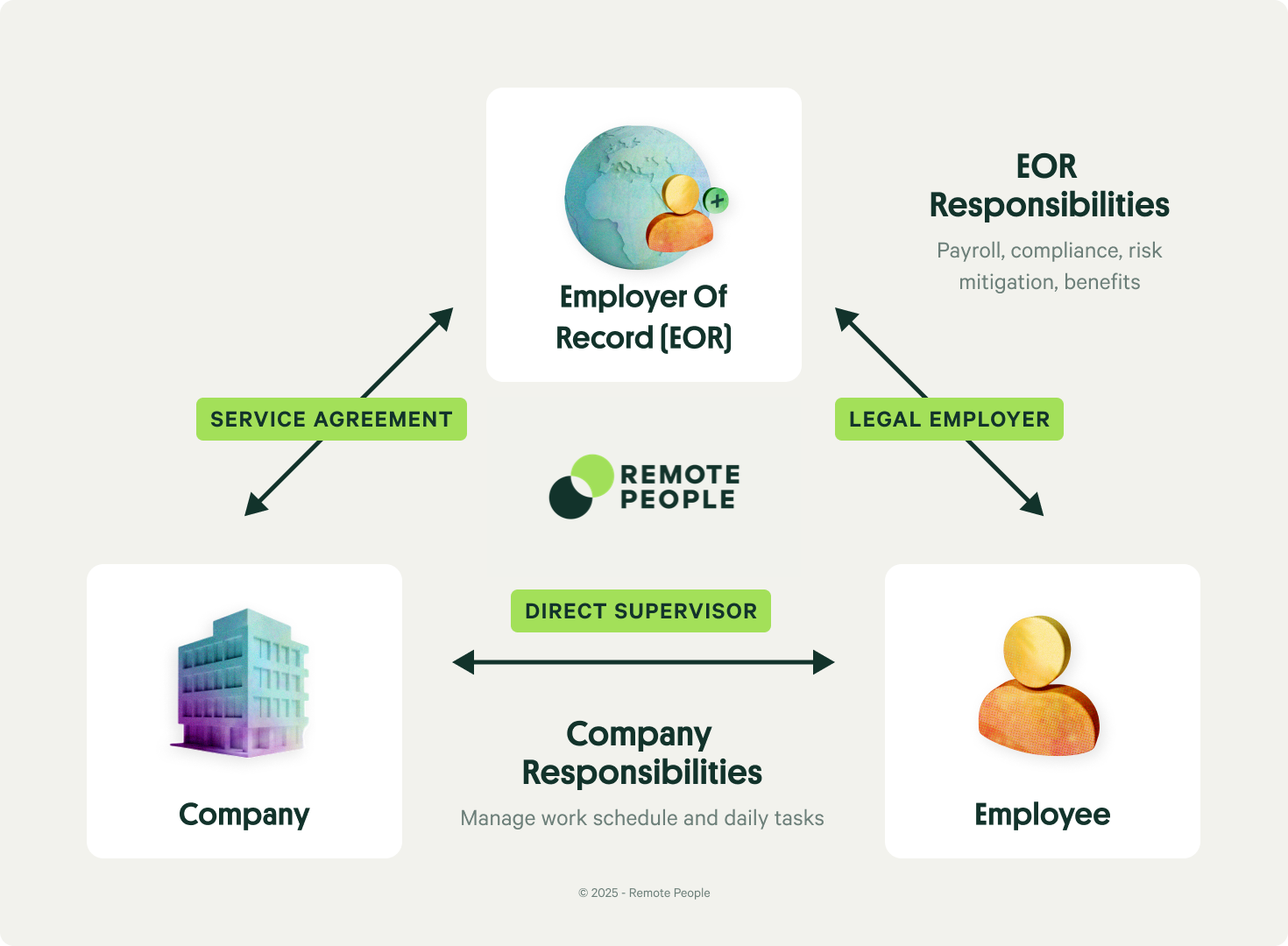
Unlike Professional Employer Organizations (PEOs), which share co-employer responsibilities, an EOR assumes full legal responsibility for payroll and compliance in the respective country. For a detailed comparison, see our PEO vs EOR guide.
What Are Some Services Provided by EORs?
The exact services provided by an EOR will be specified in a service agreement between the EOR and the client company. However, EORs usually provide the following services:
- Recruitment and Onboarding: Handling hiring and onboarding processes in compliance with local regulations.
- Employment Contracts: Drafting legally compliant contracts tailored to each country’s laws.
- Payroll Management: Ensuring accurate and timely payroll with appropriate tax withholdings.
- Compliance with Local Labor Laws: Meeting the specific legal requirements of each jurisdiction.
- Tax Compliance: Adhering to country-specific tax laws and regulations.
- Benefits Administration: Managing mandatory and voluntary employee benefits.
- Worker Classification: Assisting with proper classification of employees and contractors.
- Occupational Medical Checks: Managing mandatory medical assessments where applicable.
- Employee Termination: Handling legally compliant terminations and re-hires.
Not all EORs offer the same level of service. That’s why it’s important to get clear on your company’s needs upfront, so you can choose a provider that actually fits your global hiring goals and won’t leave you stuck with missing pieces down the line.
When Should You Use an Employer of Record?
Not sure if an EOR is right for your business? If you’re testing a new market, need to hire quickly, or want to avoid the cost and hassle of setting up a legal entity, an EOR can be the ideal solution. It’s especially useful for startups, remote-first companies, or growing teams looking to scale globally without expanding compliance risk.
7 Risks You Should Consider When Using an Employer of Record

Even when partnering with an employer of record, you can still face complex challenges and hurdles, especially as the traditional employer-employee model evolves. EORs may not work as seamlessly in certain countries, such as China, Germany, and Spain, as they may in others, such as Indonesia, The Netherlands, or the United States.
That’s why doing your homework before jumping into a new market is so important. Every country has its own quirks, rules, and red tape, and if you’re not careful, an EOR setup that looks great on paper could turn into a compliance headache. Miss the fine print, and you could be facing tax trouble, legal issues, or even damage to your brand reputation.
Here are 7 risks of using an employer of record and some best practices to consider.
1
Poorly Drafted Employment Agreements
Employers of record often rely on third parties to create their employment agreements. Unfortunately, once drafted, these agreements are not always properly vetted for country-specific terms, clarity, or consistency from agreement to agreement.
Additionally, many employment contracts impose restrictions on tenure limits or the tasks performed by workers, limiting your workforce flexibility. Failure to understand these limitations on the front end could severely impede your operations.
2
Errors and Delays in Payroll
With payroll administration serving as one of the more significant EOR offerings, you want to ensure that it’s done compliantly. However, not all EOR providers identify and share payroll issues timely and transparently, before data transfers occur or payroll slips are provided.
Failure to address errors and delays in payroll immediately (or within the next payroll cycle) can severely damage your reputation with your employees, locally and globally.
3
Misclassification of Workers
Since the global pandemic, international governments have been addressing the continuing evolution of the gig economy and remote workers. This has caused additional hurdles in identifying misclassification of global workers.
For example, the United Kingdom has strict contractor misclassification rules that EORs must take into consideration. In the United States, the Department of Labor continues to prioritize worker classification compliance, recently settling with a concrete contractor for USD 1.2 million for misclassifying 29 employees as independent contractors, and in doing so, violated their overtime pay rights.
When working with an EOR that also offers contractor services (as most do), you must be certain that the EOR understands each country’s worker misclassification rules and their enforcement.
4
Blindspots in Operational Models
Some employers of record don’t disclose how they handle your worker’s employment in each country. With laws varying drastically from region to region, it’s essential that you understand your employment relationship with workers globally – whether they are on-site or remote.
For example, an EOR model can exist without any time or job function limitations in Australia, Denmark, Ireland, or Portugal. However, France and Germany impose restrictions on length of employment. France, for instance, imposes a 36 month limitation where Germany imposes an 18 month limitation.
On February 2, 2023, the European Parliament issued new directives aimed at independent contractors and gig workers, re-classifying them as employees for the purposes of employers of record. Each EU member state has two years from the EU’s adoption of the directives to implement them into federal law.
EORs may be heavily restricted in other countries, such as Spain, where there is a risk that the EOR model may be deemed illegal, and China, where local authorities push companies to establish a local presence.
With so many nuances, it’s imperative that your EOR provider understand these rules inside and out, so that you don’t inadvertently violate employment and labor laws globally.
Pay careful attention to whether a provider is compliant before choosing that EOR as your hiring partner.
5
Data Protection Compliance
Working with a less experienced EOR can also cause issues with data protection compliance. Most countries have their own data protection laws, such as the European Union’s General Data Protection Regulation (GDPR) and India’s Digital Personal Data Protection (DPDP) Act, 2023. Each country’s laws must be fully understood so you can ensure compliance globally.
Without robust data protection measures in place, you could face data breaches and other regulatory non-compliance, costing you high fines and damage to your reputation.
6
Equity Plan Restrictions
If you offer employees any type of equity compensation, such as stock options or restricted stock units, you need to ensure that your EOR partner understands the payroll, tax, social insurance, withholding and reporting, securities law obligations, exchange control requirements, data privacy laws, and employee communications in each country where you have employees. Additionally, if you have mobile employees working in various localities, different international laws may apply, depending on the employee’s duration in each country.
Failure to address these compliance requirements could lead to increased audits (perhaps in more than one country) in addition to legal, financial, and reputational risks for your organization.
7
Intellectual Property Protections
As you expand your team globally, your organization’s intellectual property (IP) is spread across devices and clouds worldwide, making it more challenging to protect it. Like data protection compliance, your EOR must also ensure that your digital storage and data transfers don’t violate IP laws that vary from country to country.
Inexperienced EORs may also lack in vigorous global intellectual property (IP) protections, required to assign and protect your IP. Infringements of your intellectual property can result in legal and financial damages, while damaging your brand and misleading your customers or clients.
Best Practices to Consider to Mitigate Employer of Record Risk

When partnering with an employer of record, here are some best practices you can follow to mitigate any potential risk as you expand globally.
- Identify your needs, ensuring that the EOR can meet them with their provided services, resources, and expertise.
- Research the countries you want in scope. Does the EOR have a legal presence in those countries? Does it have the required licenses to operate in those countries?
- Ask questions about the employment relationships in the countries you’ve identified. For example, what are the worker classification rules? What are the national holidays? What are the overtime rules? Are there any mandatory employee benefits that must be offered? Are any work visas required for your team?
- Understand whether the EOR’s services align with your broader business goals.
- Evaluate your organization’s risk tolerance.
- Assess whether the EOR can mitigate your risks and liability in other countries. Be sure to ask questions about their services and expertise while also requesting sample documents, such as employment contracts.
- Determine how the EOR will protect your data and intellectual property.
- Conduct a cost-benefit analysis, comparing the EOR’s services against your potential cost savings.
- Ensure you protect your business with a robust Employer of Record Service Level Agreement, setting out the responsibilities and liabilities of the EOR.
Thoroughly vetting your EOR partner can help shed some light on whether the benefits of using them outweigh any potential risks.

Does Using a Cheap Employer of Record Increase Your Risk?
EOR risks do not necessarily reflect the cost of the provider: Some of the most expensive EORs have been accused of non-compliance. To understand these risks and find reliable options, read our EOR cost guide covering over 60 providers.
Managing Employer of Record Risks with Expert Guidance
While an EOR employment solution is beneficial to many companies, as with any form of outsourcing it carries risks. To ensure that you best mitigate the risks of an EOR solution, get in touch with RemotePeople’s Employer of Record services.
Frequently Asked Questions
An employer of record – or an EOR – is a registered company that administers payroll, benefits, and human resources compliance for employees or contractors in different countries. The employer of record takes on all legal, human resources, taxation, and compliance obligations while you maintain the day-to-day relationships with your team.
Here are some common risks when using a global EOR:
- Poorly drafted employment agreements
- Errors and delays in payroll
- Misclassification of workers
- Blindspots in operational models
- Data protection compliance
- Equity plan restrictions
- Intellectual property protections
Not always. Low-cost providers may cut corners on legal protections, compliance, or service quality. Always vet the provider, not just the price tag.
Ask lots of questions. Read the contract. Understand how the provider works in each country. And don’t skip legal review.
No. Some countries, like China and Spain, have limited or ambiguous rules about EOR arrangements. Always verify legal viability before hiring.