
 Recruit


The way businesses hire and manage talent is changing fast. In today’s globalized world, companies no longer need to be tied to a single country when recruiting top talent. But with international hiring comes a mess of legal, tax, and compliance headaches. That’s where Employer of Record (EOR) services come in, offering companies a way to legally hire employees in new markets—without the hassle of setting up local entities or dealing with complex labor laws.
The Employer of Record market has exploded in recent years, fueled by the rise of remote work, the gig economy, and increasing corporate expansion into international markets. Whether it’s a U.S.-based startup hiring developers in Europe, or a multinational corporation entering new territories in Asia, EOR services help businesses scale efficiently while staying legally compliant.
But just how big is the EOR market? Who are the key players? And where is the industry headed in the next five to ten years?
In this article, we’ll break down the current market size, share, and growth trends in the Employer of Record industry. We’ll explore which regions are seeing the fastest adoption, the industries driving demand, and the challenges companies face when using EOR services. Plus, we’ll look at emerging trends shaping the future of EORs—from automation to AI-driven compliance solutions.
Whether you’re an HR professional, business leader, or investor looking to understand the potential of the EOR industry, this deep dive will give you the insights you need.
What is the Employer of Record (EOR) Market?
The Employer of Record (EOR) market is built around a simple yet powerful concept: making it easier for businesses to hire talent across borders without having to navigate complex legal and administrative hurdles. An EOR acts as the official employer on paper, handling payroll, tax compliance, benefits, and labor law requirements while the client company retains full control over the employee’s daily work and responsibilities.
In other words, an EOR removes the need for companies to set up local entities in foreign countries, allowing them to quickly expand their global workforce without getting tangled in red tape. This service is particularly valuable for startups, small-to-midsized businesses, and enterprises that want to test new markets without making a heavy financial or legal commitment.
Key Services Provided by EORs
EOR providers handle a range of HR and administrative functions, including:
- Managing employment contracts that comply with local labor laws
- Handling payroll processing and tax withholdings
- Providing employee benefits, including health insurance and retirement plans
- Ensuring compliance with country-specific labor regulations
- Managing employee terminations and severance policies
- Navigating visa and work permit requirements for international employees
Why Businesses Use EOR Services
The demand for EOR services is growing rapidly as companies look for ways to stay agile in an increasingly globalized workforce. Some of the main reasons businesses turn to EOR providers include:
- Global expansion without legal complications: Setting up an entity in a foreign country can take months and cost thousands of dollars. An EOR allows companies to hire international employees almost instantly.
- Simplified compliance: Labor laws vary drastically between countries. An EOR ensures that businesses remain compliant with local tax and employment regulations.
- Cost savings: Instead of investing in a full HR team to handle international employees, companies can outsource these responsibilities to an EOR at a fraction of the cost.
- Access to top talent: Companies aren’t limited to hiring only in their home country. With an EOR, businesses can tap into global talent pools and hire the best candidates, regardless of location.
- Risk mitigation: Employment misclassification, tax penalties, and labor law violations can lead to hefty fines. EORs help businesses avoid these risks by ensuring full legal compliance.
With more companies embracing remote work and international hiring, the EOR market is experiencing significant growth.
Employer of Record Market Size: How Big is the Industry?
The Employer of Record market isn’t just growing—it’s booming. Over the last few years, businesses of all sizes have turned to EOR services to streamline international hiring, reduce compliance risks, and access talent beyond their home country’s borders. With the rise of remote work and a more globally connected workforce, the demand for EOR solutions has skyrocketed, pushing the market to new heights.
Current Market Valuation
Recent industry reports estimate that the global Employer of Record market is valued in the billions, and it’s only getting bigger. In 2025 alone, the market saw double-digit growth, reflecting a sharp increase in demand from startups, multinational corporations, and even mid-sized companies looking to scale internationally.
While exact numbers vary across research firms, analysts predict that the EOR industry will continue its strong upward trajectory, fueled by:
- The rise of remote and hybrid work models, allowing businesses to recruit globally without establishing legal entities in multiple countries.
- Stricter compliance regulations, forcing companies to seek expert partners who understand labor laws across different jurisdictions.
- Small and mid-sized businesses expanding internationally, tapping into new markets without the burden of setting up local subsidiaries.
Market Segmentation: Breaking Down Growth by Region, Business Size, and Industry
The Employer of Record market is evolving too. Certain regions and industries are adopting EOR services at a much faster rate than others. Let’s break it down.
By Region
- North America: The United States and Canada dominate the EOR market, with businesses relying on EORs to hire talent across Latin America, Europe, and Asia without the legal complexities of setting up foreign entities.
- Europe: Strict labor laws, GDPR compliance, and Brexit-related hiring challenges have led to increased demand for EOR solutions, particularly in the UK, Germany, and France.
- Asia-Pacific: Countries like India, China, and Singapore are emerging as hotspots for EOR expansion, thanks to a mix of thriving tech industries and growing startup ecosystems.
- Latin America: Rapid digital transformation and increased foreign investment are making countries like Brazil, Mexico, and Argentina key players in the EOR landscape.
- Middle East & Africa: The EOR market is still developing in this region, but as more companies explore international hiring opportunities, growth is expected to accelerate.
By Business Size
- Startups & Small Businesses: The fastest-growing segment using EOR services. Startups are leveraging EORs to scale internationally without upfront legal costs or infrastructure investments.
- Mid-Sized Companies: Businesses expanding into new markets without the budget for large in-house HR teams are turning to EORs for cost-effective workforce management solutions.
- Enterprises & Multinational Corporations: Large companies are using EORs to test new markets, manage global teams, and ensure compliance across different jurisdictions.
By Industry
Some industries are naturally more inclined to use Employer of Record services due to the nature of their work. The biggest adopters include:
- Technology & IT: Software companies, startups, and SaaS providers rely on EORs to hire global tech talent in competitive job markets.
- Healthcare: International hiring in healthcare requires strict regulatory compliance, making EORs an attractive solution for hospitals and research institutions.
- Finance & FinTech: Financial firms expanding into emerging markets rely on EORs to ensure compliance with strict financial and labor regulations.
- Manufacturing & Engineering: Companies expanding production facilities to new regions need local talent but often lack the HR infrastructure to manage hiring laws effectively.
- Retail & E-commerce: As global online shopping increases, businesses need EORs to manage international sales teams, customer service representatives, and supply chain workers.
With an expanding global workforce and an increasing need for compliance solutions, companies across various industries are turning to EOR providers to stay competitive and legally sound.
Employer of Record Market Share: Key Players and Competitive Landscape
As the demand for Employer of Record services grows, competition in the industry is heating up. Established global providers are expanding their services, while newer companies are entering the market with innovative solutions. The EOR industry is no longer a niche offering—it’s a vital service for businesses navigating international hiring and compliance challenges.
Major Players in the Employer of Record Market
Several well-known EOR providers dominate the industry, each offering unique services tailored to different business needs. Some of the leading players include:
RemotePeople

A rapidly growing provider focusing on compliance-first global hiring solutions with seamless technology integration.
ADP Global Payroll
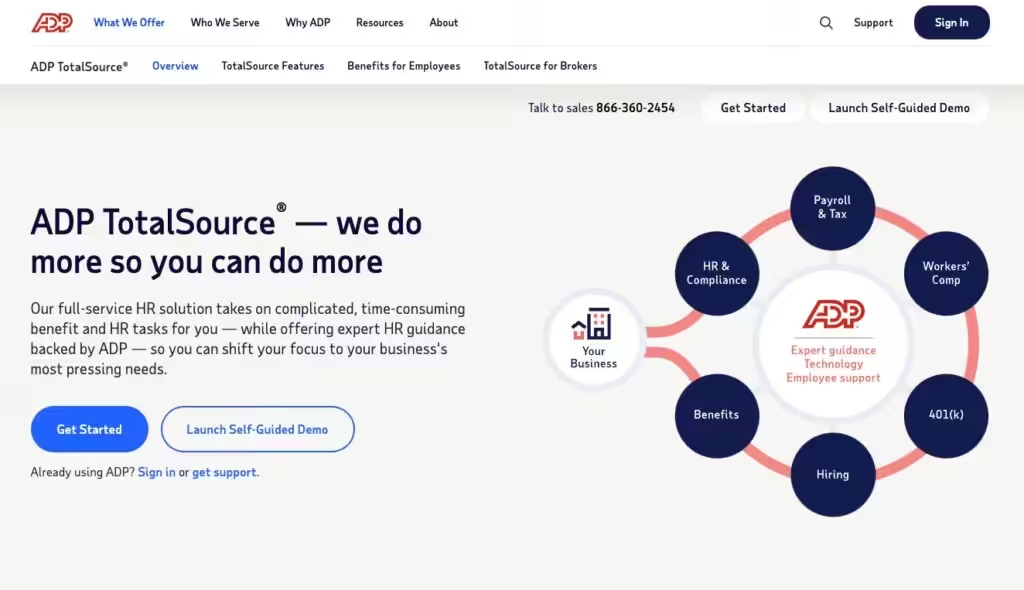
A powerhouse in payroll and compliance, ADP provides employer of record services as part of its broader HR solutions.
💡 Read our in-depth review: ADP Review
Deel

A fast-growing, tech-driven EOR provider specializing in remote workforce management with a focus on compliance automation.
💡 Read our in-depth review: Deel Review
Velocity Global

Known for helping businesses expand internationally without setting up local entities, providing full-scale HR, payroll, and legal compliance services.
💡 Read our in-depth review: Velocity Global Review
Papaya Global

A cloud-based workforce management platform that integrates payroll, compliance, and benefits administration for global teams.
💡 Read our in-depth review: Papaya Global Review
Competitive Landscape and Market Share Distribution
The EOR industry is still highly fragmented, with a mix of large multinational firms, specialized regional players, and tech-driven startups competing for market share. While established providers hold a significant portion of the market, technology-driven companies like RemotePeople are rapidly gaining traction by offering user-friendly, automated platforms that simplify global hiring.
Key factors influencing market share include:
- Technology and Automation – Companies that integrate AI, machine learning, and payroll automation are leading the way, offering businesses a smoother and more scalable hiring experience.
- Geographic Reach – EOR providers with a presence in multiple countries have a distinct advantage, as businesses seek seamless hiring solutions across multiple regions.
- Compliance Expertise – With labor laws constantly changing, EOR providers that prioritize legal and tax compliance earn greater trust from businesses expanding internationally.
- Customer Experience – Personalized service, fast response times, and transparent pricing models differentiate top providers from smaller competitors.
Emerging Players Disrupting the Market
While the big names control a significant share, new players are entering the EOR space with innovative models, competitive pricing, and specialized services. These companies focus on niche markets, such as hiring in developing economies, supporting freelancers, or offering fully remote workforce solutions.
The competition between traditional HR firms and tech-driven platforms is creating a dynamic market where businesses have more choices than ever. As companies increasingly prioritize efficiency, compliance, and cost-effectiveness, EOR providers must continue to innovate to stay ahead.
With the market becoming more competitive and evolving rapidly, businesses looking for an EOR partner must carefully evaluate providers based on their specific needs.
Factors Driving the Growth of the Employer of Record Market
The Employer of Record market is expanding rapidly, and several key trends are fueling this momentum. As businesses continue to embrace remote work, global hiring, and more flexible workforce strategies, the demand for EOR services is only set to increase. Here are the primary factors contributing to this rapid growth:
Rise of Remote Work and Global Talent Acquisition
The shift to remote work has completely changed how companies think about hiring. Businesses are no longer restricted to recruiting talent in their immediate geographic location. Instead, they’re searching for the best candidates worldwide. However, hiring internationally brings compliance challenges, tax complications, and legal risks—which is exactly where EOR services step in.
An EOR allows companies to hire international employees quickly, without setting up foreign entities or worrying about labor law violations. This makes them an essential tool for businesses looking to expand globally while staying compliant.
Increasing Complexity of International Labor Laws
Each country has its own unique employment laws, and these regulations are constantly evolving. Keeping up with tax obligations, benefits requirements, and legal protections for employees across different jurisdictions can be overwhelming for companies trying to expand internationally.
EOR providers specialize in navigating these complexities, ensuring businesses remain compliant with local regulations while avoiding hefty fines and legal disputes. As governments worldwide enforce stricter labor laws, more companies are turning to EORs to mitigate risk.
Cost-Efficiency and Risk Mitigation
For many businesses, hiring employees in a new country without an EOR means establishing a local entity, registering with tax authorities, setting up payroll systems, and managing compliance risks. This process can take months and cost thousands of dollars.
EOR services eliminate these barriers by handling all employer-related responsibilities on behalf of the company, allowing businesses to expand into new markets faster and at a fraction of the cost. Additionally, EORs reduce legal and financial risks, making them a safer alternative to direct international hiring.
Expansion of Startups and Small Businesses into Global Markets
Historically, only large multinational corporations had the resources to hire internationally. However, with the rise of EOR services, startups and small-to-midsized businesses can now expand globally without a huge upfront investment.
Tech startups, e-commerce companies, and digital service providers are particularly reliant on EORs, as these industries thrive on global talent pools. By using an EOR, smaller businesses can compete for top international talent without the burden of managing compliance and payroll across multiple countries.
Adoption of HR Technology and Workforce Automation
The rise of AI-powered HR solutions, cloud-based payroll systems, and automated compliance tracking has made EOR services more efficient and scalable than ever. Leading EOR providers are integrating advanced technology into their platforms, offering businesses seamless hiring experiences with minimal administrative effort.
Automated payroll processing, compliance alerts, and digital contract management are making it easier for businesses to scale their international workforce without increasing HR workload. This integration of HR technology with EOR services is a major driver of market growth.
Challenges and Risks in the Employer of Record Market
While the EOR market is booming, it’s not without its challenges. Businesses looking to adopt EOR services need to be aware of potential risks and limitations.
1
Compliance Complexities in Different Countries
Even with an EOR handling compliance, labor laws can change unexpectedly. Businesses must stay informed about evolving regulations in the regions they operate in to avoid legal risks.
2
Data Security and Privacy Concerns
EOR providers handle sensitive employee data, including payroll information and tax records. Companies must choose providers with strong cybersecurity measures to prevent data breaches and compliance violations.
3
High Costs for Certain Business Models
While EOR services are cost-effective compared to setting up a legal entity, they may not always be the best option for businesses looking to establish a permanent presence in a foreign market. Companies with large-scale international operations may find it more cost-effective to set up their own subsidiaries over time.
4
Growing Competition and Market Saturation
As more players enter the EOR market, businesses must carefully evaluate providers based on expertise, customer service, pricing models, and compliance track records to ensure they’re choosing the right partner.
Future Trends and Forecast for the Employer of Record Market
The future of the Employer of Record industry is bright, with significant growth expected in the coming years. Analysts project continued expansion, innovation, and widespread adoption of EOR services as more businesses recognize their benefits.
Expected Market Valuation by 2028-2030
The global EOR market is projected to reach tens of billions of dollars by 2030, driven by ongoing trends in remote work, HR automation, and international business expansion.
Growth of AI-Driven HR and Payroll Automation
Expect to see more EOR providers integrating AI and machine learning into their platforms, allowing for automated compliance updates, real-time payroll adjustments, and predictive analytics for workforce planning.
The Increasing Role of Blockchain in Global Employment Contracts
Blockchain technology could play a major role in secure, transparent employment contracts, reducing fraud and ensuring compliance in global workforce management.
Industry Regulations and Their Impact on EOR Operations
As governments tighten labor laws and data privacy regulations, EOR providers will need to evolve quickly to maintain compliance and continue offering seamless global hiring solutions.
The Evolution of EOR Services for Gig and Freelance Workers
As the gig economy grows, EOR providers will expand their services to cater to freelance, contract, and project-based workers, making international employment even more accessible for companies hiring short-term talent.
The Evolving Role of Employer of Record Services
The Employer of Record market is undergoing explosive growth, fueled by globalization, remote work, and a growing demand for simplified international hiring. Companies across industries are turning to EOR providers to cut through legal red tape, access global talent, and expand into new markets faster than ever before.
As competition among EOR providers increases, businesses must carefully evaluate their options to find the right partner for their specific needs. With advancements in HR technology, compliance automation, and workforce analytics, the future of EOR services looks promising—and businesses that embrace these solutions will gain a competitive edge in the global hiring landscape.
Whether you’re a startup looking to test international markets, a mid-sized business scaling globally, or a multinational corporation streamlining compliance, Employer of Record services are becoming an essential tool for navigating the complexities of today’s global workforce.




