
 Recruit
Employer of Record (EOR) in China
-
 Drew Donnelly
- Published
- September 27, 2026
Hire employees in China without setting up a local entity. RemotePeople handles payroll, contracts, tax compliance, and social insurance, so you can build your China team in days, not months.
Hire in China — book a free 30-minute demo
Tell us what you need. You'll get a tailored, transparent proposal within 24 hours, plus a free call to walk through it.
Tell us about your company
So we can match you with a specialist who knows your market — and unlock volume pricing tiers.
* All fields are required.
Where and when are you hiring?
Tell us the geography and timing and we'll quote each country line by line, with onboarding timelines.
* All fields are required.
Help us beat your current setup
We'll benchmark your current deal and send a line-by-line proposal in 24 hours — showing exactly where we cut cost, time, or risk. After you submit, you can book a call to walk through it together.
* All fields are required.
Thanks! Your proposal is on its way.
Expect a tailored, line-by-line proposal in your inbox within 24 hours. In the meantime…
Want to walk through it together?
Book a free 30-minute call with one of our specialists. We'll explain every line, answer your questions, and tailor the proposal further if you need.
No obligation. Pick a time that works for you.








- Hire in China — book a free 30-minute demo
- Tell us about your company
- Where and when are you hiring?
- Help us beat your current setup
- Thanks! Your proposal is on its way.
- How an Employer of Record Works in China
- Start hiring in China
- Employment Laws and Regulations in China
- Work Permits and Visas in China
- Payroll, Taxes, and Social Security in China
- Cost of Hiring Through an EOR in China
- Benefits of Using an EOR in China
- Termination and Offboarding in China
- EOR vs. Other Hiring Models in China
- Public Holidays in China
- How to Get Started with an EOR in China
- Where companies hiring in China expand next
- Frequently Asked Questions
- Related EOR Destinations
Start hiring in China
Let RemotePeople handle payroll, compliance, and HR admin worldwide so you can focus on building your team.

China is the world’s second-largest economy and home to a deep talent pool of more than 770 million workers, with world-class expertise in engineering, manufacturing, e-commerce, and digital services. For companies looking to hire employees in China, the challenge is structural: foreign businesses cannot sign direct labor contracts with Chinese nationals without first establishing a Wholly Foreign-Owned Enterprise (WFOE), a process that takes six to nine months, requires roughly $19,444 or more in setup and registered capital, and locks you into ongoing tax, audit, and HR obligations.
An employer of record in China solves this by acting as the licensed local employer through a Foreign Enterprise Service Company (FESCO) or labor dispatch structure, running payroll with the five mandatory insurances and housing fund, sponsoring Z visas for foreign hires, and absorbing compliance risk while your employees report directly to you. See how RemotePeople’s EOR solution works across 150+ countries.
How an Employer of Record Works in China
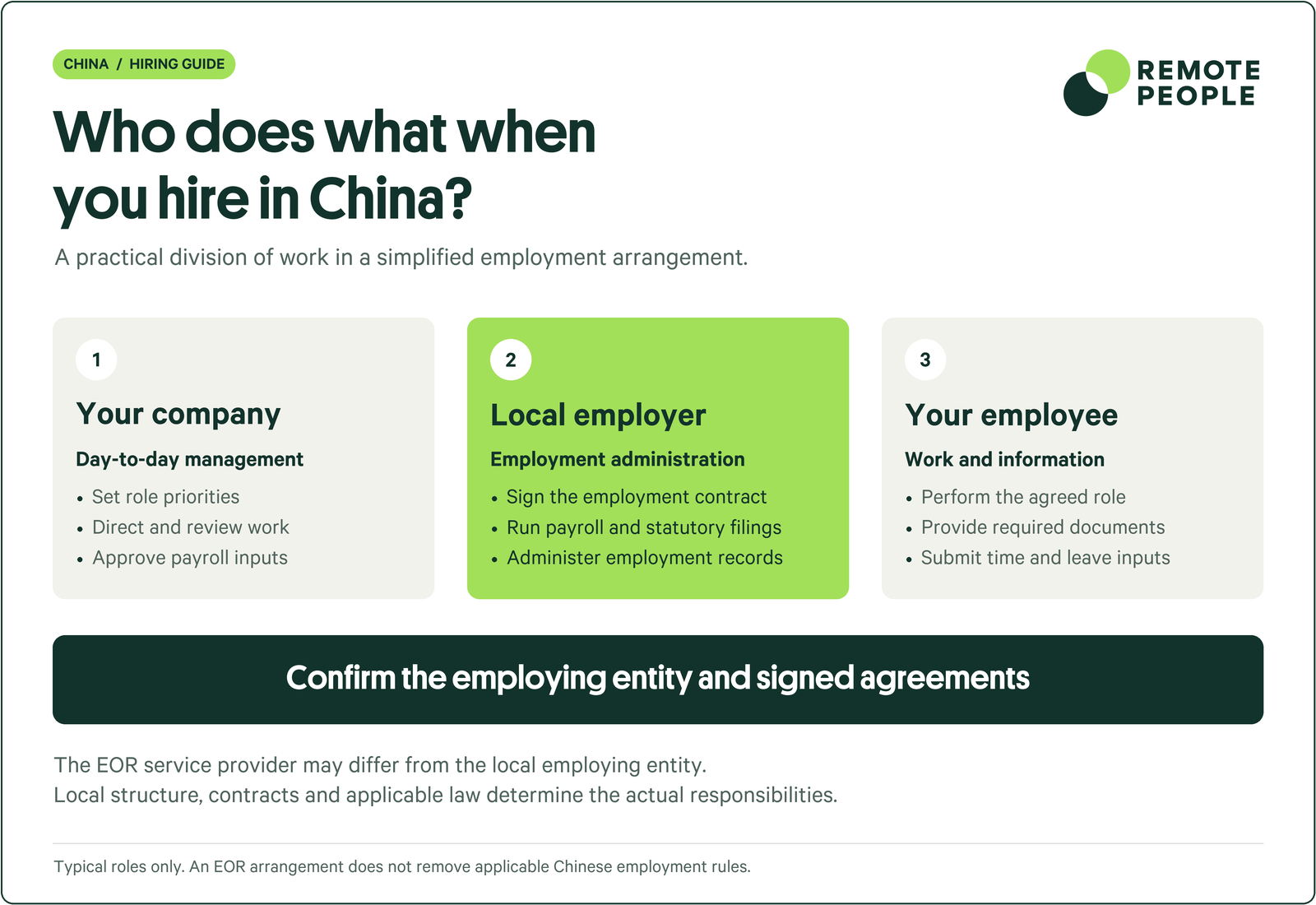
If you’d like to learn more about how Employer of Record (EOR) services work, read our What Is an Employer of Record (EOR)? guide for a complete overview of the model, its benefits, and when to use it.
If you’re comparing providers, our Best Employer of Record (EOR) Providers guide reviews the leading platforms to help you choose the right solution for your business.
Who Uses an EOR in China?
EOR services in China are typically used by companies that want a compliant hiring solution without opening a WFOE, registering with the Ministry of Commerce, and managing ongoing statutory audits. Common scenarios include testing the China market with a small Shanghai-based team, retaining a senior Mandarin-speaking hire without the six-to-nine-month WFOE timeline, or employing a local customer success manager to serve Greater China accounts. Teams building regionally often pair China with an EOR in Hong Kong or an EOR in Singapore to cover wider APAC markets.
The EOR model is also a practical fit for organizations hiring between one and fifteen people where the administrative cost of a WFOE would outweigh the benefits, for companies that need to onboard within one to two weeks rather than half a year, and for any business that wants to reduce the burden of running Chinese payroll, five-insurances filings, and Z visa sponsorship in-house. FESCO-based hiring in China is particularly valued by foreign firms because dispatch contracts create a legal firewall between the client and the Chinese labor authorities.
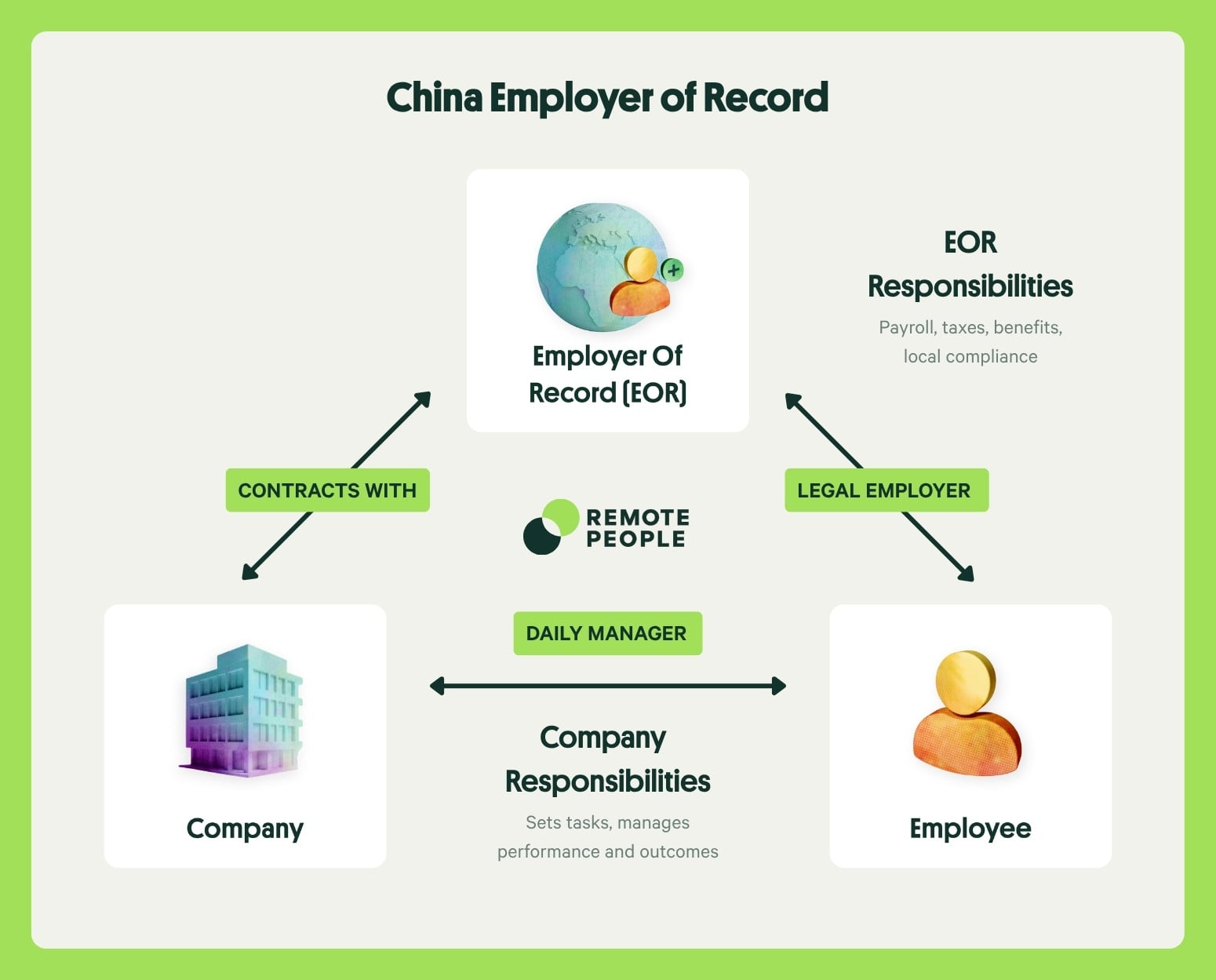
Typical Onboarding Timeline
Most EOR providers can onboard an employee in China within one to two weeks when the candidate is a Chinese national. For foreign hires, the Z visa and work permit process adds roughly six to ten additional weeks because the Notification Letter of Foreigner’s Work Permit must be issued, the consular Z visa stamped abroad, and the residence permit converted after arrival.The sequence looks like this:
- First, the client signs the EOR agreement and provides employee details, job description, and compensation package (1–2 days).
- Second, the EOR drafts the bilingual labor contract aligned with the Labor Contract Law and sends it for signature (2–3 days).
- Third, the EOR registers the employee with the city social insurance bureau, opens a housing fund account, and for foreign hires submits the work permit application through the State Administration of Foreign Experts Affairs system (3–30 days depending on nationality and city).
- Fourth, payroll is configured with the bank, the employee is enrolled in the five insurances and housing fund, and supplemental benefits such as commercial medical are activated (2–3 days).
- Fifth, the employee completes any local formalities, signs the NDA and IP assignment, and starts work on day one.
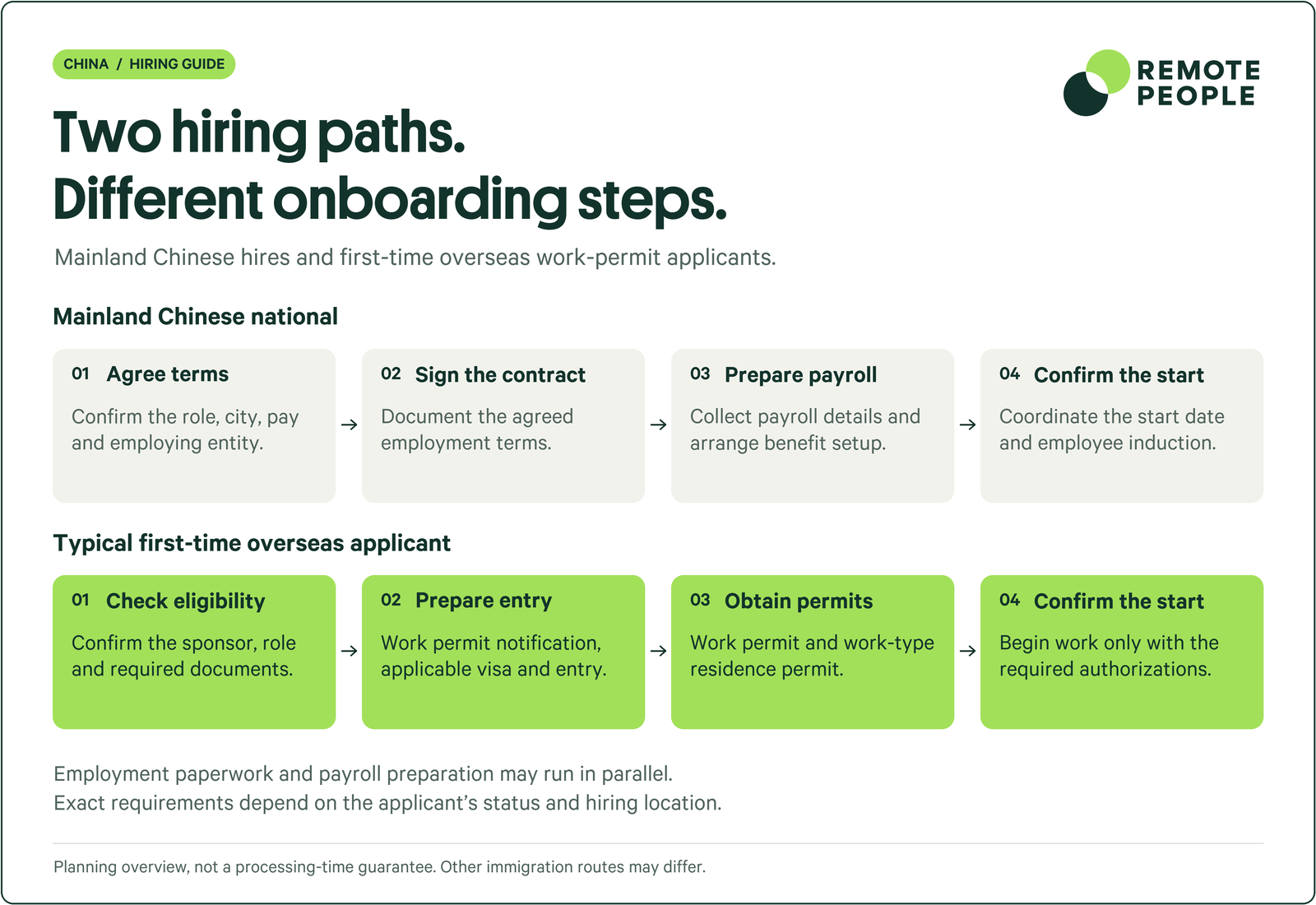
Work permit processing, health checks, and academic document authentication through the Chinese embassy in the employee’s home country can extend this timeline. A realistic planning assumption is two weeks for Chinese nationals and eight to twelve weeks for foreign hires who need Z visa sponsorship.
Start hiring in China
Let RemotePeople handle payroll, compliance, and HR administration in China so you can focus on building your team.
Employment Laws and Regulations in China
Employment Contracts
Employment in China is governed primarily by the Labor Law of 1994 and the Labor Contract Law of 2008, both enforced by the Ministry of Human Resources and Social Security and its local bureaus. A written labor contract must be signed within one month of the employee’s start date. Failure to do so exposes the employer to double wages for every month the contract is missing, and after one year of non-signature the contract is automatically deemed open-ended.
Labor contracts can be fixed-term, open-ended, or project-based. Under Article 14 of the Labor Contract Law, any employee who has signed two consecutive fixed-term contracts or has worked for the same employer for ten continuous years is entitled to an open-ended contract on renewal. Contracts must be in Chinese, and while a bilingual version is common, the Chinese text prevails in any dispute.
Working Hours and Overtime
The standard workweek in China is 40 hours, arranged as 8 hours per day over 5 days, with a hard legal ceiling of 44 hours per week under Article 36 of the Labor Law. Overtime is capped at 3 hours per day and 36 hours per month, and employers that exceed these limits risk administrative penalties and employee back-pay claims.
Overtime is paid at a statutory premium: 150% of the base wage for overtime on a standard working day, 200% for work on a scheduled rest day (if no compensatory time off is provided), and 300% for work performed on a statutory public holiday. In 2025 the Supreme People’s Court issued guidance reinforcing that so-called “996” schedules are unenforceable and that waivers of overtime pay are void, regardless of what the contract says (2025 SPC guidance).
The Labor Law of the PRC caps the standard workweek at 40 hours and layers statutory premium rates on top of it for any work beyond that ceiling. The table below shows the rate multipliers that an EOR must apply to each category of hour, the daily and monthly caps, and the relevant article of the Labor Law for each row.
China overtime and premium pay rates · Per the Labor Law of the People’s Republic of China | |||
Hour Type | Rate Multiplier | Cap | Notes |
|---|---|---|---|
Standard hours | 100% (base wage) | 8 hours/day, 40 hours/week | Per Article 36 of the Labor Law. Average weekly hours capped at 40 under the standard work-hour system. |
Weekday overtime | 150% of base wage | 1 hour/day routine, up to 3 hours/day for special reasons | Per Article 44(1). Requires consultation with the trade union and labourers under Article 41. |
Rest day overtime (no compensatory day off) | 200% of base wage | Counts toward the 36 hours/month overtime ceiling | Per Article 44(2). Employer may instead grant a compensatory day off, in which case no premium is owed. |
Statutory holiday work | 300% of base wage | Cannot be offset by compensatory time off | Per Article 44(3). Applies to all 11 statutory public holidays regardless of industry. |
Total monthly overtime | Varies by tier above | 36 hours/month absolute maximum | Per Article 41. The 2025 Supreme People’s Court guidance confirmed waivers of this cap are void, ending the “996” defence. |
These rates are statutory minimums. Collective agreements or company policy can grant more generous multipliers but never less. RemotePeople enforces the 3-hour-per-day and 36-hour-per-month overtime caps in every China payroll run and flags any manager request that would breach them.
Minimum Wage
China has no national minimum wage. Instead, each province and municipality sets its own monthly and hourly floor, which the Ministry of Human Resources and Social Security aggregates and publishes on 1 January each year. The 2026 rates range from around $190 to $380 per month depending on the city, and the Ministry requires a review at least every two to three years (L&E Global, January 2026 minimum wage release).
The highest rates apply in the first-tier cities. Shanghai leads at roughly $380 per month, followed by Beijing at about $352, Guangdong Class 1 (Shenzhen and Guangzhou) at around $350, and Jiangsu Class 1 at about $336. See the full city-by-city breakdown on our minimum wage in China page.
Probation Period
Probation periods in China are strictly tied to contract length under Article 19 of the Labor Contract Law. For contracts of three months to one year the probation cannot exceed one month; for contracts of one to three years the maximum is two months; and for contracts of three years or longer and for open-ended contracts the maximum is six months.
A single labor contract can only include one probation period, and wages during probation must be at least 80% of the agreed salary or the lowest wage for the position, whichever is higher. Full details are on our probation period in China page.
Leave Entitlements
China’s statutory leave framework is set at national level for annual, sick, and maternity leave, with paternity and extended parental leave added by each province. The Labor Law and the Regulation on Paid Annual Leave for Employees establish the minimum days, while provincial Population and Family Planning Regulations set the extended maternity and paternity rules.
Annual Leave
Paid annual leave is calculated on total years of work experience across all employers, not tenure with the current employer. Employees with less than 1 year of cumulative service receive no statutory annual leave, those with 1 to 10 years of service receive 5 days, those with 10 to 20 years receive 10 days, and those with 20 or more years receive 15 days. Unused annual leave must be paid out at 300% of the daily wage (the 100% already paid through salary plus a 200% premium) if the employer does not reschedule it within the year.
Sick Leave
Sick leave pay in China is tied to two factors: the employee’s years of service and the length of the medical treatment period. For sick leave shorter than six months, the pay scale runs from 60% of the regular wage for employees with under 2 years of service up to 100% for employees with 8 or more years of service.
Sick pay can never fall below 80% of the local minimum wage. The medical treatment period itself ranges from 3 months for employees with under 5 years of service to 24 months for employees with more than 20 years, and the employer cannot terminate the contract during this protected period.
Maternity Leave
Maternity leave in China is a national minimum of 98 days under the Special Provisions on Labor Protection of Female Employees, extended by provincial Population and Family Planning Regulations. Shanghai and Beijing provide 158 calendar days, most other provinces provide 128 to 190 days, and the leave is paid through the maternity insurance fund (part of medical insurance) rather than by the employer directly. A miscarriage before four months entitles the employee to 15 days of leave, and after four months the entitlement rises to 42 days.
Paternity Leave
Paternity leave is set by province rather than nationally and typically ranges from 7 to 30 days. Guangdong provides 15 days, Beijing and Shanghai provide 15 days each, and several provinces such as Gansu and Henan extend paternity leave to 30 days. Paternity leave is fully paid at the employee’s regular wage and is funded by the employer, not social insurance.
Other Statutory Leave
Chinese employees are also entitled to the following statutory time off:
- Marriage leave: 3 days nationally, extended by many provinces to 10 or 13 days.
- Bereavement leave: 1 to 3 days for the death of an immediate family member.
- Work injury leave: paid at 100% of the regular wage during the recovery period, funded by work injury insurance.
- Nursing leave (one-child policy legacy): 1 hour per day for female employees breastfeeding a child under 12 months.
- Childcare leave: 5 to 15 days per year for parents with children under 3 in provinces that have enacted the 2021 parenting leave reform.
Statutory Leave Summary
China’s labour code codifies every statutory leave type employers must grant, from annual leave to maternity, sick, and other protected absences (NPC Labor Contract Law). The table below summarises each statutory leave category with duration and eligibility so payroll and HR can plan accruals and cover without missing a mandatory entitlement.
China statutory leave entitlements · Per the 2008 Labor Contract Law | ||
Leave Type | Duration | Eligibility & Notes |
|---|---|---|
Annual leave | 5–15 days | Based on total career years of service: 5 days (1–10 yrs), 10 days (10–20 yrs), 15 days (20+ yrs). No entitlement in year one. Unused days paid at 300% of daily wage. |
Sick leave | 3–24 months | Medical treatment period scales with service. Pay is 60–100% of wages, never below 80% of the local minimum wage. |
Maternity leave | 98–190 days | National minimum 98 days, extended by province. Shanghai and Beijing provide 158 days. Paid by maternity insurance fund. |
Paternity leave | 7–30 days | Set by province. Shanghai, Beijing, and Guangdong provide 15 days. Fully paid by the employer. |
Marriage leave | 3–13 days | 3 days national minimum. Provinces commonly extend to 10 or 13 days. Fully paid. |
Bereavement leave | 1–3 days | For death of an immediate family member. Fully paid by the employer. |
Childcare leave | 5–15 days/year | For parents with a child under 3 in provinces that enacted the 2021 reform (most provinces). Fully paid. |
Work injury leave | As prescribed | 100% of wage during recovery, funded by work injury insurance. |
Source: NPC Labor Contract Law and PwC China Tax Summary | ||
Statutory Employee Benefits
Beyond leave, China’s mandatory employee benefit framework is built on the “five insurances and one fund” (五险一金) system: pension insurance, medical insurance, unemployment insurance, work injury insurance, maternity insurance, and the housing provident fund.
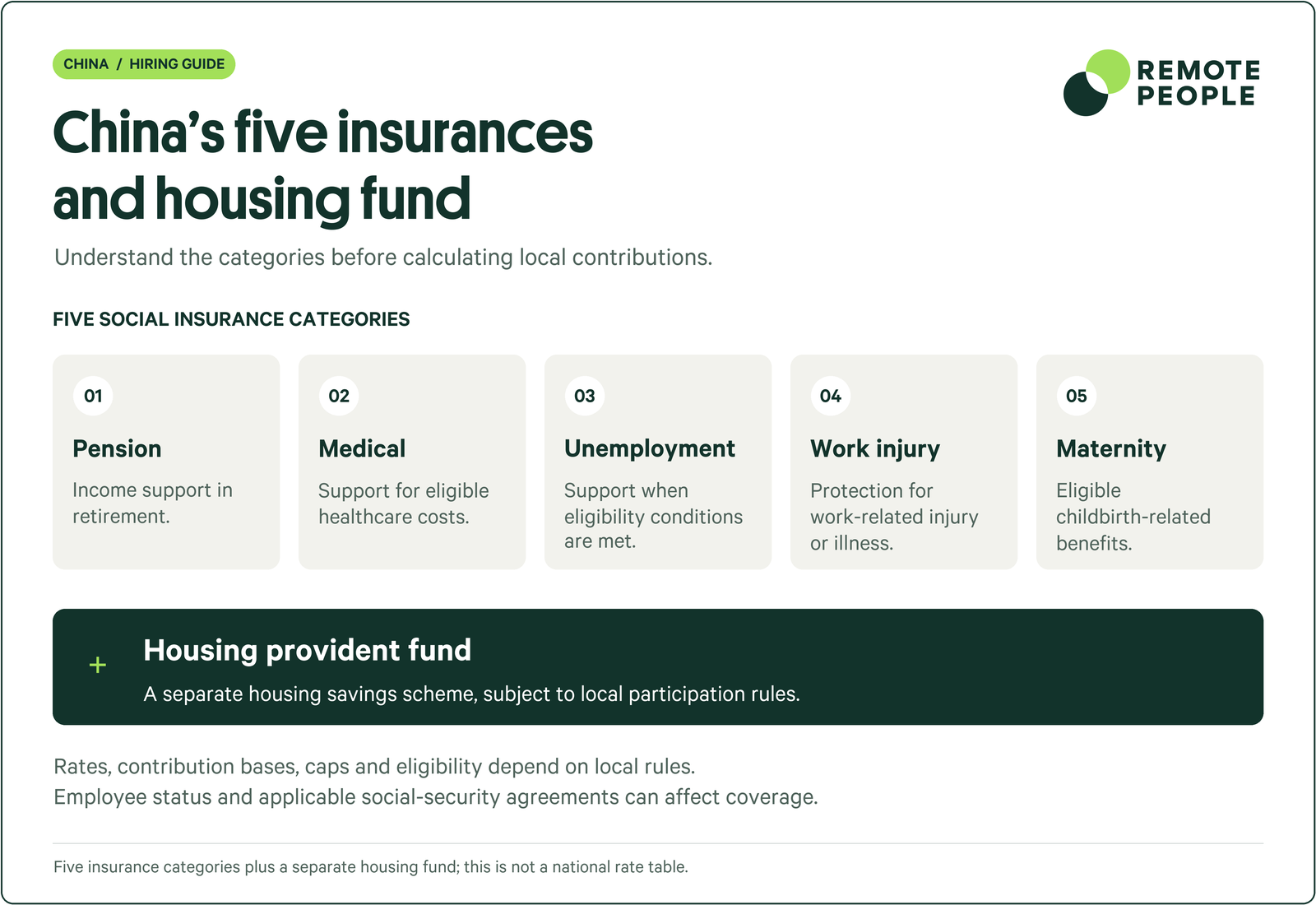
Pension contributions feed into a pooled national account and an individual account that the employee draws on at retirement, medical insurance covers inpatient and outpatient care at designated hospitals on top of any commercial top-up, and unemployment insurance provides a partial wage replacement for up to 24 months. Work injury and maternity insurance are funded entirely by the employer.
The housing provident fund is a co-contribution scheme that the employee can draw on to buy a home, pay rent, or cover mortgage interest.
Both the employer and employee contribute at the same rate, typically 5% to 12% depending on the city; Shanghai applies 7% on each side. Exact contribution bases, caps, and rates vary by city and are reset annually.
For a full breakdown of what these benefits mean in practice, see our employee benefits in China guide. Employer-paid supplemental benefits such as commercial medical insurance, annual health checks, meal allowances, and transport subsidies are common but not statutory, and they are negotiated case by case.
Recent Regulatory Updates (2026)
Three material updates have shaped China’s employment framework for 2026. First, the Ministry of Human Resources and Social Security released updated provincial minimum wage standards on 1 January 2026, with Shanghai remaining the highest at roughly $380 per month and 19 provinces adjusting their Class 1 rates upward (State Council policy portal).
Second, the statutory retirement age is now being phased in under the 2024 National People’s Congress decision, rising progressively from 60 to 63 for men, from 55 to 58 for female white-collar workers, and from 50 to 55 for female blue-collar workers over a 15-year transition that started on 1 January 2025. Pension contribution obligations for employers continue unchanged during the transition, but the window before an employee draws a pension will lengthen.
Third, the Supreme People’s Court issued judicial guidance in late 2025 that declares “996” style overtime schedules (9 a.m. to 9 p.m., 6 days a week) unenforceable and confirms that any contractual waiver of overtime premiums is void. Payroll systems and working-time policies must now rigorously cap daily overtime at 3 hours and monthly overtime at 36 hours.
Work Permits and Visas in China
Work Permit Requirements
Who Needs a Work Permit
Any foreign national (non-Chinese citizen) who takes up paid employment with a China-based entity must hold a valid Z visa, a Foreigner’s Work Permit, and a residence permit. Hong Kong, Macao, and Taiwan residents are subject to a separate simplified scheme but still require a work-related document.
Short business visitors on an M visa may not take up employment in China, and there are no bilateral exemptions that allow foreign nationals to work in China without a permit.
Eligibility and Required Documents
China classifies foreign workers into three tiers under the unified work permit scheme. Category A covers high-end talent (senior scientists, executives earning more than six times the city average wage, and scoring above 85 points on the points assessment), Category B covers professional specialists with a bachelor’s degree and at least two years of relevant experience, and Category C covers other roles under government quotas such as seasonal workers or interns.
Standard documents include a notarized degree certificate, a notarized criminal background check, a medical examination, an employment contract, and the employer’s business license and letter of invitation.
Processing Time and Validity
The end-to-end Z visa and work permit process typically takes 8 to 12 weeks. The Notification Letter of Foreigner’s Work Permit is issued in 10 to 15 working days, the Z visa is stamped at a Chinese embassy abroad in 4 to 8 business days, and the residence permit is issued by the local Public Security Bureau within 15 to 30 days of arrival. Initial work permits and residence permits are valid for 1 to 2 years for Category A and B applicants, renewable in country.
Renewal Process
Renewal applications must be filed at least 30 days before the current permit expires and require a fresh medical certificate, an updated employment contract, and proof that the employee has complied with Chinese tax and social insurance rules. The employee can continue working under the existing permit while the renewal is processed, and the renewed residence permit is usually issued within 10 to 15 business days. Dependents on S1 or S2 visas renew their own permits separately on the back of the principal’s approval.
Common Visa Types for Foreign Workers
Foreign nationals hired in China use one of several visa categories set by the National Immigration Administration. The table below maps the main types an EOR will encounter, which workers each one fits, and whether it allows paid employment.
China work visa categories for foreign workers · 2026 rules | |||
Visa Type | Who It’s For | Typical Validity | Employment Permitted |
|---|---|---|---|
Z visa (Category A) | High-end foreign talent: senior executives, internationally recognized experts, and candidates scoring 85+ on the points-based system. | Up to 5 years, multi-entry. Residence permit issued on arrival. | Yes. Fast-track processing and relaxed age and salary thresholds. |
Z visa (Category B) | Professional foreign workers with a bachelor’s degree and two years of relevant experience. The standard category for most EOR hires. | 1 to 2 years, renewable. Tied to the sponsoring employer. | Yes. Subject to age (under 60), health, and clean-record checks. |
Z visa (Category C) | Seasonal, service, and other foreign workers under bilateral agreements or special quotas set at the provincial level. | Limited to the contract term, typically under 1 year. | Yes, but capped by provincial quotas. |
R visa | High-end foreign talent who meet Category A criteria and apply directly for the fast-track R-visa stream. | Up to 10 years, multi-entry. | Yes. Streamlined document checks and expedited approval. |
S1 / S2 visa | Dependents (spouse, children, parents) of Z or R visa holders. S1 for long-term stays, S2 for visits under 180 days. | Matched to the principal visa holder. | No. Dependents must apply separately for a work permit and Z visa to take up employment. |
M visa | Short business visits: client meetings, trade fairs, contract negotiation, and site inspections. | 30 to 60 days per entry, single or multi-entry up to 1 year. | No. Paid employment on an M visa is unlawful and triggers fines or deportation. |
J1 / J2 visa | Resident foreign journalists (J1) and short-term reporting assignments (J2) approved by the relevant authority. | J1: up to 1 year. J2: up to 180 days. | Yes, limited to accredited journalism only. |
The Z visa (Category B) is the workhorse for most EOR placements, covering professional hires on one to two year contracts. Category A and the R visa are reserved for senior or specialist talent, while M, S, and J visas do not authorize general employment and should not be used as a shortcut to onboard a foreign worker.
How an EOR Handles Work Permits
The EOR acts as the sponsoring entity on the Foreigner’s Work Permit application and handles every step inside China. This includes the online filing through the State Administration of Foreign Experts Affairs platform, the medical examination appointment, and the residence permit conversion at the Public Security Bureau.
The employee is responsible for the Chinese embassy consular Z visa application in their home country and for gathering notarized documents. Adding a Z visa extends the onboarding timeline from the roughly two weeks described in the How an EOR Works section to between eight and twelve weeks. Labor dispatch-style EORs are permitted to sponsor foreign nationals in all major cities; see our China work visa guide for city-level nuances.
Payroll, Taxes, and Social Security in China
Employer Contributions
Employer social security contributions in China are levied on top of gross salary through the five-insurances and housing fund system. Rates are set at city level, so the totals below reflect Shanghai 2026 benchmarks, which are broadly representative of first-tier cities. The contribution base is capped at three times the local average wage (about $5,076 per month in Shanghai for 2026).
China employer social security contributions · 2026 rates (Shanghai benchmark) | ||
Contribution | Rate | Notes |
|---|---|---|
Pension insurance | 16.00% | Funds national pool and individual account. Capped at 3× city average wage. |
Medical insurance (incl. maternity) | 10.00% | Maternity was merged into medical in 2019. Covers designated hospital care. |
Unemployment insurance | 0.50% | Funds up to 24 months of partial wage replacement. |
Work injury insurance | 0.26% | Rate varies from 0.16% to 1.52% by industry risk class. Paid solely by employer. |
Housing provident fund | 7.00% | Shanghai default rate. Other cities range from 5% to 12%. Matched by employee. |
Total employer burden | 33.76% | Shanghai 2026 benchmark. Other first-tier cities fall within 32%–37%. |
Source: PwC China other taxes and Shanghai Municipal Government | ||
On a Shanghai hire the employer burden totals roughly 33.76% on top of the gross salary, meaning that a $1,389 gross wage becomes an all-in cost of about $1,858 before any EOR fee. Work injury insurance varies with the industry risk class assigned by the social security bureau, and the housing fund rate can be set between 5% and 12% by company choice, although the employer and employee rate must always match.
Employee Contributions
Alongside income tax, employees in China pay statutory payroll deductions that fund social security, health cover, and other state schemes (PwC China other taxes). The table below summarises the employee-side contribution rates payroll must withhold from gross pay each month.
China employee payroll deductions · 2026 monthly withholdings (Shanghai benchmark) | ||
Deduction | Rate | Notes |
|---|---|---|
Pension insurance | 8.00% | Funds individual retirement account. Capped at 3× city average wage. |
Medical insurance | 2.00% | Co-funds employee personal medical account. |
Unemployment insurance | 0.50% | Paid jointly with the employer into the unemployment pool. |
Housing provident fund | 7.00% | Matches employer rate. Shanghai default. Other cities range 5%–12%. |
Total employee deductions | 17.50% | Applied before individual income tax withholding. |
Income Tax
China applies a progressive individual income tax (IIT) to residents’ comprehensive income (wages, service fees, author remuneration, and royalties) at seven brackets ranging from 3% to 45%. Residents benefit from a standard deduction of $8,333 per year, plus itemized deductions for children’s education, housing mortgage interest, elder care, and continuing education. Employers withhold IIT monthly using the cumulative withholding method set by the State Taxation Administration.
China income tax brackets · 2026 | |
Annual Taxable Income (USD) | Tax Calculation |
|---|---|
Up to $5,000 | 3% of taxable income |
$5,000 – $20,000 | 10% minus $350 quick deduction |
$20,000 – $41,667 | 20% minus $2,350 quick deduction |
$41,667 – $58,333 | 25% minus $4,433 quick deduction |
$58,333 – $91,667 | 30% minus $7,350 quick deduction |
$91,667 – $133,333 | 35% minus $11,933 quick deduction |
Over $133,333 | 45% minus $25,267 quick deduction |
Source: PwC China Tax Summary and China Briefing IIT guide | |
All USD amounts are approximate conversions at the April 2026 exchange rate. Non-residents who spend fewer than 183 days in China are taxed only on China-sourced income at the same rates applied on a monthly basis without the standard annual deduction.
Payroll Cycle
Chinese payroll runs on a monthly cycle. Wages must be paid in the local currency on a fixed day each month by bank transfer; cash payments are uncommon and are forbidden in most cities by municipal labor bureau rules. Employers must issue a monthly pay slip showing gross salary, five insurances and housing fund deductions, and IIT withheld.
Individual income tax returns are filed monthly through the State Taxation Administration online system by the 15th of the following month, social insurance declarations are filed with the city social security bureau by the 15th, and housing fund contributions are filed with the local Housing Fund Management Centre.
13th Month Salary and Bonus Pay
A 13th month salary is not mandatory in China. It is, however, a near-universal market practice: about 72% of Chinese employers pay a year-end bonus equal to one month of salary, and in many industries it is expected as part of the compensation package (MSA 13th month guide). The bonus is typically paid before the Spring Festival in January or February and is taxable under the IIT framework.
Employees can elect to have the bonus taxed either as a separate lump sum at a preferential rate or rolled into annual comprehensive income, with the separate-lump-sum treatment extended to 31 December 2027 by the State Taxation Administration. Where a 13th month is written into the labor contract or the employee handbook, it becomes legally enforceable regardless of national law.
Cost of Hiring Through an EOR in China
EOR Service Fees
EOR services in China typically cost between $300 and $600 per employee per month, depending on salary level, city, and whether the hire is a Chinese national or a foreign national requiring Z visa sponsorship. The fee covers the local entity licence, labor contract drafting, monthly payroll, five-insurances and housing fund administration, IIT withholding, and standard HR support. Foreign national hires often sit at the upper end of the range because work permit sponsorship adds administrative overhead.
Total Employment Cost Breakdown
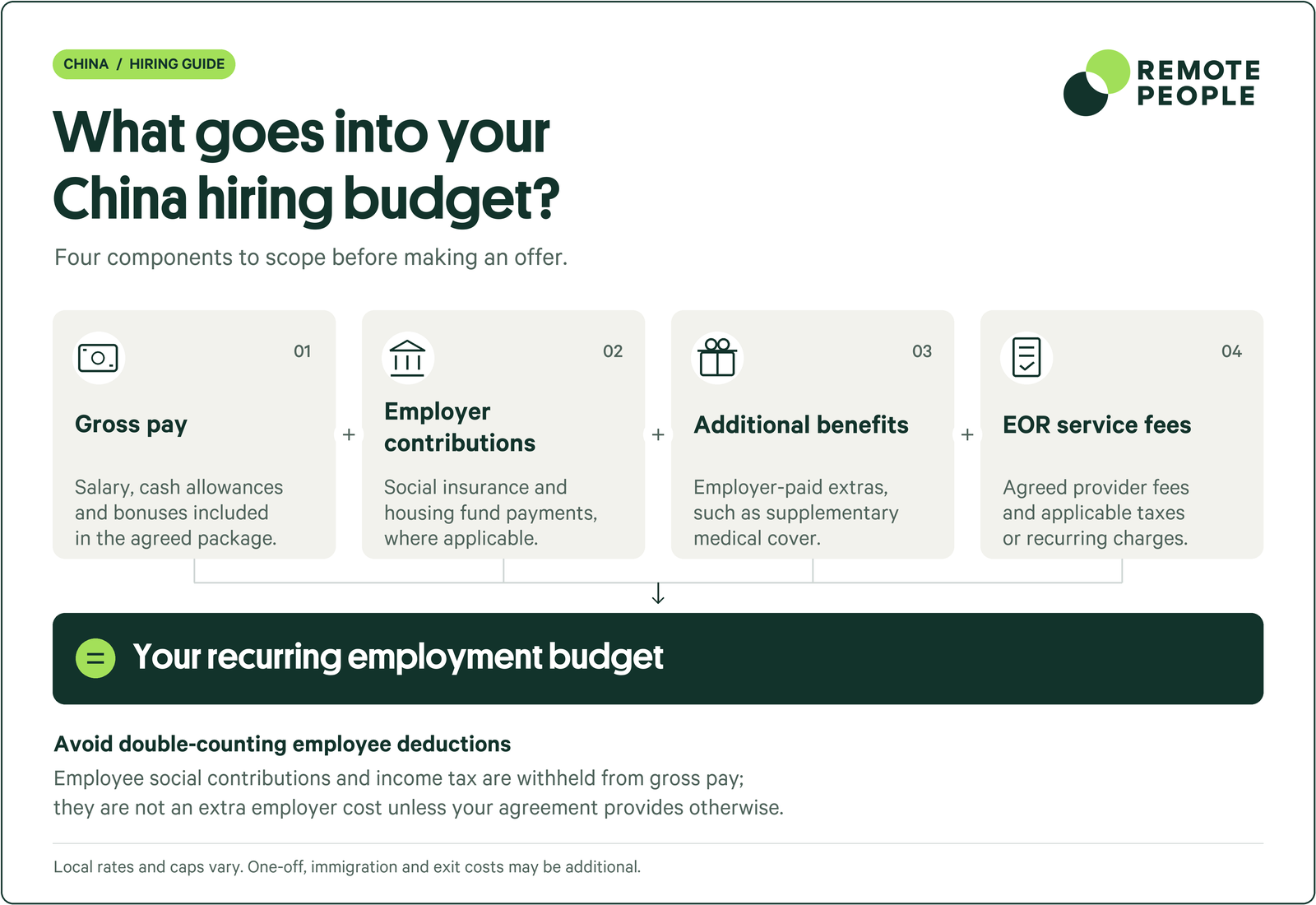
The all-in cost of employing someone in China goes well beyond gross salary. The table below walks through a realistic cost build-up for a typical hire, layering mandatory employer social contributions, statutory benefits, and payroll taxes on top of base pay so finance teams can budget accurately before an offer goes out.
China employer cost example · $1,200/month gross · 2026 | ||
Employer Cost | Amount (USD) | % of Gross |
|---|---|---|
Gross salary | $1,200.00 | 100.00% |
Pension insurance | $192.00 | 16.00% |
Medical insurance (incl. maternity) | $120.00 | 10.00% |
Unemployment insurance | $6.00 | 0.50% |
Work injury insurance | $3.12 | 0.26% |
Housing provident fund | $84.00 | 7.00% |
EOR service fee | $400.00 | 33.33% |
Total monthly cost | $2,005.12 | 167.09% |
Source: PwC China other taxes and Shanghai Municipal Government | ||
Statutory employer contributions add roughly 33.76% on top of the gross salary in Shanghai, and the EOR service fee is a flat USD charge on top of that. Other first-tier cities fall within a 32%–37% employer burden, with the variation driven mainly by housing fund rates and work injury classification.
All USD amounts are approximate conversions at the April 2026 exchange rate. See our China payroll and tax guide for city-by-city rates.
Ready to hire in China? Get started with RemotePeople and we will handle labor contracts, five-insurances payroll, IIT withholding, and full China compliance. No WFOE needed.
Benefits of Using an EOR in China
The core advantage of an EOR in China is speed to market. A WFOE takes six to nine months to register, requires registered capital, and commits you to annual audits and corporate income tax filings.
An EOR onboards a Chinese national in one to two weeks with no capital commitment and no long-term entity obligations, so companies can test the market, retain a local hire, or cover a short-term project without waiting for entity setup. This is especially valuable for companies that are still validating their China strategy and do not want to sink fixed costs into incorporation.
The second advantage is compliance risk transfer. China’s labor rules change frequently at municipal level, with social insurance bases reset each July, minimum wages reset each January, and parental leave entitlements varying by province.
An EOR tracks these changes across every city, updates payroll and contracts automatically, and absorbs liability for missed filings. For a team of one to fifteen employees, that is meaningfully cheaper than building an in-house HR function that understands the Shanghai, Beijing, and Shenzhen bureaus.
The third advantage is flexibility. Scaling down through an EOR is as simple as terminating an employee and giving statutory notice; no legal dissolution is needed. Scaling up is equally quick: new hires are added to the same master services agreement without any change to the underlying entity.
For companies that want a local employee experience (five insurances, housing fund, labor contract in Chinese) without the overhead of running their own entity, the EOR model delivers the employee’s expectations and the employer’s simplicity at the same time.
Termination and Offboarding in China
Notice Periods
The standard statutory notice period in China is 30 days, applicable to both employer and employee terminations after probation under Article 37 of the Labor Contract Law. During probation the notice period drops to 3 days.
Employers can pay one month of salary in lieu of notice, and this is where the “N+1” severance formula originates (see below). Fixed-term contracts end automatically at the agreed expiry date without statutory notice, but the employer must still pay economic compensation if the contract is not renewed.
China applies a single 30-day notice rule to most terminations, with a compressed 3-day version for probationary staff and immediate dismissal only for serious misconduct. The table below shows the statutory notice schedule by employment situation and the labour code article that governs each case.
China statutory notice periods · Per the Labor Contract Law of the People’s Republic of China | |||
Employee Category | Notice Period | During Probation | Notes |
|---|---|---|---|
Regular employee · employee-initiated resignation | 30 days prior written notice | 3 days notice | Per Article 37. Same 30-day period applies to all staff regardless of seniority or position. |
Regular employee · employer no-fault termination | 30 days prior written notice or 1 month salary in lieu | Restricted to Article 39 or Article 40(1)(2) grounds | Per Article 40. Covers incompetence (after training or reassignment), medical incapacity after the statutory treatment period, and frustration of the contract. Severance under Article 47 is also due. |
Regular employee · employer for-cause termination | None (immediate) | None (immediate) | Per Article 39. Limited to serious breach of discipline, serious dereliction of duty, criminal conviction, or loss of contract due to fraud. No severance owed. |
Fixed-term contract · natural expiration | No statutory notice required | N/A | Per Article 44. Contract ends on the agreed date. If the employer does not offer renewal on at least the same terms, severance under Article 46(5) is still owed. |
Because the Labor Contract Law does not tier notice by seniority or job grade, RemotePeople applies the same 30-day minimum to every EOR hire in China and uses the 1-month-pay-in-lieu option only when the business needs an immediate exit and has valid Article 40 grounds.
Severance Pay
Article 47 of the Labor Contract Law sets a single severance formula that scales with years of service and tops out at a city-level cap for high earners. The table below walks through worked examples at realistic tenure points, shows how the base salary is defined, and highlights the exceptions for unlawful termination and for service periods under 6 months.
China severance pay schedule by years of service · Per the Labor Contract Law of the People’s Republic of China | |||
Years of Service | Severance Amount | Base Salary | Notes |
|---|---|---|---|
Under 6 months | 0.5 month of base salary | Average monthly total wages over the final 12 months of employment | Per Article 47. Half-month rule applies to any completed service period under 6 months. |
6 months to 1 year | 1 month of base salary | Same 12-month average; includes base pay, bonuses, allowances, and overtime | Any fraction of 6 months or more counts as a full year for severance purposes. |
1 year | 1 month of base salary | 12-month average wage, capped at 3× local city average if higher | Worked example: a 1-year hire on a $1,200 monthly gross in Shanghai receives $1,200 in severance. |
3 years | 3 months of base salary | Same 12-month rolling average | Worked example: a 3-year hire on a $1,800 gross receives $5,400 total severance. |
5 years | 5 months of base salary | Same basis; add one extra month under the “N+1” rule if 30-day notice is skipped | Per Article 40. The “+1” month is a statutory substitute for notice, not an enhancement of severance. |
10 years | 10 months of base salary | Same 12-month average wage rule | Employees with 10+ years of service can request an open-ended contract under Article 14. |
12 years or more (high earner) | Capped at 12 months of base salary | Capped at 3× local city average wage (e.g., around $4,200/month in Shanghai) | Per Article 47. Caps apply only if the employee’s 12-month average exceeds 3× the prior-year city average wage. |
Unlawful termination (any tenure) | Double severance (2N) | Same 12-month average wage rule | Per Article 87. Employee may instead demand reinstatement. Probation dismissal without valid cause qualifies as unlawful. |
RemotePeople runs this calculation automatically in every China exit and issues an itemised severance statement against the employee’s 12-month average wage before the final payroll is released.
Calculation Method
Severance pay (economic compensation) is calculated as one month of the employee’s average monthly wage for every full year of service, with 0.5 month paid for service of 6 months or less and a full month paid for service between 6 months and a year. “Average monthly wage” is calculated over the 12 months preceding termination and includes base salary, bonuses, allowances, and overtime. Under Article 47 of the Labor Contract Law, where the 30-day notice is not given the employer must add one additional month of salary, creating the familiar “N+1” formula.
Caps and Exceptions
Severance is capped for high earners: if an employee’s average monthly wage exceeds three times the local city average wage, the severance base is capped at three times the city average and the total years of service counted are capped at 12 years. Employees terminated for cause under Article 39 (serious breach of discipline, fraud, criminal conviction, etc.) are not entitled to severance. Where an employer terminates in violation of the law, Article 87 doubles the economic compensation to “2N”, and the employee can also demand reinstatement.
Grounds for Termination
China is a “for-cause” jurisdiction. An employer can lawfully terminate a labor contract only under the grounds listed in Articles 39 and 40 of the Labor Contract Law: serious breach of company rules, serious dereliction of duty, criminal conviction, incompetence after training and reassignment, long-term illness beyond the medical treatment period, or a material change in circumstances that makes the contract unperformable.
Protected categories include employees during pregnancy, maternity leave, and the breastfeeding period, employees within the medical treatment period for non-work-related illness, and employees who have worked 15+ years and are within 5 years of retirement. Terminations of these categories face a very high legal bar.
EOR vs. Other Hiring Models in China
EOR vs. Setting Up a Local Entity
Choosing between an Employer of Record and setting up your own legal entity in China comes down to timeline, upfront cost, ongoing administrative burden, and how quickly you can scale up or wind down. The table below lays out both paths side by side across setup time, cost, compliance risk, and flexibility so you can match the right model to the size and duration of your China hiring plan.
China EOR vs local entity comparison · Setup time, cost, risk and best-fit | ||
Comparison | Employer of Record | Own Entity (WFOE) |
|---|---|---|
Setup time | 1–2 weeks | 6–9 months |
Upfront cost | $0 | $20,000–$50,000 |
Ongoing cost | $300–$600/employee/month | $15,000–$40,000/year maintenance |
Local partner required | No (EOR is the local entity) | No (WFOE is wholly owned) |
Social insurance registration | Handled by EOR | You manage it |
Payroll & tax filing | Handled by EOR | You manage it (or outsource) |
Best for team size | 1–15 employees | 15+ employees |
Scale down / exit | Easy (no entity to unwind) | Costly, with legal dissolution taking 12+ months |
Government contracts | Not eligible | Eligible (requires WFOE) |
Source: China Briefing WFOE guide and MOHRSS | ||
A WFOE is the traditional structure for foreign companies that plan to operate in China at scale. It gives you full ownership, the right to issue fapiao (tax invoices), the ability to sign direct labor contracts, and eligibility for government contracts and licences. The trade-off is a long incorporation process that runs through the Ministry of Commerce, the State Administration for Market Regulation, the State Taxation Administration, and the State Administration of Foreign Exchange, plus ongoing annual audit, corporate income tax, and social insurance obligations.
An EOR removes all of that for companies that are still at the early stage. You skip the WFOE, skip the registered capital, and skip the annual audit, and you pay a flat monthly fee per employee instead.
The right hiring model depends on headcount and commitment: under 15 people and under 18 months of runway, an EOR is usually the cheaper and faster option. Above 15 people or when you need to sign local commercial contracts, a WFOE becomes worth the upfront investment.
Companies sometimes run both structures in parallel: a WFOE for the core sales and operations team that needs the fapiao and the banking relationship, and an EOR for remote engineers, customer success staff, or short-term project teams scattered across other cities. See our China PEO overview for the hybrid model.
EOR vs. Hiring Independent Contractors
Classifying a China-based worker as an independent contractor rather than an employee can expose you to back-taxes, unpaid social contributions, and reclassification penalties if the working relationship looks like employment in practice. The table below contrasts EOR employment with contractor engagement across legal relationship, tax and benefits treatment, IP ownership, and misclassification risk so you can pick the right model role by role.
China EOR vs independent contractors · Compliance, cost, and risk | ||
Comparison | EOR (Full-Time Employee) | Independent Contractor |
|---|---|---|
Legal relationship | Employee of the EOR | Self-employed, no employment relationship |
Compliance risk | Low. The EOR ensures Labor Contract Law compliance | High if the relationship resembles employment (misclassification risk) |
Payroll & tax | EOR handles withholding, five insurances, IIT filing | Contractor invoices you; handles own taxes |
Benefits & leave | Statutory benefits, paid leave, five insurances | No entitlement to employee benefits |
IP protection | Stronger. The employment contract assigns IP by default | Weaker. Requires an explicit IP assignment clause |
Termination | Subject to 30-day notice and N or N+1 severance | Contract can be ended per agreement terms |
Best for | Long-term, core team roles | Short-term projects, specialized tasks |
Cost structure | Salary + 33.76% contributions + EOR fee | Contractor fee (typically higher gross, lower total cost) |
Source: NPC Labor Contract Law and PwC China IIT | ||
Hiring contractors in China looks cheaper on paper because there are no five-insurances or housing fund obligations, but the misclassification risk is real. If a labor arbitration tribunal or a local human resources bureau finds that the relationship is effectively one of employment (the worker uses your equipment, follows your schedule, reports to your manager, and is economically dependent on you), the engagement can be reclassified as a de facto labor contract, triggering back pay, unpaid social insurance, double wages for missing written contracts, and severance on termination.
Contractor arrangements are only appropriate in some cases: short-term project work, specialized consulting, roles with genuine autonomy, and businesses where the worker has multiple clients and sets their own hours. For any ongoing, integrated role that would normally sit inside your organization chart, an EOR is the safer structure. RemotePeople also offers a compliant contractor management solution; see our China contractor management page.
The practical rule of thumb is that if you would describe the person as part of your team, they should be employed through an EOR. If you would describe them as a vendor you pay for deliverables, a contractor agreement is fine, but it still needs a clear scope of work, a written IP assignment clause, and invoicing in line with the individual industrial and commercial household rules.
EOR vs. PEO (Professional Employer Organization)
EORs and PEOs both simplify international hiring, but only an EOR becomes the legal employer of record in China — a critical distinction when you don’t have a local entity of your own. The table below maps the practical differences across legal employer status, entity requirement, liability allocation, and scope of coverage.
China EOR vs PEO comparison · Legal employer, liability, and setup | ||
Comparison | Employer of Record (EOR) | PEO |
|---|---|---|
Legal employer | EOR is the legal employer | You remain the legal employer (co-employment) |
Local entity required | No. The EOR is the local entity | Yes. You must have your own WFOE in China |
Best for | Companies without a local entity | Companies that already have a WFOE |
Compliance liability | EOR assumes compliance responsibility | Shared liability between you and the PEO |
Setup time | 1–2 weeks | Depends on WFOE setup (6–9 months) |
Control over HR policies | EOR manages within local law framework | More direct control, PEO advises |
Typical use case | Market entry, small remote teams, testing new markets | Established WFOE operations needing HR outsourcing |
Source: RemotePeople China PEO and China Briefing | ||
The key difference between EOR and PEO in China is whether you already own a local entity. A PEO in China is not a separate legal category: it usually describes an HR outsourcing arrangement where a local provider runs payroll, handles the five-insurances filings, and advises on labor issues on behalf of an existing WFOE. The WFOE remains the legal employer and carries the compliance liability directly.
An EOR, by contrast, acts as the legal employer through a FESCO or labor dispatch licence, so you do not need a WFOE at all. Most foreign companies starting in China begin with an EOR and then graduate to a WFOE plus PEO once they have 15 or more employees and a clear long-term business case. This lets them test the market with minimal commitment and then bring operations in-house once they have confidence in the opportunity.
Regulatory caution: labor dispatch in China is limited by the 2014 Interim Provisions on Labor Dispatch, which cap dispatched workers at 10% of an entity’s total headcount in standard cases. A reputable EOR works within these limits by scaling across multiple licensed entities and by treating dispatch as one of several compliant structures.
Public Holidays in China
China observes a defined set of official public holidays on which most private-sector employers must give staff a paid day off (State Council 2026 holiday notice). The table below lists the statutory holidays employers need to build into payroll calendars and leave planning for the year, along with the date rule for each.
China public holidays · 2026 calendar year | ||
Date | Holiday | Type |
|---|---|---|
January 1 | New Year’s Day | Statutory (1 day; 3-day break) |
February 16–20 | Spring Festival (Chinese New Year) | Statutory (5 days; 9-day extended break) |
April 5 | Qingming Festival (Tomb Sweeping) | Statutory (1 day; 3-day break) |
May 1–2 | Labor Day | Statutory (2 days; 5-day break) |
June 19 | Dragon Boat Festival | Statutory (1 day; 3-day break) |
September 25 | Mid-Autumn Festival | Statutory (1 day; 3-day break) |
October 1–3 | National Day | Statutory (3 days; 7-day break) |
Source: State Council 2026 holiday notice and timeanddate.com | ||
China has 13 statutory paid public holidays in 2026 following the 2024 State Council reform that added two statutory days (one to Spring Festival and one to Labor Day). Extended breaks are created by swapping adjacent weekends into working days, so payroll teams must track the adjusted work-day calendar closely to avoid miscalculating overtime at the 300% holiday rate.
How to Get Started with an EOR in China
- First, define your hire: the job title, compensation, benefits package, and whether the candidate is a Chinese national or a foreign national who needs Z visa sponsorship.
- Second, choose a city. Shanghai, Beijing, Shenzhen, and Guangzhou have the deepest talent pools and the most mature EOR infrastructure, but second-tier cities such as Chengdu, Hangzhou, and Xi’an often offer lower cost bases and strong engineering talent.
- Third, sign the EOR master services agreement with RemotePeople and provide employee details.
- Fourth, the EOR drafts the bilingual labor contract, registers the employee with the local social insurance bureau and housing fund, and, for foreign nationals, files the Foreigner’s Work Permit application.
- Fifth, payroll is configured, the employee signs, and work begins, usually within one to two weeks for Chinese nationals and eight to twelve weeks for foreign hires.
Ready to build your China team? Contact RemotePeople for a free consultation on hiring costs, timelines, and compliance for your first China hire.
Where companies hiring in China expand next
Employers with teams in China often extend across Northeast Asia, where advanced manufacturing and deep tech ecosystems cluster together. Common expansion paths include South Korea (deep Asian tech and services talent) and a team in Hong Kong (the parent jurisdiction’s framework extending to this market). Teams scaling further usually add operations in Taiwan for Asia-Pacific connectivity and English-proficient hires, with Japan extending coverage through the Asia-Pacific gateway with multilingual workforce.
Frequently Asked Questions
Beyond the employer contributions (roughly 33.76% of gross salary for the five insurances and housing fund in Shanghai), you will pay an EOR service fee of $300 to $600 per employee per month. The exact amount depends on your provider, the city, and whether the hire is a Chinese national or a foreign national who needs Z visa sponsorship. On a $1,200 gross monthly salary in Shanghai, the all-in cost is roughly $2,005 per month including a $400 EOR fee.
Chinese nationals can be onboarded in one to two weeks once the labor contract is signed and social insurance registration is complete. Foreign nationals who need a Z visa and work permit take eight to twelve weeks because the Notification Letter, consular visa, and residence permit conversion all add sequential steps. RemotePeople coordinates every stage, including the State Administration of Foreign Experts Affairs filing and the Public Security Bureau residence permit.
Contractor arrangements are only appropriate for short-term projects, specialized consulting, or roles with genuine autonomy and multiple clients. Long-term integrated roles carry a real misclassification risk under Chinese labor law and can be reclassified as de facto employment, triggering back pay of five insurances, double wages for missing written contracts, and severance. RemotePeople offers a compliant contractor management solution that handles contracts, IP assignment, and tax filings; see our China contractor management page.
The employment contract assigns IP to the client company (you), not the EOR. RemotePeople makes sure the labor contract includes proper IP assignment language and a post-employment confidentiality clause so all work product, source code, designs, and trade secrets flow directly to your business. This is especially important in China because the default position of the Patent Law gives invention rights to the employer, and a clean chain of title from the EOR to the client company is essential.
China sets the minimum wage at provincial and city level, not nationally. The 2026 rates range from around $190 to $380 per employee per month, with Shanghai at the top at roughly $380 and several western provinces at the lower bound. See our China minimum wage guide for the full city-by-city breakdown.
Yes. Under Article 10 of the Labor Contract Law, a written contract must be signed within one month of the employee's start date. Failing to sign triggers double wages for every month the contract is missing, and after one year of non-signature the contract automatically becomes open-ended. RemotePeople drafts bilingual contracts with the Chinese version prevailing, which is the enforceable version in any dispute.
Terminations in China are "for cause" only, and the employer must either give 30 days' notice or pay one extra month of salary in lieu of notice. Severance is one month of average wage per year of service (N), rising to N+1 if notice is not given, and doubling to 2N where the termination violates the Labor Contract Law. RemotePeople handles the full offboarding process, including the final pay calculation, social insurance deregistration, and any negotiated mutual separation agreement.
The five insurances are pension, medical (which now includes maternity), unemployment, and work injury, and the one fund is the housing provident fund. Employers contribute roughly 26.76% for the five insurances and another 7% for the housing fund in Shanghai, while employees contribute 10.5% for the insurances and another 7% for the housing fund. Rates vary by city; the full Shanghai breakdown is in the employer and employee contribution tables above.
Employer of Record in
Employer of Record in
Employer of Record in
Employer of Record in
Employer of Record in
Employer of Record in
Employer of Record in
Employer of Record in