
 Recruit
Employer of Record (EOR) in Burkina Faso
-
 Drew Donnelly
- Published
- September 27, 2026
Hire employees in Burkina Faso without setting up a local entity. RemotePeople handles payroll, employment contracts, CNSS registration, IUTS withholding, and Labour Code 028-2008 compliance, so you can build your Burkina Faso team in days, not months.
Hire in Burkina Faso — book a free 30-minute demo
Tell us what you need. You'll get a tailored, transparent proposal within 24 hours, plus a free call to walk through it.
Tell us about your company
So we can match you with a specialist who knows your market — and unlock volume pricing tiers.
* All fields are required.
Where and when are you hiring?
Tell us the geography and timing and we'll quote each country line by line, with onboarding timelines.
* All fields are required.
Help us beat your current setup
We'll benchmark your current deal and send a line-by-line proposal in 24 hours — showing exactly where we cut cost, time, or risk. After you submit, you can book a call to walk through it together.
* All fields are required.
Thanks! Your proposal is on its way.
Expect a tailored, line-by-line proposal in your inbox within 24 hours. In the meantime…
Want to walk through it together?
Book a free 30-minute call with one of our specialists. We'll explain every line, answer your questions, and tailor the proposal further if you need.
No obligation. Pick a time that works for you.








- Hire in Burkina Faso — book a free 30-minute demo
- Tell us about your company
- Where and when are you hiring?
- Help us beat your current setup
- Thanks! Your proposal is on its way.
- How an Employer of Record Works in Burkina Faso
- Hire in Burkina Faso
- Employment Laws and Regulations in Burkina Faso
- Work Permits and Visas in Burkina Faso
- Payroll, Taxes, and Social Security in Burkina Faso
- Cost of Hiring Through an EOR in Burkina Faso
- Benefits of Using an EOR in Burkina Faso
- Termination and Offboarding in Burkina Faso
- EOR vs. Other Hiring Models in Burkina Faso
- Public Holidays in Burkina Faso
- How to Get Started with an EOR in Burkina Faso
- Where companies hiring in Burkina Faso expand next
- Frequently Asked Questions
- Related EOR Destinations
Start hiring in Burkina Faso
Let RemotePeople handle payroll, compliance, and HR admin worldwide so you can focus on building your team.

Burkina Faso offers one of the most cost-effective labour markets in West Africa, with a minimum wage of approximately $76 per month and a young, French-speaking workforce concentrated in Ouagadougou and Bobo-Dioulasso. For companies looking to hire employees in Burkina Faso, the challenge is the local regulatory stack: the 2008 Labour Code, CNSS social security registration, the IUTS payroll tax, and a work-permit process that runs through the Ministry of Public Service, Labour and Social Security. An employer of record in Burkina Faso takes on those obligations as the legal employer of your staff, so you can hire, pay, and manage a team without incorporating a local entity.
This guide walks through how an employer of record in Burkina Faso works, what the Labour Code requires in 2026, what hiring through an EOR actually costs, and how the model compares with incorporating your own entity, hiring contractors, or partnering with a PEO. All figures are verified against the Labour Code, CNSS contribution schedules, and the 2026 IUTS tax brackets.
How an Employer of Record Works in Burkina Faso
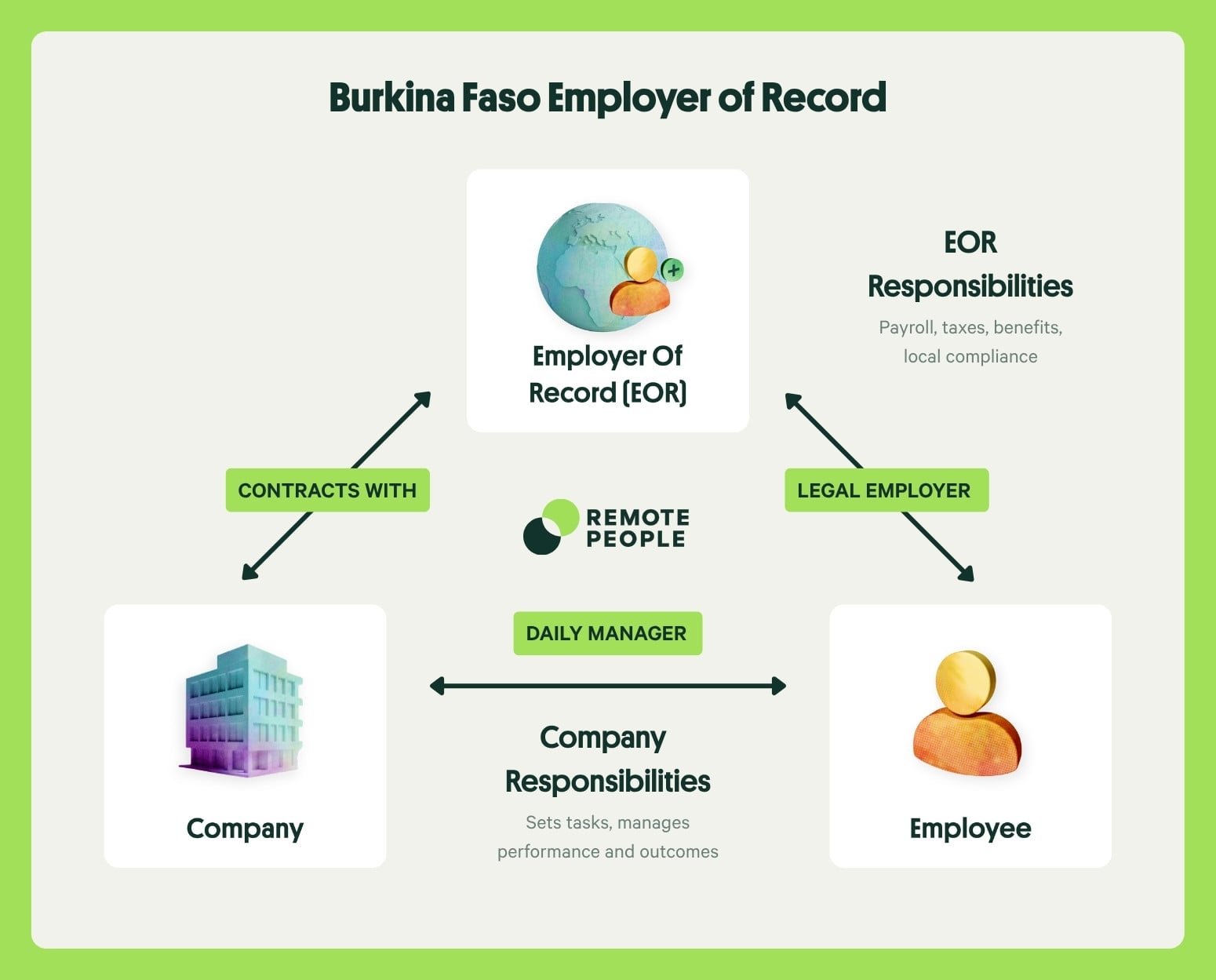
If you’d like to learn more about how Employer of Record (EOR) services work, read our What Is an Employer of Record (EOR)? guide for a complete overview of the model, its benefits, and when to use it.
If you’re comparing providers, our Best Employer of Record (EOR) Providers guide reviews the leading platforms to help you choose the right solution for your business.
Who Uses an EOR in Burkina Faso?
An employer of record in Burkina Faso is typically used by companies that want a compliant hire without committing to a full entity setup. Common situations include testing the Burkinabè market with a small mining, development, or French-language support team, onboarding a single Ouagadougou-based manager, or running a project-backed hire for an international donor, NGO, or extractive project where setting up a local SARL would take months.
The model also works well where speed matters more than scale. Any company hiring between one and fifteen employees in Burkina Faso will generally find the EOR option faster and cheaper than incorporating, and any business expanding into French-speaking West Africa from a non-African base can use the EOR to handle the local labour-law and language layer while staying focused on the business.
Typical Onboarding Timeline
Most EOR providers can onboard an employee in Burkina Faso within 1-2 weeks if no work permit is required. The stages are sequential but short:
- First, sign the EOR service agreement and share the employee’s details, proposed salary, role, and start date (1-2 days).
- Second, the EOR drafts a compliant Labour Code contract in French and sends it for employer and employee signature (2-3 days).
- Third, CNSS registration, IUTS tax number setup, and bank account collection run in parallel (3-7 days).
- Fourth, payroll is configured, statutory benefits are enrolled, and the employee is onboarded into your systems (1-2 days).
- Fifth, the employee begins work on the agreed start date.
Timelines extend when a work permit is required (add 4-6 weeks for Ministry of Labour review), when documents must be legalised at a Burkinabè embassy, or when the hire needs a regulated professional licence.
Hire in Burkina Faso
Build your Burkina Faso team in days, not months. RemotePeople is the employer of record for Burkina Faso, handling employment contracts, CNSS registration, IUTS withholding, payroll, and full Labour Code 028-2008 compliance, so you can hire without setting up a local entity.
Employment Laws and Regulations in Burkina Faso
Employment Contracts
Employment relationships in Burkina Faso are governed by Loi n° 028-2008/AN, the Labour Code adopted on 13 May 2008. The Ministry of Public Service, Labour and Social Security (Ministère de la Fonction Publique, du Travail et de la Protection Sociale) is the primary regulator, and CNSS administers social security. Written contracts are mandatory for fixed-term agreements and for any contract exceeding three months, and the working language for employment documentation is French.
Contracts can be fixed-term (contrat à durée déterminée, CDD) or indefinite (contrat à durée indéterminée, CDI). A CDD may not exceed two years in total, including one renewal, after which the contract converts to a CDI by operation of law. Every contract must specify the job title, category under the applicable collective agreement, salary, probation period, place of work, and start date.
Working Hours and Overtime
The standard workweek in Burkina Faso is 40 hours, typically spread across five days in non-agricultural sectors. Article 137 of the Labour Code caps the legal workday at eight hours and requires a minimum of 11 consecutive rest hours between shifts and at least one full rest day per week, usually Sunday.
Overtime is paid at a premium over the base hourly rate. The first eight overtime hours per week carry a 15% premium, and every hour beyond that is paid at 35% above the normal rate. Night work on ordinary weekdays is paid at a 50% premium, and work on a Sunday or a public holiday attracts a 60% to 120% premium depending on whether it is overtime or a rest-day recall.
Burkina Faso overtime premiums · Labour Code 028-2008 · 2026 |
|||
Hour Type |
Rate Multiplier |
Weekly or Daily Cap |
Notes |
|---|---|---|---|
Standard week | 100% (base rate) | 40 hours per week | Eight hours per day over five days is the norm in non-agricultural sectors |
Day overtime, hours 41 to 48 | +15% (115%) | First 8 hours beyond 40 | Article 137 of the Labour Code, daytime weekday hours |
Day overtime, hour 49 and beyond | +35% (135%) | No statutory ceiling | Applies once the 48-hour weekly threshold is crossed |
Night work on weekdays | +50% (150%) | 22:00 to 05:00 window | Night hours are defined by Arrêté 436/ITLS/HV of 15 July 1953 |
Sunday or public-holiday day work | +60% (160%) | Daytime hours only | Applies to rest-day recalls and holiday work during the day |
Sunday or public-holiday night work | +120% (220%) | 22:00 to 05:00 window | Highest statutory premium, rarely triggered outside continuous-process industries |
Minimum Wage
The statutory minimum wage in Burkina Faso (SMIG, Salaire Minimum Interprofessionnel Garanti) is approximately $76 per month at the April 2026 exchange rate. The current rate took effect on 1 July 2023 after a decree issued by the Council of Ministers raised it from a previous level of approximately $58 (WageIndicator). The SMIG applies to the formal private sector. Workers in subsistence agriculture and informal occupations are not covered, and sector-specific collective agreements (notably in banking, mining, and telecommunications) set higher floor wages. For a side-by-side view of the latest wage rules, see our minimum wage in Burkina Faso guide.
Probation Period
The maximum probation period depends on the employee category. Hourly and daily-paid workers can be probated for up to eight days, monthly-paid workers for one month, and executives, engineers, technicians, and supervisors for three months. Probation can be renewed once for the same duration. During probation either party may terminate the contract without notice, severance, or cause. Our probation period in Burkina Faso guide walks through the category rules and renewal process in detail.
Leave Entitlements
Burkina Faso’s Labour Code sets statutory minimums for annual leave, sick leave, maternity leave, paternity leave, and family-event leave. Most entitlements accrue from the first month of service, and collective bargaining agreements frequently improve on the floor set by the Code.
Annual Leave
Employees accrue 2.5 working days of paid annual leave for every month of actual service, which produces a baseline of 30 calendar days (around 22 working days) per year after twelve months of continuous employment. Tenure increases apply at 20, 25, and 30 years of service, adding two, four, and six extra working days respectively. Leave accrues during probation and paid sick leave, and accrued but untaken leave can be carried forward by agreement or paid out on termination.
Sick Leave
The Labour Code protects employees who are unable to work due to illness for up to six months, paid at the employer’s expense subject to the applicable collective agreement. In practice most agreements follow a three-months-full-pay plus three-months-half-pay structure, after which CNSS disability benefits may apply. A medical certificate from a licensed practitioner must be submitted within 48 hours of the first day of absence. Employees cannot be dismissed solely because of sickness absence during the first twelve months.
Maternity Leave
Pregnant employees are entitled to 14 weeks of paid maternity leave under Article 147 of the Labour Code: up to eight weeks before the expected date of delivery and at least six weeks after birth. Pay is split between CNSS (50%) and the employer (50%), so the employee receives her full salary during leave. Maternity leave may be extended by three weeks in the event of documented pregnancy or delivery complications. Nursing mothers are entitled to one paid hour per day for breastfeeding during the first 15 months after birth.
Paternity Leave
There is no dedicated paternity-leave entitlement in the Labour Code. Fathers instead rely on the general family-event leave (congés pour événements familiaux) under Article 158, which grants three paid days for the birth of a child. Some collective bargaining agreements and employers extend this to five or ten days.
Other Statutory Leave
Family-event leave also covers other significant life events that give rise to short paid absences:
- Marriage of the employee: four paid days.
- Marriage of a child: two paid days.
- Death of a spouse, parent, or child: three paid days.
- Death of a sibling or in-law: two paid days.
- First communion or baptism of a child: one paid day.
- Moving house: one paid day per year.
Burkina Faso statutory leave entitlements · Per Labour Code 028-2008/AN |
||
Leave Type |
Duration |
Eligibility & Notes |
|---|---|---|
Annual leave |
2.5 working days per month (~22 working days / year) |
Accrues from month one. +2, +4, +6 extra days at 20, 25, 30 years of service. Paid by employer. |
Sick leave |
Up to 6 months |
Typically 3 months full pay + 3 months half pay under collective agreements. Medical certificate within 48 hours. No dismissal for illness in first 12 months. |
Maternity leave |
14 weeks |
Up to 8 weeks prenatal + 6 weeks postnatal. 50% CNSS + 50% employer = full salary. +3 weeks for complications. Article 147. |
Paternity / birth leave |
3 days |
Granted under family-event leave (Article 158). Many collective agreements extend to 5-10 days. |
Marriage leave (self) |
4 days |
Family-event leave under Article 158. Paid by employer. |
Bereavement leave |
2-3 days |
3 days for spouse, parent, or child; 2 days for sibling or in-law. Paid by employer. |
Public holidays |
19 days in 2026 |
Paid rest days set by government decree. Work performed attracts a holiday premium of up to 120%. |
Source: Labour Code 028-2008/AN and WageIndicator Burkina Faso |
||
Statutory Employee Benefits
Burkina Faso’s statutory benefit package is built around CNSS coverage rather than a separate mandatory health insurance scheme. CNSS provides old-age, invalidity, and survivor pensions, plus occupational injury and illness coverage, family allowances, and maternity benefits, all funded through the combined employer-employee CNSS and tax contributions detailed in the payroll section below. Because public health insurance is still being rolled out through the national Régime d’Assurance Maladie Universelle (RAMU), most formal employers also offer private group health insurance as a practical matter, even though it is not yet a statutory requirement for all sectors.
Beyond CNSS, employers must provide transport allowances where the collective bargaining agreement requires them (common in banking, mining, and telecoms), a family allowance for each dependent child under the CNSS family-benefits branch, and housing allowances for positions graded as senior under the inter-professional collective agreement. Detailed benefit categories are summarised in our employee benefits in Burkina Faso guide. Meal allowances, supplementary pensions, and life insurance are widely offered but remain voluntary.
Recent Regulatory Updates (2026)
The most significant recent change is the 2023 minimum-wage decree that raised the SMIG from approximately $58 to $76 per month effective 1 July 2023, the first increase since 2012. Transitional authorities in Ouagadougou have since left the Labour Code itself untouched, with no major reforms enacted through the end of 2025, so the 2008 framework and its 2015 implementing decrees remain the core reference.
On the tax side, the 2025 finance law (Loi de Finances 2025) maintained the IUTS progressive brackets published by the Direction Générale des Impôts, with rates from 0% to 25% applied to monthly taxable income (Burkina Faso 2025 tax tables). Employers should also note that the 1% Contribution de Solidarité on salaries, introduced to support security and national reconstruction efforts, remains in force for 2026 and is withheld from employee pay alongside the IUTS.
Work Permits and Visas in Burkina Faso
Work Permit Requirements
Who Needs a Work Permit
Every foreign national who is not a citizen of a country with a bilateral labour-mobility agreement with Burkina Faso needs a work permit to take up paid employment. Citizens of ECOWAS member states enjoy visa-free entry and the right to reside and work, but they must still be declared to CNSS and obtain a residence document within three months of arrival. Non-ECOWAS nationals, including Europeans, North Americans, and non-African expatriates, must secure a work permit before starting work.
Eligibility and Required Documents
To qualify, the employer must demonstrate that the position could not be filled by a local candidate, and the foreign worker must hold qualifications matching the role. The standard dossier includes a valid passport with at least six months remaining, a signed employment contract, diplomas and professional certificates, a criminal-record extract from the home country (apostilled or legalised by the Burkinabè embassy), a recent medical certificate, passport photos, and proof of payment of the application fees.
Processing Time and Validity
The Ministry of Public Service, Labour and Social Security typically issues a decision within four to six weeks of receiving a complete dossier. Permits are granted for the duration of the employment contract, up to a maximum of three years, and are issued as a “Carte de Travailleur” (Worker Card). Delays commonly stem from missing apostilles on foreign documents and from waiting for CNSS registration to clear.
Renewal Process
Renewals must be filed at least two months before the permit expires, with an updated contract, renewed medical certificate, and proof of continued employment. Employees can usually continue working during the renewal review provided the application was filed on time. More detail on the end-to-end process is covered in our Burkina Faso work permits guide.
Common Visa Types for Foreign Workers
Foreign hires typically combine a long-stay entry visa with the Carte de Travailleur (worker card) and a residence permit. ECOWAS nationals benefit from a simplified regime under the regional free-movement protocol. The table below summarises the main visa and permit categories, their duration, and whether they grant work authorisation.
Burkina Faso work visas and permits · 2026 |
||||
Visa or Permit Type |
Duration |
Best For |
Leads to Work Authorisation? |
Processing |
|---|---|---|---|---|
Short-stay business visa (up to 30 days) | Up to 30 days | Meetings, training, exploratory trips | No. Does not authorise paid work | 3 to 7 business days via e-Visa portal |
e-Visa short stay | 30 to 90 days | Eligible nationalities applying online before travel | No. Visitor status only | 3 to 7 business days online |
Long-stay entry visa (long séjour) | Up to 90 days, extendable after arrival | Foreign hires entering to file the worker card and residence permit | Yes. Gateway to the Carte de Travailleur | 2 to 4 weeks at the consulate |
Worker card (Carte de Travailleur) | 1 to 2 years, renewable | Foreign employees with a Burkinabè employment contract | Yes. The core work authorisation, tied to one employer and role | 4 to 6 weeks after contract signing |
Intra-company transfer | 1 to 2 years, tied to worker card | Multinationals relocating existing staff to a Burkinabè subsidiary | Yes. Worker card plus internal-transfer documentation | 4 to 8 weeks including corporate paperwork |
ECOWAS residence card | 1 year, renewable | Nationals of ECOWAS member states living and working in Burkina Faso | Yes, with CNSS registration, no separate worker card needed | 2 to 4 weeks at the immigration directorate |
Source: Burkina Faso work permits and Labour Code 028-2008/AN |
||||
How an EOR Handles Work Permits
An employer of record in Burkina Faso can sponsor the worker card directly because it is already a registered Burkinabè employer with a tax ID and CNSS account. The EOR prepares the employer justification letter, files the labour market test, collects the employee’s documents, and submits the dossier to the Ministry of Public Service, Labour and Social Security. The employee is responsible for providing a valid passport, apostilled diplomas, the home-country police record, and the medical certificate.
Because the permit process adds four to six weeks to the timeline described in H3 1.4, onboarding for a foreign hire through an EOR typically lands at six to eight weeks from contract signature rather than the 1-2 weeks required for a locally-resident employee. The EOR can also handle the subsequent residence permit application at the Directorate General of National Police, which is a separate step required to legalise the stay.
Payroll, Taxes, and Social Security in Burkina Faso
Employer Contributions
Employers in Burkina Faso pay CNSS social security contributions plus an employer payroll tax (Taxe Patronale et d’Apprentissage, TPA). The combined employer burden is 19% of gross salary, broken down across pensions, family benefits, occupational accidents, and apprenticeship funding. There is no earnings ceiling on CNSS pension or TPA contributions for most categories.
Burkina Faso employer social security contributions · 2026 rates |
||
Contribution |
Rate |
Notes |
|---|---|---|
Old-age, disability, survivor pension (CNSS) |
5.5% |
Funds the CNSS pension branch. No earnings ceiling. |
Family benefits (CNSS) |
7.0% |
Funds maternity, nursery, and dependent-child allowances. |
Occupational accidents & illness (CNSS) |
3.5% |
Standard rate. Higher-risk sectors such as mining and construction can be rated up. |
Employer apprenticeship tax (TPA) |
3.0% |
Payroll tax collected by the Direction Générale des Impôts to fund vocational training. |
Total employer burden |
19.0% |
16% CNSS branches + 3% TPA. Remitted monthly by the 15th. |
Employee Contributions
Employees in Burkina Faso contribute 6.5% of gross pay to statutory schemes. The largest share is the 5.5% CNSS pension deduction, which mirrors the employer pension contribution, topped up by a 1% Contribution de Solidarité introduced to fund national security and reconstruction.
Burkina Faso employee payroll deductions · 2026 monthly withholdings |
||
Deduction |
Rate |
Notes |
|---|---|---|
Old-age, disability, survivor pension (CNSS) |
5.5% |
Mirrors the employer pension contribution. Deductible from taxable income. |
Contribution de Solidarité (CS) |
1.0% |
Funds national security and reconstruction. Collected with the IUTS. |
IUTS income tax |
0%-25% |
Progressive, applied to monthly net taxable income (see H3 4.3). |
Total employee deductions (excl. IUTS) |
6.5% |
5.5% CNSS pension + 1% Contribution de Solidarité, before IUTS withholding. |
Income Tax
The IUTS (Impôt Unique sur les Traitements et Salaires) is a progressive monthly withholding tax on employment income, with rates running from 0% on the lowest band up to 25% on the top band. CNSS pension contributions and family allowances are deductible before tax is computed, so the effective rate on a typical mid-level salary is lower than the headline bracket suggests. The 2025 finance law left the bracket structure unchanged for 2026.
Burkina Faso income tax brackets · 2026 |
|
Annual Taxable Income (USD) |
Tax Calculation |
|---|---|
Up to $604 |
0% |
$604 to $1,007 |
12.1% on the portion above $604 |
$1,007 to $1,611 |
13.9% on the portion above $1,007 |
$1,611 to $2,416 |
15.7% on the portion above $1,611 |
$2,416 to $3,423 |
18.4% on the portion above $2,416 |
$3,423 to $5,034 |
21.7% on the portion above $3,423 |
Above $5,034 |
25% on the portion above $5,034 |
Thresholds are approximate USD conversions at the April 2026 exchange rate. Non-residents are taxed under a separate 10%/20%/27.5% scale on Burkinabè-source income.
Payroll Cycle
Payroll in Burkina Faso is run monthly, with salaries paid by bank transfer or mobile money. Cash payments above the SMIG are discouraged by the Labour Code and the Central Bank of West African States (BCEAO) banking regulations. Employers must issue a detailed pay slip showing gross pay, each contribution line, IUTS withheld, and net pay.
CNSS contributions, IUTS, CS, and TPA are all remitted to the relevant authority by the 10th or 15th of the month following payment, depending on employer size. Annual returns for IUTS (Déclaration Annuelle des Salaires, DAS) are due in April, and the CNSS annual declaration is due in March.
13th Month Salary and Bonus Pay
A 13th month salary is not mandatory under Burkina Faso’s Labour Code. It is nevertheless a common voluntary benefit, especially in banking, telecommunications, and at large international employers, where end-of-year bonuses of one month’s salary are standard practice. Where a 13th month or year-end bonus is paid, it is subject to IUTS withholding under the normal bracket structure and to the employer apprenticeship tax, but not to CNSS pension contributions if paid as a distinct “prime de fin d’année” separated from salary. Collective bargaining agreements in regulated sectors may impose higher mandatory bonus rules than the Labour Code floor.
Cost of Hiring Through an EOR in Burkina Faso
EOR Service Fees
Employer of record services in Burkina Faso typically cost between $300 and $600 per employee per month, quoted as a flat fee in USD. The fee covers the employment contract, monthly payroll, CNSS and tax remittance, pay slip production, benefits administration, compliance updates, and HR support. Provider pricing depends on the complexity of the role, whether a work permit is required, and the size of the payroll.
Total Employment Cost Breakdown
The table below illustrates the total employer cost for a mid-level Burkinabè hire on a $1,200 gross monthly salary. All amounts are shown in USD.
Burkina Faso employer cost example · $1,200/month gross · 2026 |
||
Employer Cost |
Amount (USD) |
% of Gross |
|---|---|---|
Gross monthly salary |
$1,200 |
100.0% |
CNSS pension (5.5%) |
$66 |
5.5% |
CNSS family benefits (7%) |
$84 |
7.0% |
CNSS occupational accidents (3.5%) |
$42 |
3.5% |
Employer apprenticeship tax TPA (3%) |
$36 |
3.0% |
EOR service fee (flat) |
$400 |
33.3% |
Total employer cost |
$1,828 |
152.3% |
On a $1,200 gross salary, the 19% statutory employer burden adds $228 in CNSS and TPA contributions, and the EOR service fee adds $400. Total employer cost comes to $1,828, which is about 52.3% above gross pay. All USD amounts are approximate conversions at the April 2026 exchange rate ($1 = 596 XOF).
Ready to hire in Burkina Faso? Get started with RemotePeople and we handle employment contracts, CNSS registration, IUTS withholding, and full Burkina Faso compliance. No local entity required.
Benefits of Using an EOR in Burkina Faso
The strongest reason companies choose an employer of record in Burkina Faso is speed to market. Setting up a SARL in Ouagadougou typically takes two to four months once you include Centre de Formalités des Entreprises (CEFORE) registration, a notarised bank deposit, CNSS affiliation, and the tax identification number. An EOR skips all of that: a compliant hire is live within 1-2 weeks, which matters when a project, client contract, or grant cycle is already running.
Compliance is the second reason. Labour Code 028-2008 is detailed, the 2025 finance law changes every year, CNSS reporting deadlines are unforgiving, and the apprenticeship tax catches foreign employers off guard. A specialist EOR absorbs that risk: it tracks regulatory updates, files on time, and indemnifies you against mistakes in its own payroll runs. For companies running a single Burkinabè hire without a dedicated in-country HR manager, this is often cheaper than the first fine for late CNSS remittance.
Beyond speed and compliance, an EOR offers predictable monthly costs, ready-made access to statutory benefits, the ability to scale up or down without dissolving an entity, and local expertise on French-language contracts, collective bargaining agreements, and informal customs that shape how hires actually work in Burkinabè workplaces. Those advantages compound over the first year, and they are the reason international NGOs, resource companies, and technology teams increasingly default to the EOR model for West African hiring.
Termination and Offboarding in Burkina Faso
Notice Periods
Statutory minimum notice periods in Burkina Faso are set by category under the inter-professional collective agreement, as referenced in Articles 68 and 69 of the Labour Code. Hourly and daily-paid workers are entitled to eight days’ notice. Monthly-paid workers are entitled to one month. Executives, engineers, technicians, and supervisors are entitled to three months. Collective redundancies involving more than ten workers require an additional 30-day notice to the labour inspectorate and worker representatives. Notice can be waived by payment in lieu.
Burkina Faso statutory notice periods · Labour Code 028-2008, Articles 68-69 |
|||
Position Level |
Notice Period |
During Probation |
Notes |
|---|---|---|---|
Hourly or daily-paid workers | 8 days | No notice required | Probation notice is 24 to 48 hours in practice; statutory notice starts after confirmation |
Monthly-paid employees | 1 month | No notice required | Default category for clerical, administrative, and operational staff |
Supervisors, technicians, foremen | 1 month | No notice required | Category may shift to 3 months where collective agreements classify the role as cadre |
Executives, engineers, cadres | 3 months | No notice required | Longer notice can be written into individual contracts, never shorter |
Fixed-term contracts | Contract end date applies | Not applicable | Early termination without cause owes the wages due through the contract end date |
Collective redundancy (10+ workers) | Category notice plus 30 days | Not applicable | Additional notice filed with the labour inspectorate and worker representatives |
Severance Pay
Calculation Method
Severance pay (indemnité de licenciement) is owed to any employee dismissed after at least 12 months of continuous service, except in cases of gross misconduct (faute lourde). The formula is expressed as a percentage of the overall monthly wage multiplied by years of service: 25% of one month’s salary per year for years one through five, 30% per year for years six through ten, and 40% per year from year eleven onwards. The “overall wage” base includes the base salary plus usual bonuses and allowances over the twelve months preceding termination.
Caps and Exceptions
There is no statutory ceiling on total severance, but the formula itself is tenure-capped by design since the highest percentage only applies to years beyond ten. Gross misconduct excludes severance entirely, and fixed-term contracts do not carry severance if they run to their agreed end date. If a fixed-term contract is terminated early without just cause, the employer owes the wages the employee would have earned through the end of the term. Employees dismissed for economic reasons are entitled to both severance and a separate redundancy indemnity negotiated with worker representatives.
Burkina Faso severance pay · worked examples at $600 monthly wage · 2026 |
|||
Years of Service |
Severance Amount |
Base Salary |
Notes |
|---|---|---|---|
Less than 1 year | $0 | $600 per month | Minimum tenure of 12 months is required before any severance is owed |
1 year | $150 (25% × 1 × $600) | $600 per month | First qualifying year, 25% of one month’s overall wage |
3 years | $450 (25% × 3 × $600) | $600 per month | Years 1 to 5 are all paid at the 25% rate |
5 years | $750 (25% × 5 × $600) | $600 per month | End of the 25% tier, equivalent to 1.25 months of overall wage |
8 years | $1,290 ($750 + 30% × 3 × $600) | $600 per month | Years 6 to 10 accrue at the 30% rate on top of the first five years |
10 years | $1,650 ($750 + 30% × 5 × $600) | $600 per month | End of the 30% tier, equivalent to 2.75 months of overall wage |
15 years | $2,850 ($1,650 + 40% × 5 × $600) | $600 per month | Years 11 and beyond accrue at the 40% rate; total is 4.75 months |
20 years | $4,050 ($1,650 + 40% × 10 × $600) | $600 per month | Long-tenured employees accrue substantial exit costs; budget accordingly |
Source: Labour Code 028-2008/AN and WageIndicator severance. Worked at a $600 monthly overall wage for illustration only. |
|||
Grounds for Termination
The Labour Code distinguishes between termination for just cause (faute lourde or motif personnel), termination for economic reasons (motif économique), and mutual agreement. Just-cause dismissals require written notice of the alleged misconduct and an opportunity for the employee to respond. Economic redundancies require consultation with the labour inspectorate and worker representatives, a selection criteria list, and priority rehiring rights for 12 months. Protected categories include pregnant women, employees on maternity leave, worker representatives, and employees on certified sick leave, none of whom can be dismissed without prior authorisation from the labour inspector.
EOR vs. Other Hiring Models in Burkina Faso
EOR vs. Setting Up a Local Entity
Choosing between an Employer of Record and setting up your own legal entity in Burkina Faso comes down to timeline, upfront cost, ongoing administrative burden, and how quickly you can scale up or wind down. The table below lays out both paths side by side across setup time, cost, compliance risk, and flexibility so you can match the right model to the size and duration of your Burkina Faso hiring plan.
Burkina Faso EOR vs local entity comparison · Setup time, cost, risk and best-fit |
||
Comparison |
Employer of Record |
Own Entity |
|---|---|---|
Setup time |
1-2 weeks |
2-4 months |
Upfront cost |
$0 |
$3,000-$8,000 (CEFORE, notary, capital deposit, legal) |
Ongoing cost |
$300-$600/employee/month |
$6,000-$15,000/year maintenance (accounting, tax, CNSS) |
Local partner required |
No (EOR is the local entity) |
No, but a Burkinabè director or address is typical |
Social insurance registration |
Handled by EOR |
You manage CNSS affiliation and filings |
Payroll & tax filing |
Handled by EOR |
You manage it (or outsource) |
Best for team size |
1-15 employees |
15+ employees |
Scale down / exit |
Easy (no entity to unwind) |
Costly (legal dissolution required) |
Government contracts |
Not eligible |
Eligible (requires local entity) |
Source: World Bank Doing Business and Labour Code 028-2008/AN |
||
For a team of one to fifteen employees, the EOR is typically the cheaper and faster option. The $3,000-$8,000 in incorporation costs plus annual accounting and CNSS filings for a SARL will usually exceed the EOR fee until headcount grows past 15. The EOR model also avoids the two-to-four-month CEFORE setup window, which is the single biggest barrier to hiring quickly in Burkina Faso.
An own-entity structure makes sense once you need to bid on government or donor-funded contracts (which require a Burkinabè legal presence), once your team exceeds 15 employees, or once you are building physical infrastructure such as a mining site, manufacturing plant, or retail network. At that scale the fixed annual overhead of a SARL or SA is amortised across many hires, and the control over HR policies outweighs the flexibility of the EOR.
The cleanest decision rule is to start with an EOR for the first year or two, validate demand, and only incorporate once you have a clear line of sight to 15+ hires or a contract that legally requires local registration.
EOR vs. Hiring Independent Contractors
Classifying a Burkina Faso-based worker as an independent contractor rather than an employee can expose you to back-taxes, unpaid social contributions, and reclassification penalties if the working relationship looks like employment in practice. The table below contrasts EOR employment with contractor engagement across legal relationship, tax and benefits treatment, IP ownership, and misclassification risk so you can pick the right model role by role.
Burkina Faso EOR vs independent contractors · Compliance, cost, and risk |
||
Comparison |
EOR (Full-Time Employee) |
Independent Contractor |
|---|---|---|
Legal relationship |
Employee of the EOR |
Self-employed, no employment relationship |
Compliance risk |
Low (EOR ensures Labour Code compliance) |
Higher if the relationship resembles employment |
Payroll & tax |
EOR handles withholding, CNSS, and IUTS |
Contractor invoices you; they self-manage tax and social contributions |
Benefits & leave |
Statutory benefits, paid leave, CNSS coverage |
No entitlement to employee benefits |
IP protection |
Stronger (employment contract assigns IP by default) |
Weaker (requires explicit IP assignment clause) |
Termination |
Subject to Labour Code notice and severance rules |
Contract can be ended per agreement terms |
Best for |
Long-term, core team roles |
Short-term projects, specialised tasks |
Cost structure |
Salary + employer contributions + EOR fee |
Contractor fee (typically higher gross, lower total cost) |
Source: Labour Code 028-2008/AN and Burkina Faso contractor guide |
||
Independent contractors can be the right choice for short-term, specialised, or project-based work where the individual has genuine autonomy over how and when they deliver. Typical examples include a freelance translator completing a discrete assignment, a consulting engineer on a three-month feasibility study, or a creative professional producing specific deliverables.
The risk of misclassification means hiring independent contractors is only appropriate in some cases. Burkinabè labour inspectors and CNSS auditors apply a substance-over-form test: if a contractor works set hours, uses company equipment, reports to a manager, and is integrated into a team, the relationship can be re-characterised as employment. Consequences include back-dated CNSS contributions, IUTS and TPA arrears, late-payment penalties, and an obligation to pay accrued leave and severance as if the person had been an employee from day one.
RemotePeople also runs a contractor management solution for Burkina Faso that handles compliant contractor agreements, local payment rails, and classification risk review, so you can use contractors where they fit without absorbing the compliance exposure yourself.
EOR vs. PEO (Professional Employer Organization)
EORs and PEOs both simplify international hiring, but only an EOR becomes the legal employer of record in Burkina Faso — a critical distinction when you don’t have a local entity of your own. The table below maps the practical differences across legal employer status, entity requirement, liability allocation, and scope of coverage.
Burkina Faso EOR vs PEO comparison · Legal employer, liability, and setup |
||
Comparison |
Employer of Record (EOR) |
PEO |
|---|---|---|
Legal employer |
EOR is the legal employer |
You remain the legal employer (co-employment) |
Local entity required |
No (EOR is the local entity) |
Yes (you must have your own entity in Burkina Faso) |
Best for |
Companies without a local entity |
Companies that already have a local entity |
Compliance liability |
EOR assumes compliance responsibility |
Shared liability between you and the PEO |
Setup time |
1-2 weeks |
Depends on your entity setup (weeks to months) |
Control over HR policies |
EOR manages within Labour Code framework |
More direct control, PEO advises |
Typical use case |
Market entry, small remote teams, testing new markets |
Established local operations needing HR outsourcing |
Source: Labour Code 028-2008/AN and ILO social protection profile |
||
The key difference is the legal employer. Under the EOR model, the EOR is the sole legal employer and absorbs full compliance liability. Under a PEO arrangement, your own Burkinabè entity remains the employer of record, and the PEO acts as an HR outsourcing partner that advises on contracts, runs payroll on your behalf, and handles CNSS filings, while liability is shared under a co-employment structure.
Burkina Faso does not have a formal PEO regulatory framework in the way that the United States does. Companies typically buy the functional equivalent as outsourced payroll and HR services from local accounting firms once they already have an SARL in place. For a company without a Burkinabè entity, the EOR route is the only option that avoids incorporation, because a PEO cannot act as the legal employer in place of a non-resident company.
Choose the EOR if you have no entity and need to hire quickly. Choose PEO-style outsourcing once you have incorporated, have at least 15 employees, and want to offload the administrative layer while retaining direct control over HR policy and liability.
Public Holidays in Burkina Faso
Burkina Faso observes a defined set of official public holidays on which most private-sector employers must give staff a paid day off (timeanddate.com Burkina Faso 2026). The table below lists the statutory holidays employers need to build into payroll calendars and leave planning for the year, along with the date rule for each.
Burkina Faso public holidays · 2026 calendar year |
||
Date |
Holiday |
Type |
|---|---|---|
1 January (Thu) | New Year’s Day | Public holiday |
3 January (Sat) | Popular Uprising Day | Public holiday |
8 March (Sun) | International Women’s Day | Public holiday |
9 March (Mon) | Day off for International Women’s Day | Public holiday |
20 March (Fri) | Eid al-Fitr (tentative) | Public holiday |
21 March (Sat) | Eid al-Fitr Holiday | Public holiday |
6 April (Mon) | Easter Monday | Public holiday |
1 May (Fri) | Labour Day | Public holiday |
14 May (Thu) | Ascension Day | Public holiday |
15 May (Fri) | Day of Customs and Traditions | Public holiday |
27 May (Wed) | Eid al-Adha (tentative) | Public holiday |
5 August (Wed) | National Day (Independence) | Public holiday |
15 August (Sat) | Assumption of Mary | Public holiday |
26 August (Wed) | The Prophet’s Birthday (tentative) | Public holiday |
31 October (Sat) | Martyrs’ Day | Public holiday |
1 November (Sun) | All Saints’ Day | Public holiday |
2 November (Mon) | Day off for All Saints’ Day | Public holiday |
11 December (Fri) | Proclamation of Independence | Public holiday |
25 December (Fri) | Christmas Day | Public holiday |
Burkina Faso observes 19 public holidays in 2026, including Muslim feast days set on tentative dates that are confirmed by decree closer to the event. Work performed on a public holiday attracts a premium of 60% to 120% over the normal rate, and employers must build these days into payroll schedules and CNSS reporting. When a public holiday falls on a Sunday, the following Monday is typically granted as a day off by government decree.
How to Get Started with an EOR in Burkina Faso
Hiring your first Burkinabè employee through an employer of record is a short, predictable process:
- First, share the role details, proposed salary in USD, start date, and whether the candidate is a local or foreign national.
- Second, sign the EOR service agreement and receive a compliance-checked employment contract under Labour Code 028-2008 ready for the employee to sign.
- Third, the EOR registers the employee with CNSS and the tax administration, configures payroll, and enrolls statutory benefits.
- Fourth, payroll goes live and the employee starts work on the agreed date, with monthly pay, contributions, and IUTS withholding handled automatically.
- Fifth, the EOR manages ongoing compliance, collective agreement updates, renewals of work permits, and offboarding if and when the employee leaves.
Contact RemotePeople to hire employees in Burkina Faso through our employer of record, and we will have your team member onboarded within 1-2 weeks.
Where companies hiring in Burkina Faso expand next
Companies building West African operations commonly expand across the ECOWAS bloc and neighboring Francophone and Anglophone markets. Teams frequently add Ghana for aligned West African hiring norms; a team in Ivory Coast often follows for the regional West African talent footprint; operations in Cameroon is a common next step, offering overlapping West African workforce dynamics; and Nigeria rounds out the regional footprint with shared West African labor and language overlap.
Frequently Asked Questions
Beyond the employer contributions (around 19% of gross salary in CNSS and the apprenticeship tax), you will pay an EOR service fee of $300 to $600 per employee per month. The exact amount depends on your provider, the complexity of the role, and whether a work permit is required. The fee is a flat USD amount, not a percentage of salary.
Most EOR providers onboard a locally-resident employee in 1 to 2 weeks. Foreign hires requiring a work permit from the Ministry of Public Service, Labour and Social Security add another 4 to 6 weeks, for a total of 6 to 8 weeks.
Yes. The EOR is a Burkinabè registered employer that signs the Labour Code contract, pays CNSS and IUTS, and files all statutory declarations. The arrangement is recognised under Labour Code 028-2008, and it is widely used by international NGOs, donor projects, and multinational employers operating in Burkina Faso.
The employment contract assigns IP to the client company (you), not the EOR. The EOR makes sure the contract has proper IP assignment language so all intellectual property flows directly to your business, consistent with Burkinabè intellectual property law.
Contractors work for short-term, specialised, or genuinely autonomous engagements, but misclassification is a real risk if the working arrangement looks like employment. RemotePeople also offers a contractor management solution that handles compliant agreements, local payments, and classification review, so you can use contractors where they fit without the compliance exposure.
The SMIG is approximately $76 per month, effective since 1 July 2023. Sector-specific collective agreements in banking, mining, and telecommunications set higher floor wages. Our minimum wage in Burkina Faso guide covers the sector breakdown.
No, a 13th month salary is not mandatory under the Labour Code. It is nevertheless a common voluntary benefit in banking, telecommunications, and at large international employers, where end-of-year bonuses of one month's salary are market practice. Collective bargaining agreements in regulated sectors may impose their own bonus rules.
The EOR handles notice, severance calculation, CNSS deregistration, and final-pay processing in line with the Labour Code. Statutory notice runs from 8 days to 3 months depending on the employee category, and severance after 12 months of service is calculated at 25% of monthly wage per year for years 1-5, 30% for years 6-10, and 40% beyond year 10.