
 Recruit
Employer of Record (EOR) in Ivory Coast
-
 Drew Donnelly
- Published
- September 12, 2026
RemotePeople’s employer of record in Ivory Coast lets you hire employees in Ivory Coast with CNPS registration. We handle 7.7% CNPS retirement fund contributions, 5.75% family allowances, and work injury insurance.
Hire in Ivory Coast — book a free 30-minute demo
Tell us what you need. You'll get a tailored, transparent proposal within 24 hours, plus a free call to walk through it.
Tell us about your company
So we can match you with a specialist who knows your market — and unlock volume pricing tiers.
* All fields are required.
Where and when are you hiring?
Tell us the geography and timing and we'll quote each country line by line, with onboarding timelines.
* All fields are required.
Help us beat your current setup
We'll benchmark your current deal and send a line-by-line proposal in 24 hours — showing exactly where we cut cost, time, or risk. After you submit, you can book a call to walk through it together.
* All fields are required.
Thanks! Your proposal is on its way.
Expect a tailored, line-by-line proposal in your inbox within 24 hours. In the meantime…
Want to walk through it together?
Book a free 30-minute call with one of our specialists. We'll explain every line, answer your questions, and tailor the proposal further if you need.
No obligation. Pick a time that works for you.








- Hire in Ivory Coast — book a free 30-minute demo
- Tell us about your company
- Where and when are you hiring?
- Help us beat your current setup
- Thanks! Your proposal is on its way.
- How an Employer of Record Works in Ivory Coast
- Employment Laws and Regulations in Ivory Coast
- Work Permits and Visas in Ivory Coast
- Payroll, Taxes, and Social Security in Ivory Coast
- Cost of Hiring Through an EOR in Ivory Coast
- Benefits of Using an EOR in Ivory Coast
- Termination and Offboarding in Ivory Coast
- EOR vs. Other Hiring Models in Ivory Coast
- Public Holidays in Ivory Coast
- How to Get Started with an EOR in Ivory Coast
- Where companies hiring in Ivory Coast expand next
- Frequently Asked Questions
- Related EOR Destinations

Start hiring in Ivory Coast
Let RemotePeople handle payroll, compliance, and HR admin worldwide so you can focus on building your team.

Ivory Coast (Côte d’Ivoire) has a fast-growing economy and a large, educated workforce, which makes it one of the more attractive hiring destinations in West Africa. But for foreign companies, the local employment rules are complex: French-language contracts are mandatory, the CNPS social security system has multiple contribution categories, and the ITS income tax runs on a six-bracket scale. An employer of record in Ivory Coast takes all of that off your plate, acting as the legal employer while you manage the team. EOR services in Ivory Coast typically cost $199 to $599 per month per employee, depending on service level and headcount.
How an Employer of Record Works in Ivory Coast
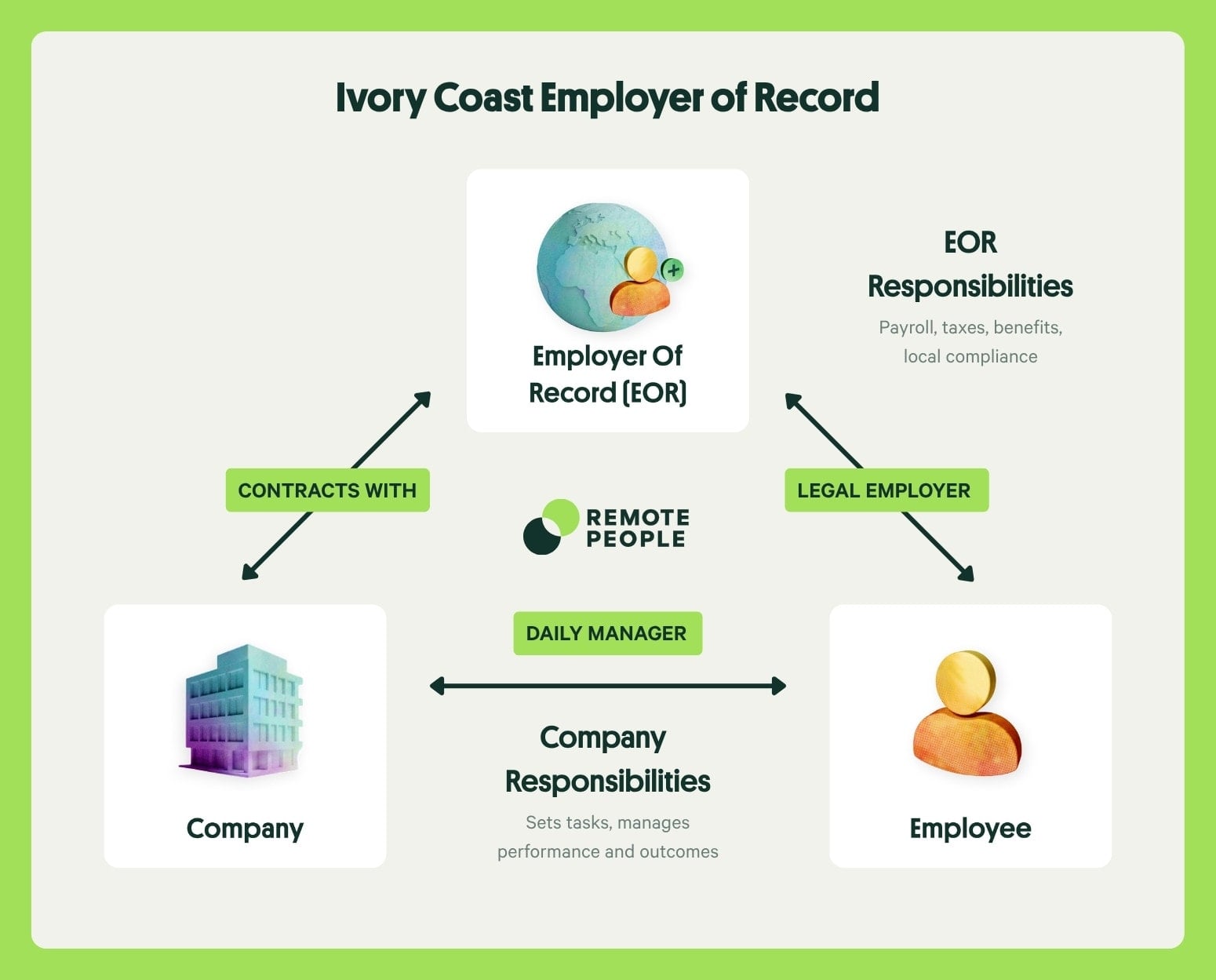
If you’d like to learn more about how Employer of Record (EOR) services work, read our What Is an Employer of Record (EOR)? guide for a complete overview of the model, its benefits, and when to use it.
If you’re comparing providers, our Best Employer of Record (EOR) Providers guide reviews the leading platforms to help you choose the right solution for your business.
Who Uses an EOR in Ivory Coast?
Companies turn to an EOR in Ivory Coast for a few common reasons:
- Testing market viability before committing to a full legal subsidiary or branch
- Building a small team (1–5 employees) without the overhead of company registration and accounting
- Hiring quickly when a project or contract has a tight start date, avoiding months of entity setup
- Employing foreign nationals who require work permits and visa sponsorship coordination
Typical Onboarding Timeline
EOR onboarding in Ivory Coast typically follows this sequence, with total elapsed time of 1–2 weeks for local hires (longer for foreign nationals requiring work permits):
- EOR Service Agreement: You and the EOR execute the master services agreement (1–2 days)
- Employment Contract Drafting: The EOR prepares the contract in French, compliant with Labour Code requirements (2–3 days)
- CNPS and Tax Registration: The EOR submits registration with CNPS, obtains tax identification, and registers with municipal authorities (3–7 days)
- Payroll and Benefits Setup: Payroll cycle configuration, CMU health insurance enrollment, and direct deposit arrangement (2–3 days)
- Employee Start Date: The employee begins work (1 day)
- Work Permit Processing (if applicable): For foreign nationals, the AEJ approval and work permit issuance extend the timeline by 2–4 weeks
Hire in Ivory Coast
A large francophone workforce, competitive labor costs, and West Africa’s largest economy make Ivory Coast a strong base for regional expansion.
We handle employment contracts, payroll, tax withholding, and full Ivory Coast compliance.
No local entity needed. Your team can start in days.
Employment Laws and Regulations in Ivory Coast
Employment Contracts
All employment in Ivory Coast must be documented in writing under the Labour Code (Law No. 2015-532) and the CCI (Convention Collective Interprofessionnelle, the collective bargaining agreement). Contracts must clearly specify the role, salary, benefits, and duration, and must be executed in French. Fixed-term contracts (CDD) require a defined end date and renewal rules, while indefinite-duration contracts (CDI) remain the default for permanent positions.
Working Hours and Overtime
The standard work week in Ivory Coast is 40 hours for non-agricultural employees and 48 hours for agricultural workers. Daily hours must not exceed 8 hours, with specific rules governing overtime eligibility, premium rates, and cumulative caps to protect worker welfare.
Ivory Coast overtime and premium pay rates | |||
Hour Type | Rate Multiplier | Weekly/Daily Cap | Notes |
|---|---|---|---|
First overtime (41st–46th hour/week) | +15% | 6 hrs/week | Applies to standard daytime work |
Additional daytime overtime (47th+ hour/week) | +50% | Max 3 hrs/day or 15 hrs/week | Daytime (6am–10pm) |
Night work (10pm–6am) | +75% | Max 3 hrs/day or 15 hrs/week | All hours outside 6am–10pm period |
Sunday/holiday daytime | +75% | Unlimited | Rest day work; rest day must be provided later |
Sunday/holiday night | +100% | Unlimited | Combined night and rest-day premium |
Minimum Wage
The SMIG (Salaire Minimum Interprofessionnel Garanti) in Ivory Coast is XOF 75,000 per month, effective January 2023 under Décret No. 2022-986. The SMAG (Salaire Minimum Agricole Garanti) for agricultural workers is approximately XOF 36,607 per month. The next statutory SMIG review is scheduled for 2026. For a full breakdown of current wage levels and sector-specific rates, see our Ivory Coast minimum wage guide. For broader context on compensation levels, see our Ivory Coast average salary guide.
Probation Period
Probation duration varies by employee category under the Labour Code: workers are subject to 1 month probation, employees and supervisors to 2 months, managers to 3 months, and senior executives to 6 months. Employers may extend probation once for the same duration, but employees retain all statutory rights during this period, including paid leave. See our Ivory Coast probation period guide for detailed rules by employee category.
Leave Entitlements
Annual Leave
Employees in Ivory Coast accrue 2.2 working days of paid annual leave per month, totaling 26 days per year. Seniority bonuses increase the entitlement: an additional 1 day after 5 years, 2 days after 10 years, 3 days after 15 years, 5 days after 20 years, 7 days after 25 years, and 8 days after 30 years of service. Employees must be granted at least 14 consecutive calendar days during any annual leave period.
Sick Leave
The employer must pay the first 5 days of sick leave per year; the first 3 days at full salary and days 4–5 at 50% salary. Extended illness beyond 5 days is covered by CNPS (national social security), which provides income replacement. A medical certificate is required only after 3 consecutive days of absence.
Maternity Leave
Female employees are entitled to 14 weeks of maternity leave: 6 weeks before the expected delivery date and 8 weeks after. CNPS provides 100% salary replacement during this period. Additional entitlements include 2 extra weeks for multiple births and 3 extra weeks for medically complicated pregnancies. After returning to work, mothers have the right to 1 hour per day of breastfeeding leave for 15 months.
Paternity Leave
Male employees receive 2 days of paid paternity leave following the birth of a child, paid by the employer. Additional unpaid days may be taken under CNPS family allowance provisions, depending on family circumstances.
Other Statutory Leave
Employees are entitled to paid leave for marriage (2–4 days), bereavement of a close relative (2–5 days depending on relation), and the marriage of a child (1–2 days). These entitlements are provided in addition to annual leave and sick leave.
Ivory Coast statutory leave entitlements | ||
Leave Type | Duration | Eligibility & Notes |
|---|---|---|
Annual leave | 26 days/year (2.2 days/month accrual) | All employees. Seniority bonuses: +1 day/5 yrs, +2 days/10 yrs, +3 days/15 yrs, +5 days/20 yrs, +7 days/25 yrs, +8 days/30 yrs. Min 14 consecutive days per period. |
Sick leave | 5 days/year paid; extended via CNPS | First 3 days at 100% salary (employer-paid), days 4–5 at 50% (employer-paid). Beyond 5 days: CNPS covers up to 3 years. Medical certificate required after 3 days absence. |
Maternity leave | 14 weeks (6 pre + 8 post) | All female employees. 100% salary paid by CNPS. +2 weeks for multiple births, +3 weeks for medical complications. Breastfeeding breaks: 1 hr/day for 15 months post-return. |
Paternity leave | 2 days paid by employer | All male employees. Additional unpaid days available via CNPS family allowance based on family circumstances. |
Marriage leave | 2–4 days | All employees. Paid by employer. Requires marriage certificate. |
Bereavement leave | 2–5 days (varies by relation) | All employees. Spouse/child: 5 days; parent: 4 days; sibling/parent-in-law: 2–3 days. Paid by employer. |
Child’s marriage leave | 1–2 days | All employees. Paid by employer. Requires marriage certificate of child. |
Statutory Employee Benefits
All employees in Ivory Coast are entitled to several mandatory statutory benefits that protect their health, retirement security, and family welfare. For the full picture, see our Ivory Coast employee benefits guide. Key statutory benefits include:
All employees are covered by CMU (Couverture Maladie Universelle), the mandatory universal health insurance scheme that reimburses 70% of eligible medical costs. Employers contribute a percentage of payroll to fund this coverage.
CNPS manages the retirement pension system. Employees become eligible for pension benefits at age 60 after a minimum of 15 years of contributions. CNPS also administers family allowances for dependent children and spouses, work injury insurance protecting against occupational accidents and diseases, and maternity income replacement during pregnancy and post-partum recovery.
Recent Regulatory Updates (2026)
The ITS (income tax on salaries) was overhauled in January 2024 under Ordonnance No. 2023-718, which updated the tax brackets and withholding procedures. In September 2025, the CMU Zéro Cotisation initiative was introduced, reducing employee health insurance premiums for lower-income workers. The SMIG (minimum wage) is scheduled for review in 2026. The Labour Code (Law No. 2015-532) remains the foundational framework governing all employment relationships.
Work Permits and Visas in Ivory Coast
Work Permit Requirements
Who Needs a Work Permit
Citizens of ECOWAS member states (Economic Community of West African States) can enter Ivory Coast visa-free, but they still require a work permit before beginning employment. Non-ECOWAS citizens must obtain both a visa and a separate work permit. The Agence Emploi Jeunes (AEJ) is the government body responsible for issuing and managing work permits for all foreign employees. For a full overview of visa categories and requirements, see our work visa and permit guide.
Eligibility and Required Documents
The employer must advertise the job position in a national newspaper for a minimum of one month before applying for a work permit, demonstrating that no qualified local candidate is available. Required documents include a valid passport, signed employment contract, proof of professional qualifications, medical certificate, and police clearance certificate from the employee’s home country.
Processing Time and Validity
Work permit applications typically take 2 to 8 weeks to process. Once approved, the permit is valid for one year and is renewable annually as long as the employment relationship continues.
Renewal Process
Employees must renew their work permits annually before expiration while they remain employed. Renewal requires submitting updated documentation including the current employment contract and confirmation of continued employment from the employer.
Common Visa Types
Ivory Coast has several visa categories for foreign workers. The type you need depends on the length and nature of the assignment:
Ivory Coast work visa types for foreign workers · 2026 | ||||
Visa Type | Duration | Best For | Leads to Residency? | Processing Time |
|---|---|---|---|---|
Temporary Work Permit | 1 year | Short-term assignment or contract work | Not directly; requires renewal | 2–8 weeks |
Permanent Work Permit | Indefinite | Long-term or permanent roles | Yes, typically after 3 years | 4–12 weeks |
Business/Investor Visa | 90 days | Business visits, meetings, short-term projects | No | 1–2 weeks |
Self-Employment Permit | 1 year | Freelancers or independent professionals | Not directly; renewable | 3–8 weeks |
How an EOR Handles Work Permits
An EOR serves as the employer of record and takes primary responsibility for sponsoring the work permit through the AEJ on behalf of the foreign employee. The EOR manages the mandatory job advertisement in the national newspaper, compiles all required documentation, and submits the complete application package to the authorities.
The work permit process extends the overall hiring timeline by 4 to 8 weeks beyond standard onboarding. A good EOR knows the AEJ requirements well and can reduce delays by getting the documentation right the first time.
Payroll, Taxes, and Social Security in Ivory Coast
Employer Contributions
Employers in Ivory Coast are required to contribute to the national social security system and certain statutory funds. For detailed rate breakdowns and filing deadlines, see our Ivory Coast payroll and tax guide. Here is the full breakdown of employer contributions:
Ivory Coast employer social security contributions · 2026 rates | ||
Contribution | Rate | Notes |
|---|---|---|
Retirement Pension (CNPS) | 7.7% | Capped at XOF 3,375,000 monthly salary ceiling |
Family Allowances | 5.75% | Capped at XOF 70,000 monthly base; portion above cap is non-insurable |
Work Injury Insurance | 2–5% | Rate varies by industry risk classification; capped at XOF 70,000 |
Maternity Benefits | 0.75% | Capped at XOF 70,000 |
Taxe d’Apprentissage (Training Tax) | 2.8% local / 12% expat | Expat rate applies to non-Ivorian employees; no cap |
Total Employer Contribution | 19.0%–22.0% | Includes apprenticeship tax; varies by employee classification and industry |
Employee Contributions
Employees also contribute to the social security system through payroll deductions. The amounts are smaller than the employer side:
Ivory Coast employee payroll deductions · 2026 monthly withholdings | ||
Deduction | Rate | Notes |
|---|---|---|
Retirement Pension (CNPS) | 6.3% | Capped at XOF 3,375,000 monthly salary ceiling |
CMU Health Insurance | XOF 1,000/month | Universal health coverage; flat-rate monthly deduction |
Total Employee Deduction | 6.3% + XOF 1,000 | Combined social security and health coverage |
Income Tax
Ivory Coast uses a progressive income tax called the ITS (Impôt sur le Traitement et Salaires) with six brackets on monthly taxable income. The top rate is 32%:
Ivory Coast income tax brackets · 2026 | |
Monthly Taxable Income (XOF) | Tax Rate |
|---|---|
0–75,000 | 0% |
75,001–240,000 | 16% |
240,001–800,000 | 21% |
800,001–2,400,000 | 24% |
2,400,001–8,000,000 | 28% |
Above 8,000,000 | 32% |
Payroll Cycle
Payroll in Ivory Coast runs on a monthly cycle and is typically paid via bank transfer in XOF (CFA Franc). All employers must issue detailed pay slips to employees showing gross salary, all deductions, and net pay.
Tax filing and social security contributions must be submitted by the 10th to 20th of the following month, depending on the specific filing type and deadlines set by the Direction Générale des Impôts.
13th Month Salary and Bonus Pay
The 13th month salary is a mandatory statutory benefit under the Collective Bargaining Agreement (CCI) for employees who have completed at least one year of service. This bonus equals one full month’s salary and must be paid in December.
Employees hired mid-year receive a pro-rata share calculated on the number of months worked. The 13th month salary is subject to income tax withholding (ITS) and social security contributions.
Cost of Hiring Through an EOR in Ivory Coast
EOR Service Fees
EOR service fees in Ivory Coast typically range from $199 to $599 per employee per month, depending on the complexity of services and the provider. This flat fee generally covers payroll processing, full labour code compliance, employment contract drafting, tax filing, and ongoing employment law advisory.
Total Employment Cost Breakdown
Here is what it actually costs to employ someone in Ivory Coast through an EOR at a gross salary of $2,000 USD per month:
Ivory Coast employer cost example · USD 2,000 gross · 2026 | ||
Employer Cost Component | Amount (USD) | % of Gross |
|---|---|---|
Gross Salary | $2,000.00 | 100% |
Retirement Pension (7.7% on full salary) | $154.00 | 7.7% |
Family Allowances (5.75% on XOF 70,000 cap) | $6.72 | 0.34% |
Work Injury Insurance (2% on XOF 70,000 cap) | $2.33 | 0.12% |
Maternity Benefits (0.75% on XOF 70,000 cap) | $0.88 | 0.04% |
Taxe d’Apprentissage (2.8% local employee) | $56.00 | 2.8% |
Total Statutory Employer Contributions | $219.93 | 11.00% |
EOR Service Fee (flat monthly) | $399.00 | 19.95% |
Total Monthly Employer Cost | $2,618.93 | 130.95% |
Source: CNPS Ivory Coast and PwC Ivory Coast Tax Summary | ||
An EOR model allows you to expand your team into Ivory Coast without the overhead of establishing a local entity. The combined statutory contributions and EOR service fee represent your total cost of employment, with no additional administrative burden or infrastructure investment required on your end.
Ready to hire in Ivory Coast? Get started with RemotePeople, we handle employment contracts, payroll, tax withholding, and full Ivory Coast compliance. No local entity needed.
Benefits of Using an EOR in Ivory Coast
There are practical reasons why the EOR model works well in Ivory Coast, especially for companies that do not yet have a local entity or want to avoid the cost and time of setting one up.
An EOR lets you onboard employees in 1–2 weeks (4–8 weeks if work permits are involved) instead of the 2–4 months required to register a local company. The EOR already has relationships with government authorities and knows how to move permit applications efficiently.
Ivory Coast’s Labour Code (Law No. 2015-532) is detailed, covering contracts, working hours, termination procedures, and benefit minimums. The EOR keeps your employment agreements and policies in line with all of it, protecting you from non-compliance penalties. You also avoid the $5,000–$15,000 setup cost and $3,000–$8,000 annual overhead of establishing a local company, converting fixed infrastructure costs into variable per-employee fees.
The EOR handles CNPS registration, monthly contribution filings, ITS withholding, and DGI submissions. This eliminates the need for in-house payroll and tax compliance staff. The EOR also ensures that employment contracts, benefits, and termination procedures meet CCI standards, which helps with employee retention and strengthens your credibility in the Ivorian market.
Termination and Offboarding in Ivory Coast
Notice Periods
Notice periods in Ivory Coast are set by the Labour Code and vary by how long the employee has been with the company. Notice must be in writing and starts from the date the other party receives it:
Ivory Coast statutory notice periods by length of service · Per Labour Code (Law No. 2015-532) Note: Exchange rate used is XOF 600 per USD 1.00. Family allowances, work injury insurance, and maternity benefits are calculated on the XOF 70,000 monthly ceiling. Actual costs may vary by industry classification and regional factors. | |||
Length of Service | Notice Period (Employer) | Notice Period (Employee) | Notes |
|---|---|---|---|
Less than 6 months (probation) | None required | None required | Either party may terminate without notice during probation |
6 months to 1 year | 8 days | 8 days | Calendar days from notification |
1 to 6 years | 1 month | 1 month | Calendar month from notification |
6 to 11 years | 2 months | 2 months | Calendar months from notification |
11 to 16 years | 3 months | 3 months | Calendar months from notification |
16 years or more | 4 months | 4 months | Calendar months from notification |
Severance Pay
Severance is owed when you terminate an employee for anything other than gross misconduct or mutual agreement. The amount depends on years of service and the employee’s base salary at the time of termination:
Ivory Coast severance pay schedule by years of service · Per Labour Code (Law No. 2015-532) | |||
Years of Service | Severance Calculation | % of Base Salary | Notes |
|---|---|---|---|
1 year (completed) | 30% of one month’s salary | 30% | Minimum severance |
3 years (completed) | 30% × 3 months | 90% | 30% for first 3 years of service |
5 years (completed) | (30% × 5) = 150% of base | 150% | Continued 30% per year through year 5 |
8 years (completed) | (30% × 5) + (35% × 3) | 255% | 30% for first 5 years; 35% for years 6–8 |
10 years (completed) | (30% × 5) + (35% × 5) | 325% | Rate increases to 35% after 5 years |
15 years (completed) | (30% × 5) + (35% × 10) | 500% | Cumulative benefit increases significantly |
Calculation Method
Severance is computed on the employee’s base monthly salary at the time of termination. For employees with more than five years of service, the calculation shifts from 30% per year to 35% per year, creating a progressive benefit structure that rewards long tenure.
Caps and Exceptions
There is no statutory cap on total severance amount, but employees terminated during probation (less than six months) do not qualify for severance. Terminations for cause (gross misconduct, theft, violence) also exempt the employer from severance obligations.
Grounds for Termination
Ivory Coast labour law recognizes three categories of termination: termination for cause (faute grave), termination for economic/organizational reasons, and termination by mutual consent. Termination for cause requires documented evidence of serious misconduct and must follow proper disciplinary procedures including warnings where applicable.
EOR vs. Other Hiring Models in Ivory Coast
EOR vs. Setting Up a Local Entity
Setting up your own LLC (SARL) in Ivory Coast gives you full control, but it also comes with $5,000–$15,000 in setup costs and a 2–4 month timeline before you can hire anyone. Here is how the two models compare:
Ivory Coast EOR vs local entity comparison · Setup time, cost, risk and best-fit | ||
Factor | EOR Model | Local Entity (LLC/SARL) |
|---|---|---|
Setup Cost | $0 (flat per-employee fee only) | $5,000–$15,000 (legal, registration, initial tax setup) |
Setup Timeline | 1–2 weeks (plus 4–8 weeks for work permits) | 2–4 months (company registration, tax ID, bank account) |
Annual Compliance Cost | Included in EOR fee ($199–$599/employee/month) | $3,000–$8,000 (accounting, tax filing, legal) |
Employer Control | You manage day-to-day; EOR is legal employer | Full direct control as business owner |
Payroll & Tax Filing | EOR handles; included in service | You manage directly or hire local accountant |
Liability & Risk | EOR assumes employer liability | Your company assumes all employment risk |
Scalability | Add employees instantly; costs scale per person | Infrastructure in place; fixed + variable costs |
Exit Strategy | Terminate contract with EOR; no dissolution needed | Complex; requires formal company liquidation |
Best For | Rapid expansion, pilot teams, cost-conscious growth | Long-term regional headquarters, large teams |
If you are hiring fewer than ten people or testing the Ivory Coast market, the EOR path is almost always faster and cheaper. A local entity starts to make sense once you have a long-term plan for a larger team and need direct ownership of employment decisions.
An EOR also protects your company from employment law risk. Ivory Coast’s Labour Code is detailed and penalties for non-compliance (unpaid severance, improper termination, tax underpayment) can be severe. By delegating employer status to an EOR, you shift legal responsibility while retaining management authority over your team’s output and priorities.
EOR vs. Hiring Independent Contractors
Hiring someone as an independent contractor costs less up front, but Ivory Coast’s labour authorities look closely at contractor relationships. If the arrangement resembles employment (set hours, one client, ongoing work), they can reclassify it, and the back-pay and penalties add up fast. Here is how the two structures compare:
Ivory Coast EOR vs independent contractors · Compliance, cost, and risk | ||
Factor | EOR Employment | Independent Contractor |
|---|---|---|
Work Control | Employer controls hours, methods, reporting | Contractor sets own schedule and methods |
Benefits Obligation | Employer provides: health, pension, 13th salary | No employer benefits; contractor self-insures |
Tax Responsibility | EOR withholds payroll tax; compliant filing | Contractor responsible for self-declaration; high audit risk |
Misclassification Penalty | None; proper legal structure | Reclassification to employee; back pay + penalties |
IP Ownership | Employer owns work-for-hire IP by law | Contractor retains IP unless contract assigns it |
Labour Code Protections | Full severance, notice, work injury coverage | No Labour Code protections; at-will termination |
Cost Efficiency | $199–$599/month per employee + statutory benefits | Lower variable cost; high legal and audit risk |
Compliance Risk | Low; EOR ensures compliance | High; labour authorities will reclassify if relationship is ongoing |
Ivory Coast labour law presumes that any long-term, ongoing work relationship is an employment relationship unless the contractor genuinely operates an independent business serving multiple clients. If you engage a contractor on a full-time or near-full-time basis for more than a few weeks, labour authorities can reclassify the relationship as employment and hold you liable for unpaid severance, back contributions to CNPS, and penalties.
The independent contractor model is appropriate only for genuinely short-term, project-specific work such as a one-month consulting engagement or discrete freelance deliverable. For ongoing headcount needs, an EOR employment relationship provides legal certainty and protects both you and the employee.
EOR vs. PEO
A PEO (Professional Employer Organization) works through co-employment: both your company and the PEO share employer status and liability. In the US and parts of Europe, PEOs are common. In Ivory Coast, the legal framework does not formally recognize or regulate co-employment, which creates compliance risk. Here are the practical differences:
Ivory Coast EOR vs PEO comparison · Legal employer, liability, and setup | ||
Factor | EOR (Employer of Record) | PEO (Professional Employer Org) |
|---|---|---|
Legal Employer Status | EOR is sole legal employer | Co-employment; both entities are employers |
Liability Assumption | EOR assumes all employer liability | Liability shared; both parties at risk |
Payroll Control | EOR processes; client approves amounts | PEO and client jointly manage payroll |
Ivory Coast Regulatory Fit | Recognized model; aligns with Labour Code | Not formally regulated; compliance unclear |
Cost Model | Flat per-employee fee; transparent pricing | Shared services; may include benefits markup |
Exit Complexity | Simple; transition employees to direct hire or new EOR | Complex; shared liability complicates transition |
Recommended for Ivory Coast | Yes; clear legal status and compliance pathway | Not recommended; regulatory uncertainty |
The EOR model is the standard in Ivory Coast because it puts one entity on the hook as the legal employer. There is no ambiguity about who is responsible for CNPS registration, tax withholding, or Labour Code compliance. With a PEO, the split liability creates grey areas, and if Ivory Coast’s labour authorities decide that neither party properly assumed employer obligations, both can face enforcement action.
For most companies hiring in Ivory Coast, an EOR is the cleaner option: clear accountability, no co-employment complications, and no requirement to have your own local entity.
Public Holidays in Ivory Coast
Ivory Coast observes both secular national holidays and Islamic observance days, totalling 15 paid days off per year. If an employee works on a public holiday, the employer must pay the Sunday/holiday overtime premium (+75% for daytime, +100% for night hours). The 2026 calendar is below:
Ivory Coast public holidays · 2026 calendar year | ||
Date | Holiday | Type / Observance |
|---|---|---|
January 1 | New Year’s Day | Secular national holiday |
January 16 | Laylat al-Miraj | Islamic observance (Night Journey) |
March 20 | Eid al-Fitr | Islamic holiday (end of Ramadan) |
April 6 | Easter Monday | Christian observance (day after Easter Sunday) |
May 1 | Labour Day | International workers’ holiday |
May 14 | Ascension Day | Christian observance (39 days after Easter) |
May 25 | Whit Monday | Christian observance (day after Pentecost) |
May 27 | Eid al-Adha | Islamic holiday (Feast of Sacrifice) |
June 16 | Islamic New Year | Islamic observance (1st Muharram) |
August 7 | Independence Day | National holiday (independence from France, 1960) |
August 15 | Assumption of Mary | Christian observance |
August 25 | Mawlid (Prophet’s Birthday) | Islamic observance |
November 1 | All Saints’ Day | Christian observance |
November 15 | Peace Day | National commemoration day |
December 25 | Christmas Day | Christian observance |
How to Get Started with an EOR in Ivory Coast
The whole process, from signing the EOR agreement to your employee’s first day, typically takes 1–2 weeks for local hires. Here is what to expect:
- First, assess your hiring needs and budget. Determine how many employees you plan to hire, their compensation range, and whether you need work permit sponsorship. Share this information with your EOR provider so they can confirm capacity and provide accurate pricing.
- Second, prepare job descriptions and candidate profiles. Work with your EOR to ensure job titles and responsibilities are compliant with the Labour Code and suitable for market positioning. If work permit sponsorship is needed, the EOR will advise on the mandatory one-month job advertisement requirement.
- Third, finalize employment terms and documentation. Your EOR will draft the employment contract in French (the official language) according to the Labour Code, specify salary, benefits, start date, and reporting structure. You review and approve all terms.
- Fourth, submit work permit applications if needed. The EOR publishes the required job advertisement, gathers documents from the employee, and files the application with the AEJ. Processing typically takes 2–8 weeks.
- Fifth, onboard your employee and commence payroll. Once the work permit is approved (or immediately if not required), the employee reports to work. The EOR sets up payroll, handles CNPS registration, and manages ongoing compliance including monthly tax filing and annual reporting.
That is the full sequence. You keep control over what your employee works on; the EOR handles every legal, tax, and payroll obligation behind the scenes. Contact a RemotePeople EOR advisor to get a customized timeline and quote for your team in Ivory Coast.
Where companies hiring in Ivory Coast expand next
Companies building West African operations commonly expand across the ECOWAS bloc and neighboring Francophone and Anglophone markets. Common expansion paths include France (the Francophone talent corridor) and a team in Gabon (shared French-speaking workforce dynamics). Teams scaling further usually add operations in Cameroon for deep French-language talent overlap, with Ghana extending coverage through ECOWAS-wide labor mobility.
Frequently Asked Questions
EOR service fees in Ivory Coast typically range from $199 to $599 per employee per month, depending on the complexity of services and the provider. This flat fee covers payroll processing, payroll tax withholding and filing, employment contract preparation, ongoing CNPS and tax compliance, and employment law advisory. Statutory employer contributions (social security, apprenticeship tax) are separate from the EOR service fee and are employer obligations paid on top of the employee’s gross salary.
No. An EOR becomes the legal employer of record, meaning your company does not need to establish a separate business entity in Ivory Coast. The EOR handles all employer responsibilities, including registration with the CNPS (social security), tax registration, and labour law compliance. You can hire employees immediately without the $5,000–$15,000 setup cost and 2–4 month timeline required to set up a local LLC or SARL.
Employers must contribute to the CNPS (Caisse Nationale de Prévoyance Sociale) at a total rate of approximately 19.0–22.0%, depending on whether the employee is local or expat and the industry classification. The contributions include retirement pension (7.7%), family allowances (5.75%), work injury insurance (2–5%), maternity benefits (0.75%), and the Taxe d’Apprentissage (2.8% for local employees, 12% for expats). Many of these contributions are capped at specific salary ceilings (e.g., XOF 70,000 for family allowances).
The hiring timeline depends on whether work permit sponsorship is required. For ECOWAS citizens who already have a valid visa or enter visa-free, onboarding can be completed in 1–2 weeks. For non-ECOWAS nationals or those requiring a work permit, the process extends to 4–8 weeks due to the mandatory one-month job advertisement and the AEJ application review period. An EOR streamlines this process by managing all government submissions and documentation.
Most EORs focus on employment relationships where they assume employer status. However, for short-term, project-specific contractor engagements, RemotePeople offers a dedicated contractor hiring solution. Ivory Coast labour law presumes that ongoing work relationships are employments, so contractor misclassification carries significant risk (reclassification, back pay, penalties). For independent contractor arrangements, contact RemotePeople for guidance on structuring compliant contractor relationships. Visit get in touch to learn more.
Your company (the client) owns all intellectual property created by the employee during the course of their employment, including software, designs, content, and inventions developed as part of their job duties. The EOR does not claim IP ownership. The employment contract drafted by the EOR includes standard work-for-hire clauses assigning all IP to your company. This ownership is automatic under Ivory Coast labour law for work created during employment.
Ivory Coast applies a progressive income tax system (Impôt sur le Traitement et Salaires, or ITS) with six brackets on monthly taxable income: 0% on income up to XOF 75,000; 16% from XOF 75,001–240,000; 21% from XOF 240,001–800,000; 24% from XOF 800,001–2,400,000; 28% from XOF 2,400,001–8,000,000; and 32% on income above XOF 8,000,000. The EOR withholds income tax from each paycheck and files tax returns with the Direction Générale des Impôts (DGI) by the 10th–20th of the following month.
Yes. The EOR serves as the sponsoring employer for work permit applications submitted to the Agence Emploi Jeunes (AEJ). The EOR is responsible for publishing the mandatory one-month job advertisement in a national newspaper, gathering required documentation (passport, contract, qualifications, medical certificate, police clearance), and filing the complete application. Processing typically takes 2–8 weeks. For ECOWAS citizens with valid entry documents, a work permit is still required but the process may be expedited. Your EOR provider will manage all steps and advise on timelines specific to each candidate.
Employer of Record in
Employer of Record in
Employer of Record in
Employer of Record in
Employer of Record in
Employer of Record in
Employer of Record in
Employer of Record in




