
 Recruit
Employer of Record (EOR) in Liberia
-
 Drew Donnelly
- Published
- September 22, 2026
RemotePeople’s employer of record in Liberia lets you hire employees in Liberia without complex statutory setup. We handle NASSCORP registration, mandatory employer contributions of 4% and employee contributions of 6% to the social security schemes, and Employment Injury Scheme compliance.
Hire in Liberia — book a free 30-minute demo
Tell us what you need. You'll get a tailored, transparent proposal within 24 hours, plus a free call to walk through it.
Tell us about your company
So we can match you with a specialist who knows your market — and unlock volume pricing tiers.
* All fields are required.
Where and when are you hiring?
Tell us the geography and timing and we'll quote each country line by line, with onboarding timelines.
* All fields are required.
Help us beat your current setup
We'll benchmark your current deal and send a line-by-line proposal in 24 hours — showing exactly where we cut cost, time, or risk. After you submit, you can book a call to walk through it together.
* All fields are required.
Thanks! Your proposal is on its way.
Expect a tailored, line-by-line proposal in your inbox within 24 hours. In the meantime…
Want to walk through it together?
Book a free 30-minute call with one of our specialists. We'll explain every line, answer your questions, and tailor the proposal further if you need.
No obligation. Pick a time that works for you.








- Hire in Liberia — book a free 30-minute demo
- Tell us about your company
- Where and when are you hiring?
- Help us beat your current setup
- Thanks! Your proposal is on its way.
- How an Employer of Record Works in Liberia
- Employment Laws and Regulations in Liberia
- Work Permits and Visas for Foreign Employees
- Payroll, Taxes, and Social Security in Liberia
- Cost of Hiring an Employee in Liberia Through an EOR
- Benefits of Using an EOR in Liberia
- Termination and Offboarding
- EOR vs Other Hiring Models in Liberia
- Public Holidays in Liberia 2026
- How to Get Started With an EOR in Liberia
- Where companies hiring in Liberia expand next
- Frequently Asked Questions
- Related EOR Destinations

Start hiring in Liberia
Let RemotePeople handle payroll, compliance, and HR admin worldwide so you can focus on building your team.

Liberia is one of West Africa’s most open economies for foreign employers, with English as the official language, a common-law legal system rooted in U.S. jurisprudence, and a young workforce concentrated in Monrovia, Buchanan, and Ganta. Companies hiring in Liberia still face a detailed compliance stack: the Decent Work Act 2015, National Social Security and Welfare Corporation (NASSCORP) registration, Liberia Revenue Authority (LRA) withholding, Ministry of Labour work permits, and a statutory leave and severance framework that differs sharply from the U.S. model.
For businesses that need to hire one or two people in Liberia without registering a subsidiary, an employer of record in Liberia handles the local entity requirement, payroll, tax withholding, and compliance on your behalf. This guide covers how the model works, what the law requires in 2026, and what it costs.
How an Employer of Record Works in Liberia
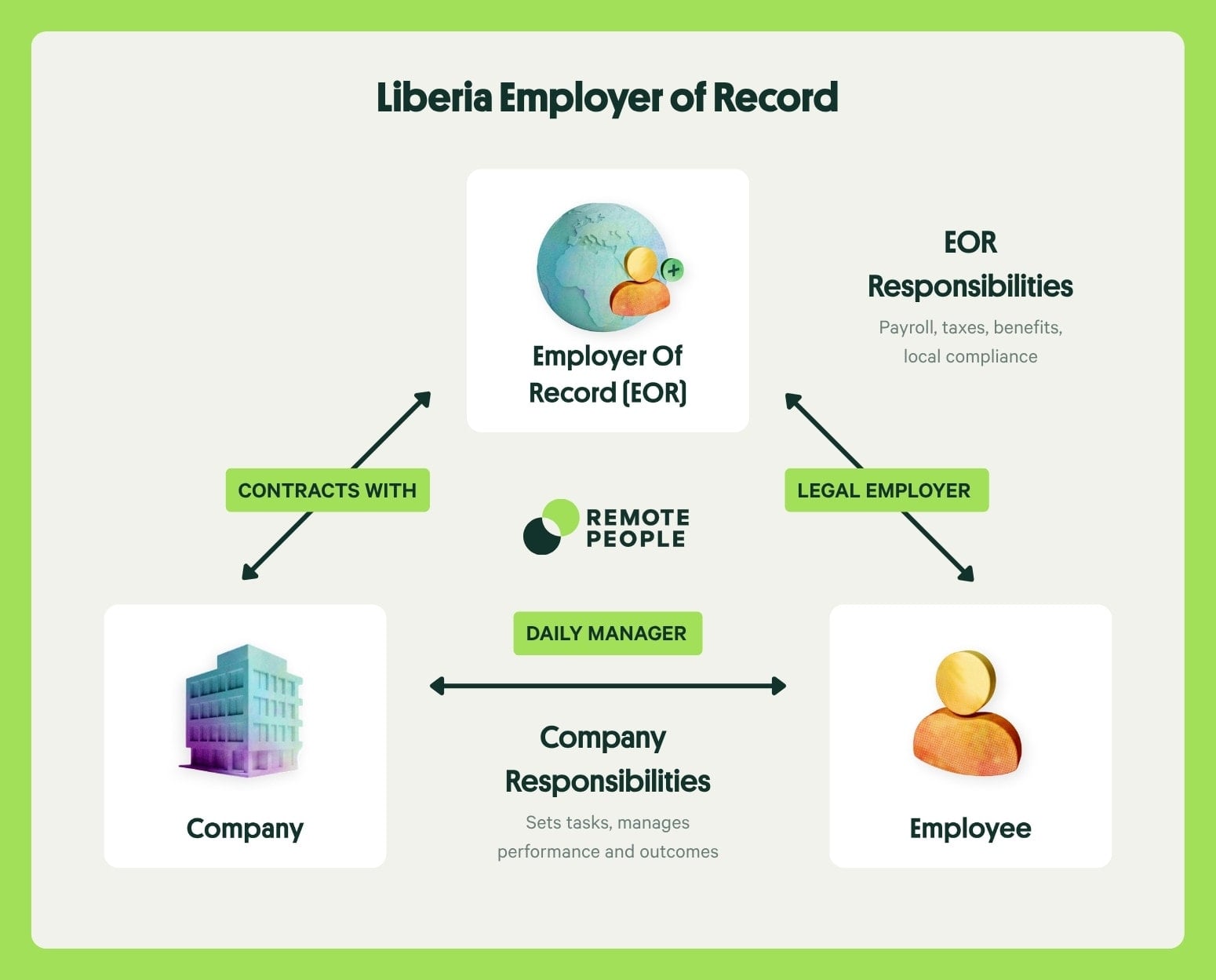
If you’d like to learn more about how Employer of Record (EOR) services work, read our What Is an Employer of Record (EOR)? guide for a complete overview of the model, its benefits, and when to use it.
If you’re comparing providers, our Best Employer of Record (EOR) Providers guide reviews the leading platforms to help you choose the right solution for your business.
Who Uses an EOR in Liberia?
Liberia is a relatively small labour market, so most foreign employers hiring here are not building a full local operation. Typical EOR users include:
Liberia is a relatively small labour market, so the foreign employers who hire here are rarely trying to build a full local operation. The most common EOR user is a business testing West African demand that wants a presence in Monrovia without committing to the several-month subsidiary registration at the Liberia Business Registry. Small teams of one to ten employees, typically a country manager, project lead, or technical specialist, also fit the model because a single EOR contract delivers a compliant employment relationship within two weeks where a new entity would take months.
Donor-funded and NGO programmes are the third natural fit, since they need local staff on short timelines and want an experienced partner to absorb NASSCORP enrolment, PIT withholding, and audit-ready record-keeping. Finally, any employer onboarding a foreign national benefits from an established EOR, because Labour Employment Permit sponsorship requires Ministry of Labour registration and a history of prior applications that most new-entrant companies cannot match.
These use cases share one theme: the client wants Liberian-law employment without the fixed cost of a registered branch. Any business hiring employees in Liberia that expects to scale slowly or stay under fifteen headcount usually finds the EOR model cheaper and faster than incorporation.
Typical Onboarding Timeline
A standard Liberia EOR onboarding runs one to two weeks, assuming the employee is already Liberian and has a valid LRA Tax Identification Number (TIN). The sequence is:
- EOR agreement and employee details collected: 1–2 days.
- Employment contract drafted in English and reviewed: 2–3 days.
- NASSCORP enrolment and LRA tax registration: 3–7 days, depending on Monrovia office turnaround.
- Payroll setup and bank details verified: 2–3 days.
- Start date and first payroll cycle: 1 day.
For non-Liberian hires, a Labour Employment Permit and residence visa extend the timeline to roughly six to eight weeks because the Ministry of Labour processing window runs two to six weeks on top of the standard onboarding. Background checks and degree verifications can add a further week in each direction.
Hire in Liberia
English common-law employment, a young bilingual workforce, USD-friendly payroll, and Decent Work Act protections make Liberia an accessible entry point to West Africa without the overhead of local incorporation.
We handle employment contracts, payroll, tax withholding, and full Liberia compliance.
No local entity needed. Your team can start in days.
Employment Laws and Regulations in Liberia
Employment Contracts
The governing statute is the Decent Work Act 2015 (DWA), administered by the Ministry of Labour. Contracts must be written in English and should identify the parties, the job title and duties, the place of work, the start date, working hours, remuneration, leave entitlements, and the notice period. Fixed-term contracts are permitted but chained renewals can be reclassified as indefinite if the arrangement has been in place continuously; the DWA requires the employer to justify a fixed term with a genuine project or seasonal need. Indefinite contracts are the default for ongoing roles. The Act also sets minimum standards on probation, leave, and termination that override any less favourable clause in a private contract (Decent Work Act 2015, Civil Service Agency).
Working Hours and Overtime
Under the Decent Work Act 2015, the standard workweek is 48 hours spread over six days, with a daily ceiling of 8 hours at normal pay. Managerial employees with genuine decision-making authority may be excluded from overtime premiums. Overtime is capped at an average of 5 hours per week measured over a four-month reference period, and absolute daily hours (normal plus overtime) cannot exceed 12. Employees are entitled to a minimum of 12 consecutive rest hours between working days and at least 36 consecutive hours of weekly rest, usually on Sunday. All overtime must be paid at no less than 1.5 times the normal hourly rate; rest day and public holiday work attract the same 50% premium unless a collective agreement provides a higher rate (Decent Work Act 2015 sections 17.1–17.5).
The table below sets out the premium structure required by Sections 17.3 to 17.5 of the Decent Work Act. Every Liberian private-sector employer should apply at least these multipliers; industry-level collective bargaining agreements can set more favourable terms but cannot drop below the statutory floor.
Liberia overtime and premium pay rates · Per Decent Work Act 2015 |
|||
Hour Type |
Rate Multiplier |
Weekly / Daily Cap |
Notes |
|---|---|---|---|
Weekday overtime (beyond 8 hrs/day) |
1.5× base hourly rate |
Max 12 hrs/day incl. OT |
DWA §17.5; OT must not exceed 5 hrs/week averaged over 4 months |
Weekly rest day work |
1.5× base hourly rate |
36-hr rest rule waived |
Employer must grant compensatory rest in the following week |
Public holiday work |
1.5× base hourly rate |
Daily 8-hr cap still applies |
Premium is on top of the ordinary holiday pay entitlement |
Night work (22:00–06:00) |
As agreed in contract / CBA |
Not statutorily fixed |
DWA §17.4 requires compensation but leaves the rate to collective bargaining |
Managerial / senior staff |
Exempt from premium |
No statutory cap |
Only true decision-makers qualify; title alone is not enough |
Two practical points flow from this structure. First, the four-month averaging rule means that a project-based employer can compress extra hours into a crunch week as long as the four-month total stays within the 5-hour weekly average. Second, the “managerial exemption” is narrow – a supervisor who still takes instruction from a more senior manager does not qualify and must be paid overtime.
Minimum Wage
Liberia’s statutory private-sector minimum wage was set at LRD 15 per hour by the Decent Work Act 2015 and remains unchanged in 2026. That works out to roughly LRD 2,600 per month on a standard 48-hour week, or approximately USD 14 at mid-2026 exchange rates. A separate civil-service floor of LRD 5,600 per month applies to government employees. The Ministry of Labour’s Minimum Wage Board has been consulting on an upward revision since 2024 but no decree has been gazetted at the time of writing, so employers should continue to apply the 2015 figure while monitoring the Official Gazette (Ministry of Labour, Minimum Wage Board).
In practice, market rates for skilled workers sit far above the statutory floor. Monrovia-based accountants, engineers, and project managers typically earn between USD 600 and USD 2,500 per month, and most EOR-managed contracts are denominated in USD or a USD-indexed LRD equivalent to protect employees against foreign-exchange movement.
Probation Period
The Decent Work Act Section 24 caps probation at three months, after which the employee automatically becomes a confirmed hire. During probation either side can terminate with only the pay already earned, but dismissal cannot be arbitrary or discriminatory – the general grounds-for-termination rules in Section 25 still apply. Probation can be extended only by written agreement and only where the role is demonstrably complex enough to require more than three months of assessment; Ministry of Labour inspectors disallow informal extensions. Annual leave does not accrue against the statutory schedule during probation, but NASSCORP contributions are due from the first payroll cycle regardless of confirmation status.
Leave Entitlements
Statutory leave in Liberia is governed by Sections 18 to 21 of the Decent Work Act. The entitlements are progressive – annual leave rises with tenure – and maternity pay is split between the employer and NASSCORP. The sections below break down each leave type; Table 5 then summarises every entitlement in one place.
Annual Leave
Annual leave accrues on a sliding scale tied to length of service. Employees with under 12 months of service are entitled to one week of paid leave; between 12 and 36 months of service the entitlement rises to two weeks; after 36 months it is three weeks; and after 60 months of continuous service an employee earns four weeks (20 working days). Workers under the age of 18 receive an extra week at each tier. Unused leave can be carried forward but cannot accumulate beyond three years of entitlement. Payment must be at the employee’s normal wage and is the employer’s responsibility, not NASSCORP’s. Leave does not formally accrue during the three-month probation but attaches retrospectively from day one once the employee is confirmed (DWA §18).
Sick Leave
Section 19 of the Decent Work Act entitles every employee to up to 10 working days of paid sick leave per year at the full normal wage. The employer carries the cost; NASSCORP does not reimburse sick pay for private-sector workers. A medical certificate from a licensed practitioner is required for absences of more than three consecutive days, and the DWA allows up to three short-term sick days per rolling 12-month period without a certificate. Where a chronic condition requires longer absence, the contract can be suspended and the employer may apply to the Ministry of Labour for guidance before invoking termination.
Maternity Leave
Maternity leave is 14 consecutive weeks, of which at least six must be taken immediately after childbirth. The employer pays at least two-thirds of the employee’s normal wage during the leave, and NASSCORP contributes a maternity benefit to top up the balance where the mother meets the contribution history requirements. Employment is protected during the entire period and for an additional month if certified pregnancy or delivery complications extend the medically required absence. Dismissal during maternity leave or during a six-month post-return window is explicitly prohibited by DWA Section 20 (DWA §20).
Paternity Leave
Fathers are entitled to five days of paternity leave around the birth of a child. The leave is unpaid under the Decent Work Act, though many employers pay it as a matter of policy and some collective bargaining agreements convert it into paid leave. It must be taken within one month of the birth.
Other Statutory Leave
Beyond annual, sick, and family leave, the Decent Work Act provides several additional paid entitlements:
The Decent Work Act also recognises a cluster of shorter leave entitlements that most Liberian employers build into their contracts. Bereavement leave runs up to five paid days per year for the death of a spouse, parent, child, or sibling. Public holidays are fully paid, and every gazetted national holiday listed in the 2026 calendar below counts against the entitlement. Jury and civic duty time off is paid at full wage when an employee is summoned to court or called for civic service. Marriage leave is not mandated by the Act itself, but two to three days is the customary contractual benefit most employers extend. Where a collective bargaining agreement is in place, the DWA additionally allows reasonable paid time for union duties and job-related training.
The table below draws every statutory leave entitlement into one place. It is the first document a Liberia EOR refers to when building a leave policy: annual leave rises with tenure, maternity leave is partly funded by the employer, and paternity leave is unpaid unless the contract upgrades it.
Liberia statutory leave entitlements · Per Decent Work Act 2015 |
||
Leave Type |
Duration |
Eligibility & Notes |
|---|---|---|
Annual leave – year 1 |
1 week (5 working days) |
After 12 months of continuous service; employer-paid at normal wage |
Annual leave – years 1–3 |
2 weeks (10 working days) |
12–36 months of service; +1 week for employees under 18 |
Annual leave – 3–5 years |
3 weeks (15 working days) |
After 36 months of service |
Annual leave – 5+ years |
4 weeks (20 working days) |
After 60 months of continuous service; carry-over capped at 3 years |
Sick leave |
10 working days / year |
Full pay, employer-funded; medical certificate for absences over 3 days |
Maternity leave |
14 weeks |
At least 6 weeks post-birth; 2/3 wage from employer, NASSCORP top-up where contributions qualify |
Paternity leave |
5 days |
Unpaid by default; must be taken within one month of birth |
Bereavement leave |
Up to 5 days / year |
Paid at normal wage for death of spouse, parent, child, or sibling |
Public holidays |
12 gazetted days / year |
Paid at normal wage; work on a holiday triggers 1.5× premium |
Statutory Employee Benefits
Alongside leave, Liberian law imposes a core set of employer-funded benefits. Most of them flow through NASSCORP or the Liberia Revenue Authority, so an EOR handles them by default:
Liberia runs a lean statutory benefit package built around NASSCORP and a handful of fixed paid-leave entitlements. Every employee is enrolled in the NASSCORP National Pension Scheme, funded by a combined 8% contribution (4% employer, 4% employee) that underwrites retirement, invalidity, and survivor benefits. NASSCORP also administers the Employment Injury Scheme, financed entirely by a 2% employer premium that covers workplace accidents and occupational disease under a no-fault model. Paid annual leave is set by the Decent Work Act at 21 working days after one year of continuous service, and sick leave follows a tiered schedule of up to 30 days at full pay and a further 30 days at half pay per year, subject to a medical certificate. Maternity leave is 14 weeks, split before and after the birth, and is paid at 100% of salary by the employer. There is no statutory health insurance levy or unemployment contribution, so the employer cost stack is notably lighter than in neighbouring West African markets.
Employers should not duplicate the exact contribution percentages in this section; refer to the employer and employee contribution tables in Section 4 for the precise 2026 rates.
Recent Regulatory Updates (2026)
The most significant recent change is the Tax Amendment Act of December 2024, signed on 17 December 2024, which amended eleven sections and three chapters of the Liberia Consolidated Revenue Code. The most visible effect for employers is the increase in the non-resident individual income tax rate from 15% to a flat 20%, which applies to Liberian-source employment income paid to foreigners who do not meet the six-month residence test (Liberia Revenue Authority, tax laws and amendments).
For the 2026 fiscal year, the Government has proposed a further set of measures in the draft National Budget submitted to the legislature in late 2025: a one-point increase in Goods and Services Tax from 12% to 13%, a framework for taxing digital-economy services, and a 2% presumptive corporate income tax on major concession holders (KPMG Tax Newsflash, January 2026). On the immigration side, the Liberia Immigration Service launched a digital Visa on Arrival and Re-entry Permit platform in March 2025, which has materially shortened processing times for short-term business visas (Liberia Immigration Service). The Decent Work Act itself has not been amended since enactment, but the Minimum Wage Board has opened public consultations on a long-overdue increase to the LRD 15 per hour floor.
Work Permits and Visas for Foreign Employees
Work Permit Requirements
Who Needs a Work Permit
Every non-Liberian national hired for paid work in Liberia must hold a valid Labour Employment Permit issued by the Ministry of Labour under Regulation No. 17 (2025), plus a matching residence visa from the Liberia Immigration Service. ECOWAS nationals benefit from visa-free entry but still need the Ministry of Labour permit for salaried employment. Dual-nationals with a Liberian passport are treated as Liberian for employment purposes and do not require a permit.
Eligibility and Required Documents
The employer of record, as the sponsoring entity, must be registered with the Ministry of Labour and in good standing on NASSCORP and LRA obligations. A permit application requires a signed employment contract, the employee’s passport valid for at least six months, a certified copy of the degree or qualification relevant to the role, a criminal-record check from the employee’s country of residence, and a medical certificate where the posting lasts longer than one year. Regulation No. 17 also requires the employer to document a good-faith effort to recruit a qualified Liberian for the position (Ministry of Labour Regulation No. 17).
Processing Time and Validity
Ministry of Labour processing for a standard Labour Employment Permit runs two to six weeks after the full file is lodged. Initial permits are issued for 12 months and are renewable in 12-month increments. Residence visas issued in parallel by the Liberia Immigration Service can be single-entry (up to three months) or multiple-entry (one to two years, three years for U.S. citizens under the bilateral reciprocity arrangement). Delays arise most often from incomplete criminal-record checks or from NASSCORP arrears at the employer level.
Renewal Process
Renewals must be filed at least 30 days before the existing permit expires. The renewal pack is lighter than the initial application – typically the current permit, an updated contract, a recent NASSCORP clearance, and an LRA tax clearance for the sponsoring entity. The employee may continue working while the renewal is in process as long as the application was filed before the expiry date and the Ministry of Labour has issued the interim acknowledgement.
Common Visa Types for Foreign Workers
The Ministry of Labour issues the work permit itself, while the Liberia Immigration Service issues the entry and residence visa that allows the holder to live in the country. The table below maps the main categories that a Liberia EOR can sponsor, alongside their usual duration and processing windows.
Liberia work visa types for foreign workers · 2026 |
||||
Visa Type |
Duration |
Best For |
Leads to Long-Term Residency? |
Processing |
|---|---|---|---|---|
Labour Employment Permit (Class A) |
12 months, renewable |
Salaried hires sponsored by a Liberian employer or EOR |
Yes, after several renewals |
2–6 weeks |
Intra-company transfer permit |
12–24 months |
Foreign nationals moved from a parent company to a Liberian subsidiary or EOR-sponsored role |
Yes, with renewals |
3–6 weeks |
Investor / Business Permit |
1–5 years, renewable |
Foreign directors or shareholders running a registered Liberian business |
Yes, converts to long-term residency |
4–8 weeks |
Multiple-entry visa |
1–2 years (3 years for U.S. citizens) |
Frequent travellers combining short business trips with remote roles |
No – a work permit is still required for paid employment |
1–3 weeks |
Single-entry visa on arrival |
Up to 90 days |
Short project visits, no salaried employment |
No |
On arrival, digital system since March 2025 |
A few other categories are worth flagging, though none of them authorise paid employment. A Tourist visa covers short holiday or family visits and must not be used for work of any kind, as the Liberia Immigration Service checks stay intent at the border. A Business visa permits meetings, negotiations, and conference attendance but again carries no right to take up paid employment in-country. Finally, a Diplomatic or Official visa is reserved for accredited mission personnel and their dependants; it sits outside the standard work-permit regime and is handled by the Ministry of Foreign Affairs rather than the Ministry of Labour.
How an EOR Handles Work Permits
A Liberian EOR acts as the sponsoring employer on both the Ministry of Labour and Liberia Immigration Service sides of the application. That means the EOR files the Regulation No. 17 employment permit, lodges the residence visa with LIS, and remains responsible for NASSCORP and LRA compliance during the life of the permit. The employee contributes the personal documents – passport, qualifications, police clearance, medical certificate – and attends any in-person appointments. Because the Ministry of Labour review adds two to six weeks to the timeline described in Section 1.4, most foreign-national hires need roughly six to eight weeks from offer to first day. The EOR’s registered status with the Ministry removes one of the biggest delays in first-time sponsorships, which is vetting the employer itself.
Payroll, Taxes, and Social Security in Liberia
Employer Contributions
Employer-side payroll taxes in Liberia are comparatively light. The only statutory levy is NASSCORP, which covers pension and employment-injury cover. There is no employer-side health-insurance mandate or unemployment levy, which keeps the total employer on-cost at roughly 6% of gross salary.
Liberia employer social security contributions · 2026 rates |
||
Contribution |
Rate |
Notes |
|---|---|---|
NASSCORP National Pension Scheme |
4.00% |
Employer share of the 8% combined pension contribution; covers old-age, survivor, and disability benefits |
NASSCORP Employment Injury Scheme |
2.00% |
Employer-only; covers workplace injury and occupational disease |
Total employer contribution |
6.00% |
Payable to NASSCORP by the 15th of the following month |
Employee Contributions
Employees contribute 4% of gross monthly earnings to the NASSCORP National Pension Scheme, deducted by the employer at source. There is no employee-side health-insurance levy and no separate unemployment contribution. Personal Income Tax withholding runs through the Liberia Revenue Authority’s PAYE regime and is detailed in Section 4.3; the amount deducted depends on the employee’s gross salary and the progressive PIT brackets.
Liberia employee payroll deductions · 2026 monthly withholdings |
||
Deduction |
Rate |
Notes |
|---|---|---|
NASSCORP National Pension Scheme |
4.00% |
Employee share of 8% combined pension contribution; withheld at source |
Personal Income Tax (PAYE) |
0% – 25% progressive |
Calculated per the annual bracket schedule (see Section 4.3) |
Total employee deduction |
4% + PAYE |
Remitted monthly to NASSCORP and the LRA |
Income Tax
Personal Income Tax (PIT) in Liberia is progressive for residents and operates on a four-band schedule defined in the Liberia Consolidated Revenue Code. Residents are taxed on worldwide employment income; non-residents pay a flat 20% on Liberian-source income. The table below shows the 2026 brackets as confirmed by PwC’s Worldwide Tax Summaries and the Liberia Revenue Authority (PwC Liberia – Taxes on Personal Income).
Liberia income tax brackets · 2026 |
|
Annual Taxable Income |
Tax Calculation |
|---|---|
LRD 0 – 70,000 |
0% (nil) |
LRD 70,001 – 200,000 |
5% of the amount exceeding LRD 70,000 |
LRD 200,001 – 800,000 |
LRD 6,500 + 15% of the amount exceeding LRD 200,000 |
LRD 800,001 and above |
LRD 96,500 + 25% of the amount exceeding LRD 800,000 |
Non-residents (flat) |
20% of Liberian-source employment income |
Payroll Cycle
Liberian payroll runs on a monthly cycle. Wages are paid in Liberian Dollars or, where the contract provides for it, in U.S. Dollars, which are legal tender alongside LRD. Payment must be made via bank transfer for any employee earning above a Ministry of Labour cash-payment threshold; larger employers use mobile money for field staff but must retain documented proof of receipt. Itemised payslips are mandatory and must show gross pay, NASSCORP deductions, PAYE, and net pay. NASSCORP contributions are due by the 15th of the month following the pay period, and PAYE returns to the Liberia Revenue Authority are due by the 10th. Annual reconciliations must be filed with both authorities within 90 days of the end of the calendar year (Liberia Revenue Authority). For more detail on Liberian payroll and tax mechanics, see the dedicated subpage.
13th Month Salary and Bonus Pay
Liberia has no statutory 13th month salary requirement. The Decent Work Act 2015 does not impose a mandatory year-end bonus, and NASSCORP contributions are calculated only against actual wages paid. Many employers nonetheless pay a discretionary year-end bonus – commonly a half-month or full month of salary – tied to company performance, and international NGOs often contractualise a 13th month as a retention tool. Where a bonus is paid, it is treated as ordinary employment income for PAYE and NASSCORP purposes and must run through payroll, not as an off-book gift.
Cost of Hiring an Employee in Liberia Through an EOR
EOR Service Fees
RemotePeople’s EOR service in Liberia is priced at a flat monthly fee per employee in the USD 300 to USD 600 range. That fee covers the Liberian employment contract, monthly NASSCORP and PAYE filings, payslip generation, annual reconciliation with NASSCORP and the LRA, leave tracking, and ongoing compliance updates. Pricing depends on headcount and the complexity of the role; senior positions that need work-permit sponsorship and a private medical plan typically sit at the upper end of the range, and contractor conversions or bulk hires sit nearer the lower end. See RemotePeople pricing for full detail.
Total Employment Cost Breakdown
The example below shows the monthly all-in cost of hiring a mid-level employee in Liberia on a USD 2,500 gross monthly salary. All values are in U.S. Dollars; figures are converted at 1 USD ≈ 192 LRD (mid-2026 indicative rate) for the statutory amounts that are calculated in LRD. The purpose of the table is to give a buyer a realistic landed cost comparison – the gross figure is the employee’s take-home before tax, NASSCORP, and the EOR fee.
Liberia employer cost example · USD 2,500 gross · 2026 |
||
Employer Cost |
Amount (USD) |
% of Gross |
|---|---|---|
Gross monthly salary |
$2,500.00 |
100.0% |
NASSCORP National Pension Scheme (employer) |
$100.00 |
4.0% |
NASSCORP Employment Injury Scheme (employer) |
$50.00 |
2.0% |
RemotePeople EOR fee (est.) |
$499.00 |
20.0% |
Total monthly employer cost |
$3,149.00 |
126.0% |
Statutory contributions converted from Liberian Dollars at 1 USD ≈ 192 LRD (April 2026 indicative rate). EOR fee is set at the midpoint of RemotePeople’s USD 300–600 range.
Adding NASSCORP (6%) and the EOR service fee gives a total employer cost of about 26% above gross salary for a mid-market role – materially lower than the comparable 35%+ load in most European jurisdictions, and the main reason Liberia’s cost-of-hire profile looks attractive once the compliance wrapper is in place.
Ready to hire in Liberia? Get started with RemotePeople – we handle employment contracts, payroll, tax withholding, and full Liberia compliance. No local entity needed.
Benefits of Using an EOR in Liberia
An EOR is not just an administrative convenience in Liberia – it is often the only commercially viable way to hire a handful of people without registering a branch at the Liberia Business Registry. The benefits below cover the full pitch that most foreign employers weigh when they compare the model against building their own entity.
The headline benefit is speed: a Liberia EOR can onboard a new hire within one to two weeks, against the four to six months a foreign company needs to register a limited liability company, open an LRA tax file, and complete NASSCORP enrolment for a new entity. Compliance is the second benefit. The Decent Work Act 2015, LRA PAYE rules, and NASSCORP filing deadlines evolve frequently, and an EOR’s in-country team absorbs the rule-watching and carries audit-ready records on your behalf. Cost sits alongside speed: incorporating and maintaining a Liberian subsidiary routinely runs several thousand dollars in year one and a recurring annual cost for accounting, statutory filings, and office lease, whereas an EOR is priced per employee per month with no fixed overhead.
Beyond the mechanics, an EOR gives you local expertise on sensitive questions – Monrovia salary benchmarks, NASSCORP ceiling treatment, how a bereavement-leave claim should be documented – that would otherwise require a retained Liberian employment lawyer. The model scales in both directions, which matters in a market where project funding cycles and commodity prices can swing headcount quickly; you can add or release staff through the EOR with compliant notice and severance rather than restructuring a subsidiary. Risk mitigation is another key draw: the EOR carries the statutory employer obligations, so a missed NASSCORP return, a contested termination, or a labour inspector visit lands in the EOR’s inbox rather than on your finance team. Finally, the employee experience is demonstrably better than ad-hoc contractor arrangements – workers receive a Liberian contract in English, a compliant LRD or USD payslip, NASSCORP coverage, and the leave and severance entitlements that a professional job expects, which in a tight talent market translates directly into retention.
For most companies hiring one to fifteen people in Liberia, the EOR model captures the full upside of a direct employment relationship without the capital cost and regulatory exposure of a subsidiary. To evaluate the fit for your roles, speak to a RemotePeople specialist.
Termination and Offboarding
Notice Periods
Section 25 of the Decent Work Act sets a tenure-graded statutory notice floor that applies to both employer-initiated and employee-initiated termination. Notice can be paid in lieu at the employee’s current wage, and fixed-term contracts that run to their natural end require no notice. The schedule below is the minimum; contracts and collective agreements can extend it but cannot drop below the statutory level. Payment-in-lieu is the cleanest route in a commercial parting, and the one most EOR clients default to.
Liberia statutory notice periods by position level · Per Decent Work Act 2015 |
|||
Length of Service |
Notice Period |
During Probation |
Notes |
|---|---|---|---|
Less than 3 months |
1 week |
No notice required within probation |
Probation caps at 3 months (DWA §24) |
3 – 6 months |
2 weeks |
N/A – post-probation |
Notice may be paid in lieu |
6 – 12 months |
3 weeks |
N/A |
Same rule applies to employer and employee |
More than 12 months |
4 weeks |
N/A |
Statutory floor; contract may extend |
Collective dismissal (economic) |
4 weeks + Ministry notification |
N/A |
Ministry of Labour must be notified in advance |
Notice is not required where the employer dismisses for serious misconduct (“just cause”) or where the employee voluntarily resigns after the contract expiry of a fixed-term assignment. Mutual-agreement exits with a documented settlement are common and avoid the Ministry of Labour filings that accompany contested terminations.
Severance Pay
Severance in Liberia is owed only where termination is for economic or redundancy reasons – not for dismissal on grounds of misconduct and not on natural expiry of a fixed-term contract. Section 26 of the Decent Work Act sets the statutory formula at four weeks of base salary per completed year of service, payable in addition to any notice or pay-in-lieu. The table below shows how the payment scales on a LRD 60,000 monthly base – representative of a confirmed mid-market role in Monrovia.
Liberia severance pay schedule by years of service · Per Decent Work Act 2015 |
|||
Years of Service |
Severance Amount |
Base Salary |
Notes |
|---|---|---|---|
1 year |
4 weeks of base pay (LRD 60,000) |
Normal monthly wage |
Only for redundancy / economic termination |
3 years |
12 weeks of base pay (LRD 180,000) |
Normal monthly wage |
Paid at exit, in addition to accrued leave |
5 years |
20 weeks of base pay (LRD 300,000) |
Normal monthly wage |
Subject to PAYE at the employee’s marginal rate |
10 years |
40 weeks of base pay (LRD 600,000) |
Normal monthly wage |
No statutory cap, but Ministry of Labour may review large layoffs |
Calculation Method
Severance is calculated as four weeks of the employee’s normal base monthly wage for every completed year of continuous service. The base is the ordinary contractual salary and does not include overtime premiums, discretionary bonuses, or allowances that were not treated as pensionable for NASSCORP purposes. Partial years are typically pro-rated at one week per quarter of service in the final year, though the Act leaves room for a more generous contractual formula. Table 13 above shows how a LRD 60,000 base scales from a single year through ten years of service; for a full worked example at a different base, multiply the monthly wage by four for each completed year.
Caps and Exceptions
The Decent Work Act imposes no hard cap on severance, but three exceptions apply. First, dismissal for serious misconduct (“just cause”) – theft, gross insubordination, or breach of confidentiality – extinguishes the severance entitlement entirely. Second, fixed-term contracts that run to their stated end do not trigger severance because there is no involuntary termination. Third, during the three-month probation window the employer owes only earned wages and accrued leave. Where the Ministry of Labour is notified of a collective dismissal, it may review the redundancy plan and, in rare cases, require the employer to retain priority categories such as pregnant employees or union officers.
Grounds for Termination
Dismissal in Liberia must fall into one of two statutory categories under DWA Section 25. The first is “just cause” – documented misconduct, persistent failure to perform after written warnings, criminal conviction for an offence related to the role, or a material breach of confidentiality. Just-cause dismissals require written reasons and the employee has a right to respond before the decision is final. The second is economic or redundancy termination, which triggers the notice and severance obligations above and, for collective dismissals, a filing with the Ministry of Labour. Pregnant employees, employees on maternity leave, and union officers enjoy additional protections and cannot be dismissed on redundancy grounds without Ministry approval. A termination that does not fit one of these categories is “unfair dismissal” and can be challenged at the Ministry of Labour or in the Labour Court, where the usual remedy is reinstatement or an indemnity equal to four to twelve months of wages on top of statutory notice and severance.
EOR vs Other Hiring Models in Liberia
EOR vs. Setting Up a Local Entity
The choice between an EOR and a Liberian subsidiary comes down to scale, speed, and the type of work on the roadmap. For a team of one to ten in Liberia, the EOR takes a compliant hire live in one to two weeks at zero upfront cost; a subsidiary registered through the Liberia Business Registry, LRA, and NASSCORP takes four to six months and USD 8,000–15,000 to stand up. The table below compares the two on the dimensions that drive the decision.
Liberia EOR vs local entity comparison · Setup time, cost, risk and best-fit |
||
Comparison |
Employer of Record (Faster) |
Own Entity |
|---|---|---|
Setup time |
1–2 weeks |
4–6 months (Liberia Business Registry, LRA, NASSCORP) |
Upfront cost |
$0 |
$8,000–$15,000 (incorporation, legal, bank setup) |
Ongoing cost |
$300–$600 / employee / month |
$5,000–$12,000 / year maintenance plus local finance headcount |
Local partner required |
No – the EOR is the local entity |
Yes – a registered agent in Monrovia is required |
Social insurance registration |
Handled by the EOR |
You manage NASSCORP enrolment and remittance |
Payroll and tax filing |
Handled by the EOR |
You manage LRA PAYE filings or outsource |
Best for team size |
1–15 employees |
15+ employees |
Scale down / exit |
Easy – no entity to unwind |
Costly – legal dissolution and tax clearance required |
Government contracts |
Not eligible |
Eligible (requires local entity and sometimes local ownership) |
For a team of one to ten in Liberia, an EOR is almost always the cheaper option once the setup cost and in-country finance overhead of running a subsidiary are factored in. The break-even point where a local entity starts to make sense is around 15 confirmed hires, and even then many groups keep their first local employees on an EOR until a full HR and finance function is staffed.
The one clear case for incorporating is public-sector or state-enterprise work, where tender rules usually require a Liberian-registered bidder. If a government contract is part of the roadmap, an entity is unavoidable – but many companies still use an EOR for the preceding pilot year so the incorporation runs in parallel with live delivery.
EOR vs. Hiring Independent Contractors
Many foreign buyers instinctively reach for an independent-contractor agreement when they hire in Liberia because it looks simpler and cheaper. Under the Decent Work Act 2015 and Ministry of Labour guidance, misclassification is the most common enforcement issue, and a long-term, full-time role that looks like employment will be treated as such regardless of how the contract is labelled. The comparison below shows where each model fits and where the liability sits.
Liberia EOR vs independent contractors · Compliance, cost, and risk |
||
Comparison |
EOR (Full-Time Employee) |
Independent Contractor |
|---|---|---|
Legal relationship |
Employee of the EOR under a Liberian contract |
Self-employed; no employment relationship |
Compliance risk |
Low – EOR ensures Decent Work Act compliance |
Material if the relationship resembles employment; Ministry of Labour can reclassify |
Payroll and tax |
EOR withholds PAYE and NASSCORP |
Contractor invoices you; they file their own LRA returns |
Benefits and leave |
Full statutory leave, sick pay, NASSCORP |
No statutory benefits |
IP protection |
Stronger – employment contract assigns IP to the client by default |
Weaker – requires an explicit written IP assignment clause |
Termination |
Subject to statutory notice and severance |
Contract can be ended per the service agreement |
Best for |
Long-term, core team roles |
Short-term projects or clearly scoped specialist tasks |
Cost structure |
Salary + 6% NASSCORP + EOR fee |
Contractor invoice (typically higher gross, lower total cost) |
Liberia applies a substance-over-form test when it inspects the contractor relationship. Where a person works full-time hours under the client’s supervision, uses the client’s tools, and has no other material customers, Ministry of Labour inspectors routinely reclassify them as employees. The consequence is back-payment of PAYE and NASSCORP, a fine, and the statutory leave and severance the worker would have earned. Contractors are the right model for a short specialist engagement – a two-week audit, a one-off training programme, a fixed-deliverable design project – but for a long-term role, the EOR route is materially safer. If a contractor arrangement is genuinely appropriate, RemotePeople’s Liberia contractor management service handles the invoicing, compliance, and payment logistics without forcing a reclassification.
EOR vs. PEO (Professional Employer Organization)
A PEO differs from an EOR on a single but decisive point: the legal employer. In an EOR arrangement the EOR holds the Liberian employment contract; in a PEO co-employment, the client company remains the legal employer and the PEO provides HR administration alongside it. That means a PEO only works where a Liberian subsidiary already exists, while an EOR is the route for a foreign company hiring into Liberia without an entity.
Liberia EOR vs PEO comparison · Legal employer, liability, and setup |
||
Comparison |
Employer of Record (EOR) |
PEO |
|---|---|---|
Legal employer |
EOR is the legal employer in Liberia |
You remain the legal employer (co-employment) |
Local entity required |
No – the EOR is the local entity |
Yes – you must have a registered company in Liberia |
Best for |
Companies without a Liberian entity |
Companies that already have one |
Compliance liability |
EOR assumes compliance responsibility |
Shared liability between you and the PEO |
Setup time |
1–2 weeks |
Depends on your entity setup – weeks to months |
Control over HR policies |
EOR manages within Liberian law |
More direct control; the PEO advises |
Typical use case |
Market entry, small remote teams, testing Liberia |
Established Liberian operations needing HR outsourcing |
Liberia does not have a bespoke statutory framework for PEOs; the local HR-outsourcing market tends to combine payroll bureau services with a co-employment agreement, without a separate licence. That means any Liberian “PEO” engagement ultimately relies on the client’s own local entity to remain the legal employer, which is the defining difference from an EOR. For a company that already has a registered subsidiary in Monrovia and wants to outsource payslips, NASSCORP filings, and leave tracking, a PEO-style service can work. For a company without a Liberian entity – which is the typical RemotePeople client – the EOR is the only compliant model because it provides the legal employer the labour inspectorate will expect to see.
Public Holidays in Liberia 2026
Liberia observes twelve statutory public holidays in 2026. Holidays that fall on a Sunday are typically observed on the following Monday under a Ministerial proclamation, and the President retains the discretion to declare additional one-off holidays during the year. Employers should treat every gazetted holiday as a full paid day off; work performed on a holiday attracts the 1.5× premium rate set out in the overtime table earlier.
Liberia public holidays · 2026 calendar year |
||
Date |
Holiday |
Type |
|---|---|---|
1 January (Thu) |
New Year’s Day |
National |
11 February (Wed) |
Armed Forces Day |
National |
11 March (Wed) |
Decoration Day |
National (second Wednesday of March) |
15 March (Sun) |
J.J. Roberts’ Birthday (observed 16 March) |
National |
3 April (Fri) |
Good Friday |
Religious |
10 April (Fri) |
Fast & Prayer Day |
National (second Friday of April) |
14 May (Thu) |
National Unification Day |
National |
26 July (Sun) |
Independence Day (observed 27 July) |
National |
24 August (Mon) |
National Flag Day |
National |
5 November (Thu) |
Thanksgiving Day |
National (first Thursday of November) |
29 November (Sun) |
President Tubman’s Birthday (observed 30 November) |
National |
25 December (Fri) |
Christmas Day |
Religious |
Three holidays fall on a Sunday in 2026 – J.J. Roberts’ Birthday, Independence Day, and Tubman’s Birthday – so the observed day shifts to the following Monday. Payroll systems should pick up the shift automatically if configured against the Liberian gazette calendar; otherwise scheduling and leave balances can drift.
How to Get Started With an EOR in Liberia
Moving from a decision to a live hire is straightforward, and most RemotePeople Liberia onboardings follow the five-step path below. Plan for ten working days from signature to first payslip for Liberian nationals and six to eight weeks where a Labour Employment Permit is needed.
- First, scope the role and compensation. Confirm the job description, base salary, and any allowances, and decide whether the contract will be denominated in LRD or USD – both are permitted. Share the Liberia average-salary benchmarks with the hiring manager so the offer is grounded in market data.
- Second, sign the EOR service agreement. RemotePeople issues a master services agreement that covers the country scope, fees, invoicing cycle, and indemnities. Most clients sign within a week.
- Third, provide the employee details and supporting documents. We need the employee’s passport copy, Tax Identification Number (or TIN application), NASSCORP membership number if any, bank account, and preferred start date. For foreign nationals, we also collect the police clearance, degree copy, and medical certificate that the Ministry of Labour requires.
- Fourth, the EOR drafts and executes the Liberian contract. You review the draft, we finalise it with the employee, and both parties sign electronically. NASSCORP enrolment and LRA tax registration run in parallel.
- Fifth, the employee starts and is paid through the EOR. Monthly payroll runs on the calendar cycle, payslips are issued in English, NASSCORP and PAYE are filed by the statutory deadlines, and you receive a single consolidated invoice in USD.
Ready to move? Talk to RemotePeople – we will confirm feasibility for your role in Liberia, quote the exact monthly cost, and have a compliant contract in your employee’s inbox within days.
Where companies hiring in Liberia expand next
Companies building West African operations commonly expand across the ECOWAS bloc and neighboring Francophone and Anglophone markets. Many companies add an EOR partner in Nigeria first, drawing on the regional West African talent footprint. Ghana follows as overlapping West African workforce dynamics, while a team in Ivory Coast offers shared West African labor and language overlap. Operations in Cameroon is often the fourth step, valued for aligned West African hiring norms.
Frequently Asked Questions
RemotePeople's Liberia EOR fee is a flat monthly charge per employee between USD 300 and USD 600, on top of the employee's gross salary and the statutory 6% NASSCORP contribution. A USD 2,500 gross hire therefore lands at about USD 3,149 per month all-in – approximately 126% of gross. The fee covers employment contract, payroll, NASSCORP and LRA filings, leave tracking, and ongoing compliance support.
Most Liberian-national hires are onboarded in one to two weeks, covering the EOR agreement, contract drafting, NASSCORP enrolment, and LRA tax registration. Foreign-national hires typically take six to eight weeks because the Ministry of Labour needs two to six weeks on top of the base timeline to issue a Labour Employment Permit under Regulation No. 17 (Ministry of Labour Regulation No. 17).
Employers must remit 6% of gross salary to NASSCORP each month: 4% to the National Pension Scheme and 2% to the Employment Injury Scheme. There is no employer-side health-insurance levy and no unemployment contribution. Employees contribute a further 4% to the pension scheme. Total NASSCORP cost is 10% of gross salary (PwC Worldwide Tax Summaries, Liberia).
Liberia applies a four-band progressive PIT for resident individuals: LRD 0–70,000 at 0%; LRD 70,001–200,000 at 5% of the amount above LRD 70,000; LRD 200,001–800,000 at LRD 6,500 plus 15% of the excess; and LRD 800,001 and above at LRD 96,500 plus 25% of the excess. Non-residents pay a flat 20% on Liberian-source income following the Tax Amendment Act of December 2024 (PwC – Liberia PIT).
No. A statutory 13th month salary is not mandatory under the Decent Work Act 2015. Many employers pay a discretionary year-end bonus, typically half a month to a full month, but it is a contractual benefit and is subject to PAYE and NASSCORP in the month it is paid (Decent Work Act 2015).
Under Section 25 of the Decent Work Act, statutory notice runs from one week for service under three months, to two weeks for three to six months, three weeks for six to twelve months, and four weeks for service over twelve months. Notice may be paid in lieu. Just-cause dismissal requires no notice, and fixed-term contracts that run to their natural end do not trigger notice.
Severance is owed only on economic or redundancy termination and is set at four weeks of base salary per completed year of service under DWA Section 26. Dismissal for just cause, natural expiry of a fixed-term contract, and termination during the three-month probation window do not trigger severance. There is no statutory cap on total severance (Decent Work Act 2015 §26).
For long-term, full-time roles the Ministry of Labour will usually treat the worker as an employee regardless of how the contract is labelled, and misclassification triggers back-PAYE, NASSCORP, and statutory leave liability. Contractors are the right model only for short, clearly scoped engagements with genuine autonomy over how the work is done. RemotePeople's Liberia contractor management service keeps the invoicing and payment compliant and is the recommended route where a contractor relationship is genuinely appropriate. For long-term roles, use the EOR to place the worker in a full employment relationship.
Under a standard Liberian employment contract, intellectual property created by the employee in the course of employment belongs to the client company (you), not the EOR. The RemotePeople contract template includes an express IP assignment clause that flows work product through the EOR to the client on completion. That is materially stronger than an independent-contractor relationship, where IP ownership defaults to the creator unless the contract says otherwise.
Employer of Record in
Employer of Record in
Employer of Record in
Employer of Record in
Employer of Record in
Employer of Record in
Employer of Record in
Employer of Record in




