
 Recruit
Employer of Record (EOR) in Benin
-
 Drew Donnelly
- Published
- September 27, 2026
RemotePeople handles employer of record services in Benin so you can hire employees without setting up a local entity. We manage CNSS contributions (17.4% employer), ITS payroll withholding, French-language employment contracts, and statutory benefits, so you can build your Benin team in 2 to 3 weeks.
Hire in Benin — book a free 30-minute demo
Tell us what you need. You'll get a tailored, transparent proposal within 24 hours, plus a free call to walk through it.
Tell us about your company
So we can match you with a specialist who knows your market — and unlock volume pricing tiers.
* All fields are required.
Where and when are you hiring?
Tell us the geography and timing and we'll quote each country line by line, with onboarding timelines.
* All fields are required.
Help us beat your current setup
We'll benchmark your current deal and send a line-by-line proposal in 24 hours — showing exactly where we cut cost, time, or risk. After you submit, you can book a call to walk through it together.
* All fields are required.
Thanks! Your proposal is on its way.
Expect a tailored, line-by-line proposal in your inbox within 24 hours. In the meantime…
Want to walk through it together?
Book a free 30-minute call with one of our specialists. We'll explain every line, answer your questions, and tailor the proposal further if you need.
No obligation. Pick a time that works for you.








- Hire in Benin — book a free 30-minute demo
- Tell us about your company
- Where and when are you hiring?
- Help us beat your current setup
- Thanks! Your proposal is on its way.
- How an Employer of Record Works in Benin
- Employment Laws and Regulations in Benin
- Work Permits and Visas in Benin
- Payroll, Taxes, and Social Security in Benin
- Cost of Hiring Through an EOR in Benin
- Benefits of Using an EOR in Benin
- Termination and Offboarding in Benin
- EOR vs. Other Hiring Models in Benin
- Public Holidays in Benin
- How to Get Started with an EOR in Benin
- Where companies hiring in Benin expand next
- Frequently Asked Questions About Employer of Record in Benin
- Related EOR Destinations
Start hiring in Benin
Let RemotePeople handle payroll, compliance, and HR admin worldwide so you can focus on building your team.

Benin offers a stable francophone workforce concentrated in Cotonou and Porto-Novo, with strong administrative, finance, and customer-service talent that speaks French and increasingly English. The country has positioned itself as a digital and logistics hub for West Africa, supported by the Glo-Djigbé Industrial Zone and the Port of Cotonou, the second busiest in the region. For companies expanding into Benin, the primary compliance requirements are navigating the Benin Labour Code (Law No. 98-004 of 27 January 1998), registering employees with the Caisse Nationale de Sécurité Sociale (CNSS), and running monthly payroll through the Impôt sur les Traitements et Salaires (ITS) system.
An employer of record in Benin removes the need to incorporate a local company while keeping every hire fully compliant with Beninese labour law. The EOR acts as the legal employer on paper, managing French-language employment contracts, CNSS registration, ITS withholding, statutory benefits, and work permit sponsorship. You keep full operational control over the employee’s work, performance, and daily management.
How an Employer of Record Works in Benin
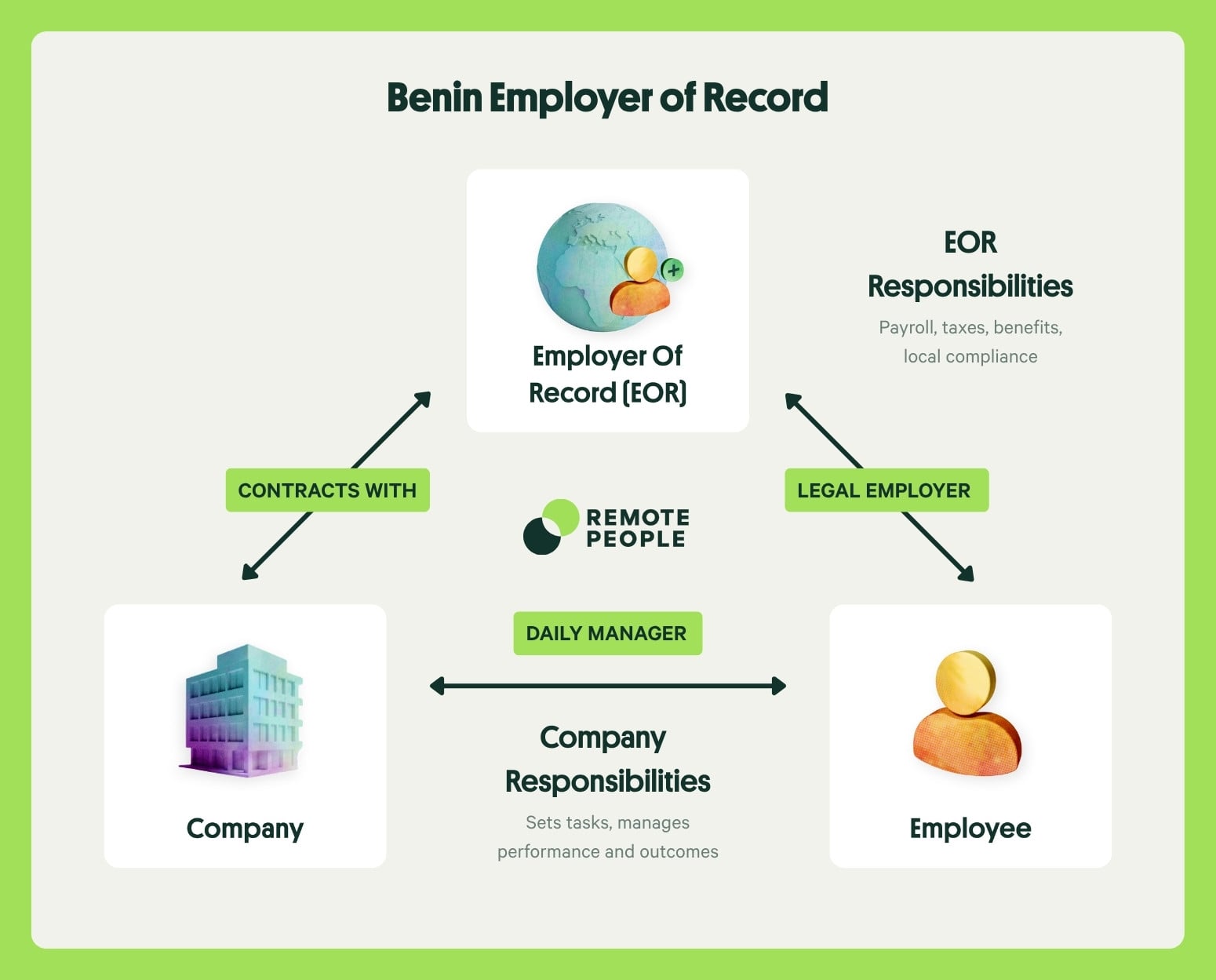
If you’d like to learn more about how Employer of Record (EOR) services work, read our What Is an Employer of Record (EOR)? guide for a complete overview of the model, its benefits, and when to use it.
If you’re comparing providers, our Best Employer of Record (EOR) Providers guide reviews the leading platforms to help you choose the right solution for your business.
Who Uses an EOR in Benin?
Companies typically use an EOR in Benin to test the francophone West African market before committing to a full entity, to hire a small team of 1 to 15 people without the overhead of incorporation, or to onboard a single high-value hire in days rather than the months full entity setup would take. The model is especially useful for firms in fintech, logistics, customer support, and French-speaking content operations that are hiring remote workers in Cotonou or Porto-Novo. For any company expanding into Benin, an EOR removes the legal, banking, and HR barriers to a quick start.
Typical Onboarding Timeline
The onboarding process typically takes 2 to 3 weeks for Beninese nationals, broken into five clear stages.
- First, sign the EOR service agreement and share the employee’s details (1–2 days).
- Second, the EOR drafts a compliant French-language employment contract and sends it for signature (2–3 days).
- Third, CNSS registration and bank account setup happen in parallel (3–5 business days).
- Fourth, payroll configuration, ITS tax file opening, and benefits enrollment are finalised (2–3 days).
- Fifth, the employee officially starts work and receives their first paycheck on the next monthly payroll cycle.
If the hire is a non-Beninese national requiring a work permit, add 6 to 10 weeks for standard processing through the Ministry of Labour and the immigration authority. An expedited pathway may be available for senior technical roles and investors registered under Benin’s Investment Code.
Hire in Benin
A young workforce, French-speaking business environment, and OHADA’s harmonised legal framework make Benin an accessible entry point into West African hiring.
We handle employment contracts, payroll, tax withholding, and full Beninese compliance.
No local entity needed. Your team can start in days.
Employment Laws and Regulations in Benin
Employment Contracts
The Benin Labour Code (Law No. 98-004 of 27 January 1998, as amended) governs every employment relationship in Benin and is administered by the Ministry of Labour and Civil Service (WIPO Lex Benin profile). Written contracts are mandatory for fixed-term, part-time, and foreign worker contracts, and strongly advised for all other arrangements. Indefinite-term contracts (CDI) are the default for ongoing roles, while fixed-term contracts (CDD) are capped at 4 years total including renewals.
Employment contracts must be written in French and must specify job title, workplace, wages, working hours, leave entitlement, probation period, notice terms, and references to the applicable collective bargaining agreement. The 2005 Inter-professional Collective Agreement (Convention Collective Générale du Travail) supplements the Labour Code with enhanced severance and notice schedules and is incorporated by reference in most private-sector contracts.
Working Hours and Overtime
The standard legal workweek in Benin is 40 hours, typically distributed as 8 hours per day over 5 days (Article 142 of the Labour Code). Agricultural workers may work up to 2,400 hours per year under seasonally adjusted schedules. Overtime must be authorised by the labour inspectorate and is paid at premium rates set by decree.
Overtime premiums are calculated in bands. Hours 41 to 48 in a week are paid at 112% of the base rate, hours beyond 48 are paid at 135%, night hours between 9 p.m. and 5 a.m. carry a 150% premium, and Sunday or public holiday work is paid at 200%. Employees are entitled to a minimum 24-hour continuous rest period each week, normally on Sunday.
The Benin Labour Code sets a standard workweek of 40 hours and caps overtime at 240 hours per year per employee under Article 145. Article 147 defines premium pay as percentage uplifts on the base hourly rate, with distinct day and night tiers and higher rates for Sunday or public holiday work.
Benin overtime and premium pay rates · Per Labour Code Law No. 98-004, Article 147 | |||
Hour Type | Rate (% of Base Hourly) | Weekly or Daily Cap | Notes |
|---|---|---|---|
Day overtime, hours 41 to 48 | 112% (12% premium) | 8 hours per week above the 40-hour standard | Applies to most private-sector workers under Article 147(a) |
Day overtime, beyond hour 48 | 135% (35% premium) | Counts toward the 240-hour annual cap | Higher tier triggered once weekly total exceeds 48 hours |
Day work on Sunday or public holiday | 150% (50% premium) | Compensatory rest day required | Cannot replace the statutory 24-hour weekly rest period |
Night work on a weekday (21:00 to 05:00) | 150% (50% premium) | Counts toward the weekly overtime allowance | Applies to non-shift workers whose night hours are exceptional |
Night work on Sunday or public holiday | 200% (100% premium) | Subject to the 240-hour annual overtime cap | Highest tier; applies to the 13 statutory paid holidays |
Minimum Wage
The statutory minimum wage (SMIG) in Benin is 52,000 XOF per month, equivalent to approximately USD 93 per month at the April 2026 exchange rate of $1 = 561 XOF. The rate has applied since 1 January 2023 following a 30% increase from the previous SMIG of 40,000 XOF, and it remains in force for 2026 (Benin SMIG decree). For verification and updates, see the Benin minimum wage page.
Probation Period
Probation periods are set by the Labour Code and vary by employee category (Benin probation period). Hourly workers may be placed on probation for up to 15 days, monthly-paid employees for up to 1 month, technicians and supervisors for up to 3 months, and engineers and senior executives for up to 6 months. Each probation period may be renewed once, but total probation may not exceed 6 months. During probation, either party may terminate without notice or indemnity, provided the contract explicitly includes a probation clause.
Leave Entitlements
Beninese law provides a comprehensive set of statutory leave entitlements under the Labour Code and the Inter-professional Collective Agreement, covering paid annual leave, sick leave, maternity leave, paternity leave, and family events. Leave accrues monthly and is funded by the employer, except maternity leave which is partly reimbursed by CNSS.
Annual Leave
Employees are entitled to 24 working days of paid annual leave per year, accruing at the rate of 2 working days per month of service (Article 158 of the Labour Code). Leave entitlement increases with length of service, with an additional 2 days granted after 20 years of service, an additional 4 days after 25 years, and an additional 6 days after 30 years. Mothers receive 2 extra days of leave per child under 14 years of age. Annual leave is paid at the employee’s normal rate and cannot be replaced by a cash indemnity except at the end of the contract.
Sick Leave
Paid sick leave is granted to employees who have at least 6 months of service, subject to a medical certificate issued by an approved physician. Length and pay depend on tenure, set by the 2005 Collective Agreement. Employees with less than 1 year of service receive 1 month at full pay and 1 month at half pay, employees with 1 to 5 years receive 1 month at full pay and 3 months at half pay, and employees with more than 5 years receive up to 6 months at full pay. After the employer-paid period, further absence is covered by CNSS health benefits or unpaid leave.
Maternity Leave
Female employees are entitled to 14 weeks of paid maternity leave, structured as 6 weeks before the expected date of delivery and 8 weeks after birth (Article 170 of the Labour Code). Pay is split 50% employer and 50% CNSS during the leave period, provided the employee has made at least 6 months of CNSS contributions prior to the leave start. Dismissal during maternity leave is prohibited, and pregnant employees may not be assigned work that risks their health.
Paternity Leave
Paid paternity leave is not a standalone statutory category in Benin, but fathers are entitled to 3 days of paid family leave for the birth of a child under the family events provisions of the Collective Agreement. These 3 days form part of the 10 days of paid family event leave available per year (see below) and are taken from the total family event allowance.
Other Statutory Leave
Employees are entitled to up to 10 days of paid family event leave per year, covering marriage, birth or baptism of a child, death of a close family member, or moving house. Specific allowances are set by the Collective Agreement: typically 4 days for the employee’s own marriage, 3 days for the birth of a child, 3 days for the death of a spouse or child, and 2 days for the death of a parent. Jury duty and civic leave are also paid where required by public authorities.
Leave Entitlements Summary
Benin’s labour code codifies every statutory leave type employers must grant, from annual leave to maternity, sick, and other protected absences (WIPO Lex Benin Labour Code). The table below summarises each statutory leave category with duration and eligibility so payroll and HR can plan accruals and cover without missing a mandatory entitlement.
Benin statutory leave entitlements · Per Labour Code and 2005 Collective Agreement | ||
Leave Type | Duration | Eligibility & Notes |
|---|---|---|
Annual Leave | 24 working days/year | Accrues at 2 days/month. +2 days after 20 years, +4 after 25, +6 after 30. +2 days/child under 14 for mothers. Paid by employer. |
Sick Leave | Up to 6 months | Requires 6 months service and medical certificate. Under 1 year: 1 month full + 1 month half pay. 1–5 years: 1 month full + 3 months half pay. 5+ years: up to 6 months full pay. |
Maternity Leave | 14 weeks | 6 weeks pre-birth, 8 weeks post-birth. Paid 50% employer + 50% CNSS. Requires 6 months of CNSS contributions. Dismissal during leave is prohibited. |
Paternity / Family Leave | 10 days/year | Covers marriage, birth (3 days), death of spouse/child (3 days), death of parent (2 days), moving house. Paid by employer. |
Public Holidays | 13 days/year | Paid time off on 13 official public holidays. Work on a public holiday is paid at 200% of the normal rate. |
Statutory Employee Benefits
The core mandatory benefit in Benin is enrollment in the Caisse Nationale de Sécurité Sociale (CNSS), the national social security fund, which covers family allowances, work injury, and the old-age/invalidity/survivor pension branch. The combined contribution rate is about 21% of insurable wages (roughly 17.4% employer and 3.6% employee) based on gross salary up to the CNSS ceiling, and it funds pension benefits, disability income, maternity cash allowance, child allowances, and work injury compensation.
Healthcare is partly covered by CNSS work-injury and family branches, and the government is rolling out the Assurance pour le Renforcement du Capital Humain (ARCH) universal health insurance scheme for informal sector workers. Most private-sector employers supplement CNSS with voluntary private health insurance (mutuelle de santé), a transport allowance, and a meal allowance, which together form a competitive benefits package for skilled hires in Cotonou.
Recent Regulatory Updates (2026)
The CNSS pension branch was revalued by Decree No. 2023-455 of 13 September 2023, which adjusted contribution ceilings and pension payment formulas for inflation. The Family Allowances branch rate remains at 9.0% (including a 0.2% maternity cash component), the Work Injury branch rate remains at 1–4% depending on sector risk classification, and the old-age pension rate remains at 6.4% employer and 3.6% employee, unchanged into 2026.
The Government of Benin has been piloting the ARCH universal health insurance scheme and expanding digital tax filing under the Direction Générale des Impôts e-services platform. The 2023 SMIG increase to 52,000 XOF per month remains in force and has not been revised for 2026. No structural amendments to the Labour Code have been enacted since the early 2020s.
Work Permits and Visas in Benin
Work Permit Requirements
Who Needs a Work Permit
Every non-Beninese national who takes up paid employment in Benin must hold a valid work permit (autorisation d’emploi) issued by the Ministry of Labour, together with a residence permit from the Direction de l’Emigration et de l’Immigration (Benin work visa and permit). Citizens of ECOWAS member states benefit from freedom of movement and a simplified residency process, but paid work still requires an employment contract visa and CNSS registration. There are no blanket exemptions from the work permit requirement for non-ECOWAS nationals.
Eligibility and Required Documents
Applications are employer-driven, meaning the Beninese employer (or the EOR acting as legal employer) submits the application package to the Ministry of Labour on behalf of the foreign national. Required documents include a valid passport with at least 12 months remaining validity, a signed employment contract, proof of professional qualifications translated into French, a criminal record certificate from the country of residence, a medical certificate, recent photographs, and the applicable government fees. Labour market testing may apply for mid-skilled roles to demonstrate that no qualified Beninese candidate was available.
Processing Time and Validity
Work permits typically take 6 to 10 weeks to process from the date of submission, depending on the role category and completeness of the file. Initial permits are valid for up to 2 years and are tied to a specific employer and job title. The accompanying residence permit is issued by immigration authorities for the same duration and must be renewed alongside the work permit.
Renewal Process
Work permit holders must file a renewal application at least 60 days before the current permit expires. Renewal requires an updated employment contract, proof of continued employment, CNSS compliance confirmation, and payment of the renewal fee. Processing takes 4 to 6 weeks for standard renewals, and employment may continue during the renewal window provided the application was filed on time.
Common Visa Types for Foreign Workers
Benin recognises four main work authorisation routes for foreign nationals, administered jointly by the Ministry of Labour and the Direction de l’Emigration et de l’Immigration. The right category depends on the employee’s nationality, their role, and the expected duration of assignment.
Benin work visa types for foreign workers · 2026 | ||||
Visa Type | Duration | Best For | Leads to APT? | Processing |
|---|---|---|---|---|
Autorisation d’Emploi (Standard Work Permit) | 12 months, renewable | Non-ECOWAS foreign employees hired by a Benin-registered entity for a specific role | Yes, after three years of continuous employment | 6 to 10 weeks |
ECOWAS Residency Card | Up to 3 years, renewable | Nationals of ECOWAS member states (Nigeria, Ghana, Côte d’Ivoire, Togo, etc.) who want to live and work in Benin | Yes, under the ECOWAS Protocol on Free Movement of Persons | 2 to 4 weeks |
Investor and Executive Visa | 12 to 24 months, renewable | Foreign investors, directors and senior executives of registered Benin companies meeting minimum capital thresholds | Yes, after three years and on satisfaction of investment conditions | 4 to 8 weeks |
Short-Stay Business Visa | Up to 90 days per entry | Temporary visits for meetings, conferences, training or short assignments that do not constitute employment | No | 1 to 2 weeks |
Source: Benin Ministry of Labour (Direction Générale du Travail) and ECOWAS Protocol on Free Movement of Persons. Processing times are estimates for standard applications and may vary with case complexity. | ||||
How an EOR Handles Work Permits
An EOR acts as the official employer sponsor on the work permit application, handling the Ministry of Labour paperwork, labour market testing documentation, and fee payments on your behalf. The employee provides their personal documents (passport, qualifications, police clearance, medical certificate), while the EOR manages the rest of the process in French and in person where required. For a non-Beninese hire, work permit sponsorship typically extends the 2 to 3 week standard onboarding timeline by an additional 6 to 10 weeks.
Payroll, Taxes, and Social Security in Benin
Employer Contributions
Employers hiring in Benin owe mandatory contributions on top of gross salary, funding social security, health, pensions, and other statutory schemes (Cleiss Benin 2024 contribution schedule). The table below lists the employer-side contribution rates so you can calculate the true all-in cost of each hire.
Benin employer payroll contributions · 2026 rates | ||
Contribution | Rate | Notes |
|---|---|---|
CNSS Family Allowances | 9.0% | Includes 0.2% maternity cash component. Funds child allowances and maternity indemnities. Applied to gross salary up to CNSS ceiling. |
CNSS Work Injury | 1.0% – 4.0% | Rate depends on sector risk (office = 1%, standard commerce = 2%, construction/industrial = up to 4%). Funds work accident and occupational disease compensation. |
CNSS Pension (Vieillesse-Invalidité-Décès) | 6.4% | Employer share of the old age, invalidity, and survivors pension branch. Applied to insurable wages up to CNSS ceiling. |
Total (standard commerce, 2% work injury) | 17.4% | Combined mandatory employer contribution for a typical office or commercial role. No separate unemployment insurance or 13th month mandate. |
Employers in Benin pay three CNSS branches on gross wages up to the social security ceiling: Family Allowances at 9.0%, Work Injury at 1–4% depending on sector risk, and the old-age pension branch at 6.4%. The standard total employer burden for an office or administrative role is approximately 17.4% of gross salary, assuming a 2% work injury rate. Construction, transportation, and heavy industry roles may attract the higher 4% work injury rate, pushing total employer contributions to around 19.4%.
Benin does not levy a separate unemployment insurance tax, a training levy, or a statutory 13th month bonus, which keeps the total employer burden moderate for the region. Work injury rates are assigned by CNSS based on the activity code declared at employer registration, and the EOR handles this classification on your behalf. Combined with the absence of a payroll tax, Benin remains one of the more predictable francophone West African jurisdictions for employer cost modelling.
Employee Contributions
Alongside income tax, employees in Benin pay statutory payroll deductions that fund social security, health cover, and other state schemes (Cleiss Benin contribution schedule). The table below summarises the employee-side contribution rates payroll must withhold from gross pay each month.
Benin employee payroll deductions · 2026 monthly withholdings | ||
Deduction | Rate | Notes |
|---|---|---|
CNSS Pension | 3.6% | Employee share of the old age, invalidity, and survivors branch. Withheld from gross salary up to CNSS ceiling. |
ITS Income Tax (PAYE) | 0% – 30% | Progressive 5-bracket scale (see Income Tax Brackets table). Withheld at source monthly and remitted to the Direction Générale des Impôts by the 10th of the following month. |
Total Employee Deductions | 3.6% + ITS | Employees pay only the 3.6% CNSS pension share; the other CNSS branches are fully employer-funded. ITS varies by bracket. |
Employees in Benin contribute a single CNSS deduction of 3.6% to the old-age pension branch, withheld from gross salary up to the CNSS ceiling. The Family Allowances and Work Injury branches are fully funded by the employer, so employees see only the 3.6% pension line on their payslip. In addition, employees are subject to ITS income tax withholding at source under the monthly progressive scale.
Income Tax Brackets
Personal income tax in Benin is levied on a progressive basis, with the rate rising as taxable income crosses statutory thresholds (PwC Benin Individual Tax Summary). The table below sets out the current income-tax brackets that apply to resident employees so you can model net-of-tax compensation before making an offer.
Benin ITS income tax brackets · 2026 (annual USD, approx.) | |
Annual Taxable Income (USD) | Tax Rate |
|---|---|
Up to $1,285 | 0% |
$1,285.01 – $3,210 | 10% |
$3,210.01 – $5,350 | 15% |
$5,350.01 – $10,700 | 20% |
Above $10,700 | 30% |
Source: PwC Benin Individual Tax Summary. USD thresholds approximate at $1 = 561 XOF (April 2026). Monthly brackets: 0 to 60,000 XOF (0%); 60,001 to 150,000 (10%); 150,001 to 250,000 (15%); 250,001 to 500,000 (20%); above 500,000 (30%). | |
Benin applies a 5-bracket progressive ITS scale under the Code Général des Impôts, with the top marginal rate of 30% kicking in at a monthly income of 500,000 XOF (approximately $891 per month or $10,700 per year). A family quotient adjustment reduces taxable income for married employees and for each dependent child, capped at the applicable statutory limits. The monthly threshold of 60,000 XOF (approximately $107) keeps low-wage and minimum-wage earners outside the income tax net.
Payroll Cycle
Monthly payroll is standard in Benin, with payment due no later than the 8th day of the following month under the Labour Code. Employers calculate gross salary, deduct the 3.6% CNSS employee share and applicable ITS withholding, and remit CNSS contributions by the 15th of the following month and ITS by the 10th. Payslips must be provided in French and must show gross salary, each deduction line, and net pay. For complete payroll compliance guidance, see RemotePeople’s Benin payroll outsourcing page.
Cost of Hiring Through an EOR in Benin
EOR Service Fees
RemotePeople’s EOR service fee for Benin is a flat monthly rate of USD $300 to $600 per employee, depending on payroll complexity, number of hires, and service tier (est.). The fee covers employment contract drafting and updates, CNSS registration and monthly declarations, ITS withholding and remittance, statutory leave tracking, payroll processing, and basic HR support. Work permit sponsorship and immigration services for non-Beninese nationals incur additional fees of approximately $500 to $1,500 per permit depending on processing pathway and urgency.
Total Employment Cost Breakdown
The all-in cost of employing someone in Benin goes well beyond gross salary. The table below walks through a realistic cost build-up for a typical hire, layering mandatory employer social contributions, statutory benefits, and payroll taxes on top of base pay so finance teams can budget accurately before an offer goes out.
Benin employer cost example · $1,000/month gross · 2026 | ||
Employer Cost | Amount (USD) | % of Gross |
|---|---|---|
Gross Salary | $1,000.00 | 100.00% |
CNSS Family Allowances | $90.00 | 9.00% |
CNSS Work Injury (standard 2%) | $20.00 | 2.00% |
CNSS Pension (Employer share) | $64.00 | 6.40% |
EOR Service Fee | $500.00 | 50.00% |
Total Monthly Employer Cost | $1,674.00 | 167.40% |
All USD amounts approximate at $1 = 561 XOF (April 2026). EOR fee shown as mid-tier estimate of $500/month. CNSS totals 17.4% of gross for a standard office role. Severance accrues at termination and is not included in monthly run rate. | ||
The total employer cost for a $1,000 per month employee in Benin is approximately $1,674, representing about 67.4% above the gross salary. The breakdown is straightforward: the employee receives $1,000 gross; you pay $174 in CNSS employer contributions (17.4% of gross); and the EOR service fee of $500 per month covers all legal, payroll, and compliance administration. Statutory employer contributions alone add 17.4% above gross, which is on the lighter side for francophone West Africa.
Ready to hire in Benin without the cost and delay of entity setup? Contact RemotePeople today for a customised quote and a realistic onboarding timeline for your first Beninese hire.
Benefits of Using an EOR in Benin
An EOR in Benin delivers immediate legal compliance with the Labour Code, CNSS, and Direction Générale des Impôts without the capital outlay and 2 to 4 month timeline required to incorporate a local entity. The EOR carries all statutory employer liability for wage disputes, wrongful dismissal claims, ITS withholding errors, and CNSS contribution shortfalls, which protects your company from legal exposure in an unfamiliar jurisdiction. You also skip the complexity of opening a local bank account in CFA francs, obtaining a tax identification number, and recruiting local HR expertise.
The EOR model lets you test the Beninese market with a single high-value hire or a small team before committing to a permanent office. If the hire proves successful, you can scale up employees under the same EOR or transition to a local company in the future without disrupting employment relationships. Employment contracts are drafted in French and are fully compliant with the Labour Code and the 2005 Collective Agreement, which removes ambiguity around probation periods, notice entitlements, and severance calculations.
From a cash flow standpoint, monthly costs are predictable with no surprise compliance fines, back-pay liabilities, or hidden accruals on your balance sheet. Payroll and benefits are handled by the EOR’s Beninese team, which has direct working knowledge of CNSS filings, ITS calculations, and the Ministry of Labour’s inspection practices. Employees receive professional French-language payslips, have clear job security, and can access transparent dispute resolution through the labour inspectorate if the need arises.
Termination and Offboarding in Benin
Notice Periods
Notice periods in Benin are set by the Labour Code and the 2005 Inter-professional Collective Agreement, and they depend on the employee category rather than length of service alone. Hourly workers require 15 days of notice, monthly-paid workers require 1 month, technicians and supervisors require 2 months, and engineers, senior managers, and executives require 3 months. Notice may be given by either party in writing and is intended to allow the other party to find a replacement or alternative employment.
Notice periods may be waived by mutual agreement, or replaced by payment in lieu of notice calculated on the employee’s normal monthly salary. The Labour Code requires employers to give written reasons for dismissal at the point of termination, and to provide the employee with a certificate of employment and a final settlement within 8 days of the last working day.
Notice periods in Benin are set by Article 53 of the Labour Code and mirrored in Article 23 of the 2005 Inter-professional Collective Agreement. Duration is tied to the employee’s job category rather than length of service, and pay in lieu of notice is permitted for every tier.
Benin statutory notice periods by job category · Per Labour Code Law No. 98-004, Article 53 | |||
Position Level | Notice Period | During Probation | Notes |
|---|---|---|---|
Hourly-paid workers | 15 days | None (either party may terminate at will) | Applies to workers paid by the hour or on short engagements |
Monthly-paid employees, workers and labourers | 1 month | None | Covers administrative and non-supervisory staff on monthly payroll |
Supervisors, engineers, executives and assimilated (agents de maîtrise, cadres et assimilés) | 3 months | None | Pay in lieu of notice is permitted; the Code groups all management tiers together at 3 months |
Severance Pay
Severance pay in Benin is governed by Article 28 of the 2005 Inter-professional Collective Agreement and applies to employees dismissed without gross misconduct (faute lourde) after at least one year of continuous service. The Labour Code requires an indemnity distinct from notice, with tier rates that rise with seniority and step up further for collective dismissals.
Benin severance pay schedule by years of service · Per 2005 Collective Agreement, Article 28 | |||
Years of Service | Individual Dismissal | Collective Dismissal | Notes |
|---|---|---|---|
Less than 1 year | No severance payable | No severance payable | Minimum 1 year of continuous service required |
Years 1 to 5 | 0.25 month of salary per year | 0.30 month of salary per year | Based on average global monthly salary over the last 12 months |
Years 6 to 10 | 0.30 month of salary per year | 0.35 month of salary per year | Higher tier applies only to years 6 onward |
Years 11 and above | 0.35 month of salary per year | 0.40 month of salary per year | Top tier applies only to years 11 and beyond |
Worked example: 10 years of service (individual) | 2.75 months of salary | 3.25 months of salary | Individual: (5 × 0.25) + (5 × 0.30); collective: (5 × 0.30) + (5 × 0.35) |
Worked example: 15 years of service (individual) | 4.50 months of salary | 5.25 months of salary | Adds 5 × 0.35 (individual) or 5 × 0.40 (collective) for years 11 to 15 |
Source: 2005 Benin Inter-professional Collective Agreement, Article 28 and Benin Labour Code (Law No. 98-004). Severance is not payable in cases of gross misconduct (faute lourde). | |||
Calculation Method
Severance pay (indemnité de licenciement) is payable for dismissals not attributable to the employee’s gross misconduct, once the employee has completed at least 1 year of service. Severance is calculated as a percentage of the employee’s average monthly salary for each year of service, with percentages increasing by tenure band. For individual dismissals, the formula is 30% of monthly salary per year for years 1 to 5, 35% per year for years 6 to 10, and 40% per year for years 11 and above (Cleiss Benin employee regime).
Caps and Exceptions
For collective dismissals (redundancies affecting multiple employees for economic reasons), the percentages are enhanced to 35%, 40%, and 45% respectively for the same tenure bands. Severance is not owed where the employee is terminated for gross misconduct (faute lourde), such as theft, assault, or wilful breach of contract, although notice pay and accrued leave remain due in most cases. Severance is calculated on average gross monthly earnings over the 12 months preceding termination, including regular bonuses and fixed allowances.
Grounds for Termination
The Labour Code recognises three main grounds for termination: dismissal for personal reasons (performance, misconduct, disciplinary breach), dismissal for economic reasons (redundancy, restructuring, closure), and termination by mutual agreement. Dismissal for personal reasons requires a prior warning and a formal hearing in many cases, while economic dismissals require prior consultation with employee representatives and, for collective redundancies, notification to the labour inspectorate. Unjustified dismissals expose the employer to damages of up to 9 months of salary on top of statutory severance.
EOR vs. Other Hiring Models in Benin
EOR vs. Local Entity
Choosing between an Employer of Record and setting up your own legal entity in Benin comes down to timeline, upfront cost, ongoing administrative burden, and how quickly you can scale up or wind down. The table below lays out both paths side by side across setup time, cost, compliance risk, and flexibility so you can match the right model to the size and duration of your Benin hiring plan.
EOR vs. local entity in Benin · Setup and cost comparison | ||
Comparison | Employer of Record | Local Entity (SARL) |
|---|---|---|
Setup Time | 2–3 weeks | 8–16 weeks |
Setup Cost | None (EOR absorbs) | $2,000–$5,000 in legal, notary, and registration fees |
Minimum Capital | None | SARL: 1,000,000 XOF (~$1,785) OHADA-standard |
Monthly Running Cost | $300–$600 EOR fee + CNSS | $500–$1,500 local payroll + accounting + audit |
Bank Account | Not required | Mandatory local CFA franc account |
Best For | 1–15 employees, market testing | 15+ employees, permanent operations |
Source: OHADA Uniform Act on Commercial Companies and RemotePeople internal pricing (April 2026). | ||
Incorporating a Beninese SARL requires 8 to 16 weeks and costs around $2,000 to $5,000 in legal, notary, and registration fees through the Agence de Promotion des Investissements et des Exportations. OHADA company law requires a minimum share capital of 1,000,000 XOF (approximately $1,785) and the appointment of a manager (gérant). Ongoing costs include mandatory accounting in OHADA SYSCOHADA format, annual tax filings, and CNSS declarations, which together typically run $500 to $1,500 per month in local professional fees.
An EOR removes all incorporation costs and the local bank account requirement, with fixed monthly costs of $300 to $600 per employee. Monthly costs are predictable and scale linearly with headcount, which makes the EOR ideal for 1 to 15 hires. If you later transition to a local SARL, the EOR can facilitate the transfer of employees with no service interruption. For short-term market testing or a small distributed team, the EOR model is faster, cheaper, and carries substantially lower legal risk than self-incorporation.
EOR vs. Independent Contractors
Classifying a Benin-based worker as an independent contractor rather than an employee can expose you to back-taxes, unpaid social contributions, and reclassification penalties if the working relationship looks like employment in practice. The table below contrasts EOR employment with contractor engagement across legal relationship, tax and benefits treatment, IP ownership, and misclassification risk so you can pick the right model role by role.
EOR employee vs. independent contractor in Benin | ||
Comparison | EOR Employee | Independent Contractor |
|---|---|---|
Legal Status | Full employee under Labour Code | Self-employed, commercial service contract |
Statutory Benefits | Full (CNSS, paid leave, sick leave, maternity) | None; contractor pays own CNSS if registered |
Tax Withholding | ITS withheld by EOR monthly | Contractor files and pays own income tax (BIC/BNC) |
Misclassification Risk | None; legal employment relationship | Back-pay for CNSS, ITS, and leave; penalties |
Termination | Follows Labour Code notice and severance | Governed by contract terms only |
Best For | Ongoing roles, full-time staff | Short projects, specialised expertise |
Source: Benin Labour Code and Code Général des Impôts, summarised by RemotePeople. | ||
Contractors can be appropriate in some cases such as one-off projects, short consulting engagements, or specialist technical work where the individual serves multiple clients. In those scenarios, the commercial service contract framework works cleanly, and the contractor manages their own CNSS registration and income tax filings. RemotePeople offers a dedicated contractor management product that handles contracts, invoicing, and payments in compliance with Beninese rules, which is the safest way to engage legitimate contractors without creating misclassification exposure.
For ongoing roles that look and feel like employment (set hours, direct supervision, exclusive work for one client), the EOR route is the cleaner choice. Engaging someone as a contractor when the relationship has the substance of employment can be reclassified by the labour inspectorate, triggering back-pay for CNSS contributions, ITS withholdings, and statutory leave. RemotePeople’s contractor management solution keeps genuine contractor engagements compliant and handles all invoicing, payment, and documentation.
EOR vs. PEO
EORs and PEOs both simplify international hiring, but only an EOR becomes the legal employer of record in Benin — a critical distinction when you don’t have a local entity of your own. The table below maps the practical differences across legal employer status, entity requirement, liability allocation, and scope of coverage.
EOR vs. PEO model in Benin | ||
Comparison | Employer of Record | Professional Employer Organization |
|---|---|---|
Legal Employer | EOR entity | Your local entity (co-employment) |
Entity Required | No | Yes, Beninese SARL or branch |
Pricing Model | Flat monthly fee per employee | Percentage of payroll, typically 10–15% |
Minimum Team Size | 1 employee | Typically 10–20 employees |
Liability | EOR holds legal liability | Shared between PEO and client entity |
Best For | Companies without a Benin entity | Established local operations needing HR outsourcing |
Source: RemotePeople analysis of West African EOR and PEO market structures, April 2026. | ||
A PEO (Professional Employer Organization) operates through a co-employment model where the client company must have its own Beninese legal entity, and the PEO provides shared HR, payroll, and benefits administration in parallel. This arrangement is designed for established operations with 10 or more employees, and it assumes the client company already carries its own CNSS registration and legal liability. PEOs typically charge as a percentage of total payroll rather than a flat fee, which makes them expensive for small teams.
An EOR does not require the client to have a local entity and handles 100% of the legal employer obligations. For companies hiring 1 to 15 employees in Benin, the EOR is materially cheaper, faster to set up, and carries less legal liability than a PEO arrangement. PEO becomes more attractive only once the client has an existing Beninese subsidiary and wants to outsource ongoing HR operations.
Public Holidays in Benin
Benin observes a defined set of official public holidays on which most private-sector employers must give staff a paid day off (timeanddate.com Benin 2026). The table below lists the statutory holidays employers need to build into payroll calendars and leave planning for the year, along with the date rule for each.
Benin public holidays · 2026 calendar year | ||
Date | Holiday | Type |
|---|---|---|
Thursday, January 1 | New Year’s Day | National |
Saturday, January 10 | Vodun Day (Traditional Religions Day) | Cultural |
Friday, March 20 | Eid al-Fitr (estimated) | Religious (Islamic, variable) |
Monday, April 6 | Easter Monday | Religious |
Friday, May 1 | Labour Day | National |
Thursday, May 14 | Ascension Day | Religious |
Monday, May 25 | Whit Monday | Religious |
Wednesday, May 27 | Eid al-Adha (Tabaski, estimated) | Religious (Islamic, variable) |
Saturday, August 1 | Independence Day | National |
Saturday, August 15 | Assumption of Mary | Religious |
Wednesday, August 26 | Mawlid al-Nabi (estimated) | Religious (Islamic, variable) |
Sunday, November 1 | All Saints’ Day | Religious |
Friday, December 25 | Christmas Day | Religious |
Source: timeanddate.com Benin 2026. Islamic holiday dates are approximate and subject to official lunar confirmation. | ||
Benin observes 13 official public holidays in 2026, combining national, Christian, Islamic, and traditional religious days, which reflects the country’s multi-confessional character. Employees are entitled to paid time off on each public holiday, and work performed on a public holiday is paid at 200% of the normal rate under the Labour Code. Islamic holidays (Eid al-Fitr, Eid al-Adha, Mawlid) shift each year based on the lunar calendar and are confirmed by government decree closer to the date.
How to Get Started with an EOR in Benin
Getting started with a RemotePeople EOR in Benin is straightforward and takes 2 to 3 weeks for a Beninese national hire. First, contact RemotePeople to discuss your hiring plan and confirm the EOR service fee for your headcount. Second, you complete the EOR service agreement and share the employee’s details: full name, date of birth, national ID or passport, address, job title, start date, and agreed salary.
Third, the EOR drafts a French-language employment contract compliant with the Benin Labour Code and the 2005 Collective Agreement and sends it to you and the employee for signature. Fourth, the EOR registers the employee with CNSS, opens the ITS payroll file with the Direction Générale des Impôts, and configures monthly payroll in the local system. Finally, the employee starts work on the agreed date and receives their first paycheck on the next monthly payroll cycle.
For a non-Beninese hire requiring a work permit, add 6 to 10 weeks for Ministry of Labour and immigration processing. The EOR handles all immigration paperwork, labour market testing documentation, fee payments, and coordination with the Direction de l’Emigration et de l’Immigration, so you do not need to navigate the process directly. Once the permit is approved, the employee begins work and payroll runs as normal.
RemotePeople provides ongoing support that includes monthly payroll, CNSS and ITS declarations, statutory leave tracking, benefits administration, and termination support when needed. If your team grows, you can add employees under the same EOR or transition to a local SARL in the future without disrupting active employment relationships. Contact RemotePeople today to discuss your Benin hiring plans and receive a customised quote.
Where companies hiring in Benin expand next
Companies building West African operations commonly expand across the ECOWAS bloc and neighboring Francophone and Anglophone markets. After building a team in Benin, employers often look to operations in Nigeria for shared West African labor and language overlap, then Ghana for aligned West African hiring norms. Hiring in Ivory Coast follows with the regional West African talent footprint, and an EOR partner in Cameroon typically closes the regional footprint via overlapping West African workforce dynamics.
Frequently Asked Questions About Employer of Record in Benin
EOR services in Benin typically cost between $300 and $600 per employee per month as a flat USD fee (est.), depending on payroll complexity and service tier. The fee covers employment contracts, CNSS registration, monthly payroll, ITS withholding, statutory benefits, and HR support. Work permit sponsorship incurs additional fees of approximately $500 to $1,500 per permit. For a $1,000 per month gross salary, the total employer cost is about $1,674, including $174 in CNSS contributions and a $500 EOR fee.
For a Beninese national, the standard onboarding timeline is 2 to 3 weeks. This covers signing the EOR agreement, drafting and signing the French-language employment contract, registering with CNSS, opening the ITS payroll file, and configuring monthly payroll. For a non-Beninese hire requiring a work permit, add 6 to 10 weeks for Ministry of Labour and immigration processing. ECOWAS nationals benefit from a simplified residency path but still require CNSS registration through the employer.
No. The EOR assumes all legal employer obligations under the Benin Labour Code, the 2005 Inter-professional Collective Agreement, CNSS rules, and ITS withholding requirements. The EOR holds the legal employment relationship and is liable for wage disputes, wrongful dismissal claims, CNSS shortfalls, and ITS penalties. Your role is to direct the employee's daily work and performance; the EOR handles French-language contracts, monthly payroll, statutory declarations, and all inspectorate correspondence.
Contractors are only appropriate in some cases, such as short projects, specialist work, or engagements with multiple clients. For ongoing full-time roles, engaging someone as a contractor when the relationship looks like employment (set hours, direct supervision, single-client work) can be reclassified by the labour inspectorate, triggering back-pay for CNSS, ITS, and statutory leave. For legitimate contractor engagements, RemotePeople offers a dedicated contractor management solution that handles contracts, invoicing, and payments in compliance with Beninese rules.
Intellectual property created by an employee during the course of their employment is assigned to the client company (you), not the EOR. The employment contract explicitly provides that all work product, inventions, and IP generated within the scope of the job belong to the client company that directs the work. The EOR's role is solely to manage the legal employment relationship in Benin, so you retain full operational and IP control over every hire.
Termination follows the Benin Labour Code and the 2005 Inter-professional Collective Agreement. Notice periods depend on job category under Article 53 of the Labour Code: 15 days for hourly-paid workers, 1 month for monthly-paid employees and labourers, and 3 months for supervisors, engineers, executives and assimilated staff (agents de maîtrise, cadres et assimilés). Severance applies after 1 year of service under Article 28 of the Collective Agreement and is calculated on average global monthly salary. For individual dismissal (excluding gross misconduct) the tiers are 25% per year for years 1 to 5, 30% per year for years 6 to 10, and 35% per year for years 11 and above. For collective dismissal the tiers rise to 30%, 35% and 40% respectively. The EOR handles all notice, severance, and final settlement calculations.
The statutory minimum wage (SMIG) in Benin is 52,000 XOF per month, equivalent to approximately $93 per month at the April 2026 rate of $1 = 561 XOF. The SMIG has been in force since 1 January 2023 following a 30% increase. It applies uniformly across sectors, with agricultural and domestic workers covered by the same floor. For verification, see RemotePeople's Benin minimum wage page.
The EOR acts as the official employer sponsor and handles the full work permit application on your behalf, including Ministry of Labour submission, labour market testing documentation, medical certificate coordination, and fee payments. The employee provides their passport, qualifications, police clearance, and medical certificate. Processing typically takes 6 to 10 weeks for standard applications. For more information, see RemotePeople's Benin work visa and permit page.
Employer of Record in
Employer of Record in
Employer of Record in
Employer of Record in
Employer of Record in
Employer of Record in
Employer of Record in
Employer of Record in




