
 Recruit
Employer of Record (EOR) in Guinea
-
 Drew Donnelly
- Published
- September 21, 2026
RemotePeople’s employer of record in Guinea lets you hire employees in Guinea with CNSS registration. We handle National Social Security Fund contributions, pension and disability benefits, and work injury insurance.
Hire in Guinea — book a free 30-minute demo
Tell us what you need. You'll get a tailored, transparent proposal within 24 hours, plus a free call to walk through it.
Tell us about your company
So we can match you with a specialist who knows your market — and unlock volume pricing tiers.
* All fields are required.
Where and when are you hiring?
Tell us the geography and timing and we'll quote each country line by line, with onboarding timelines.
* All fields are required.
Help us beat your current setup
We'll benchmark your current deal and send a line-by-line proposal in 24 hours — showing exactly where we cut cost, time, or risk. After you submit, you can book a call to walk through it together.
* All fields are required.
Thanks! Your proposal is on its way.
Expect a tailored, line-by-line proposal in your inbox within 24 hours. In the meantime…
Want to walk through it together?
Book a free 30-minute call with one of our specialists. We'll explain every line, answer your questions, and tailor the proposal further if you need.
No obligation. Pick a time that works for you.








- Hire in Guinea — book a free 30-minute demo
- Tell us about your company
- Where and when are you hiring?
- Help us beat your current setup
- Thanks! Your proposal is on its way.
- How an Employer of Record Works in Guinea
- Employment Laws and Regulations in Guinea
- Work Permits and Visas in Guinea
- Payroll, Taxes, and Social Security in Guinea
- Cost of Hiring Through an EOR in Guinea
- Benefits of Using an EOR in Guinea
- Termination and Offboarding in Guinea
- EOR vs. Other Hiring Models in Guinea
- Public Holidays in Guinea
- How to Get Started with an EOR in Guinea
- Where companies hiring in Guinea expand next
- Frequently Asked Questions
- Related EOR Destinations

Start hiring in Guinea
Let RemotePeople handle payroll, compliance, and HR admin worldwide so you can focus on building your team.

You want to hire someone in Guinea but you don’t have a local entity there.
An employer of record (EOR) solves that problem. The EOR becomes the legal employer on paper, taking on payroll, tax filings, CNSS social security contributions, and Labour Code compliance.
You keep full control over the work itself. This guide walks through how that arrangement works in practice: what it costs, what the Labour Code requires, how work permits and visas are handled through AGUIPE, what leave and benefits your employees are entitled to, and when an EOR makes more sense than setting up your own subsidiary or hiring contractors.
How an Employer of Record Works in Guinea
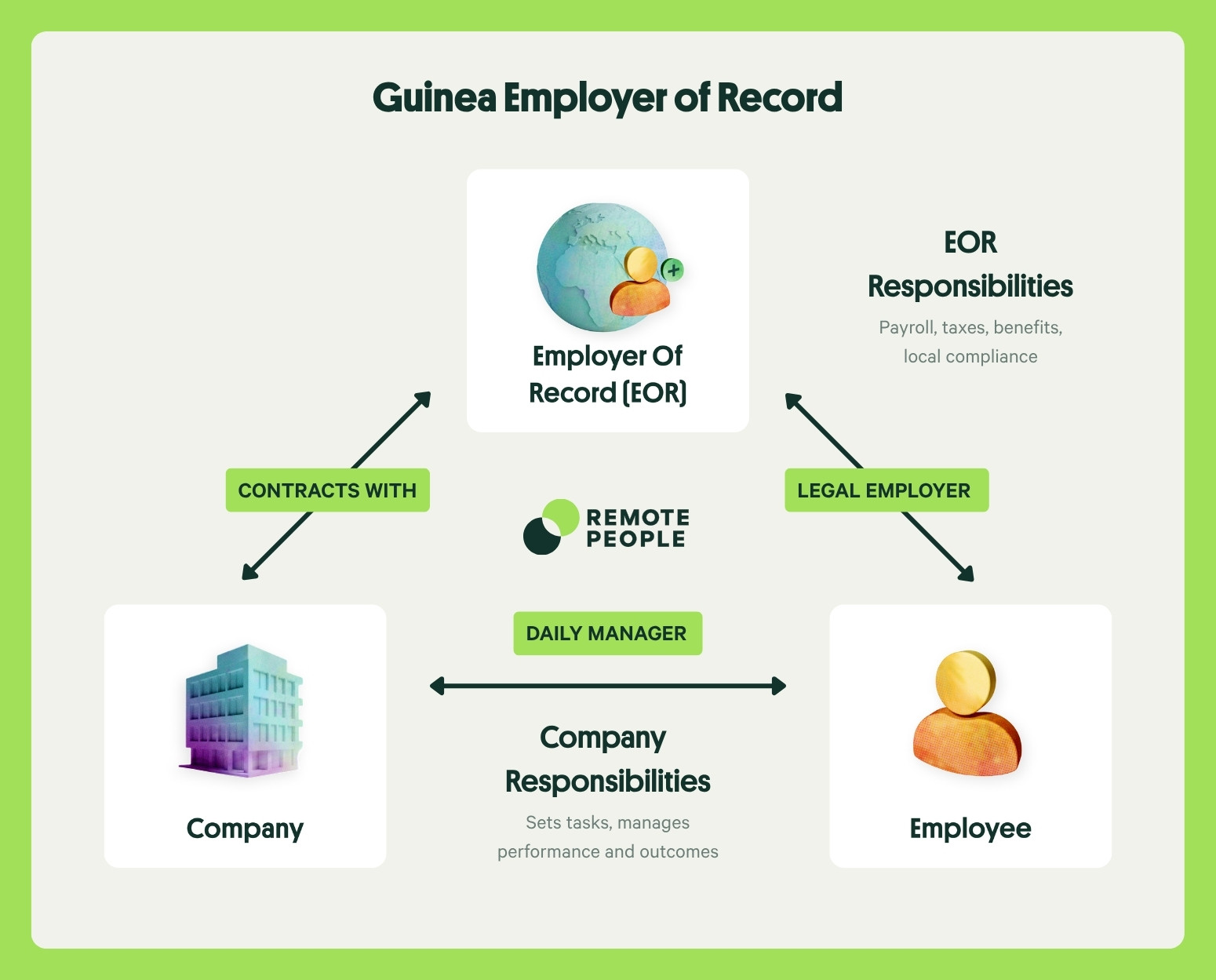
An employer of record (EOR) is a third-party company that becomes the legal employer of your team members in Guinea. It takes on payroll processing, tax withholding, social insurance registration, and compliance with local labor laws.
You still manage the day-to-day work, projects, and performance. The EOR handles the back-office side that would otherwise require you to set up a full subsidiary.
In Guinea specifically, that back-office side is dense. You’d need to register with the CNSS (Caisse Nationale de Sécurité Sociale), comply with the Labour Code (Law No. L/2014/072/CNT), and coordinate work permits through AGUIPE (Agence Guinéenne pour la Promotion de l’Emploi). An EOR takes all of that off your plate.
If you’d like to learn more about how Employer of Record (EOR) services work, read our What Is an Employer of Record (EOR)? guide for a complete overview of the model, its benefits, and when to use it.
If you’re comparing providers, our Best Employer of Record (EOR) Providers guide reviews the leading platforms to help you choose the right solution for your business.
Who Uses an EOR in Guinea?
A few common situations where companies turn to an EOR in Guinea.
- Market testing: You want to hire a small team in West Africa before committing to a full subsidiary. An EOR lets you do that without upfront entity costs, and you can scale up or pull back depending on results.
- Remote team building: You’re assembling a distributed team across multiple countries and need a way to put someone on payroll in Guinea without setting up a local company.
- Fast hiring for key roles: You have a critical position to fill and can’t wait three to six months for entity registration. An EOR gets someone on payroll in one to two weeks.
- Foreign national onboarding: You’re hiring workers who need work permits and statutory benefits. The EOR handles visa sponsorship, AGUIPE registration, and immigration compliance.
Once your Guinea team reaches about 15 employees, the math may shift in favor of a local entity. Until then, an EOR is typically the cheaper and faster option.
Typical Onboarding Timeline
Onboarding through an EOR in Guinea typically takes one to two weeks. You gather the employee’s personal identification, tax registration details, and bank account information.
The EOR drafts the employment contract, registers the employee with the CNSS and tax authority, and configures payroll. If the hire is a foreign national, the EOR also submits the work permit application and schedules the biometric registration appointment (biometric permits have been mandatory since May 2023). Most employees are fully operational and receiving their first paycheck within 10 to 14 business days from document submission.
Hire in Guinea
Low employer costs starting at 23% of gross salary, a growing French-speaking talent pool, and straightforward CNSS registration make Guinea a practical base for West African operations.
We handle employment contracts, payroll, RTS tax withholding, and full Guinea Labour Code compliance.
No local entity needed. Your team can start in days.
Employment Laws and Regulations in Guinea
Two pieces of legislation define most of what employers need to know in Guinea. Labour Code L/2014/072/CNT covers contracts, working hours, leave, termination, and worker protections.
The CNSS social insurance system, established by the Law of 1994, handles mandatory coverage for pensions, disability, medical care, work injury, and family benefits. Whether you’re using an EOR or running your own entity, these are the rules you’re working within.
Employment Contracts
Guinean law requires employment contracts to be in writing and to specify the position, compensation, duration, and key terms. Contracts must be clear about the nature of employment (permanent, fixed-term, or probationary), working hours, remuneration, and termination conditions.
For foreign workers, the contract also needs to reference the specific work permit type. An EOR drafts contracts that meet these standards and includes clauses for intellectual property assignment, confidentiality, and dispute resolution.
Working Hours and Overtime
The standard working week is 40 hours, spread across five days with an eight-hour daily maximum (Article 210). Overtime is capped at 10 hours per day and 48 hours per week without authorization from the labour inspector, and annual overtime can’t exceed 100 hours without that same approval.
Overtime pay is tiered. The first four overtime hours in a week are paid at 130 percent of the normal rate (a 30 percent premium). After that, the rate jumps to 160 percent (60 percent premium).
Night work between 8:00 PM and 6:00 AM adds a 20 percent premium. Sunday work pays 130 to 160 percent depending on total weekly hours, and the employee must also get compensatory rest. Public holiday work pays 160 percent during the day and 200 percent at night.
Guinea overtime and premium pay rates · Per Labour Code L/2014/072/CNT | |||
Hour Type | Rate Multiplier | Weekly/Daily Cap | Notes |
|---|---|---|---|
Regular hours | 100% (base) | 40 hrs/week, 8 hrs/day | Standard compensation |
First 4 overtime hours/week | 130% | 4 hrs maximum | 30% premium |
5+ overtime hours/week | 160% | Beyond 4 hrs | 60% premium |
Night work (20:00–06:00) | 120% | Nightly | 20% premium on any hour |
Weekly rest day (Sunday) | 130% or 160% | Full day | Plus compensatory rest time required |
Public holiday (daytime) | 160% | Full day | Daytime hours 06:00–20:00 |
Public holiday (nighttime) | 200% | Full day | Nighttime hours 20:00–06:00 |
Maximum annual overtime | Varies | 100 hrs/year | Without labour inspector approval; may be exceeded with authorization |
Minimum Wage
Guinea’s minimum wage is 550,000 GNF per month, set by presidential decree and last updated in 2022. It applies to all private sector employees. In practice, most roles filled through an EOR will pay well above this floor, particularly for skilled positions and expatriate hires.
Probation Period
The Labour Code allows probationary periods, but they’re short. Managers and supervisors get up to three months.
Everyone else gets one month. For fixed-term contracts, it’s calculated at one day per week of the contract duration, maxing out at one month. During probation, either side can walk away without notice or severance.
Leave Entitlements
Guinea’s leave entitlements are relatively generous. The baseline is 2.5 working days per month, which adds up to 30 working days per year.
At least 12 of those days must be taken consecutively within the calendar year. The Labour Code also provides protections for health-related and family-related absences beyond this baseline.
Annual Leave
Every employee gets a minimum of 30 working days of paid annual leave per year (2.5 days per month). Unused leave can carry over to the next year if the employer approves, but at least 12 consecutive days must be taken within the calendar year. Leave pay is based on the employee’s average salary over the preceding 12 months.
Sick Leave
Paid sick leave runs up to six months. The employer pays full salary for the first eight days.
From day nine onward, pay drops to 50 percent of average salary, with the CNSS sickness insurance fund picking up the cost. A medical certificate is required for any absence beyond three days, and the employer can request an independent medical examination at the employer’s expense.
Maternity Leave
Maternity leave totals 14 weeks: six weeks before the due date and eight weeks after. It’s fully paid, split 50/50 between the employer and the CNSS.
Multiple births add two extra weeks. After the 14 paid weeks, employees can request an unpaid extension of up to nine months with job protection.
Paternity Leave
There is no statutory paternity leave in Guinea. Some employers offer it as a company benefit, but the Labour Code doesn’t require it.
Other Statutory Leave
Employees get short paid leave for the death of a spouse, child, parent, or sibling, typically one to three days as defined by employer policy. All employees also have the right to one weekly rest day (usually Sunday), though alternative rest days can be arranged by agreement.
Guinea statutory leave entitlements · Per Labour Code L/2014/072/CNT | ||
Leave Type | Duration | Eligibility & Notes |
|---|---|---|
Annual leave | 30 working days/year (2.5 days/month) | All employees; minimum 12 consecutive days/year required; paid at average salary |
Sick leave (paid) | Up to 6 months (first 8 days at 100%, 9+ days at 50%) | Medical certificate required after 3 days; employer + CNSS fund the cost |
Maternity leave (paid) | 14 weeks total (6 prenatal + 8 postnatal); multiple births: +2 weeks | 100% paid (50% employer + 50% CNSS); no loss of employment rights |
Parental leave (unpaid) | Up to 9 months | Optional extension; unpaid; job protection applies |
Paternity leave | Not statutorily required | Discretionary employer benefit; no legal entitlement |
Bereavement leave | Short duration (typically 1–3 days) | Death of spouse, child, parent, or sibling; employer policy defines specifics |
Weekly rest day | 1 day per week (typically Sunday) | All employees; alternative rest days permitted with agreement and rotation |
Statutory Employee Benefits
Beyond leave, the CNSS system funds several mandatory benefits: old-age pensions based on contribution history, disability insurance for workers who can no longer work, survivor benefits for families of deceased workers, sickness and maternity insurance covering medical care, work injury insurance for workplace accidents and occupational diseases, and family allowances including child allowances and cash maternity grants. All employees above the CNSS contribution threshold are automatically enrolled, and employers must pay the statutory contribution rates. The EOR manages these contributions and makes sure employees receive what they’re owed.
Recent Regulatory Updates (2026)
Guinea has been tightening its employment regulations in recent years. Since May 2023, all work permits are issued in biometric format, which has improved verification and reduced fraud.
The Ministry of Technical Education, Vocational Training, Employment and Labor has been pushing harder on Labour Code compliance, particularly around working hours, overtime caps, and safety standards. For 2026, keep an eye on potential adjustments to the CNSS contribution ceiling and any presidential decree changes to the minimum wage. An EOR tracks these developments and updates payroll and compliance practices when the rules change.
Work Permits and Visas in Guinea
Any foreign national working in Guinea needs authorization from AGUIPE (Agence Guinéenne pour la Promotion de l’Emploi). There are two layers to this: the visa (issued by the Ministry of Foreign Affairs) and the work permit (issued by AGUIPE). An EOR handles coordination with both agencies, which takes most of the burden off you and the employee.
Work Permit Requirements
Who Needs a Work Permit
Everyone needs one, whether they’re coming in as an employee, consultant, or manager. This applies to non-ECOWAS nationals and to ECOWAS nationals seeking permanent or long-term employment.
Even holding a valid residence or tourist visa doesn’t authorize work. Working without a permit exposes both the employer and the worker to penalties.
Eligibility and Required Documents
Eligibility depends on the position, the applicant’s qualifications, and whether a Guinean or ECOWAS national could fill the role. The documentation package typically includes a completed application form, passport, valid visa or visa application, CV, job offer letter or employment contract, professional qualification certificates, medical examination results, and a criminal background check. An EOR organizes and submits all of this to AGUIPE on the employee’s behalf.
Processing Time and Validity
Processing takes 5 to 15 business days depending on the visa type and how complete the application is. Permits are valid for 12 months and can be renewed annually. Start the renewal process at least 30 days before expiration to avoid gaps in authorization.
Renewal Process
Renewals are simpler than first-time applications. You typically need a renewal form, proof of continued employment, and an updated health certificate if required. The EOR handles the filing and tracks expiration dates so nothing lapses.
Common Visa Types for Foreign Workers
Guinea has several visa categories for foreign workers. Here is how they break down.
Guinea work visa types for foreign workers · 2026 | ||||
Visa Type | Duration | Best For | Leads to APT? | Processing |
|---|---|---|---|---|
Long-term Work Visa | 12 months, renewable | Permanent positions, expatriate managers, multi-year assignments | Yes, after 2–3 continuous renewals | 10–15 business days |
Short-term Work Visa | 12 months (work window ≤90 days) | Project-based work, consultants, temporary assignments | No | 5–10 business days |
Special Skills Visa | 12 months, renewable | In-demand technical roles, industry experts, specialized positions | Yes, after multiple renewals | 10–15 business days |
ECOWAS Transfer Visa | 12 months, renewable | ECOWAS citizens (West African passport holders) | Requires separate work permit via AGUIPE | 5–10 business days |
Tourist/Visitor Visa | 30–90 days | NOT suitable for work; work permit still required if working | No | 3–5 business days |
AGUIPE charges work permit fees based on position level. Managers (Category A) pay about $3,000 per year.
Supervisors and technical specialists (Category B) pay roughly $2,000. Other skilled workers (Category C) pay around $1,200.
ECOWAS citizens still need a work permit, though fees and processing may differ. Since May 2023, all permits are biometric, which means the employee needs to attend an in-person appointment for biometric data collection.
How an EOR Handles Work Permits
When you hire a foreign national through an EOR, the EOR owns the permit process end to end. They gather the employee’s documentation, submit it to AGUIPE with the job offer letter and qualification proof, follow up with AGUIPE during processing, schedule the biometric appointment, and collect the issued permit.
The permit is then filed with the local labour authority and kept on record. The employee gets regular updates on timelines and next steps throughout.
Payroll, Taxes, and Social Security in Guinea
Payroll in Guinea involves several moving parts: CNSS social contributions from both employer and employee, progressive income tax withholding, and a handful of additional levies that fund apprenticeship and vocational training programs. An EOR calculates, withholds, and remits all of these on schedule.
Employer Contributions
The employer’s CNSS contribution totals 18 percent of covered payroll, capped at a monthly ceiling of about 5,000,000 GNF ($571 USD). That 18 percent breaks down into pensions at 4 percent, sickness and maternity at 4 percent, work injury at 4 percent, and family allowances at 6 percent.
On top of CNSS, employers owe a versement forfaitaire (payroll tax) of 6 percent on total gross salary, an apprenticeship tax of 3 percent, and a vocational training levy (ONFPP) of 1.5 percent. These additional levies have no ceiling and apply to the full salary.
Guinea employer social security contributions · 2026 rates | ||
Contribution | Rate | Notes |
|---|---|---|
CNSS – Pensions (Old Age, Disability, Survivors) | 4% | On covered payroll; capped at 5,000,000 GNF/month |
CNSS – Sickness & Maternity | 4% | On covered payroll; capped at 5,000,000 GNF/month |
CNSS – Work Injury (Accidents du Travail) | 4% | On covered payroll; capped at 5,000,000 GNF/month |
CNSS – Family Allowances (Allocations Familiales) | 6% | On covered payroll; capped at 5,000,000 GNF/month |
Total CNSS Employer | 18% | Combined rate; monthly ceiling 5,000,000 GNF |
Versement Forfaitaire (Payroll Tax) | 6% | On full gross salary; no ceiling |
Apprenticeship Tax (Taxe d’Apprentissage) | 3% | On full gross salary; no ceiling |
ONFPP – Vocational Training Levy | 1.5% | On full gross salary; no ceiling |
Total Employer Payroll Taxes (excluding CNSS) | 10.5% | Combined payroll taxes on full salary |
Employee Contributions
On the employee side, CNSS contributions total 5 percent of gross salary (2.5 percent for pensions, 2.5 percent for sickness and medical), also subject to the 5,000,000 GNF monthly ceiling. These are withheld from the paycheck each period and sent to the CNSS along with the employer’s share.
One important detail: CNSS deductions come off the salary before income tax is calculated. The tax authority taxes what’s left after CNSS, not the full gross.
Guinea employee payroll deductions · 2026 monthly withholdings | ||
Deduction | Rate | Notes |
|---|---|---|
CNSS – Pensions | 2.5% | On gross salary; capped at 5,000,000 GNF/month |
CNSS – Sickness & Medical | 2.5% | On gross salary; capped at 5,000,000 GNF/month |
Total CNSS Employee | 5% | Combined rate; monthly ceiling 5,000,000 GNF; deducted before income tax |
RTS – Income Tax (Retenue sur Traitements) | 0–25% | Progressive; calculated on salary after CNSS deduction |
Income Tax
Income tax for salaried employees in Guinea is called RTS (Retenue sur Traitements et Salaires). It’s calculated monthly using progressive brackets applied to the salary amount after CNSS deductions.
The first 1,400,000 GNF per month (about $160 USD) is tax-free. After that, rates climb from 10 percent up to a top rate of 25 percent on income above 15,000,000 GNF ($1,712 USD). The full bracket schedule is below.
Guinea income tax brackets · 2026 | |
Monthly Bracket | Tax Calculation |
|---|---|
0 – 1,400,000 GNF | 0% |
1,400,001 – 5,000,000 GNF | 10% |
5,000,001 – 10,000,000 GNF | 15% |
10,000,001 – 15,000,000 GNF | 20% |
Above 15,000,000 GNF | 25% |
Payroll Cycle
Payroll runs monthly in Guinea. Salaries are typically paid by the 30th for work done that month.
Some employers offer mid-month advances, but monthly is the standard. An EOR processes payroll on a fixed schedule (usually the 28th or 30th), giving employees predictable pay dates. Tax and social contributions must be remitted within 15 days of the end of the pay month.
13th Month Salary and Bonus Pay
There’s no mandatory 13th month salary or year-end bonus in Guinea. Many employers offer one anyway, either as a discretionary perk or through collective bargaining agreements.
When offered, it’s usually paid in December and calculated as one extra month’s salary or a percentage of annual earnings. Any 13th month or bonus payments are taxed and subject to social contributions the same as regular salary.
Cost of Hiring Through an EOR in Guinea
The total cost of an EOR hire in Guinea has three components: the employee’s gross salary, mandatory employer contributions (CNSS and payroll taxes), and the EOR’s service fee. Here’s how those costs add up in practice.
EOR Service Fees
EOR fees in Guinea typically run $300 to $600 per employee per month. The exact price depends on the provider, the complexity of the role, and what’s included.
Most fees cover payroll processing, tax and contribution calculations, filing, contract management, leave tracking, and compliance support. Some services like benefits enrollment, performance management support, or termination assistance may be priced separately. Ask your EOR provider for a clear breakdown of what’s included before signing.
Total Employment Cost Breakdown
Here’s a worked example using a $1,500 USD monthly gross salary (for context, see average salary benchmarks in Guinea).
Guinea employer cost example · $1,500 gross · 2026 | ||
Employer Cost | Amount (USD) | % of Gross |
|---|---|---|
Gross Salary | $1,500.00 | 100.0% |
CNSS Contributions (18%, capped at ~$571) | $103 | 6.9% |
Versement Forfaitaire (6%) | $90 | 6.0% |
Apprenticeship Tax (3%) | $45 | 3.0% |
ONFPP Training Levy (1.5%) | $23 | 1.5% |
Total Employer Contributions | $261 | 17.4% |
EOR Service Fee (est.) | $450 | 30.0% |
Total Monthly Employer Cost | $2,211 | 147.4% |
So for a $1,500 gross salary, you’re looking at $2,211 per month all in. The employer contributions add about 17.4 percent on top of gross, and the EOR fee adds another 30 percent.
That sounds like a lot until you compare it to the alternative: setting up your own entity costs $10,000 or more upfront, plus $8,000 to $15,000 annually in accounting, compliance, and office costs. For a small team, the EOR math is usually much better.
If you’d rather skip the entity setup and get someone on payroll in Guinea within two weeks, an EOR is the way to go. Talk to a specialist about EOR options for your Guinea hiring needs.
Benefits of Using an EOR in Guinea
Here’s what you get when you hire through an EOR in Guinea instead of going the entity or contractor route.
The EOR keeps everything aligned with the Labour Code, CNSS regulations, tax laws, and work permit rules from day one. You do not need to hire local compliance experts or stay current on regulatory changes yourself.
Employees can be on payroll within one to two weeks, compared to three to six months for entity setup. The EOR runs payroll calculations, withholds income tax, pays CNSS contributions, and files returns each month.
For foreign hires, the EOR manages AGUIPE applications, biometric registration, and annual renewals. Employment contracts are drafted to meet Guinean law, including IP assignment, confidentiality, and termination clauses.
The EOR tracks annual leave, sick leave, maternity leave, and public holidays automatically. It also manages termination, severance calculation, and final settlement if an employee exits.
Termination and Offboarding in Guinea
Ending an employment relationship in Guinea comes with statutory notice periods and severance obligations that you can’t skip. Getting these wrong opens the door to wrongful termination claims, so it’s worth knowing the rules before you need them.
Notice Periods
Notice periods depend on the employee’s role and tenure. Less than one year of service: one week.
Standard employees: two weeks. Supervisors and foremen: one month. Senior and middle managers get three months.
Anyone with five or more years of continuous service gets at least two months. These are employer obligations; employees can often leave with shorter notice or none at all.
During probation, either side can end the relationship immediately. The notice period starts from the date the termination letter is delivered, and the employee is paid through the end of it whether they keep working or are released early.
Guinea statutory notice periods by position level · Per Labour Code L/2014/072/CNT | |||
Position Level | Notice Period | During Probation | Notes |
|---|---|---|---|
Less than 1 year service | 1 week | No notice required | Minimum notice for any tenure |
Standard/Operational Staff | 2 weeks | No notice required | Applies to non-supervisory roles |
Supervisors & Foremen | 1 month | No notice required | For direct supervisory positions |
Senior/Middle Managers | 3 months | No notice required | For executive and management roles |
5+ years of service | 2 months | No notice required | Additional protection for long-tenured employees |
Severance Pay
Unless the employee is terminated for serious misconduct (faute grave), they’re entitled to severance. The calculation is based on years of continuous service and the average monthly salary from the previous 12 months. Years 1 through 5 pay out at 33 percent of average monthly salary per year.
Years 6 through 10 bump up to 35 percent per year. Beyond 10 years, it’s 40 percent per year. Serious misconduct (gross negligence, theft, violence, abandonment of duty) disqualifies the employee from severance entirely. The lump sum is due within 15 days of the employee’s last working day.
Guinea severance pay schedule by years of service · Per Labour Code L/2014/072/CNT | |||
Years of Service | Severance Amount | Base Salary | Notes |
|---|---|---|---|
1 to 5 years | 33% per year | Average monthly salary (last 12 months) | Maximum 165% of average monthly salary (5 years × 33%) |
6 to 10 years | 35% per year | Average monthly salary (last 12 months) | First 5 years: 165% (33% × 5); additional years: 35% each |
10+ years | 40% per year | Average monthly salary (last 12 months) | Calculation includes all service years at applicable rates |
Serious misconduct | No severance | N/A | Faute grave disqualifies severance; notice may be waived |
Calculation Method
Here’s a worked example. An employee with 7 years of service and a $1,500 average monthly salary: the first 5 years at 33 percent each come to 165 percent of average salary ($2,475).
The remaining 2 years at 35 percent each add 70 percent ($1,050). Total severance: $3,525. Incomplete years in the final bracket are prorated to the nearest month.
Caps and Exceptions
There’s no cap on severance in Guinea, so long-tenured employees can accumulate significant obligations for the employer. For misconduct terminations, the employer can terminate without notice and without severance, but the misconduct must be documented and the employee must have a chance to respond.
If the employee challenges the decision, a labour tribunal may review it. An EOR makes sure that misconduct terminations are properly documented and that severance calculations are accurate.
Grounds for Termination
Guinean law recognizes two main grounds for termination. Economic or organizational reasons (business closure, reduced activity, technological change) require notice and severance but don’t need proof of misconduct.
Disciplinary reasons require documented cause, and the employee must have a chance to respond to the allegations. Skip the proper procedures and you risk a wrongful termination claim with damages on top. An EOR handles the documentation and process to keep terminations legally clean.
EOR vs. Other Hiring Models in Guinea
You have three ways to hire in Guinea: through an EOR, by setting up your own legal entity, or by engaging independent contractors. The right choice depends on your team size, timeline, and how long you plan to operate in the country.
Guinea EOR vs local entity comparison · Setup time, cost, risk and best-fit | ||
Comparison | Employer of Record | Own Legal Entity |
|---|---|---|
Setup time | 1–2 weeks | 3–6 months |
Upfront cost | $0 | $5,000–$15,000 |
Ongoing cost | $300–$600 per employee per month | $8,000–$15,000 per year (accounting, compliance, rent, utilities) |
Local partner required | No (EOR is the local entity) | Yes (or full subsidiary governance structure) |
Social insurance registration | Handled by EOR | You manage it (or hire local accountant) |
Payroll and tax filing | Handled by EOR | You manage it (or hire local accountant) |
Best for team size | 1–15 employees | 15+ employees (economies of scale justify fixed costs) |
Scale down or exit | Easy; no entity to unwind | Costly and time-consuming; legal dissolution required |
Government contracts | Not eligible (EOR is foreign entity); limited to private sector | Eligible (local entity can bid and contract with government) |
If you’re hiring fewer than 15 people, the EOR is almost certainly cheaper. Zero setup cost versus $5,000 to $15,000 for entity registration.
Monthly EOR fees of $300 to $600 per employee versus $8,000 to $15,000 per year in entity maintenance (accounting, compliance, rent). You also avoid hiring local accountants and legal counsel. The entity route starts to make financial sense once you pass about 15 employees, or if you need to bid on government contracts.
For a detailed look at EOR pricing and service tiers, compare your projected headcount and salary levels to determine which model fits your budget.
Guinea EOR vs independent contractors · Compliance, cost, and risk | ||
Comparison | EOR (Full-Time Employee) | Independent Contractor |
|---|---|---|
Legal relationship | Employee of the EOR; you manage the work | Self-employed; no employment relationship with you |
Compliance risk | Low; EOR ensures local labour law compliance | High; misclassification risk if relationship resembles employment |
Payroll and tax | EOR withholds taxes and contributions; handles filings | Contractor invoices you; they handle their own taxes |
Benefits and leave | Statutory benefits, paid leave, CNSS coverage | No entitlement to employee benefits or paid leave |
IP protection | Stronger; employment contract assigns IP by default | Weaker; requires explicit IP assignment clause |
Termination | Subject to notice periods and severance (Labour Code) | Contract can be ended per agreement terms (more flexible) |
Best for | Long-term, core team roles; permanent positions | Short-term projects, specialized tasks, one-off work |
Cost structure | Salary + employer contributions + EOR fee | Contractor fee (typically higher gross, lower total cost) |
Misclassification is a real risk in Guinea. If a contractor works fixed hours, uses company equipment, depends on a single client, and takes ongoing direction from you, labour authorities can reclassify them as an employee.
That means back-payment of all statutory benefits, CNSS contributions, income tax, and penalties. For ongoing, dedicated roles, an EOR is safer. For genuinely short-term, project-based work with independent professionals, contractor engagement through a compliant framework works fine.
RemotePeople offers both employer of record and contractor management services, allowing you to choose the right model for each hire.
EOR vs. PEO (Professional Employer Organization)
People sometimes use EOR and PEO interchangeably, but they’re different models. An EOR is the legal employer.
A PEO is a co-employer. That distinction matters.
Guinea EOR vs PEO comparison · Legal employer, liability, and setup | ||
Comparison | Employer of Record (EOR) | PEO (Professional Employer Organization) |
|---|---|---|
Legal employer | EOR is the legal employer | You remain the legal employer (co-employment) |
Local entity required | No; EOR is the local entity | Yes; you must have your own entity in Guinea |
Best for | Companies without a local entity; market entry | Companies that already have a local entity |
Compliance liability | EOR assumes compliance responsibility | Shared liability between you and the PEO |
Setup time | 1–2 weeks | Weeks to months (depends on your entity setup) |
Control over HR policies | EOR manages within local law framework | More direct control; PEO advises and ensures compliance |
Typical use case | Market entry, small remote teams, testing new markets | Established local operations needing HR outsourcing |
Source: RemotePeople EOR Solutions and Invest.gov.gn Labour Code | ||
Guinea doesn’t have a formal PEO regulatory framework. PEO services that do exist operate under the general provisions of the Labour Code and CNSS rules. Since PEOs require you to already have a local entity, they’re only relevant for companies that have already incorporated in Guinea.
The bottom line: with an EOR, the EOR is the legal employer and takes on full compliance responsibility. With a PEO, you stay the legal employer and share compliance with the PEO. If you don’t already have an entity in Guinea, the EOR is your only option for compliant employment.
Public Holidays in Guinea
Guinea has 12 public holidays in 2026. Most businesses close on these days, and employees who do work are entitled to premium pay: 160 percent for daytime hours and 200 percent for nighttime.
A few holidays follow the Islamic lunar calendar (Eid al-Fitr, Eid al-Adha, Mawlid al-Nabi), so exact dates can shift by a day or two. Confirm specific dates as the year approaches.
Guinea public holidays · 2026 calendar year | ||
Date | Holiday | Type |
|---|---|---|
January 1 | New Year’s Day | Fixed |
March 20 | Eid al-Fitr | Movable (Islamic calendar) |
April 3 | Second Republic Day (Founding of the Second Republic) | Fixed |
April 6 | Easter Monday | Movable (Christian calendar) |
May 1 | Labour Day (International Workers’ Day) | Fixed |
May 25 | Africa Day | Fixed |
May 27 | Eid al-Adha | Movable (Islamic calendar) |
August 15 | Assumption of Mary | Fixed |
August 25 | Mawlid al-Nabi (Prophet Muhammad’s Birthday) | Movable (Islamic calendar) |
October 2 | Independence Day | Fixed |
November 1 | All Saints’ Day | Fixed |
December 25 | Christmas Day | Fixed |
How to Get Started with an EOR in Guinea
Getting started with an EOR in Guinea follows a clear sequence.
- Define the role: Clarify the job title, primary responsibilities, required skills and experience, expected salary range, and start date. If the hire is a foreign national, determine whether they will require visa sponsorship.
- Gather employee information: Collect the candidate’s full name, date of birth, nationality, passport or national ID number, home address, phone number, email, banking details (for direct deposit), and tax identification number (if applicable). For foreign nationals, confirm their passport validity and visa eligibility.
- Prepare the employment contract: Work with the EOR to prepare an employment contract that specifies the position, salary, benefits, working hours, probation period (if any), leave entitlements, and termination conditions. The contract must comply with the Labour Code and be executed by both you and the employee.
- Submit work permit application (if needed): If the employee is a foreign national, provide the EOR with all required documentation (passport, visa application materials, job offer letter, CV, qualification certificates, health examination results, background check). The EOR submits the work permit application to AGUIPE and coordinates the biometric registration appointment.
- Configure payroll and benefits: Provide the EOR with the employee’s salary, any bonus structure, benefits elections (if options are available), and banking information. The EOR sets up the payroll system and ensures that the first salary is paid on schedule.
Ready to hire in Guinea? Contact RemotePeople to get a proposal tailored to your team size and hiring timeline. We handle contracts, payroll setup, CNSS registration, and work permits so your new employee can start contributing from day one.
Where companies hiring in Guinea expand next
Companies building West African operations commonly expand across the ECOWAS bloc and neighboring Francophone and Anglophone markets. Teams frequently add Ivory Coast for shared West African labor and language overlap; a team in Cameroon often follows for aligned West African hiring norms; operations in Nigeria is a common next step, offering the regional West African talent footprint; and Ghana rounds out the regional footprint with overlapping West African workforce dynamics.
Frequently Asked Questions
About one to two weeks from the time you submit the employee’s information and signed contract. If the hire is a foreign national who needs a work permit, add another 5 to 10 business days for AGUIPE processing and biometric registration. Once approvals come through, the employee can start work and receive their first paycheck within the same pay cycle.
The EOR manages leave processing. For sick leave, the employee provides a medical certificate after three days, and the EOR coordinates with the CNSS to cover costs beyond the first eight days. For maternity leave, the EOR makes sure the employee receives the full 14 weeks of paid leave (split 50/50 between employer and CNSS) and that her job is protected when she returns. Leave balances are tracked automatically.
Gross salary plus about 17 to 18 percent in employer payroll contributions (CNSS and taxes) plus the EOR fee ($300 to $600 per employee per month). For a $1,500 gross salary, expect around $2,210 per month total. That’s less than setting up your own entity ($10,000+ upfront, $8,000 to $15,000 per year in maintenance), and you can be operational in weeks rather than months.
Generally no. Guinea’s government procurement requires contractors to be local entities, and an EOR employee works for the EOR (a foreign entity). If government contracts are a strategic priority, you’ll need your own local entity. For private sector work, an EOR is fine.
The EOR manages the full termination process. For economic or performance-based terminations, you’ll owe notice (one week to three months depending on role and tenure) and severance (33 to 40 percent of average monthly salary per year of service). For serious misconduct, notice can be waived and severance isn’t owed, but the misconduct must be documented. The EOR calculates severance, processes the final payment, and handles all filings with the labour authority.
An EOR monitors regulatory changes and adjusts policies as laws evolve. If CNSS rates change, the minimum wage goes up, or overtime rules are updated, the EOR implements those changes and lets you know how your payroll is affected. You don’t have to track Guinean regulatory developments yourself.
You can, but it’s not the typical use case. An EOR employs workers through its own entity, not yours. If you already have a local entity and just want to outsource HR and payroll, a PEO (which co-employs workers under your entity) may be a better fit. An EOR is designed for companies that don’t have their own entity in Guinea.
Most roles are fine: administrative, technical, sales, marketing, management, and professional positions. Some regulated professions (law, medicine, architecture) require local licensing that the individual employee must hold. Government roles and security-sensitive positions may also require local hiring. Check with your EOR provider if you’re unsure about a specific role.
Employer of Record in
Employer of Record in
Employer of Record in
Employer of Record in
Employer of Record in
Employer of Record in
Employer of Record in
Employer of Record in