
 Recruit
Employer of Record (EOR) in Guinea-Bissau
-
 Drew Donnelly
- Published
- September 21, 2026
RemotePeople’s employer of record in Guinea-Bissau lets you hire employees in Guinea-Bissau with local compliance. We handle 7% social security fund contributions, 2% vocational training fund fees, and INSS registration.
Hire in Guinea-Bissau — book a free 30-minute demo
Tell us what you need. You'll get a tailored, transparent proposal within 24 hours, plus a free call to walk through it.
Tell us about your company
So we can match you with a specialist who knows your market — and unlock volume pricing tiers.
* All fields are required.
Where and when are you hiring?
Tell us the geography and timing and we'll quote each country line by line, with onboarding timelines.
* All fields are required.
Help us beat your current setup
We'll benchmark your current deal and send a line-by-line proposal in 24 hours — showing exactly where we cut cost, time, or risk. After you submit, you can book a call to walk through it together.
* All fields are required.
Thanks! Your proposal is on its way.
Expect a tailored, line-by-line proposal in your inbox within 24 hours. In the meantime…
Want to walk through it together?
Book a free 30-minute call with one of our specialists. We'll explain every line, answer your questions, and tailor the proposal further if you need.
No obligation. Pick a time that works for you.








- Hire in Guinea-Bissau — book a free 30-minute demo
- Tell us about your company
- Where and when are you hiring?
- Help us beat your current setup
- Thanks! Your proposal is on its way.
- How an Employer of Record Works in Guinea-Bissau
- Employment Laws and Regulations in Guinea-Bissau
- Work Permits and Visas in Guinea-Bissau
- Payroll, Taxes, and Social Security in Guinea-Bissau
- Cost of Hiring Through an EOR in Guinea-Bissau
- Benefits of Using an EOR in Guinea-Bissau
- Termination and Offboarding in Guinea-Bissau
- EOR vs. Other Hiring Models in Guinea-Bissau
- Public Holidays in Guinea-Bissau
- How to Get Started with an EOR in Guinea-Bissau
- Where companies hiring in Guinea Bissau expand next
- Frequently Asked Questions
- Related EOR Destinations

Start hiring in Guinea-Bissau
Let RemotePeople handle payroll, compliance, and HR admin worldwide so you can focus on building your team.

Guinea-Bissau offers businesses a growing market in West Africa with a young, multilingual workforce. For companies looking to hire employees in Guinea-Bissau, the challenges of navigating unfamiliar labour laws, tax compliance, and social security registration can delay expansion plans. An employer of record in Guinea-Bissau (often called an EOR or EoR) takes on these responsibilities, letting businesses hire and manage employees without setting up a local company. This guide covers everything you need to know about using an EOR to build your team in Guinea-Bissau.
How an Employer of Record Works in Guinea-Bissau
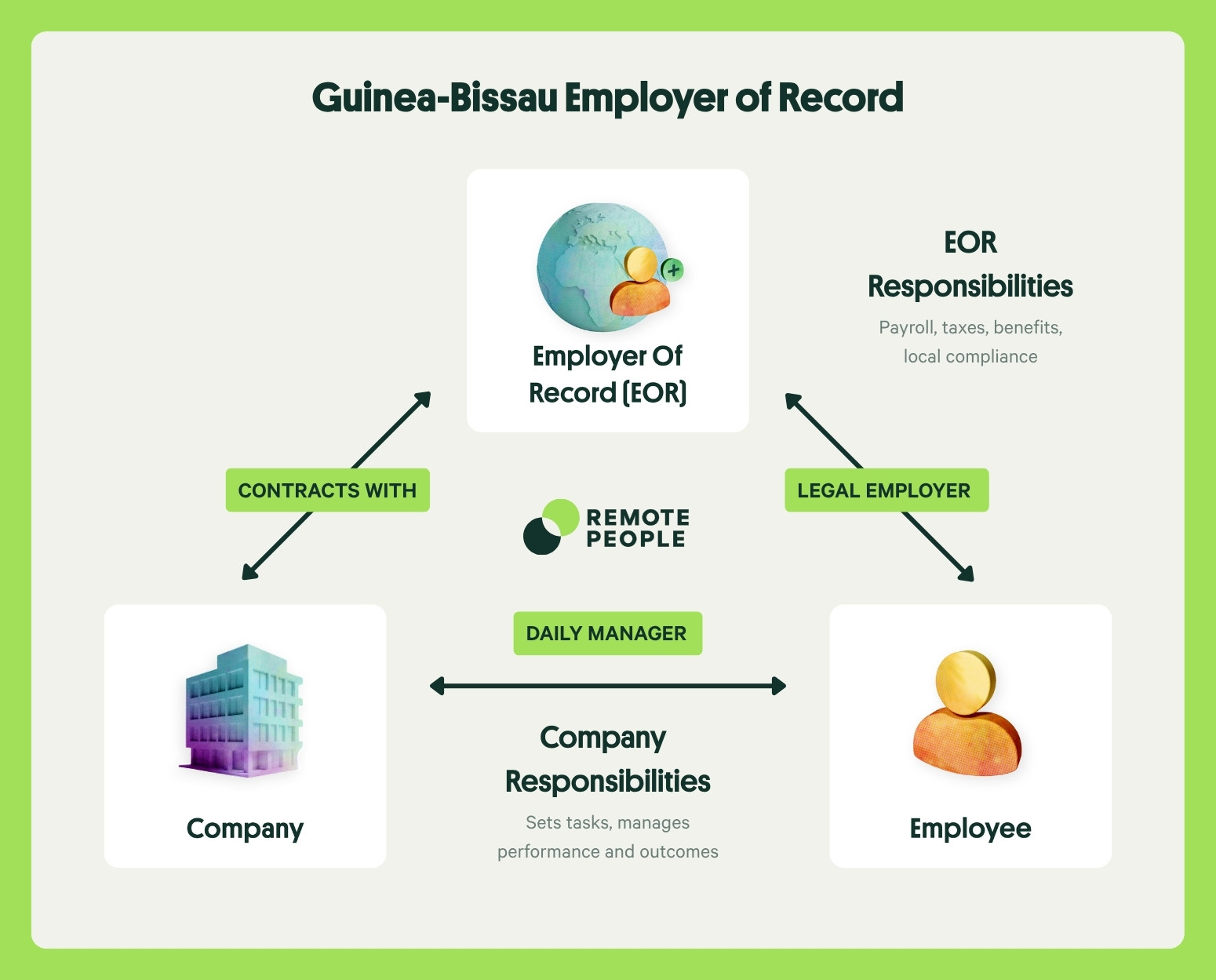
If you’d like to learn more about how Employer of Record (EOR) services work, read our What Is an Employer of Record (EOR)? guide for a complete overview of the model, its benefits, and when to use it.
If you’re comparing providers, our Best Employer of Record (EOR) Providers guide reviews the leading platforms to help you choose the right solution for your business.
Who Uses an EOR in Guinea-Bissau?
Companies at various stages use EOR services in Guinea-Bissau for different reasons:
- Early-stage startups: New companies testing a market without the expense of a full legal entity, hiring 1-5 employees quickly.
- Expanding remote-first teams: Organizations with distributed workforces adding Guinea-Bissau-based talent alongside remote contractors.
- Specialized hiring: Companies recruiting for technical, healthcare, or professional roles where finding local expertise is challenging.
- Market entry: Foreign firms entering Guinea-Bissau for the first time who need local employment infrastructure without long-term commitment.
Typical Onboarding Timeline
The EOR onboarding process in Guinea-Bissau typically follows this timeline:
- Days 1–2: Complete initial intake forms, provide employee information, and confirm salary structure.
- Days 3–5: EOR prepares employment contracts, tax documentation, and INSS registration applications.
- Days 6–8: Government submissions are filed; background checks and compliance reviews occur.
- Days 9–14: INSS confirms registration, final payroll setup is completed, and the first payment is scheduled.
Hire in Guinea-Bissau
A Portuguese-speaking West African nation with INSS contributions and Bissau-Guinean labour compliance requirements.
We handle employment contracts, payroll, social contributions, and full Guinea-Bissau compliance.
No local entity needed. Your team can start in days.
Employment Laws and Regulations in Guinea-Bissau
Employment Contracts
Guinea-Bissau employment law requires all employment relationships to be documented in writing. The governing statute is the Lei Geral do Trabalho (Lei n.º 2/86 de 5 de Abril), the General Labour Code. Contracts must specify the job title, duties, compensation, benefits, and employment type (fixed-term or permanent). Portuguese is the official language, so all contracts must be written in Portuguese to be enforceable. Employment contracts should also cover notice periods, termination grounds, confidentiality, and any non-compete clauses where applicable. The EOR ensures all contracts comply with the Labour Code and keeps copies for audit purposes.
Working Hours and Overtime
Guinea-Bissau law sets a maximum working week of 45 hours, typically spread across 8 hours per day. Employees get at least one day off per week. Overtime is allowed but must be paid at higher rates. The table below outlines standard overtime pay:
Guinea-Bissau overtime and premium pay rates · Per Lei Geral do Trabalho | |||
Hour Type | Rate Multiplier | Weekly/Daily Cap | Notes |
|---|---|---|---|
Weekday overtime | 1.5x hourly rate | Max 2 extra hours/day | Applies beyond the standard 8-hour workday |
Weekly rest day work | 2x daily rate | Full day | Compensatory rest day required within the following week |
Public holiday work | 2x daily rate | Full day | Applies to all 10 statutory public holidays |
Night work (22:00–06:00) | 1.25x hourly rate | 8 hours maximum | Cumulative with overtime if applicable |
Source: Lei Geral do Trabalho and ILO NORMLEX | |||
Minimum Wage
The statutory minimum wage in Guinea-Bissau is XOF 59,000 per month, roughly $98 USD. This rate hasn’t changed since January 2015. All employers must pay at least this amount for a standard 45-hour work week. For part-time workers, the minimum wage is calculated proportionally based on hours worked. An EOR makes sure all salaries meet or exceed this threshold and adjusts pay if new laws require it.
Probation Period
Guinea-Bissau labour law allows a probation period for both employer and employee to assess the working relationship. For permanent positions, probation usually lasts 1-2 months, though it can extend to 3 months for managerial or highly specialized roles. During probation, either party can end the employment with minimal notice, typically 24 hours. Once probation ends, the employee moves to a permanent contract with full statutory protections. Fixed-term contracts don’t usually have a formal probation phase; the short initial duration serves that evaluation purpose.
Leave Entitlements
Guinea-Bissau law provides leave entitlements for annual, sick, maternity, paternity, and bereavement absences. These balance worker needs with business operations. Here’s a breakdown of each leave type:
Annual Leave
Employees get 22 working days of annual leave after one year of service. During the first year, leave builds up monthly. Leave must be taken in the calendar year it accrues unless the employer and employee agree differently. Unused leave is typically lost at year-end, though some employers allow carryover in special cases. Annual leave is paid at the employee’s regular rate.
Sick Leave
Employees get 100% of earnings during sick leave for up to 960 days, paid by INSS social security. For absences covered by INSS, the employer doesn’t pay directly; INSS provides sickness benefits. A medical certificate is needed for absences of more than three consecutive days. Short absences of 1-3 days are usually paid by the employer and reimbursed through social security later.
Maternity Leave
Female employees get 60 days of maternity leave at 100% of regular pay, paid by the employer. At least 30 days must be after childbirth. The leave can be taken as one continuous block or split between pre- and post-birth periods. During maternity leave, the job is protected; the employer cannot fire the worker or cut benefits. Health insurance and other statutory benefits continue.
Paternity Leave
Paternity leave in Guinea-Bissau isn’t clearly defined in the Labour Code. Some sources mention a customary practice of 1-5 days after a child is born, though it’s not a legal requirement. Employers and employees often work out paternity arrangements individually. Labour reform discussions may eventually formalize these rights. An EOR advises on current practices and any changes affecting paternity.
Other Statutory Leave
Other leave includes 3 days for marriage, 3 days for bereavement, and all 10 public holidays paid in full. Some employers offer extra compassionate leave for family emergencies. If an employee works on a public holiday, they get double pay.
Guinea-Bissau statutory leave entitlements · Per Lei Geral do Trabalho | ||
Leave Type | Duration | Eligibility & Notes |
|---|---|---|
Annual leave | 22 working days | After 1 year of service; paid at 100% by employer; accrues monthly during first year |
Sick leave | Up to 960 days | 100% of earnings funded by INSS; medical certificate required after 3 days |
Maternity leave | 60 days | 100% pay by employer; minimum 30 days must be taken after childbirth |
Paternity leave | 1–5 days (customary) | Not codified in primary Labour Code; commonly granted by employers |
Bereavement leave | 3 days | Paid by employer; for death of immediate family member |
Marriage leave | 3 days | Paid by employer; taken around date of marriage ceremony |
Public holidays | 10 days per year | Paid day off; 2x pay if employee is required to work on the holiday |
Source: Lei Geral do Trabalho and SSA Guinea-Bissau | ||
Statutory Employee Benefits
Guinea-Bissau law requires several statutory benefits beyond leave. All employees in INSS get coverage for old-age pensions, disability, survivor benefits, sickness support, and workplace injury protection. Employers contribute 14% of gross monthly payroll to INSS for core social insurance. There’s also a work injury insurance contribution of 2%-10%, depending on sector and risk level; most office roles sit at 2%. Employees contribute 8% of gross earnings to INSS. There’s no earnings ceiling, so high earners pay the same percentage as others. Health insurance, when provided, usually comes from INSS contributions and covers outpatient care, hospitalization, and prescriptions.
Recent Regulatory Updates (2026)
Guinea-Bissau hasn’t made major labour law changes in 2025–2026 according to the World Bank Women, Business and the Law 2024 report. However, Guinea-Bissau ratified the International Labour Organization Maritime Labour Convention in June 2024, effective June 2025, which improves protections for seafaring workers. This affects employers in maritime and fishing. Based on current government guidance, no changes to minimum wage, income tax brackets, or social security rates are expected in 2026. Monitor official labour ministry announcements for updates.
Work Permits and Visas in Guinea-Bissau
Work Permit Requirements
Who Needs a Work Permit
Any foreign national who wants to work in Guinea-Bissau must get a work permit. This includes long-term employees and short-term contractors. Guinea-Bissau citizens and permanent residents can work without extra documents. A work permit is different from a visa; a tourist visa lets you enter but doesn’t let you work. All foreign workers need both valid travel documents and work authorization.
Eligibility and Required Documents
To get a work permit, the employer (or EOR) must apply to the Ministry of Labour and Public Service. You’ll typically need a letter from the employer describing the job and duration, the employee’s resume, proof of qualifications or credentials, a copy of the employment contract, and a medical certificate. The employer must show that no qualified local candidate can fill the role. Processing usually takes 2-4 weeks, though it can take longer during holidays or if more documents are needed.
Processing Time and Validity
Work permits are issued for a specific length matching the employment contract. Short-term permits cover stays up to 90 days, while long-term permits cover contracts over 3 months. Both are tied to the employer named in the application; the worker can’t switch employers without a new permit. Permits usually last 1-2 years, then need renewal.
Renewal Process
Renewal must start 30-60 days before the permit expires. The process is similar to the initial application but usually moves faster if the worker stays with the same employer and nothing major has changed. An EOR handles the full timeline, tracks expiration dates, and submits renewal papers on time to avoid work disruptions.
Common Visa Types for Foreign Workers
Guinea-Bissau offers several visa options for foreign workers depending on the intended stay duration and professional background:
Guinea-Bissau work visa types for foreign workers · 2026 | ||||
Visa Type | Duration | Best For | Leads to Residency? | Processing |
|---|---|---|---|---|
Short-term work visa | Up to 90 days | Temporary projects, business trips | No | 1–2 weeks |
Long-term work visa | 1–2 years | Full-time employment contracts | Yes | 2–4 weeks |
Specialized professional visa | 1–3 years | Healthcare, IT, technical roles | Yes | 3–6 weeks |
Business/investor visa | 1–2 years | Business owners, entrepreneurs | Yes | 4–8 weeks |
Source: Lei Geral do Trabalho and ILO NORMLEX | ||||
How an EOR Handles Work Permits
An EOR in Guinea-Bissau handles work permits from start to finish. After hiring, the EOR gathers employee documents and submits the full application to the Ministry of Labour. The EOR stays in touch with government authorities, tracks permit status, and updates you on approval or additional needs. For renewals, the EOR starts the process on time, ensuring no gap in work authorization. This cuts compliance risk and lets you focus on your business instead of administrative paperwork.
Payroll, Taxes, and Social Security in Guinea-Bissau
Employer Contributions
Employers in Guinea-Bissau bear several statutory contribution obligations beyond base salary:
Guinea-Bissau employer social security contributions · 2026 rates | ||
Contribution | Rate | Notes |
|---|---|---|
INSS social security | 14.0% | Old-age, disability, survivor, sickness, medical |
Work injury insurance | 2.0% | Occupational injury and disability (baseline) |
Total employer contribution | 16.0% | Combined mandatory payroll cost |
Source: SSA Guinea-Bissau and ISSA profile | ||
Employee Contributions
Employees in Guinea-Bissau are responsible for their own social security contributions:
Guinea-Bissau employee payroll deductions · 2026 monthly withholdings | ||
Deduction | Rate | Notes |
|---|---|---|
INSS social security (employee) | 8.0% | Pension, sickness, survivor benefits |
Income tax (IRPS) | 8%–25% (progressive) | National income tax (varies by bracket) |
Total employee deduction | 16%–33% | Combined employee obligation |
Source: SSA Guinea-Bissau and Generisonline tax | ||
Income Tax
Guinea-Bissau imposes income tax (IRPS – Imposto sobre o Rendimento de Pessoas Singulares) on all resident employees. The tax is progressive and calculated on an annual basis, with four income brackets ranging from 8% to 25%:
Guinea-Bissau income tax brackets · 2026 | |
Bracket | Tax Calculation |
|---|---|
Up to XOF 3,000,000 | 8% |
XOF 3,000,001 – 5,000,000 | 15% |
XOF 5,000,001 – 10,000,000 | 20% |
Above XOF 10,000,000 | 25% |
Source: Generisonline tax and ICAEW Guinea-Bissau | |
An EOR calculates income tax withholding for each pay period based on the employee’s yearly salary and expected tax bracket. The EOR sends withheld taxes to the tax authority and gives employees yearly tax statements. There’s no earnings ceiling for social security or income tax; high earners pay the full percentage for their bracket.
Payroll Cycle
Most employers in Guinea-Bissau use monthly payroll, with salaries paid by the last day of the month or first business day of the next. Some larger employers offer bi-weekly payroll for manual workers. An EOR works with your preferred payroll schedule and ensures withholdings are accurate, contributions are registered, and payments go out on time. The EOR also keeps payroll records for audits and compliance.
13th Month Salary and Bonus Pay
Guinea-Bissau doesn’t legally require a 13th month salary (Christmas bonus). But many employers give customary bonuses of 10-15 days’ salary around national holidays, especially Independence Day in September and Christmas in December. These aren’t required by law but are increasingly expected by employees. An EOR can handle bonus payments and track them separately from regular pay. Document any bonus in the employment contract or bonus policy to set clear expectations.
Cost of Hiring Through an EOR in Guinea-Bissau
EOR Service Fees
EOR service fees in Guinea-Bissau usually range from $300 to $600 USD per employee per month, depending on the provider and your employment needs. Some charge flat rates, others use a percentage model (typically 20-30% of salary). Team size affects pricing (larger teams get discounts), along with the type of work (specialized roles may cost more) and extras like HR consulting or visa support. When comparing providers, make sure statutory contributions, payroll, and government compliance are all included in the fee.
Total Employment Cost Breakdown
To illustrate the complete cost of hiring an employee in Guinea-Bissau through an EOR, consider this example using a gross monthly salary of $1,500 USD:
Guinea-Bissau employer cost example · $1,500 gross · 2026 | ||
Employer Cost | Amount (USD) | % of gross salary |
|---|---|---|
Employee gross salary | $1,500.00 | 100.0% |
INSS employer contribution (14%) | $210.00 | 14.0% |
Work injury insurance (2%) | $30.00 | 2.0% |
EOR service fee (30% model) | $450.00 | 30.0% |
Total employer monthly cost | $2,190.00 | 146.0% |
Source: SSA Guinea-Bissau and ISSA country profile | ||
In this example, your total monthly cost is $2,190, or 146% of the employee’s gross salary. The employee takes home about $1,170 after income tax and social security deductions (assuming the lowest tax bracket). For one employee yearly, the cost is around $26,280 USD. For five employees at similar pay, annual costs are roughly $131,400 USD. An EOR handles monthly invoicing, making budgeting simple and predictable.
Ready to expand your team in Guinea-Bissau? Contact RemotePeople to discuss pricing tailored to your hiring plan and get a custom quote.
Benefits of Using an EOR in Guinea-Bissau
An EOR offers real advantages when hiring in Guinea-Bissau. Beyond compliance and administrative relief, an EOR lets you enter the market fast, cuts legal risk, and scales without a local office. Here are the main benefits:
- Instant local employment setup: Start hiring in 1-2 weeks instead of waiting 3-6 months for a local company. You can respond to market moves and snap up talent before competitors.
- No entity setup costs: Skip the $5,000-$15,000 cost and paperwork of registering a business in Guinea-Bissau. The EOR is your legal employer, so you avoid upfront spending and ongoing governance headaches.
- Full compliance: The EOR handles contracts, tax withholding, social security, government reports, and labour law. You stay clear of regulatory violations and penalties.
- Predictable monthly costs: All-in monthly fees mean no budget surprises. No hidden tax bills, legal fees, or compliance costs; the EOR takes the risk and gives you transparent, flat pricing.
- Payroll and benefits handled: The EOR runs payroll on your schedule, calculates deductions, manages benefits, and pays employees. No payroll hassles or mistakes.
- Easy scaling and exit: Hire or fire employees without admin hassle. If your Guinea-Bissau plans change, just stop using the EOR; no company dissolution needed.
- Local expertise and language support: An EOR team that knows Guinea-Bissau labour law, Portuguese contracts, and local customs aligns your policies with local norms and cuts disputes.
Whether you’re a startup testing the market or a large company expanding globally, an EOR removes hiring barriers in Guinea-Bissau and frees you to build your business instead of handling employment paperwork.
Termination and Offboarding in Guinea-Bissau
Notice Periods
Guinea-Bissau law sets different notice periods based on the employee’s role and time with the company. Notice periods give both sides time to prepare for the split. Here’s the statutory framework:
Guinea-Bissau statutory notice periods by position level · Per Lei Geral do Trabalho | |||
Position Level | Notice Period | During Probation | Notes |
|---|---|---|---|
Manual worker, <1 year | 8 calendar days | 24 hours (or 7 days if >60 days served) | Applies to hourly and daily-rate workers |
Manual worker, 1–5 years | 15 calendar days | N/A (probation complete) | Notice reciprocal for employer and employee |
Manual worker, 5+ years | 30 calendar days | N/A | Long-service protection |
Non-manual worker, <1 year | 15 calendar days | 24 hours (or 7 days if >60 days served) | Applies to salaried and office-based roles |
Non-manual worker, 1–5 years | 30 calendar days | N/A | Notice reciprocal for employer and employee |
Non-manual worker, 5+ years | 60 calendar days | N/A | Highest tier of statutory notice |
Source: Lei Geral do Trabalho and ILO NORMLEX | |||
During notice, the employment continues as normal. The employee keeps working and the employer pays full wages. Breaking notice periods can mean liability for damages. An EOR makes sure notice is in writing, the legal period is followed, and all obligations are met through the final date.
Severance Pay
Severance pay is required in Guinea-Bissau for permanent employees fired without cause. The law sets severance based on years of service and employee type. Fixed-term employees whose contracts end usually don’t get severance. Here are the statutory guidelines:
Calculation Method
Severance is calculated as days’ wages per year of service. For permanent employees, severance ranges from 15 to 30 days’ wages per year, depending on position and length of service. Manual workers typically get 15 days per year, while office and supervisory staff may get up to 30 days per year. Severance is based on the final daily wage (monthly salary divided by 22 working days).
Caps and Exceptions
The Labour Code doesn’t set a maximum severance cap, so obligations can build up for long-service workers. But severance isn’t due if the employee quits, resigns during probation, or is fired for gross misconduct (theft, violence, breach of duty). Dismissals must have real cause and be documented; random firings can be challenged in court and may result in reinstatement or damages.
Guinea-Bissau severance pay schedule by years of service · Per Lei Geral do Trabalho | |||
Years of Service | Severance Amount | Base Salary | Notes |
|---|---|---|---|
1 year | $1,023 (15 days × $68.18/day) | $1,500/month gross ÷ 22 = $68.18/day | Manual worker at 15 days per year of service |
3 years | $3,068 (45 days × $68.18/day) | $1,500/month gross ÷ 22 = $68.18/day | Manual worker at 15 days per year of service |
5 years | $17,045 (150 days × $113.64/day) | $2,500/month gross ÷ 22 = $113.64/day | Non-manual worker at 30 days per year of service |
10 years | $34,091 (300 days × $113.64/day) | $2,500/month gross ÷ 22 = $113.64/day | Non-manual worker at 30 days per year of service |
Source: Lei Geral do Trabalho and ILO NORMLEX | |||
Grounds for Termination
An employer can fire someone for legitimate cause, like documented poor performance, policy violations, insubordination, unmet qualifications, or gross misconduct (theft, violence, breach of confidentiality). The reason must be in the Labour Code or employment contract; random firings are illegal. Before firing, give a written warning (except for gross misconduct) and a fair chance to improve or respond. An EOR follows proper legal steps, makes sure records are complete, calculates severance right, and settles final pay and benefits. Bad terminations can lead to wrongful dismissal claims.
EOR vs. Other Hiring Models in Guinea-Bissau
EOR vs. Setting Up a Local Entity
Setting up your own local company in Guinea-Bissau is an alternative to an EOR, but it takes much more time, money, and management. The table below compares the two:
Guinea-Bissau EOR vs local entity comparison · Setup time, cost, risk and best-fit | ||
Comparison | Employer of Record | Own Entity |
|---|---|---|
Setup time | 1–2 weeks | 3–6 months |
Upfront cost | $0 | $5,000–$15,000 |
Ongoing monthly cost (1 employee) | $450–$600 | $800–$1,200 (maintenance + HR) |
Local partner required | No (EOR is the local entity) | Yes (local director/shareholder) |
Social insurance registration | Handled by EOR | Your company manages it |
Payroll & tax filing | Handled by EOR | Your company (or outsourced) |
Best for team size | 1–15 employees | 15+ employees (cost efficiency) |
Scale down or exit | Easy, no entity to unwind | Costly, legal dissolution required |
Government contracts | Not eligible (EOR employment) | Eligible (local registered entity) |
Source: RemotePeople EOR and World Bank Doing Business | ||
For most startups and small teams, an EOR is the best choice. It lets you test the Guinea-Bissau market, hire talent, and grow without the cost and legal hassle of setting up a company. If you grow past 15 employees and need long-term presence or government contracts, moving to a local entity makes sense. An EOR can help with the handover to your own company when you’re ready.
A local entity also means corporate governance: keeping a local director, filing yearly accounts, meeting regulations. An EOR cuts out all these ongoing tasks, so you can focus on growing.
EOR vs. Hiring Independent Contractors
Some companies hire independent contractors to skip employment duties. But this approach carries big legal and financial risks in Guinea-Bissau. The comparison below shows the key differences:
Guinea-Bissau EOR vs independent contractors · Compliance, cost, and risk | ||
Comparison | EOR (Full-Time Employee) | Independent Contractor |
|---|---|---|
Legal employment status | Employee with full statutory rights | Self-employed, limited protections |
Social security obligations | Employer pays 14% INSS, 2% work injury | Contractor pays own social contributions |
Tax withholding | Employer withholds income tax | Contractor files own tax return |
Leave entitlements | 22 days annual, sick, maternity, etc. | No statutory entitlements |
Termination notice | 8–60 days depending on tenure | Contract-dependent (often immediate) |
Dispute risk | Clear legal framework, low risk | High risk of reclassification as employee |
Typical monthly cost | $1,500 salary + $450 EOR fee + 16% contributions | $1,500–$2,000 (varies, no benefits) |
Compliance burden | Low (EOR manages all compliance) | High (you manage all documentation) |
Source: Lei Geral do Trabalho and RemotePeople contractors | ||
Independent contractors may look cheaper at first, but the risks are real. If a contractor claims they’re an employee, a Guinean labour court could make you pay back social contributions, income tax, severance, and damages. Contractors in Guinea-Bissau also have limited legal options in disputes, which hurts your reputation. An EOR gives clarity and legal compliance, protecting you and your workers.
Workers who plan to stay in Guinea-Bissau want employment benefits and stability. Offering contractor deals to core team members suggests you’re not committed and scares away top talent.
EOR vs. PEO
A Professional Employer Organization (PEO) works like an EOR in some ways but differently. In the US and some rich countries, PEOs are common. Guinea-Bissau has no PEO framework though, and real PEO services aren’t widely available. The table below contrasts EOR with a theoretical PEO:
Guinea-Bissau EOR vs PEO comparison · Legal employer, liability, and setup | ||
Comparison | Employer of Record (EOR) | Professional Employer Org (PEO) |
|---|---|---|
Legal employment status | EOR is sole legal employer | Co-employment; your firm shares employer status |
Regulatory framework in Guinea-Bissau | Established and recognized | No formal PEO framework; not standard |
Liability for compliance | EOR bears full legal liability | Shared liability; your firm shares risk |
Payroll processing | EOR handles all payroll | Typically handled by PEO |
Cost structure | $300–$600/employee/month | Percentage-based (typically 20–35%) |
Best market fit | Small to mid-size international hiring | Not well-suited to Guinea-Bissau market |
Availability | Multiple providers | Limited or unavailable locally |
Source: RemotePeople EOR and SSA Guinea-Bissau | ||
For Guinea-Bissau, an EOR is the practical and legal choice. The EOR takes full employment responsibility and liability, protecting you from regulatory risk. A PEO would share liability, which you don’t want in a place where labour law isn’t as settled. Since Guinea-Bissau has no PEO framework, EOR is the only legitimate way for international companies to hire without creating a local company.
Public Holidays in Guinea-Bissau
Guinea-Bissau has 10 public holidays in 2026. On public holidays, employees get the day off at full pay unless they work (then double pay). Here are all the public holidays for 2026:
Guinea-Bissau public holidays · 2026 calendar year | ||
Date | Holiday | Type |
|---|---|---|
January 1 | New Year’s Day | Fixed |
January 20 | Heroes’ Day | Fixed |
March 8 | International Women’s Day | Fixed |
≈ March 20 | Eid al-Fitr (Korité) | Variable |
May 1 | Labour Day | Fixed |
≈ May 27 | Eid al-Adha (Tabaski) | Variable |
August 3 | Pidjiguiti Day | Fixed |
September 24 | Independence Day | Fixed |
November 14 | Readjustment Movement Day | Fixed |
December 25 | Christmas Day | Fixed |
Source: timeanddate.com holidays and Official Holidays | ||
Eid al-Fitr and Eid al-Adha follow the Islamic lunar calendar, so dates shift year to year. Guinea-Bissau has a large Muslim population and recognizes both holidays. Plan payroll and projects around these holidays to avoid disruptions. If an employee works on a public holiday, they get double pay plus the day off later.
How to Get Started with an EOR in Guinea-Bissau
Hiring in Guinea-Bissau through an EOR is simple. Here’s how to start:
- First, define your hiring needs. Say how many employees you’ll hire, their roles, salary ranges, and start dates. This helps an EOR quote accurately and plan timelines.
- Second, pick an EOR provider. Compare multiple providers on fees (flat or percentage), make sure they cover all compliance (INSS, taxes, work permits), and check they know Guinea-Bissau well.
- Third, do the intake. Give the EOR your company info, candidate details (names, addresses, qualifications), terms (salary, job title, contract type), and payroll schedule. The EOR preps a service agreement for you to sign.
- Fourth, prepare employment documents. Work with the EOR to review and approve contracts in Portuguese, confirm benefits, and lock down any company policies (confidentiality, non-compete) for the contract.
- Fifth, file government apps. The EOR submits all docs to the Ministry of Labour, INSS, and tax authorities. You get updates on application status and any requests for more info.
Intake to first payroll usually takes 1-2 weeks. Once your team starts, the EOR handles payroll, compliance, and admin. You manage your team and grow the business while the EOR runs the employment side.
Ready to expand to Guinea-Bissau? Contact RemotePeople today to discuss your hiring plans and receive a customized proposal.
Where companies hiring in Guinea Bissau expand next
Companies building West African operations commonly expand across the ECOWAS bloc and neighboring Francophone and Anglophone markets. After building a team in Guinea Bissau, employers often look to Ghana for aligned ECOWAS labor and trade norms, then hiring in Ivory Coast for ECOWAS trade ties and simplified cross-border workforce rules. An EOR partner in Cabo Verde follows with the Portuguese-language talent corridor, and Portugal typically closes the regional footprint via the Portuguese-speaking talent bridge.
Frequently Asked Questions
Yes. If your remote worker is a Guinea-Bissau citizen or resident working from Guinea-Bissau, they're subject to Guinea-Bissau employment law. You need an EOR or local entity to meet legal duties. An EOR is much simpler than setting up a company.
An EOR treats workers as employees with statutory protections (leave, social security, severance) and makes the EOR legally liable for compliance. A contractor is self-employed with no statutory protections; calling an employee a contractor is risky in Guinea-Bissau.
Total monthly cost ranges from $1,800–$2,200 USD for a $1,500 salary, including 16% employer social contributions (14% INSS + 2% work injury) and typical 20–30% EOR fees. Costs differ by provider and fee model.
Yes. The statutory minimum wage is XOF 59,000 per month (about $98 USD), unchanged since 2015. All employees must earn at least this.
After one year of service, employees get 22 working days of annual leave per year. In the first year, leave builds up monthly. Unused leave is usually lost at year-end.
You must give written notice (8–60 days depending on tenure) and pay severance. For permanent employees, severance is 15–30 days’ wages per year of service. Fixed-term contracts ending don’t trigger severance. The EOR calculates severance right and ensures all final payments go out.
Yes. All foreign nationals must get a work permit from the Ministry of Labour, whatever visa type they have. The EOR handles the full work permit application and renewal for you.
Yes. Once your team grows and you want a local company, the EOR can help with the handover. Your employees move from the EOR to your new company with all social security and employment records transferred. That flexibility is a big plus for starting with an EOR.
Employer of Record in
Employer of Record in
Employer of Record in
Employer of Record in
Employer of Record in
Employer of Record in
Employer of Record in
Employer of Record in