
 Recruit
Employer of Record in Sri Lanka
-
 Drew Donnelly
- Published
- September 22, 2026
RemotePeople’s employer of record in Sri Lanka lets you hire employees in Sri Lanka with EPF and ETF expertise. We handle Employees’ Provident Fund contributions at 12 percent, Employees’ Trust Fund contributions at 3 percent, and statutory gratuity calculations.
Hire in Sri Lanka — book a free 30-minute demo
Tell us what you need. You'll get a tailored, transparent proposal within 24 hours, plus a free call to walk through it.
Tell us about your company
So we can match you with a specialist who knows your market — and unlock volume pricing tiers.
* All fields are required.
Where and when are you hiring?
Tell us the geography and timing and we'll quote each country line by line, with onboarding timelines.
* All fields are required.
Help us beat your current setup
We'll benchmark your current deal and send a line-by-line proposal in 24 hours — showing exactly where we cut cost, time, or risk. After you submit, you can book a call to walk through it together.
* All fields are required.
Thanks! Your proposal is on its way.
Expect a tailored, line-by-line proposal in your inbox within 24 hours. In the meantime…
Want to walk through it together?
Book a free 30-minute call with one of our specialists. We'll explain every line, answer your questions, and tailor the proposal further if you need.
No obligation. Pick a time that works for you.








- Hire in Sri Lanka — book a free 30-minute demo
- Tell us about your company
- Where and when are you hiring?
- Help us beat your current setup
- Thanks! Your proposal is on its way.
- Why Hire Employees in Sri Lanka?
- Hire in Sri Lanka with RemotePeople
- How an Employer of Record Works in Sri Lanka
- Employment Laws and Regulations in Sri Lanka
- Payroll, Taxes, and Social Security Contributions in Sri Lanka
- Termination, Notice, and Severance in Sri Lanka
- Work Permits and Visas in Sri Lanka
- How to Hire in Sri Lanka: EOR vs. Local Entity Setup
- Hire in Sri Lanka with RemotePeople
- Where companies hiring in Sri Lanka expand next
- Frequently Asked Questions About Hiring in Sri Lanka
- Related EOR Destinations

Start hiring in Sri Lanka
Let RemotePeople handle payroll, compliance, and HR admin worldwide so you can focus on building your team.

An employer of record in Sri Lanka is a licensed local entity that legally hires your workers on your behalf, handling payroll in Sri Lankan rupees (LKR), Employees’ Provident Fund (EPF) and Employees’ Trust Fund (ETF) contributions, Advance Personal Income Tax (APIT) withholding, work visa sponsorship, and full compliance with the Shop and Office Employees Act and the Termination of Employment of Workmen Act — without requiring you to register a company in Sri Lanka. Through RemotePeople, EOR service in Sri Lanka costs $300 to $600 per employee per month, onboards new hires in 2–5 business days, and eliminates the 3–6 months and $15,000+ typically required to establish a Board of Investment (BOI) subsidiary or local private limited company.
This guide covers everything you need to know about hiring employees in Sri Lanka, whether you use an EOR or set up your own company.
Why Hire Employees in Sri Lanka?
Sri Lanka has quietly become one of Asia’s most cost-effective destinations for skilled remote talent, combining English-language fluency, strong technical education, and competitive wage levels. For companies scaling software development, finance operations, customer support, or BPO teams, the country offers a mature talent pool at roughly one-third the fully loaded cost of equivalent hires in Western Europe or North America.
Talent Pool and Skills
Sri Lanka produces more than 32,000 university graduates each year, with strong concentrations in engineering, IT, accounting, and business administration. The Information and Communication Technology Agency (ICTA) estimates that the country’s IT and BPM sector employs over 125,000 professionals, and Colombo alone hosts more than 350 software and digital service firms. English is a working language across the professional sector, and most graduates of private universities and top public institutions hold conversational or fluent proficiency. For finance and shared-services teams, ACCA, CA Sri Lanka, and CIMA certifications are widely available; the country has one of the highest ACCA-certified populations per capita in South Asia.
Cost Advantage
Sri Lankan salary expectations are materially lower than those of India, the Philippines, or Vietnam for comparable roles. A mid-level software engineer with 4 to 6 years of experience typically earns between LKR 180,000 and LKR 350,000 per month (approximately USD 600 to USD 1,170), depending on the technology stack and employer. Customer support specialists earn LKR 70,000 to LKR 150,000 per month (USD 235 to USD 500). Even after adding employer EPF, ETF, gratuity accrual, and EOR service fees, the total cost of employment remains well below equivalent roles in most other regional markets.
Time Zone and Collaboration
Sri Lanka is on Indian Standard Time +30 minutes (UTC+5:30), which overlaps comfortably with European and Middle Eastern business hours and offers a reasonable afternoon overlap with the US East Coast. Teams based in Colombo or Galle can attend morning meetings with London and afternoon standups with New York, making the country well suited for “follow-the-sun” product or support operations.
Stable Business Environment
After the 2022 economic crisis, Sri Lanka has stabilised under an IMF Extended Fund Facility programme and has introduced reforms that directly benefit foreign employers, including the APIT tax reform (April 2025), a new Digital Nomad Visa (2026), and an updated Minimum Wages Amendment Act (No. 11 of 2025). The Board of Investment of Sri Lanka (BOI) actively supports foreign investment and offers tax incentives for qualifying tech, export, and manufacturing ventures. Internet penetration exceeds 70%, and commercial-grade fibre connectivity is available across Colombo, Kandy, Galle, and most provincial capitals.
Strategic Position
For companies operating in the Indian Ocean corridor, Sri Lanka offers proximity to India, the Maldives, Singapore, and the Gulf states. Colombo’s port is among the busiest transhipment hubs in South Asia, and direct flights connect the country to London, Dubai, Singapore, Tokyo, and Sydney within a 4 to 11-hour range. For remote-first companies, the combination of English, favourable time zones, and lower wage levels makes Sri Lanka a strong addition to a distributed team footprint.
An EOR is typically the fastest way to test the Sri Lanka talent market. You can hire your first two or three employees in a few weeks, validate the team’s performance, and only commit to a local subsidiary if and when the business case is proven.
Hire in Sri Lanka with RemotePeople
Ready to onboard your Sri Lankan team in days, not months? RemotePeople handles EPF, ETF, APIT, gratuity, employment visas, and every TEWA compliance detail so you can focus on your people. Get a transparent quote and clear timeline today.
How an Employer of Record Works in Sri Lanka
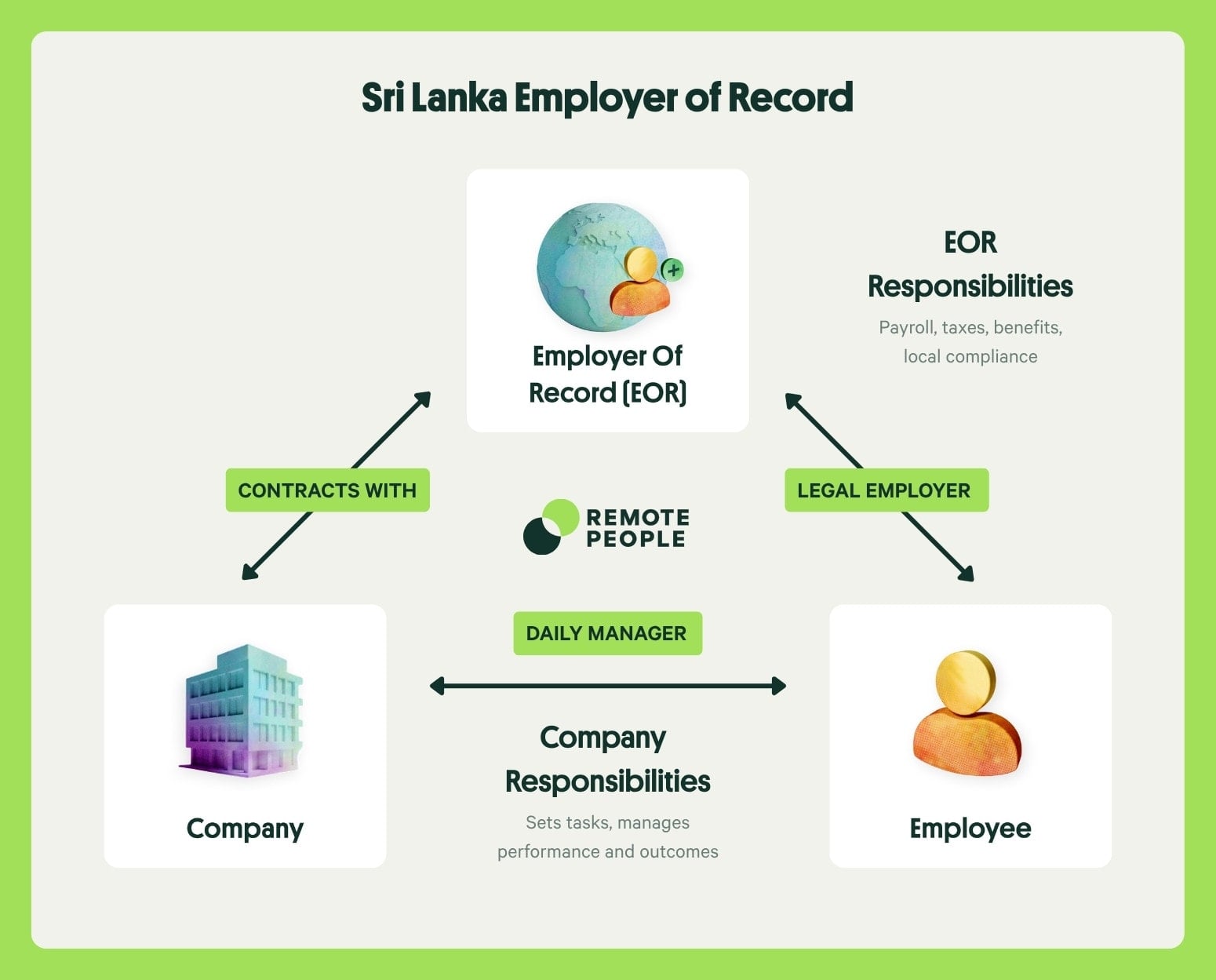
If you’d like to learn more about how Employer of Record (EOR) services work, read our What Is an Employer of Record (EOR)? guide for a complete overview of the model, its benefits, and when to use it.
If you’re comparing providers, our Best Employer of Record (EOR) Providers guide reviews the leading platforms to help you choose the right solution for your business.
Who Uses an EOR in Sri Lanka?
Companies use an EOR in Sri Lanka for several common scenarios:
- Market Testing: You’re not yet ready to commit to a full company setup in Sri Lanka. An EOR lets you hire one or two employees, test the market, and scale only after you’ve validated the opportunity.
- Small Team Without Entity Overhead: You need a small local team (1–5 people) and don’t want to deal with company registration, board meetings, annual filings, and director compliance obligations. An EOR eliminates all of this administrative burden.
- Rapid Hiring and Time-to-Value: You have a candidate ready to start next week. An EOR can onboard within 1–2 weeks for a resident, cutting months off the timeline compared to entity setup.
- Foreign National Hiring: You’re hiring a non-Sri Lankan who needs work visa sponsorship. The EOR handles all immigration paperwork, reducing the risk and timeline of visa denials or delays.
After the employee relationship matures or your team reaches a certain size, you can transition to a local subsidiary if desired, though many companies find the EOR model so efficient that they never need to establish a separate legal entity.
Typical Onboarding Timeline
Onboarding through an EOR in Sri Lanka follows this sequence:
- EOR Agreement & Employee Details (1–2 days): You and the EOR sign the service agreement. You provide employee name, role, salary, start date, and any special terms (e.g., probation length, remote work setup).
- Employment Contract Drafting & Review (2–3 days): The EOR drafts a contract compliant with the Shop and Office Employees Act and submits it for your review. You approve terms, and the contract is signed by both parties.
- Social Security & Tax Registration (3–7 days): The EOR registers the employee with EPF and ETF authorities, obtains tax identification, and files initial payroll setup with the Inland Revenue Department. For foreign nationals, work visa processing begins (6–12 weeks for employment visas).
- Payroll Setup & Benefits Enrollment (2–3 days): The EOR configures payroll in their system, sets up leave tracking, calculates annual leave entitlements, and confirms the employee’s bank account for salary deposits.
- Employee Onboarding & First Day (1 day): The employee receives their contract, payroll details, leave calendar, and company orientation. They can begin work once the contract is signed and payroll is activated.
Most EOR providers can onboard an employee in Sri Lanka within 1–2 weeks. Hiring a foreign national adds 6–12 weeks for employment visa processing. Medical checks, background verifications, or special licensing can extend timelines further.
Employment Laws and Regulations in Sri Lanka
Employment Contracts
All employment in Sri Lanka must be governed by a written contract. The governing law is the Shop and Office Employees Act No. 19 of 1954 for retail, office, and service sector employees. The contract must specify the job title, salary, working hours, probation period, leave entitlements, benefits, notice period, and termination clauses.
Contracts should be written in English, the standard for Sri Lankan business employment. The contract must clearly state whether the employment is indefinite or fixed-term. Fixed-term contracts are enforceable if the term is specified upfront and not used to evade statutory protections.
Probation periods are common and permitted. The maximum probation period is 6 months for standard employees and up to 12 months for senior or executive roles if both parties agree in writing. Probation must be explicitly mentioned in the contract along with performance conditions and grounds for early termination.
Working Hours and Overtime
The standard working week in Sri Lanka is 45 hours, with daily limits of 8–9 hours depending on sector. Under the Shop and Office Employees Act, office and retail employees work a maximum of 9 hours per day and 45 hours per week. Factory workers, governed by the Factories Ordinance, work a maximum of 8 hours per day and 45 hours per week.
Employees are entitled to at least one weekly rest day (typically Sunday). Excessive working hours can result in employer penalties of LKR 10,000–50,000 under labour law.
Sri Lanka Overtime and Premium Pay Rates · Per Labour Code | |||
|---|---|---|---|
Hour Type | Rate Multiplier | Weekly Cap | Governing Law |
Weekday Overtime (Hours 1–5 beyond 8 hrs/day) | 1.5× (150% of normal rate) | 12 hours/week max | Shop and Office Act § 20–26 |
Weekday Overtime (Hours 6+ beyond 8 hrs/day) | 1.5× (150% of normal rate) | 12 hours/week max | Shop and Office Act § 20–26 |
Weekly Rest Day Work (Sunday) | 2.0× (200% of normal rate) | No statutory limit | Shop and Office Act § 24 |
Public Holiday Work (Incl. Poya Days) | 2.0× (200% of normal rate) | No statutory limit | Shop and Office Act § 26 |
Night Work Allowance (Industry Practice) | 15–25% premium (voluntary) | No statutory limit | Not mandated; contractual only |
Overtime is strictly controlled. The maximum overtime permitted is 12 hours per week in most sectors. Employer consent is required for all overtime work, and records must be kept. Overtime payments are calculated on the hourly rate and must be paid no later than the next salary period. Compensation for rest day and public holiday work is separate from the base salary and must be calculated and paid in full.
Minimum Wage
The statutory minimum wage in Sri Lanka was recently increased. As of January 1, 2026, the monthly minimum wage is LKR 30,000 per month (approximately USD 100) under the National Minimum Wage of Workers (Amendment) Act No. 11 of 2025. From April 1 to December 31, 2025, a transitional rate of LKR 27,000 per month applied.
The Budgetary Relief Allowance (BRA) of LKR 3,500 per month was consolidated into this minimum wage effective April 1, 2025. This means all wage calculations (gratuity, leave encashment, severance) now use the higher base, benefiting employees.
The minimum wage applies across all sectors: manufacturing, services, retail, and public sector. Wages Board orders for specific industries (e.g., textiles, rubber processing) may mandate higher rates. Employers cannot pay below the statutory minimum except where permitted by collective bargaining agreements that exceed the minimum.
Probation Period
Probation periods in Sri Lanka are limited. The Shop and Office Employees Act permits a maximum probation of 6 months for standard employees. Senior or executive positions may extend to 12 months if both parties agree in writing at hire.
During probation, the employer may terminate with cause (poor performance, unsuitability, misconduct) with less formal notice than post-probation. However, grounds must be documented and communicated to the employee. After probation ends, termination is subject to full notice periods and severance requirements under the Termination of Employment of Workmen Act.
Leave Entitlements
Sri Lanka offers a comprehensive leave framework protecting employees. The entitlements vary by tenure and type of leave.
Annual Leave
Annual leave under the Shop and Office Employees Act is earned from the third calendar year of employment onward. In years 1 and 2, employees accrue no annual leave. From year 3 onwards, employees receive 14 working days of annual leave per calendar year. Leave can typically be carried forward unless the employment contract specifies otherwise, though many employers encourage leave to be taken in the year earned.
Casual Leave
Casual leave (which includes medical/sick leave) is separate from annual leave. In year 1, employees earn 0.5 days per completed month, totalling up to 6 days by year-end. From year 2 onwards, employees receive 7 days per calendar year. Casual leave is paid at 100% of regular earnings and must be approved by the employer, though medical grounds are typically accommodated.
Sick Leave
Statutory sick leave is 7 days per year at full pay, covered under the Shop and Office Employees Act and ISSA frameworks. This may be integrated into casual leave or tracked separately depending on company policy. A medical certificate is usually required after 3 consecutive days.
Maternity Leave
Female employees are entitled to 84 paid working days of maternity leave for a live birth, regardless of the number of previous children (this was amended in 2018). The leave is split as 14 days pre-confinement and 70 days post-confinement. For unsuccessful confinement (miscarriage), the entitlement is 42 days (14 pre- and 28 post-).
Maternity leave is paid at 100% of regular wage and is funded by the employer. Medical certification is required. There is no service period requirement; maternity leave is available to all female employees in covered establishments (15+ employees).
Paternity Leave
Statutory paternity leave is limited. The public sector provides 3 days of paid paternity leave anytime within 3 months of birth. The private sector has no statutory requirement, though some employers offer 1–3 days by company policy or collective agreement.
Sri Lanka Statutory Leave Entitlements · Per Shop and Office Employees Act | |||
|---|---|---|---|
Leave Type | Entitlement | Pay Rate | Notes |
Annual Leave (Year 1–2) | 0 days | N/A | Probationary period; no leave accrual |
Annual Leave (Year 3+) | 14 working days/year | 100% of regular wage | Accrued from the 3rd calendar year onward |
Casual Leave (Year 1) | 0.5 days per completed month (max 6 days) | 100% of regular wage | Medical grounds accepted |
Casual Leave (Year 2+) | 7 days/year | 100% of regular wage | Integrated with sick leave in some contexts |
Sick Leave | 7 days/year | 100% of regular wage | Medical certificate often required after 3 days |
Maternity Leave (Live Birth) | 84 working days (14 pre- + 70 post-) | 100% of regular wage | No service requirement; all children eligible |
Maternity Leave (Unsuccessful) | 42 working days (14 pre- + 28 post-) | 100% of regular wage | Miscarriage, stillbirth, or termination |
Paternity Leave (Private Sector) | 0 days (voluntary by employer) | N/A | Not statutory; some employers offer 1–3 days |
Public Holidays & Poya Days | 26 days/year (varies by lunar calendar) | 100% of daily wage if not worked | 2.0× pay if work required; includes 12 Poya days |
Leave is non-negotiable and protected by law. Employers cannot waive leave entitlements or pressure employees to forgo leave. Leave must be tracked, approved, and paid in full. Unused leave can be encashed upon termination if the employment contract allows, though carrying forward is more common.
Public Holidays in Sri Lanka (2026)
Sri Lanka observes 26 public holidays in 2026, including 12 Poya days (full moon Buddhist observances), the largest share of religious holidays in the region. Work performed on a public holiday must be compensated at 2.0× the regular wage, or the employee must receive a substitute day off within 7 days. An EOR tracks the lunar calendar and adjusts payroll automatically.
Sri Lanka Public Holidays 2026 · Gazetted by Ministry of Public Administration | ||
|---|---|---|
Date | Holiday | Type |
January 3 | Duruthu Full Moon Poya Day | Buddhist (Poya) |
January 14 | Tamil Thai Pongal Day | Hindu |
February 4 | National Independence Day | National |
February 1 | Navam Full Moon Poya Day | Buddhist (Poya) |
February 15 | Maha Shivaratri | Hindu |
March 3 | Medin Full Moon Poya Day | Buddhist (Poya) |
March 21 | Id-Ul-Fitr (Ramazan Festival Day) | Islamic |
April 2 | Bak Full Moon Poya Day | Buddhist (Poya) |
April 3 | Good Friday | Christian |
April 13 | Day Prior to Sinhala & Tamil New Year | National |
April 14 | Sinhala & Tamil New Year | National |
May 1 | May Day (Labour Day) | National |
May 2 | Vesak Full Moon Poya Day | Buddhist (Poya) |
May 3 | Day After Vesak Poya Day | Buddhist |
May 28 | Id-Ul-Alha (Hajj Festival) | Islamic |
May 31 | Poson Full Moon Poya Day | Buddhist (Poya) |
June 29 | Esala Full Moon Poya Day | Buddhist (Poya) |
July 29 | Nikini Full Moon Poya Day | Buddhist (Poya) |
August 26 | Milad-un-Nabi (Prophet’s Birthday) | Islamic |
August 28 | Binara Full Moon Poya Day | Buddhist (Poya) |
September 26 | Vap Full Moon Poya Day | Buddhist (Poya) |
October 26 | Ill Full Moon Poya Day | Buddhist (Poya) |
November 9 | Deepavali (Festival of Lights) | Hindu |
November 24 | Unduvap Full Moon Poya Day | Buddhist (Poya) |
December 24 | Christmas Eve | Christian |
December 25 | Christmas Day | Christian |
Source: Ministry of Public Administration Sri Lanka and Department of Labour Sri Lanka. Poya day dates shift annually by the lunar calendar; confirm current-year gazette. | ||
Payroll, Taxes, and Social Security Contributions in Sri Lanka
Income Tax (APIT)
Sri Lanka’s personal income tax system is called Advance Personal Income Tax (APIT), effective from April 1, 2025. APIT replaced the previous PAYE system and introduced a more generous personal relief threshold.
The personal relief for tax year 2025/26 is LKR 1,800,000 per annum (LKR 150,000 per month). This means the first LKR 1,800,000 of annual income is tax-free. Only income above this threshold is taxable.
Sri Lanka Income Tax Brackets · YA 2025/26 (APIT) | ||
|---|---|---|
Taxable Income (Above LKR 1.8M Relief) | Tax Rate | Cumulative Tax |
First LKR 1,000,000 | 6% | LKR 60,000 |
LKR 1,000,001 – 1,500,000 | 18% | LKR 90,000 (total: LKR 150,000) |
LKR 1,500,001 – 2,000,000 | 24% | LKR 120,000 (total: LKR 270,000) |
LKR 2,000,001 – 2,500,000 | 30% | LKR 150,000 (total: LKR 420,000) |
Above LKR 2,500,000 | 36% | Cumulative |
Employers withhold APIT monthly from employees’ salaries based on the tax brackets. The employee’s EPF contribution (8%) is deductible from gross salary before calculating APIT. APIT is remitted to the Inland Revenue Department by the 15th of the following month.
Example: An employee earning LKR 200,000 per month (LKR 2,400,000 annually) would have:
- Annual gross: LKR 2,400,000
- Less personal relief: LKR 1,800,000
- Taxable income: LKR 600,000
- Tax due (6% of LKR 600,000): LKR 36,000 annually (LKR 3,000 per month)
- Plus EPF deduction (8%): LKR 16,000 per month
- Net take-home after tax and EPF: approximately LKR 181,000 per month
Sri Lanka Employee Payroll Deductions · Monthly Withholdings | ||
|---|---|---|
Deduction Type | Rate | Base |
EPF (Employees’ Provident Fund) | 8% | Gross monthly salary |
APIT (Advance Personal Income Tax) | 6–36% (progressive) | Gross minus EPF above LKR 1.8M annual relief |
Total Deductions (Approximate) | 14–44% (varies by income) | Gross salary |
Employer Social Security Contributions
Employers must contribute to two mandatory social security funds in Sri Lanka: the Employees’ Provident Fund (EPF) and the Employees’ Trust Fund (ETF).
The Employees’ Provident Fund (EPF) is a mandatory retirement and savings scheme. The employer contribution is 12% of gross monthly salary, and the employee contributes 8% (deducted from salary). The total is 20% of gross. Both contributions are paid into the employee’s individual EPF account and accumulated with interest. Contributions must be remitted by the last working day of the following month.
The Employees’ Trust Fund (ETF) is an additional mandatory benefit fund. The employer contributes 3% of gross monthly salary (employee contribution is zero). ETF funds are allocated to employee benefits such as sickness, disability, and death benefits, and surplus is shared with employees at the end of each financial year.
Sri Lanka Employer Contributions in 2026 · Mandatory Social Security | ||
|---|---|---|
Contribution | Rate | Base |
EPF (Employees’ Provident Fund) | 12% | Gross monthly salary |
ETF (Employees’ Trust Fund) | 3% | Gross monthly salary |
Total Employer Cost | 15% | Gross salary |
Source: EPF/ETF Official Authority and ISSA Sri Lanka Profile | ||
Employer contributions of 15% are not withheld from the employee’s salary; they are paid separately by the employer. These contributions are a direct employer cost above the gross salary.
Statutory Benefits and Compensation
Beyond payroll deductions and employer contributions, employers must provide statutory benefits to employees.
Gratuity is a mandatory lump-sum payment due to employees who have completed 5 or more years of continuous service (employers with 15+ employees only). The payment is calculated as 1/2 month’s salary per completed year of service. For example, an employee with 10 years of service receives 5 months’ salary as gratuity upon termination. The gratuity must be paid within 30 days of termination. The first LKR 5 million of gratuity is tax-exempt; amounts above LKR 5 million are taxed at 12%. The gratuity cap under the Payment of Gratuity Act No. 12 of 1983 is LKR 2.5 million (as of 2025).
Mandatory Health Insurance: There is no statutory employer-funded health insurance requirement in Sri Lanka. However, larger employers often offer voluntary health insurance plans as a benefit. Employees can purchase individual health insurance independently.
Pension/Retirement: The EPF is the primary retirement vehicle. Both employer and employee contributions accumulate in the employee’s individual account. Upon retirement (age 55 for men, 50 for women), employees receive a lump sum of their accumulated EPF balance plus dividends. The ETF also provides a supplementary lump sum at retirement.
Workmen’s Compensation: Employers must carry workmen’s compensation insurance covering work-related injuries, occupational diseases, and death. This is separate from EPF and is governed by the Workmen’s Compensation Ordinance.
Termination, Notice, and Severance in Sri Lanka
Notice Periods
Sri Lanka does not impose a fixed statutory notice period for all terminations. Instead, notice periods are contractually determined. The standard is 1 month’s notice for ordinary terminations, though contracts may specify shorter (1–2 weeks) or longer (2–3 months) periods for specific roles.
For retrenchment or redundancy (non-disciplinary termination), the Termination of Employment of Workmen (Special Provisions) Act No. 45 of 1971 (TEWA) applies to employers with 15 or more employees. Under TEWA, the employer must obtain written consent from the employee OR written approval from the Commissioner of Labour before terminating. This approval process typically takes 2–4 weeks.
Notice periods vary by employee category and tenure. The following table summarises the common notice-period conventions used in Sri Lankan employment contracts.
Sri Lanka Notice Periods by Employee Category · Contractual standards | ||
|---|---|---|
Employee Category / Tenure | Standard Notice (Employer) | Standard Notice (Employee) |
Probationary Employee (0–6 months) | 1 day to 1 week | 1 day to 1 week |
Weekly-Paid Workman | 1 week | 1 week |
Monthly-Paid Employee (Clerical / Office) | 1 month | 1 month |
Executive / Managerial | 2–3 months | 2–3 months |
Retrenchment / Redundancy (TEWA, 15+ employees) | Commissioner of Labour approval + contractual notice | Not applicable |
Dismissal for Misconduct (after inquiry) | No notice required; follow disciplinary procedure | Not applicable |
Payment in lieu of notice is permitted if the employment contract allows it. In practice, most Sri Lankan contracts include a payment-in-lieu clause to allow an immediate exit when needed.
Severance Pay
Severance is due only upon termination due to retrenchment, closure, or redundancy, not for resignation or cause dismissal. Severance is calculated based on years of service as follows:
Sri Lanka Severance Pay by Years of Service · Per TEWA | ||
|---|---|---|
Years of Service | Monthly Severance Rate | Cumulative Example |
1–5 years | 2.5 months’ salary per year | 5 years = 12.5 months’ pay |
6–14 years | 2 months’ salary per year | 10 years = 10 additional months (total 22.5 months) |
15–19 years | 1.5 months’ salary per year | 15 years = 7.5 additional months (total 30 months) |
20+ years | 1 month’s salary per year | 20 years = 5 additional months (total 35 months) |
Example Calculations:
- 3 years of service: 3 × 2.5 = 7.5 months’ salary
- 10 years of service: (5 × 2.5) + (5 × 2) = 12.5 + 10 = 22.5 months’ salary
- 15 years of service: (5 × 2.5) + (9 × 2) + (1 × 1.5) = 12.5 + 18 + 1.5 = 32 months’ salary
Severance is calculated on the last month’s basic salary or the average of the last 12 months (per contract or practice). The total severance cap under TEWA is LKR 2.5 million (increased from LKR 1.25 million in 2025).
If an employee has 5+ years of service, both severance AND gratuity may be payable. Severance applies to redundancy/retrenchment; gratuity applies upon any termination after 5 years of service in qualifying employers. The commissioner must approve severance calculations and may adjust amounts based on the circumstances.
Work Permits and Visas in Sri Lanka
Employment Visa
Foreign nationals seeking to work in Sri Lanka require an employment visa. The process begins with an Entry Visa (EV) for Employment, which is applied for by the employer through the Ministry of Labour and Department of Immigration & Emigration. The employment visa is valid for 1 year and renewable annually as long as employment continues.
Processing Timeline: 6–12 weeks total (6–8 weeks for Ministry of Labour review, 2–3 weeks for immigration approval, then 2–4 weeks for the Residence Visa upon arrival).
Cost: Typically USD 200 per year for the residence visa. Employer sponsorship costs vary (USD 500–1,500 depending on EOR/legal provider).
Requirements: Foreign national must have a valid passport (6+ months validity), employment contract, health certificate, and clean background check. The employer must demonstrate the foreign national fills a skill gap not available locally.
Business Visa
A short-term business visa is available for visitors attending meetings, conferences, or negotiations without working. The visa is valid for 30–60 days and renewable. No sponsorship is required. Cost is approximately USD 20–40. A business visa does NOT permit employment or income generation in Sri Lanka.
Digital Nomad Visa
Sri Lanka launched a Digital Nomad Visa in early 2026, valid for 12 months and renewable. The visa is designed for remote workers employed by non-Sri Lankan companies or self-employed freelancers.
Eligibility: Applicant must be earning a minimum of USD 2,000 per month (solo), plus USD 500 per dependent (up to 2 dependents included). Proof includes bank statements, employment contract, or client letters. Mandatory health insurance and proof of accommodation (rental lease or property deed) are required.
Restrictions: The applicant cannot work for a Sri Lankan company or generate income from Sri Lankan sources. All work must be for international clients. This visa is ideal for remote employees of foreign companies or international freelancers wanting to reside in Sri Lanka.
Cost: Approximately USD 500 per year.
Sri Lanka Work Visa Types for Foreign Workers · 2026 | ||||
|---|---|---|---|---|
Visa Type | Duration | Work Allowed? | Sponsorship Required? | Annual Cost |
Employment Visa (EV + RV) | 1 year, renewable | Yes (sponsored employer only) | Yes (employer required) | USD 200 (visa) + sponsorship fees |
Business Visa | 30–60 days, renewable | No | No | USD 20–40 |
Digital Nomad Visa (D-Visa) | 1 year, renewable | Yes (remote work, non-SL clients only) | No | USD 500 |
Investor Visa | TBD (multi-year likely) | Likely yes | Yes (BOI coordination) | TBD (investment-dependent) |
The employment visa is the standard path for hiring foreign employees. The digital nomad visa is ideal for remote workers or freelancers not based in Sri Lanka who want to establish residence temporarily. An EOR can handle employment visa sponsorship on your behalf, managing all Ministry of Labour submissions and immigration coordination.
How to Hire in Sri Lanka: EOR vs. Local Entity Setup
EOR vs. Private Company Comparison
When expanding into Sri Lanka, you face a choice: hire through an EOR or establish a private subsidiary company. The decision depends on your timeline, cost tolerance, and growth plans.
Sri Lanka EOR vs. Local Company Comparison · Setup time, cost, and compliance | ||
|---|---|---|
Factor | EOR in Sri Lanka | Local Private Company |
Time to First Employee | 1–2 weeks (resident) / 2–3 months (foreign hire with visa) | 4–6 months (registration, licenses, bank account, setup) |
Setup Costs | EOR service fee only (5–12% of payroll) | LKR 500,000–1,500,000 (registration, legal, accounting setup) |
Monthly Payroll Overhead | EOR management + all statutory contributions included in fee | Accountant, HR software, tax compliance (LKR 50,000–150,000/month) |
Employer Obligations | EOR assumes all legal responsibility (contracts, EPF/ETF, taxes, termination, work permits) | You assume all obligations; risk of non-compliance |
Compliance Risk | Low (EOR is expert, insured) | Medium to high (depends on management quality) |
Ownership & Control | No local entity ownership; limited local control over legal hiring/firing decisions (EOR retains veto over compliance issues) | Full ownership and control; your company is the employer |
Scalability (Growing to 10+ Employees) | EOR model scales; you remain hands-off on compliance. Some companies transition to private company for strategic control. | Scales naturally; you have full control but increased administrative burden |
Exit Strategy | Low barrier to exit; terminate EOR agreement and employees transition off payroll | Higher barrier; must wind down company (3–6 months), tax audit, final filings |
Cost Example: Hiring a developer earning LKR 200,000/month (approximately USD 667) through an EOR:
Sri Lanka Employer Cost Example · LKR 200,000 monthly salary (2026) | ||
|---|---|---|
Cost Component | LKR | USD |
Employee Gross Salary | 200,000 | 667 |
Employer EPF (12%) | 24,000 | 80 |
Employer ETF (3%) | 6,000 | 20 |
EOR Service Fee (8% est.) | 16,000 | 53 |
Total Monthly Cost | 246,000 | 820 |
Source: Calculation based on IRD Rates 2026 and EPF Authority Contribution Schedule. Exchange rate: LKR 300 = USD 1. Note: Employee net take-home is approximately LKR 181,000 after APIT and EPF deductions. | ||
An EOR model is best for rapid hiring, minimal local setup, and predictable compliance. A local company is better if you plan to scale beyond 10 employees, require significant local control, or expect to operate in Sri Lanka long-term.
EOR vs. PEO in Sri Lanka
An EOR and a PEO (Professional Employer Organization) are often confused. Both manage payroll and HR administration, but the legal relationship is fundamentally different. A PEO operates under a co-employment arrangement and requires you to already have a registered legal entity in Sri Lanka. An EOR acts as the sole legal employer, so you can hire without any local entity at all. For companies entering Sri Lanka for the first time, an EOR is almost always the right starting point.
Sri Lanka EOR vs. PEO · Legal relationship and prerequisites | ||
|---|---|---|
Factor | EOR in Sri Lanka | PEO in Sri Lanka |
Legal Entity Required? | No (EOR is the legal employer) | Yes (you must have a registered company) |
Employment Relationship | Sole employer (EOR holds contract) | Co-employment (shared responsibility) |
Compliance Liability | EOR assumes full legal liability | Shared between you and the PEO |
Time to First Hire | 1–2 weeks | 4–6 months (entity setup first) |
Payroll & Tax Filing | EOR files under its own Tax Identification Number (TIN) | Filed under your company’s TIN |
EPF / ETF Registration | EOR’s account | Your company’s account |
Termination Risk | EOR handles TEWA approvals and Commissioner of Labour process | You handle (PEO may advise) |
Best For | First hires, small teams (1–20), market entry | Established entities seeking HR outsourcing |
Most companies entering Sri Lanka begin with an EOR, then transition to a PEO (or in-house HR) once they have registered a local subsidiary and grown beyond 20 to 30 employees.
EOR vs. Contractors
Some companies consider hiring contractors instead of employees to reduce compliance burden. This carries risks in Sri Lanka.
Sri Lanka EOR vs. Independent Contractors · Compliance, cost, and risk | ||
|---|---|---|
Factor | Employee (EOR) | Independent Contractor |
Legal Status | Employment relationship; statutory protections apply | Self-employed; contractor responsible for own taxes and compliance |
Benefits | Statutory leave, maternity, gratuity, EPF/ETF, severance | None (contractor’s responsibility) |
Tax Withholding | Employer withholds APIT and EPF; remits to authorities | Contractor responsible for own income tax and filing |
Notice & Termination | Notice period required; severance/gratuity may apply | Contract-based; typically easier to terminate |
Misclassification Risk | Low (clear employment relationship) | High (tax authorities may reclassify as employee; penalties apply) |
Cost (Short-term) | Higher (contributions, EOR fee, benefits) | Lower (no employer contributions; contractor bears costs) |
IP Assignment | Clear; work-for-hire protections | Risky; contractor may retain IP rights; requires explicit assignment |
Sri Lankan tax authorities scrutinize contractor arrangements. If a contractor works exclusively for your company, attends your office, follows your processes, and provides services for extended periods, tax authorities may reclassify them as an employee, retroactively assessing unpaid APIT, EPF, and penalties. Using a contractor for short-term, project-based work (e.g., consultancy, freelance design, temporary support) is safer than long-term outsourcing of core roles.
Hire in Sri Lanka with RemotePeople
Ready to expand your team into Sri Lanka? RemotePeople simplifies hiring with our EOR service. We handle employment contracts, payroll in LKR, APIT and EPF withholding, leave management, work visa sponsorship, and full compliance with Sri Lankan labour law. You can onboard your first employee within 1–2 weeks, no local company required. Whether you’re testing the market or scaling rapidly, RemotePeople removes the compliance burden so you can focus on building your team.
Contact us today at remotepeople.com/contact to discuss your Sri Lanka hiring needs and get a customized proposal.
Where companies hiring in Sri Lanka expand next
Companies hiring in Sri Lanka commonly expand across South Asia, drawing on shared English proficiency and deep tech talent pools. Many companies add Bangladesh first, drawing on Asia-Pacific connectivity and English-proficient hires. Hiring in Nepal follows as the Asia-Pacific gateway with multilingual workforce, while an EOR partner in India offers access to pan-Asian talent and supply-chain clusters. Pakistan is often the fourth step, valued for deep Asian tech and services talent.
Frequently Asked Questions About Hiring in Sri Lanka
An employer of record (EOR) is a third-party provider that becomes the legal employer of your worker in Sri Lanka. You retain operational control and management of the employee while the EOR handles all payroll, taxes, social security, compliance with Sri Lankan labour law, and work visa sponsorship. This eliminates the need to establish a local company and accelerates time-to-hire from months to weeks.
No. You do not need to register a local company in Sri Lanka to legally hire employees there. An employer of record (EOR) such as RemotePeople acts as the in-country legal entity on your behalf, handling Board of Investment (BOI) registration requirements, Employees\u2019 Provident Fund (EPF) and Employees\u2019 Trust Fund (ETF) enrolment, Advance Personal Income Tax (APIT) withholding, and full compliance with the Shop and Office Employees Act \u2014 steps that would otherwise take 3\u20136 months and USD 15,000+ in setup costs. Your team in Colombo, Kandy, or anywhere in Sri Lanka is employed under RemotePeople\u2019s Sri Lankan entity while doing day-to-day work for your business.
For a developer earning LKR 200,000/month, the total monthly cost is approximately LKR 246,000 (USD 820), which includes the gross salary, employer EPF (12%), employer ETF (3%), and EOR service fees (typically 5–12% of payroll, averaging 8%). This totals around USD 800–1,200 per month depending on salary level and EOR pricing.
The statutory minimum wage in Sri Lanka is LKR 30,000 per month as of January 1, 2026, under the National Minimum Wage of Workers (Amendment) Act No. 11 of 2025. From April 1 to December 31, 2025, a transitional rate of LKR 27,000 per month applied. The minimum wage applies across all sectors unless superseded by a Wages Board order or collective bargaining agreement.
Employers in Sri Lanka must contribute 12% to the Employees' Provident Fund (EPF) and 3% to the Employees' Trust Fund (ETF), totalling 15% of gross monthly salary. These are mandatory social security contributions and are separate from the employee's gross salary. Both must be remitted by the last working day of the following month.
Onboarding a resident of Sri Lanka typically takes 1–2 weeks. Hiring a foreign national requires employment visa sponsorship, which takes 2–3 months (6–8 weeks for Ministry of Labour approval plus 2–3 weeks for immigration processing). An EOR handles all visa paperwork, reducing your administrative burden.
You can hire contractors for short-term, project-based work. However, Sri Lankan tax authorities may reclassify long-term or exclusive contractor relationships as employment, retroactively assessing unpaid APIT, EPF, and penalties. An EOR employee model is safer for ongoing roles and provides your worker with statutory protections (leave, gratuity, severance).
APIT (Advance Personal Income Tax) is Sri Lanka's personal income tax system, effective from April 1, 2025. Employers withhold APIT monthly based on progressive tax brackets (6–36%) on income above the personal relief threshold of LKR 1,800,000 per year (LKR 150,000/month). An EOR calculates and remits APIT correctly on your behalf.
The standard working week in Sri Lanka is 45 hours, with daily limits of 8 hours (factories) to 9 hours (offices and retail). Overtime is limited to 12 hours per week maximum and compensated at 1.5× for weekday hours and 2.0× for rest day or public holiday work. All overtime requires employee consent and must be documented.
Sri Lanka introduced a Digital Nomad Visa in early 2026 for remote workers employed by non-Sri Lankan companies or self-employed freelancers. The visa is valid for 12 months, costs approximately USD 500, and requires proof of USD 2,000+ monthly income. The applicant cannot work for a Sri Lankan company or generate local income. This visa is ideal for international remote workers wanting to reside in Sri Lanka temporarily.
Employer of Record in
Employer of Record in
Employer of Record in
Employer of Record in
Employer of Record in
Employer of Record in
Employer of Record in
Employer of Record in