
 Recruit
Employer of Record in the United Arab Emirates
-
 Drew Donnelly
- Published
- September 27, 2026
RemotePeople’s employer of record in United Arab Emirates lets you hire employees in United Arab Emirates with GPSSA compliance for UAE nationals. We handle General Pension and Social Security Authority contributions at 12.5 percent employer share in most emirates, mandatory health insurance, and end-of-service gratuity.
Hire in United Arab Emirates — book a free 30-minute demo
Tell us what you need. You'll get a tailored, transparent proposal within 24 hours, plus a free call to walk through it.
Tell us about your company
So we can match you with a specialist who knows your market — and unlock volume pricing tiers.
* All fields are required.
Where and when are you hiring?
Tell us the geography and timing and we'll quote each country line by line, with onboarding timelines.
* All fields are required.
Help us beat your current setup
We'll benchmark your current deal and send a line-by-line proposal in 24 hours — showing exactly where we cut cost, time, or risk. After you submit, you can book a call to walk through it together.
* All fields are required.
Thanks! Your proposal is on its way.
Expect a tailored, line-by-line proposal in your inbox within 24 hours. In the meantime…
Want to walk through it together?
Book a free 30-minute call with one of our specialists. We'll explain every line, answer your questions, and tailor the proposal further if you need.
No obligation. Pick a time that works for you.








- Hire in United Arab Emirates — book a free 30-minute demo
- Tell us about your company
- Where and when are you hiring?
- Help us beat your current setup
- Thanks! Your proposal is on its way.
- How to Hire Employees in the United Arab Emirates
- UAE Employer of Record vs UAE Legal Entity
- Using an Employer of Record in the United Arab Emirates
- How Much Does EOR Cost in the UAE?
- Employment and Labor Laws in the UAE
- Payroll Taxes in the UAE
- Employment Taxes in the UAE
- Work Permits and Visas in the UAE
- Time Off and Leave in the UAE
- Terminations and Severance in the UAE
- Using an Employer of Record to Administer Benefits in the UAE
- Expand into United Arab Emirates Easily with RemotePeople’s Employer of Record in the UAE
- Where companies hiring in the United Arab Emirates expand next
- Frequently Asked Questions
- Related EOR Destinations
Start hiring in United Arab Emirates
Let RemotePeople handle payroll, compliance, and HR admin worldwide so you can focus on building your team.

The UAE is one of the world’s most open economies for international business, built on a workforce that is over 85% expatriate and a regulatory environment designed to attract foreign investment. With no personal income tax, a strategic location between East and West, and a rapidly maturing legal framework, it consistently ranks among the top destinations for companies expanding into the Middle East.
Hiring here comes with its own set of rules. Employment contracts must be fixed-term and registered with MOHRE. Salaries must be paid through the Wage Protection System. Visa sponsorship is employer-driven. And if you are hiring UAE nationals, Emiratisation quotas and GPSSA contributions add another layer of compliance to manage.
The UAE also operates across two distinct frameworks, mainland and free zone, each with different licensing, hiring, and operational rules. Getting this right from the start determines how freely your team can operate across the country.
This guide covers everything you need to know about hiring in the UAE compliantly, from employment contracts and payroll taxes to visa sponsorship, gratuity, and termination rules. Whether you are hiring your first employee or scaling a team across Dubai and Abu Dhabi, an Employer of Record removes the complexity so you can move fast without the risk.
How to Hire Employees in the United Arab Emirates
Hiring in the UAE can open doors to a highly skilled, multinational workforce, but the rules are specific, and the paperwork is no joke. Before you onboard your first employee, it’s important to decide how you’ll legally employ them. Your method will affect everything from processing payroll to securing work permits.

Setting Up a Local Entity
Setting up a branch, subsidiary, or Free Zone company gives you full control over your hiring and operations in the UAE. The trade-off is upfront setup costs, ongoing legal obligations, and administrative responsibilities that require local expertise to manage correctly.
Free Zone vs Mainland
The UAE has over 40 free zones, each offering simplified licensing, 100% foreign ownership, and tax advantages. They work well for companies operating within a defined sector or location, but come with an important limitation: employees hired under a free zone licence can generally only work within that free zone or for the free zone entity. Any work performed on the UAE mainland requires a separate mainland work permit.
Mainland employment is licensed through MOHRE and carries no such geographic restriction. Employees can work freely across the UAE, making it the more flexible option for most businesses. For this reason, EOR arrangements in the UAE are structured on a mainland basis as standard, ensuring your team can operate wherever the work takes them.
Working with an Employer of Record (EOR)
An EOR becomes the legal employer on your behalf, handling employment contracts, payroll, taxes, and visa sponsorships. You direct the employee’s daily tasks while the EOR ensures full compliance with UAE labor and immigration laws.
Hiring Independent Contractors
While this route offers flexibility, it’s risky. The UAE has clear definitions for employment, and misclassification can lead to fines or legal disputes. Use this option with caution and clear documentation.
If you’d like to learn more about how Employer of Record (EOR) services work, read our What Is an Employer of Record (EOR)? guide for a complete overview of the model, its benefits, and when to use it.
If you’re comparing providers, our Best Employer of Record (EOR) Providers guide reviews the leading platforms to help you choose the right solution for your business.
UAE Employer of Record vs UAE Legal Entity
Setting up a legal entity in the UAE gives you full operational control, but the process is neither quick nor straightforward. The most common structure for foreign companies is a Limited Liability Company (LLC), though a branch office, sole proprietorship, or free zone entity may be more appropriate depending on your sector and operational needs.
To incorporate an LLC, you must register a trade name, submit a Memorandum of Association and Articles of Association, secure a registered office address, and obtain approvals from the relevant emirate authority. Documents are submitted to the Department of Economic Development in the relevant emirate. Timeline typically ranges from two to six weeks depending on the emirate and business activity, with additional time required for MOHRE registration and visa quota approvals.
Companies operating in the DIFC (Dubai International Financial Centre) or ADGM (Abu Dhabi Global Market) follow separate common law frameworks and have their own employment regulations, which differ significantly from mainland UAE labour law. These are worth considering for financial services, legal, and professional services firms.
An EOR removes the need for any of this. Under Federal Decree-Law No. (47) of 2021, the EOR acts as the legal employer, managing contracts, payroll, visa sponsorship, MOHRE compliance, and benefits on your behalf. You retain full control over day-to-day management while the EOR carries the legal and administrative burden.
Using an Employer of Record in the United Arab Emirates
If you’re looking to hire in the UAE without launching a full-blown local entity, an Employer of Record (EOR) is your shortcut to compliant, hassle-free hiring. The EOR legally employs your talent on your behalf, taking care of all the legal, administrative, and HR responsibilities, while you stay focused on growing your business.
From onboarding employees in Dubai to issuing compliant contracts in Abu Dhabi, an EOR navigates local regulations, so you don’t have to. This is especially valuable in the UAE, where employment laws, immigration rules, and Free Zone requirements can shift quickly.
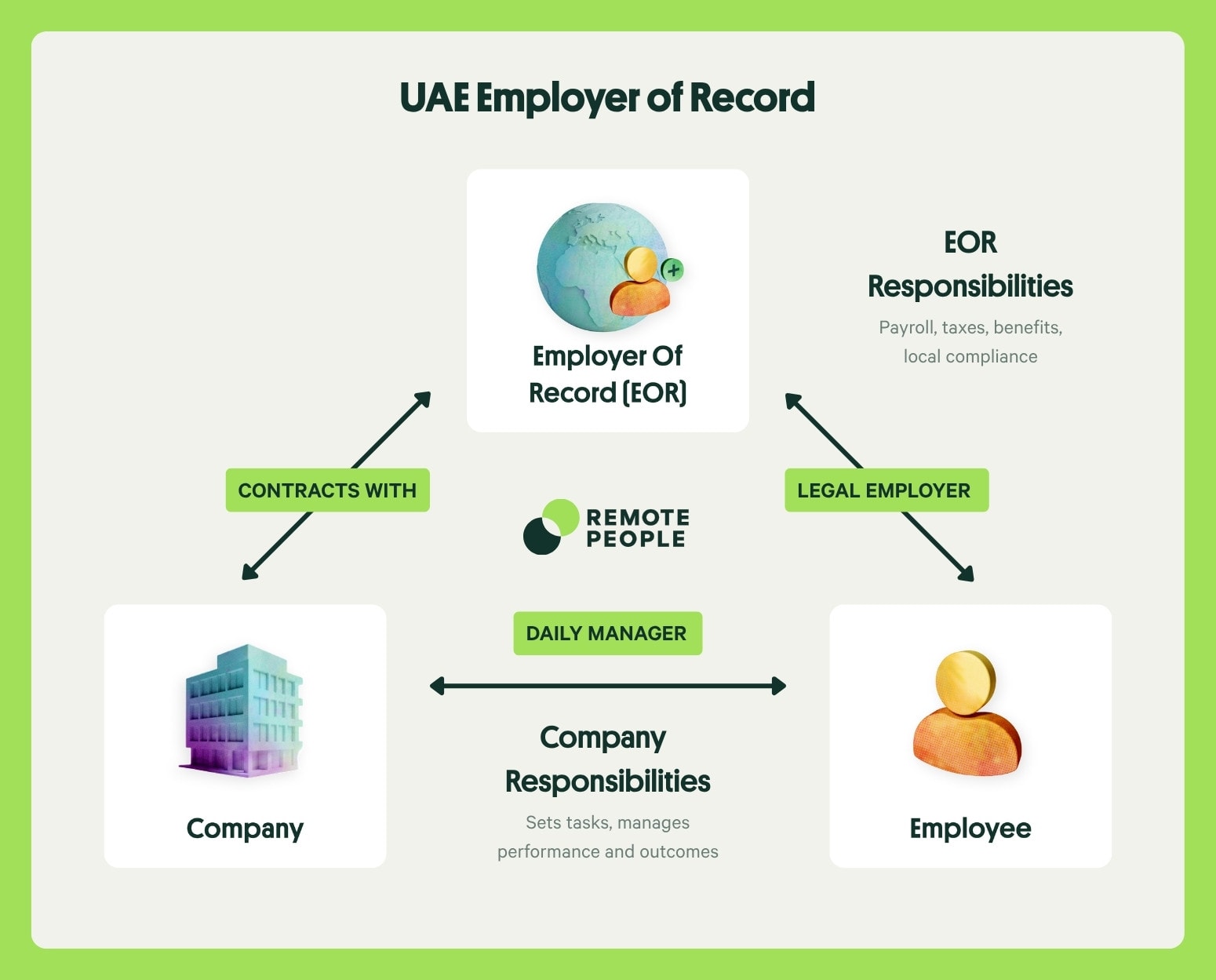
Here’s what an EOR handles in the UAE:
- Drafts bilingual employment contracts aligned with local labor laws
- Registers employees with government authorities
- Manages compliant UAE payroll and benefits contributions
- Secures work visas and sponsorship for expat employees
- Tracks paid leave, public holidays, and sick days
- Stays updated with evolving labor laws and regulatory changes
By partnering with a UAE-based EOR, you can scale faster and safer with no local entity required, no compliance headaches, and no risk of falling out of step with UAE labor law.
How Much Does EOR Cost in the UAE?

EOR pricing in the UAE varies by provider and scope of service, but there are a few UAE-specific factors that make costs here different from other markets. Visa sponsorship and residency processing, mandatory health insurance administration, WPS compliance, and gratuity accrual management all add to the operational workload, which is reflected in pricing.
Most full-service UAE EOR packages range from $600 to $2,000 per employee per month, depending on the employee’s role, whether the EOR is handling visa sponsorship and Emirates ID processing, and the level of ongoing HR support required. Some providers charge a flat monthly fee per employee while others price as a percentage of gross salary.
RemotePeople’s pricing starts from $199 per employee per month, which includes employment contracts, payroll processing, MOHRE compliance, and statutory benefits administration. Visa sponsorship and health insurance can be included depending on your package.
When comparing providers, ask specifically what is included around visa renewals, gratuity tracking, and WPS registration, as these are often where hidden costs appear in UAE payroll management.
Employment and Labor Laws in the UAE
The United Arab Emirates has a structured legal framework that’s designed to balance business efficiency with employee protection. The most recent updates to the UAE Labor Law (Federal Decree-Law No. 33 of 2021) brought more flexibility to employment types and clarified worker rights, so staying current is crucial.
Employment Contracts
Under Federal Decree Law No. 33 of 2021, which came into effect in February 2022, all employment contracts in the UAE must be fixed-term. Unlimited duration contracts are no longer permitted. The maximum term for a fixed-term contract is 3 years, after which it can be renewed for equivalent or shorter periods indefinitely.
Employers who had existing unlimited contracts in place were required to convert them to fixed-term contracts by February 2023. Any contracts not converted are treated as non-compliant.
All contracts must be in writing and submitted to the Ministry of Human Resources and Emiratisation (MOHRE) before the employee commences work. The contract must be in Arabic, or in both Arabic and another language, with the Arabic version taking precedence in the event of a dispute. Key terms including job title, salary, working hours, leave entitlement, and notice period must all be clearly stated.
Failure to register a contract with MOHRE or to issue a compliant fixed-term agreement can result in administrative penalties for the employer.
Working Hours
The standard workweek is 8 hours per day, 48 hours per week. During Ramadan, daily hours are reduced by 2. Overtime is paid at 125% – 150%, depending on the time and day of work.
Overtime
The standard workweek is 48 hours (8 hours/day, 6 days/week). During Ramadan, working hours are reduced by 2 hours per day for Muslim employees.
Public Holidays
The UAE observes approximately 12 to 13 public holidays per year, combining fixed national dates with Islamic holidays that follow the Hijri calendar. Islamic holiday dates are not confirmed until closer to the time based on official moon sightings and may shift by a day.
- New Year’s Day (1 January)
- Eid Al Fitr (varies)
- Arafat Day and Eid Al Adha (varies)
- Islamic New Year (varies)
- Prophet Muhammad’s Birthday (varies)
- Commemoration Day (30 November)
- UAE National Day (2–3 December)
If a public holiday falls mid-week, the UAE government may transfer it to the start or end of the working week. This does not apply to Eid holidays. Final confirmed dates are announced by the UAE government closer to each occasion.
Probation Periods
Employers may include a probation period of up to 6 months. During this time, either party can terminate the contract with relatively short notice, but the contract still must be reported and compliant.
Emiratisation
Private sector companies with 50 or more employees must increase their Emirati workforce by 2% annually, targeting 10% Emirati representation by 2026. The requirement applies to 14 designated economic sectors including banking, financial services, IT, healthcare, and retail.
Non-compliance carries a fine of AED 96,000 per unfilled Emirati position per year. Quotas are tracked in real time through MOHRE’s Nafis platform. EOR clients operating in affected sectors should factor Emiratisation targets into their hiring strategy from the outset.
Payroll Taxes in the UAE
Running payroll in the UAE means navigating a system that blends statutory obligations with cultural expectations. Salaries are typically paid monthly in Emirati dirhams (AED), and payment timelines, benefit entitlements, and termination policies must comply with UAE Labor Law or, in some cases, specific Free Zone regulations.
Category |
Details |
|---|---|
Monthly Salary Payments |
Most employees are paid monthly, with strict timeliness rules under the Wage Protection System (WPS). Delays or underpayments can lead to penalties or license suspensions. |
Currency Requirements |
Salaries must be paid in AED unless otherwise agreed, using UAE-approved banking channels registered with WPS. |
Gratuity Pay |
End-of-service gratuity replaces a pension. Employees receive 21 days of basic pay per year of service (up to 5 years), and 30 days per year thereafter. |
Leave Encashments |
Accrued annual leave and unused sick days must be compensated upon termination or can be encashed per company policy. |
No Income Tax |
The UAE has no personal income tax, but employers manage end-of-service benefits, insurance, and allowances. |
Partnering with an Employer of Record (EOR) ensures every payroll run ticks the right boxes, from timely salary transfers to legal end-of-service settlements. With an EOR, payroll in the UAE stops being a legal tightrope and becomes just another smooth, automated process.
Minimum Wage
The UAE does not have a universal statutory minimum wage. However, the Ministry of Human Resources and Emiratisation (MOHRE) applies qualification-based salary thresholds when issuing work visas for expatriate employees:
Qualification Level |
Minimum Monthly Salary |
|---|---|
University degree holders |
AED 12,000 |
Skilled technicians |
AED 7,000 |
Secondary school certificate holders |
AED 5,000 |
These thresholds are not statutory minimums in the traditional sense but are enforced at the point of visa issuance. Offering a salary below the applicable threshold will result in the work permit application being rejected.
UAE nationals employed in the private sector have a separate minimum salary of AED 6,000 per month, which applies regardless of qualification level.
Social Security and Pension Contributions
The UAE operates two entirely separate systems depending on the employee’s nationality. Understanding this distinction is critical for accurate employment cost planning.
UAE National Employees
UAE nationals in the private sector are covered by the General Pension and Social Security Authority (GPSSA). Under Federal Law No. 57 of 2023, the total contribution rate is 26% of pensionable salary, split as follows:
Contributor |
Rate |
Notes |
|---|---|---|
Employee |
11% |
Deducted from salary |
Employer |
15% |
Paid on top of gross salary |
Government subsidy |
2.5% |
Applies where the UAE national earns under AED 20,000/month; subsidises part of the employer share |
The maximum pensionable salary is AED 50,000 per month. Contributions above this threshold are not required.
The administering authority varies by emirate. UAE nationals employed in Dubai register with GPSSA, while those in Abu Dhabi register with the Abu Dhabi Pension Fund (ADPF). Both operate under similar contribution structures but are separate entities with their own registration and remittance processes. Employees in all other emirates fall under GPSSA.
Expatriate Employees
GPSSA contributions do not apply to expatriate employees, who make up approximately 90% of the UAE private sector workforce. Expatriates are not covered by the social security system. Instead, they are entitled to an end-of-service gratuity upon termination, calculated based on length of service and final salary.
This means the employer’s mandatory cost for expatriate staff is limited to salary and gratuity accrual, with no ongoing social security or pension contributions. This makes the UAE one of the lowest employer-cost environments globally for businesses hiring expatriate talent.
From July 2025, GPSSA enforces a late payment penalty of AED 100 per day per insured employee for contributions not remitted by the 15th of the following month. This applies to both the employer and employee portions. For companies with multiple UAE national employees, penalties can accumulate quickly and should be treated as a hard deadline rather than a guideline.
Employment Taxes in the UAE
One of the most attractive features of hiring in the UAE is its tax-friendly environment. For both employers and employees, the landscape is refreshingly simple compared to other global markets. However, “simple” doesn’t mean hands-off, as there are still important financial obligations to meet.
Here’s what you need to know about employment-related taxes and contributions in the UAE:
- No Personal Income Tax: Employees enjoy 100% of their salaries without deductions for federal income tax. This is a major incentive for talent relocating to the region.
- Corporate Payroll Tax: A 9% corporate tax applies to business profits exceeding AED 375,000, effective from June 2023. Qualifying free zone businesses continue to pay 0% on qualifying income derived from free zone activities. From January 2025, a Domestic Minimum Top-Up Tax applies to multinational enterprises with consolidated global revenue of €750 million or more, ensuring a minimum effective tax rate of 15% in line with the OECD Pillar Two framework.
- Social Security Contributions (UAE nationals only): UAE nationals must be enrolled in GPSSA or ADPF depending on their emirate of employment. Under Federal Law No. 57 of 2023, the total contribution is 26% of pensionable salary, split between employer (15%) and employee (11%), capped at a maximum pensionable salary of AED 50,000 per month. Expatriate employees are not covered.
- End-of-Service Gratuity: In place of pension contributions for expatriates, employers accrue a lump-sum gratuity payable upon termination, calculated on the employee’s last basic salary and length of service.
- VAT Considerations: The standard VAT rate is 5% on most goods and services. Registration is required once annual turnover exceeds the statutory threshold. VAT is not an employment tax but affects overall business cost planning.
Although the UAE tax regime is relatively straightforward, compliance with local employment finance laws is non-negotiable, especially for social security and gratuity requirements. Many companies choose to work with an Employer of Record to handle these details and avoid missteps.
Work Permits and Visas in the UAE
Over 80% of the UAE’s workforce is expatriate, and the country operates a well-structured employer-sponsored visa system. All foreign nationals require a valid work permit and residence visa before commencing employment.

- Employment Visa is the standard route for most foreign hires. Sponsored by the employer, it includes a residence permit valid for one to two years and is renewable. The employer must submit a valid employment contract, trade licence, medical clearance, and identification documents to MOHRE.
- Golden Visa is available to highly skilled professionals, investors, and entrepreneurs. Valid for up to ten years, it is not tied to a specific employer, offering greater mobility and stability for senior or specialist hires.
- Free Zone Visas are issued by the relevant free zone authority rather than MOHRE. Employees on free zone visas are generally restricted to working within that zone unless additional permissions are obtained.
Health insurance is mandatory for all expatriate employees. Failure to provide compliant coverage can result in penalties and rejected visa renewals.
An EOR sponsors the visa, manages renewals, and ensures full immigration compliance on your behalf, removing one of the most time-intensive parts of hiring in the UAE.
Time Off and Leave in the UAE
Employee benefits in the UAE are influenced by both labor law and cultural expectations. To attract and retain top talent in this highly competitive region, companies often go beyond the minimums.
Annual Leave Entitlement
Employees are entitled to 30 calendar days of paid annual leave after completing one year of service. For less than a year, leave is prorated.
Sick Leave
After a probationary period, employees are entitled to up to 90 days of sick leave per year. The first 15 days are paid in full, the next 30 at half-pay, and the rest unpaid.
Maternity Leave
Female employees receive 60 days of maternity leave: 45 fully paid and 15 at half-pay. Some companies offer extended or fully paid time off as a competitive benefit.
Paternity Leave
Male employees are entitled to 5 days of paid paternity leave, which must be taken within the first 6 months of the child’s birth.
Terminations and Severance in the UAE
Ending an employment relationship in the UAE must be handled with legal precision. Whether it’s a resignation, redundancy, or dismissal, both employer and employee rights are protected under UAE labor law.
Notice Periods
Standard notice is 30 days, but this can be extended up to 90 days if agreed upon in the contract. Shorter notice is only acceptable in serious cases (like gross misconduct).
Just Cause for Dismissal
Termination without notice is legal under certain conditions (e.g., repeated performance violations, breach of confidentiality), but must be documented and justified.
End-of-Service Gratuity
All expatriate employees who complete at least one year of continuous service are entitled to end-of-service gratuity upon leaving employment. Gratuity is calculated on the employee’s last basic salary only, excluding allowances, bonuses, and other components of total compensation.

Years of Service |
Gratuity Rate |
|---|---|
First 5 years |
21 days’ basic salary per year |
Beyond 5 years |
30 days’ basic salary per year for each additional year |
Total gratuity is capped at 2 years’ total remuneration regardless of length of service. The entitlement also varies depending on how employment ends:
Circumstance |
Gratuity Entitlement |
|---|---|
Less than 1 year of service |
No gratuity |
Resignation after 1–3 years |
One-third of full gratuity |
Resignation after 3–5 years |
Two-thirds of full gratuity |
Resignation after 5+ years |
Full gratuity |
Employer-initiated termination |
Full gratuity regardless of tenure |
Employers should accrue gratuity throughout the employment period rather than treating it as a lump sum obligation at termination. For EOR clients, this accrual is tracked and managed on your behalf.
Probation Periods
Usually capped at six months. During probation, termination can occur with shorter notice (typically 14 days) but without gratuity entitlement.
Final Pay
All dues, including unused leave, wages, and gratuity, must be paid within 14 days of termination. Failure to comply can result in legal claims or fines.
Using an Employer of Record to Administer Benefits in the UAE
Employee benefits in the UAE go beyond just basic salary. From health insurance to end-of-service gratuity, delivering a complete and compliant benefits package is key to attracting and retaining talent. But managing those benefits, especially from abroad, can quickly become complex.
That’s where an Employer of Record (EOR) becomes your strategic ally. Here’s how an EOR simplifies benefits administration in the UAE:
- Health Insurance Compliance: Health coverage is mandatory in most emirates (like Dubai and Abu Dhabi). Your EOR ensures every employee is enrolled in a compliant plan, avoiding costly delays or legal penalties.
- End-of-Service Gratuity: Calculating and disbursing this statutory payment is essential when employees exit. An EOR tracks tenure, manages payout formulas, and ensures timely delivery.
- Paid Leave & Holidays: UAE labor law mandates paid annual leave (at least 30 days after a year of service), as well as leave for public holidays and sick days. Your EOR tracks and processes all entitlements accordingly.
- Parental Leave: Maternity leave includes 60 calendar days (45 fully paid, 15 half paid), with paternity leave at 5 days. An EOR ensures proper application and records for leave policies.
- Work Permits & Residency: Benefit access is tied to visa status. Since the EOR sponsors your team, they ensure all legal documents stay active—so employees don’t lose coverage.
- Custom Perks: Want to stand out in a competitive market? Your EOR can help you offer additional perks like education allowances, relocation support, or wellness stipends, all locally managed.
In short, an EOR doesn’t just make hiring easier; it ensures your people are fully cared for under UAE law. You stay compliant, competitive, and focused on scaling, not getting buried in HR paperwork.
Hire in the United Arab Emirates
Free zones, mainland, and DIFC each have different employment frameworks, plus WPS, visa sponsorship, and UAE Labour Law.
We handle employment contracts, payroll, social contributions, and full UAE compliance.
No local entity needed. Your team can start in days.
Expand into United Arab Emirates Easily with RemotePeople’s Employer of Record in the UAE
Hiring in the United Arab Emirates opens the door to one of the most diverse and opportunity-rich markets in the world. From its ambitious business hubs in Dubai and Abu Dhabi to its pro-growth labor policies and talent-rich population, the UAE is a launchpad for regional and global success.
But navigating labor laws, visas, and payroll in the UAE takes more than good intentions. It takes precision and local expertise.
That’s where partnering with an Employer of Record (EOR) can make all the difference. Whether you’re making your first hire or scaling a regional team, an EOR helps you stay compliant, save time, and focus on what really matters: growing your business with confidence.
Where companies hiring in the United Arab Emirates expand next
Companies hiring in the United Arab Emirates commonly expand across the GCC, where harmonized residency rules and aligned payroll practices make regional coverage straightforward. Common expansion paths include operations in Saudi Arabia (harmonized GCC labor rules and talent mobility) and Qatar (shared GCC employment frameworks). Teams scaling further usually add hiring in Bahrain for GCC-wide compensation and compliance parity, with an EOR partner in Oman extending coverage through GCC-aligned residency and payroll practices.
Frequently Asked Questions
Yes. One of the primary functions of a UAE EOR is visa sponsorship. The EOR acts as the legal employer and sponsor of record, handling the full visa and Emirates ID process on your behalf. This includes initial applications, medical tests, renewals, and cancellations when employment ends.
Yes, but there are additional obligations to manage. UAE nationals must be enrolled in GPSSA or ADPF depending on their emirate, contributions must be remitted by the 15th of each month, and the hire may count toward your Emiratisation quota if you are in one of the 14 designated sectors. A knowledgeable EOR will handle all of this correctly.
When an EOR relationship ends, the employee's visa sponsorship must be transferred to a new sponsor or cancelled. There is a 30-day grace period after visa cancellation for the employee to secure a new sponsor or exit the country. EOR transitions should be planned carefully to avoid leaving employees in an undocumented status.
Yes. Employers are legally required to provide private health insurance for all employees and their dependants in Dubai and Abu Dhabi. Other emirates are progressively rolling out the same requirement. Failure to maintain valid coverage can result in visa renewal rejections and administrative fines. An EOR includes health insurance administration as part of its service.
The WPS requires all private sector employers to pay salaries electronically through an approved financial institution and report payments to MOHRE. Delays or underpayments are flagged automatically and can trigger licence suspension. An EOR manages WPS registration and ensures every payroll run is submitted on time and in full.
Technically yes, but it creates complications around visa status, residency, and employer obligations. UAE residence visas require the holder to enter the country at least once every 180 days to remain valid. Long-term remote work from abroad may also trigger tax residency questions in the employee's home country. Each situation should be assessed individually.
The Dubai International Financial Centre operates under its own employment law, the DIFC Employment Law, which is based on common law principles and differs significantly from the federal UAE Labour Law. DIFC-based employees have different notice period rules, end-of-service entitlements, and dispute resolution procedures. Companies registered in DIFC must comply with DIFC law, not federal MOHRE regulations. An EOR operating in both frameworks will structure contracts accordingly.