
 Recruit
Employer of Record in Qatar
-
 Drew Donnelly
- Published
- September 22, 2026
An Employer of Record (EOR) in Qatar is a locally registered company that hires employees on your behalf, sponsoring residence permits, running Wage Protection System (WPS) payroll, calculating end-of-service gratuity, and managing Ministry of Labour compliance. A Qatar EOR lets you hire Qatari and expat staff in 2–3 weeks—no Commercial Registration required.
Hire in Qatar — book a free 30-minute demo
Tell us what you need. You'll get a tailored, transparent proposal within 24 hours, plus a free call to walk through it.
Tell us about your company
So we can match you with a specialist who knows your market — and unlock volume pricing tiers.
* All fields are required.
Where and when are you hiring?
Tell us the geography and timing and we'll quote each country line by line, with onboarding timelines.
* All fields are required.
Help us beat your current setup
We'll benchmark your current deal and send a line-by-line proposal in 24 hours — showing exactly where we cut cost, time, or risk. After you submit, you can book a call to walk through it together.
* All fields are required.
Thanks! Your proposal is on its way.
Expect a tailored, line-by-line proposal in your inbox within 24 hours. In the meantime…
Want to walk through it together?
Book a free 30-minute call with one of our specialists. We'll explain every line, answer your questions, and tailor the proposal further if you need.
No obligation. Pick a time that works for you.








- Hire in Qatar — book a free 30-minute demo
- Tell us about your company
- Where and when are you hiring?
- Help us beat your current setup
- Thanks! Your proposal is on its way.
- How an Employer of Record Works in Qatar
- Employment Laws and Regulations in Qatar
- Work Permits and Visas in Qatar
- Payroll, Taxes, and Social Security in Qatar
- Cost of Hiring Through an EOR in Qatar
- Benefits of Using an EOR in Qatar
- Termination and Offboarding in Qatar
- EOR vs. Other Hiring Models in Qatar
- Public Holidays in Qatar
- How to Get Started with an EOR in Qatar
- Where companies hiring in Qatar expand next
- Frequently Asked Questions
- Related EOR Destinations

Start hiring in Qatar
Let RemotePeople handle payroll, compliance, and HR admin worldwide so you can focus on building your team.

Qatar runs one of the highest-income labour markets in the Gulf, with no personal income tax, 100% foreign ownership allowed in most sectors since 2019, and a concentrated professional talent pool in Doha’s Education City, Msheireb, and West Bay districts. For companies looking to hire employees in Qatar, the challenge is the operational load: Labour Law No. 14 of 2004 sets specific rules on end of service gratuity, notice periods, and leave, the Wage Protection System (WPS) requires every private-sector salary to move through a local bank in Qatari riyals, and the Ministry of Labour plus Ministry of Interior jointly run a sponsored work permit regime that ties each foreign hire to a licensed employer.
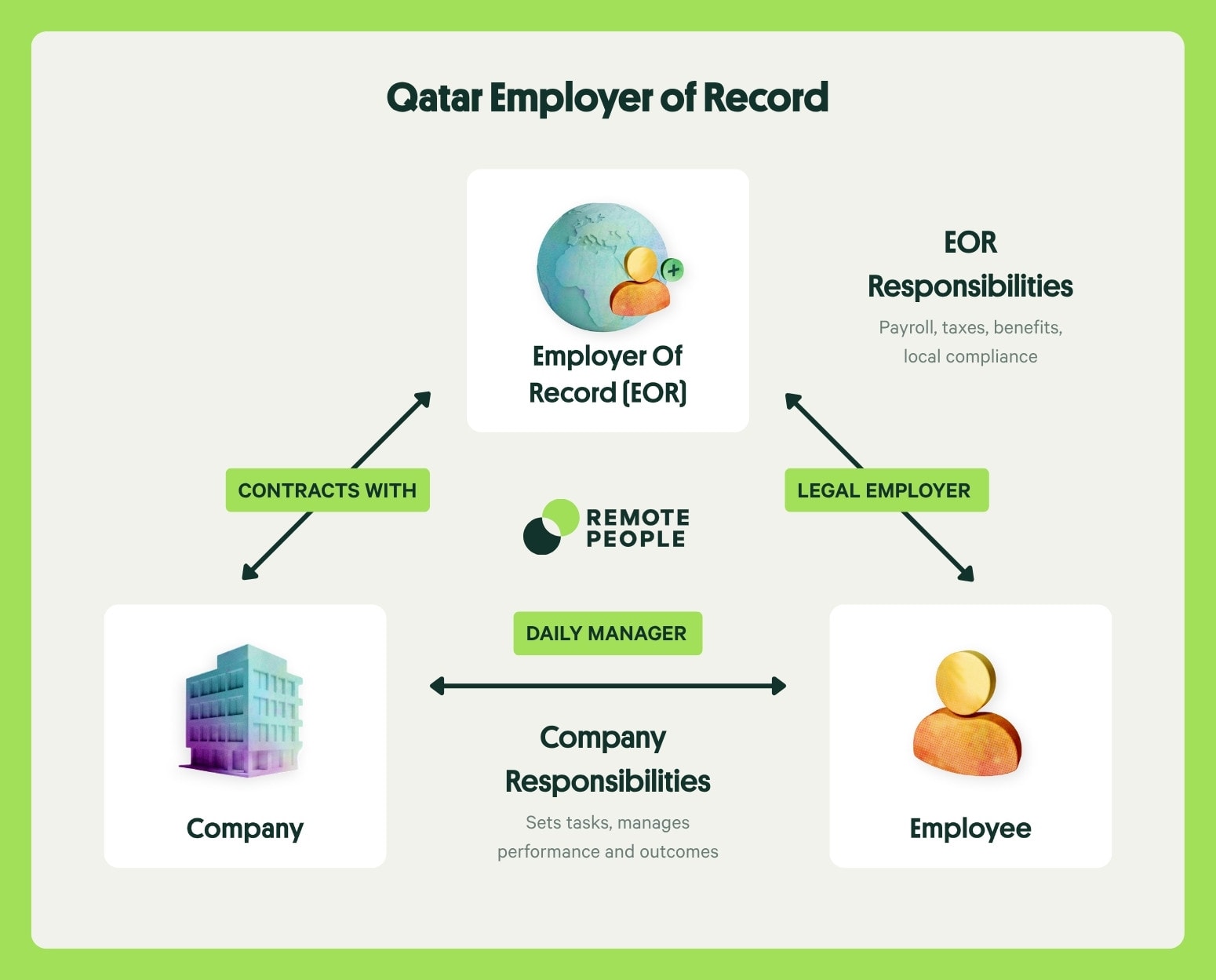
An employer of record in Qatar solves this by acting as the legal employer on your behalf, handling contracts, WPS payroll, work permit sponsorship, end of service gratuity accruals, and offboarding while your employees report directly to you. See how RemotePeople’s EOR solution works across 150+ countries.
How an Employer of Record Works in Qatar
If you’d like to learn more about how Employer of Record (EOR) services work, read our What Is an Employer of Record (EOR)? guide for a complete overview of the model, its benefits, and when to use it.
If you’re comparing providers, our Best Employer of Record (EOR) Providers guide reviews the leading platforms to help you choose the right solution for your business.
Who Uses an EOR in Qatar?
EOR services in Qatar are typically used by companies that want a compliant hiring solution without committing to a Qatari commercial registration or a QFC licence. Common scenarios include:
- Testing the Gulf market: A company looking to validate demand in Doha before committing to an entity can hire one or two people through an EOR while retaining the option to set up later.
- Hiring a regional lead based in Doha: For organizations expanding into the GCC, placing a regional manager in Qatar through an EOR is faster than registering a Qatar Financial Centre entity.
- Retaining relocating employees: An existing employee moving to Doha on a spouse’s residence permit can be kept on payroll through an EOR rather than lost to resignation.
- Onboarding foreign hires quickly: Any business hiring employees in Qatar who need sponsored work permits can use the EOR’s existing Ministry of Labour establishment file instead of building one from scratch.
The EOR model is also a practical fit for teams hiring between one and fifteen people in Qatar, where the cost and lead time of entity setup would outweigh the benefit. Companies hiring regionally often pair Qatar with an EOR in Saudi Arabia or an EOR in Bahrain to cover the wider Gulf market under a single provider.
Typical Onboarding Timeline
Most EOR providers can onboard an employee in Qatar within one to two weeks when the candidate is already a Qatari resident with a valid QID. For expatriates hired from outside Qatar, the Ministry of Labour block work permit plus Ministry of Interior employment visa plus residence permit chain adds roughly four to six weeks in total. The typical sequence looks like this:
- First, the client signs the EOR agreement and provides employee details, job description, and compensation package (1–2 days).
- Second, the EOR drafts the bilingual Arabic-English employment contract under Labour Law No. 14 of 2004 and sends it for signature (2–3 days).
- Third, the EOR files the block work permit with the Ministry of Labour and obtains the employment visa approval from the Ministry of Interior (2–3 weeks for applicants outside Qatar, 3–5 days for local residents).
- Fourth, on arrival, the employee completes biometric capture, medical fitness testing, and residence permit issuance inside the seven-day statutory window.
- Fifth, payroll is configured on WPS, benefits are enrolled, and the employee starts work fully payrolled on day one.
Background checks, attestation of academic certificates, and medical testing at Ministry of Public Health approved centres can extend this timeline. A realistic planning assumption is two weeks for locally resident hires and five to six weeks for expatriates arriving from abroad.
Hire in Qatar
One of the wealthiest per-capita economies with WPS wage protection, end-of-service gratuity, and Qatar Labour Law compliance.
We handle employment contracts, payroll, social contributions, and full Qatari compliance.
No local entity needed. Your team can start in days.
Employment Laws and Regulations in Qatar
Employment Contracts
Employment in Qatar’s private sector is governed by Labour Law No. 14 of 2004, administered by the Ministry of Labour and the Al Meezan legal portal, which publishes the consolidated Arabic-English text. Written contracts are mandatory, must be lodged with the Ministry of Labour, and should set out the parties, job title, start date, basic salary, allowances, working hours, leave, probation (if any), and contract duration.
Contracts can be either fixed-term or indefinite. Fixed-term agreements cannot exceed five years and convert to indefinite contracts if renewed past that point. Arabic is the official language of record, and bilingual Arabic-English contracts are standard practice, with the Arabic version prevailing in any dispute before the Labour Court. Any clause that reduces statutory rights under Law No. 14 of 2004 is void by default.
Working Hours and Overtime
The standard private-sector workweek in Qatar is 48 hours, normally arranged as eight hours per day over six days, under Article 73 of the Labour Law. During the holy month of Ramadan, working hours for all employees are reduced to six hours per day and 36 hours per week with no reduction in pay. Friday is the weekly rest day for most employees under Article 75, and workers on day schedules cannot be required to work more than two consecutive Fridays.
Overtime rules sit in Articles 74 to 78 of Law No. 14 of 2004. The table below summarises the premium pay rates that apply in Qatar, drawing on the labour code plus the PwC Qatar tax summary for practical guidance.
Qatar overtime and premium pay rates · Per Labour Law No. 14 of 2004 | |||
Hour Type | Rate Multiplier | Daily Cap | Notes |
|---|---|---|---|
Weekday overtime (day hours) | 125% of basic wage | Up to 2 extra hours | Article 74. Total daily work capped at 10 hours including overtime. |
Night work (9 PM to 3 AM) | 150% of basic wage | Up to 2 extra hours | Article 74. Applies outside shift-based roles and certain managerial positions. |
Friday or weekly rest day work | 150% of basic wage plus compensatory day off | Maximum 2 consecutive Fridays | Article 75. Alternative day off or payment equal to a normal rest day must be provided. |
Public holiday work | 150% of basic wage plus compensatory day off | Normal daily working hours only | Article 78. Applies to all four gazetted public holidays. |
Ramadan working hours | Standard pay, reduced hours | 6 hours daily / 36 weekly | Article 73. Applies to all employees, not just Muslim workers, with no reduction in pay. |
Total overtime is capped so that daily working time, including overtime, does not exceed 10 hours under normal circumstances. The 9 PM to 3 AM night window is measured against the individual employee’s schedule, not the calendar, so a shift worker whose scheduled hours run through this window is not automatically entitled to the 150% premium. Overtime hours are calculated on the basic wage only, not on allowances or the full compensation package.
Minimum Wage
Qatar introduced a universal, non-discriminatory statutory minimum wage in March 2021 under Law No. 17 of 2020, making it the first country in the Gulf to set a legally binding floor that applies to all workers regardless of nationality or sector. The minimum wage in Qatar comprises three components:
- Basic wage: QAR 1,000 per month
- Accommodation allowance: QAR 500 per month if the employer does not provide suitable housing
- Food allowance: QAR 300 per month if the employer does not provide meals
The combined minimum compensation package is therefore QAR 1,800 per month where neither housing nor food is provided in kind, confirmed by the International Labour Organization. The floor has not been revised since 2021, but the Ministry of Labour reviews it every three years against inflation and labour market data. Most professional roles in Doha pay well above this level, which is designed to protect low-wage migrant workers rather than set market benchmarks for skilled positions.
Probation Period
The probation period in Qatar is capped at six months under Article 39 of Law No. 14 of 2004. Only one probation period may be applied with the same employee, and re-hiring an employee who previously completed probation with the same employer does not reset the clock. During probation, either party can terminate the contract with at least one month’s written notice. If the employee resigns during probation to move to a different Qatari employer, the new employer must compensate the original employer for recruitment costs, capped at two months’ basic wage.
Leave Entitlements
Qatar’s statutory leave framework sits inside Chapter 7 of Law No. 14 of 2004 and covers annual, sick, maternity, and several special leave categories. The rules apply to all private-sector employees, Qatari and expatriate, and cannot be reduced by contract.
Annual Leave
Employees in Qatar are entitled to 21 days of paid annual leave after one year of continuous service, rising to 28 days after five years of service with the same employer, under Article 79 of the Labour Law. Leave accrues pro-rata from day one, so employees who leave before completing a full year still receive a proportional payout. Unused leave days are paid out in cash on termination based on the last basic wage.
Sick Leave
Under Article 82, employees who have completed their probation period are entitled to 12 weeks of sick leave per year, funded by the employer in a tiered structure: the first two weeks at full pay, the next four weeks at half pay, and the final six weeks unpaid. A medical certificate from a Ministry of Public Health approved facility is required. If the employee remains unable to work after 12 weeks, the contract can be terminated with full payment of end of service gratuity.
Maternity Leave
Female employees in Qatar receive 50 days of paid maternity leave under Article 96, provided they have completed at least one year of continuous service. At least 35 of those days must be taken after the birth. The leave is funded by the employer at full pay. Nursing mothers are entitled to one additional paid hour per day for breastfeeding for a period of one year from the end of maternity leave. Where medical complications arise, employees can apply for up to 60 days of additional unpaid leave with a medical certificate.
Paternity Leave
Paternity leave is not a statutory entitlement under Qatar Labour Law No. 14 of 2004. Many large employers, particularly in banking and professional services, voluntarily offer three to five paid days, but there is no legal minimum. EOR providers typically layer in a three-day paternity policy as a standard benefit where the client requests it.
Other Statutory Leave
Law No. 14 of 2004 also provides for several additional paid leave categories for private-sector employees:
- Hajj leave: up to two weeks once in the course of service for Muslim employees with five or more years of tenure with the same employer
- Marriage leave: not a statutory right but commonly offered as three days of paid leave by larger employers
- Bereavement leave: granted at the employer’s discretion, with three days being common market practice
- Special leave: the Labour Court or Ministry of Labour may grant leave for court attendance, civic duties, or educational examinations
- Unpaid leave: available by agreement for extended personal reasons, with social insurance and gratuity accrual paused during unpaid periods
Qatar’s leave framework sits in Chapter 7 of Labour Law No. 14 of 2004 and is administered by the Ministry of Labour through the WPS pay cycle. The table below summarises the seven statutory and commonly granted leave categories an EOR tracks for every Qatar employee. The key practical takeaway for employers is that annual leave accrues from day one but entitlement only vests after the probation period completes, and sick leave is fully employer-funded rather than paid by social insurance.
Qatar statutory leave entitlements · Per Labour Law No. 14 of 2004 | ||
Leave Type | Duration | Eligibility and Notes |
|---|---|---|
Annual leave | 21 days up to 5 years, 28 days after | Article 79. Accrues pro-rata from day one. Unused days paid out on termination at last basic wage. |
Sick leave | 12 weeks per year (tiered) | Article 82. First 2 weeks full pay, next 4 weeks half pay, final 6 weeks unpaid. Employer-funded. Ministry of Public Health medical certificate required. |
Maternity leave | 50 days paid | Article 96. Requires one year of continuous service. At least 35 days taken after birth. Nursing hour entitlement for one year after leave ends. |
Paternity leave | Not statutory | No statutory entitlement. Voluntary 3–5 days common in banking, tech, and professional services. |
Hajj leave | Up to 2 weeks | Muslim employees with 5+ years of continuous service with the same employer. Granted once in career. |
Public holiday leave | Four gazetted holidays | National Sports Day, Eid Al Fitr (3 days), Eid Al Adha (3 days), Qatar National Day. Work on holidays requires 150% pay plus compensatory day. |
Unpaid personal leave | By agreement | Available by written agreement. Gratuity and GRSIA accrual pause during unpaid periods. Residence permit remains valid if employer maintains sponsorship. |
Statutory Employee Benefits
Mandatory employee benefits in Qatar split along nationality lines. For Qatari nationals, the General Retirement and Social Insurance Authority (GRSIA) covers retirement, disability, and death benefits through a single pooled contribution. For expatriate workers, who make up around 95% of the private-sector workforce, there is no social insurance scheme. Instead, the employer funds an end of service gratuity under Article 54 and carries the cost of statutory sick leave and any voluntary benefits.
Health insurance is moving toward mandatory coverage. Under Law No. 22 of 2021 on Healthcare Services within the State, the Ministry of Public Health is rolling out a compulsory insurance scheme for expatriate workers and visitors in phases, with private-sector expatriate workers scheduled to be fully covered by 2027. In the meantime, most employers provide private medical insurance as a standard benefit, and EOR providers typically bundle a compliant group plan into their fee. Housing and transport allowances are not statutory above the minimum wage floor but are customary for mid-level and senior roles, and are structured outside the gratuity base to control long-term liability.
Recent Regulatory Updates 2026
Qatar’s employment law has seen significant reform over the past six years, and several 2025 and 2026 changes are still working through payroll systems. The most important recent updates are:
Effective 3 January 2023, GRSIA contribution rates were lifted from 15% to 21% under the 2022 amendments to the Social Insurance Law, with 14% payable by employers and 7% by Qatari national employees (GPSSA announcement). The contribution salary base now includes basic salary plus social and accommodation allowances, capped at QAR 100,000 per month.
Qatar’s kafala reforms continue to bed in. Law No. 19 of 2020 removed the requirement for a No Objection Certificate (NOC) before switching employers, and Law No. 18 of 2020 abolished the exit permit requirement for most private-sector workers. These reforms, combined with the minimum wage and stronger WPS enforcement, have reshaped how employment contracts and internal transfers are managed in 2026. Penalties for WPS non-compliance now run up to QAR 6,000 per infringement, and repeat offenders risk being placed on the Ministry of Labour’s blocked employer list (Government Communications Office).
Work Permits and Visas in Qatar
Work Permit Requirements
Who Needs a Work Permit
All non-Qatari employees need a sponsored work permit and residence permit before they can start employment in Qatar. GCC nationals benefit from simplified procedures under the Gulf Cooperation Council common market framework, but still need an employer-held work permit record at the Ministry of Labour. Qatari nationals do not need permits but must be registered with GRSIA for social insurance from their first day of employment.
Eligibility and Required Documents
To qualify, the employer must hold an active Ministry of Labour establishment registration with available visa quota, a computer card, and no outstanding fees or blocks. The standard documentation bundle for the employee includes a signed employment contract, a passport valid for at least six months, attested academic and professional certificates, a recent passport photograph, a medical fitness certificate from an approved facility, a security clearance check, and biometric capture on arrival.
Processing Time and Validity
The Ministry of Labour typically processes block work permits in three to five working days for licensed employers with available quota. After entry, the residence permit must be issued within seven days under Law No. 21 of 2015 on the Entry, Exit and Residency of Expatriates, as administered by the Ministry of Interior. Standard residence permits are valid for one to three years, aligned to the employment contract, and fees are payable in Qatari riyals with the exact amount varying by profession and permit duration.
Renewal Process
Renewals must be filed before the existing residence permit expires, typically within the 90-day window before expiry. Processing usually takes three to five working days once medical recertification and updated documents are submitted. The employee can continue working during the renewal window as long as the application is filed in time. Late renewals trigger daily fines of QAR 10 per day, capped at QAR 6,000, and risk the employee being placed on the Ministry of Interior’s overstayer list.
Common Visa Types for Foreign Workers
Qatar’s work permit framework is run jointly by the Ministry of Labour (employer side) and the Ministry of Interior (immigration side), with the Ministry of Foreign Affairs handling visa issuance at Qatari embassies. The table below summarises the work permit categories available in 2026 and which ones an EOR can typically sponsor.
Qatar work visa types for foreign workers · 2026 | ||||
Visa Type | Duration | Best For | Leads to PR? | Processing |
|---|---|---|---|---|
Standard employment visa and residence permit | 1–3 years, renewable | Full-time sponsored employees, all professional categories | Yes, after 20 years (limited quota) | 2–4 weeks |
Temporary work visa | Up to 6 months, non-renewable | Short assignments, project work, audits | No | 1–2 weeks |
Work visa with family sponsorship | Tied to main permit | Senior employees earning above QAR 10,000 per month | Tied to sponsor | 3–5 weeks |
Qatar Financial Centre (QFC) sponsored visa | 1–3 years, renewable | Roles inside a QFC-registered entity | No direct route | 2–3 weeks |
Permanent residency (Law No. 10 of 2018) | Indefinite | Exceptional expatriates, spouses of Qataris, long-serving residents | Yes (100 per year quota) | 6–12 months |
Source: Qatar Ministry of Labour and Qatar Ministry of Interior | ||||
Visa types outside this table do not permit employment:
- Visit visa (30 days, extendable once): tourism and business visits only
- Transit visa (96 hours): airside transit through Hamad International Airport
- Student visa: enrolment in Qatari universities, no work rights
- Family residence as a dependent: requires separate work permit if the dependent takes up employment
How an EOR Handles Work Permits
An employer of record in Qatar is the legal sponsor for Ministry of Labour purposes, which means it files the block work permit application, submits the individual employment visa request through the Ministry of Interior, pays all fees, and assumes the compliance obligations toward both ministries and the Ministry of Foreign Affairs. The EOR handles employer-side steps like establishment registration, Qatarisation compliance, contract attestation, and residence permit coordination. The employee still needs to provide personal documents, attend biometric capture, and complete the medical fitness check in person at an approved centre.
Because the work permit chain adds up to four weeks for applicants outside Qatar, expatriate onboarding runs closer to five to six weeks end to end rather than the one to two weeks quoted in the onboarding timeline for locally resident hires. The EOR can only sponsor work permits within the employment relationship it controls, so clients needing Qatarisation credit or government contract eligibility through a company-owned entity still need a local commercial registration or QFC licence.
Payroll, Taxes, and Social Security in Qatar
Employer Contributions
Qatar has no personal income tax on wages, so the main payroll lines an employer funds are social insurance (for Qatari nationals), end of service gratuity accruals (for expatriates), and statutory allowances. The table below summarises the employer cost stack for a Qatari national under the 2023 GRSIA rates. Expatriates carry a different structure: no GRSIA, but a gratuity accrual equivalent to 5.77% of basic wage per year under Article 54.
Qatar employer social security contributions · 2026 rates | ||
Contribution | Rate | Notes |
|---|---|---|
GRSIA social insurance (Qatari nationals) | 14% of contribution salary | Base = basic salary + social and accommodation allowances, capped at QAR 100,000 per month. Effective 3 January 2023. |
GRSIA (GCC nationals) | Home country rate | Employer contributes at the GCC reciprocal protocol rate of the employee’s home country (Saudi 12%, UAE 12.5%, Kuwait 11.5%, Oman 10.5%, Bahrain 15%). |
End of service gratuity accrual (expatriates) | ~5.77% of basic wage | Article 54. Three weeks of basic wage per year of service after one year, accrued monthly on the last basic wage. |
Private health insurance | QAR 2,000–5,000 per employee per year | Required by policy practice, moving to full statutory coverage under Law No. 22 of 2021 by 2027. |
Work injury insurance | Employer-funded | Article 110. Employers must cover medical costs and compensation for work-related injuries, typically via a private policy. |
Total employer cost above gross wage (Qatari national) | ~14% plus benefits | Varies with insurance premium and role risk rating. |
Employee Contributions
Qatar does not levy personal income tax on wages, salaries, or allowances paid to employed individuals, confirmed by the PwC Qatar personal income tax summary. The only employee-side deduction is GRSIA social insurance for Qatari nationals, and the GCC reciprocal protocol rate for nationals of other Gulf states.
Qatar employee payroll deductions · 2026 monthly withholdings | ||
Deduction | Rate | Notes |
|---|---|---|
Personal income tax | 0% | No income tax on employment income in Qatar. All wages paid gross of tax. |
GRSIA social insurance (Qatari nationals) | 7% of contribution salary | Employee-side share on the same contribution salary as the employer. Cap QAR 100,000 per month. |
GRSIA (GCC nationals) | Home country employee rate | Deducted per GCC reciprocal protocol and remitted to the home country’s scheme by the Qatar employer. |
Expatriate employee deductions | 0% | No statutory payroll deductions for non-GCC expatriate employees. Any voluntary deductions require written consent. |
Total employee deductions (Qatari national) | 7% | Capped at QAR 7,000 per month (7% of QAR 100,000). |
Source: PwC Qatar Personal Income Tax and GRSIA Qatar | ||
Income Tax
Qatar does not levy a personal income tax on employment earnings, so there are no income tax brackets, no withholding on salaries, and no annual filing obligation for individuals whose only Qatari income is employment wages. The 10% flat income tax rate described in Qatar’s Income Tax Law (Law No. 24 of 2018) applies only to self-employment income or business activity sourced in Qatar, not to employed individuals.
Qatar income tax brackets · 2026 | |
Income Category | Tax Treatment |
|---|---|
Employment income (all brackets) | 0% (no personal income tax on salaries, wages, or allowances) |
Self-employment or business income from Qatari sources | 10% flat rate under Law No. 24 of 2018 |
Capital gains (individuals, non-business) | 0% (exempt unless part of a taxable business activity) |
Capital gains (non-residents, Qatar-sourced) | 10% where sourced in Qatar |
Bank interest and rental income (individuals) | 0% (exempt unless part of a taxable business activity) |
Payroll Cycle
Private-sector payroll in Qatar runs on a monthly cycle and must be paid through the Wage Protection System (WPS) into a local Qatari bank account within seven days of the due date under Article 66 of Law No. 14 of 2004. Salaries must be paid in Qatari riyals, and all allowances, overtime, and deductions must be itemised on the Salary Information File (SIF) submitted to the Qatar Central Bank via the WPS gateway. Employers file monthly WPS reports and must retain payroll records for ten years for Ministry of Labour inspection.
There are no payroll tax filing deadlines as such, because Qatar has no income tax. GRSIA contributions for Qatari and GCC national employees are remitted monthly by the fifteenth of the following month. Failure to pay on time triggers an interest charge of 0.5% per month under the GRSIA regulations. Pay slips must be issued monthly and must show the breakdown between basic wage, allowances, overtime, and any deductions.
13th Month Salary and Bonus Pay
Qatar has no statutory 13th month salary, 14th month, or mandatory bonus requirement under Law No. 14 of 2004. Annual performance bonuses, Ramadan bonuses, and discretionary allowances are common in Doha’s professional services, banking, and energy sectors but remain entirely at the employer’s discretion. The only guaranteed end-of-year payment is accrued annual leave and the ongoing end of service gratuity. Where a bonus is contractually guaranteed, it becomes part of the employee’s entitled wage under Article 66 and must be paid through WPS like any other payment.
Cost of Hiring Through an EOR in Qatar
EOR Service Fees
EOR service fees in Qatar typically range from $300 to $600 per employee per month, depending on the provider, seniority of the role, and whether work permit sponsorship is required for expatriate hires. The fee generally covers contract drafting, WPS payroll processing, monthly reporting, GRSIA or gratuity accruals, statutory leave tracking, and standard offboarding. Work permit sponsorship, attestation fees, and government charges are billed as pass-through costs on top of the base fee. Health insurance and any voluntary benefits (additional paternity leave, relocation support, housing allowance) are either layered into the monthly fee or billed separately depending on the provider’s bundling.
Total Employment Cost Breakdown
The example below shows the monthly employer cost of hiring a Qatari national on a gross basic salary of USD 4,000 through an EOR. Qatar’s lack of personal income tax means the employee receives the full USD 4,000 as take-home pay minus only the 7% GRSIA contribution. Employer-side costs are driven by the 14% GRSIA contribution plus health insurance and the EOR fee. For expatriate hires, the GRSIA line is replaced by a 5.77% end of service gratuity accrual.
Qatar employer cost example · USD 4,000 gross · 2026 | ||
Employer Cost | Amount (USD) | % of Gross |
|---|---|---|
Gross monthly basic salary | $4,000 | 100.0% |
GRSIA social insurance (14%, Qatari national) | $560 | 14.0% |
Private health insurance (estimated) | $250 | 6.3% |
Work injury and general insurance | $40 | 1.0% |
EOR service fee (est.) | $450 | 11.3% |
Total monthly employer cost | $5,300 | 132.5% |
Source: GRSIA contribution rates and PwC Qatar Other Taxes | ||
Figures converted at 1 USD ≈ 3.64 QAR, April 2026. Qatar’s riyal is pegged to the US dollar, so conversion is stable over time.
The total employer cost of hiring a Qatari national through an EOR lands at roughly 32% above gross basic salary. For an expatriate, the GRSIA line is replaced by the 5.77% gratuity accrual, bringing the total markup down to roughly 24% above gross. That is one of the lowest markups in the Gulf, reflecting Qatar’s zero-income-tax regime and the absence of social insurance for expatriate workers.
Ready to hire in Qatar? Get started with RemotePeople. We handle employment contracts, WPS payroll, work permit sponsorship, end of service gratuity, and full Qatar compliance. No local entity needed.
Benefits of Using an EOR in Qatar
An employer of record in Qatar compresses months of entity setup, labour law research, and government liaison into a single commercial agreement. For companies hiring between one and fifteen people, or testing the market before committing to a Qatari entity, the case is usually compelling. The main advantages are:
- Speed to market: An EOR can onboard a locally resident hire in Qatar in one to two weeks, compared to three to six months for a full commercial registration or QFC licence. For expatriates, the five to six week end-to-end timeline is still faster than building an entity from scratch.
- Compliance assurance: The EOR signs contracts under Labour Law No. 14 of 2004, runs WPS payroll on time, accrues end of service gratuity correctly, and files with the Ministry of Labour. Failures on any of these lines can trigger fines up to QAR 6,000 per infringement and blocked employer status.
- Cost efficiency: A local entity in Qatar typically costs $15,000 to $40,000 to set up (Qatar Chamber of Commerce registration, commercial registration, immigration card, office lease, legal fees) and $20,000 to $60,000 per year in ongoing accounting, audit, and compliance costs. An EOR fee of $300 to $600 per employee per month breaks even somewhere between 10 and 15 employees, below which the EOR wins clearly on cost.
- Local expertise: Qatar’s labour system has specific rules on kafala reforms, Qatarisation quotas, WPS file formats, and Ministry of Interior sponsorship that are not intuitive to foreign HR teams. EOR staff in Doha deal with these every day and keep the client insulated from the operational detail.
- Flexibility to scale: Headcount can move up or down inside the EOR relationship without the cost and lead time of entity registration or dissolution. Qatari law makes entity closure slow and expensive, so the EOR’s flexibility matters most on the way out.
- Risk mitigation: The EOR carries the employer-of-record risk, including unpaid wages disputes, Ministry of Labour complaints, and Labour Court claims. The client retains commercial control of the role without holding legal employer liability.
- Employee experience: A properly run EOR in Qatar gets residence permits issued inside the seven-day window, salaries paid on time through WPS, health insurance enrolled from day one, and end of service gratuity paid without the delays that plague under-resourced employers. Employee retention is measurably better.
For companies hiring at scale in Qatar, the economics flip the other way and an entity becomes cheaper on a unit basis above roughly 15 to 20 employees. The EOR is a stepping stone rather than a permanent solution, and most providers can migrate staff into a client-owned entity when the time is right.
Termination and Offboarding in Qatar
Notice Periods
Notice periods in Qatar are set by length of service under Article 49 of Law No. 14 of 2004 and apply equally to the employer and the employee. Notice must be given in writing, the contract remains in force and fully paid until the last day of notice, and notice can be paid in lieu by either party at the basic wage rate. Either party that fails to give proper notice owes compensation equal to the basic wage for the remaining notice period.
Qatar statutory notice periods by position level · Per Labour Law No. 14 of 2004 | |||
Length of Service | Notice Period | During Probation | Notes |
|---|---|---|---|
Less than 1 year | 1 week minimum, 1 month typical | 1 month written notice | Article 49. Applies to indefinite contracts after probation ends. |
1 to 5 years | 1 month | Not applicable | Article 49. Standard tier for most private-sector employees. |
More than 5 years | 2 months | Not applicable | Article 49. Applies to both employer-initiated and employee-initiated termination. |
Fixed-term contracts | Contractual period | Notice per contract | Early termination triggers compensation equal to the wages remaining on the contract, unless cause applies under Article 61. |
Managerial and senior staff | Per contract, typically 2–3 months | Per contract | Labour Law floor applies. Contracts commonly extend notice for senior roles. |
Notice is always calendar days rather than working days. Summary dismissal without notice is available under Article 61 for specific just-cause events such as assault on the employer, disclosure of trade secrets, or repeated breach of safety rules, but requires a documented internal investigation. Mutual termination by written agreement bypasses the notice requirement but cannot reduce the employee’s end of service gratuity entitlement.
Severance Pay
End of service gratuity is the core severance mechanism in Qatar and is mandatory for any employee who completes at least one year of continuous service under Article 54 of Law No. 14 of 2004. The gratuity applies to employer-initiated termination (other than for just cause under Article 61), resignation after one year, contract expiry, and death in service. The governing article is clear that the formula is a floor, not a ceiling, and contracts commonly provide more generous terms for senior staff.
Qatar severance pay schedule by years of service · Per Labour Law No. 14 of 2004 | |||
Years of Service | Severance Amount | Base Salary | Notes |
|---|---|---|---|
Less than 1 year | Nil | Not applicable | Article 54. No gratuity if service is under one year. Accrued annual leave is still paid out. |
1 year | 3 weeks of basic wage | Last monthly basic wage | For a QAR 10,000 basic wage: QAR 10,000 ÷ 30 × 21 = QAR 7,000. |
3 years | 9 weeks of basic wage | Last monthly basic wage | For a QAR 10,000 basic wage: QAR 7,000 × 3 = QAR 21,000. |
5 years | 15 weeks of basic wage | Last monthly basic wage | For a QAR 10,000 basic wage: QAR 7,000 × 5 = QAR 35,000. |
10 years | 30 weeks of basic wage | Last monthly basic wage | For a QAR 10,000 basic wage: QAR 7,000 × 10 = QAR 70,000. |
Calculation Method
The statutory formula under Article 54 is three weeks (21 days) of basic wage per completed year of service, calculated on the last basic wage at the date of termination. Partial years are paid pro-rata, so an employee who works two years and six months receives 2.5 years’ worth of gratuity. Only basic wage counts for the calculation, not allowances, overtime, or commissions, unless the employment contract explicitly extends the gratuity base. See the worked examples in Table 13 above rather than recalculating them in prose.
Caps and Exceptions
There is no statutory cap on total gratuity in Qatar, so a 25-year employee receives 25 times three weeks of basic wage. Gratuity is forfeited only in narrow Article 61 just-cause scenarios, such as assault on the employer, disclosure of trade secrets, repeated intoxication at work, or conviction of a crime involving honour or trust. Employees on fixed-term contracts who resign before contract end forfeit gratuity unless the resignation is for a reason recognised under Article 51 (non-payment of wages, employer breach, etc.). The employer may deduct amounts owed by the employee (unpaid loans, inventory shortfalls) from the gratuity payment.
Grounds for Termination
Qatari law distinguishes between without-cause termination (requires notice plus gratuity), just-cause dismissal under Article 61 (no notice, no gratuity), mutual termination (negotiated), contract expiry (fixed-term), and resignation. Protected categories include pregnant employees, employees on maternity leave, employees on certified sick leave, and employees who have filed Labour Court complaints. The Ministry of Labour can order reinstatement or compensation where termination is deemed arbitrary. On termination, the employer must pay all outstanding wages, accrued leave, and gratuity, cancel the work permit, and release the employee’s residence permit within the statutory grace period.
EOR vs. Other Hiring Models in Qatar
EOR vs. Setting Up a Local Entity
Qatar EOR vs local entity comparison · Setup time, cost, risk and best-fit | ||
Comparison Factor | Employer of Record | Own Entity (LLC or QFC) |
|---|---|---|
Setup time | 1–2 weeks | 3–6 months (LLC), 2–3 months (QFC) |
Upfront cost | $0 | $15,000–$40,000 |
Ongoing cost | $300–$600/employee/month | $20,000–$60,000/year maintenance |
Local partner required | No (EOR is the local entity) | Not required since 2019 for most sectors, required in restricted sectors |
Social insurance registration | Handled by EOR | You manage it |
WPS payroll and tax filing | Handled by EOR | You manage it (or outsource) |
Best for team size | 1–15 employees | 15+ employees |
Scale down / exit | Easy (no entity to unwind) | Costly (legal dissolution required, typically 6 to 12 months) |
Government contracts | Not eligible | Eligible (requires local entity plus Qatarisation compliance) |
For small teams and market-entry hires, the EOR wins on time, cost, and cash outlay. For employers looking to hire 15 or more staff, bid on Qatari government contracts, or build a long-term Qatarisation track record, a local entity becomes the right structural choice. The middle ground is common: companies start on an EOR, validate demand, then migrate staff into a newly established LLC or QFC entity once scale justifies the fixed costs.
Qatar Financial Centre entities are a popular middle path for financial services, professional services, and holding structures. The QFC offers its own employment law regime (broadly similar to English common law), its own tax treatment, and faster incorporation than a mainland LLC, but is restricted to QFC-licensed activities. For operational companies outside QFC’s permitted list, a Ministry of Commerce and Industry LLC remains the route.
EOR vs. Hiring Independent Contractors
Qatar EOR vs independent contractors · Compliance, cost, and risk | ||
Comparison Factor | EOR (Full-Time Employee) | Independent Contractor |
|---|---|---|
Legal relationship | Employee of the EOR | Self-employed, no employment relationship |
Compliance risk | Low (EOR ensures Labour Law compliance) | Elevated (misclassification risk if relationship resembles employment) |
Payroll and tax | EOR handles WPS, contributions, and filings | Contractor invoices you; they handle any self-employment tax |
Benefits and leave | Statutory benefits, paid leave, end of service gratuity | No entitlement to employee benefits |
IP protection | Stronger (employment contract assigns IP to the client company by default) | Weaker (requires explicit IP assignment clause in the service agreement) |
Termination | Subject to Article 49 notice and Article 54 gratuity | Contract can be ended per agreement terms |
Best for | Long-term, core team roles | Short-term projects, specialised one-off tasks |
Cost structure | Salary + employer contributions + EOR fee | Contractor fee (typically higher gross, lower total cost) |
Qatar does not have the same body of misclassification case law as Europe or North America, but the Ministry of Labour and the Labour Court apply a functional test: if the relationship involves regular hours, line-management direction, exclusive services, and use of company equipment, it will be treated as employment regardless of the contract label. Consequences of a reclassification include back-dated end of service gratuity, unpaid annual leave, WPS back-filings, and potential immigration issues because the worker never held a valid work permit.
Contractors are only appropriate in some cases, such as a short-term audit assignment, a specific deliverable from a specialist firm, or cross-border advisory where the individual is based outside Qatar. For long-term core roles based in Doha, RemotePeople’s EOR or contractor of record solution keeps the commercial relationship clean while taking the compliance and IP risk off the client’s books.
EOR vs. PEO (Professional Employer Organization)
Qatar EOR vs PEO comparison · Legal employer, liability, and setup | ||
Comparison Factor | Employer of Record (EOR) | PEO |
|---|---|---|
Legal employer | EOR is the legal employer | You remain the legal employer (co-employment) |
Local entity required | No (the EOR is the local entity) | Yes (you must have your own entity in Qatar) |
Best for | Companies without a local entity | Companies that already have a local entity |
Compliance liability | EOR assumes compliance responsibility | Shared liability between you and the PEO |
Setup time | 1–2 weeks | Depends on your entity setup (weeks to months) |
Control over HR policies | EOR manages within the Labour Law framework | More direct control, PEO advises |
Typical use case | Market entry, small remote teams, testing new markets | Established local operations needing HR outsourcing |
Qatar does not have a formal PEO licensing regime in the US or South-East Asian sense. The co-employment model itself is not recognised by Qatari labour law, which treats the registered sponsor as the sole legal employer. What Qatari providers market as a PEO is generally a payroll-and-HR outsourcing service attached to a client-owned entity, rather than true co-employment. For companies without a Qatari entity, the EOR route is the only compliant option; for companies with an entity, a payroll or HR outsourcing partner can still take operational work off the table without changing the legal employer.
The practical choice between EOR and PEO-style outsourcing is therefore driven by whether the client already holds a Qatari commercial registration. Below 15 employees, an EOR avoids the entity overhead. Above that threshold, a local entity plus a payroll outsourcer usually becomes cheaper and gives the client control over Qatarisation credit, government contracts, and long-term presence.
Public Holidays in Qatar
Qatar gazettes four official public holidays per year, covering Islamic observances and the national day. The Eid dates shift each year based on lunar moon sighting confirmed by the Qatar Cabinet, and the exact number of days off is announced shortly before each Eid. The table below shows the 2026 calendar based on the Amiri Diwan’s latest announcements.
Qatar public holidays · 2026 calendar year | ||
Date | Holiday | Type |
|---|---|---|
Tuesday, 10 February 2026 | National Sports Day | National observance (second Tuesday of February) |
Tuesday, 17 March 2026 – Monday, 23 March 2026 | Eid Al Fitr | Islamic (dates subject to moon sighting, private sector minimum 3 days) |
Wednesday, 27 May 2026 – Sunday, 31 May 2026 | Eid Al Adha | Islamic (private sector minimum 3 days, public sector up to 5) |
Friday, 18 December 2026 | Qatar National Day | National (commemorates 1878 founding by Sheikh Jassim bin Mohammed bin Thani) |
Employees required to work on a gazetted public holiday are entitled to 150% pay plus a compensatory day off under Article 78 of Law No. 14 of 2004. The private sector receives a minimum of three paid days for each Eid holiday, even when the public sector takes a longer break, so scheduling around Eid requires confirmation of the exact dates from the Ministry of Labour a few weeks before each occurrence.
How to Get Started with an EOR in Qatar
Hiring through an EOR in Qatar is a short, linear process. The steps below map the typical client journey from first enquiry to first payroll cycle:
- First, identify the role and compensation package. Confirm the job title, reporting line, basic salary in Qatari riyals or US dollars, allowances, and any voluntary benefits. RemotePeople’s team benchmarks compensation against the average salary in Qatar by role and tenure.
- Second, sign the EOR service agreement. The agreement sets out the monthly fee, in-scope services, and the pass-through costs for work permits and attestations. Standard EOR contracts can be signed in one to two business days.
- Third, complete the employee documentation pack. The EOR drafts the bilingual employment contract under Labour Law No. 14 of 2004 and collects the supporting documents needed for work permit and residence permit issuance.
- Fourth, run the work permit process for expatriate hires. The EOR files the block work permit with the Ministry of Labour, obtains the employment visa from the Ministry of Interior, and coordinates residence permit issuance inside the seven-day statutory window after arrival.
- Fifth, payroll go-live and ongoing management. The first WPS payroll runs on the next monthly cycle. The EOR handles GRSIA and gratuity accruals, statutory leave tracking, health insurance, and offboarding through the full life of the employment relationship.
Ready to hire in Qatar? Contact RemotePeople to start the process. We handle contracts, WPS payroll, work permit sponsorship, end of service gratuity, and full Qatar Labour Law compliance, so your team can start in days, not months.
Where companies hiring in Qatar expand next
Companies hiring in Qatar commonly expand across the GCC, where harmonized residency rules and aligned payroll practices make regional coverage straightforward. Many companies add hiring in Bahrain first, drawing on GCC-aligned residency and payroll practices. An EOR partner in Oman follows as harmonized GCC labor rules and talent mobility, while the United Arab Emirates offers shared GCC employment frameworks. A team in Saudi Arabia is often the fourth step, valued for GCC-wide compensation and compliance parity.
Frequently Asked Questions
EOR services in Qatar typically cost between $300 and $600 per employee per month, depending on seniority of the role, work permit sponsorship requirements, and any voluntary benefits layered on top. The fee covers contract drafting, WPS payroll, GRSIA or end of service gratuity accruals, statutory leave tracking, and standard offboarding (PwC Qatar). Work permit fees, attestations, and medical tests are billed as pass-through costs on top of the monthly fee.
No. Qatar does not levy personal income tax on wages, salaries, or allowances paid to employed individuals, regardless of nationality (PwC Qatar Personal Income Tax). Qatari nationals pay 7% of their contribution salary to GRSIA social insurance; expatriates have no statutory payroll deductions at all. Employers pay 14% GRSIA on Qatari nationals and accrue end of service gratuity for expatriates at three weeks of basic wage per year of service.
For a locally resident candidate with a valid Qatari ID and existing residence permit, onboarding through an EOR typically takes one to two weeks. For an expatriate hired from outside Qatar, the work permit and residence permit chain adds roughly three to four weeks, giving a total timeline of five to six weeks (Ministry of Labour). Attestation of foreign academic certificates can add another one to two weeks depending on the origin country.
End of service gratuity is a mandatory payment to any employee who completes at least one year of continuous service, calculated as three weeks of basic wage per completed year under Article 54 of Law No. 14 of 2004. For an employee earning a QAR 10,000 basic wage with five years of service, gratuity is QAR 35,000 (QAR 10,000 ÷ 30 × 21 × 5). Partial years are paid pro-rata. Only basic wage counts, not allowances, unless the contract extends the gratuity base.
Contractors are only appropriate in some cases, such as short-term project work, specialist advisory from an established firm, or remote workers based outside Qatar. For long-term roles based in Doha with regular hours and line-management direction, the Ministry of Labour and Labour Court will treat the relationship as employment regardless of the contract label, triggering back-dated gratuity, leave, and WPS liabilities. RemotePeople\u2019s contractor of record solution handles compliant contractor engagement for Qatar alongside the EOR for permanent hires.
The EOR is the legal employer for all Qatar labour law, immigration, and tax purposes. The EOR holds the Ministry of Labour establishment file, the Ministry of Interior sponsor code, and the commercial registration, and it signs the employment contract with the employee. The client company (you) directs the day-to-day work, sets the role, and manages performance, but does not hold legal employer liability. The employment contract assigns intellectual property to the client company (you), not the EOR.
Yes. All non-Qatari employees, including GCC nationals in most cases, need a sponsored work permit and residence permit before they can start work (Ministry of Interior). The employer files a block work permit with the Ministry of Labour, obtains an employment visa through the Ministry of Interior, and must issue the residence permit within seven days of the employee\u2019s arrival in Qatar under Law No. 21 of 2015. An EOR holds the sponsor code and files all these steps on your behalf.
On termination, the EOR serves the statutory notice under Article 49 (one week to two months depending on tenure), runs the final WPS payroll, pays accrued annual leave and end of service gratuity, cancels the work permit with the Ministry of Labour, and releases the residence permit with the Ministry of Interior. Expatriate employees typically have a 90-day grace period after residence permit cancellation to find a new sponsor or leave the country. The EOR retains payroll and contract records for ten years as required by Article 66 of Law No. 14 of 2004.
Employer of Record in
Employer of Record in
Employer of Record in
Employer of Record in
Employer of Record in
Employer of Record in
Employer of Record in
Employer of Record in