
 Recruit
Employer of Record (EOR) in Lebanon
-
 Drew Donnelly
- Published
- September 22, 2026
RemotePeople’s employer of record in Lebanon lets you hire employees in Lebanon without complex social security setup. We handle National Social Security Fund registrations, employer contributions of 21.5% and employee contributions of 2%, and mandatory maternity leave and leave entitlements.
Hire in Lebanon — book a free 30-minute demo
Tell us what you need. You'll get a tailored, transparent proposal within 24 hours, plus a free call to walk through it.
Tell us about your company
So we can match you with a specialist who knows your market — and unlock volume pricing tiers.
* All fields are required.
Where and when are you hiring?
Tell us the geography and timing and we'll quote each country line by line, with onboarding timelines.
* All fields are required.
Help us beat your current setup
We'll benchmark your current deal and send a line-by-line proposal in 24 hours — showing exactly where we cut cost, time, or risk. After you submit, you can book a call to walk through it together.
* All fields are required.
Thanks! Your proposal is on its way.
Expect a tailored, line-by-line proposal in your inbox within 24 hours. In the meantime…
Want to walk through it together?
Book a free 30-minute call with one of our specialists. We'll explain every line, answer your questions, and tailor the proposal further if you need.
No obligation. Pick a time that works for you.








- Hire in Lebanon — book a free 30-minute demo
- Tell us about your company
- Where and when are you hiring?
- Help us beat your current setup
- Thanks! Your proposal is on its way.
- How an Employer of Record Works in Lebanon
- Employment Laws and Regulations in Lebanon
- Work Permits and Visas in Lebanon
- Payroll, Taxes, and Social Security in Lebanon
- Cost of Hiring Through an EOR in Lebanon
- Benefits of Using an EOR in Lebanon
- Termination and Offboarding in Lebanon
- EOR vs. Other Hiring Models in Lebanon
- Public Holidays in Lebanon
- How to Get Started with an EOR in Lebanon
- Where companies hiring in Lebanon expand next
- Frequently Asked Questions
- Related EOR Destinations

Start hiring in Lebanon
Let RemotePeople handle payroll, compliance, and HR admin worldwide so you can focus on building your team.

Lebanon attracts international employers with skilled, multilingual talent fluent in Arabic, French, and English. But setting up shop locally means navigating the 1946 Labour Code, mandatory National Social Security Fund (NSSF) enrollment, and a shifting regulatory landscape.
An employer of record in Lebanon streamlines this process by serving as the legal employer, managing all compliance obligations while you focus on strategic hiring decisions. This guide walks you through everything you need to know about EOR hiring in Lebanon for 2026 – employment law, payroll, taxes, benefits, and step-by-step onboarding.
How an Employer of Record Works in Lebanon
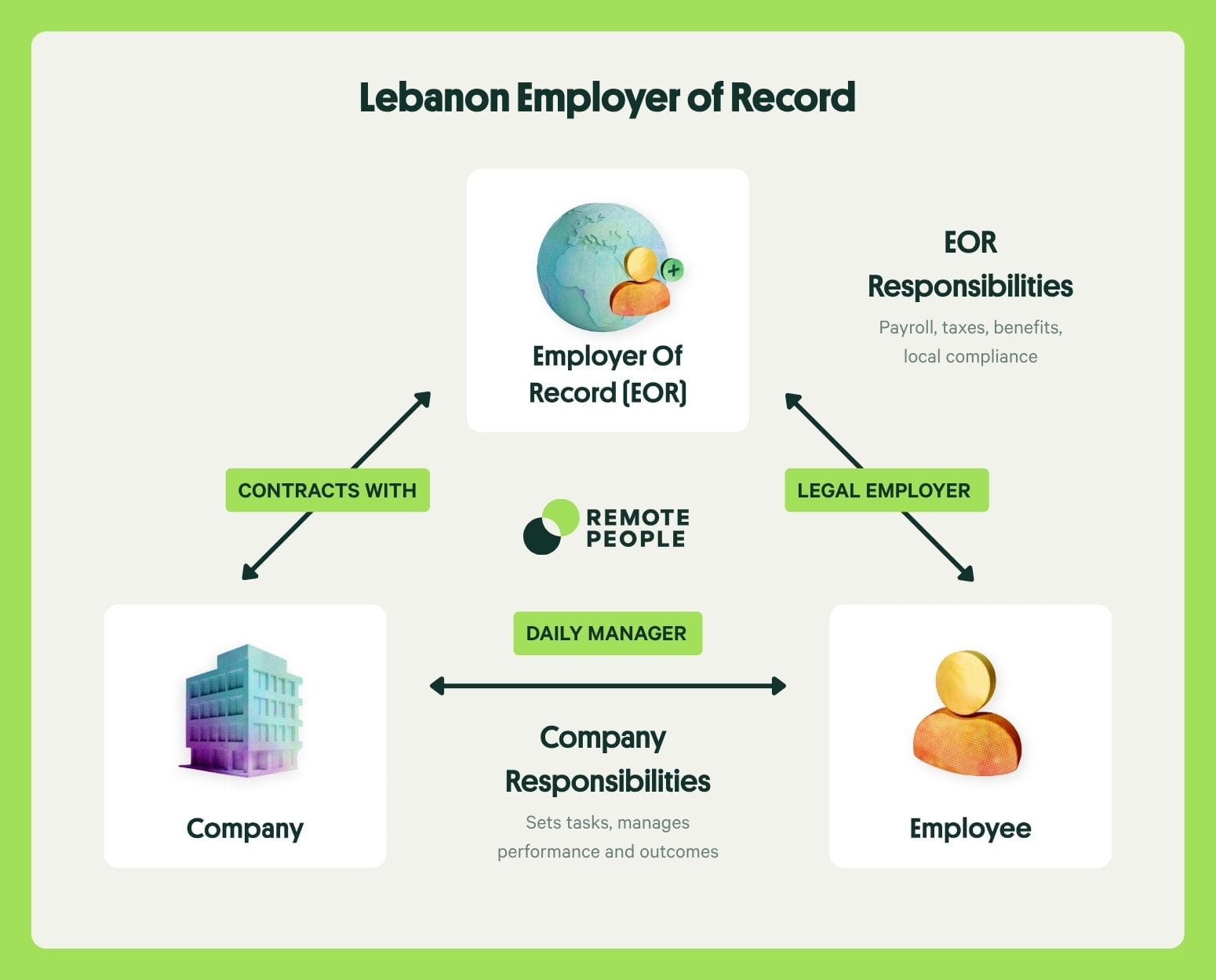
If you’d like to learn more about how Employer of Record (EOR) services work, read our What Is an Employer of Record (EOR)? guide for a complete overview of the model, its benefits, and when to use it.
If you’re comparing providers, our Best Employer of Record (EOR) Providers guide reviews the leading platforms to help you choose the right solution for your business.
Who Uses an EOR in Lebanon?
Companies of all sizes use EOR services in Lebanon. Companies exploring the Lebanese market before committing to a local entity use EORs for market testing. Organizations building distributed teams with Lebanese talent rely on EORs for remote hiring. Companies with short-term projects lasting under 12 months use EORs to avoid the overhead of establishing a formal business structure.
Employers seeking to reduce compliance risk use EORs to ensure proper employment classification and avoid misclassification penalties.
Bottom line is that an EOR gets you access to Lebanon’s talent pool while a local expert handles all the regulatory and HR legwork, in full compliance with local law.
Typical Onboarding Timeline
Hiring through an EOR is fast.
First, the EOR agreement is signed and employee details are collected, including personal information, contract preferences, and tax identifiers. Second, the EOR drafts a locally compliant employment contract in Arabic and registers the employee with NSSF within one to two days.
Third, payroll accounts are configured and the first pay cycle is scheduled during days three through five. Fourth, work permits are initiated for foreign nationals through General Security by the end of the first week. Fifth, the employee begins work with full compliance coverage in place by day seven to ten.
Work permits for foreign nationals extend the timeline by 1–3 months. Lebanese nationals typically complete onboarding within 7–10 business days.
Hire in Lebanon
A multilingual workforce, competitive labour costs, and a strategic position between Europe and the Gulf make Lebanon a strong hiring destination for companies expanding across the Middle East.
We handle employment contracts, payroll, NSSF contributions, tax withholding, and full Lebanese compliance.
No local entity needed. Your team can start in days.
Employment Laws and Regulations in Lebanon
Employment Contracts
The Lebanese Labour Code of 1946, as amended by Law No. 22 of May 2025, governs all private-sector employment relationships. Written employment contracts are strongly preferred and provide legal clarity for both parties. Contracts must be provided in Arabic; a certified Arabic translation is required for any English-language original.
Fixed-term contracts automatically convert to indefinite-term contracts if renewed or extended beyond two consecutive years of service. This automatic conversion is mandatory under the Labour Code and cannot be waived by agreement.
Working Hours and Overtime
The Lebanese Labour Code sets a standard 48-hour work week (8 hours daily, 6 days). Employees get a minimum of 9 consecutive hours off per day and at least 36 continuous hours weekly (usually Sunday). Overtime work is regulated under Article 33 of the Labour Code and must be compensated at the premium rates outlined below.
Lebanon overtime and premium pay rates · Per Labour Code of 1946 | |||
Hour Type | Rate Multiplier | Weekly/Daily Cap | Notes |
|---|---|---|---|
Weekday Overtime (Daytime) | 150% (1.5×) | 2 hours per day | Article 33 of the Labour Code |
Night Work (7 PM – 7 AM) | 150% (1.5×) | – | Applies to shifts between 7 PM and 7 AM |
Weekly Rest Day Work | 200% (2×) | – | Plus compensatory rest day |
Public Holiday Work | 200% (2×) | – | Plus compensatory rest day |
Source: Lebanon Labour Code – VERTIC and PwC Lebanon Tax Summary | |||
Total overtime is capped at 2 hours per day for weekday daytime work. Employees working on public holidays or weekly rest days must receive double pay plus a compensatory rest day. Certain managerial and supervisory roles may be exempt from overtime provisions.
Minimum Wage
Lebanon’s minimum wage was increased to LL 28,000,000 per month (approximately $313 at the official exchange rate), effective August 1, 2025, per Ministry of Labour Decree No. 699. The previous rate was LL 18,000,000 per month, which had been in effect since April 2024. The daily minimum wage is LL 1,300,000.
Probation Period
The maximum probation period in Lebanon is 3 months, and it is non-renewable. During probation, employers may terminate the employment relationship without providing notice or severance indemnity. Once the probation period concludes successfully, the full tenure clock begins from the original employment start date for purposes of leave, notice, and severance calculations.
Leave Entitlements
Annual Leave
Employees are entitled to a minimum of 15 working days of paid annual leave after one year of continuous service. Leave accrues at a rate of 1.25 days per month.
The Labour Code does not mandate additional leave based on tenure, though employment contracts may provide more generous entitlements.
Sick Leave
Sick leave entitlements in Lebanon are graduated by length of service. A medical certificate is required for all absences.
Employees with less than two years of service receive half pay for 15 days and unpaid leave for 15 days. Those with two to four years receive full pay for 15 days, half pay for 15 days, and unpaid leave for 15 days.
Employees with four to six years of service receive full pay for one month, half pay for 15 days, and unpaid leave for 15 days. Those with six to ten years receive full pay for 45 days, half pay for one month, and unpaid leave for 15 days. Employees with more than ten years receive full pay for two months, half pay for one month, and unpaid leave for 15 days.
Maternity Leave
Female employees are entitled to 10 weeks of paid maternity leave, typically 6 weeks before and 4 weeks after the expected date of birth. The employer must pay full salary during maternity leave. Dismissal during pregnancy or maternity leave is strictly prohibited under the Labour Code.
Paternity Leave
Lebanon does not provide statutory paternity leave. No legal entitlement exists for male employees following the birth of a child. Some employers offer 1–3 days as a voluntary benefit.
Other Statutory Leave
The Labour Code and applicable collective agreements recognize several additional leave types. Bereavement leave provides 2 paid days for the death of a parent, spouse, child, or grandparent.
Marriage leave is typically 3–5 days, depending on the collective agreement. Pilgrimage leave of up to 15 days is available once during the employee’s tenure for religious pilgrimage.
Lebanese law provides several statutory leave protections. The table below shows the minimum entitlements. One key point: annual leave accrues from day one, not after probation ends.
Lebanon statutory leave entitlements · Per Labour Code of 1946 | ||
Leave Type | Duration | Eligibility & Notes |
|---|---|---|
Annual Leave | 15 working days | After 1 year of continuous service; accrues at 1.25 days/month |
Sick Leave (under 2 years) | 15 days full + 15 days half pay | Medical certificate required |
Sick Leave (2–4 years) | 1 month full + 1 month half pay | Medical certificate required |
Sick Leave (10+ years) | 2.5 months full + 2.5 months half pay | Maximum statutory entitlement |
Maternity Leave | 10 weeks | Full pay; typically 6 weeks pre-birth + 4 weeks post-birth |
Paternity Leave | None statutory | No legal entitlement; voluntary employer policy only |
Bereavement Leave | 2 days | Death of parent, spouse, child, or grandparent |
Pilgrimage Leave | Up to 15 days | Once during employment; for religious pilgrimage |
Statutory Employee Benefits
Beyond leave, Lebanon mandates several employer-funded benefits through NSSF and labour law.
Health insurance provided through NSSF covers medical treatment, hospitalization, and maternity benefits. The NSSF also funds family allowances for dependents, providing additional financial support for workers with eligible family members.
End-of-service indemnity is a mandatory employer contribution of 8.5% paid as a lump sum at the time of employee separation. Transportation allowance is a statutory monthly allowance established under Decree 7426.
Meal and education allowances are not legally mandated but are commonly provided by employers as competitive benefits.
Recent Regulatory Updates (2026)
Lebanon enacted significant labour law amendments in May 2025 (Law No. 22), formally recognizing remote work, flexible working arrangements, and compressed work schedules for the first time. These changes provide legal clarity for employers and employees using non-traditional work models and reduce uncertainty for companies operating distributed teams.
The minimum wage was raised to LL 28,000,000 per month in August 2025 (Decree No. 699), up from LL 18,000,000. NSSF contribution ceilings were also updated per Memorandum No. 793 (July 2025), increasing the sickness and maternity ceiling to LL 120,000,000 and the family allowance ceiling to LL 18,000,000 per month.
Work Permits and Visas in Lebanon
Work Permit Requirements
Who Needs a Work Permit
All foreign nationals employed in Lebanon require a work permit, regardless of their nationality or employment duration. Gulf Cooperation Council (GCC) citizens receive visa-free entry for up to six months, but they must still obtain a work permit from the Ministry of Labour to be legally employed. Similarly, Jordanian nationals qualify for visa-free entry for up to three months but remain subject to work permit requirements.
Eligibility and Required Documents
Here’s what you need to get a work permit: valid passport (6+ months validity), employment contract, educational credentials, medical certificate, police clearance, and proof of employer registration with the Ministry of Labour. The Ministry reviews everything, then forwards to the Directorate General of Security for final approval.
Processing Time and Validity
Work permit processing typically requires 1–3 months from submission to approval. Once issued, permits are valid for one year and may be renewed annually. The Ministry of Labour reviews all applications before the Directorate General of Security issues the official residence permit.
Renewal Process
Work permits must be renewed annually before expiry. Employees should submit updated documents, including a valid employment contract, updated medical certificate, and passport copy, at least one month before the current permit expires. Employees may continue working during the renewal period if the application is filed before the permit’s expiration date.
Common Visa Types for Foreign Workers
Lebanon offers several visa categories for foreign workers, from standard employment to investment-backed residency.
Lebanon work visa types for foreign workers · 2026 | ||||
Visa Type | Duration | Best For | Leads to Residency? | Processing |
|---|---|---|---|---|
Standard Work Permit | 1 year (renewable) | Employees with a specific job offer | Eligible to apply | 1–3 months |
Intra-Company Transfer | 1 year (renewable) | Employees transferred within same company | Eligible to apply | 1–3 months |
Freelance / Self-Employment Permit | 1 year | Independent professionals and consultants | Case-by-case | 2–4 months |
Investor Visa | 1–3 years | Individuals making significant investment | Yes, after review | 2–6 months |
Seasonal Work Permit | Up to 9 months | Temporary employment during peak periods | No | 1–2 months |
Tourist and student visas don’t allow work in Lebanon. You need a proper work permit before accepting any paid role.
- Tourist visas are issued for temporary visits and specifically prohibit commercial or wage-earning activity.
- Student visas are limited to full-time study and do not authorize employment unless explicitly noted by the issuing authority.
- Converting from tourist or student status to employment requires a new work permit application.
How an EOR Handles Work Permits
An Employer of Record coordinates directly with the Ministry of Labour and Directorate General of Security on behalf of the employer and employee. The EOR prepares all required documentation, submits applications, tracks approval status, and maintains compliance records. While some EORs sponsor permits directly under their registration, others coordinate with local labour partners to ensure timely processing and compliance with current regulations.
Employers should note that work permit processing may add 1–3 months to the overall onboarding timeline, even when using an EOR. Planning ahead and submitting applications promptly helps minimize delays and ensures the employee can begin work as scheduled.
Payroll, Taxes, and Social Security in Lebanon
Employer Contributions
Employers in Lebanon contribute to the National Social Security Fund (NSSF), which operates three separate branches: sickness and maternity insurance, family allowances, and end-of-service indemnity. These contributions are mandatory and are calculated as a percentage of gross salary, with specified monthly ceilings that reduce the effective rate for higher earners.
Lebanon employer social security contributions · 2026 rates | ||
Contribution | Rate | Notes |
|---|---|---|
NSSF Sickness and Maternity | 8% | Ceiling: LL 120,000,000/month (max LL 9,600,000) |
NSSF Family Allowances | 6% | Ceiling: LL 18,000,000/month (max LL 1,080,000) |
NSSF End-of-Service Indemnity | 8.5% | No ceiling; applies to total earnings |
Total Employer NSSF | 22.5% | Effective rate lower for high earners due to ceilings |
Source: PwC Lebanon Tax Summary and NRC Employment Rights Guide | ||
Employee Contributions
Employees contribute 3% to NSSF sickness and maternity, withheld monthly by the employer. Unlike employers, who fund three branches, employees only fund one branch, keeping their burden low by regional standards.
Lebanon employee payroll deductions · 2026 monthly withholdings | ||
Deduction | Rate | Notes |
|---|---|---|
NSSF Sickness and Maternity | 3% | Ceiling: LL 120,000,000/month (max LL 3,600,000) |
Total Employee NSSF | 3% | Employers withhold from gross salary each pay period |
Source: PwC Lebanon Tax Summary and PwC Lebanon Income Tax | ||
Income Tax
Lebanon imposes a progressive income tax with seven brackets ranging from 2% to 25%. Individuals receive a personal exemption of LL 450,000,000 (single), plus LL 225,000,000 for an unemployed spouse, and LL 45,000,000 per dependent child. Income tax is withheld monthly from salary by the employer.
Lebanon income tax brackets · 2026 | |
Bracket | Tax Calculation |
|---|---|
Up to LL 360,000,000 | 2% of taxable income |
LL 360,000,001 – LL 900,000,000 | 4% on the excess over LL 360,000,000 |
LL 900,000,001 – LL 1,800,000,000 | 7% on the excess over LL 900,000,000 |
LL 1,800,000,001 – LL 3,600,000,000 | 11% on the excess over LL 1,800,000,000 |
LL 3,600,000,001 – LL 7,200,000,000 | 15% on the excess over LL 3,600,000,000 |
LL 7,200,000,001 – LL 13,500,000,000 | 20% on the excess over LL 7,200,000,000 |
Over LL 13,500,000,000 | 25% on the excess over LL 13,500,000,000 |
Source: PwC Lebanon Income Tax and Trading Economics | |
Payroll Cycle
Payroll runs monthly. Bank transfer is mandatory for salaries over LL 10 million; all payments are in Lebanese pounds (LBP). Employers provide detailed pay slips each period showing gross, deductions, and net.
Employers must file NSSF contributions and income tax withholdings on a monthly basis with the relevant government agencies. Failure to comply with payroll filing deadlines can result in penalties and interest charges.
13th Month Salary and Bonus Pay
A 13th month salary is not mandatory under Lebanese labour law. The Labour Code of 1946 does not require employers to pay a year-end bonus or additional monthly salary. However, if an employer voluntarily offers a 13th month bonus or end-of-year payment, or if it is specified in the employment contract, it becomes a binding contractual obligation that must be paid.
Cost of Hiring Through an EOR in Lebanon
EOR Service Fees
EOR service fees run $300–$600 per employee monthly. That covers payroll, NSSF and tax filing, contract prep, compliance checks, and ongoing HR support. Costs vary by role complexity and service level.
Your total hiring cost = gross salary + employer NSSF contributions + statutory allowances + EOR fee. Here’s a real-world example: $5,000 USD monthly salary.
Lebanon employer cost example · USD 5,000 gross · 2026 | ||
Employer Cost | Amount (USD) | % of Gross |
|---|---|---|
Gross Monthly Salary | $5,000 | 100.0% |
NSSF Sickness and Maternity (8%, capped) | $107 | 2.1% |
NSSF Family Allowances (6%, capped) | $12 | 0.2% |
NSSF End-of-Service Indemnity (8.5%) | $425 | 8.5% |
Statutory Transportation Allowance | $111 | 2.2% |
EOR Service Fee (est.) | $450 | 9.0% |
Total Monthly Employer Cost | $6,105 | 122.1% |
Source: PwC Lebanon Tax Summary and WageIndicator Lebanon | ||
Figures are converted at 1 USD = LL 89,500 (April 2026). NSSF sickness and maternity contributions and family allowance contributions are subject to monthly ceilings, which significantly reduces the effective employer rate for salaries above those thresholds. The transportation allowance shown is a statutory benefit required by Lebanese labour law and is in addition to the base salary.
Ready to hire in Lebanon? Get started with RemotePeople, and we handle employment contracts, payroll, tax withholding, and full Lebanon compliance. No local entity needed.
Benefits of Using an EOR in Lebanon
Lebanon’s three-branch NSSF system, strict labour laws, and currency volatility make hiring complicated. An EOR takes that off your plate by handling compliance, managing payroll in local currency, and coordinating with government agencies.
An EOR enables rapid market entry, with operational setup achieved in one to two weeks compared to months required for establishing a legal entity. The EOR maintains full legal compliance by staying current with Lebanese labour law changes. Cost efficiency is significant, as the EOR model eliminates entity setup costs, legal fees, and registered office expenses.
The EOR handles all LBP payment processing, NSSF deductions, and income tax calculations. Risk mitigation is built into the structure, as the EOR assumes employer liability for statutory compliance. The model supports easy scaling of the team without entity restructuring.
Outsourcing HR administration, payroll, and compliance management to the EOR allows the employer to focus on core business activities and strategic growth in Lebanon.
Bottom line: let the EOR handle compliance while you focus on growing your Lebanon team.
Termination and Offboarding in Lebanon
Notice Periods
Notice periods in Lebanon vary based on the employee’s tenure with the employer and are specified in Article 50D of the Labour Code of 1946. The employer or employee must provide written notice to the other party before terminating an indefinite employment contract. Notice can be paid in lieu by mutual agreement, allowing immediate separation while compensating the employee for the notice period.
Lebanon statutory notice periods by tenure · Per Labour Code of 1946 | |||
Tenure | Notice Period | During Probation | Notes |
|---|---|---|---|
Less than 3 years | 1 month | None required | Standard indefinite contract |
3 – 6 years | 2 months | None required | Written notice required |
6 – 12 years | 3 months | None required | Written notice required |
More than 12 years | 4 months | None required | Written notice required |
During probation periods, neither party is required to provide notice; the employment relationship can be terminated immediately. Termination for just cause, such as fraud, intentional damage, or serious misconduct, requires no notice period. Fixed-term contracts do not trigger notice periods; instead, the remaining contract value (or agreed termination payment) becomes due upon early termination.
Severance Pay
Severance = 1 month salary × years of service. It’s due when you terminate without just cause, but not for misconduct. Partial years are pro-rated.
Lebanon severance pay schedule by years of service · Per Labour Code of 1946 | |||
Years of Service | Severance Amount | Base Salary | Notes |
|---|---|---|---|
1 year | 1 month salary | Last gross monthly salary | Pro-rated for partial years |
3 years | 3 months salary | Last gross monthly salary | Includes regular allowances |
5 years | 5 months salary | Last gross monthly salary | – |
10 years | 10 months salary | Last gross monthly salary | No statutory cap |
Source: Lebanon Labour Code – VERTIC and PwC Lebanon Tax Summary | |||
Calculation Method
The severance formula is straightforward: one month of the employee’s last gross monthly salary, multiplied by the total number of years of service. The base salary includes regular allowances (such as transportation and housing allowances) but not irregular bonuses. Years are calculated from the employment start date to the termination date, with partial years pro-rated to the nearest month.
Caps and Exceptions
Lebanon imposes no statutory cap on severance pay; theoretically, an employee with 30 years of service would receive 30 months’ severance. Termination for just cause under Articles 74–75 of the Labour Code eliminates severance entitlement entirely. Terminations deemed abusive by a labour court can result in additional compensation of 2–12 months’ salary beyond standard severance. Fixed-term contracts do not use the severance formula; instead, the remaining contract value is paid as termination compensation.
Grounds for Termination
Just cause for termination under Articles 74–75 of the Labour Code includes fraud, intentional damage to employer property, assault, and serious professional misconduct that violates employment duties. Termination without cause is permitted with notice and severance; the employer need not prove wrongdoing but must provide statutory notice and severance pay. Employees cannot be terminated based on pregnancy, motherhood status, union membership, or union-related activities; such terminations are deemed abusive and trigger additional compensation of 2–12 months’ salary.
EOR vs. Other Hiring Models in Lebanon
Companies expanding into Lebanon have three main hiring options: using an EOR, setting up a local entity, or engaging independent contractors. Each model has distinct advantages depending on team size, timeline, and long-term strategy.
EOR vs. Setting Up a Local Entity
Setting up a subsidiary in Lebanon involves registration with the Commercial Registry, Ministry of Finance, and NSSF, a process that typically takes 3–6 months. An EOR eliminates this process entirely, serving as the legal employer from day one. The comparison below highlights the key differences in cost, speed, and operational requirements.
Lebanon EOR vs local entity comparison · Setup time, cost, risk and best-fit | ||
Comparison | Employer of Record | Own Entity |
|---|---|---|
Setup time | 1–2 weeks | 3–6 months |
Upfront cost | $0 | $15,000–$30,000 |
Ongoing cost | $300–$600/employee/month | $10,000–$25,000/year maintenance |
Local partner required | No (EOR is the local entity) | Yes, for most structures |
Social insurance registration | Handled by EOR | You manage it |
Payroll and tax filing | Handled by EOR | You manage it (or outsource) |
Best for team size | 1–15 employees | 15+ employees |
Scale down / exit | Easy, no entity to unwind | Costly, legal dissolution required |
Government contracts | Not eligible | Eligible (requires local entity) |
Source: RemotePeople EOR and PwC Lebanon | ||
Go with an EOR if you’re entering Lebanon fresh or testing the market. No registration costs, fast hiring. Add employees as you grow and exit clean if things change.
Choose a local entity if you’re planning 15+ hires and staying long-term. You’ll get government contracts and more control, but expect 3–6 months setup, $15k–$30k upfront, and $5k–$10k to dissolve if you leave.
Most startups use an EOR first, then build an entity if they hit 15+ employees or need government contracts.
EOR vs. Hiring Independent Contractors
Contractor arrangements are cheaper for short-term work, but watch out for misclassification risk. If the worker is directed daily, works exclusively for you, or uses your equipment, labour authorities may reclassify them as an employee.
Lebanon EOR vs independent contractors · Compliance, cost, and risk | ||
Comparison | EOR (Full-Time Employee) | Independent Contractor |
|---|---|---|
Legal relationship | Employee of the EOR | Self-employed, no employment relationship |
Compliance risk | Low, EOR ensures local labor law compliance | High, misclassification risk if relationship resembles employment |
Payroll and tax | EOR handles withholding, contributions, filings | Contractor invoices you; they handle their own taxes |
Benefits and leave | Statutory benefits, paid leave, social security | No entitlement to employee benefits |
IP protection | Stronger, employment contract assigns IP by default | Weaker, requires explicit IP assignment clause |
Termination | Subject to local notice periods and severance | Contract can be ended per agreement terms |
Best for | Long-term, core team roles | Short-term projects, specialized tasks |
Cost structure | Salary + employer contributions + EOR fee | Contractor fee (typically higher gross, lower total cost) |
Use an EOR for permanent roles. You get compliance certainty and IP protection. Contractors work best for short-term projects with a defined end date and scope.
Misclassification is a real threat in Lebanon. Daily direction, exclusive work, company gear, or ongoing renewals can trigger reclassification as employment, bringing retroactive NSSF dues, back wages, penalties, and severance liability. Use a contractor platform that gets the structure and docs right.
For core team roles, use an EOR. You avoid misclassification risk and get stronger IP protection.
EOR vs. PEO
A PEO creates co-employment where both the PEO and you share legal responsibility. Lebanon has no formal PEO framework, so these arrangements run on general labour law.
Lebanon EOR vs PEO comparison · Legal employer, liability, and setup | ||
Comparison | Employer of Record (EOR) | PEO |
|---|---|---|
Legal employer | EOR is the legal employer | You remain the legal employer (co-employment) |
Local entity required | No, the EOR is the local entity | Yes, you must have your own entity in Lebanon |
Best for | Companies without a local entity | Companies that already have a local entity |
Compliance liability | EOR assumes compliance responsibility | Shared liability between you and the PEO |
Setup time | 1–2 weeks | Depends on your entity setup (weeks to months) |
Control over HR policies | EOR manages within local law framework | More direct control, PEO advises |
Typical use case | Market entry, small remote teams, testing new markets | Established local operations needing HR outsourcing |
Source: RemotePeople EOR and PwC Lebanon | ||
EOR = you hire fast (1–2 weeks) without a local entity. PEO = you already have an entity and share compliance with the PEO. For market entry, EOR wins.
Since Lebanon doesn’t formally regulate PEOs, co-employment runs on general labour law. That ambiguity is risky in a jurisdiction with strict employment rules. Most PEO deals end up as consulting partnerships, which weakens their value in Lebanon’s regulated world.
New to Lebanon? Use an EOR. It is clearer and faster.
Already have an entity? You can look at PEOs, but know that compliance risk is higher without formal PEO regulation.
Public Holidays in Lebanon
Lebanon honors a wide range of holidays, including Christian, Islamic, Armenian, and national. Employees get paid time off on all official holidays, and work on those days triggers overtime pay. 2026 has 17 official holidays total.
Lebanon public holidays · 2026 calendar year | ||
Date | Holiday | Type |
|---|---|---|
January 1 | New Year’s Day | National |
January 6 | Armenian Christmas | Religious |
February 9 | Feast of Saint Maron | Religious |
March 20 | Eid al-Fitr | Religious (Islamic) |
March 25 | Annunciation Day | Religious |
April 3 | Good Friday (Western) | Religious |
April 6 | Easter Monday (Western) | Religious |
April 17 | Orthodox Good Friday | Religious |
April 20 | Orthodox Easter Monday | Religious |
May 1 | Labour Day | National |
May 6 | Martyrs’ Day | National |
May 27 | Eid al-Adha | Religious (Islamic) |
June 17 | Islamic New Year | Religious (Islamic) |
August 15 | Assumption of Mary | Religious |
August 26 | Prophet’s Birthday (Mawlid) | Religious (Islamic) |
November 22 | Independence Day | National |
December 25 | Christmas Day | Religious |
Source: TimeAndDate and Office Holidays | ||
Islamic holidays are lunar-based estimates for 2026. Actual dates shift with official moon-sighting announcements, usually by a day or two. That multi-faith approach means your team gets broad holiday coverage.
Public holidays mean paid time off for employees. Work them, and you owe overtime or compensatory days. An EOR tracks all this and makes sure payroll reflects statutory holiday entitlements.
How to Get Started with an EOR in Lebanon
Ready to hire? Here are five straightforward steps, each with compliance safeguards.
First, define the role and compensation structure, including salary amount, benefits package, and any special allowances required under Lebanese law.
Second, select an EOR provider with demonstrated expertise in Lebanese labour law and NSSF compliance. Third, proceed with employee onboarding by providing the EOR with employment details and documentation needed to draft a compliant contract.
Fourth, activate payroll by confirming salary, deduction preferences, and payment schedules with the EOR. Fifth, establish ongoing management practices through regular communication with the EOR regarding changes to employment terms, benefits, or compliance requirements.
RemotePeople makes hiring in Lebanon simple. Contact our team to get started.
Where companies hiring in Lebanon expand next
Employers with teams in Lebanon often extend across the Levant and into nearby Gulf markets, where Arabic fluency and business ties create natural overlap. After building a team in Lebanon, employers often look to operations in Israel for overlapping Levant labor markets and mobility, then the United Arab Emirates for a shared Arabic-speaking talent pool. Hiring in Saudi Arabia follows with overlapping Arabic-language hiring profiles, and an EOR partner in Jordan typically closes the regional footprint via shared Levant workforce norms.
Frequently Asked Questions
EOR service fees in Lebanon range from $300 to $600 per employee per month, depending on service complexity and the provider. This flat fee covers payroll processing, NSSF and income tax filings, employment contract management, compliance monitoring, and ongoing HR support. Some providers charge higher fees for multi-currency management or specialized reporting. Fees do not include the employee’s salary or statutory contributions – only the EOR’s administrative service.
Onboarding through an EOR takes 1–2 weeks for contract preparation, NSSF registration, and payroll setup. Work permits add an additional 1–3 months of processing time with the Directorate General of Security. Most employees can begin work immediately while permits are pending, provided the application is filed before the start date. Total time from decision to first paycheck: 2–4 weeks.
Total employer NSSF contributions equal 22.5% of gross salary: 8% for sickness and maternity, 6% for family allowances, and 8.5% for end-of-service indemnity. However, sickness and maternity and family allowance contributions have monthly ceilings, reducing the effective rate for higher-earning employees. End-of-service indemnity has no ceiling and applies to all earnings. For a $5,000 USD monthly salary, effective contributions total approximately $545 USD per month, or 10.9% of gross.
No, Lebanon’s Labour Code does not require a 13th month salary or year-end bonus. However, if an employer voluntarily offers a bonus or if it is written into the employment contract, it becomes a binding obligation. Most Lebanese employers do not provide 13th month pay unless it is explicitly agreed upon in writing.
Notice periods under the Labour Code of 1946 are 1 month for employment lasting less than 3 years, 2 months for 3–6 years, 3 months for 6–12 years, and 4 months for more than 12 years. Notice can be paid in lieu by mutual agreement, allowing immediate separation. During probation, no notice is required. Just-cause dismissal also requires no notice period.
Yes. RemotePeople's contractor management platform handles engagement agreements, invoicing, and compliance so you avoid misclassification risk under Lebanese labour law. Contractors invoice monthly and manage their own taxes. The platform ensures proper classification, timely payments, and full compliance with local regulations.
The employment contract automatically assigns intellectual property created during employment to the client company (you), not the EOR. The EOR is merely the legal employer for payroll and compliance purposes. All work product, inventions, and creative output developed by the employee belong to the client company. If additional IP protection is needed, explicit IP assignment clauses can be added to the employment contract.
LL 28,000,000 per month (roughly $313 USD at official rates), effective August 2025. It applies to all sectors unless a collective agreement says otherwise. Most professional roles pay well above it. EORs verify compliance as part of their process.
Employer of Record in
Employer of Record in
Employer of Record in
Employer of Record in
Employer of Record in
Employer of Record in
Employer of Record in
Employer of Record in




