
 Recruit
Employer of Record in Turkey
-
 Drew Donnelly
- Published
- September 22, 2026
RemotePeople’s Employer of Record in Turkey (Türkiye) lets you hire Turkish employees in one to two weeks without setting up a local entity, with EOR fees starting at $300 to $600 per employee per month. We run fully compliant Turkish payroll under Labour Law No. 4857, handle SGK employer contributions of 22.75% covering social security, general health, and unemployment insurance, fund kıdem tazminatı severance accruals monthly, and sponsor work permits under Law No. 6735 for foreign hires.
Hire in Turkey — book a free 30-minute demo
Tell us what you need. You'll get a tailored, transparent proposal within 24 hours, plus a free call to walk through it.
Tell us about your company
So we can match you with a specialist who knows your market — and unlock volume pricing tiers.
* All fields are required.
Where and when are you hiring?
Tell us the geography and timing and we'll quote each country line by line, with onboarding timelines.
* All fields are required.
Help us beat your current setup
We'll benchmark your current deal and send a line-by-line proposal in 24 hours — showing exactly where we cut cost, time, or risk. After you submit, you can book a call to walk through it together.
* All fields are required.
Thanks! Your proposal is on its way.
Expect a tailored, line-by-line proposal in your inbox within 24 hours. In the meantime…
Want to walk through it together?
Book a free 30-minute call with one of our specialists. We'll explain every line, answer your questions, and tailor the proposal further if you need.
No obligation. Pick a time that works for you.








- Hire in Turkey — book a free 30-minute demo
- Tell us about your company
- Where and when are you hiring?
- Help us beat your current setup
- Thanks! Your proposal is on its way.
- How an Employer of Record Works in Turkey
- Employment Laws and Regulations in Turkey
- Work Permits and Visas in Turkey
- Payroll, Taxes, and Social Security in Turkey
- Cost of Hiring Through an EOR in Turkey
- Benefits of Using an EOR in Turkey
- Termination and Offboarding in Turkey
- EOR vs. Other Hiring Models in Turkey
- Public Holidays in Turkey
- How to Get Started with an EOR in Turkey
- Where companies hiring in Turkey expand next
- Frequently Asked Questions
- Related EOR Destinations

Start hiring in Turkey
Let RemotePeople handle payroll, compliance, and HR admin worldwide so you can focus on building your team.

Turkey sits between Europe, the Middle East, and Central Asia, runs the Customs Union with the EU, and pairs a young, tech-heavy talent pool with salaries that remain competitive against Western European benchmarks. For companies looking to hire employees in Turkey, the operational load is real: Labour Law No. 4857 sets detailed rules on working hours, annual leave, notice, and severance (kıdem tazminatı), the Social Security Institution (Sosyal Güvenlik Kurumu, SGK) requires monthly declarations inside tight deadlines, and the Ministry of Labour and Social Security (Çalışma ve Sosyal Güvenlik Bakanlığı) controls a foreign work permit regime that enforces a 5:1 Turkish-to-foreign staffing ratio.
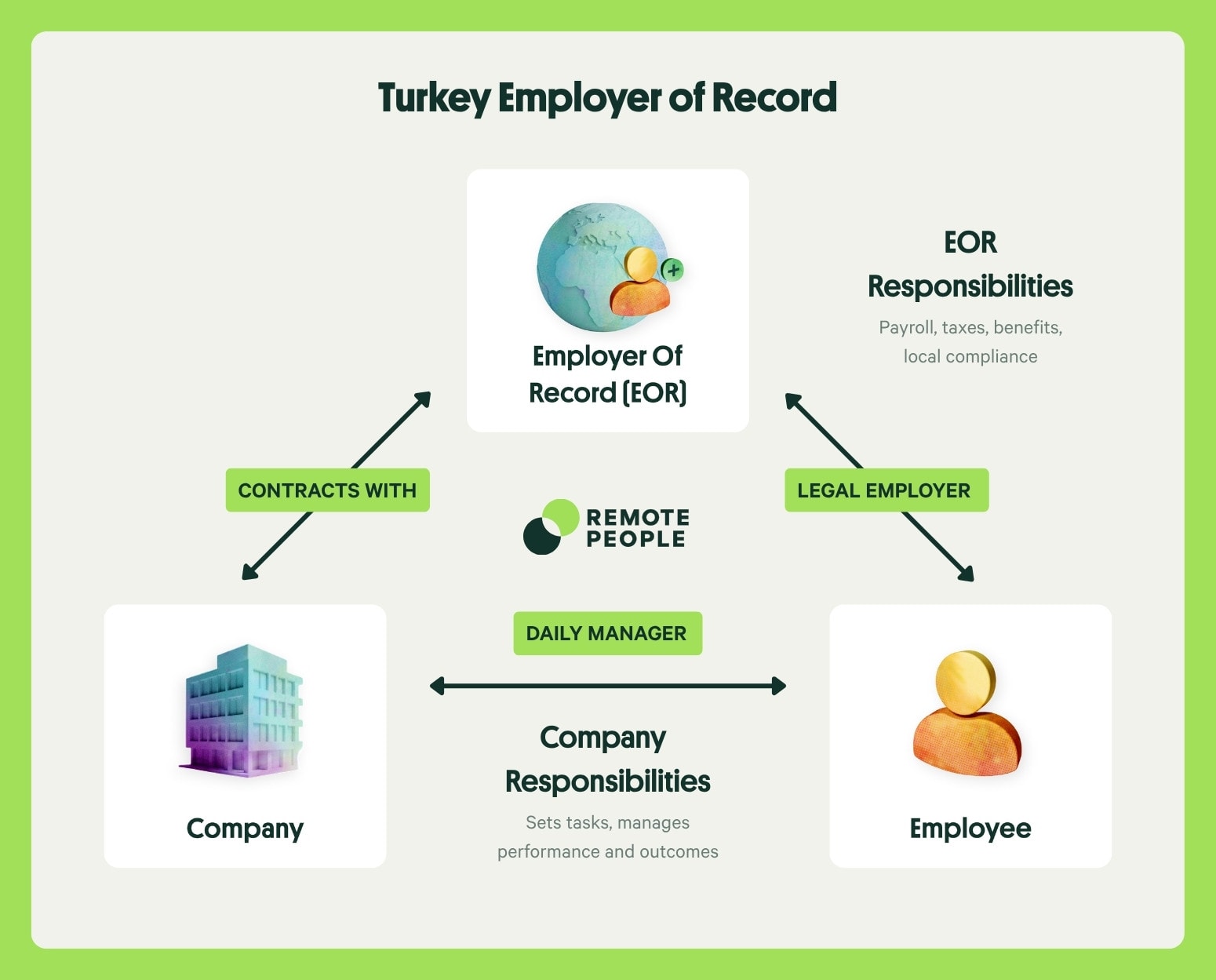
An employer of record in Turkey solves this by acting as the legal employer on your behalf, handling contracts, SGK payroll, income tax withholding, work permit sponsorship, and severance accruals while your employees report directly to you. See how RemotePeople’s EOR solution delivers compliant Turkey hiring across Istanbul, Ankara, Izmir, and the wider country.
How an Employer of Record Works in Turkey
An employer of record (EOR) is the simplest compliant route for a foreign company to hire in Turkey without setting up a local entity. The EOR becomes the legal employer on paper, absorbing every obligation tied to Labour Law No. 4857, SGK social security, and the Ministry of Labour’s work permit regime, while the client retains full operational control over the employee’s day-to-day work. The sections below explain what an EOR is, what it handles on the client’s behalf, who typically uses one in Turkey, and how long onboarding takes from signed service agreement to payrolled hire.

If you’d like to learn more about how Employer of Record (EOR) services work, read our What Is an Employer of Record (EOR)? guide for a complete overview of the model, its benefits, and when to use it.
If you’re comparing providers, our Best Employer of Record (EOR) Providers guide reviews the leading platforms to help you choose the right solution for your business.
Who Uses an EOR in Turkey?
EOR services in Turkey are typically used by organizations that want a compliant hiring solution without establishing a Turkish company. Common scenarios include:
- Testing the Turkish market: A company looking to validate demand in Istanbul or Ankara before committing to a limited liability company (Ltd. Şti.) can hire one or two people through an EOR while preserving the option to set up an entity later.
- Hiring a regional lead based in Istanbul: For organizations expanding into Europe, the Middle East, and Central Asia, placing a regional manager in Istanbul through an EOR is faster than registering an A.Ş. or Ltd. Şti.
- Onboarding remote engineering or support teams: Any business hiring employees in Turkey for distributed teams can use an EOR to keep each hire fully compliant with SGK, income tax, and Labour Law 4857 while your managers handle day-to-day direction.
- Sponsoring foreign hires under the 5:1 rule: For organizations expanding into Turkey with a mix of Turkish and foreign staff, an established EOR establishment file makes it possible to sponsor work permits from day one, instead of first hiring five local employees to unlock the ratio.
The EOR model is also a practical fit for teams hiring between one and fifteen people in Turkey, where the cost and lead time of entity setup would outweigh the benefit. Companies hiring regionally often pair Turkey with an EOR in Poland or a Georgia EOR to cover the wider Black Sea and Eastern European market under a single provider.
Typical Onboarding Timeline
Most EOR providers can onboard a Turkish-resident employee in Turkey within one to two weeks. For foreign hires who require a work permit, the Ministry of Labour and Social Security e-İzin system adds roughly four to six weeks on top of the standard onboarding. The typical sequence looks like this:
- First, the client signs the EOR agreement and provides employee details, job description, and compensation package (1–2 days).
- Second, the EOR drafts the Turkish-language employment contract under Labour Law No. 4857 and sends it for signature (2–3 days).
- Third, the EOR registers the new hire with the SGK by filing the İşe Giriş Bildirgesi (Employment Commencement Declaration) at least one day before the start date (same day when done electronically).
- Fourth, for foreign hires, the EOR files the work permit application through the e-İzin system on the Ministry of Labour and Social Security portal; approvals typically arrive within 30 calendar days.
- Fifth, payroll is configured on the EOR’s Turkish payroll engine, private health insurance is enrolled (optional), and the employee starts work fully payrolled on day one.
Background checks, diploma equivalence through the Council of Higher Education (YÖK), and medical clearance for certain regulated roles can extend the timeline. A realistic planning assumption is two weeks for Turkish citizens and holders of valid residence permits, and five to six weeks for foreign hires who need a new work permit issued from outside Turkey.
Who Uses an EOR in Turkey?
EOR services in Turkey are typically used by organizations that want a compliant hiring solution without establishing a Turkish company. Common scenarios include:
- Testing the Turkish market: A company looking to validate demand in Istanbul or Ankara before committing to a limited liability company (Ltd. Şti.) can hire one or two people through an EOR while preserving the option to set up an entity later.
- Hiring a regional lead based in Istanbul: For organizations expanding into Europe, the Middle East, and Central Asia, placing a regional manager in Istanbul through an EOR is faster than registering an A.Ş. or Ltd. Şti.
- Onboarding remote engineering or support teams: Any business hiring employees in Turkey for distributed teams can use an EOR to keep each hire fully compliant with SGK, income tax, and Labour Law 4857 while your managers handle day-to-day direction.
- Sponsoring foreign hires under the 5:1 rule: For organizations expanding into Turkey with a mix of Turkish and foreign staff, an established EOR establishment file makes it possible to sponsor work permits from day one, instead of first hiring five local employees to unlock the ratio.
The EOR model is also a practical fit for teams hiring between one and fifteen people in Turkey, where the cost and lead time of entity setup would outweigh the benefit. Companies hiring regionally often pair Turkey with an EOR in Poland or a Georgia EOR to cover the wider Black Sea and Eastern European market under a single provider.
Typical Onboarding Timeline
Most EOR providers can onboard a Turkish-resident employee in Turkey within one to two weeks. For foreign hires who require a work permit, the Ministry of Labour and Social Security e-İzin system adds roughly four to six weeks on top of the standard onboarding. The typical sequence looks like this:
- First, the client signs the EOR agreement and provides employee details, job description, and compensation package (1–2 days).
- Second, the EOR drafts the Turkish-language employment contract under Labour Law No. 4857 and sends it for signature (2–3 days).
- Third, the EOR registers the new hire with the SGK by filing the İşe Giriş Bildirgesi (Employment Commencement Declaration) at least one day before the start date (same day when done electronically).
- Fourth, for foreign hires, the EOR files the work permit application through the e-İzin system on the Ministry of Labour and Social Security portal; approvals typically arrive within 30 calendar days.
- Fifth, payroll is configured on the EOR’s Turkish payroll engine, private health insurance is enrolled (optional), and the employee starts work fully payrolled on day one.
Background checks, diploma equivalence through the Council of Higher Education (YÖK), and medical clearance for certain regulated roles can extend the timeline. A realistic planning assumption is two weeks for Turkish citizens and holders of valid residence permits, and five to six weeks for foreign hires who need a new work permit issued from outside Turkey.
Hire in Turkey
With a young, tech-heavy workforce, salaries competitive against Western Europe, and a strategic bridge between Europe, the Middle East, and Central Asia, Turkey is a compelling hiring destination.
We handle employment contracts, SGK payroll, income tax withholding, and full Turkey Labour Law 4857 compliance.
No local entity needed. Your team can start in days.
Employment Laws and Regulations in Turkey
Turkish employment sits inside a tight legal framework anchored by Labour Law No. 4857, administered jointly by the Ministry of Labour and Social Security and the Social Security Institution (SGK). The rules that matter for foreign-invested employers cover contract formalities, working hours and overtime, minimum wage, probation, statutory leave, mandatory benefits, and the annual regulatory refresh. Each of these pieces moves on its own schedule, with the minimum wage updated every January and SGK rate changes published through the Resmî Gazete throughout the year.
Employment Contracts
Employment in Turkey is governed by Labour Law No. 4857, published in the Resmî Gazete on 10 June 2003, and administered by the Ministry of Labour and Social Security together with the Social Security Institution. The full consolidated text is maintained on the Mevzuat Bilgi Sistemi (Legislative Information System), the official government legislative database. Written contracts are mandatory for any agreement lasting one year or longer, and are strongly recommended for shorter engagements because the absence of a written contract shifts the burden of proof onto the employer.
Contracts can be either indefinite (belirsiz süreli) or fixed-term (belirli süreli). Fixed-term agreements are only valid where there is an objective reason (a specific project, seasonal work, a defined temporary need); otherwise they are treated as indefinite-term from day one. Turkish is the contractual language of record, and bilingual Turkish-English contracts are standard for foreign-invested employers, with the Turkish version prevailing in any dispute. Any clause that reduces statutory rights under Law No. 4857, such as lower annual leave, shorter notice, or reduced severance, is void by operation of law.
Working Hours and Overtime
The standard workweek in Turkey is 45 hours under Article 63 of Labour Law No. 4857, normally distributed over six days (7.5 hours per day) or five days (9 hours per day). Daily working time may not exceed 11 hours under any arrangement, and employees under 18 are capped at 8 hours per day. Rest breaks are mandatory: 15 minutes for shifts of 4 hours or less, 30 minutes for shifts between 4 and 7.5 hours, and one hour for shifts longer than 7.5 hours.
Overtime sits in Articles 41 and 42 of the Labour Law and is capped at 270 hours per employee per calendar year, with written employee consent required each year. The table below summarises the premium pay rates that apply in Turkey, drawing on the labour code plus the PwC Turkey tax summary for practical guidance.
Turkey overtime and premium pay rates · Per Labour Law No. 4857 | |||
Hour Type | Rate Multiplier | Annual Cap | Notes |
|---|---|---|---|
Overtime above 45 hours per week | 150% of normal hourly wage | 270 hours per year | Article 41. Written consent required each year. Can be converted to 1.5 hours of compensatory time off at the employee’s request. |
Extra work (41–45 hours in short-workweek schedules) | 125% of normal hourly wage | Inside the 45-hour legal ceiling | Article 41. Applies where the contractual workweek is below 45 hours and the extra hours stay within the legal limit. |
Weekly rest day (Sunday) work | Normal daily wage plus 150% overtime | Counts toward 270-hour cap | Article 46. Employees are entitled to a 24-hour uninterrupted rest period each week. Sunday work must be compensated accordingly. |
National and public holiday work | Normal daily wage plus one additional daily wage | Not counted against 270-hour cap | Article 47. Applies to all gazetted public holidays, including religious bayrams. |
Night work (8 PM to 6 AM) | Standard pay, reduced maximum | 7.5 hours per night | Article 69. Night work may not exceed 7.5 hours in 24 hours; overtime in a night shift is generally prohibited. |
Total overtime is hard-capped at 270 hours per year regardless of written consent, and any hours above this ceiling are void for overtime purposes (the employee still has a civil claim for unjust enrichment). Overtime multipliers apply to the normal hourly rate, which for monthly-paid employees is calculated by dividing gross monthly salary by 225 (monthly working hours based on a 45-hour week). Managerial employees who genuinely exercise autonomous decision-making authority are excluded from the overtime regime under Article 41, but the exclusion is construed narrowly by the Turkish labour courts.
Minimum Wage
The minimum wage in Turkey is set by the Minimum Wage Determination Commission (Asgari Ücret Tespit Komisyonu) under Article 39 of Labour Law No. 4857, and published each year in the Resmî Gazete before 1 January. For 2026, effective 1 January 2026, the Commission set the monthly figures as follows:
- Gross monthly minimum wage: TRY 33,030 per month
- Net monthly minimum wage (after SGK, unemployment, and stamp duty): TRY 28,075.50 per month
- Daily minimum wage: TRY 1,101 per day
- Hourly minimum wage: approximately TRY 146.80 per hour
The 2026 figure represents a 27% increase over the 2025 minimum wage, announced by the Minister of Labour and Social Security following the Commission’s final session in December 2025. There is no sector, age, or regional differential: the same national floor applies to every private-sector employee, including apprentices and probation-period hires, and the Treasury support for employers hiring at the minimum wage has been increased to TRY 1,270 per eligible employee per month according to the Vergi Merkezi 2026 payroll guide.
Probation Period
The probation period in Turkey is capped at two months under Article 15 of Labour Law No. 4857, and may be extended to a maximum of four months only by collective bargaining agreement. The probation clause is only valid where it is written into the employment contract; if the contract is silent, the employee is considered permanent from day one. During probation, either party may terminate the contract without notice or severance, provided the decision is taken before the probation expires and is not discriminatory or abusive. Probation time still counts toward SGK-insured days, annual leave accrual, and tenure for future severance calculation, so the clock on kıdem tazminatı starts running on day one.
Leave Entitlements
Turkey’s statutory leave framework sits inside Chapters 5 and 6 of Labour Law No. 4857 and covers annual, sick, maternity, paternity, and several special leave categories. The rules apply to all private-sector employees, Turkish and foreign, and cannot be reduced by contract.
Annual Leave
Under Article 53 of Labour Law No. 4857, employees who complete at least one year of service (including probation) are entitled to paid annual leave that scales with tenure. The statutory minimums are 14 working days for 1 to 5 years of service, 20 working days for more than 5 and less than 15 years, and 26 working days for 15 years and above. Employees aged under 18 or aged 50 and above are entitled to a minimum of 20 working days regardless of tenure. Annual leave cannot be waived in exchange for pay during employment, but any unused days are paid out in cash on termination based on the last gross wage.
Sick Leave
Employees who are unable to work due to illness or injury are entitled to time off for the period shown on an official medical report (iş göremezlik raporu) from an SGK-contracted healthcare institution. The Social Security Institution pays a cash sickness benefit from the third day onwards, at 2/3 of the daily insured earning for outpatient treatment and 1/2 for hospitalisation, provided the employee has at least 90 days of contributions in the year before the illness. The first two days are statutorily unpaid, though many employers top them up by internal policy. During the medical report period, the employee’s employment contract is protected against termination for up to the relevant notice period plus six weeks under Article 25/I.
Maternity Leave
Female employees are entitled to 16 weeks of paid maternity leave under Article 74 of Labour Law No. 4857, split 8 weeks before and 8 weeks after childbirth; in the case of multiple pregnancies, the pre-birth component is extended by 2 weeks to 10 weeks. During maternity leave, SGK pays a cash benefit equal to 2/3 of the insured daily earning directly to the employee; most employers voluntarily top up the remaining third to 100% of salary as a benefit. After maternity leave ends, the employee is entitled to either a half-time work arrangement for 60, 120, or 180 days (depending on whether it is the first, second, or third child and later), or up to six months of unpaid leave on request.
Paternity Leave
Fathers are entitled to 5 working days of fully paid paternity leave under Article 3 of Annex 2 of Labour Law No. 4857, triggered by the birth of a child and paid entirely by the employer (not SGK). The 5-day entitlement is treated as ordinary paid leave and cannot be denied by the employer, though it must be taken in a single block within a reasonable period of the birth.
Other Statutory Leave
Labour Law No. 4857 provides several additional statutory leave categories beyond annual, sick, and parental leave:
- Marriage leave: 3 working days of paid leave on the occasion of the employee’s own marriage.
- Bereavement leave: 3 working days of paid leave on the death of the employee’s spouse, parent, child, or sibling.
- Adoption leave: 3 working days of paid leave when adopting a child under 3 years of age.
- Paid education leave: 5 working days per year for employees with a disability or chronic illness, or for parents of a disabled child attending medical treatment.
- Unpaid leave: Up to 6 months of unpaid leave after maternity leave on the employee’s written request.
Under Labour Law No. 4857, the table below summarises every statutory leave entitlement at a glance. Annual leave is measured in working days (Saturdays and Sundays are excluded), and the pay rate column indicates who funds the leave: the employer, the SGK, or a combination of both. The most important takeaway for new hires is that annual leave only accrues after one full year of service, but probation time counts toward that year.
Turkey statutory leave entitlements · Per Labour Law No. 4857 | ||
Leave Type | Duration | Eligibility & Notes |
|---|---|---|
Annual leave (1–5 years) | 14 working days | Article 53. Full pay by employer. Requires one full year of service. Unused days paid out on termination. |
Annual leave (5–15 years) | 20 working days | Article 53. Full pay by employer. Also applies to workers under 18 or aged 50+ regardless of tenure. |
Annual leave (15+ years) | 26 working days | Article 53. Full pay by employer. Tenure counts across all employers in the same workplace. |
Sick leave | Per medical report (no fixed cap) | Article 25/I. SGK pays 2/3 of daily earning from day 3 (outpatient); employer tops up by internal policy. Requires 90 days of contributions. |
Maternity leave | 16 weeks (18 for multiples) | Article 74. SGK pays 2/3 of daily earning; employer commonly tops up. 8 weeks before and 8 weeks after birth. |
Paternity leave | 5 working days | Annex 2 Article 3. Full pay by employer, not SGK. Must be taken within a reasonable period of birth. |
Marriage leave | 3 working days | Annex 2 Article 3. Full pay by employer. Triggered by the employee’s own marriage. |
Bereavement leave | 3 working days | Annex 2 Article 3. Full pay by employer. Applies to death of spouse, parent, child, or sibling. |
Unpaid post-maternity leave | Up to 6 months | Article 74. Unpaid, on written request. Half-time work alternative available for 60–180 days depending on child order. |
Statutory Employee Benefits
Beyond leave and payroll-linked contributions, Turkish employers must provide several statutory benefits directly to employees. These are mandated by Labour Law No. 4857, Social Security Law No. 5510, and the Unemployment Insurance Law No. 4447:
- Public health insurance (Genel Sağlık Sigortası): Universal coverage through SGK is automatic from the first day of SGK registration. Employers contribute 7.5% of the gross wage and employees contribute 5%, granting access to the public healthcare network under Law No. 5510.
- Long-term social insurance: Covers old-age pension, invalidity, and survivors’ pension. Employer share is 11% and employee share is 9% of the gross wage, deducted up to the SGK ceiling of TRY 297,270 per month in 2026 as published on the SGK official portal.
- Unemployment insurance (İşsizlik Sigortası): Administered by the Turkish Employment Agency (İŞKUR). Employer pays 2%, employee pays 1%, and the state adds 1% on top, providing up to 10 months of benefits subject to qualifying insured days.
- Work accident and occupational disease insurance: Short-term insurance of roughly 2% paid entirely by the employer. Covers temporary incapacity benefits, permanent disability pensions, and survivor benefits in the event of a work-related incident.
- Private supplementary health insurance: Not mandatory, but offered by more than 75% of white-collar employers in Istanbul and Ankara. An EOR can enrol employees in a group plan priced against the Turkish private market.
- Automatic enrolment pension (BES): Automatic Enrolment to the Private Pension System applies to employees under 45 at hire, with a default 3% employee contribution; employees may opt out within two months with no penalty.
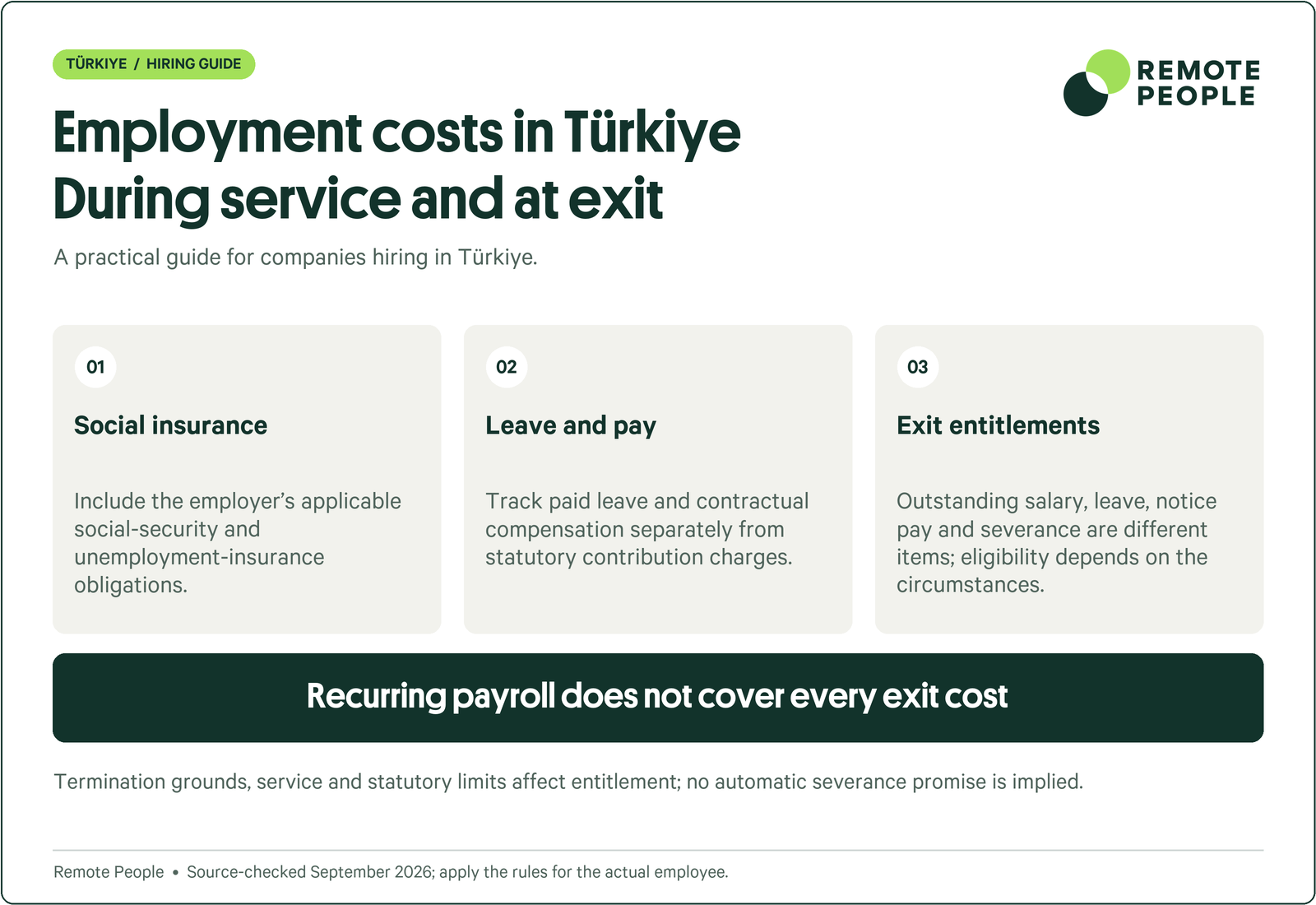
Contribution rates and ceilings for 2026 are summarised in the payroll tables in the next section, so no line item is duplicated here. The SGK ceiling was raised from 7.5 times to 9 times the minimum wage for 2026, which is why high-earner employer costs have risen more than the 27% minimum wage increase alone would suggest.
Recent Regulatory Updates (2026)
Three significant changes took effect in Turkey’s employment framework for 2026. First, the minimum wage was raised 27% to TRY 33,030 gross per month effective 1 January 2026, announced by the Minister of Labour and Social Security following the Determination Commission vote in December 2025. The Treasury support for employers hiring at minimum wage was lifted from TRY 1,000 to TRY 1,270 per eligible employee per month. The income tax and stamp duty exemption tied to the minimum wage was automatically rebased, removing TRY 57,881.23 of annual income tax and TRY 3,008.40 of annual stamp duty from every payslip.
Second, under Law No. 7566 the employer SGK contribution rate for long-term insurance was raised by one percentage point, lifting the headline employer SGK rate from 20.75% to 21.75% effective 1 January 2026. Employers in the manufacturing sector continue to access a 5-point incentive that brings the rate down to 16.75%, and non-manufacturing employers who meet the conditions of the 5-point incentive under Law No. 5510 Article 81 receive a 4-point reduction, per the Sadık Sözer Çizmeci SGK premium rate analysis. The social security earnings ceiling was simultaneously raised from 7.5 times to 9 times the minimum wage, increasing employer cost for higher-paid employees.
Third, the severance pay ceiling (kıdem tazminatı tavanı) for January 2026 was set at TRY 63,948.00 per year of service, up from the 2025 ceiling. This cap is recalculated in line with civil service salary indexation and revised every six months, so employers should expect a mid-year adjustment in the July 2026 period as well.
Work Permits and Visas in Turkey
Turkey runs a centralised work authorisation regime through the Ministry of Labour and Social Security. Every foreign hire needs a permit before they can legally start work, regardless of nationality, and the process runs through the e-İzin electronic application system. The Turkish government applies a 5:1 Turkish-to-foreign staffing ratio at each workplace, which is the single biggest constraint on how quickly a foreign team can scale up in the country.
Work Permit Requirements
Work permit rules in Turkey are set by International Labour Force Law No. 6735 and supporting regulations, and they apply to every foreign national working under an employment relationship. The subsections below cover who needs a permit, what documents are required, how long processing takes, and how renewals are handled before expiry.
Who Needs a Work Permit
Every foreign national who works in Turkey under an employment relationship needs a work permit (Çalışma İzni), issued by the Ministry of Labour and Social Security under the International Labour Force Law No. 6735. There is no visa waiver or e-visa that grants the right to work. A small number of categories are exempt, including short-term academic visits, diplomatic assignments, and specific reciprocal arrangements; in all commercial hiring situations, assume a work permit is required. EU and non-EU nationals are treated identically; Turkey is not an EU member state and has no equivalent of EU free movement of workers.
Eligibility and Required Documents
The core documentary pack for a Turkish work permit application includes a passport valid for at least six months beyond the intended residence, a signed Turkish employment contract specifying a gross salary that meets the role-based minimum threshold, the employer’s trade registry extract and tax registration, a recent payroll declaration showing the company’s Turkish employee count (to test the 5:1 ratio), diploma or equivalent education certificates, and 4 biometric photographs. Applications for roles in regulated sectors (healthcare, engineering, law) require a professional recognition from the relevant chamber or ministry, and certified Turkish translations are mandatory for all non-Turkish documents.
Processing Time and Validity
The standard processing time on the Ministry of Labour and Social Security e-İzin system is up to 30 calendar days from the date the employer submits the complete application, though most well-documented files clear in two to three weeks. The first permit is issued for up to one year and is tied to the specific employer and role on file. Processing time can be extended by document deficiencies, chamber approvals, or ratio-related queries; for foreign applicants applying from outside Turkey, the consular interview step adds another one to two weeks before the employer can even upload the file.
Renewal Process
Work permit renewals must be filed no earlier than 60 days before and no later than the date of expiry. The first renewal extends the permit by up to two years with the same employer and role; subsequent renewals extend it by up to three years. After eight years of uninterrupted residence or six years of legal employment, the foreign worker can apply for an indefinite-term work permit (Süresiz Çalışma İzni). During the renewal window, the employee may continue working on the existing permit until a decision is issued, avoiding any employment gap.
Common Visa Types for Foreign Workers
Turkey operates a centralised foreign worker regime through the Ministry of Labour and Social Security, which issues every work-authorisation document. The main categories cover traditional sponsored employment, intra-company transfers, independent professionals, and high-skilled talent under the Turquoise Card. An EOR can sponsor every category on this list except the Turquoise Card, which is assessed against individual merit rather than employer sponsorship.
Turkey work visa types for foreign workers · 2026 | ||||
Visa Type | Duration | Best For | Leads to Long-Term? | Processing |
|---|---|---|---|---|
Definite-Term Work Permit (Süreli) | Up to 1 year initial, extendable 2 + 3 years | Standard foreign hires sponsored by a Turkish employer or EOR | Yes (after 6 years of legal work) | ≈ 30 days via e-İzin |
Indefinite-Term Work Permit (Süresiz) | Unlimited | Foreign workers with 8 years of legal residence or 6 years of work permit | Yes (permanent right to work) | ≈ 30–60 days |
Independent Work Permit (Bağımsız) | Up to 3 years | Self-employed professionals and entrepreneurs | Yes (basis for residence) | ≈ 60 days |
Turquoise Card (Turkuaz Kart) | 3-year probation then permanent | High-skilled workers, investors, scientists, acclaimed artists | Yes (spouse and dependants also covered) | ≈ 90 days |
Intra-Company Transfer Permit (ICT) | Up to 3 years | Managers, specialists, or trainees from the same corporate group | Yes (renewable) | ≈ 30–45 days |
Other Turkish visa categories do not permit employment and should not be used as a workaround:
- Tourist visa (e-visa): for short stays only, with no right to work or conduct paid activity.
- Student residence permit: allows part-time work after first year of study, but only for a limited number of hours per week.
- Short-term tourist residence permit: based on property ownership or family reasons, does not confer work rights.
How an EOR Handles Work Permits
The EOR uses its existing establishment file on the Ministry of Labour and Social Security e-İzin portal to sponsor the work permit application, so the client company does not need a Turkish entity of its own. The EOR is listed as the legal employer of record, handles the upload of all corporate and employee documents, pays the government application fees, and tracks the file through the 30-day review window. On approval, the EOR generates an appointment at the Provincial Directorate of Migration Management for biometric capture and residence permit activation.
The client company remains the functional manager of the employee’s work, but the EOR’s name appears on the work permit card and in the SGK records. Because the permit is tied to the employer on file, any transfer between EOR providers or to the client’s future Turkish entity requires a fresh application. As covered in the onboarding timeline earlier in this guide, sponsoring a new foreign hire adds roughly four to six weeks on top of standard onboarding.
Payroll, Taxes, and Social Security in Turkey
Turkey’s payroll engine combines SGK social security contributions, a progressive income tax schedule, unemployment insurance through İŞKUR, and a small stamp duty charge on each payslip. The 2026 framework reflects three recent changes: the 27% minimum wage increase from 1 January 2026, the Law No. 7566 one-point lift in employer SGK rates, and the rebased minimum-wage income tax exemption that flows through to every employee’s net pay. The breakdowns below cover employer contributions, employee deductions, income tax brackets, payroll cycle timing, and how 13th-month pay is treated.
Employer Contributions
Employer contributions in Turkey consist of SGK social insurance (long-term, short-term, and general health) plus unemployment insurance. The 2026 rates below reflect the Law No. 7566 adjustment that lifted the headline employer rate by one point effective 1 January 2026, as confirmed by the PwC Worldwide Tax Summaries – Turkey and the Social Security Institution 2026 payroll circular.
Turkey employer social security contributions · 2026 rates | ||
Contribution | Rate | Notes |
|---|---|---|
Long-term social insurance (pension, invalidity, survivors) | 11.00% | Increased from 10% effective 1 January 2026 under Law No. 7566. Applied to gross wage up to the SGK ceiling of TRY 297,270/month. |
Short-term insurance (work accidents and occupational illness) | 2.00% | Employer-only. Funds temporary incapacity benefits, permanent disability pensions, and survivor pensions for work-related events. |
General health insurance (GSS) | 7.75% | Universal coverage through SGK. Opens access to public hospital network for employees and dependants. |
Unemployment insurance (İşsizlik Sigortası) | 2.00% | Administered by İŞKUR. Funds unemployment benefits up to 10 months subject to qualifying insured days. |
Total employer cost on gross wage | 22.75% | Before 4-point incentive reduction (16.75% SGK + 2% unemployment = 18.75%) or 5-point manufacturing incentive. |
Employee Contributions
Employee deductions include SGK contributions, unemployment insurance, stamp duty (damga vergisi), and income tax withholding. The 2026 rates have not changed for employees, but the interaction with the minimum-wage income tax exemption has been rebased for the higher 2026 minimum wage, reducing the net tax for every employee regardless of salary level, per the CottGroup 2026 Statutory Deductions circular.
Turkey employee payroll deductions · 2026 monthly withholdings | ||
Deduction | Rate | Notes |
|---|---|---|
SGK long-term insurance (pension share) | 9.00% | Employee share of pension, invalidity, and survivors’ insurance. Capped at SGK ceiling of TRY 297,270/month. |
SGK general health insurance | 5.00% | Employee share of universal public health coverage. |
Unemployment insurance | 1.00% | Employee contribution to İŞKUR unemployment benefit fund. |
Stamp duty (damga vergisi) | 0.759% | Applied to gross wage; minimum-wage portion is exempt (TRY 3,008.40 exemption per year in 2026). |
Income tax withholding | 15% – 40% progressive | Applied to gross wage minus SGK and unemployment; minimum-wage portion exempt (TRY 57,881.23 per year in 2026). |
Total before income tax | 15.759% | Income tax applied on top of this total, using the bracket schedule in the next section. |
Income Tax
Turkey applies a progressive income tax on employment income under the Income Tax Law No. 193, updated annually. The 2026 schedule was gazetted on 30 December 2025 and became effective 1 January 2026. The first-bracket threshold was lifted from TRY 158,000 to TRY 190,000 to offset cumulative wage inflation, and the second bracket ceiling was raised to TRY 400,000. The full 2026 bracket schedule for employment income is published on the Revenue Administration portal and cross-referenced by PwC Worldwide Tax Summaries.
Turkey income tax brackets · 2026 | |
Bracket (annual) | Tax Calculation |
|---|---|
Up to TRY 190,000 | 15% |
TRY 190,001 – TRY 400,000 | TRY 28,500 for the first 190,000, plus 20% on the excess |
TRY 400,001 – TRY 1,500,000 | TRY 70,500 for the first 400,000, plus 27% on the excess |
TRY 1,500,001 – TRY 5,300,000 | TRY 367,500 for the first 1,500,000, plus 35% on the excess |
Above TRY 5,300,000 | TRY 1,697,500 for the first 5,300,000, plus 40% on the excess |
Payroll Cycle
Payroll in Turkey runs on a monthly cycle. Salaries are paid in Turkish lira by bank transfer, which became mandatory for employers with 3 or more employees following a 2025 regulatory update, and payment must land by the end of the month or by the date specified in the employment contract (usually the 1st through the 5th of the following month). Cash wages are only permitted for very small employers and remain disallowed in any case where the employee would be left below the bank payment threshold.
The SGK Monthly Premium and Service Document is due by the 23rd of the month following the payroll period for private-sector employers. The quarterly Withholding Tax Return (Muhtasar Beyanname) consolidates income tax and stamp duty and is filed by the 26th of the month following each quarter. An EOR keeps all three filings on the Turkish payroll calendar automatically and reconciles late-payment risk that would otherwise create SGK penalties of up to 5% plus delay interest.
13th Month Salary and Bonus Pay
Turkey does not mandate a 13th or 14th month salary; there is no statutory ikramiye (bonus) obligation under Labour Law No. 4857. Any bonus, commission, or performance payment is entirely contractual and must be specified in the employment contract or collective bargaining agreement to be enforceable. Discretionary bonuses are common in banking, technology, and consulting, with typical structures including two half-payments in July and December, quarterly performance pay, or an annual lump-sum linked to company results. Where a bonus is contractually promised and consistently paid for three years or more, the Turkish courts have occasionally treated it as a vested benefit, so foreign employers should document the discretionary nature of any annual pay clearly in writing. All bonus payments are taxed as employment income and attract SGK contributions up to the monthly ceiling.
Cost of Hiring Through an EOR in Turkey
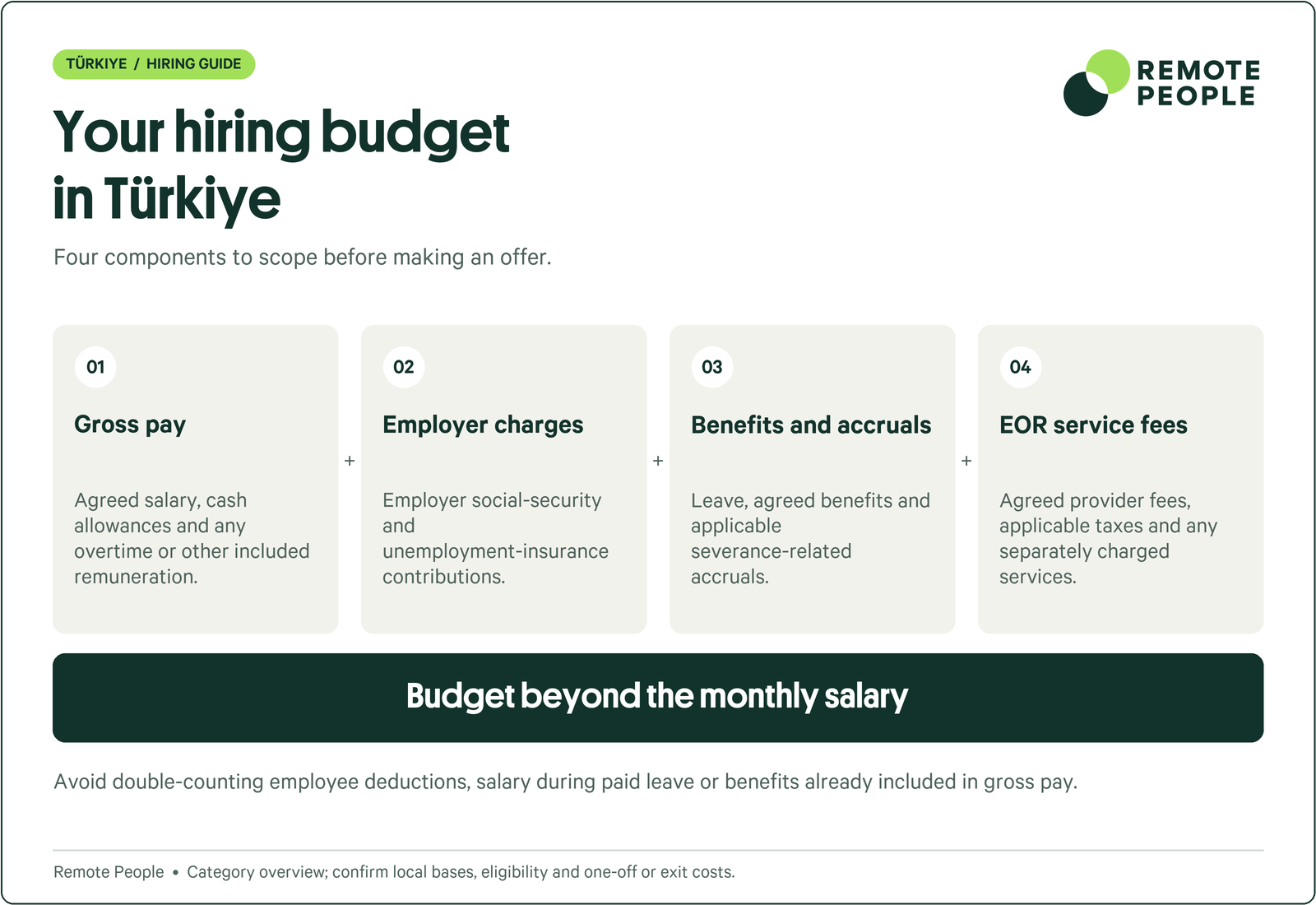
Hiring through an EOR in Turkey has two stacked cost components: the employer’s statutory burden on top of gross salary (social security, unemployment, and stamp duty), and the monthly EOR service fee itself. Together they sit well below the combined upfront and ongoing cost of maintaining a local Turkish entity for small teams, and the break-even point typically arrives around 15 employees. The cost sections below isolate the EOR fee range, show a fully worked USD example at a $4,500 gross monthly salary, and link each line item back to the 2026 SGK and PwC sources used for the calculations.
EOR Service Fees
EOR service fees in Turkey generally range from $300 to $600 per employee per month, depending on salary level, benefits complexity, and whether foreign work permit sponsorship is involved. RemotePeople’s Turkey EOR fee is a flat monthly rate that includes SGK payroll processing, income tax withholding, SGK and İŞKUR filings, contract drafting, HRIS access, and severance accrual management. Work permit sponsorship, where applicable, is quoted separately because it involves government fees and sworn translation costs that vary by country of origin.
Total Employment Cost Breakdown
The table below shows the employer cost of hiring a $4,500/month gross salary employee in Turkey, converted to USD for easy comparison. Turkish lira employment costs are volatile due to the minimum wage indexation cycle and FX movement, so USD figures offer a steadier buyer view. The breakdown uses the 2026 SGK rates without any incentive, which is the conservative baseline most foreign-invested employers are costed against.
Turkey employer cost example · USD 4,500 gross · 2026 | ||
Employer Cost | Amount (USD) | % of Gross |
|---|---|---|
Gross salary (employee) | $4,500.00 | 100.00% |
Long-term social insurance (11%) | $495.00 | 11.00% |
Short-term insurance (2%) | $90.00 | 2.00% |
General health insurance (7.75%) | $348.75 | 7.75% |
Unemployment insurance (2%) | $90.00 | 2.00% |
EOR service fee (est.) | $499.00 | 11.09% |
Total employer cost | $6,022.75 | 133.84% |
Figures converted at 1 USD ≈ 42 TRY (April 2026). Exact figures move with the Turkish lira exchange rate and any SGK incentive claimed by the employer.
The worked example shows that statutory employer contributions add roughly 22.75% on top of gross salary, plus the EOR fee. For a $4,500 gross hire, this brings the total monthly cost to about $6,023, or 133.84% of the gross amount paid to the employee. Employers in the manufacturing sector or those who qualify for the 4-point incentive under Law No. 5510 Article 81 can reduce the SGK subtotal by 4 to 5 points, bringing total employer cost closer to 129–130% of gross.
Ready to hire in Turkey? Get started with RemotePeople. We handle employment contracts, SGK payroll, income tax withholding, and full Turkey compliance across Istanbul, Ankara, Izmir, and the wider country. No local entity needed. Contact our Turkey team for a quote.
Benefits of Using an EOR in Turkey
An EOR delivers speed, compliance, and cost efficiency that Turkish entity setup cannot match for small and medium teams. The right partner absorbs the Labour Law, SGK, and immigration risk that would otherwise consume months of internal HR bandwidth. Key benefits for companies hiring in Turkey include:
- Speed to market: An EOR can onboard a Turkish-resident hire in one to two weeks, compared with three to four months to register an A.Ş. or Ltd. Şti., open an SGK employer file, and set up Turkish payroll.
- Compliance assurance: The EOR absorbs Labour Law No. 4857, SGK filings, stamp duty, and income tax withholding inside a single monthly process, removing the risk of the late-filing penalties and delay interest that trip up foreign-invested employers.
- Cost efficiency versus a local entity: Entity setup in Turkey costs roughly $8,000–$15,000 up front plus $12,000–$24,000 per year in local accounting, legal, and SGK-certified payroll provider fees. EOR service at $300–$600 per employee per month stays cheaper up to roughly 15 hires.
- Local expertise: Turkish employment law is heavily precedent-driven, and kıdem tazminatı disputes are the single most litigated area of private-sector labour. An EOR with Turkish HR and legal staff on the ground prevents the drafting errors that trigger avoidable claims at the Labour Court.
- Flexibility to scale: You can add, transfer, or offboard employees with a single contract amendment to the EOR agreement, without any amendments to a Turkish entity’s articles of association, trade registry, or SGK employer file.
- Risk mitigation on termination: Turkey’s graduated notice and severance regime is strict, with eight weeks of notice plus 30 days of severance per year of service. The EOR funds these obligations against the monthly fee so that exits close cleanly without cash-flow surprises.
- Employee experience: Local-language contracts, Turkish HR support, and on-time payroll in Turkish lira make the hire feel like a first-class employee rather than a cross-border contractor, helping retention in a market where offer competition from local tech and banking groups is fierce.
RemotePeople’s Turkey EOR pairs these operational benefits with a single global dashboard, so a team split across Istanbul, Dubai, and other markets is managed from one console. Talk to our team to scope your Turkey hiring plan.
Termination and Offboarding in Turkey
Turkish termination law is one of the most protective employee regimes in the region. The cost of exit combines statutory notice (ihbar tazminatı), severance (kıdem tazminatı), accrued annual leave pay-out, and the procedural requirement to articulate a valid reason for any dismissal in workplaces above 30 employees. The sections below cover each component in order: notice periods scaling with tenure, severance pay calculation and the 2026 ceiling, and the grounds on which an employer-initiated termination can lawfully proceed.
Notice Periods
Turkish notice periods are set by Article 17 of Labour Law No. 4857 and scale with the employee’s length of service. Notice must be given in writing and runs from the day after the notice is delivered. Either party may pay the notice period in lieu (ihbar tazminatı), and the statutory minimums cannot be reduced by contract, though employers and employees may agree to longer periods. During probation, the notice regime does not apply and either party can terminate without notice.
Turkey statutory notice periods by position level · Per Labour Law No. 4857 | |||
Length of Service | Notice Period | During Probation | Notes |
|---|---|---|---|
Less than 6 months | 2 weeks | No notice required | Article 17. Minimum floor; contractual extensions allowed but cannot be reduced. |
6 months – 1.5 years | 4 weeks | No notice required | Article 17. Applies to both employer-initiated and employee-initiated dismissals. |
1.5 – 3 years | 6 weeks | N/A (probation has ended) | Article 17. Can be paid in lieu at gross salary rate including allowances. |
3 years and above | 8 weeks | N/A (probation has ended) | Article 17. Maximum statutory notice; collective agreements commonly extend this for senior or managerial staff. |
Notice is not required where the termination is for just cause (haklı nedenle fesih) under Article 25, such as serious misconduct, breach of trust, or prolonged unauthorised absence. Fixed-term contracts expiring on the agreed end date also do not require notice. In all cases, employers terminating indefinite-term contracts in workplaces with 30 or more employees (and for employees with at least six months of service) must also meet the just-cause or valid-reason test under Article 18 to avoid a reinstatement claim.
Severance Pay
Severance pay (kıdem tazminatı) in Turkey is mandatory for employees terminated by the employer without just cause, or who resign with a qualifying reason (retirement, military service, marriage within one year for female employees). It is governed by Article 14 of the repealed Labour Law No. 1475, which remains in force by reference from Law No. 4857, and is due only after one full year of service.
Turkey severance pay schedule by years of service · Per Labour Law No. 4857 | |||
Years of Service | Severance Amount | Base Salary | Notes |
|---|---|---|---|
1 year (worked example: TRY 50,000/month) | TRY 50,000 (30 days × daily rate) | Last “dressed” gross salary | Includes regular bonuses, meal and transport allowances. Capped at TRY 63,948/year of service in January 2026. |
3 years (worked example: TRY 50,000/month) | TRY 150,000 | Last dressed gross salary | 3 × 30 days × daily rate; no cap hit because monthly gross stays below ceiling. |
5 years (worked example: TRY 50,000/month) | TRY 250,000 | Last dressed gross salary | 5 × 30 days × daily rate; tax-exempt up to ceiling per Income Tax Law Article 25. |
10 years (worked example: TRY 80,000/month) | TRY 639,480 | Capped at TRY 63,948 per year | Ceiling limits severance to 10 × 63,948 because TRY 80,000 exceeds the monthly cap. |
Calculation Method
The severance formula is 30 days of “dressed” gross wage for each full year of service, where “dressed” means the last gross monthly salary plus regularly paid benefits in kind such as meal allowance, transport allowance, and any fixed monthly bonus that is not discretionary. Partial years are pro-rated on a monthly basis. The daily rate is calculated by dividing monthly gross by 30. See Table 13 for the full set of worked examples that illustrate how the formula interacts with the monthly ceiling.
Caps and Exceptions
The severance pay ceiling (kıdem tazminatı tavanı) is revised every six months in line with civil service salary indexation. For January 2026 it was set at TRY 63,948.00 per year of service, which caps the base daily rate used in the 30-day formula. Severance is not payable where the employee resigns without a qualifying reason, where the employer terminates for just cause under Article 25/II, or where a fixed-term contract ends on its agreed date without early termination. Severance paid up to the ceiling is exempt from income tax under Income Tax Law Article 25/7; any amount above the ceiling (which is rare given the cap itself) is taxable.
Grounds for Termination
Employer-initiated terminations of indefinite-term contracts in workplaces with 30 or more employees require a valid reason (geçerli neden) under Article 18: either conduct-related (performance, attendance), business-related (redundancy, reorganisation), or capacity-related (incapacity, fit to role). Employees terminated without a valid reason can file a reinstatement claim inside one month and, if successful, are entitled to back wages of up to four months plus either reinstatement or a judicial severance bonus of 4 to 8 months of gross salary. Protected categories with additional safeguards include pregnant employees (no termination during pregnancy or maternity leave), union representatives, and members of workplace occupational safety committees.
EOR vs. Other Hiring Models in Turkey
Foreign companies considering a Turkish hire have three realistic routes: an EOR, a Turkish entity (Ltd. Şti. or A.Ş.), or an independent contractor arrangement. A Professional Employer Organization (PEO) is sometimes marketed as a fourth option but is essentially unavailable in Turkey because the regulatory framework does not support co-employment. The comparisons below weigh each option against the EOR on setup time, cost, compliance burden, and suitability for typical market-entry scenarios.
EOR vs. Setting Up a Local Entity
The choice between an EOR and a Turkish limited liability company (Ltd. Şti.) or joint-stock company (A.Ş.) is the single biggest structural decision for any foreign-invested employer. The table below summarises the trade-offs for typical hiring scenarios.
Turkey EOR vs local entity comparison · Setup time, cost, risk and best-fit | ||
Comparison | Employer of Record | Own Entity (Ltd. Şti. or A.Ş.) |
|---|---|---|
Setup time | 1–2 weeks | 2–4 months (trade registry, tax office, SGK employer file) |
Upfront cost | $0 | $8,000–$15,000 (capital, notary, legal, registration) |
Ongoing cost | $300–$600/employee/month | $12,000–$24,000/year maintenance (accounting, audit, SGK-certified payroll) |
Local partner required | No – EOR is the local entity | No, but Turkish legal counsel is recommended |
Social insurance registration | Handled by EOR | You manage SGK employer file, monthly declarations, and reconciliations |
Payroll and tax filing | Handled by EOR | You manage (or outsource to a Turkish SMMM or YMM) |
Best for team size | 1–15 employees | 15+ employees or plans to exceed |
Scale down or exit | Easy – no entity to unwind | Costly – legal dissolution, SGK de-registration, tax clearance |
Government contracts | Not eligible | Eligible (requires Turkish entity and trade registry) |
For teams up to 15 employees, the EOR route saves both time and cash outlay, and lets the business test the Turkish market before committing to a permanent legal footprint. Once hiring grows past 15 employees, the monthly EOR fee starts to approach the cost of running a Turkish Ltd. Şti. with a local accountant, and the trade-off flips in favour of owning the entity directly.
Employers that require government procurement access, a regulated-sector licence (banking, insurance, healthcare), or the ability to sponsor their own Turquoise Card candidates will need a Turkish entity regardless of team size. The EOR model is a launch vehicle, not a permanent replacement for a subsidiary when long-term scale, regulated licensing, or bid eligibility is on the roadmap.
EOR vs. Hiring Independent Contractors
Hiring freelancers in Turkey as independent contractors is common in software, design, and consulting, but the misclassification test is strict and the downside risk is significant. The table below contrasts the two models.
Turkey EOR vs independent contractors · Compliance, cost, and risk | ||
Comparison | EOR (Full-Time Employee) | Independent Contractor |
|---|---|---|
Legal relationship | Employee of the EOR | Self-employed, no employment relationship |
Compliance risk | Low – EOR is accountable for Labour Law 4857 compliance | Moderate – misclassification risk if the relationship resembles employment |
Payroll and tax | EOR handles withholding, SGK contributions, and filings | Contractor invoices you; they handle their own income tax and Bağ-Kur |
Benefits and leave | Statutory benefits, paid leave, SGK coverage | No entitlement to employee benefits |
IP protection | Stronger – employment contract assigns IP by default under Law No. 5846 | Weaker – requires explicit IP assignment clause in the service agreement |
Termination | Subject to Article 17 notice and Article 14 severance | Contract can be ended per agreement terms |
Best for | Long-term, core team roles | Short-term projects, specialised tasks, deliverables-based work |
Cost structure | Salary plus employer SGK plus EOR fee | Contractor fee plus 18% VAT (if invoicing over the small-business threshold) |
Turkey applies the common law “employment substance over form” test to misclassification. The decisive factors are behavioural control (does the company set hours, methods, and workplace), economic dependence (does the contractor earn most of their revenue from one client), and continuity (is the engagement renewed repeatedly for more than six months). If the Turkish labour inspectorate or a court reclassifies a contractor as an employee, the company can be assessed for the full SGK back contributions, unpaid income tax withholding, stamp duty, interest, fines, and severance as if the employment had existed from day one.
Contracting with a Turkish freelancer is appropriate only where the work is genuinely independent and time-limited. For anything that looks like a salaried role, especially engineering, customer support, or any function integrated into the company’s day-to-day operations, the EOR route eliminates the misclassification risk entirely. RemotePeople also offers a contractor of record service that sits between the two models for short-term, deliverable-based engagements where the EOR commitment would be over-engineered.
EOR vs. PEO (Professional Employer Organization)
Turkey does not have a formal PEO (co-employment) regulatory framework, so the EOR model is the standard route for foreign-invested hiring. Some providers market PEO services in Turkey, but in practice they are either outsourced HR administration for companies that already operate a Turkish entity, or an EOR rebranded. The table below keeps the distinction clear for buyers comparing offers.
Turkey EOR vs PEO comparison · Legal employer, liability, and setup | ||
Comparison | Employer of Record (EOR) | PEO (Professional Employer Organization) |
|---|---|---|
Legal employer | EOR is the legal employer | You remain the legal employer (co-employment) |
Local entity required | No – the EOR is the local entity | Yes – you must have your own entity in Turkey |
Best for | Companies without a local entity | Companies that already have a local entity |
Compliance liability | EOR assumes compliance responsibility | Shared liability between you and the PEO |
Setup time | 1–2 weeks | Depends on your entity setup (weeks to months) |
Control over HR policies | EOR manages within Labour Law 4857 framework | More direct control, PEO advises on compliance |
Typical use case | Market entry, small remote teams, testing new markets | Established local operations needing HR outsourcing |
The key distinction is whether you already operate a Turkish entity. An EOR removes the need for one entirely; a PEO requires you to have one, then outsources HR administration on top. Because foreign investors rarely enter Turkey with an entity pre-built, the EOR is the default solution for market entry and small to medium teams.
For companies that already operate a Turkish Ltd. Şti. but want to offload payroll, SGK, and benefits administration, a Turkish HR outsourcing contract (often with an SMMM-certified local accountant) will cover most PEO use cases without the co-employment overlay. RemotePeople can still administer benefits and local HR support through a service agreement in that scenario, without taking on the legal employer role.
Public Holidays in Turkey
Turkey observes both national holidays fixed by the Gregorian calendar and religious holidays (bayrams) that shift each year according to the Islamic lunar calendar. For 2026, the official list confirmed by the Presidency and published by the Office of the Prime Minister totals 14.5 days of paid holiday once the Eid al-Fitr and Eid al-Adha bayrams and the half-day for Republic Day are counted, per the CottGroup 2026 Public Holidays analysis.
Turkey public holidays · 2026 calendar year | ||
Date | Holiday | Type |
|---|---|---|
1 January 2026 (Thu) | New Year’s Day (Yılbaşı) | National |
19 March 2026 (Thu, from 13:00) | Ramadan Feast Eve (Arife) | Religious (half day) |
20–22 March 2026 (Fri–Sun) | Ramadan Feast (Ramazan Bayramı) | Religious |
23 April 2026 (Thu) | National Sovereignty and Children’s Day | National |
1 May 2026 (Fri) | Labour and Solidarity Day | National |
19 May 2026 (Tue) | Commemoration of Atatürk, Youth and Sports Day | National |
26 May 2026 (Tue, from 13:00) | Sacrifice Feast Eve (Arife) | Religious (half day) |
27–30 May 2026 (Wed–Sat) | Sacrifice Feast (Kurban Bayramı) | Religious |
15 July 2026 (Wed) | Democracy and National Unity Day | National |
30 August 2026 (Sun) | Victory Day (Zafer Bayramı) | National |
28 October 2026 (Wed, from 13:00) | Republic Day Eve | National (half day) |
29 October 2026 (Thu) | Republic Day (Cumhuriyet Bayramı) | National |
Work on a gazetted public holiday must be paid at double time (one normal day’s wage plus one additional day’s wage) under Article 47 of Labour Law No. 4857, and is not counted against the 270-hour annual overtime cap. The religious bayrams move each year, so payroll calendars must be refreshed annually. The government occasionally declares an “administrative holiday” (idari izin) around long weekends, which binds public-sector employers but is optional for the private sector.
How to Get Started with an EOR in Turkey
Setting up a compliant Turkey hire through RemotePeople’s EOR is a five-step process that keeps you out of the SGK, income tax, and Labour Law 4857 weeds. The sequence below mirrors the way most foreign-invested employers onboard their first Istanbul or Ankara-based hire.
- First, request a quote and scope call with RemotePeople’s Turkey team. Share the role, location, target gross salary in Turkish lira or USD, and whether the candidate is a Turkish citizen or will need work permit sponsorship. We return a written quote inside one business day covering the monthly EOR fee and any permit-related government and translation fees.
- Second, sign the service agreement with RemotePeople. The agreement defines the scope of the EOR relationship, the monthly fee, the client’s responsibilities, and the indemnity structure. Signature is electronic and takes hours, not days.
- Third, RemotePeople drafts the Turkish-language employment contract under Labour Law No. 4857. The draft covers gross salary, working hours, probation, notice, annual leave, and any commission or bonus structure. You review, approve, and the employee signs electronically.
- Fourth, RemotePeople registers the hire with SGK by filing the İşe Giriş Bildirgesi (Employment Commencement Declaration) and, for foreign hires, files the work permit application on the e-İzin system. Payroll is configured and private health insurance is enrolled if it is part of the package.
- Fifth, the employee starts work on the agreed date, fully payrolled under a compliant Turkish contract. RemotePeople processes every monthly payroll cycle, files SGK and tax returns on schedule, and tracks annual leave, severance, and kıdem accruals through to eventual offboarding.
Ready to hire in Turkey? Contact RemotePeople to scope your first hire or receive a full cost quote for a planned Turkey team. We cover all 81 provinces and support on-the-ground HR in Istanbul, Ankara, Izmir, Bursa, and Antalya.
Where companies hiring in Turkey expand next
Employers hiring in Turkey often extend across the Balkans, Caucasus, and MENA — a natural east-west corridor. Many companies add operations in Azerbaijan first, drawing on Caucasus-region cost parity and tech ecosystem. Bulgaria follows as aligned Balkan labor practices, while hiring in Greece offers Balkan cost profile and regional mobility. An EOR partner in Georgia is often the fourth step, valued for shared Caucasus talent pool.
Frequently Asked Questions
EOR services in Turkey typically cost between $300 and $600 per employee per month, depending on salary level, benefits package, and whether foreign work permit sponsorship is included. On top of the EOR fee, employers pay statutory social security contributions of about 22.75% of the gross wage (SGK long-term insurance at 11%, short-term insurance at 2%, general health insurance at 7.75%, and unemployment insurance at 2%), per the PwC Turkey tax summary. For a $4,500 monthly gross hire, total employer cost lands near $6,023 per month.
For Turkish citizens or holders of a valid Turkish residence permit, onboarding through an EOR takes one to two weeks. For foreign hires who need a new work permit, the Ministry of Labour and Social Security e-İzin system adds roughly four to six weeks on top, with a standard processing time of about 30 calendar days. RemotePeople handles every step, so the client's only task is to approve the employment contract and the compensation package.
There is no 13th or 14th month salary mandated by Turkish law. Labour Law No. 4857 does not require any bonus or ikramiye payment, and any annual bonus is strictly contractual. Some employers in banking, technology, and consulting pay discretionary half-salary bonuses in summer and at year-end, but this is negotiated individually and must be written into the employment contract to be enforceable. All bonus payments are taxed as employment income and attract SGK contributions up to the monthly ceiling.
Turkey applies a progressive income tax from 15% to 40% on employment income in 2026. The brackets are: 15% up to TRY 190,000, 20% up to TRY 400,000, 27% up to TRY 1,500,000, 35% up to TRY 5,300,000, and 40% above that. The minimum-wage portion of every employee's salary is exempt from income tax (TRY 57,881.23 per year in 2026), so actual take-home pay is higher than the raw bracket calculation would suggest, as confirmed by the Revenue Administration 2026 tax schedule.
Yes, but every foreign hire requires a work permit issued by the Ministry of Labour and Social Security under Law No. 6735. Turkish employers must also meet a 5:1 Turkish-to-foreign staffing ratio at the workplace, and the foreign employee's gross salary must meet a role-based minimum calibrated as a multiple of the minimum wage. Using a RemotePeople EOR means RemotePeople's Turkish establishment file is the basis for the ratio, so you do not need to hire five Turkish employees of your own before sponsoring a foreign hire.
Intellectual property created by an employee in the course of their duties is assigned to the client company (you), not the EOR. The EOR agreement and the Turkish employment contract both include IP assignment clauses that route ownership through to the client company. This is enforceable under Turkish IP Law No. 5846 (Law on Intellectual and Artistic Works) and Industrial Property Law No. 6769. Contractor agreements, by contrast, require an explicit IP assignment clause, which is one of the main reasons companies prefer EOR over contractor arrangements for any role producing proprietary work product.
Kıdem tazminatı (severance pay) is a mandatory termination payment owed to employees in Turkey who are dismissed by the employer without just cause, or who resign for a qualifying reason (retirement, military service, marriage within one year for female employees). The formula is 30 days of "dressed" gross wage per full year of service. For 2026, severance is capped at TRY 63,948.00 per year of service, with the ceiling reviewed every six months. Severance paid up to the ceiling is exempt from income tax under Article 25/7 of the Income Tax Law. An EOR funds these accruals against the monthly fee so no cash-flow surprise appears at exit.
No. That is the core value of the EOR model. RemotePeople's Turkish entity is the legal employer of record and holds the SGK employer file, the Ministry of Labour and Social Security establishment number, and the tax registration needed to run compliant payroll. You sign a service agreement with RemotePeople, your employee signs a Turkish-language employment contract with RemotePeople as employer, and the day-to-day working relationship sits between you and the employee directly.
An EOR in Turkey employs your worker directly under a full Turkish employment contract with SGK registration, kıdem tazminatı severance accruals, and statutory paid leave, so it is not the right model for short specialist engagements. For those, RemotePeople also offers Contractor of Record services, which handle invoicing, withholding tax reporting, and misclassification risk under Turkish Commercial Code rules without converting the worker into an employee. Converting a contractor to an EOR employee takes one to two weeks once the new employment contract is signed, and all accrued rights (leave, severance) start fresh from the EOR start date.
An Employer of Record (EOR) in Turkey is the legal employer of your staff and holds its own SGK establishment file, so you do not need a Turkish entity to hire. A Professional Employer Organization (PEO), by contrast, operates as a co-employer alongside your own Turkish entity, sharing HR and payroll administration while you retain the direct employment relationship. Because Turkish law under Labour Law No. 4857 does not formally recognize co-employment, what is marketed in Turkey as "PEO services" usually means outsourced HR or staff leasing rather than true US-style co-employment. If you do not already have a Turkish entity and want to hire employees (not contractors), the EOR model is the only fully compliant path; RemotePeople handles SGK, payroll, and compliance end-to-end.
Employer of Record in
Employer of Record in
Employer of Record in
Employer of Record in
Employer of Record in
Employer of Record in
Employer of Record in
Employer of Record in