
 Recruit
Employer of Record in Oman
-
 Drew Donnelly
- Published
- September 22, 2026
RemotePeople’s employer of record in Oman lets you hire employees in Oman with Social Protection Fund compliance. We handle employer contributions of 11% for old-age, disability and death insurance, 1% for work injuries, 1% for maternity leave insurance, and 9% for expatriate end-of-service savings scheme.
Hire in Oman — book a free 30-minute demo
Tell us what you need. You'll get a tailored, transparent proposal within 24 hours, plus a free call to walk through it.
Tell us about your company
So we can match you with a specialist who knows your market — and unlock volume pricing tiers.
* All fields are required.
Where and when are you hiring?
Tell us the geography and timing and we'll quote each country line by line, with onboarding timelines.
* All fields are required.
Help us beat your current setup
We'll benchmark your current deal and send a line-by-line proposal in 24 hours — showing exactly where we cut cost, time, or risk. After you submit, you can book a call to walk through it together.
* All fields are required.
Thanks! Your proposal is on its way.
Expect a tailored, line-by-line proposal in your inbox within 24 hours. In the meantime…
Want to walk through it together?
Book a free 30-minute call with one of our specialists. We'll explain every line, answer your questions, and tailor the proposal further if you need.
No obligation. Pick a time that works for you.








- Hire in Oman — book a free 30-minute demo
- Tell us about your company
- Where and when are you hiring?
- Help us beat your current setup
- Thanks! Your proposal is on its way.
- How an Employer of Record Works in Oman
- Employment Laws and Regulations in Oman
- Work Permits and Visas in Oman
- Payroll, Taxes, and Social Security in Oman
- Cost of Hiring Through an EOR in Oman
- Benefits of Using an EOR in Oman
- Termination and Offboarding in Oman
- EOR vs. Other Hiring Models in Oman
- Public Holidays in Oman
- How to Get Started with an EOR in Oman
- Where companies hiring in Oman expand next
- Frequently Asked Questions
- Related EOR Destinations

Let RemotePeople handle payroll, compliance, and HR admin worldwide so you can focus on building your team.

Oman offers one of the most stable hiring environments in the Gulf, with a young Arabic-English workforce, 100% foreign ownership in most sectors under the 2020 Foreign Capital Investment Law, and no personal income tax on wages through the end of 2027. For companies looking to hire employees in Oman, the challenge is the paperwork: a modernised Labour Law under Royal Decree 53/2023, Social Protection Fund contributions that differ sharply between Omanis and expatriates, and a work visa system administered jointly by the Ministry of Labour and the Royal Oman Police that ties every foreign hire to a licensed sponsor with an approved Omanisation ratio.
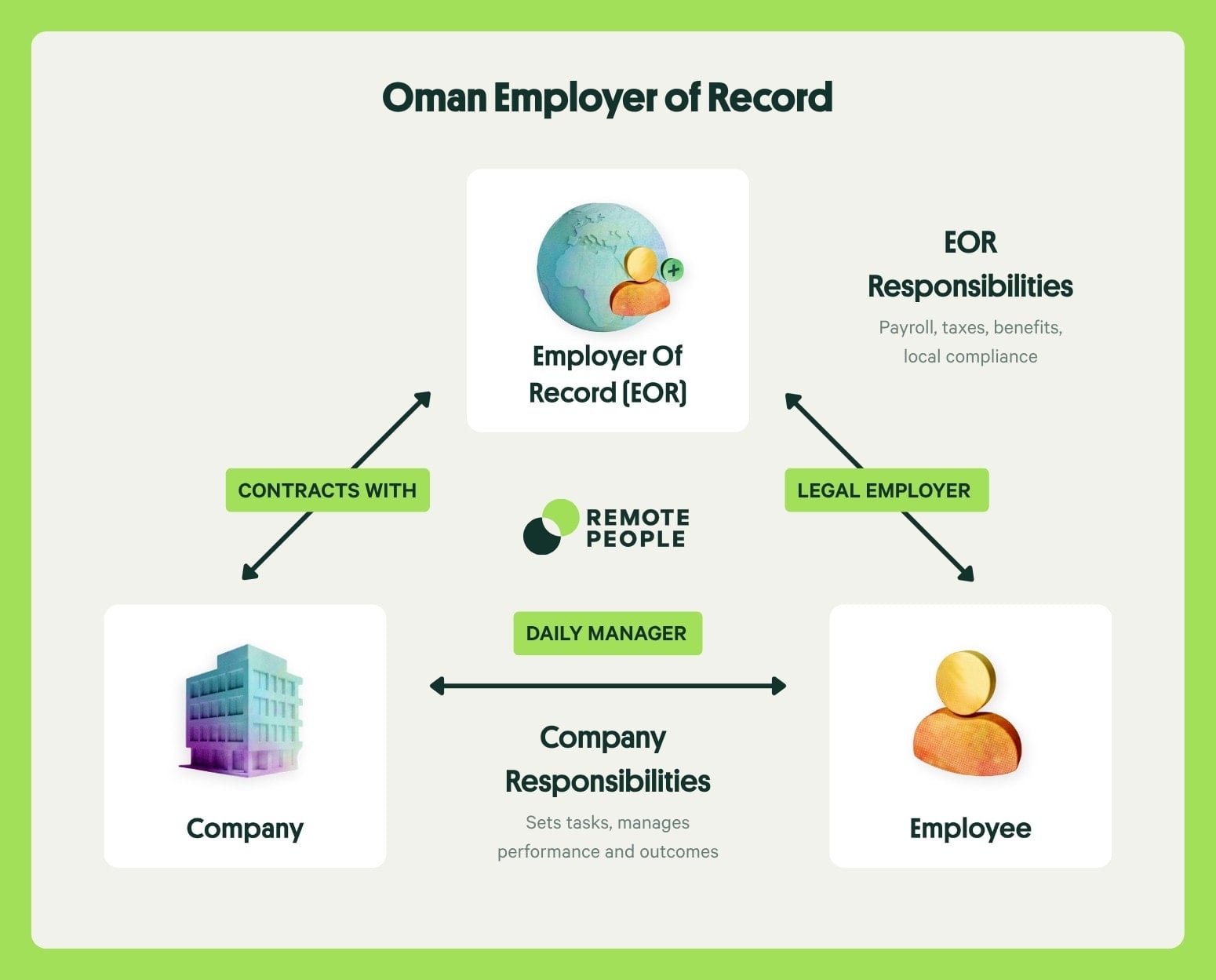
An employer of record in Oman solves this by acting as the legal employer on your behalf, handling contracts, payroll, SPF registration, labour clearance, and offboarding while your employees report directly to you. See how RemotePeople’s EOR solution works across 150+ countries.
How an Employer of Record Works in Oman
What Does an EOR Handle?
The EOR drafts the employment contract in line with the Labour Law, runs monthly payroll in Omani rials through the Wages Protection System, and remits contributions to the Social Protection Fund every month on behalf of Omani employees. Because Oman has no personal income tax on private-sector wages in 2026, the main payroll workstreams are SPF contributions, end-of-service gratuity accruals for expatriates, and the mandatory Dhamani health insurance premium.
Beyond payroll, the EOR applies for labour clearances through the Ministry of Labour, coordinates the employment visa with the Royal Oman Police, and takes care of day-one onboarding: resident card issuance, bank account setup guidance, Dhamani enrollment, and benefits registration. When the employment ends, the EOR handles the notice period, end-of-service gratuity calculation, and visa cancellation, which is the part most foreign employers underestimate.
A good EOR also absorbs compliance risk. Oman’s legal framework has been rewritten twice in 24 months (Royal Decree 52/2023 on social protection and Royal Decree 53/2023 on labour), with further phased obligations coming through 2027. The EOR updates its process, its contracts, and its payroll engine without the client needing to read the Official Gazette.
Who Uses an EOR in Oman?
EOR services in Oman are typically used by companies that want a compliant hiring solution without committing to a Commercial Registration in Muscat. Common scenarios include testing the Gulf market with one or two hires before opening an entity, hiring a regional manager who happens to live in Muscat or Salalah, bringing on a small support team to serve GCC and East African clients, or retaining an existing employee who is relocating to Oman from abroad. Teams hiring regionally often pair Oman with an EOR in the UAE or an EOR in Saudi Arabia to cover the wider Gulf market.
The EOR model is also a practical fit for organizations hiring between one and fifteen people in Oman where entity setup would be slow and expensive, for companies that need to onboard in weeks rather than months, and for any business that wants to reduce the compliance burden of running its own payroll, SPF file, and labour clearance process.
Typical Onboarding Timeline
Most EOR providers can onboard an employee in Oman within one to two weeks when the candidate is already an Omani national or holds a valid resident card. For expatriates hired from outside Oman, the labour clearance plus employment visa sequence adds roughly three to four additional weeks. The typical sequence looks like this:
- First, the client signs the EOR agreement and provides employee details, job description, and compensation package (1–2 days).
- Second, the EOR drafts the Arabic-English employment contract in line with Royal Decree 53/2023 and sends it for signature (2–3 days).
- Third, the EOR files the Ministry of Labour clearance and, for foreign hires, submits the employment visa application through the ROP portal (5–10 working days for clearance; further 2–3 weeks for visa issuance).
- Fourth, payroll is configured in the Wages Protection System and Dhamani health insurance plus any voluntary benefits are enrolled (1–2 days).
- Fifth, the employee completes resident card issuance at the Royal Oman Police and starts work, fully payrolled.
Background checks, medical screening, attested qualifications, and Omanisation quota reviews can extend this timeline. A realistic planning assumption is two weeks for locally resident hires and four to six weeks for expatriates arriving from abroad.
If you’d like to learn more about how Employer of Record (EOR) services work, read our What Is an Employer of Record (EOR)? guide for a complete overview of the model, its benefits, and when to use it.
If you’re comparing providers, our Best Employer of Record (EOR) Providers guide reviews the leading platforms to help you choose the right solution for your business.
Hire in Oman
A deep talent pool, English proficiency across professional sectors, and Oman’s tax-free income framework make Oman an attractive market for global teams.
We handle employment contracts, payroll, social security contributions, and full Oman compliance.
No local entity needed. Your team can start in days.
Employment Laws and Regulations in Oman
Employment Contracts
Employment in Oman’s private sector is governed by Royal Decree 53/2023 (Oman Labour Law), which came into force on 31 July 2023 and repealed the previous Royal Decree 35/2003. The law is administered by the Ministry of Labour. Written contracts are required and should set out the parties, job title, start date, wage, working hours, leave, probation (if any), and the duration of the contract.
Contracts can be indefinite or fixed-term, and fixed-term agreements that are renewed or continue to run after their stated end date automatically convert into indefinite contracts. Arabic is the official language of record; bilingual Arabic-English contracts are standard practice and the Arabic version prevails in any dispute.
Working Hours and Overtime
The standard private-sector workweek in Oman is 40 hours, arranged as 8 hours per day over 5 days, under Article 66 of the Labour Law (PwC summary of Royal Decree 53/2023). During the holy month of Ramadan, working hours for Muslim employees are reduced to 6 hours per day without any reduction in pay. No worker may be employed for more than 6 continuous hours without a break of at least one hour.
Overtime is only permitted with the employee’s consent and is capped so that total hours on any given day cannot exceed 12. The Labour Law sets the following premium rates for hours worked beyond standard hours:
Oman overtime and premium pay rates · Per Royal Decree 53/2023 | |||
Hour Type | Rate Multiplier | Daily Cap | Notes |
|---|---|---|---|
Daytime overtime | Basic wage + 25% | 12 hrs total | Applied to hours worked beyond the 8-hour day or 40-hour week. Requires employee consent. |
Night overtime (9pm–5am) | Basic wage + 50% | 12 hrs total | Applied to hours worked between 9pm and 5am under employer supervision. |
Weekly rest day work | Basic wage + 100% | 12 hrs total | Employee receives 200% of basic wage for the day, or a compensatory rest day in lieu. |
Official holiday work | Basic wage + 100% | 12 hrs total | Alternative: 2 rest days in lieu for every day worked on an official public holiday. |
Ramadan working hours | No reduction in pay | 6 hrs / day | Applies to Muslim employees; maximum 30 hours per week during Ramadan. |
Overtime cannot exceed the 12-hour daily total or be imposed without written consent, and in practice most salaried managerial staff are either excluded from overtime entirely or compensated through time off in lieu. Overtime and holiday premiums are calculated on the basic wage, not on gross pay, so allowances are typically excluded from the multiplier base.
Minimum Wage
The minimum wage in Oman is set at OMR 325 per month for Omani nationals in the private sector, comprising a basic salary of OMR 225 and allowances of OMR 100. The figure has been unchanged since Ministerial Decision 222/2013 and is confirmed by the WageIndicator Oman country profile. There is no statutory minimum wage for expatriate workers; in practice, employers benchmark expat wages against the sector, the role, and the average salary in Oman.
Proposals to raise the Omani minimum to OMR 360–400 have been under discussion since 2024 but no new decree has been issued. Employers hiring at the minimum must also apply the mandatory annual performance-based compensation scheme, which from 1 January 2026 pays Omani employees with six or more months of service between 2% and 5% of basic salary depending on performance rating.
Probation Period
The probation period in Oman is capped at 3 months for employees paid monthly and 2 months for those paid on another cycle, under Article 36 of Royal Decree 53/2023. Probation can only be used once between the same employer and worker, so re-hiring an employee who previously completed probation does not reset the clock. Either party may terminate during probation with at least 7 days’ written notice, and no severance is owed when the dismissal occurs before the probation period ends.
Leave Entitlements
Oman’s statutory leave framework sits inside Articles 80–92 of Royal Decree 53/2023 and significantly expanded almost every category when the new law took effect. The rules apply to all private-sector employees regardless of nationality.
Annual Leave
Employees in Oman are entitled to 30 days of paid annual leave after six months of continuous service, accruing at 2.5 days per month (Decree blog on Omani leave types). Up to 30 unused days may be carried forward to the following leave year. Unused annual leave is paid out in cash on termination at the last basic wage.
Leave accrues during probation, so early leavers receive pro-rata entitlement. The employer sets the timing of leave in line with operational needs but must give reasonable notice.
Sick Leave
The annual sick leave entitlement under Article 83 is up to 182 days per year, staged across four pay bands: 100% of wage for the first 21 days, 75% from days 22–35, 50% from days 36–70, and 25% from days 71–182 (Lexology analysis of the new Oman Labour Law). Sick leave is funded by the employer and is subject to a medical certificate issued by a Ministry of Health licensed facility. From 19 July 2026, sick-leave insurance becomes part of the Social Protection Fund scheme for expatriates, shifting part of the cost from the employer to the new fund.
Maternity Leave
Female employees in Oman receive 98 days of fully paid maternity leave, funded by the employer, and may use this entitlement an unlimited number of times during their service (Lockton briefing on Oman parental leave). Dismissal during maternity leave is prohibited. After returning, the employee is entitled to one paid hour per day for nursing breaks for 12 months, and may take up to one year of unpaid childcare leave immediately after maternity leave.
Paternity Leave
Fathers in Oman are entitled to 7 days of fully paid paternity leave under Royal Decree 53/2023, provided the leave is taken within 98 days of the child’s birth. This is a substantial expansion from the previous law, which had no statutory paternity entitlement.
Other Statutory Leave
The Labour Law also provides for several additional paid leave categories for private-sector employees:
- Marriage leave: 3 days on full pay, granted once during an employee’s service.
- Bereavement leave: 3 days on the death of a first-degree relative; 2 days for other close relatives.
- Iddah leave for Muslim widows: 130 days on full pay after the death of a husband.
- Hajj leave: up to 15 days once during service for Muslim employees with at least one year of tenure.
- Study and examination leave: up to 15 days per year for employees enrolled in accredited programmes.
Under Royal Decree 53/2023 (Articles 80–92), the table below summarises every statutory leave entitlement and their funding responsibility. The single most important takeaway is that annual leave now accrues from day one of service rather than after a 12-month qualifying period, which materially changes entitlements for short-tenure leavers.
Oman statutory leave entitlements · Per Royal Decree 53/2023 | ||
Leave Type | Duration | Eligibility and Notes |
|---|---|---|
Annual leave | 30 days / year | Available after 6 months of service. Accrues at 2.5 days per month. Up to 30 days may be carried forward. Paid on exit if unused. |
Sick leave | Up to 182 days / year | Paid by employer: 100% days 1–21, 75% days 22–35, 50% days 36–70, 25% days 71–182. MoH medical certificate required. |
Maternity leave | 98 days paid | Paid in full by employer. Unlimited instances allowed. Dismissal prohibited during leave. 1-hour paid nursing breaks for 12 months after return. |
Paternity leave | 7 days paid | Full pay. Must be taken within 98 days of the child’s birth. |
Childcare leave | Up to 1 year unpaid | Available to female employees immediately after maternity leave. Job is preserved for the duration. |
Marriage leave | 3 days | Paid leave, granted once during employment. |
Bereavement leave | 2–3 days | 3 days for first-degree relatives; 2 days for other close relatives. Paid in full. |
Iddah leave | 130 days | Muslim widows, on full pay after the death of a husband. |
Hajj leave | Up to 15 days | Once during service for Muslim employees with at least 1 year of tenure. Paid in full. |
Source: Royal Decree 53/2023 and Lexology Oman labour law guide | ||
Statutory Employee Benefits
Mandatory employee benefits in Oman split cleanly into three pillars: Social Protection Fund contributions (for Omanis today, expanding to expatriates by 2027), mandatory Dhamani health insurance (both Omanis and expatriates), and end-of-service gratuity for expatriate workers until the new savings system comes online. Employers should account for each pillar when budgeting total cost of employment.
- Social Protection Fund contributions: Omani nationals are covered through the merged SPF (formerly PASI) across old age, disability, death, work injury and job security. Expatriates are outside the scheme in 2026 but enter progressively between July 2026 and July 2027 under Royal Decree 52/2023.
- Mandatory health insurance (Dhamani): Under the Unified Health Insurance Policy administered by the Financial Services Authority, employers must provide medical cover to all private-sector employees with a minimum annual coverage limit of OMR 4,500.
- End-of-service gratuity for expatriates: Until the SPF savings system for non-Omanis takes effect on 19 July 2027, employers accrue lump-sum gratuity of 15 days per year for the first three years and one month per year thereafter.
- Mandatory annual performance compensation (Omanis only): From 1 January 2026, every Omani employee with six or more months of service is entitled to a tiered annual increment of 2%–5% of basic salary based on performance rating.
- Voluntary benefits: Housing, transport, and education allowances are not statutory but are common on top of base salary for mid-level and senior roles.
The contribution tables in H2 4 list the exact rates for each pillar. Most EOR providers bundle a compliant Dhamani group plan into their service fee and pass through optional benefits at cost.
Recent Regulatory Updates 2026
The Omani employment framework has been rebuilt twice in rapid succession. Royal Decree 53/2023 (the new Labour Law) and Royal Decree 52/2023 (the Social Protection Law) both took effect on 31 July 2023 and 1 January 2024 respectively, with several provisions phased in across 2025–2027. Employers should expect further operational changes through 2027.
Effective 1 January 2026, the mandatory annual performance-based compensation for Omani nationals was restructured from a flat 3% of basic salary into a tiered 2%–5% band based on performance rating (Lockton briefing). Effective 19 July 2026, sick-leave insurance and work-injury insurance for non-Omani workers come into force under the Social Protection Law, financed by a combined 1% contribution split equally between employer and employee. The compulsory savings scheme that replaces the lump-sum end-of-service gratuity for expatriates now takes effect on 19 July 2027, following a one-year extension. The Royal Oman Police also issued updated Golden and Silver Visa rules under a 31 August 2025 decree, widening the qualifying investment categories beyond property.
Work Permits and Visas in Oman
Work Permit Requirements
Who Needs a Work Permit
All non-Omani employees, with narrow exceptions for GCC nationals taking up certain roles, need a labour clearance from the Ministry of Labour and an employment visa issued by the Royal Oman Police before they can start employment in Oman. Omani nationals do not need a work permit. Dependent family members on resident cards need their own employment visa if they later take up paid work, even if their main permit is still valid.
Eligibility and Required Documents
To sponsor a foreign hire, the employer must hold an active Commercial Registration, an active Ministry of Labour establishment card, an approved foreign labour quota for the relevant occupation, and be compliant with its Omanisation percentage. Jobs on the “Omani-only” list (200+ reserved occupations) cannot be sponsored. The standard documentation bundle includes a signed employment contract, a passport valid for at least 6 months, academic and professional qualifications attested in the country of origin, a recent passport photo, a medical fitness certificate from an approved clinic, and a security check processed through the ROP.
Processing Time and Validity
The Ministry of Labour typically issues labour clearance within 5–10 working days once documentation is complete. The employment visa is issued by the ROP within a further 2–3 weeks (Royal Oman Police visa portal). Standard employment visas are valid for 2 years and renewable for as long as the employment continues. Shorter 6-month and 1-year options exist for temporary projects. Fees scale with duration and occupation category.
Renewal Process
Renewals must be submitted before the existing visa expires. The employee can continue working during the renewal window provided the file was submitted on time. Renewal fees are lower than new-issue fees, and late renewals trigger penalties as well as a risk of the employee’s resident card being cancelled. Omanisation compliance is re-verified at renewal, so employers near the quota line should model their Omani-to-expatriate ratio well in advance.
Common Visa Types for Foreign Workers
Oman’s immigration framework is administered by the Royal Oman Police in coordination with the Ministry of Labour for work-related categories, and by Invest Oman for the Golden and Silver Visa tiers launched in 2021 and expanded in August 2025. An EOR can sponsor standard employment visas but cannot sponsor investor or golden categories, which are tied to the individual’s own investment or qualifications.
Oman work visa types for foreign workers · 2026 | ||||
Visa Type | Duration | Best For | Leads to APT? | Processing |
|---|---|---|---|---|
Standard employment visa | 2 years, renewable | Full-time employees sponsored by a registered Omani employer or EOR. | No | 3–5 weeks |
Temporary work visa | Up to 3 months (renewable once) | Short-term projects, specialists, urgent contracts. | No | 1–2 weeks |
Investor residence visa | 2 years, renewable | Foreign shareholders of Omani companies; tied to the business. | Pathway possible | 2–4 weeks |
Golden Visa (Category I) | 10 years, renewable | Investors from OMR 500,000 in qualifying assets, senior executives, exceptional talent. | Yes | 4–8 weeks |
Silver Visa (Category II) | 5 years, renewable | Investors from OMR 250,000, retirees, skilled professionals meeting income thresholds. | Pathway possible | 4–8 weeks |
Family / dependent resident visa | Matches sponsor’s visa | Spouse and children of sponsored workers; residence only, no work rights. | No | 1–2 weeks |
The following categories exist but do not permit private-sector employment and are not handled by an EOR:
- Tourist visa: for leisure travel only, no work rights.
- Business visit visa: for short meetings and site inspections, not paid employment.
- Student visa: for enrolled students; limited part-time rights may apply with special authorisation.
- Transit visa: for travellers passing through Oman within 72 hours.
How an EOR Handles Work Permits
An employer of record in Oman is the legal sponsor for Ministry of Labour purposes, which means it files the labour clearance, pays the associated fees, and assumes the compliance obligations toward the Ministry and the Royal Oman Police. The EOR handles employer-side steps like establishment registration, Omanisation quota tracking, contract drafting, and resident card coordination. The employee still needs to provide personal documents, attend medical screening, and submit biometrics in person.
Because the clearance plus visa sequence adds about 3–5 weeks for applicants outside Oman, expatriate onboarding runs closer to 4–6 weeks end to end rather than the 1–2 weeks quoted in the timeline for locally resident hires. The EOR sponsors standard employment visas within the employment relationship it controls; Golden and Silver visa applications require the individual to apply directly, and the EOR simply continues as payroll employer once the visa is granted.
Payroll, Taxes, and Social Security in Oman
Employer Contributions
Employer social insurance costs in Oman differ sharply between Omani nationals and expatriates. For Omani workers, the employer pays a 12.5% combined contribution to the Social Protection Fund covering old age, disability, death, work injury, and job security. For expatriates, the only current Labour-Law-mandated accrual is the end-of-service gratuity, with new SPF work-injury and sick-leave contributions phasing in from 19 July 2026.
Oman employer social security contributions · 2026 rates | ||
Contribution | Rate | Notes |
|---|---|---|
SPF old age, disability, death (Omanis) | 11.0% | Applied to contributory pay capped at OMR 3,000 per month. Paid monthly to the Social Protection Fund. |
SPF work injury (Omanis) | 1.0% | Covers occupational injury and disease. Non-Omani coverage phases in from 19 July 2026. |
SPF job security insurance (Omanis) | 0.5% | Funds unemployment benefits. Matched by employee 0.5% contribution. |
End-of-service gratuity accrual (expatriates) | ≈ 4.2% of basic wage | Accrues at 15 days’ basic wage per year for first 3 years, 30 days from year 4. Paid as lump sum on exit until SPF savings system starts 19 July 2027. |
Dhamani health insurance premium | Fixed premium (OMR 35–120/year) | Mandatory for all private-sector employees. Premium depends on age, role, and plan; minimum OMR 4,500 annual coverage. |
Total employer burden (Omani) | 12.5% + premium | SPF contributions on capped pay, plus Dhamani premium and mandatory annual performance increment. |
Total employer burden (expatriate) | ≈ 4.2% + premium | Gratuity accrual on basic wage plus Dhamani premium. SPF work-injury and sick-leave contributions (1% split) start 19 July 2026. |
Employee Contributions
Employee-side deductions in Oman are minimal because there is no personal income tax in 2026. Omani nationals pay a combined 8.0% to the Social Protection Fund covering pension and job security insurance. Expatriates currently have no SPF deduction; a 0.5% work-injury and sick-leave contribution is due from 19 July 2026 under the Social Protection Law.
Oman employee payroll deductions · 2026 monthly withholdings | ||
Deduction | Rate | Notes |
|---|---|---|
SPF old age, disability, death (Omanis) | 7.5% | Withheld monthly on contributory pay capped at OMR 3,000. Funds retirement and invalidity benefits. |
SPF job security insurance (Omanis) | 0.5% | Funds the national unemployment protection scheme. Matched by employer 0.5%. |
SPF work injury / sick leave (expatriates from 19 July 2026) | 0.5% | Begins mid-2026 under Royal Decree 52/2023. Matched by employer 0.5%. |
Personal income tax | 0.0% | Oman levies no personal income tax on wages in 2026. A 5% PIT above OMR 42,000 annual income is scheduled for 2028. |
Total employee deduction (Omani) | 8.0% | SPF line items only; no PIT withholding applies in 2026. |
Income Tax
Oman levies no personal income tax on wages or self-employment income in 2026. There is also no wealth tax, inheritance tax, or capital gains tax on individuals (PwC Oman personal income tax summary).
A Personal Income Tax Law was published in 2025 introducing a 5% tax on annual income above OMR 42,000, but the first taxable year is 2028, with the first returns due in 2029. For 2026 and 2027 payrolls, the only withholding from a private-sector paycheque is the 8.0% SPF contribution for Omani nationals, or nothing for expatriates under current rules. The “tax brackets” table is therefore effectively a single flat-zero band across all income levels for 2026.
Oman income tax brackets · 2026 | |
Annual Taxable Income | Tax Calculation |
|---|---|
OMR 0 and above (2026) | 0% – no personal income tax on employment or other income for 2026 |
Above OMR 42,000 (from 2028) | 5% flat rate on the excess above the threshold, first taxable year 2028 |
Payroll Cycle
Wages are paid monthly under Oman’s payroll and income tax rules, no later than 7 days after the end of the wage period, in Omani rials through a local bank account under the Wages Protection System. Cash payments and non-OMR currency are not permitted for private-sector employees, and late payments are reported to the Ministry of Labour’s WPS dashboard for enforcement.
Payslips must be provided and should show gross pay, SPF contributions (where applicable), Dhamani premium, any deductions, and net pay. SPF contributions are due monthly through the Social Protection Fund portal, and annual reconciliations are filed alongside the employer’s Omanisation status report.
13th Month Salary and Bonus Pay
A 13th-month salary is not mandatory in Oman. In place of a 13th cheque, employers pay Omani employees with six or more months of service a mandatory annual performance-based compensation: from 1 January 2026 this is a tiered increment of 2%–5% of basic salary based on performance rating, replacing the previous flat 3% (Lockton Oman briefing). The scheme does not apply to expatriate workers.
Discretionary bonuses, sales commissions, and Ramadan gifts are common but not legally required. When bonuses are paid, they are generally excluded from the end-of-service gratuity base unless the employment contract explicitly makes them part of basic wage.
Cost of Hiring Through an EOR in Oman
EOR Service Fees
Employer-of-record services in Oman typically cost between $300 and $600 per employee per month in USD, depending on provider, complexity, headcount, and whether labour clearance and employment-visa sponsorship are included. The fee generally covers compliant contract drafting, monthly payroll, SPF registration and filings (where applicable), Ministry of Labour clearance, visa sponsorship, Dhamani enrollment, offboarding, and ongoing compliance monitoring. Visa government fees, medical insurance premium, and any voluntary benefits are usually passed through at cost.
Total Employment Cost Breakdown
The cost example below illustrates a typical expatriate hire in 2026. Because Oman imposes no personal income tax, the employee keeps nearly all of the gross salary, while the employer carries the end-of-service gratuity accrual and the Dhamani health insurance premium. All figures are shown in USD so buyers can compare directly against other Gulf markets.
Oman employer cost example · USD 2,500/month gross · 2026 | ||
Employer Cost | Amount (USD) | % of Gross |
|---|---|---|
Gross monthly salary (expatriate) | $2,500.00 | 100.0% |
End-of-service gratuity accrual (years 1–3) | $105.00 | 4.2% |
Dhamani health insurance (monthly estimate) | $25.00 | 1.0% |
EOR service fee (estimate) | $450.00 | 18.0% |
Total monthly cost to employer | $3,080.00 | 123.2% |
Source: Social Protection Fund and PwC Oman other taxes | ||
Figures converted at 1 USD ≈ 0.385 OMR (April 2026 indicative rate). Government visa and clearance fees are passed through at cost and are not included in this illustrative example.
At a $2,500 monthly gross salary for an expatriate hire, the total employer cost works out to roughly $3,080 per month, or about 23.2% above gross once gratuity accrual, Dhamani insurance, and a representative EOR fee are included. Because Oman has no personal income tax in 2026, the employee keeps 100% of the gross salary, which is the highest net take-home position in the Gulf alongside Bahrain and the UAE.
Contact RemotePeople to get started with an employer of record in Oman. We handle employment contracts, payroll, SPF contributions, Ministry of Labour clearances, employment visas, Dhamani enrollment, and full Oman Labour Law compliance, with no local entity needed.
Benefits of Using an EOR in Oman
The strongest arguments for using an employer of record in Oman are tied directly to the Gulf market’s two realities: speed wins regional contracts, and compliance mistakes are expensive. An EOR compresses the onboarding cycle and absorbs the ongoing regulatory load so client teams can focus on customers and delivery.
- Speed to market: A full Omani Commercial Registration with the Ministry of Commerce, Industry and Investment Promotion plus Ministry of Labour establishment setup typically takes 2–4 months. An EOR can onboard a first hire in 1–2 weeks for residents and 4–6 weeks for expatriates, which is often the deciding factor when a regional opportunity has a narrow window.
- Compliance assurance: Royal Decree 53/2023 and Royal Decree 52/2023 phase in new obligations through 2027, and every misstep carries administrative penalties. An EOR absorbs that regulatory maintenance, tracking updates to Omanisation ratios, SPF contribution triggers, and visa rule changes on the client’s behalf.
- Cost efficiency vs local entity: Setting up and running an Omani entity costs around $20,000 upfront and $15,000–$40,000 per year in ongoing maintenance. For teams of 1–15, the per-head EOR fee is typically lower than entity overhead, with no exit cost if the team is later wound down.
- Local expertise: The EOR handles Arabic contract drafting, WPS payroll mechanics, Dhamani enrollment, and labour clearance nuances that are hard to master remotely. That local knowledge layer is baked into the monthly fee rather than hired separately.
- Flexibility to scale up and down: Adding a second or tenth hire follows the same onboarding path as the first. Scaling down requires nothing more than a compliant notice period and final settlement, rather than dissolving a Commercial Registration.
- Risk mitigation: Misclassification risk, payroll timing slip-ups, and visa expiry issues can trigger fines, work bans, or employee disputes in Oman. An EOR assumes operational liability for these processes and is contractually accountable for compliance.
- Better employee experience: Timely OMR payments through WPS, correct Dhamani coverage, smooth visa renewal, and accurate gratuity accrual all contribute to employee retention. That experience is difficult to replicate on an ad-hoc basis for a single hire.
Get started with RemotePeople to build your Oman team without setting up a local entity.
Termination and Offboarding in Oman
Notice Periods
Either party must give written notice to terminate an indefinite contract in Oman under Article 42 of Royal Decree 53/2023. Notice must be delivered in writing, and the period runs from the date of receipt. Employees paid monthly are entitled to a minimum 30-day notice; those paid on other cycles receive 15 days (Dentons briefing on termination under the new Oman Labour Law).
Oman statutory notice periods by position level · Per Royal Decree 53/2023 | |||
Position Level | Notice Period | During Probation | Notes |
|---|---|---|---|
Monthly-paid employees (indefinite contract) | 30 calendar days | 7 days | Default for most private-sector roles paid on monthly cycle. |
Other-cycle employees (indefinite contract) | 15 calendar days | 7 days | Applies to weekly or daily wage arrangements. |
Fixed-term contracts | Per contract terms | 7 days | Early termination without cause entitles the employee to remaining contract value up to a statutory cap. |
Collective dismissals (10+ employees) | 60 days to Ministry of Labour + standard notice | Not applicable | Advance notification to MoL is required, in addition to individual notice periods. |
Just-cause termination (Article 44) | No notice required | Not applicable | Must fall within the listed serious misconduct categories; written warning trail usually required. |
During the notice period, the employee remains entitled to wages, accrues annual leave, and can be released on garden leave only by mutual agreement. Notice can be paid in lieu where the employment contract allows it. Unilateral termination without notice outside the listed just-cause categories entitles the employee to compensation on top of gratuity.
Severance Pay
End-of-service gratuity (EOSG) is the main severance entitlement under Article 61 of Royal Decree 53/2023 for expatriate workers. Omani nationals are covered instead by the Social Protection Fund and receive their pension benefits directly from the SPF on retirement or redundancy. Gratuity becomes payable to an expatriate whose employment ends for any reason other than gross misconduct under Article 44.
Oman severance pay schedule by years of service · Per Royal Decree 53/2023 | |||
Years of Service | Severance Amount | Base Salary | Notes |
|---|---|---|---|
1 year (OMR 1,000 basic) | OMR 500 (15 days × 1) | Last basic wage | 15 days basic wage per year for the first 3 years; pro-rated for fractions. |
3 years (OMR 1,000 basic) | OMR 1,500 (15 days × 3) | Last basic wage | Cumulative total after 3 full years at 15 days per year. |
5 years (OMR 1,000 basic) | OMR 3,500 (15 × 3 + 30 × 2) | Last basic wage | 30 days (1 month) basic wage per year from year 4 onwards. |
10 years (OMR 1,000 basic) | OMR 8,500 (15 × 3 + 30 × 7) | Last basic wage | Formula continues at 30 days per year for every year beyond the third. |
Calculation Method
The gratuity formula is 15 days of the last basic wage for each of the first three years of service, plus 30 days (one month) of the last basic wage for each subsequent year. Partial years are pro-rated, so an employee leaving at 3.5 years of service receives gratuity for three full years at the 15-day rate plus six months at the 30-day rate. The calculation base is the most recent basic wage only; allowances, bonuses, and irregular overtime are excluded unless the employment contract explicitly makes them part of basic pay. See Table 13 for worked examples at 1, 3, 5, and 10 years of service.
Caps and Exceptions
There is no statutory cap on total gratuity, but the figure is limited by the final basic wage used for the calculation. Employees dismissed for gross misconduct under Article 44 of the Labour Law forfeit gratuity, and termination during probation does not trigger any severance entitlement. Fixed-term contracts terminated early by the employer without cause attract gratuity plus compensation equal to the remaining contract period, subject to any cap in the contract. From 19 July 2027, expatriate gratuity will be replaced by a monthly SPF savings contribution that accrues into an individual account, ending the lump-sum-at-exit model.
Grounds for Termination
Oman’s Labour Law allows termination with or without cause. Termination without cause requires notice and full payment of gratuity. Termination for cause under Article 44 is allowed only in listed circumstances such as impersonation, repeated serious breach of duties after written warning, gross misconduct, unexplained absence of more than 7 consecutive days or 10 intermittent days in one year, disclosure of trade secrets, or conviction of a crime affecting honour or integrity.
Protected categories include women on maternity leave and employees on approved sick leave within the 182-day statutory entitlement. Unlawful dismissal can entitle the employee to compensation of up to three months’ wage plus gratuity and notice pay, depending on tenure and circumstances.
EOR vs. Other Hiring Models in Oman
EOR vs. Setting Up a Local Entity
Oman EOR vs local entity comparison · Setup time, cost, risk and best-fit | ||
Comparison | Employer of Record | Own Entity |
|---|---|---|
Setup time | 1–2 weeks | 2–4 months |
Upfront cost | $0 | $8,000–$20,000 |
Ongoing cost | $300–$600/employee/month | $15,000–$40,000/year maintenance |
Local partner required | No (EOR is the local entity) | Not required for most activities; restricted sectors still need Omani participation |
Social insurance registration | Handled by EOR | You manage it |
Payroll and tax filing | Handled by EOR | You manage it (or outsource) |
Best for team size | 1–15 employees | 15+ employees |
Scale down / exit | Easy, no entity to unwind | Costly, legal dissolution required |
Government contracts | Not eligible | Eligible (requires local entity) |
An EOR is the right choice for most companies entering Oman for the first time or running a small team. Setup is measured in weeks rather than months, there is no minimum capital to deposit, and scaling down is a matter of serving notice rather than dissolving a Commercial Registration.
A local entity becomes more attractive once headcount crosses about 15 employees, where the monthly EOR fee stack starts to exceed the cost of running in-house HR and payroll. An entity is also mandatory if the business needs to bid for Omani government contracts, hold its own Commercial Registration for licensing reasons, or participate in Omanisation credit directly.
EOR vs. Hiring Independent Contractors
Oman EOR vs independent contractors · Compliance, cost, and risk | ||
Comparison | EOR (Full-Time Employee) | Independent Contractor |
|---|---|---|
Legal relationship | Employee of the EOR | Self-employed, no employment relationship |
Compliance risk | Low, EOR ensures Oman Labour Law compliance | Higher, misclassification risk if the relationship resembles employment |
Payroll and tax | EOR handles SPF, gratuity, Dhamani, WPS filings | Contractor invoices you; they manage their own registrations |
Benefits and leave | Statutory leave, Dhamani cover, gratuity or SPF | No entitlement to employee benefits |
IP protection | Stronger, employment contract assigns IP by default | Weaker, requires explicit IP assignment clause |
Termination | Subject to Labour Law notice and gratuity | Contract can be ended per agreement terms |
Best for | Long-term, core team roles | Short-term projects, specialist deliverables |
Cost structure | Salary + gratuity + Dhamani + EOR fee | Contractor fee (typically higher gross, lower total cost) |
Oman applies a substance-over-form test to contractor relationships. If a “contractor” is paid a regular monthly fee for exclusive full-time work, reports into a client manager, uses client tools, and cannot deliver the work to another principal, the Ministry of Labour and the courts will usually re-characterise the relationship as employment. The consequences include back payment of SPF contributions, Dhamani premiums, and gratuity, plus administrative fines and possible work-ban decisions against the client.
Contractors are only appropriate in some cases such as short project deliverables, freelance creative assignments, or specialist consulting engagements. For ongoing, full-time, exclusive work, an EOR is safer because it preserves the employment relationship, IP assignment, and compliance wrapper that contractors lack. RemotePeople’s contractor management solution and Oman contractor service handle compliant contractor onboarding and payments for projects where a contractor relationship genuinely fits.
EOR vs. PEO (Professional Employer Organization)
Oman EOR vs PEO comparison · Legal employer, liability, and setup | ||
Comparison | Employer of Record (EOR) | PEO |
|---|---|---|
Legal employer | EOR is the legal employer | You remain the legal employer (co-employment) |
Local entity required | No, the EOR is the local entity | Yes, you must have your own entity in Oman |
Best for | Companies without a local entity | Companies that already have a local entity |
Compliance liability | EOR assumes compliance responsibility | Shared liability between you and the PEO |
Setup time | 1–2 weeks | Depends on your entity setup (weeks to months) |
Control over HR policies | EOR manages within Oman Labour Law framework | More direct control, PEO advises |
Typical use case | Market entry, small remote teams, testing new markets | Established Omani operations needing HR outsourcing |
Source: Oman Ministry of Labour and Royal Decree 53/2023 | ||
Oman does not recognise co-employment as a distinct legal concept, so the PEO model imported from the United States translates only loosely. In practice, global providers offering “PEO services” in Oman are running either full EOR arrangements (if the client has no entity) or HR/payroll outsourcing on top of the client’s own entity.
The key distinction remains: EOR removes the need for a local entity entirely, while PEO-style outsourcing assumes you already have one. For most foreign companies hiring their first few Omani staff, the EOR route is both faster and cleaner. Once the entity is in place and headcount is stable, switching to an outsourced payroll or HR partner is a separate decision that sits outside the EOR conversation.
Public Holidays in Oman
Oman observes both fixed and Islamic (moon-sighted) holidays. Islamic holiday dates are confirmed closer to the event by official announcement, which can shift a specific date by one day in either direction. When a public holiday falls on a weekend, the following working day is typically declared a substitute holiday.
Oman public holidays · 2026 calendar year | ||
Date | Holiday | Type |
|---|---|---|
Thursday, 15 January 2026 | Accession Day of His Majesty the Sultan | National |
Sunday, 18 January 2026 | Isra and Mi’raj | Islamic |
Friday–Monday, 20–23 March 2026 | Eid al-Fitr | Islamic |
Wednesday, 27 May 2026 | Day of Arafah | Islamic |
Thursday–Sunday, 28–31 May 2026 | Eid al-Adha | Islamic |
Sunday, 21 June 2026 | Islamic New Year (Hijri 1447) | Islamic |
Friday, 28 August 2026 | Prophet Muhammad’s Birthday (Mawlid) | Islamic |
Wednesday, 18 November 2026 | Oman National Day | National |
Thursday, 19 November 2026 | Oman National Day (second day) | National |
Work performed on a public holiday is compensated at 200% of basic wage, or alternatively with two rest days in lieu for each day worked. Employers should plan payroll, project deadlines, and visa appointments around these dates, especially during Ramadan (February–March 2026) when working hours are reduced to 6 per day for Muslim employees.
How to Get Started with an EOR in Oman
Getting started with an employer of record in Oman is a five-step process. Most teams move from contact to first payroll in one to two weeks for locally resident hires, and four to six weeks for expatriates requiring an employment visa.
- First, scope the hire with RemotePeople: Share the role, salary, start date, and nationality so the team can confirm Omanisation quota availability, visa category, and a total-cost-of-employment estimate in USD and OMR.
- Second, sign the EOR agreement and issue the contract: RemotePeople drafts a bilingual Arabic-English employment contract that complies with Royal Decree 53/2023, including probation, notice, gratuity, and benefits clauses. The candidate signs electronically.
- Third, clear labour and visa steps: RemotePeople files the Ministry of Labour clearance, coordinates attested documents, and submits the employment visa through the Royal Oman Police portal. Resident-card issuance and medical screening complete this step.
- Fourth, configure payroll, SPF, and Dhamani: Monthly payroll is set up in the Wages Protection System, SPF contributions are registered for Omani hires, Dhamani health coverage is enrolled, and any voluntary benefits are layered on top.
- Fifth, go live and run ongoing compliance: On the first payroll cycle, the employee is paid in OMR and receives a compliant payslip. RemotePeople runs monthly SPF filings, manages visa renewals, and tracks every regulatory change through 2027.
Contact RemotePeople to get started with an employer of record in Oman. We handle contracts, payroll, SPF, labour clearance, employment visas, Dhamani, and offboarding, with no local entity needed.
Where companies hiring in Oman expand next
Companies hiring in Oman commonly expand across the GCC, where harmonized residency rules and aligned payroll practices make regional coverage straightforward. Common expansion paths include a team in Saudi Arabia (GCC-aligned residency and payroll practices) and operations in Qatar (harmonized GCC labor rules and talent mobility). Teams scaling further usually add Bahrain for shared GCC employment frameworks, with hiring in the United Arab Emirates extending coverage through GCC-wide compensation and compliance parity.
Frequently Asked Questions
Most locally resident candidates can be onboarded within 1–2 weeks once the EOR agreement is signed. Expatriates arriving from outside Oman add roughly 3–4 weeks for the Ministry of Labour clearance, employment visa via the Royal Oman Police, medical screening, and resident-card issuance, for a realistic total of 4–6 weeks end to end. Background checks, attested qualifications, and Omanisation-quota reviews can extend this timeline further.
Yes. An employer of record operates through its own Omani Commercial Registration, Ministry of Labour establishment card, Social Protection Fund employer file, and Omanisation quota. Every contract is a direct employment contract under Royal Decree 53/2023 between the EOR and the employee, so there is no grey-area arrangement. The EOR is the legal sponsor for work visas and assumes compliance liability toward the Ministry of Labour and the Royal Oman Police.
The employment contract assigns intellectual property created during employment to the client company (you), not to the EOR. RemotePeople's contracts include standard IP assignment, confidentiality, and post-employment obligation clauses that track Omani practice. This is stronger than a contractor arrangement, where IP assignment must be negotiated explicitly in every statement of work.
Employer of Record in
Employer of Record in
Employer of Record in
Employer of Record in
Employer of Record in
Employer of Record in
Employer of Record in
Employer of Record in