
 Recruit
Employer of Record in California
-
 Drew Donnelly
- Published
- September 27, 2026
California’s strict labor laws include AB5 classification, CCPA privacy rules, and mandatory paid sick leave, and a California EOR handles full state compliance with no local entity needed.
Hire in California — book a free 30-minute demo
Tell us what you need. You'll get a tailored, transparent proposal within 24 hours, plus a free call to walk through it.
Tell us about your company
So we can match you with a specialist who knows your market — and unlock volume pricing tiers.
* All fields are required.
Where and when are you hiring?
Tell us the geography and timing and we'll quote each country line by line, with onboarding timelines.
* All fields are required.
Help us beat your current setup
We'll benchmark your current deal and send a line-by-line proposal in 24 hours — showing exactly where we cut cost, time, or risk. After you submit, you can book a call to walk through it together.
* All fields are required.
Thanks! Your proposal is on its way.
Expect a tailored, line-by-line proposal in your inbox within 24 hours. In the meantime…
Want to walk through it together?
Book a free 30-minute call with one of our specialists. We'll explain every line, answer your questions, and tailor the proposal further if you need.
No obligation. Pick a time that works for you.








- Hire in California — book a free 30-minute demo
- Tell us about your company
- Where and when are you hiring?
- Help us beat your current setup
- Thanks! Your proposal is on its way.
- California Employer of Record
- What Is the Difference Between a California Employer of Record and a California PEO?
- How Does a California EOR Work?
- How Do Labor Laws Affect Hiring in California?
- Payroll Taxes and Employer Cost in California
- Employee Classification Rules in California
- What Makes Hiring in California Unique?
- What Are the Benefits of a California Employer of Record Service?
- What Are the Downsides of a California Employer of Record Service?
- How to Choose a California Employer of Record
- Engage a California Employer of Record, with RemotePeople
- Frequently Asked Questions
- Related EOR Destinations
Let RemotePeople handle payroll, compliance, and HR admin worldwide so you can focus on building your team.
Key Takeaways
- Every employer must pay a minimum wage of $16.90 per hour, regardless of the total number of employees.
- White-collar exemptions require a minimum salary of $70,304 per year.
- California’s strict “ABC test” places a heavy burden on employers who want to show that any worker is properly classified as an independent contractor.
- Any discharged employee must be paid all final wages and unused vacation time immediately to avoid heavy daily penalties.
- Employers are required to provide at least 40 hours or five days of paid sick leave annually and participate in the state’s eight-week Paid Family Leave program.
California’s 2026 economy features top-tier innovation, but the most regulation in the country. California is home to most of the U.S. AI, green tech, and biotech, but its labor market has since softened after high-wage job losses. Employer uncertainty is high in a volatile market that includes a surging tech sector and unsettled federal policies on trade and immigration.
Operating costs are one of the highest in the country, due in large part to high inflation and strict labor laws. While labor laws in California place emphasis on worker protection, they do not favor corporate flexibility. The financial risks associated with non-compliance are steep, and companies need to have a strong understanding of the ordinances at both the state and, often, more stringent municipal levels. California remains an attractive ecosystem for innovation and is able to draw the best talent, despite the challenges and high costs associated with the market.
California Employer of Record
What is an EOR can help explain how this employment model works in more detail.
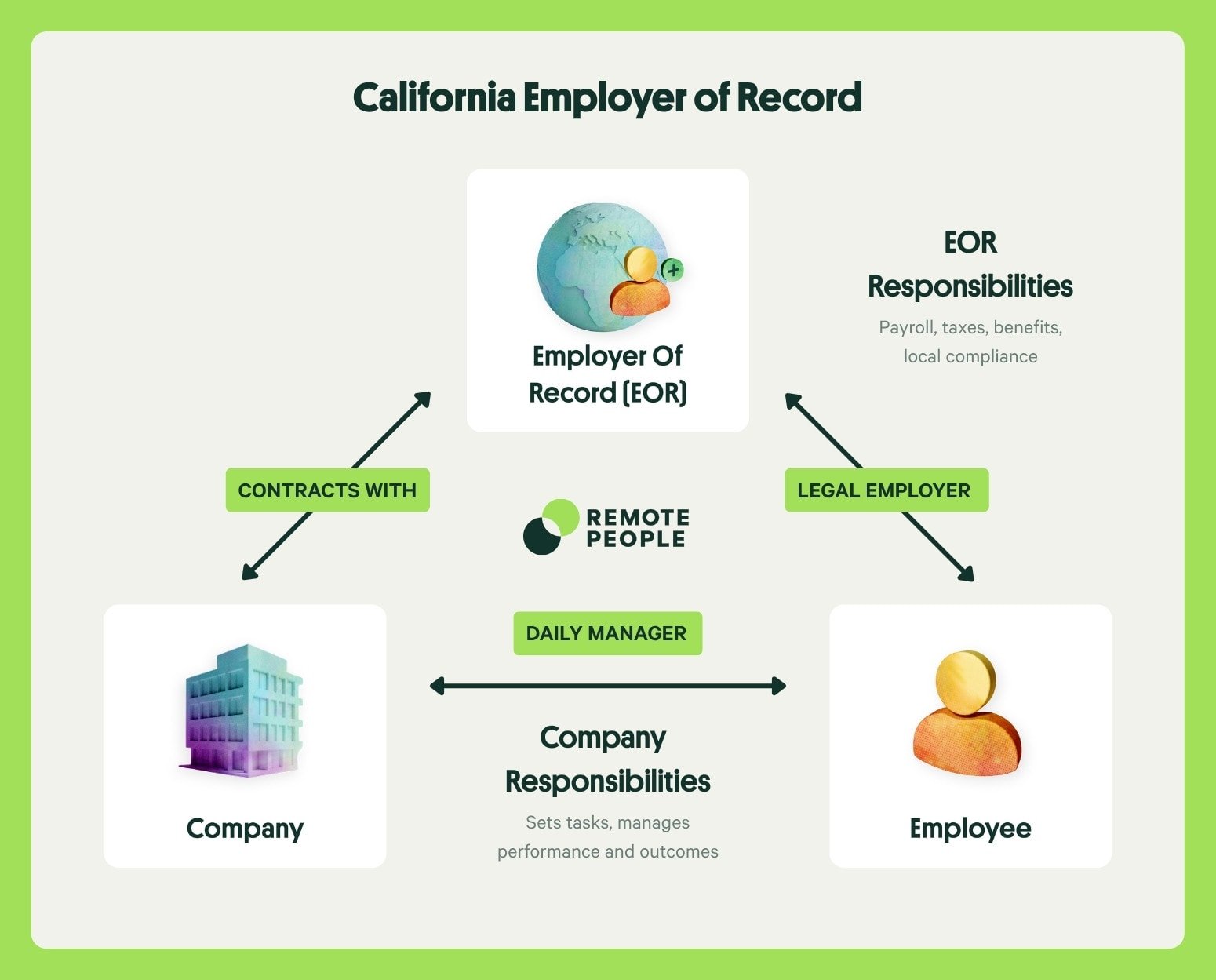
A California Employer of Record (EOR) is a business that legally employs a local workforce on your behalf, managing all administrative and legal obligations. An EOR provides a back-office lifecycle, processing payroll, state and local taxes, required benefits, and workers’ comp. While an EOR fully manages these financial and legal triggers, the client organization exercises total discretion and authority over the day-to-day work, performance standards, and professional management.
The EOR model offers a compliant hiring channel without the barrier of a local legal entity. As opening a California subsidiary is an expensive and time-consuming endeavor, an EOR grants employers access to hire talent in days using their infrastructure. The EOR also assumes significant liability by relieving the client of wage-and-hour disputes and tax audits, in the face of the state’s aggressive penalty structure.
What Is the Difference Between a California Employer of Record and a California PEO?
PEO
A Professional Employer Organization (PEO) is in the business of co-employment. A PEO and a client enter into a partnership where each is an employer of the client’s employees.
When contracting with a PEO in California, the client organization must already have a legal entity, federal employer identification number (EIN), and domestic bank account. In a PEO relationship, the client is the real employer of record for most legal purposes and is ultimately responsible for the lion’s share of any employment-related catastrophes.
Although the PEO may offer some administrative relief by administering payroll and providing access to pooled benefits packages, the client is not “off the hook” for local labor law exposure and compliance issues.
EOR
An Employer of Record (EOR) is the sole legal employer of the workforce. This is what fundamentally separates the EOR model from PEO in both entity requirements as well as risk insulation. There is no need for the client organization to create any presence in California, as the EOR will provide its own established entities to employ, pay, and manage the employees.
This creates a huge positioning advantage, as it shifts the entire compliance risk to the EOR. If the state (Employment Development Department or Labor Commissioner, for example) kicks off an audit, it is the EOR that will need to respond and bear the brunt of any findings.
This makes the EOR a much more efficient solution for an organization that wants to avoid the entity maintenance administrative costs and offload the entire burden of California’s specific tax and labor obligations.
Start hiring with a California EOR
Let us handle the complexities of hiring, compliance, and payroll in California while you focus on growing your team.
- Hire employees in California with a California EOR
- No local entity is needed
- Pricing starts at USD 199 per employee
- RemotePeople can also help you find the best talent in California
How Does a California EOR Work?
At the beginning of an employee’s lifecycle, a California Employer of Record ensures that the employment contract is 100% compliant with state-specific labor codes (i.e., presence of at-will language, absence of illegal language such as non-compete clauses, and illegal debt repayment clauses).
After contract execution, a California EOR will set up payroll for the employees (registering with applicable agencies and cities), which includes registering the employer for California SIT (State Income Tax), SUI (State Unemployment Insurance), and SDI (State Disability Insurance).
Managing compliance on a day-to-day basis is another fundamental element of EOR services. This includes calculating and withholding the correct amount of taxes for each pay period, including navigating progressive state brackets, as well as unique local taxes in San Francisco or Los Angeles, for example.
California EOR services also include administration of benefits packages, including mandated healthcare and leave offerings, which are some of the most stringent in the country.
Employer-side taxes and contributions will also be paid regularly to the Employment Development Department, while the employer will have all payroll registrations up to date, as well as quarterly filings.
The EOR will manage the employee’s lifecycle from onboarding to offboarding, without the organization having to manage compliance itself, therefore maintaining a clean relationship with state agencies.
How Do Labor Laws Affect Hiring in California?
Minimum Wage & Overtime
California has a complicated series of minimum wage laws. Local requirements are generally in addition to a state minimum wage floor. The minimum wage in California for all employers is $16.9 per hour as of January 2026. The state does not allow “tipped wages”, each employee earns full minimum wage plus tips.
Some industries have higher minimums (fast-food workers at large chains: $20.00, some health care: $18.63-$24.00). Higher local minimums in places like West Hollywood ($20.25), San Francisco ($19.61 effective July 1), and Emeryville ($19.9) also require tracking.
Overtime must be paid at a rate of one and a half times the regular rate for over 8 hours in a day and for over 40 hours in a week. Double-time must be paid for shifts over 12 hours and for work over 8 hours on the seventh consecutive day of work.
Income Tax
California’s state income tax system is progressive, with the marginal rates in California among the highest in the country. For 2026, the amount to withhold is determined by nine different tax brackets and rates that start at 1.1% and increase to 13.3% for individuals with wages over $1 million.
Employers are responsible for determining and withholding these amounts, using methods prescribed by the EDD, including the Wage Bracket Tables or the Exact Calculation Method, with each payroll.
There is also an extra 1% mental health services tax surcharge for high-income earners on earnings above $1 million, for a top all-in rate of 14.4% including social insurance taxes.
State Unemployment Insurance (SUI)
State Unemployment Insurance is a tax paid by the employer for workers who become unemployed through no fault of their own. The taxable wage base for California is $7,000 per employee as of 2026.
New employers generally pay a standard SUI rate of 3.4% for the first 2 to 3 years of business. Experienced employers will have rates that vary based on their history of claims from 1.5% to 6.2% under the 2026 Schedule F+, with an additional 15% emergency surcharge.
Employers are subject to an additional Employment Training Tax (ETT) of 0.1% on the same $7,000 wage base to fund state-supported workforce development.
Paid Leave
California has more expansive paid leave laws than the federal standard. All employers must provide employees a minimum of 40 hours or five days of paid sick leave each year, beginning in 2026. This time must be available to each worker through either an accrual system, at a rate of no less than one hour for every 30 hours worked, or “front-loaded” with the entire allotment available at the beginning of each 12-month cycle.
California has a Paid Family Leave program. This program allows for up to eight weeks of partial wage replacement for bonding with a new child or caring for a family member with a serious health condition. Benefits from this program are financed by SDI deductions. In 2026, the SDI withholding rate on all wages is 1.3%.
Employers located in certain California jurisdictions are also required to pay supplemental compensation under these local laws, such as San Francisco’s Paid Parental Leave Ordinance (PPLO). Under the PPLO, eligible employees receive a benefit that will bring their income to 100% of their gross weekly wages (up to the 2026 maximum of $2,522 per week) while on bonding leave.
Workers’ Compensation
Workers’ compensation insurance is required for all California employers, and provides financial benefits to workers who become injured or ill due to their job. In 2026, the California Department of Insurance increased the advisory pure premium rate by 8.7% due to increased medical inflation and system litigation costs.
The overall average pure premium rate is estimated to be $1.56 per $100 of payroll. Actual premiums paid by employers will vary greatly, depending on their industry and classification code. The average premium can range from as low as $0.28 per $100 of payroll for clerical office employees to more than $23.06 per $100 of payroll for roofing, flooring, glazing, and other masonry and tile work.
Employers who fail to carry this insurance are committing a crime in the State of California and could face substantial civil penalties and stop-work orders.
Termination and Final Pay
California is an “at-will” state, so either party can end the employment relationship at any time, but it has the strictest final pay laws in the country. If an employee is terminated or laid off, the final check must be paid immediately, at the time and place of discharge. It must include all wages earned up until that time (including overtime or double time), as well as the cash value of all accrued and unused vacation or PTO hours. Because vacation hours are considered “earned wages” in California, the employer can never implement a “use-it-or-lose-it” policy.
If an employee is resigning, the timing is based on the amount of notice given. If at least 72 hours’ notice is given, they must be paid on their last day of work. If no notice is given, the employer has 72 hours from the time the employee quits to provide the final check.
If any of these wages are not paid on time, waiting time penalties are assessed. These are equal to the employee’s daily rate of pay, for each day the payment is late, up to 30 days.
Payroll Taxes and Employer Cost in California
California’s employers must deal with the growing federal and state payroll taxes, insurance premiums, and local requirements. Employers should expect to pay an additional 9% to 15% on top of salary, though costs for industrial or construction employers can easily be much higher.
|
Category |
Cost |
|---|---|
|
Social Security (Employer share) |
6.2% (Wage base capped at $184,500 in 2026) |
|
Medicare (Employer share) |
1.45% (no wage base) |
|
Federal Unemployment (FUTA) |
0.6% Federal Unemployment Tax on first $7,000 in wages. |
|
State Unemployment Insurance (SUI) |
3.4% standard new employer rate on first $7,000 in wages. |
|
Employment Training Tax (ETT) |
0.1% on first $7,000 in wages |
|
State Disability Insurance (SDI) |
1.3% employee withholding (no wage cap in 2026); employee-funded, but employer is responsible for calculating and remitting. |
|
Workers’ Compensation |
Premium varies according to the risk of the industry and payroll size. |
Example Cost Breakdown
An office-based employee in California on a gross annual salary of $100,000 in 2026 would see the following amounts added to that gross salary by the employer: The employer’s portion of Federal payroll taxes would be $6,200 (Social Security), $1,450 (Medicare), and $42 for FUTA for the year. The employer’s portion of State payroll taxes, assuming a new employer, would be $238 (State Unemployment Insurance) and $7 (Employment Training Tax).
Employers in California also pay for workers’ compensation insurance. For example, at a rate of 0.8% of payroll, this would add another $800 for the year for a clerical employee. The total employer burden for the minimum requirements would be $8,737 for the year, or 8.74% of the base salary.
This calculation does not include EOR service fees or voluntary health/dental/retirement benefits, which are frequently required to attract high-quality employees in California’s competitive labor market.
Employee Classification Rules in California
Employee classification is the most litigated area of California labor law due to Assembly Bill 5 (AB 5). In California, all workers are presumed to be employees unless the hiring entity can pass the three-part “ABC test”. This test is much harder to meet than the federal common law standard, so most professional services are independent contractor status are quite rare and legally precarious.
An employer must show the worker is free from control and direction, the work is performed outside the usual course of the hiring entity’s business, and that the worker is customarily engaged in an independently established trade or business. The consequences for misclassification are dire and financially catastrophic. Businesses can be held liable for unpaid wages, tax liabilities, and civil penalties of between $5,000 and $25,000 per worker.
An EOR takes the risk by classifying all workers as employees and meeting all of the legal “triggers” for wage and hour protections on day one of service.
What Makes Hiring in California Unique?
Employers in California must understand the state’s unique combination of a robust, high-growth, technology-driven economy and an aggressive, worker-friendly legislative environment. While the state’s workforce is highly specialized and competitive in frontier industries such as artificial intelligence and robotics, employers also face a highly competitive labor market for talent.
- Costly and Unique Labor Pool – A high concentration of workers with top-tier talent in areas such as AI, biotechnology, and renewable energy, with the expectation of commensurate high salaries.
- Extensive Regulation – Businesses face stringent regulatory requirements, including the ABC worker classification test and one of the most comprehensive paid leave laws in the nation.
- Progressive Tax System – A state income tax system that is among the most progressive in the U.S., which funds extensive social services but necessitates precise payroll tax administration.
- Higher Local Standards – A range of local ordinances that can impose more stringent requirements than state laws, such as San Francisco’s health care spending and higher minimum wage, as well as West Hollywood’s minimum wage ordinance.
- Litigious Climate – A business climate where legal challenges can result in substantial penalties, calling for a dynamic and responsive administrative setup.
What Are the Benefits of a California Employer of Record Service?
- No Entity Formation Fees – Create a subsidiary in the state without the associated high expense or time.
- Faster Speed to Hire – Hire preferred talent in days, not the months it takes for the employer to register locally.
- Full Compliance Coverage – The EOR tracks and executes any state changes to minimum wages, sick leave accrual rates, and tax tables.
- Lower Risk Exposure – The EOR provides liability protection by serving as the legal employer for your employees and contractors. The EOR assumes the risks of misclassification and wage-and-hour legal claims.
- Statewide Expansion – Scale your workforce with one partner while ensuring compliance with local employment laws.
What Are the Downsides of a California Employer of Record Service?
Companies should keep in mind that the EOR model does require trade-offs. The most obvious is the service fee, which will be higher than basic payroll processing expenses, as it factors in the premium for taking on the legal liability of employment as well as state compliance complexity.
The company may also have less direct influence over certain HR policies or healthcare provider choices, as the EOR will be limited to using standard, state-compliant systems for its own legal protection.
Balanced against these, however, is that an EOR should be a much more streamlined operation than the in-house compliance in a state where even a small misstep can expose the business to huge fines and years of legal vulnerability.
How to Choose a California Employer of Record
Transparent Pricing
Ensure the partner provides an all-inclusive price and doesn’t have any additional fees for tax registrations or onboarding/offboarding services.
Dedicated EOR Infrastructure
Ensure the partner has their own legal entities in California and not one who passes the work to a network of third-party providers.
Multi-State and Local Knowledge
Ensure the team is well-versed with state labor codes as well as local city ordinances.
Compliance Support
Look for a partner with experience in successfully navigating California’s unique classification rules and immediate final pay requirements.
Reputation and Track Record
Choose a partner with a proven record of navigating the high regulatory intensity and aggressive enforcement landscape in California.
Engage a California Employer of Record, with RemotePeople
California’s unique labor laws should not be an obstacle to growing your organization. With our California Employer of Record service, RemotePeople will handle the intricacies of state and local compliance laws for your organization.
As the official legal employer, our California EOR will take on payroll, tax, and benefit compliance, giving your organization the strong compliance advantage needed to protect itself against the state’s severe penalties. We offer organizations peace of mind during the hiring processes so they can focus on innovation. RemotePeople will ensure that every new hire is properly classified, and every payroll is processed on time and accurately.
To expand your team in California quickly, easily, and without risk, get a proposal today.
Frequently Asked Questions
Yes, using an EOR is legal in California. However, the provider must follow strict state-specific labor laws, including those related to worker classification (such as AB5), wage and hour compliance, and mandatory benefits. A reputable EOR ensures full alignment with California employment regulations.
California has some of the strictest labor laws in the U.S., including detailed rules on meal and rest breaks, paid sick leave, termination processes, and employee classification. Noncompliance can lead to heavy fines, making it essential to work with an EOR that understands local nuances.
California EOR services typically range from $600 to $2,000 per employee per month, depending on the provider and service level. Some EORs charge a flat fee, while others apply a percentage of gross salary. Be sure to request a detailed quote to avoid hidden fees.
Yes. A qualified EOR can manage benefits required under California law, including paid sick leave, State Disability Insurance (SDI), Paid Family Leave (PFL), and ACA-compliant health coverage. They also ensure timely contributions to state-run programs like unemployment and workers' comp.
Hiring directly in California without local legal expertise can result in misclassification penalties, wage and hour violations, and noncompliance with state employment laws. An EOR minimizes these risks by handling contracts, taxes, benefits, and compliance from day one.