
 Recruit
Employer of Record in Montana
-
 Drew Donnelly
- Published
- September 22, 2026
Montana’s employment law includes state unemployment insurance and unique discharge protections, and a Montana EOR handles payroll and full state compliance with no local entity needed.
Hire in Montana — book a free 30-minute demo
Tell us what you need. You'll get a tailored, transparent proposal within 24 hours, plus a free call to walk through it.
Tell us about your company
So we can match you with a specialist who knows your market — and unlock volume pricing tiers.
* All fields are required.
Where and when are you hiring?
Tell us the geography and timing and we'll quote each country line by line, with onboarding timelines.
* All fields are required.
Help us beat your current setup
We'll benchmark your current deal and send a line-by-line proposal in 24 hours — showing exactly where we cut cost, time, or risk. After you submit, you can book a call to walk through it together.
* All fields are required.
Thanks! Your proposal is on its way.
Expect a tailored, line-by-line proposal in your inbox within 24 hours. In the meantime…
Want to walk through it together?
Book a free 30-minute call with one of our specialists. We'll explain every line, answer your questions, and tailor the proposal further if you need.
No obligation. Pick a time that works for you.








- Hire in Montana — book a free 30-minute demo
- Tell us about your company
- Where and when are you hiring?
- Help us beat your current setup
- Thanks! Your proposal is on its way.
- Montana Employer of Record
- What Is the Difference Between a Montana Employer of Record and a Montana PEO?
- How Does a Montana Employer of Record Work?
- How Labor Laws Affect Hiring in Montana?
- What Are the Benefits of a Montana Employer of Record?
- What Are the Downsides of a Montana Employer of Record?
- How to Choose a Montana Employer of Record?
- Engage a Montana Employer of Record with RemotePeople
- Related EOR Destinations

Let RemotePeople handle payroll, compliance, and HR admin worldwide so you can focus on building your team.
Key Takeaways
- Montana’s growing economy, diverse industries, and business-friendly environment make it an attractive location for companies looking to expand and hire talent..
- A Montana Employer of Record (EOR) enables businesses to hire employees in the state without establishing a legal entity by managing employment responsibilities.
- While both EORs and PEOs offer HR services, an EOR fully assumes legal employer responsibilities, while a PEO shares responsibilities with the client company.
- Companies considering a Montana EOR should evaluate factors such as service offerings, compliance expertise, pricing transparency, and industry specialization to find the best provider.
Montana’s economy has grown steadily in recent years and has marked an increase in economic production across various sectors, such as agriculture, mining, manufacturing, and tourism. In 2023, the state’s labor force reached an all-time high, with employment continuing to expand and unemployment rates remaining near record lows.
This robust economy makes Montana an attractive destination for businesses seeking expansion opportunities. An Employer of Record (EOR) in Montana can help such companies hire talent in the state efficiently and compliantly.
Montana Employer of Record
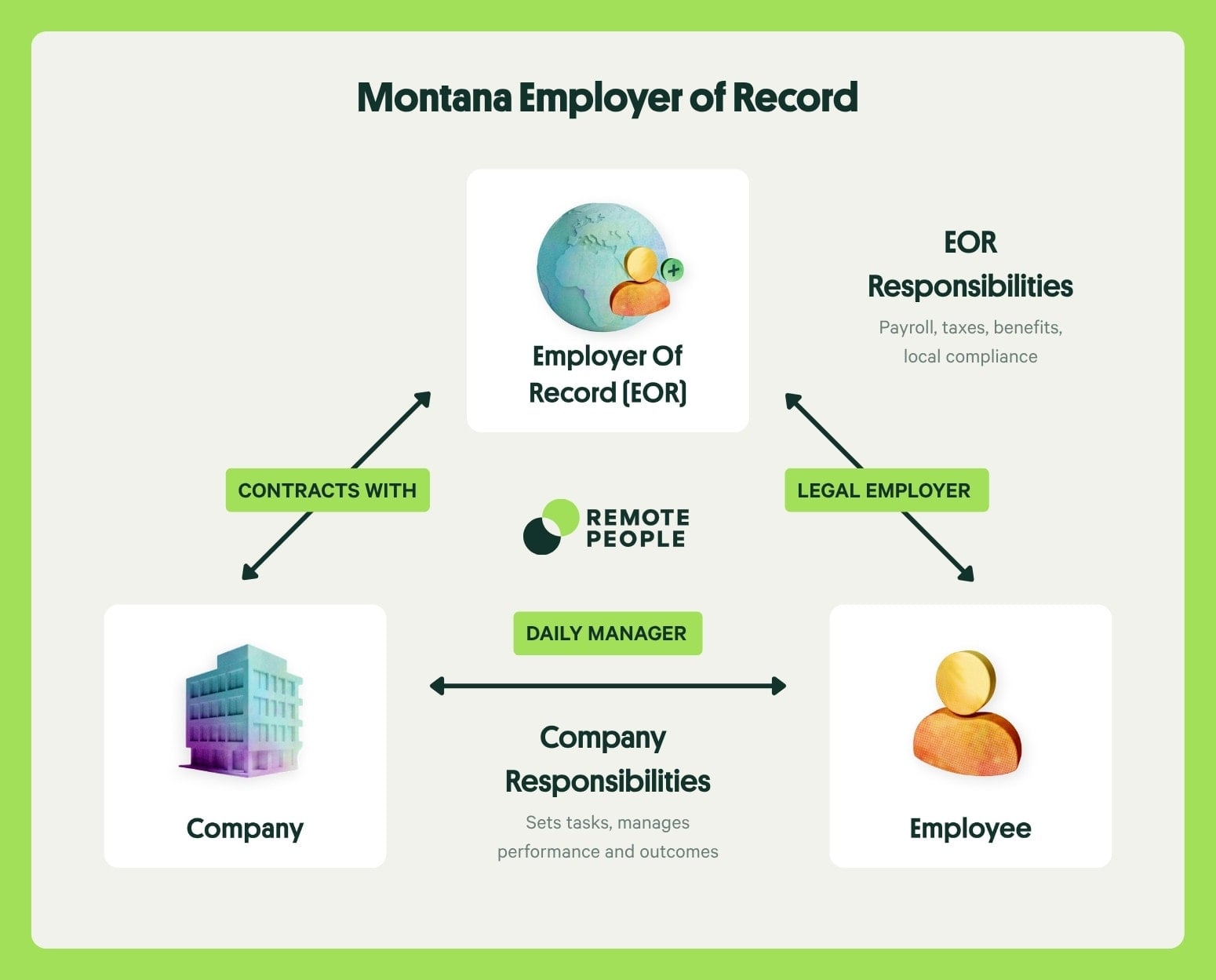
A Montana EOR is an organization that employs staff on behalf of another company and assumes the role of the legal employer. Businesses collaborating with EOR companies can hire employees in Montana without establishing a legal entity within the state.
What is an EOR can help explain how this employment model works in more detail.
The EOR handles all employer duties, including payroll processing, tax withholding, and benefits administration, and also ensures that the working relationship complies with local labor laws. Companies can efficiently and compliantly expand their operations into Montana with the help of an EOR company.
What Is the Difference Between a Montana Employer of Record and a Montana PEO?
Although they offer similar services, there are some differences in the way a Montana EOR and a Montana Professional Employer Organization (PEO) operate. An EOR provider becomes the full legal employer of the workforce, and it is responsible for handling employer responsibilities like ensuring compliance with labor laws, managing employees’ payroll and tax processes, and administering employee benefits. Companies using the EOR model can operate in the Montana market without establishing a legal entity, as the EOR handles all employment obligations.
A PEO, on the other hand, is a company that manages another company’s workforce in a co-employment arrangement. A PEO shares employment responsibilities with the client company rather than taking full legal responsibility. While the PEO may manage payroll and benefits administration, the client company retains legal responsibilities and liabilities related to employment.
Companies need to consider factors such as the size of the business, expansion objectives, and the desired level of control over employment practices before choosing between an EOR and a PEO. The EOR model can be excellent for companies seeking to enter Montana’s market without establishing a local entity, while the PEO arrangement is well-suited for companies that have established a presence in Montana, seeking to outsource some HR functions.
Start hiring with a Montana EOR
Let us handle the complexities of hiring, compliance, and payroll in Montana while you focus on growing your team.
- Hire employees in Montana with a Montana EOR
- No local entity is needed
- Pricing starts at USD 199 per employee
- RemotePeople can also help you find the best talent in Montana
How Does a Montana Employer of Record Work?
A Montana EOR firm handles the hiring and managing of employees within the state by assuming certain employment responsibilities. This includes overseeing the recruitment and onboarding processes to ensure that new hires are seamlessly integrated into the company. The EOR provider manages payroll administration, ensuring accurate and timely compensation while withholding appropriate state and federal taxes.
Also, the EOR firm ensures compliance with Montana’s labor laws, including adherence to regulations on minimum wage, overtime, and mandatory benefits. With these functions handled, the EOR enables client companies to focus on their core operations while mitigating the risks associated with employment compliance in Montana.
How Labor Laws Affect Hiring in Montana?
In Rhode Island, labor laws are designed to protect workers by enforcing fair wages, paid leave, and overtime regulations while helping businesses maintain compliant operations. Understanding and complying with these laws is essential for creating a fair workplace and avoiding legal issues.
Minimum Wage & Overtime
Montana’s minimum wage is currently fixed at $10.55 per hour but is subject to annual adjustments based on inflation rates. Employees who work overtime receive one and a half times their regular pay rate for hours worked beyond 40 in a workweek.
Workers’ Compensation
While Montana does not require employers to provide meal or rest breaks, any short breaks offered (typically under 20 minutes) must be compensated by federal guidelines.
Employers must also adhere to regulations concerning workers’ compensation and unemployment insurance, ensuring that employees are protected in cases of workplace injuries or job loss.
Employment Termination
Montana laws require that terminations be for a good cause after a probationary period.
What Are the Benefits of a Montana Employer of Record?
Engaging a Montana EOR offers several advantages for businesses seeking to establish business within the state.
One significant benefit is the ability to enter the Montana market quickly, as the EOR’s established infrastructure allows immediate hiring without the need to set up a legal entity. This arrangement minimizes financial risks and overhead costs associated with entity establishment and ongoing compliance management.
Furthermore, a Montana EOR possesses in-depth knowledge of local labor laws and employment practices, ensuring that all HR functions are managed in compliance with state regulations. This expertise mitigates legal risks and enhances workforce management.
What Are the Downsides of a Montana Employer of Record?
While partnering with a Montana EOR offers benefits, it is important to consider potential downsides.
Engaging an EOR involves ongoing monthly costs, which can accumulate over time and impact the company’s budget. Also, partnering with an EOR may result in less direct control over employee supervision and day-to-day management, as the EOR assumes many employer responsibilities.
Companies also become dependent on the EOR’s local network for legal updates and compliance, which means they must rely on the EOR’s expertise to navigate changes in Montana’s labor laws.
Companies must carefully evaluate these factors to determine if an EOR arrangement aligns with the company’s operational and financial objectives.
How to Choose a Montana Employer of Record?
Selecting the right Montana EOR requires careful consideration of several key factors, including the following:
Evaluate Pricing Transparency
Ensure that the EOR provides clear and detailed information about their fee structure to avoid unexpected costs. Transparent pricing also makes it easier to compare providers and budget accurately.
Evaluate the Range of Services Offered
This is essential as different EOR providers may vary in their capabilities, including payroll management, benefits administration, and compliance support. Choosing a provider with comprehensive services can reduce the need for multiple vendors.
Ensure Industry Expertise
Some EORs specialize in particular sectors, such as technology, healthcare, or manufacturing, and choosing a provider with experience in your industry can enhance the quality of service. Industry-specific expertise can also help address unique compliance and workforce challenges.
Consider the Provider's Track Record and Reputation
You can check client reviews and testimonials to confirm that the provider can successfully manage employment in Montana. A strong reputation often reflects reliable service and customer satisfaction.
Ensure Compliance Support
The EOR should have a strong understanding of state-specific employment regulations and be proactive in ensuring compliance with evolving labor laws. This can help your business avoid fines, penalties, and legal complications.
Assess Customer Support and Responsiveness
This is important to ensure efficient communication with the EOR for addressing employment-related concerns quickly. Responsive support can make resolving payroll or HR issues much faster and less stressful.
Consider Technology Integration
Modern EORs offer digital platforms that make payroll processing, tax filings, and employee record management easy. Choosing an EOR with user-friendly technology can enhance operational efficiency and improve the overall employee experience.
Engage a Montana Employer of Record with RemotePeople
A Montana EOR provides a valuable solution for businesses looking to expand into the state without establishing a local entity.
For businesses navigating employment in Montana, RemotePeople delivers comprehensive EOR services that manage payroll, employment contracts, tax compliance, and ongoing HR responsibilities. Our solutions are designed to support your operations while reducing administrative complexity.
We ensure that companies find reliable EOR solutions that align with their operational needs and budgets while ensuring a fully compliant and efficient employment structure. Contact us today to get started.
Employer of Record in
Employer of Record in
Employer of Record in
Employer of Record in
Employer of Record in
Employer of Record in
Employer of Record in
Employer of Record in