
 Recruit
Employer of Record in Washington
-
 Drew Donnelly
- Published
- September 22, 2026
Washington’s employment law includes paid family leave, L&I insurance, and specific overtime rules, and a Washington EOR handles full state compliance with no local entity needed.
Hire in Washington — book a free 30-minute demo
Tell us what you need. You'll get a tailored, transparent proposal within 24 hours, plus a free call to walk through it.
Tell us about your company
So we can match you with a specialist who knows your market — and unlock volume pricing tiers.
* All fields are required.
Where and when are you hiring?
Tell us the geography and timing and we'll quote each country line by line, with onboarding timelines.
* All fields are required.
Help us beat your current setup
We'll benchmark your current deal and send a line-by-line proposal in 24 hours — showing exactly where we cut cost, time, or risk. After you submit, you can book a call to walk through it together.
* All fields are required.
Thanks! Your proposal is on its way.
Expect a tailored, line-by-line proposal in your inbox within 24 hours. In the meantime…
Want to walk through it together?
Book a free 30-minute call with one of our specialists. We'll explain every line, answer your questions, and tailor the proposal further if you need.
No obligation. Pick a time that works for you.








- Hire in Washington — book a free 30-minute demo
- Tell us about your company
- Where and when are you hiring?
- Help us beat your current setup
- Thanks! Your proposal is on its way.
- Washington Employer of Record
- What Is the Difference Between a Washington Employer of Record and a Washington PEO?
- How Does a Washington Employer of Record Work?
- How Labor Laws Affect Hiring in Washington?
- Payroll Taxes and Employer Cost in Washington
- Employee Classification Rules in Washington
- What Makes Hiring in Washington Unique?
- What Are the Benefits of a Washington Employer of Record?
- What Are the Downsides of a Washington EOR?
- How to Choose a Washington Employer of Record?
- Engage a Washington Employer of Record with RemotePeople
- Related EOR Destinations

Let RemotePeople handle payroll, compliance, and HR admin worldwide so you can focus on building your team.
Key Takeaways
- Washington State is a major tech hub full of skilled workers.
- In this state, employment is highly regulated, and penalties for non-compliance are severe.
- Payroll taxes and salaries in Washington are much higher than the national average.
- EORs manage compliance and HR services, helping to reduce risk and administrative burden in Washington.
Washington is home to just over 8 million people, making it the 13th most populous state in the US. What may come as a surprise to many is the fact that this state has a GDP of more than $854 billion, which is the 9th-highest state GDP in America. If Washington state were its own country, it would have the 22nd-largest economy in the world, falling somewhere between Taiwan and Belgium. While the costs of doing business are high and the state is highly regulated, Washington’s skilled workforce, economic power, and focus on technology and innovation lead it to rank as the 14th-best state for doing business.
Despite the Great Recession in 2007-2009 and the global pandemic from 2019-2020, Washington State’s economic growth has still been extraordinary. Over the last 20 years, its GDP has more than tripled, led by growth in the high-end manufacturing and technology industries. However, the state maintains a strong foundation in agriculture, forest products, and marine resources. Nearly 14% of the workforce is employed in the technology industry, and Seattle is a major hub for tech in the country and the world.
Entering this market can be a challenge, especially for employers from abroad. If you’re looking into hiring talented workers in Washington state, partnering with an EOR might be the fastest and easiest way for you to tap into the state’s economy and labor force while staying fully compliant with local regulations.
Washington Employer of Record
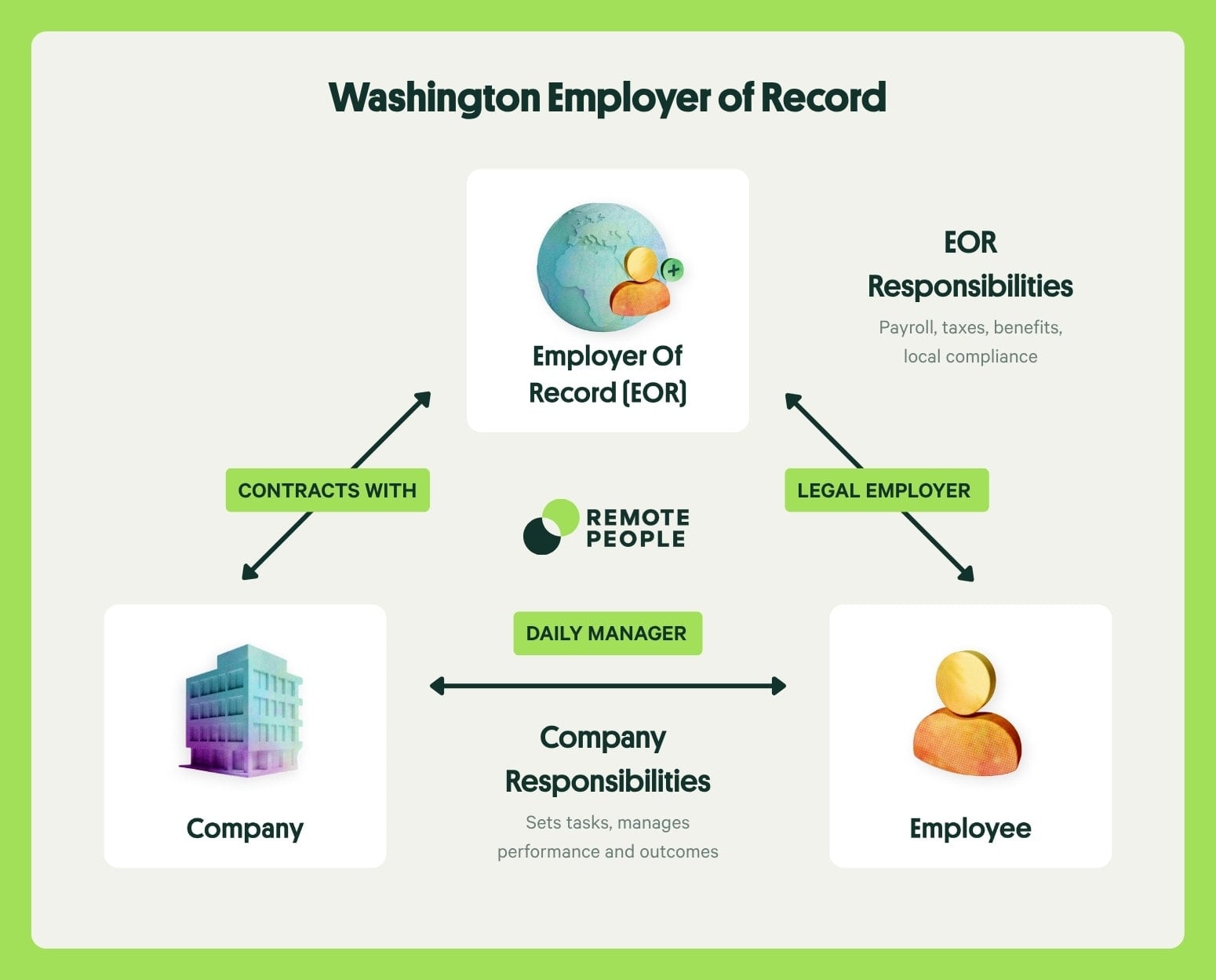
When you want to hire employees in Washington but aren’t already set up in the state, you have a couple of choices. You could spend the time, energy, and financial resources necessary to establish a business entity in the state, or you can hire employees through a Washington EOR, or Employer of Record. This type of service provider hires the workers you need on your behalf, becoming their legal employer in Washington, while you take on the role of the worksite employer. This means you don’t need to own an entity in Washington, or even in the US at all, to access skilled local talent.
What is an EOR can help explain how this employment model works in more detail.
Not only do EORs hire on your behalf, but they also take care of administration and HR for your employees. Processing payroll and paying your employees are major responsibilities that EORs provide for you. They also administer your employees’ benefits, ensuring that federal and state programs are correctly contributed to and reported correctly to the authorities. Very importantly, EORs manage legal compliance on your behalf so that you can focus on your key business activities.
These days, EORs generally use digital platforms to deliver their services. These cloud-based online software packages help to automate core functions, like managing payroll and PRO (paid time off). Most also offer a wide range of other features and functions, including talent management, performance management, employee engagement, and more. Many can be considered full Human Resources Information Systems (HRISs). They typically also give employees access to their profiles so they can monitor their pay and benefits, which also greatly reduces the overall administrative burden of managing HR.
When you partner with an EOR, it takes on the responsibilities of the legal employer of your workers in Washington. You still have to manage key activities, however, like scheduling, tracking time and attendance, and, naturally, monitoring your employees’ day-to-day tasks. However, this partnership allows you to perform far less administration, take on less liability, and hire workers much faster than if you set up and managed a business entity in Washington by yourself.
What Is the Difference Between a Washington Employer of Record and a Washington PEO?
The description of what an EOR is and what it does may remind you of a different kind of service provider – a PEO or Professional Employer Organization. PEOs are active in Washington and all other US states, and perform many of the same services that EORs offer. However, there are some important differences between EORs and PEOs, including:
PEO
PEOs act as co-employers, sharing some but not all legal responsibility with their clients. Unlike EORs, they do not directly hire employees on your behalf, meaning you still need a registered business entity in Washington or elsewhere in the US to work with one. Their services are also primarily designed for domestic companies, making them less suited for foreign businesses looking to hire without an established local presence.
EOR
Because EORs contract workers directly, clients do not need a registered US entity to hire in Washington. The EOR becomes the legal employer, taking on full responsibility for compliance with state and federal employment laws. This makes them a practical and efficient route for international employers looking to access the Washington state labour market without the overhead of local incorporation.
Start hiring with a Washington EOR
Let us handle the complexities of hiring, compliance, and payroll in Washington while you focus on growing your team.
- Hire employees in Washington with a Washington EOR
- No local entity is needed
- Pricing starts at USD 199 per employee
- RemotePeople can also help you find the best talent in Washington
How Does a Washington Employer of Record Work?
As we’ve already seen, EORs can help employers hire employees in Washington state without needing to own entities, but their roles are far more extensive than just this useful service. When you partner with an EOR service provider, it manages most or all of the following:
Compliant Employment Contract
Even before you officially hire employees, EORs in Washington can help you put forth offers by recommending salary levels and benefits that are suitable for workers in the state for your industry. Many EORs will also provide you with support during negotiations and with employee commitments. Once the terms are decided, your EOR will create fully-compliant contracts for each of your workers based on their specific work and compensation details. It will then sign these contracts directly with your employees, making it their legal employer in the state.
Payroll Setup with Correct State Registrations
While you’ll need to onboard your workers by providing them with orientations and job training, your EOR will handle the administrative side of onboarding. It will collect your workers’ personal and banking information, then add them to your payroll and set up calculations for their earnings and deductions. It will also prepare direct bank deposits or other salary payment methods. Critically, the EOR will register the employees with the appropriate federal and state authorities, including the IRS, the Washington Department of Revenue (DOR), and the WA Cares Fund. This will cement the EOR as their legal employer and shift liability away from you as the client.
Tax Withholding and Remittance
As a key part of its payroll process duties, your EOR partner will calculate the income taxes owed by each employee and withhold them from their paychecks. As employers are required to remit tax payments monthly, your EOR will send these funds to the IRS on your behalf. It will also maintain all of your employment tax records and report to the authorities as required.
Benefits Administration
Employees working anywhere in the US are entitled to mandatory benefits through both federal and state programs. After registration, your EOR will manage contributions from you and your employees to federal Social Security and Medicare programs, as well as state unemployment insurance, workers’ compensation, paid family and medical leave, and long-term care programs.
Most EORs will also offer supplementary benefits through their partner providers, including health and life insurance, retirement savings plans, and more. You can pay additional fees to have your EOR manage the administration of these supplementary benefits for you.
Ongoing Compliance Management
In addition to registering your employees with the federal and state authorities and managing their taxes and benefits contributions, EORs also employ legal experts who monitor changing laws. They ensure that your contracts and reporting systems are up-to-date with current requirements so that you’re always legally compliant.
Recruitment
While not a standard service for all EORs, some providers offer services and tools to help you find the Washington workers you require. A select few providers offer active recruitment services from professional in-house recruiters. Many more simply provide you with tools like access to talent pools and applicant tracking systems (ATSs) so you can recruit on your own more efficiently.
How Labor Laws Affect Hiring in Washington?
As with any state in the US, Washington has its own labor and employment regulations that employers need to be aware of. The main rules that will affect your hiring plans include:
Minimum Wage & Overtime
While employers in all states have to pay their workers at least the federal minimum wage of $7.25/hour, Washington’s minimum wage is the highest in the country. Employers have to pay their workers at least $17.13/hour in the state, and $21.30 if they work in the city of Seattle. This includes tipped workers, who must be paid the minimum wage regardless of their tips, so employers can’t use tip credits to pay them lower wages.
Full-time employees can work up to 40 hours a week, with any additional hours counted as overtime. In line with the federal Fair Labor Standards Act, Washington workers must be paid 150% of their normal wages for their overtime hours. However, employees who earn over $1,332.80/week with small employers (fewer than 50 employees) or $1,499.40/week with larger employers (50+ employees) are exempt from overtime premium pay.
Income Tax
Unlike in many other states, Washington does not assess a personal income tax on workers’ earnings. However, a millionaire’s tax on income over $1 million is being considered and may come into effect in the future.
State Unemployment Insurance (SUI) and Employment Administration Fund (EAF)
Washington state workers who have worked at least 680 hours in the past 18 months can be entitled to state unemployment insurance (SUI) benefits if they lose their jobs. Employers need to contribute between 0.24% and 6.12% of their payroll to the SUI program, based on their experience, on each worker’s first $72,800 earned each year. New employers pay 115% of the average rate for their industry for their first three years. The state also assesses a mandatory tax for administration, with these EAF rates ranging from 0.02% to 0.03%.
As in other states, when employers in Washington pay their SUI on time and correctly, their FUTA (Federal Unemployment Tax Act) taxes are reduced from 6.0% to 0.6% of payroll for the employee’s first $7,000 of earnings.
Paid Leave
In Washington state, employers are required to provide all workers with earned sick leave. Workers gain one hour of paid sick leave for every 40 hours they work. There is no cap on these hours, but only 40 unused hours can be carried over to the following year. This leave can be used if the employee is sick, needs to care for a sick family member, or is absent due to situations of family violence.
Washington also has a Paid Family and Medical Leave (PFML) program, which entitles workers who have worked for at least 820 hours in their qualifying period to paid leave for qualifying events. They can normally take up to 12 weeks of paid leave for a single event and 16 weeks for multiple events. These include serious illnesses and injuries in the family, childbirth, and adoption. Employees pay most of the contributions to this program, at a rate of 0.807% of their earnings. Employers have to pay 0.323% of payroll if they have 50 or more employees. These contributions are paid up to the $184,500 wage base cap for Social Security.
Workers’ Compensation
Nearly all Washington employers are required to take out Workers’ compensation insurance from the monopolistic state fund, overseen by the Department of Labor and Industries. Average premiums are 1.5% of payroll, but employers pay just 75% of these contributions (employees pay the other 25%), meaning that they pay around 1.125% of payroll.
Workers also pay 0.58% of their earnings to the state’s WA Cares Fund, which provides them with coverage for long-term care. However, employers don’t need to contribute to this fund.
Termination and Final Pay
Washington is an “at-will” employment state, which means that employees can resign or be terminated at any time. Employers don’t need to give reasons for terminations, provide notice, or pay severance as they might in other locations. However, notice periods and severance pay may be included in individual or collective agreements, in which case they are legally binding.
At the same time, employers are barred from terminating employees for discriminatory reasons. They can’t fire employees for making safety complaints, joining unions, or whistle-blowing. Whether they resign or are terminated, employees must be paid everything they’re owed on their following regular payday, including salary, overtime, bonuses, and the cash value of any vacation time they’ve accumulated.
Payroll Taxes and Employer Cost in Washington
When you plan your hiring in Washington, you need to think not only about the salaries you’ll need to pay your workers but also the additional costs of employing them in this state. Payroll costs to consider include:
| Category | Cost |
|---|---|
| Federal payroll taxes | 1.45% Medicare contribution, 6.2% Social Security contribution to a maximum of $184,500, 0.6% FUTA tax on their first $7,000 of earnings. |
| SUI contributions | 0.24% and 6.12% of the employee’s first $72,800 of earnings. |
| EAF contributions | 0.02% to 0.03% of payroll. |
| Workers’ compensation premiums | 1.125% of payroll, on average. |
| PFML contributions | 0.323% for employers with 50+ employees. |
| Mandatory health insurance contributions | Around $5,200/employee/year for employers with 50+ employees. |
Example Cost Breakdown
To illustrate the true cost of employment, take a Washington-based employee with an annual salary of $75,000.
| Category | Cost |
|---|---|
| Medicare | $1,087.50 |
| Social Security | $4,650 |
| FUTA | $450 |
| SUI | $174.72 – $4,455.36 |
| Workers’ compensation | $843.75 |
| PFML | $242.25 |
| Health insurance | $5,200 |
| TOTAL | $12,647.72 – $16,928.36 |
On top of the base salary, employers in Washington can expect to pay an additional 16.86% to 22.75% in employer-side costs, covering statutory contributions, payroll taxes, and mandatory insurance obligations.
Employee Classification Rules in Washington
In Washington, as in other states, employees are entitled to certain legal protections and benefits that independent contractors are not. For this reason, employers must take care when they classify workers as contractors and not employees, because if they make mistakes, they could be liable for paying back benefits and earnings, as well as paying hefty fines.
Washington uses a six-part test to see if a worker can be classified as an independent contractor – all of the following statements have to be true for you to do so:
The worker…
- Is not directly under your control.
- Provides a service outside of the normal operations, location, or costs of your business.
- Has a place of business and/or is engaged in the service or trade you’ve hired them to perform.
- Files a schedule of expenses with the IRS.
- Is registered with the Washington DOR.
- Maintains their own income and expense accounts.
For the construction industry, a worker must also be registered as a contractor or hold an electrical contractor’s license.
Fines for misclassification can range from $1,200-10,000 depending on the number of offences. Employers are also required to pay for lost wages, overtime (at time-and-a-half), and benefits contributions like Social Security and Medicare. Working with an EOR helps protect you from these costly penalties, as your partner will test your workers to find out if they’re legally employees or contractors.
What Makes Hiring in Washington Unique?
When you choose to hire in Washington state, you access a unique set of advantages and disadvantages relative to hiring in other locations. Workers in this state are considered highly educated, with around 40% holding Bachelor’s degrees or higher qualifications. Workers are becoming increasingly skilled in IT, technology, and engineering, with a constant stream of new workers graduating from the state’s educational institutions. Washington has no personal income tax and doesn’t assess a corporate income tax (CIT), though it levies a business and occupations tax of 0.47 to 3.3% on gross receipts instead. The state also offers numerous tax incentives, especially for high-tech businesses.
At the same time, regulation is strict in this state, and penalties are relatively high for non-compliance. While the economy has grown quickly in recent decades, there is still relatively high demand in the state for skilled workers, especially in the manufacturing and tech industries, which can lead to significant competition between employers. Wages are some of the highest in the country, and employer costs are also high.
Hiring in Washington can be costly. However, it can also give you access to highly-skilled professionals who can make significant contributions to your business.
What Are the Benefits of a Washington Employer of Record?
While you could register an entity in the state of Washington, build your own HR team, and manage compliance yourself, working with an EOR instead can provide you with some important advantages, including:
- Saving time and resources setting up an entity in the state.
- Onboarding workers quickly: days vs. weeks if you hire on your own.
- Protection from liability as the EOR acts as the workers’ legal employer.
- Full support with contracts and legal compliance.
- Easy expansion to other states and even other countries without the need to build any additional infrastructure
What Are the Downsides of a Washington EOR?
Not every aspect of working with an EOR is positive, however. You’ll also need to consider these potentially negative factors before making your decision:
- You’ll need to pay service fees to the EOR, which can be costly if you hire large numbers of employees.
- HR is run through the EOR as an intermediary, which can potentially slow things down or introduce challenges if you don’t choose a highly professional provider.
How to Choose a Washington Employer of Record?
Not all EOR providers are created equal, and choosing the right partner is a critical business decision. Look for a Washington EOR that offers all the services you need, whether that includes recruitment support, supplementary benefits, or beyond. Transparent pricing, dedicated support, and demonstrable multi-state expertise across the US are non-negotiable. Above all, they should have a strong and verifiable track record of compliance specifically in Washington state.
Engage a Washington Employer of Record with RemotePeople
If getting skilled Washington-based workers on your team quickly is your priority, working with an EOR can be an excellent option for your business. With an EOR, you can hire quickly, offer excellent HR services, and keep compliant with all state and federal laws. Contact RemotePeople today to take advantage of our professional Washington EOR services.