
 Recruit
Employer of Record in Idaho
-
 Drew Donnelly
- Published
- September 22, 2026
Idaho’s employment law includes state unemployment insurance, workers’ comp, and wage rules, and an Idaho EOR handles payroll, taxes, and full state compliance with no local entity needed.
Hire in Idaho — book a free 30-minute demo
Tell us what you need. You'll get a tailored, transparent proposal within 24 hours, plus a free call to walk through it.
Tell us about your company
So we can match you with a specialist who knows your market — and unlock volume pricing tiers.
* All fields are required.
Where and when are you hiring?
Tell us the geography and timing and we'll quote each country line by line, with onboarding timelines.
* All fields are required.
Help us beat your current setup
We'll benchmark your current deal and send a line-by-line proposal in 24 hours — showing exactly where we cut cost, time, or risk. After you submit, you can book a call to walk through it together.
* All fields are required.
Thanks! Your proposal is on its way.
Expect a tailored, line-by-line proposal in your inbox within 24 hours. In the meantime…
Want to walk through it together?
Book a free 30-minute call with one of our specialists. We'll explain every line, answer your questions, and tailor the proposal further if you need.
No obligation. Pick a time that works for you.








- Hire in Idaho — book a free 30-minute demo
- Tell us about your company
- Where and when are you hiring?
- Help us beat your current setup
- Thanks! Your proposal is on its way.
- Idaho Employer of Record
- What Is the Difference Between an Idaho Employer of Record and an Idaho PEO?
- How Does a Idaho Employer of Record Work?
- How Labor Laws Affect Hiring in Idaho?
- Payroll Taxes and Employer Cost in Idaho
- Employee Classification Rules in Idaho
- What Makes Hiring in Idaho Unique?
- What Are the Benefits of an Idaho Employer of Record?
- What Are the Downsides of an Idaho EOR?
- How to Choose an Idaho Employer of Record?
- Engage an Idaho Employer of Record with RemotePeople
- Related EOR Destinations

Let RemotePeople handle payroll, compliance, and HR admin worldwide so you can focus on building your team.
Key Takeaways
- An Employer of Record in Idaho allows companies to hire legally and compliantly without setting up a local entity.
- Idaho is attractive to businesses looking to expand, with low taxes, moderate labor regulations, and strong support available for employers.
- EORs reduce compliance risk while enabling quick market entry.
- Key industries in Idaho include technology, agriculture, manufacturing, and logistics.
Idaho is becoming an increasingly business-friendly area for companies expanding their US workforce. The state has a strong economy with a GDP of 99.6 billion US dollars (2024), and is driven by key industries such as technology, semiconductors, agriculture, food processing, manufacturing, logistics, and healthcare.
From a business perspective, Idaho is known for its supportive stance towards employers. Its labor laws closely follow federal standards, which makes compliance straightforward, and it benefits from competitive wages, affordable commercial real estate, and manageable business expenses.
The above conditions make Idaho an ideal location for companies hiring in the US, particularly when using an Employer of Record.
Idaho Employer of Record
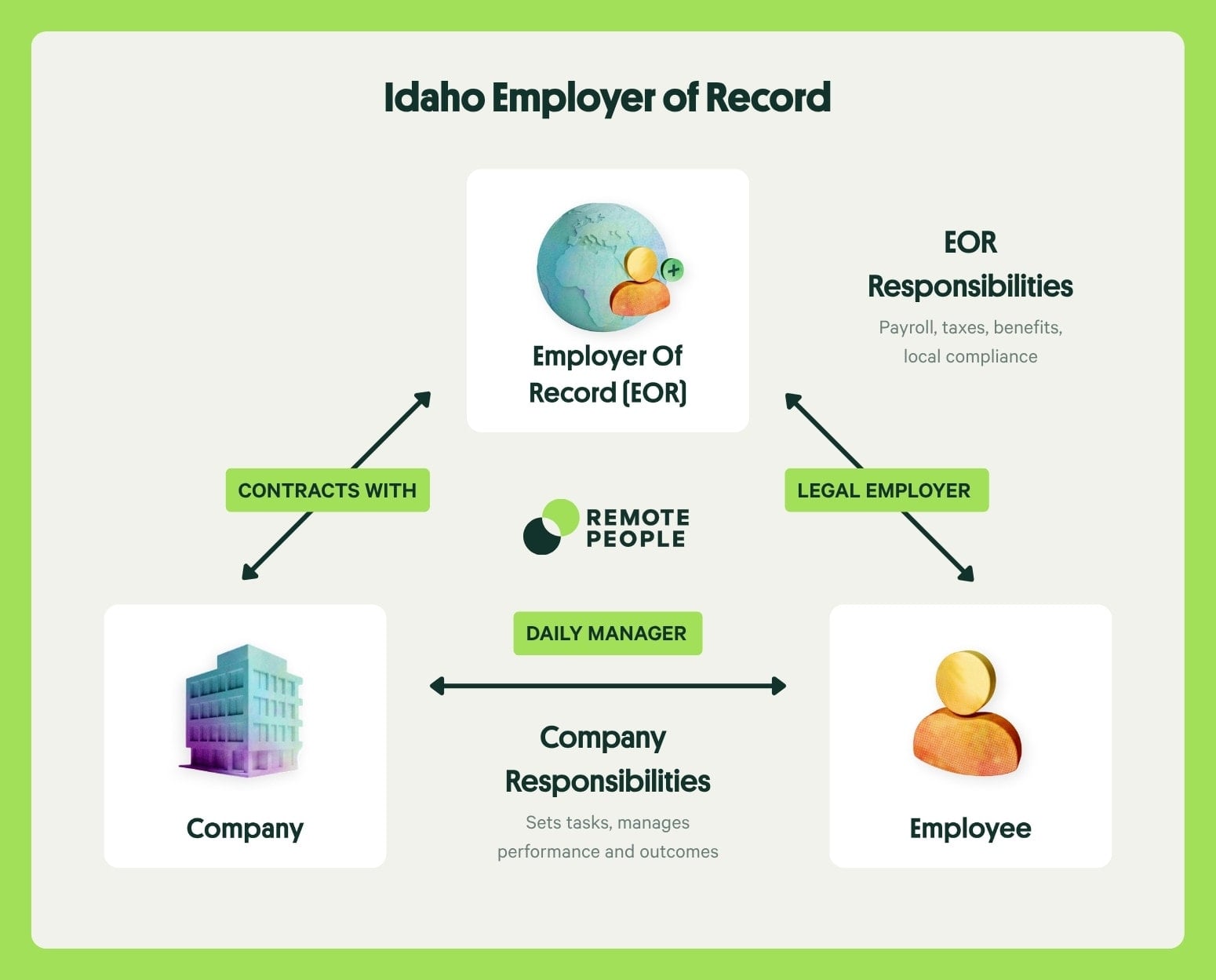
An Idaho Employer of Record (EOR) is a third-party company that acts as the legal employer of workers in Idaho, on behalf of your business. This allows companies to retain full control of day-to-day operations, while the EOR ensures that employees are hired compliantly and efficiently.
What is an EOR can help explain how this employment model works in more detail.
EORs have a range of key responsibilities, including:
- Running payroll and administering paychecks.
- Handling Idaho and federal tax filings.
- Managing employment contracts.
- Ensuring strict compliance with local and federal labor laws.
- Administering employee benefits and worker compensation.
One of the main advantages that attracts employers to EORs is that they won’t need to set up a legal entity. This can be an expensive and time-consuming process, particularly if you’re looking to test the waters when doing business in Idaho for the first time. Instructing an EOR allows companies to hire quickly and compliantly, by shifting responsibilities to the EOR and reducing risk for your company.
What Is the Difference Between an Idaho Employer of Record and an Idaho PEO?
Many businesses choose to instruct a Professional Employer Organization (PEO) instead of an EOR. While both support HR and payroll functions, they operate under different legal models and provide different sets of services.
Professional Employer Organization (PEO)
A PEO works for a company via a co-employment relationship. This means that both your company and the PEO share employment responsibilities, but your company will be the legal employer of workers in Idaho.
Within this model, your company must already have a registered legal entity in Idaho and retain full primary liability for compliance with local/federal labor laws.
PEOs are best suited to domestic companies already established in Idaho and are looking to outsource HR administration.
Employer of Record (EOR)
An EOR works under a full employment model, with no legal entity required by the company.
The EOR would act as the legal employer of new workers, taking on legal employment liability while the company handles day-to-day operations.
This model is most typically used by international and multi-state companies, allowing them to enter the Idaho market quickly and with less compliance risk.
Start hiring with an Idaho EOR
Let us handle the complexities of hiring, compliance, and payroll in Idaho while you focus on growing your team.
- Hire employees in Idaho with an Idaho EOR
- No local entity is needed
- Pricing starts at USD 199 per employee
- RemotePeople can also help you find the best talent in Idaho
How Does a Idaho Employer of Record Work?
An Idaho EOR simplifies hiring by managing the full employment lifecycle, from creating employment contracts to handling ongoing compliance management.
The typical process includes the following steps:
Compliant Employment Contract
EORs begin an employment relationship with new workers by preparing and issuing a legally compliant employment agreement.
This agreement will be fully aligned with both Idaho and federal labor laws and will cover a range of aspects, including salary, benefits, termination rules, and statutory requirements.
Payroll Setup with Correct State Registrations
The EOR would register as the employer of new workers in Idaho with the relevant local authorities. As part of this process, they would set up payroll systems with:
The Idaho State Tax Commission
The Idaho Department of Labor
Workers’ Compensation Insurance Providers
Setting up these registrations correctly ensures that employees are always paid correctly and on time, from the start of the employment relationship.
Tax Withholding and Remittance
EORs calculate, withhold, and remit all required payroll taxes, which include federal income taxes, Social Security contributions, Medicare contributions, and Idaho state income tax.
All filings and payments would be handled on time to avoid the risk of legal/financial penalties to the employer.
Benefits Administration
All employees are entitled to statutory employee benefits when working in Idaho, and an EOR would manage these on behalf of the employer.
This would involve ensuring benefits such as health insurance, retirement plans, and workers’ compensation coverage are administered in line with state and federal standards.
Ongoing Compliance Management
EOR manages any regulatory changes to labor laws, maintains employee records, and ensures ongoing compliance with wage, tax, and federal/state laws.
This reduces the administrative burden on employers, as well as the risk of legal exposure.
Centralizing the above processes enables an Idaho EOR to hire quickly, compliantly, and efficiently without the employer needing to build an internal HR or payroll team.
How Labor Laws Affect Hiring in Idaho?
Labor laws in Idaho are known to be employer-friendly. They are closely aligned with federal standards, which makes them predictable and easy to follow.
Understanding these labor laws is essential when ensuring compliant hiring in Idaho.
Minimum Wage
Idaho follows the federal minimum wage, which currently sits at $7.25 per hour.
As the state has not enacted a higher local minimum wage, the federal rate applies to most employees working in Idaho.
Tipped Wages
Tip credit is permitted in Idaho, in line with federal laws. Employers may pay a tipped worker a minimum cash wage of $3.35 per hour, provided that their total tipped earnings bring their hourly wage to at least $7.25.
If tips fall short at any point, the employer is responsible for making up the difference.
Overtime Thresholds and Limits
Overtime in Idaho is dictated by federal laws, more specifically, the Fair Labor Standards Act (FLSA).
This specifies that overtime pay must be at least 1.5 times the employee’s regular pay rate, and applies to hours over 40 per week.
There are currently no daily limits for overtime in Idaho or state-specific requirements beyond federal standards.
Income Tax
Idaho imposes a state income tax on wages earned by employees.
All employers are obligated to register with the Idaho State Tax Commission and ensure that all Idaho income taxes are withheld from employee wages before remitting. Withheld wages must include salaries, tips, bonuses, and taxable benefits.
Idaho currently uses a flat individual tax rate of 5.3% on taxable income above basic thresholds. It also has 6% state sales tax rate and an average combined state and local sales tax rate of 6.03%.
Employers must withhold Idaho income tax based on withholding tables and employee W-4 information.
State Unemployment Insurance (SUI)
All employers in Idaho must contribute to state unemployment insurance (SUI), which ensures workers who lose their jobs through no fault of their own are financially protected.
New employers are typically assigned a rate of 1% of taxable wages, with a taxable wage base of approximately $58,300.
Established employers’ SUI rates vary based on experience and history, typically ranging from 0.208% – 5.40%.
Taxes and reports must be filed quarterly with the Idaho Department of Labor. Many employers choose to partner with an EOR to ensure all tax filings are managed accurately and in line with deadlines.
Paid Leave
Idaho does not mandate state-level paid leave for private sector employees. Instead, employers are offered broad flexibility in designing their own leave policies.
There are no requirements for employers to pay sick leave, with no statutory accrual rules, minimum usage thresholds, or carryover requirements set out in state laws.
Idaho does not operate a state-mandated paid family or medical leave program. However, employers are required to comply with the federal Family and Medical Leave Act (FMLA), which stipulates that eligible employees must receive up to 12 weeks of unpaid, job-protected leave per year for certain family/medical reasons.
Workers' Compensation
Employers are generally required to administer workers’ compensation coverage, which provides medical and wage replacement benefits to employees who experience a work injury.
If an employer hires one or more employees, they must carry workers’ compensation insurance. The only exceptions to this requirement are if the employer is partaking in certain agricultural or casual labor roles. If employers fail to provide adequate coverage, they may incur fines, business restrictions, or personal liability for workplace injuries.
Employers typically obtain private insurance through licensed private insurance carriers or self-insurance programs, which apply to qualified, larger employers. Premiums tend to vary by industry risk level, with sectors such as construction, manufacturing, agriculture, and transportation incurring higher rates due to more extreme physical or operational risks.
Termination and Final Pay
It’s important for all employers operating in Idaho to understand termination rules to reduce wage disputes and legal exposure.
Is Idaho At-Will?
Idaho follows the ‘At-Will’ employment process, which allows either the employer or employee to terminate the employment relationship at any time, with or without cause, provided that the reason isn’t unlawful.
This provides flexibility for employers, but doesn’t remove the risk of wrongful termination claims. It’s therefore important to always maintain good documentation and processes to ensure you can protect your company if necessary.
Final Paycheck Deadline
Idaho laws require that terminated employees receive their final paycheck by the next scheduled payday.
If an employee has made a written request for earlier payment, wages must be paid within 48 hours.
PTO Payout Requirement
There is no obligation in Idaho for employers to pay unused vacation or PTO if an employee’s contract is terminated.
However, this isn’t the case if an employer’s written policy promises a payout, or if an employment agreement allows for it.
Notice Requirements
There are no state-required notice periods for individual terminations in Idaho. However, the federal WARN Act requirements may apply to large-scale layoffs or closures.
Risk Considerations
While Idaho is a very employer-friendly state, wage payment violations can trigger administrative penalties, legal costs, interest, or back pay awards.
EORs ensure final wage payments are calculated correctly and issued in full compliance with both state and federal rules, helping to reduce legal risk and exposure for employers.
Payroll Taxes and Employer Cost in Idaho
There are several payroll taxes and statutory employment costs that employers hiring in Idaho must account for.
While Idaho is relatively cost-efficient compared with other states, these obligations must still be considered as they represent a fair portion of total employment costs.
Federal Payroll Taxes
All employers in the US are obligated to pay federal employment taxes, including:
| Category | Cost |
|---|---|
| Social Security (Employer share) | 6.2% (up to the annual wage cap). |
| Medicare (Employer share) | 1.45% (no cap). |
| Federal Unemployment (FUTA) | Up to 0.6% on the first $7,000 of wages (after credits). |
Income Tax Withholding
Employers are responsible for withholding Idaho state income tax from employee wages. Payments must be remitted to the Idaho State Tax Commission.
While this is deducted from employee wages, employers are responsible for ensuring accurate calculation, reporting, and filing.
State Unemployment Insurance (SUI)
Employers in Idaho must contribute to the state unemployment insurance program, based on assigned rates and the annual wage base.
Rates will vary depending on employer experience and industry. New employers tend to pay a standard entry rate of around 1%.
Workers’ Compensation Premiums
Workers’ compensation premiums are mandatory and can only be purchased through licensed, private insurers.
Premiums vary depending on industry risk classification, payroll volume, and claims history.
Example Cost Breakdown
Below is an illustration of typical employer costs for hiring an Idaho-based employee on an annual salary of $100,000:
| Cost Component | Estimated Range |
|---|---|
| Federal Payroll Taxes | 7.65% |
| FUTA | 0.6% (capped) |
| Workers’ Compensation | 0.3% – 3%+ |
| Idaho SUI | 0.2% – 5.4% |
| Benefits | 5% – 15% |
This equates to approximately 12% – 25% of an employee’s base salary, depending on industry, benefits, and unemployment insurance rates.
For an employee earning $100,000 per year, total employer costs may range from between $112,000 – $125,000 or more annually.
The benefit of instructing an EOR is that some of these costs can be consolidated into a predictable model, helping businesses budget accurately for these costs.
Employee Classification Rules in Idaho
Employers must ensure that all workers are correctly classified as either employees or independent contractors. This is crucial for legal compliance in Idaho, with misclassification potentially leading to financial or legal penalties.
Independent Contractor Test
Idaho relies on an independent contractor test, which determines the degree of control, independence, and economic dependence within a working relationship.
This usually combines:
These tests identify key factors such as who controls how and when work is performed, whether the worker provides their own tools and equipment, and the permanency of the relationship.
If employers misclassify workers, they may face back payment of wages and overtime, unpaid payroll taxes/penalties, retroactive benefit liabilities, plus interest/fines.
In severe cases, employers may even face civil claims from workers, along with audits and ongoing monitoring.
Classification Strictness
Idaho isn’t highly restrictive in its worker classification compared with other states, such as California. It doesn’t apply an “ABC test” for most employment purposes, which tends to make classification more flexible.
However, enforcement has increased nationwide, and Idaho must cooperate with federal agencies to identify any misclassification.
A key benefit of working with an EOR is that, as the legal employer, EORs assume responsibility for worker classification and employment compliance, and will have experience with local classification rules. This can reduce legal exposure for employers, adding an extra layer of protection and enabling compliant expansion.
What Makes Hiring in Idaho Unique?
Idaho offers a unique hiring landscape compared to more heavily regulated US states, with a good industry mix, including advanced manufacturing and semiconductors, agriculture and food production, logistics and distribution, and tech/professional services.
It’s also considered low-regulation in comparison to states like California and New York, with most employment regulations aligning with federal law. This helps reduce compliance administration and overhead.
Wages remain lower than national coastal averages; however, population growth has led to gradual wage increases, particularly in tech and skilled trades. Its general workforce is strong due to inbound migration; however, tight labor markets in certain regions can make competition more intense.
A major difference when hiring in Idaho is its tax environment, where Idaho’s flat state income tax and moderate unemployment insurance rates make it cost-efficient compared with other states.
Paired with its absence of mandatory paid leave programs, Idaho is generally a state of low employer burden, making it an attractive state for companies scaling their US hiring presence.
What Are the Benefits of an Idaho Employer of Record?
There are many key advantages to hiring an Idaho Employer of Record, including:
- Companies can hire employees without registering a local entity.
- Employees can be hired in a matter of days in many cases.
- Payroll, taxes, benefits, and reporting are handled in one place.
- Liability shifts to the EOR.
- Expand beyond Idaho without needing to build separate HR structures.
What Are the Downsides of an Idaho EOR?
While a highly efficient employment option, the EOR model does have some downsides that must be considered.
Most EORs charge via a service fee, which is usually a set monthly fee or as a percentage of monthly payroll. These charges must be carefully looked at to ensure this model is the best fit for your business.
Employers must also consider that instructing an EOR will naturally affect the control they have over payroll administration, as this will be handled externally rather than in-house.
However, when compared with independently establishing a legal entity, managing registrations, maintaining HR staff, and navigating compliance risks, EORs are usually significantly more cost-effective and operationally efficient, particularly for small teams or testing the waters.
How to Choose an Idaho Employer of Record?
Choosing the right EOR for your business is critical, as it could both make or break your expansion into Idaho.
Follow the checklist below to ensure you’re instructing the best EOR for your company:
- They must offer clear service fees with no hidden costs.
- Avoid layered partner networks that outsource responsibility.
- EORs should support hiring beyond Idaho as you grow your business.
- You should be able to easily contact your EOR and access knowledgeable HR/compliance specialists.
- Look for demonstrated experience managing payroll taxes, labor laws, and regulatory updates.
Engage an Idaho Employer of Record with RemotePeople
RemotePeople acts as an EOR broker, connecting your business with the best Employer of Record services in Idaho for your business.
Our services enable companies to hire quickly and efficiently, without establishing a legal entity, and overall reducing compliance risks. Our network of EORs in Idaho can handle responsibilities such as creating employment contracts, administering payroll processes, tax filings, and employee benefits, plus managing workers’ compensation and ongoing compliance requirements.
Contact RemotePeople to see how we can help your business expand into Idaho, with a simplified, compliant process.
Employer of Record in
Employer of Record in
Employer of Record in
Employer of Record in
Employer of Record in
Employer of Record in
Employer of Record in
Employer of Record in