
 Recruit
Employer of Record in Utah
-
 Drew Donnelly
- Published
- September 22, 2026
Utah’s employment law includes state unemployment insurance, workers’ comp, and wage rules, and a Utah EOR handles payroll, taxes, and full state compliance with no local entity needed.
Hire in Utah — book a free 30-minute demo
Tell us what you need. You'll get a tailored, transparent proposal within 24 hours, plus a free call to walk through it.
Tell us about your company
So we can match you with a specialist who knows your market — and unlock volume pricing tiers.
* All fields are required.
Where and when are you hiring?
Tell us the geography and timing and we'll quote each country line by line, with onboarding timelines.
* All fields are required.
Help us beat your current setup
We'll benchmark your current deal and send a line-by-line proposal in 24 hours — showing exactly where we cut cost, time, or risk. After you submit, you can book a call to walk through it together.
* All fields are required.
Thanks! Your proposal is on its way.
Expect a tailored, line-by-line proposal in your inbox within 24 hours. In the meantime…
Want to walk through it together?
Book a free 30-minute call with one of our specialists. We'll explain every line, answer your questions, and tailor the proposal further if you need.
No obligation. Pick a time that works for you.








- Hire in Utah — book a free 30-minute demo
- Tell us about your company
- Where and when are you hiring?
- Help us beat your current setup
- Thanks! Your proposal is on its way.
- Utah Employer of Record
- What Is the Difference Between a Utah Employer of Record and a Utah PEO?
- How Does a Utah Employer of Record Work?
- How Labor Laws Affect Hiring in Utah?
- Payroll Taxes and Employer Cost in Utah
- Employee Classification Rules in Utah
- What Makes Hiring in Utah Unique?
- What Are the Benefits of a Utah EOR?
- What Are the Downsides of a Utah EOR?
- How to Choose a Utah Employer of Record?
- Engage a Utah Employer of Record with RemotePeople
- Related EOR Destinations

Let RemotePeople handle payroll, compliance, and HR admin worldwide so you can focus on building your team.
Key Takeaways
- Agriculture and tourism play a major role in Utah’s economy, with farming supporting rural communities and tourism bringing in billions in revenue.
- Industries like healthcare, manufacturing, and legal services rely on flexible hiring solutions such as EOR and PEO services.
- Select an EOR with experience in your industry to ensure they understand specific labor laws, compliance needs, and best practices.
- Look for customizable service packages that allow you to adjust payroll, benefits, and compliance support as needed.
If you’re hiring in Utah, you’ve picked a state that’s become a compelling business destination. You’ll find that Utah led the nation with 4.5% real GDP growth in 2024, and its tech workforce now exceeds 67,500 jobs. Furthermore, the unemployment rate hovers around a low 3.4%. That’s well below the national average.
The cost environment remains favorable compared to coastal tech hubs, though housing affordability has emerged as a genuine constraint on workforce expansion. And despite Utah’s reputation for business-friendly policies, the regulatory system has its own challenges. Particularly with a major minimum wage overhaul taking effect in 2026.
Whether you’re a startup placing your first employee in Salt Lake City or an international company establishing a U.S. foothold, we’ll explain the best practices to get started. You’ll also learn why an Employer of Record is the ideal option for businesses.
Utah Employer of Record
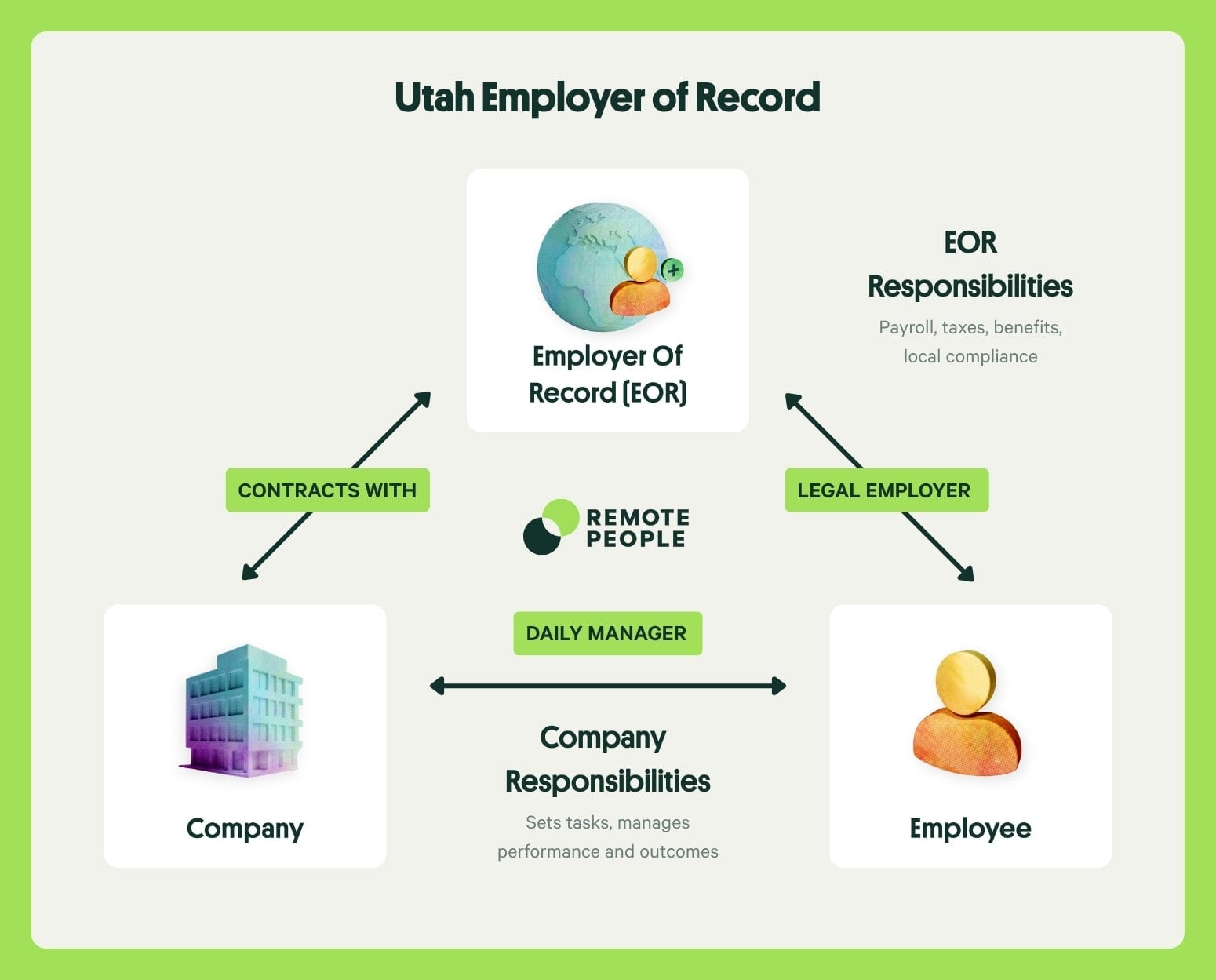
An Employer of Record in Utah functions as the legal employer for your workforce while you retain complete control over their day-to-day work. Here are the key tasks they perform:
What is an EOR can help explain how this employment model works in more detail.
- Handles all state registrations with the Utah State Tax Commission and Department of Workforce Services. You never file a single state form or obtain a state tax ID. The EOR’s existing infrastructure allows you to hire immediately without waiting for your own entity approvals.
- Runs payroll legally in Utah for every pay cycle. The EOR calculates gross pay, deductions, and employer taxes specific to Utah requirements. Funds are transferred to the EOR, which then distributes wages directly to employees. You approve hours and amounts, and the EOR ensures every paycheck complies with state wage laws.
- Withholds and remits all taxes, including Utah’s flat 4.65% income tax. Furthermore, federal withholdings and local obligations are automatically deducted from each paycheck. The EOR files quarterly and annual returns with the IRS and Utah State Tax Commission, meeting every statutory deadline.
- Provides compliant benefits access through the EOR’s aggregated purchasing power. In fact, your Utah employees gain access to health insurance, retirement plans, and voluntary benefits. The EOR handles COBRA administration, benefits deductions, and carrier communications.
- Maintains ongoing compliance because the EOR monitors Utah legislative changes. This includes adjustments for minimum wage increases, updates unemployment insurance filings, and manages worker compensation coverage continuously. When laws change, the EOR updates systems automatically. Hence, your compliance risk transfers to the EOR entirely.
What Is the Difference Between a Utah Employer of Record and a Utah PEO?
The difference between an EOR and a PEO comes down to a question of whether you already have a legal entity in Utah. If the answer is no, the PEO model simply isn’t available to you.
PEO
A Professional Employer Organization operates through a co-employment arrangement. Your company maintains its own legal entity and registers with the state. It then partners with the PEO to handle HR functions, benefits administration, and payroll.
Furthermore, the PEO becomes a co-employer for tax and compliance purposes, but your entity remains the Employer of Record on paper. This model works well for domestic companies that already have Utah operations and want to outsource HR complexity without transferring legal liability.
But it requires you to be established in Utah first. This means you’ve already done the entity setup, state registrations, and compliance groundwork before the PEO can help.
EOR
An Employer of Record requires no existing entity, which means it becomes the legal employer. Hence, your company isn’t registered in Utah, doesn’t appear on state payroll tax records, and doesn’t assume the direct liability for employment compliance.
This is the preferred structure for:
- International companies entering the U.S. market.
- Out-of-state businesses hiring their first Utah employee.
- Organizations that want to test the state’s talent pool without committing to a full entity setup.
The EOR assumes the compliance burden, and you assume the operational control. If you’re comparing the two, the positioning advantage is clear. PEOs optimize existing infrastructure while EORs eliminate the need for it entirely.
Here’s a table sharing the biggest differences at a glance:
| Aspect | PEO | EOR |
|---|---|---|
| Legal Entity Required | Yes, your company must be registered in Utah. | No, EOR uses its own entity. |
| Employment Liability | Shared (co-employment. | Assumed entirely by EOR. |
| Best For | Domestic companies with existing Utah presence. | International companies or out-of-state businesses testing market. |
| Compliance Responsibility | Your company retains ultimate liability. | EOR bears compliance risk. |
| Speed to Hire | Slower (requires entity first). | Immediate. |
Start hiring with a Utah EOR
Let us handle the complexities of hiring, compliance, and payroll in Utah while you focus on growing your team.
- Hire employees in Utah with a Utah EOR
- No local entity is needed
- Pricing starts at USD 199 per employee
- RemotePeople can also help you find the best talent in Utah
How Does a Utah Employer of Record Work?
Compliant Employment Contract
The relationship begins with a legally binding employment contract between the EOR and your new hire. This agreement establishes the EOR as the Employer of Record for all legal and tax purposes. You’ll want to include:
- Your company’s specific terms around the role
- Compensation
- Reporting structure
- Intellectual property
The contract must align with Utah’s employment laws, including any applicable wage requirements and at-will employment provisions. Once signed, the employee is legally onboarded and ready to work. You’ll find that it’s often within 24 hours.
Payroll Setup with State Registrations
Before the first paycheck can run, the EOR ensures all state-level registrations are complete. This includes:
- Obtaining a Utah state tax ID.
- Registering with the Department of Workforce Services for unemployment insurance.
- Establishing accounts for any mandatory withholdings.
Utah requires specific filings for W-2 and 1099 forms, including the state reconciliation form TC-941E. Furthermore, the EOR handles these registrations on your behalf. That’s because the EOR is already registered and bonded in Utah, so there’s no waiting period for your account to be approved.
Tax Withholding and Remittance
Each pay period, the EOR calculates and withholds the correct amounts for federal income tax, Social Security, Medicare, and Utah state income tax. Additionally, Utah imposes a flat individual income tax rate, which simplifies calculations but still requires precise remittance.
Then, the EOR files quarterly and annual returns with the IRS and Utah State Tax Commission. This ensures that every dollar withheld reaches the correct agency by its statutory deadline.
Benefits Administration
Beyond payroll, the EOR provides access to employee benefits packages that might otherwise be unavailable to small or mid-sized companies. This includes:
- Health insurance
- Dental and vision coverage
- 401(k) plans
- Voluntary benefits
All of these are offered through the EOR’s aggregated purchasing power.
Note that in Utah’s competitive job market, tech salaries average above $120,000, and specialized roles command over $200,000. The EOR ensures your offering is competitive without requiring you to source and manage benefit plans yourself.
Ongoing Compliance Management
Employment compliance isn’t a one-time event but it’s continuous. The EOR monitors changes in Utah employment law and handles annual wage base updates for unemployment insurance. They also manage worker compensation coverage and ensure that any regulatory filings are submitted on time.
When tax rates change, the EOR updates its systems. This means your team remains focused on business objectives instead of regulatory alerts.
How Labor Laws Affect Hiring in Utah?
Minimum Wage & Overtime
Here’s where Utah employers need to pay close attention. From January 1st, 2026, Utah’s minimum wage structure changed. The new system introduces age-based tiers:
| Age Group | Minimum Wage (per hour) |
|---|---|
| Under 18 | $10.00 |
| 18 to 20 | $13.00 |
| 21 to 22 | $15.00 |
| 23 and older | $19.00 |
These rates apply if they exceed the federal minimum wage of $7.25 per hour, which they all do.
Overtime follows federal law under the Fair Labor Standards Act. This means time-and-a-half for hours worked beyond 40 in a workweek. Utah does not impose daily overtime limits.
Income Tax
Utah imposes a flat individual income tax rate, which for 2026 remains at 4.65%. Unlike states with progressive brackets, Utah’s system applies the same rate regardless of income level.
Employers must withhold this tax from employee wages and remit it to the Utah State Tax Commission. The flat rate simplifies payroll calculations but doesn’t eliminate the need for precise withholding and timely filing.
State Unemployment Insurance (SUI)
Unemployment insurance tax rates in Utah vary based on employer experience and industry classification. For 2026, the taxable wage base is $50,700. This means employers pay UI tax on the first $50,700 of each employee’s wages.
New employers are generally assigned an industry-specific rate based on the average benefit ratio for businesses in their sector. However, new out-of-state contractors face the maximum rate of 7.1% unless they purchase an existing Utah business.
Finally, experienced employer rates are calculated using a formula that combines their benefit ratio, a reserve factor, and a social cost component. For 2026, rates range from 0.1% to 7.1%, with a potential 1% surcharge for delinquent employers.
Paid Leaves
Utah does not mandate general paid sick leave for private employers. Furthermore, there is no state law requiring employers to provide paid time off for illness, medical appointments, or family care.
However, Utah has enacted paid parental and postpartum recovery leave for certain public education employees, which took effect in 2025. For private employers, paid leave remains voluntary unless offered as an employee benefit. This places Utah among the less restrictive states regarding mandatory leave.
Workers' Compensation
Worker compensation insurance is mandatory for most Utah employers. The state requires coverage for all employees, with very limited exceptions. Furthermore, Utah operates a competitive market, so employers can purchase workers comp insurance from private carriers.
Also, coverage must include medical benefits, wage replacement for work-related injuries or illnesses, and death benefits. Industries with higher risk profiles, such as construction and manufacturing, face higher premiums.
Note that failure to carry required coverage can result in significant penalties, including stop-work orders and personal liability for workplace injuries.
Termination and Final Pay
Utah follows the at-will employment doctrine, meaning either party may terminate the employment relationship at any time. That’s for any lawful reason without notice or cause. However, at-will employment does not override contractual obligations or anti-discrimination laws, and terminations motivated by protected characteristics remain unlawful.
When employment ends, Utah law requires final pay to be delivered by the next regular payday following termination. This applies regardless of whether the employee resigned or was terminated.
Furthermore, accrued paid time off (PTO) must be paid out only if the employer’s written policy requires it. Utah law does not mandate PTO payout in the absence of such a policy. This makes clear communication of PTO policies essential for compliance.
Final Pay
There is no state requirement for advance notice of termination or separation agreements, though employers often use them to obtain releases of claims. When offering severance in exchange for a release, employers must comply with federal requirements.
That’s under the Older Workers Benefit Protection Act for employees age 40 or older, including specified consideration and revocation periods. Wage penalty risks exist if final pay is delayed beyond the statutory deadline, making prompt payment a priority.
Payroll Taxes and Employer Cost in Utah
Understanding the full cost of employment in Utah requires looking beyond base salary. Employers face a combination of federal and state tax obligations that add to total labor expenses.
You’ll find that federal payroll taxes apply uniformly across the country:
| Tax | Rate | Wage Limit |
|---|---|---|
| Social Security | 6.2% | Up to annual wage base |
| Medicare | 1.45% | No limit |
| Federal Unemployment Tax (FUTA) | 6.0% | First $7,000 of wages |
However, credits typically reduce the effective rate to 0.6% for timely state payments.
Other Costs
State taxes add another layer. Utah income tax withholding at 4.65% applies to all covered wages. Also, state unemployment insurance contributions vary by employer, with new employer rates often falling between 1.0% and 3.0% depending on industry. Then, experienced rates range from 0.1% to 7.1% on the $50,700 wage base.
Finally, workers compensation premiums vary by industry and claims history but typically range from 0.5% to 3.0% of payroll for low-risk office environments.
Example Cost Breakdown
Consider a salaried employee earning $75,000 annually in Utah:
| Cost Component | Rate/Amount | Annual Employer Cost |
|---|---|---|
| Base Salary | $75,000 | |
| Social Security | 6.2% up to $168,600 | $4,650 |
| Medicare | 1.45% | $1,087.50 |
| FUTA (after credit) | 0.6% on first $7,000 | $42 |
| SUI (new employer estimate) | 1.5% on $50,700 | $760.50 |
| Workers Comp (office estimate) | 0.75% | $562.50 |
The total employer burden falls between 9% and 12% of base salary for this profile. It depends on the SUI rate and worker comp classification. Higher-risk industries or maximum SUI rates can push the burden higher.
Employee Classification Rules in Utah
Worker classification remains one of the most scrutinized areas of employment law, and Utah takes a distinct approach. For unemployment insurance purposes, Utah applies its own statutory test. That’s instead of the “ABC test” used in some states.
However, a multi-factor analysis that examines whether the worker is customarily engaged in an independently established trade, occupation, profession, or business of the same nature as that involved in the contract of hire.
To classify a worker as an independent contractor, the worker must have substantial control over the means and methods of their work and must actually be in business for themselves. It also means available to perform similar services for others in the market.
Additional factors include whether the worker maintains their own tools, carries business insurance, has a separate business license, and holds a business bank account.
Penalties for Misclassification
Employers found to have misclassified employees as contractors face back taxes, interest, penalties, potential workers compensation liability for workplace injuries, and claims for unpaid overtime and benefits.
This is where an EOR provides meaningful protection. That’s because the EOR is the legal employer, so classification exposure shifts to the EOR. If you engage contractors through an EOR, it ensures proper classification and assumes the associated compliance risk.
What Makes Hiring in Utah Unique?
Advanced manufacturing is expanding rapidly, with AeroVironment’s new facility beginning full production in 2026 and established employers like L3Harris and BioFire Diagnostics continuing to grow. Biotech adds another layer, with nearly 40,000 workers across more than 1,000 companies driving innovation in genomics and medical diagnostics.
The regulatory environment remains business-friendly by national standards. Utah preempts local governments from establishing their own minimum wage rates, creating uniform standards across the state.
The Workforce and Taxes
Workforce availability presents both opportunities and constraints. Utah’s population is young and highly educated, with a strong work ethic that employers prize. But housing affordability has become a genuine bottleneck. With median single-family home prices around $547,700, Utah ranks as the ninth most expensive housing market nationally. This makes recruitment and retention of mid-tier talent more challenging.
However, tax advantages remain significant. The flat 4.65% income tax is competitive, and the absence of complex local payroll taxes reduces administrative burden. Combined with the state’s economic momentum, these factors create a compelling environment for businesses.
What Are the Benefits of a Utah EOR?
An Employer of Record in Utah offers several advantages that make the costs worthwhile. Here are the main ones:
- Eliminates entity setup requirements since you never register with Utah agencies or obtain state tax IDs. The EOR’s existing infrastructure lets you hire immediately. It means no waiting weeks for approval, no filing formation documents, no appointing registered agents. Your first employee starts when you need them, not when the state finally processes your paperwork.
- Accelerates hiring timelines from signed agreement to active payroll takes days. There is no entity formation delay, no unemployment insurance account waiting period, and no state tax ID approval backlog. The EOR’s pre-existing Utah registrations mean your candidate accepts an offer and begins working immediately.
- Centralizes multi-state compliance as one provider handles Utah filings alongside any other states where you hire. Therefore, you receive consolidated invoicing, unified reporting, and a single point of contact for all employment matters. You don’t need to juggle multiple vendors or track filing deadlines.
- Transfers legal employment risk because the EOR assumes liability for wage and hour compliance, tax accuracy, and regulatory filings. Misclassification exposure shifts entirely to the EOR. You direct the work, since the EOR owns the employment relationship legally. Your business avoids direct exposure to Utah labor law claims and state agency audits.
- Scales across jurisdictions since adding employees in Utah and other states requires no new entity formations. The EOR’s national infrastructure expands with your workforce automatically. You hire talent where it exists without restricting growth to states where you have already established legal entities.
What Are the Downsides of a Utah EOR?
No model is perfect, and EOR engagement comes with trade-offs. Here are the main ones that you should keep in mind:
- Carries a monthly service fee because the EOR charges a recurring per-employee fee for handling compliance, payroll, and benefits administration. For large teams, this ongoing cost may eventually exceed the expense of running your own in-house payroll and HR function. The convenience comes with a price tag that scales with headcount.
- Reduces direct payroll control as you lose the ability to run payroll independently or make last-minute adjustments without EOR involvement. Every payroll change, bonus payment, or off-cycle run must go through the provider’s system and approval process. This creates coordination friction that some finance teams find frustrating.
- Creates dependency on provider systems since your Utah hiring stops immediately if the EOR encounters technical issues or service disruptions. Also, you cannot simply take payroll in-house without first establishing your own legal entity and state registrations.
How to Choose a Utah Employer of Record?
Selecting the right EOR partner requires due diligence. Use this checklist to evaluate providers:
Transparent Pricing
Look for transparent pricing with clear upfront fees and no hidden charges for setup or termination.
Direct EOR Structure
The provider should operate as the actual legal employer rather than a broker, ensuring direct compliance accountability with no liability gaps.
US Multi-State Expertise
Prioritise providers with proven multi-state experience, including Utah-specific regulations, allowing for seamless expansion without requalifying vendors.
Dedicated Support
A dedicated support contact in US time zones is preferable over an anonymous ticket system, particularly when payroll issues require a timely response.
Compliance Track Record
Verify the provider’s compliance track record through audit history, proper insurance coverage, and client references.
Engage a Utah Employer of Record with RemotePeople
When you’re ready to hire in Utah, you need a partner who understands both the local system and the global context. RemotePeople combines deep expertise in Utah employment law with the infrastructure to onboard talent quickly and compliantly.
Whether you’re placing your first employee in Salt Lake City or building a distributed team across the Silicon Slopes, we handle the compliance so you can focus on the work that matters. Let’s talk about how to make your Utah hiring strategy a competitive advantage.
Do you want to hire the best Employer of Record in Utah? Then contact us to get started with a proposal.
Employer of Record in
Employer of Record in
Employer of Record in
Employer of Record in
Employer of Record in
Employer of Record in
Employer of Record in
Employer of Record in