
 Recruit
Employer of Record in Colorado
-
 Drew Donnelly
- Published
- September 22, 2026
Colorado’s labor law includes paid family leave, FAMLI, mandatory sick leave, and pay transparency rules, and a Colorado EOR handles full state compliance with no local entity needed.
Hire in Colorado — book a free 30-minute demo
Tell us what you need. You'll get a tailored, transparent proposal within 24 hours, plus a free call to walk through it.
Tell us about your company
So we can match you with a specialist who knows your market — and unlock volume pricing tiers.
* All fields are required.
Where and when are you hiring?
Tell us the geography and timing and we'll quote each country line by line, with onboarding timelines.
* All fields are required.
Help us beat your current setup
We'll benchmark your current deal and send a line-by-line proposal in 24 hours — showing exactly where we cut cost, time, or risk. After you submit, you can book a call to walk through it together.
* All fields are required.
Thanks! Your proposal is on its way.
Expect a tailored, line-by-line proposal in your inbox within 24 hours. In the meantime…
Want to walk through it together?
Book a free 30-minute call with one of our specialists. We'll explain every line, answer your questions, and tailor the proposal further if you need.
No obligation. Pick a time that works for you.








- Hire in Colorado — book a free 30-minute demo
- Tell us about your company
- Where and when are you hiring?
- Help us beat your current setup
- Thanks! Your proposal is on its way.
- Colorado Employer of Record
- What is the Difference Between a Colorado EOR and a Colorado PEO?
- How Does a Colorado Employer of Record Work?
- How Labor Laws Affect Hiring in Colorado?
- Payroll Taxes and Employer Cost in Colorado
- Employee Classification Rules in Colorado
- What Makes Hiring in Colorado Unique?
- What Are the Benefits of a Colorado Employer of Record Service?
- What Are the Downsides of a Colorado Employer of Record Service?
- How to Choose a Colorado Employer of Record
- Engage a Colorado Employer of Record, with RemotePeople
- Related EOR Destinations

Let RemotePeople handle payroll, compliance, and HR admin worldwide so you can focus on building your team.
Key Takeaways
- Colorado has stronger worker protections and higher regulatory intensity than many Midwest states.
- The state minimum wage exceeds the federal rate and is adjusted annually.
- Colorado operates a mandatory Paid Family and Medical Leave Insurance (FAMLI) program funded by employer and employee contributions.
- Employer payroll costs typically range from 12% to 18% above base salary depending on industry and benefit structure.
- A Colorado Employer of Record reduces exposure to wage claims, paid leave compliance risk, and classification errors.
Colorado has one of the fastest-growing economies in the United States, driven by technology, aerospace, renewable energy, healthcare, professional services, and outdoor recreation industries. Denver serves as the primary economic center, with Boulder and Colorado Springs contributing significantly to the technology, defense, and engineering sectors.
The business climate in Colorado is innovative and growth-oriented, but it is also more regulated than states like Indiana. Employers must navigate higher wage floors, mandatory paid leave programs, stricter overtime rules, and detailed wage transparency requirements.
From a cost perspective, Colorado wages are higher than many Midwest states, reflecting cost of living and competitive labor markets. Employer compliance obligations are also more layered due to paid family leave contributions and wage enforcement standards.
Colorado is not considered anti-business, but it is a worker-protective state. Companies expanding into Colorado must account for regulatory requirements from the outset.
Colorado Employer of Record
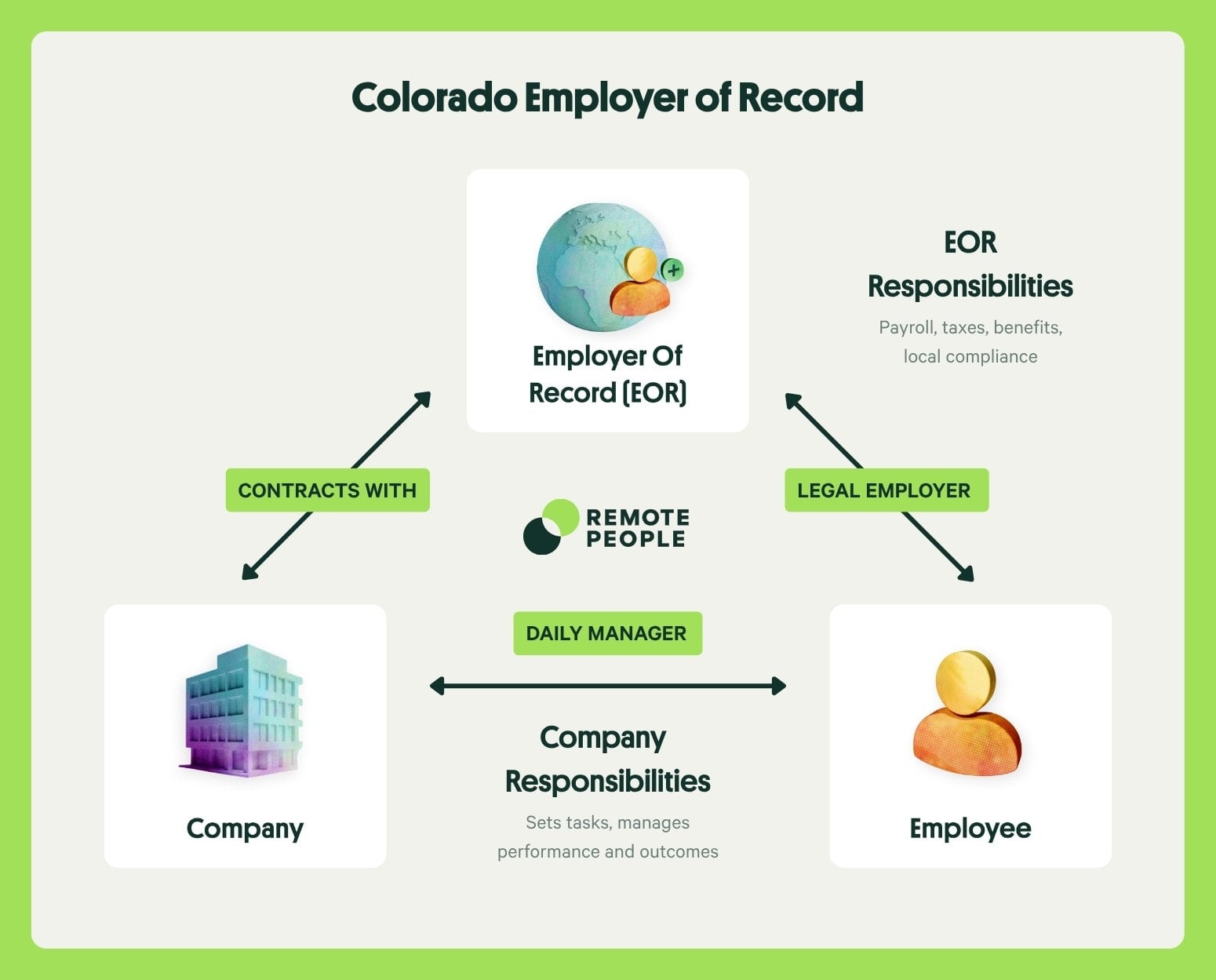
A Colorado Employer of Record is a third-party organization that legally employs workers on your behalf within the state.
What is an EOR can help explain how this employment model works in more detail.
The EOR becomes the legal employer for purposes of:
- Payroll processing.
- Federal and Colorado income tax withholding.
- State unemployment insurance registration.
- Paid Family and Medical Leave Insurance contributions.
- Workers’ compensation coverage.
- Wage and hour compliance.
Your company maintains full operational control over the employee’s daily work and performance.
The primary value of an EOR in Colorado is compliance risk mitigation. Colorado has detailed wage and hour enforcement rules, and penalties for violations can be significant. By shifting legal employment responsibility to an EOR, companies reduce direct exposure.
An EOR also removes the need to form and register a Colorado legal entity before hiring.
What is the Difference Between a Colorado EOR and a Colorado PEO?
A Colorado PEO operates under a co-employment structure. Your company must already have a registered entity in Colorado. Employment responsibilities are shared between your organization and the PEO.
A Colorado EOR does not require entity formation. The EOR becomes the sole legal employer for compliance purposes and assumes primary responsibility for payroll taxes and labor law adherence.
For international companies or US organizations expanding into Colorado for the first time, the EOR structure is simpler and faster.
In a higher-regulation state like Colorado, the clean liability allocation provided by an EOR is particularly valuable.
Start hiring with a Colorado EOR
Let us handle the complexities of hiring, compliance, and payroll in Colorado while you focus on growing your team.
- Hire employees in Colorado with a Colorado EOR
- No local entity is needed
- Pricing starts at USD 199 per employee
- RemotePeople can also help you find the best talent in Colorado
How Does a Colorado Employer of Record Work?
The hiring process under a Colorado EOR typically follows these steps:
Compliant Employment Contract
The EOR drafts a compliant employment contract consistent with Colorado wage law, overtime rules, and leave entitlements.
Payroll with Correct State Registrations
The EOR registers for:
- Colorado state income tax withholding
- Colorado Unemployment Insurance.
- Paid Family and Medical Leave Insurance (FAMLI) contributions.
These registrations must be in place prior to payroll processing.
Payroll Administration
The EOR calculates and withholds:
- Federal income tax
- Social Security and Medicare
- Colorado state income tax
- Employee portion of FAMLI contributions
The employer portion of FAMLI contributions is also remitted by the EOR.
Benefits Administration
Colorado employers must administer paid family and medical leave benefits under the state program. The EOR tracks eligibility and contribution requirements.
Ongoing Compliance Management
Colorado regularly updates wage thresholds and posting requirements. The EOR monitors and implements changes.
How Labor Laws Affect Hiring in Colorado?
Colorado has one of the more detailed wage law frameworks among US states.
Minimum Wage & Overtime
Colorado’s minimum wage is currently $14.42 per hour and adjusts annually based on inflation.
Tipped employees must receive a reduced base wage but must still meet total compensation thresholds above the federal level.
Colorado overtime rules are governed by the COMPS Order, which includes:
Overtime Trigger | Rate |
|---|---|
Hours worked over 40 in a workweek | 1.5x regular rate |
Hours worked over 12 in a workday | 1.5x regular rate |
Hours worked over 12 consecutive hours regardless of start time | 1.5x regular rate |
This layered overtime framework increases payroll calculation complexity.
Income Tax
Colorado applies a flat state income tax rate of 4.4%. Employers must withhold and remit state income taxes to the Colorado Department of Revenue. Failure to properly remit withholding can result in penalties and interest.
State Unemployment Insurance (SUI)
Colorado SUI structure includes:
- New employer rate typically around 1.7% to 2.4%.
- Wage base approximately $20,000.
- Quarterly filing requirements
Rates may increase based on employer claims history.
An EOR structure isolates your company from direct unemployment experience rating exposure.
Paid Leave
Colorado operates the Paid Family and Medical Leave Insurance program (FAMLI), under which both employers and employees contribute a percentage of wages to fund paid leave benefits. Employers must:
- Withhold employee contributions.
- Remit employer contributions.
- Maintain accurate payroll records.
This requirement adds cost and administrative responsibility beyond many states.
Workers' Compensation
Workers’ compensation insurance is mandatory in Colorado, with premium rates varying by industry classification and payroll volume. Coverage requirements are strictly enforced.
Termination and Final Pay
Colorado is an at-will employment state, though wage payment rules are strict. Employees terminated involuntarily must receive their final wages immediately, while those who resign are paid on the next regular payday. Failure to issue timely final wages may result in statutory penalties and additional wage claims. Colorado also has specific requirements regarding wage statements and permissible deductions.
Payroll Taxes and Employer Cost in Colorado
Colorado employers must account for:
Category | Cost |
|---|---|
Federal payroll taxes | 1.45% Medicare contribution; 6.2% Social Security on wages up to $176,100; 0.6% FUTA on first $7,000 of earnings. |
SUI contributions | New employer rate approximately 2.05%–3.05% on first $30,600 of wages (2026). Experienced employer rates vary based on claims history. |
FAMLI contributions | 0.44% employer share (employers with 10+ employees) on wages up to $184,500. Total combined rate is 0.88%, split equally with employee. |
Workers’ compensation premiums | Varies by industry classification; approximately 0.89% of payroll on average for clerical roles. |
Mandatory health insurance contributions | Approximately $6,700/employee/year for employers with 50+ employees under ACA requirements. |
Example Cost Breakdown
The following example shows the employer burden for a professional employee earning $100,000 per year in Colorado. It is based on a typical clerical employee and assumes a low risk for workers’ compensation.
Assuming the worker has a $100,000 salary, the employer would pay:
Category | Cost |
|---|---|
FICA | $7,650 |
FUTA | Up to $420 |
SUI | (2% on $20,000 wage base): $400 |
FAMLI employer contribution | (Assume 0.45%): $450 |
Workers’ compensation | (1% to 2%): $1,000 to $2,000 |
Estimated employer burden | $12,000 to $18,000 |
Total employment cost: approximately $112,000 to $118,000 annually, excluding optional benefits.
Colorado’s total burden is typically higher than Indiana and Alaska due to paid leave funding requirements and higher wage levels.
Employee Classification Rules in Colorado
Colorado applies stricter independent contractor standards than the federal baseline.
Workers must be free from control and customarily engaged in an independent trade to qualify as contractors.
Misclassification can result in:
- Back wages
- Retroactive tax assessments
- Penalties
- Liability under wage protection statutes
Colorado is considered more aggressive in enforcing classification rules than Indiana.
An EOR reduces classification exposure by ensuring employees are properly structured and compliant from the outset.
What Makes Hiring in Colorado Unique?
Colorado stands out for its strong wage transparency requirements, mandatory paid family leave program, inflation-adjusted minimum wage, and detailed overtime rules. The state combines a skilled, highly educated workforce with elevated regulatory standards that demand careful compliance management.
Companies hiring in Denver or Boulder often compete aggressively for technology and aerospace talent, which creates upward pressure on compensation. For organizations looking to access Colorado’s innovation ecosystem, being compliance-ready from day one is not optional.
What Are the Benefits of a Colorado Employer of Record Service?
- No entity setup required, allowing you to hire in Colorado without navigating state registration requirements.
- Faster onboarding timelines with compliance managed from day one.
- Centralized handling of Colorado-specific obligations including FAMLI contributions, wage transparency requirements, and SUI filings.
- Reduced exposure to wage claims and overtime disputes in a state with active labor enforcement.
- Scalable framework that extends consistently across multiple US states without adding internal overhead.
What Are the Downsides of a Colorado Employer of Record Service?
- Service fees add to the overall cost of employment and should be factored into budget planning.
- Less direct control over payroll customization compared to managing an in-house payroll function.
- Reduced internal oversight of day-to-day administrative processes, which may require adjustment for companies with specific operational preferences.
However, in a compliance-heavy state, outsourcing payroll and regulatory oversight often reduces long-term operational risk.
How to Choose a Colorado Employer of Record
When evaluating providers, consider:
- Transparent pricing
- Direct EOR employment structure
- Experience with Colorado overtime and FAMLI compliance.
- Dedicated US compliance support
- Strong payroll accuracy controls
Because Colorado’s regulatory framework is more layered, provider expertise is critical.
Engage a Colorado Employer of Record, with RemotePeople
RemotePeople delivers Employer of Record services across Colorado, including payroll administration, state tax withholding, FAMLI contribution management, unemployment insurance reporting, and workers’ compensation coverage.
We enable companies to hire in Colorado quickly and compliantly without forming a local entity while maintaining full operational control of their workforce.
If you are expanding into Denver, Boulder, Colorado Springs, or hiring remote employees in the state, RemotePeople provides a structured and scalable employment solution.
Our team manages the full employment lifecycle, from compliant contract issuance and onboarding to ongoing payroll accuracy, statutory reporting, and final wage compliance at termination. We monitor updates to Colorado wage law, overtime regulations, and leave requirements so you do not need to build in-house compliance infrastructure.
Whether you are hiring a single senior employee or building a multi-state US team, RemotePeople provides predictable pricing, centralized reporting, and reduced legal exposure in one of the country’s more regulated employment environments. Contact us today.
Employer of Record in
Employer of Record in
Employer of Record in
Employer of Record in
Employer of Record in
Employer of Record in
Employer of Record in
Employer of Record in