
 Recruit
Employer of Record in Hawaii
-
 Drew Donnelly
- Published
- September 22, 2026
Hawaii’s employment law includes TDI, prepaid health care, and specific employment regulations, and a Hawaii EOR handles payroll, taxes, and full state compliance with no local entity needed.
Hire in Hawaii — book a free 30-minute demo
Tell us what you need. You'll get a tailored, transparent proposal within 24 hours, plus a free call to walk through it.
Tell us about your company
So we can match you with a specialist who knows your market — and unlock volume pricing tiers.
* All fields are required.
Where and when are you hiring?
Tell us the geography and timing and we'll quote each country line by line, with onboarding timelines.
* All fields are required.
Help us beat your current setup
We'll benchmark your current deal and send a line-by-line proposal in 24 hours — showing exactly where we cut cost, time, or risk. After you submit, you can book a call to walk through it together.
* All fields are required.
Thanks! Your proposal is on its way.
Expect a tailored, line-by-line proposal in your inbox within 24 hours. In the meantime…
Want to walk through it together?
Book a free 30-minute call with one of our specialists. We'll explain every line, answer your questions, and tailor the proposal further if you need.
No obligation. Pick a time that works for you.








- Hire in Hawaii — book a free 30-minute demo
- Tell us about your company
- Where and when are you hiring?
- Help us beat your current setup
- Thanks! Your proposal is on its way.
- Hawaii Employer of Record
- What Is the Difference Between a Hawaii Employer of Record and a Hawaii PEO?
- How Does a Hawaii Employer of Record Work?
- How Labor Laws Affect Hiring in Hawaii?
- Payroll Taxes and Employer Cost in Hawaii
- Employee Classification Rules in Hawaii
- What Makes Hiring in Hawaii Unique?
- What Are the Benefits of a Hawaii Employer of Record?
- What Are the Downsides of a Hawaii EOR?
- How to Choose a Hawaii Employer of Record?
- Engage a Hawaii Employer of Record with RemotePeople
- Related EOR Destinations

Let RemotePeople handle payroll, compliance, and HR admin worldwide so you can focus on building your team.
Key Takeaways
- Hawaii offers targeted incentives through the Department of Business, Economic Development & Tourism (DBEDT), including tax credits for R&D, film production, renewable energy, and support for small businesses.
- An Employer of Record (EOR) lets you hire in Hawaii without a local entity by becoming the legal employer and handling payroll, taxes, unemployment, workers’ comp, Temporary Disability Insurance (TDI), prepaid health care, and compliance.
- Hawaii follows at-will employment, meaning termination is allowed at anytime for lawful reasons with no notice required.
- Mandatory programs include Temporary Disability Insurance (TDI) and workers’ compensation for nearly all employers, increasing overall payroll costs.
- Hawaii’s economy focuses on tourism, renewable energy, defense, technology, and agriculture, with a higher cost of living and payroll burden than most mainland states.
Hawaii has a unique business environment as the only U.S. island state, with an economy driven by tourism, military presence, renewable energy initiatives, and emerging sectors like technology and sustainable agriculture.
While not typically ranked among the top states for doing business due to higher costs and geographic isolation, it provides targeted support for growth through the Department of Business, Economic Development & Tourism (DBEDT) programs, including grants for sustainable tourism infrastructure, trade-oriented production, and small business accelerators.
The state features a high minimum wage, mandatory Temporary Disability Insurance (TDI), prepaid health care requirements for many employers, and workers’ compensation obligations that together reflect a genuine commitment to worker welfare. Wages run higher to match the cost of living, particularly in Honolulu and the major tourist areas, and that investment in your workforce tends to pay off in a labor market built around loyalty and stability.
The Port of Honolulu supports logistics operations, and the state’s proximity to Asia-Pacific markets is a genuine competitive advantage for companies with interests in that region.
This guide covers what an Employer of Record is and how it works in Hawaii, the key labor laws that shape your obligations as an employer, what your payroll costs will realistically look like, and what to think about when choosing the right EOR partner for the state.
Hawaii Employer of Record
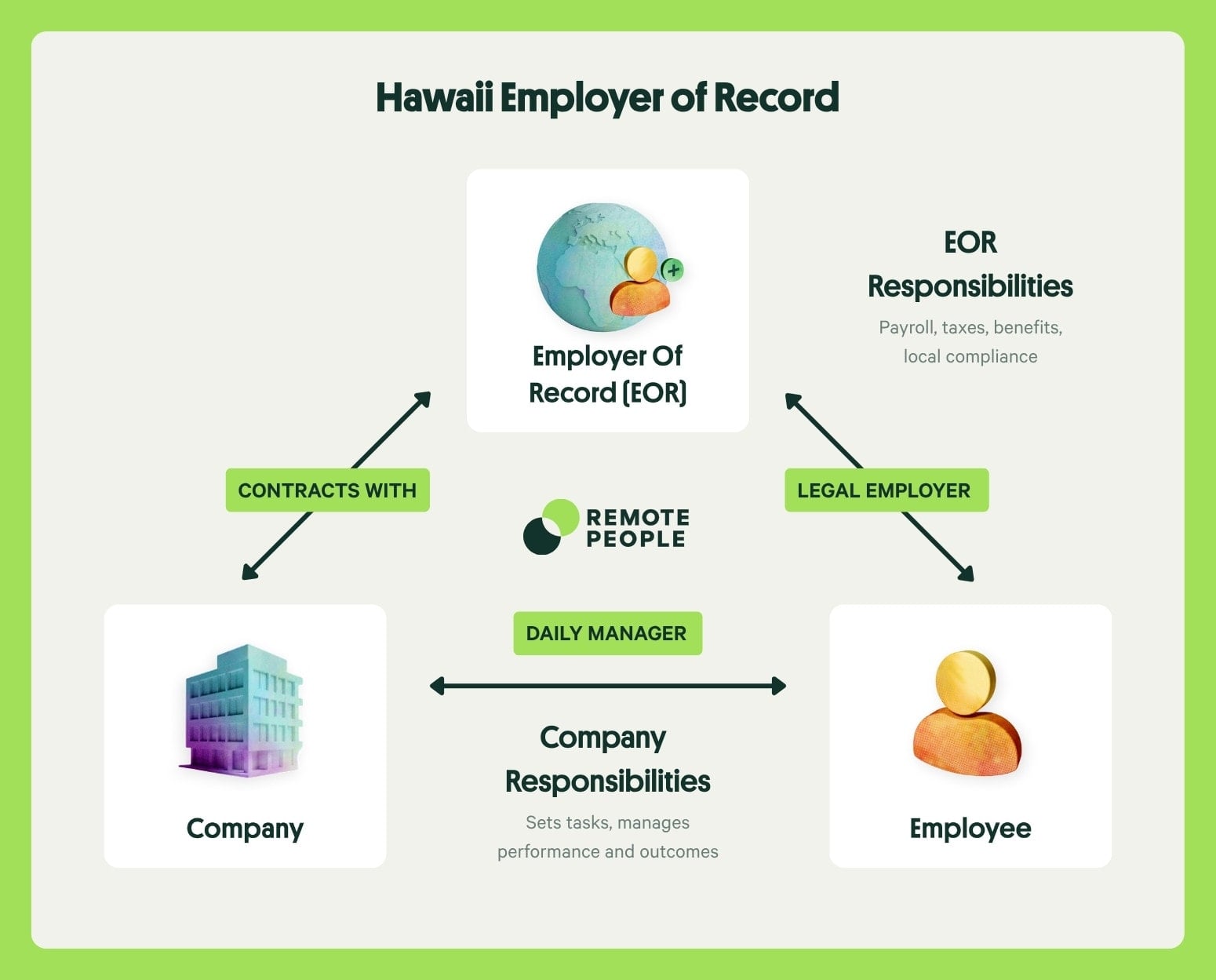
A Hawaii Employer of Record (EOR) takes on legal employer status for your workers in the state while you keep full control over the work itself. You set the direction, manage performance, make hiring decisions, and run the day-to-day operation of your team. The EOR takes care of everything that comes with being the employer of record under Hawaii and federal law.
What is an EOR can help explain how this employment model works in more detail.
However, in Hawaii, that scope is broader than in most states. Beyond the standard payroll processing, tax withholding and remittance, and unemployment insurance contributions, the EOR also manages Temporary Disability Insurance, workers’ compensation coverage that applies from your very first employee, and Prepaid Health Care Act compliance for qualifying staff. They file the required reports with the Hawaii Department of Taxation, the Department of Labor and Industrial Relations, and any other relevant agencies, so those obligations never land on your plate.
For businesses coming into Hawaii from outside the state, whether an international company establishing a U.S. presence or a mainland business expanding into a new market, an EOR removes what would otherwise be a significant barrier to getting started. Setting up a local entity, obtaining a Hawaii tax ID, navigating TDI and prepaid health care requirements, and opening unemployment and workers’ comp accounts takes real time and real money.
An EOR already has all of that infrastructure in place. You can have someone hired, onboarded, and on payroll within days of deciding to move forward, and the employer liability that comes with that relationship transfers to the EOR rather than sitting with your company.
What Is the Difference Between a Hawaii Employer of Record and a Hawaii PEO?
Both options offer HR and compliance support, but they are built differently and suit different situations. Knowing which one fits your circumstances before you start shopping saves a lot of time.
A PEO works through co-employment, meaning both the PEO and your company share employer status. This usually requires you to already have a legal entity in Hawaii. PEOs are well-suited to established businesses that want to hand off HR administration, access better group benefits rates through pooled coverage, and streamline payroll without fully stepping out of the employer role. They work as an operational support layer for companies that are already up and running in the state.
An EOR, on the other hand, is the sole legal employer and takes on full liability without requiring any existing entity on your end. That structural difference is what makes it the better starting point for companies entering Hawaii fresh.
There is no entity to set up, no state-specific registration process to work through, and no delay between deciding to hire and being able to do it legally and compliantly. The EOR model is faster, cleaner from a liability standpoint, and far less demanding on your internal resources, particularly in a state with as many mandatory programs as Hawaii.
Start hiring with a Hawaii EOR
Let us handle the complexities of hiring, compliance, and payroll in Hawaii while you focus on growing your team.
- Hire employees in Hawaii with a Hawaii EOR
- No local entity is needed
- Pricing starts at USD 199 per employee
- RemotePeople can also help you find the best talent in Hawaii
How Does a Hawaii Employer of Record Work?
Compliant Employment Contract
The EOR prepares and signs an employment contract built around Hawaii law and federal requirements. It covers at-will employment status, compensation, overtime, and other relevant terms while keeping your operational control over the role completely intact.
Payroll Setup with Correct State Registrations
The EOR already holds the registrations needed to run compliant payroll in Hawaii, including those with the Department of Taxation for income tax withholding and with the Department of Labor and Industrial Relations for unemployment insurance and related contributions. Your new hire can be on payroll and paid legally from day one.
Tax Withholding and Remittance
Every payroll run covers federal deductions, including Social Security, Medicare, and federal unemployment tax, plus Hawaii’s graduated state income tax, which carries some of the highest rates in the country. The EOR calculates the correct amounts, sends payments to the right agencies on schedule, and manages all required filings throughout the year.
Benefits Administration
Health insurance, dental, and retirement plans, if you offer them, are all managed by the EOR. This includes enrollment, maintaining records, and handling required notices when employment ends. Hawaii’s Prepaid Health Care Act creates specific obligations for qualifying employees that the EOR manages as part of its standard process. Workers’ compensation and TDI coverage are also arranged and administered through the EOR, so your employees are properly protected from day one.
Ongoing Compliance Management
Hawaii’s employment laws evolve, and the EOR tracks those changes and adjusts your payroll and processes to stay current. When someone leaves, the EOR handles the final paycheck on the correct legal timeline. When state agencies have questions or an audit comes up, the EOR manages it. The compliance work runs in the background continuously, which means you are always covered without having to monitor it yourself.
How Labor Laws Affect Hiring in Hawaii?
Hawaii has more employer obligations layered on top of federal law than most states. Some of it follows familiar patterns with higher numbers attached. Some of it is unique to Hawaii and worth understanding specifically before you make your first hire. Here is the full picture.
Minimum Wage and Overtime
Hawaii’s minimum wage is $16.00 per hour effective January 1, 2026, with a scheduled increase to $18.00 on January 1, 2028. The higher baseline reflects the cost of living and supports a workforce that, in return, tends to be stable and committed. Tipped employees must reach the state minimum wage once tips are counted in, with the employer making up any shortfall if a particular shift falls short.
Overtime follows Fair Labor Standards Act(FLSA) rules. Non-exempt employees earn 1.5 times their regular rate for hours worked beyond 40 in a workweek. There is no daily overtime threshold, and exemption categories follow the federal definitions.
Income Tax
Hawaii uses a graduated income tax structure with up to 12 brackets and rates ranging from 1.4% to 11%, which places it among the higher state income tax environments nationally. Employers withhold state income tax from employee wages and remit to the Department of Taxation. The complexity of the bracket structure means withholding calculations require more precision than a flat-rate state, and an EOR that handles this routinely.
State Unemployment Insurance (SUI)
The SUI taxable wage base in Hawaii is $64,500 per employee, one of the highest bases in the country. New employers typically start at a rate of 2.4%, with rates adjusting over time based on experience and claims history up to a maximum of 5.6%. Contributions go to the Department of Labor and Industrial Relations quarterly.
Temporary Disability Insurance (TDI)
TDI is one of the things that genuinely sets Hawaii apart from every other state in the country. It is mandatory and provides partial wage replacement for employees who cannot work due to a non-work-related illness or injury.
Employers can self-insure or use an approved plan, and benefits run up to a maximum of $871 per week. For companies used to hiring on the mainland, TDI is a new line item to plan for, and getting the coverage in place correctly from the start is something an experienced Hawaii EOR handles as routine.
Paid Leave
Hawaii has no state mandate for paid sick leave or paid vacation. The Hawaii Family Leave Law provides up to four weeks of unpaid job-protected leave per year for eligible employees after six months of service, for qualifying family and medical reasons.
The Federal Family and Medical Leave Act(FMLA) applies on top of that for employers with 50 or more employees. TDI provides income replacement during qualifying disability periods as a separate layer of support for your workforce.
Workers' Compensation
Workers’ compensation is mandatory in Hawaii for nearly all employers, from the very first employee, which is a lower threshold than in most states. Coverage comes through private insurers or approved plans overseen by the DLIR’s Disability Compensation Division. Premium rates reflect Hawaii’s geography and the nature of work in the state’s major industries, and having an EOR manage this coverage means it is in place and compliant before your employee starts work.
Prepaid Health Care Act
Hawaii is the only state in the country that requires most employers to provide health care coverage to employees working at least 20 hours per week for four consecutive weeks. This is a meaningful added cost that has no equivalent anywhere else in the U.S., and it reflects Hawaii’s broader approach to employee welfare. An EOR with genuine Hawaii expertise will have this process down and can fold it into your overall employment cost picture clearly and accurately.
Termination and Final Pay
Hawaii is an at-will employment state, which gives both employers and employees the flexibility to end the working relationship at any time for any lawful reason without a required notice period, unless a contract says otherwise. That flexibility is a genuine operational advantage for businesses managing dynamic teams.
The standard protections apply within the at-will framework. Terminations based on race, sex, age, disability, national origin, religion, or other protected characteristics are not permitted, and retaliation against employees who have exercised legal rights or reported concerns is also off limits. At-will covers legitimate business decisions made in good faith.
Final pay timing in Hawaii is worth knowing precisely because the timelines are tighter than most mainland states. For involuntary terminations, wages are due immediately or by the next working day. For voluntary resignations, payment is due by the next regular payday, but if the employee gave at least one full pay period’s notice, final wages are due at the time they leave. These are firm deadlines, and missing them creates real liability.
Unused vacation and Paid Time Off(PTO) are generally treated as earned wages in Hawaii, which means they typically need to be paid out at termination unless you have a clear, written forfeiture policy that was properly communicated to employees. A vague or inconsistently applied policy offers little protection if a former employee challenges it. Getting the policy right in advance, with help from an EOR that understands Hawaii’s approach to this, is the straightforward way to manage it.
Penalties for late or unpaid final wages include additional damages on top of the amount owed, plus interest, costs, and attorney fees. An EOR that manages offboarding as part of its standard process handles all of this correctly and removes that exposure entirely.
Payroll Taxes and Employer Cost in Hawaii
Hawaii costs more per employee than most other states, and planning for that reality upfront makes the whole experience much smoother. The mandatory programs stack in a way that is unique to Hawaii, and each one adds a real line item to your cost per employee.
The federal layer is standard across all U.S. states. Social Security at 6.2% up to the annual wage cap, Medicare at 1.45% with no ceiling, and the Federal Unemployment Tax Act(FUTA) at an effective rate of around 0.6% for employers who stay current on state unemployment contributions.
The state layer is where Hawaii diverges significantly from the mainland. The SUI taxable wage base of $64,500 means you are paying unemployment contributions on a larger share of each employee’s wages before hitting the cap.
Workers’ comp rates tend to run higher than for equivalent roles on the mainland. TDI contributions add another line. And for employers subject to the Prepaid Health Care Act, health coverage costs sit on top of all of that.
| Cost Component | Estimated Employer Cost |
|---|---|
| Federal FICA (Social Security and Medicare, employer share) | roughly $7,650 |
| FUTA | around $42 after the state credit |
| State unemployment insurance | approximately $1,548 at 2.4% on the $64,500 base |
| Workers’ compensation | $1,000 or more, depending on classification |
| TDI and health contributions | additional costs that vary by plan and coverage level |
Total employer overhead in Hawaii typically runs 12 to 20 percent or more above base salary. It is higher than most states, and that is simply part of the cost structure of doing business here. The upside is a workforce that is well supported, a compliance environment that rewards employers who do things properly, and access to a genuinely unique market with real advantages for the right businesses.
Employee Classification Rules in Hawaii
Hawaii follows the federal framework for worker classification without layering on a stricter state-specific standard. For wage and hour purposes under the FLSA, the economic reality test applies, looking at the full picture of the working relationship, including control over the work, the worker’s financial independence, how permanent the arrangement is, whether the worker has invested in their own equipment, and whether the work is central to the company’s core business. The whole picture matters rather than any single factor.
For unemployment insurance and workers’ comp, the common law right-to-control test governs. The key question is whether the employer controls how the work gets done, not just what the end result looks like. Direction over methods, tools, and process points toward employment. Control limited to outcomes alone is more consistent with genuine independent contracting.
Hawaii does not apply California’s ABC test, which makes the classification framework here more flexible and predictable. Misclassification still carries real consequences, though, including back taxes, unpaid wages, penalties, interest, and audits from multiple agencies. An EOR removes most of that exposure by bringing workers on as employees from day one and maintaining documentation that supports that classification throughout.
What Makes Hiring in Hawaii Unique?
Hawaii is a genuinely different hiring environment, and the companies that do well there are usually the ones that approach it on its own terms rather than treating it like a mainland state with higher costs attached.
The workforce is multicultural, deeply rooted in the local community, and tends toward strong loyalty when employers invest in the relationship. Retention rates in Hawaii can be excellent for companies that take the work culture seriously and engage with the state’s values around community and sustainability. The labor market is smaller and more connected than major mainland metros, which means both that great candidates are findable and that your reputation as an employer travels quickly.
The state’s DBEDT programs offer real support for targeted industries. Tax credits for R&D, film production, and renewable energy are genuinely meaningful for qualifying businesses. Small business accelerators and sustainable tourism grants reflect the state’s priorities, and companies that align with those priorities often find state support that goes beyond what the standard business environment would suggest. Hawaii wants to grow its economy in specific directions, and businesses that fit those directions are welcome partners.
The Asia-Pacific positioning is also worth taking seriously if it applies to your business. Hawaii sits closer to major Asian markets than any other U.S. state, and for companies with supply chains, customers, or operations in that region, the logistical and cultural advantages of a Hawaii presence are real.
The Port of Honolulu handles substantial freight volume, and the state’s workforce includes genuine multilingual and multicultural depth that is valuable in those markets.
What Are the Benefits of a Hawaii Employer of Record?
- No Entity Setup Required: You skip business registration, state tax ID applications, unemployment and workers’ comp account setup, TDI arrangements, and the compliance groundwork that comes with entering a state with Hawaii’s specific requirements. The EOR already has it all in place.
- Faster Onboarding: You can hire and pay compliant employees in Hawaii within days. The EOR’s existing state registrations and established agency relationships cut out what would otherwise be months of setup work.
- Centralized Compliance: One partner covers payroll taxes, SUI, workers’ comp, TDI, Prepaid Health Care Act requirements, wage and hour compliance, and all required filings. They track changes to Hawaii law and adjust proactively so you are always current.
- Reduced Legal Risk: The EOR carries the liability for employment taxes, wage claims, misclassification disputes, and compliance violations. In a state with as many mandatory programs as Hawaii, that liability transfer is particularly valuable.
- Scalable Across Multiple States: The same EOR partner handles your Hawaii employees and any other states you operate in, without separate entity setups or state-specific expertise on your end.
What Are the Downsides of a Hawaii EOR?
The main consideration is cost. EOR fees, whether a percentage of payroll or a flat monthly rate per employee, add to your total employment expense on top of Hawaii’s already higher baseline. You also hand some control of payroll timing and mechanics over to the EOR’s systems.
For most companies entering Hawaii without an existing entity, those fees represent a genuinely good investment. Building the compliance infrastructure yourself in a state with TDI, Prepaid Health Care Act obligations, a $64,500 SUI wage base, and workers’ comp mandatory from employee one is a meaningful undertaking.
The EOR gets you into the market quickly and keeps the compliance work running correctly in the background. When your Hawaii team eventually grows large and stable enough that maintaining your own entity starts to make better financial sense, that option is always there. Until that point, the EOR is the smarter way to operate.
How to Choose a Hawaii Employer of Record?
Transparent Pricing Plans
Look for clear upfront fees that account for Hawaii’s full cost structure, including TDI and prepaid health care. You should know exactly what you are paying before you commit.
Direct EOR Model
Choose a provider that operates directly rather than through subcontractors. In a state with Hawaii’s compliance complexity, direct accountability matters.
U.S. Multi-State Expertise
Make sure they have real working experience managing payroll, tax filings, and compliance across multiple states, with specific knowledge of Hawaii’s requirements.
Dedicated Support
Real people who can answer Hawaii-specific questions quickly. When a TDI question or a final pay timeline issue comes up, you want a direct answer from someone who knows the rules.
Strong Compliance Track Record
Clean filing history, appropriate insurance coverage, regular audits, and references from clients who have hired in Hawaii specifically are all worth asking about.
Engage a Hawaii Employer of Record with RemotePeople
An Employer of Record in Hawaii manages compliant employment contracts, payroll, federal and state tax withholding, TDI, workers’ compensation, Prepaid Health Care Act compliance, benefits administration, and all required filings.
They do this so you can keep full day-to-day control over the employee’s work and performance without the need for a local entity.
And if you’re looking to hire in Hawaii right now, RemotePeople provides direct EOR service starting at $199 per month per employee. Reach out to us today!
Employer of Record in
Employer of Record in
Employer of Record in
Employer of Record in
Employer of Record in
Employer of Record in
Employer of Record in
Employer of Record in