
 Recruit
Employer of Record (EOR) in Equatorial Guinea
-
 Drew Donnelly
- Published
- September 21, 2026
RemotePeople’s employer of record in Equatorial Guinea lets you hire employees in Equatorial Guinea without setting up a local entity. We handle INSESO social security contributions, Work Protection Fund payments, and annual vacation entitlements.
Hire in Equatorial Guinea — book a free 30-minute demo
Tell us what you need. You'll get a tailored, transparent proposal within 24 hours, plus a free call to walk through it.
Tell us about your company
So we can match you with a specialist who knows your market — and unlock volume pricing tiers.
* All fields are required.
Where and when are you hiring?
Tell us the geography and timing and we'll quote each country line by line, with onboarding timelines.
* All fields are required.
Help us beat your current setup
We'll benchmark your current deal and send a line-by-line proposal in 24 hours — showing exactly where we cut cost, time, or risk. After you submit, you can book a call to walk through it together.
* All fields are required.
Thanks! Your proposal is on its way.
Expect a tailored, line-by-line proposal in your inbox within 24 hours. In the meantime…
Want to walk through it together?
Book a free 30-minute call with one of our specialists. We'll explain every line, answer your questions, and tailor the proposal further if you need.
No obligation. Pick a time that works for you.








- Hire in Equatorial Guinea — book a free 30-minute demo
- Tell us about your company
- Where and when are you hiring?
- Help us beat your current setup
- Thanks! Your proposal is on its way.
- How an Employer of Record Works in Equatorial Guinea
- Employment Laws and Regulations in Equatorial Guinea
- Work Permits and Visas in Equatorial Guinea
- Payroll, Taxes, and Social Security in Equatorial Guinea
- Cost of Hiring Through an EOR in Equatorial Guinea
- Benefits of Using an EOR in Equatorial Guinea
- Termination and Offboarding in Equatorial Guinea
- EOR vs. Other Hiring Models in Equatorial Guinea
- Public Holidays in Equatorial Guinea
- How to Get Started with an EOR in Equatorial Guinea
- Where companies hiring in Equatorial Guinea expand next
- Frequently Asked Questions
- Related EOR Destinations

Start hiring in Equatorial Guinea
Let RemotePeople handle payroll, compliance, and HR admin worldwide so you can focus on building your team.

Equatorial Guinea is the wealthiest country per capita in Central Africa, home to a concentrated oil and gas industry, a growing services sector around Malabo and Bata, and the only Spanish-speaking workforce on the continent. For international companies, the attraction is access to specialised hydrocarbon talent and a central location in the CEMAC economic zone. The challenge is registering a local entity, navigating the 1990 General Labour Ordinance, and running compliant payroll through INSESO with the country’s unusual triple-bonus wage structure.
An employer of record in Equatorial Guinea removes that burden by becoming the legal employer on paper while you keep day-to-day control of the work. This guide walks through how an EOR operates in Equatorial Guinea, the employment laws that apply in 2026, payroll and tax mechanics, total hiring costs, and how an EOR compares with other hiring models.
How an Employer of Record Works in Equatorial Guinea
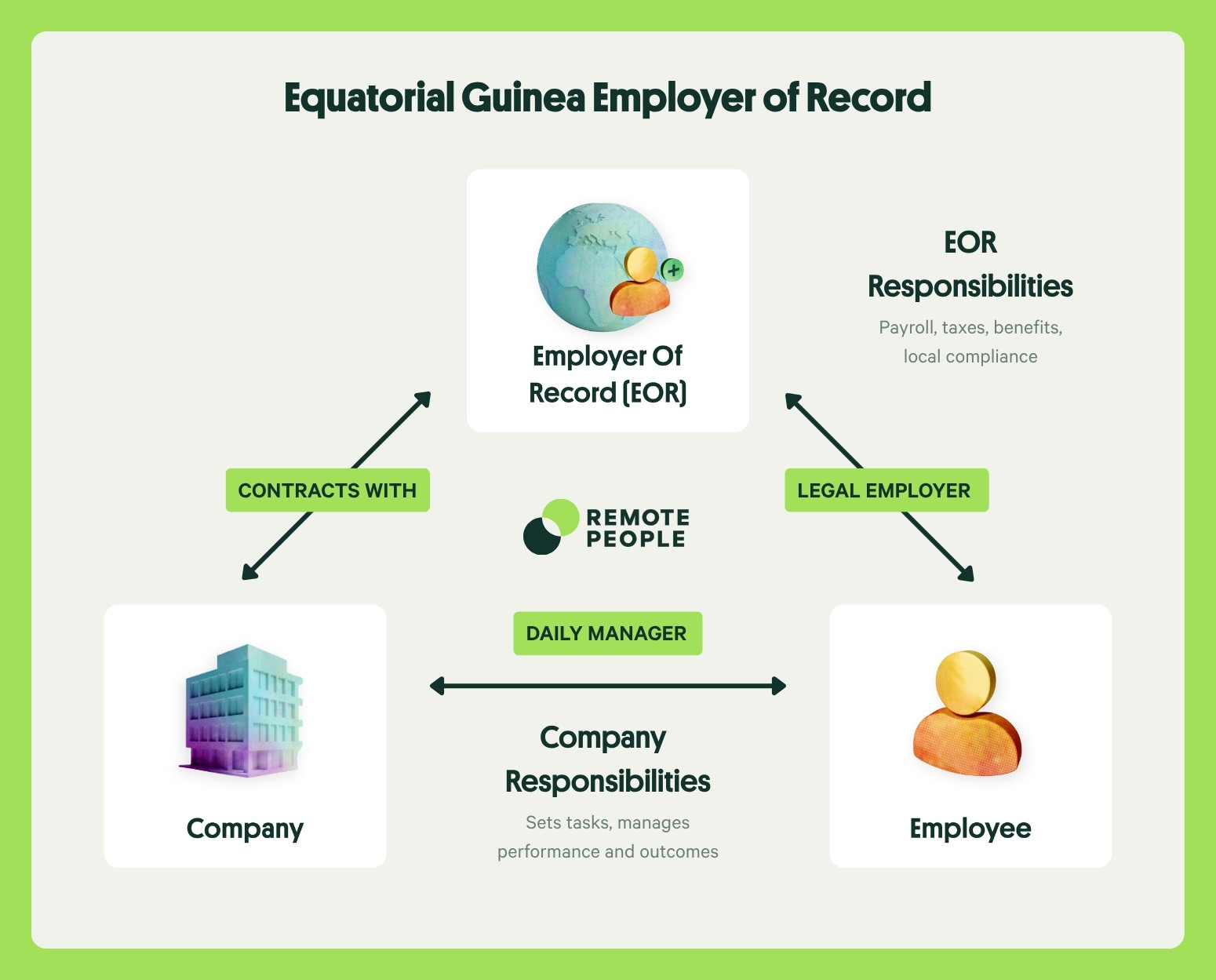
If you’d like to learn more about how Employer of Record (EOR) services work, read our What Is an Employer of Record (EOR)? guide for a complete overview of the model, its benefits, and when to use it.
If you’re comparing providers, our Best Employer of Record (EOR) Providers guide reviews the leading platforms to help you choose the right solution for your business.
Who Uses an EOR in Equatorial Guinea?
An EOR fits any business that wants to employ one or more people in Equatorial Guinea without opening a subsidiary. It is the fastest path for companies testing the market, hiring a small team of 1 to 15 people, or sponsoring a foreign specialist who needs work authorisation. It is also a practical choice for organisations that need to onboard quickly, since entity registration in Malabo can take three to five months while EOR onboarding typically takes one to two weeks.
Common scenarios include placing a country manager on the ground, hiring petroleum engineers, geologists, and oilfield services staff for LNG and upstream operations, employing Spanish-speaking finance and administration professionals in Malabo or Bata, and bringing on local project staff for construction and infrastructure work. A company can also use an EOR to convert an existing independent contractor into a compliant full-time employee without setting up an entity.
Typical Onboarding Timeline
Most employer of record providers can onboard an Equatorial Guinean employee within one to two weeks from signed agreement to first day of work. The timeline extends if a foreign hire needs a residence visa and work authorisation, which can add six to eight weeks.
- First, sign the EOR service agreement and share employee details, role, and compensation (1 to 2 days).
- Second, the EOR drafts a Spanish-language employment contract aligned with Ley 2/1990 and sends it for review and signature (2 to 3 days).
- Third, INSESO social security enrolment and tax office registration run in parallel (4 to 6 days).
- Fourth, payroll is configured, the opening pay slip is generated, and benefits are activated (2 days).
- Fifth, the employee receives onboarding documents and starts work on the agreed date.
Factors that extend the timeline include foreign hires requiring a residence visa and work permit, background and criminal record checks, medical screening for oil and gas sites, and contracts that require collective-agreement alignment in sectors such as hydrocarbons or banking.
Hire in Equatorial Guinea
Central Africa’s only Spanish-speaking nation with INSESO contributions and Equatoguinean Labour Law compliance.
We handle employment contracts, payroll, social contributions, and full Equatoguinean compliance.
No local entity needed. Your team can start in days.
Employment Laws and Regulations in Equatorial Guinea
Employment Contracts
The primary statute governing private-sector employment in Equatorial Guinea is Ley 2/1990 de 4 de enero sobre Ordenamiento General del Trabajo, known as the Ley General de Trabajo. It is administered by the Ministry of Labour, Employment Promotion and Social Security, and enforced alongside INSESO and the Labour Inspectorate. Employment contracts must be in writing for fixed-term, part-time, and foreign-worker arrangements, and should be drafted in Spanish to be enforceable before the country’s labour courts.
A compliant contract names the parties, job role, workplace, salary, working time, probation period, and duration. Indefinite-term contracts are the default; fixed-term contracts are permitted for objective reasons such as project work, seasonal peaks, or replacement of absent staff, and may run for a maximum of two years including renewals before converting to an indefinite contract under CLG Global’s employment law guide.
Working Hours and Overtime
The standard working week in Equatorial Guinea is 48 hours, with a daily cap of 8 hours. Employees are entitled to at least one 24-hour uninterrupted rest period per week, normally Sunday, and a paid rest break of at least 30 minutes after six consecutive hours of work.
Overtime is capped at 2 hours per day and must be authorised in writing. Work beyond standard hours is paid at 125% of the regular hourly rate for the first two hours on normal days, 150% thereafter, and 200% on weekly rest days and public holidays. Night work between 8 p.m. and 6 a.m. carries a 25% premium on top of the base rate.
Minimum Wage
The national minimum wage in Equatorial Guinea is approximately $230 per month (XAF 129,035), effective under the current national wage decree and in force throughout 2026. This rate applies across the private sector and was set by the Ministry of Labour, Employment Promotion and Social Security. Sectoral minimums are higher in hydrocarbons, banking, and construction under industry collective agreements, and entry-level oil and gas roles typically pay well above the statutory floor.
Probation Period
Probation in Equatorial Guinea is contractual and must be set out in writing. The standard maximum is 1 month for most roles, extendable to 3 months for technical staff and 6 months for highly qualified or management positions. During probation, either party can terminate without notice or severance, provided the termination is in writing.
Leave Entitlements
Equatorial Guinea offers a standard Central African leave framework centred on 30 calendar days of annual leave, paid sick leave funded jointly by the employer and INSESO, and 12 weeks of maternity leave. The section below breaks down each statutory category.
Annual Leave
Employees are entitled to 30 calendar days of paid annual leave per year after completing 12 months of service. During the first year of employment, leave accrues at 2.5 calendar days per full month worked. Leave must generally be taken in the year it is earned, and employers cannot pay in lieu of untaken leave except on termination.
Sick Leave
Employees receive paid sick leave subject to a medical certificate. The employer pays the first 3 days at 100% of the regular salary, and INSESO covers the remainder of the illness period at around 50% of the reference salary for up to 26 weeks. Extended illness beyond 26 weeks may be reclassified as disability through an INSESO medical board review.
Maternity Leave
Maternity leave in Equatorial Guinea is 12 weeks, typically split as 6 weeks before birth and 6 weeks after birth. Leave is paid by INSESO at 75% of the reference salary, topped up to 100% by the employer in most collective agreements. Mothers are also entitled to paid breastfeeding breaks of 1 hour per working day during the first 9 months after returning to work.
Paternity Leave
Paternity leave is limited in Equatorial Guinea. Fathers are typically granted 2 working days of paid leave around the birth under the Labour Ordinance, with some collective agreements in the hydrocarbons sector extending this to 5 days.
Other Statutory Leave
The Labour Ordinance provides additional short-term leave for specific life events. Employees can request paid leave for their own marriage, the death of a close family member, the birth of a child, and mandatory civic or legal duties such as attending court. Exact durations are set by contract or collective agreement, typically between 1 and 5 working days per event.
Equatorial Guinea statutory leave entitlements · Per Ley 2/1990 General Labour Ordinance | ||
Leave Type | Duration | Eligibility & Notes |
|---|---|---|
Annual Leave | 30 calendar days | After 12 months of service; 2.5 days accrued per month in first year. Paid by employer. |
Sick Leave | Up to 26 weeks | Days 1-3 paid by employer at 100%; remainder paid by INSESO at around 50% of reference salary. Medical certificate required. |
Maternity Leave | 12 weeks | 6 weeks before + 6 weeks after birth. Paid by INSESO at 75% of reference salary, usually topped up by employer. |
Breastfeeding Leave | 1 hour/day for 9 months | Paid by employer during normal working day after return from maternity leave. |
Paternity Leave | 2 working days | Paid by employer, taken around the birth. Sector collective agreements may extend to 5 days. |
Marriage Leave | Up to 5 working days | Granted for the employee’s own marriage. Paid by employer. |
Bereavement Leave | 2-5 working days | For death of spouse, parent, child, or close relative. Paid by employer. |
Public Holidays | 12 days (2026) | Paid; work on a holiday is compensated at 200% of the regular rate. |
Statutory Employee Benefits
Statutory benefits in Equatorial Guinea are delivered mainly through INSESO, the national social security institute. Contributions from both employer and employee fund a pool covering old-age, disability, and survivor pensions, sickness and maternity benefits, family allowances, and work accident insurance via the Work Protection Fund. Health care is primarily delivered through the public system, though most mid-sized and oil sector employers add private health insurance as a standard benefit to attract skilled staff.
Beyond social security, the Labour Ordinance requires employers to cover work-related accidents and occupational disease, maintain safe working conditions, and provide three mandatory wage bonuses each year: the 13th month salary, the Independence Day bonus paid in October, and the Christmas bonus paid in December. Meal and transport allowances are standard practice in sector collective agreements. For exact contribution percentages, see the employee benefits in Equatorial Guinea guide and the employer contributions table in Section 4.
Recent Regulatory Updates (2026)
The most significant recent change to Equatorial Guinea tax and employment law is the personal income tax reform introduced by Law 1/2024, which reshaped the progressive income tax brackets into five bands topping out at 25% on annual income above XAF 15 million. The reform was published in late 2024 and applies to all 2026 payrolls, replacing the previous bracket structure that had remained largely unchanged since 2004.
On the social security side, the INSESO employer contribution remains at 21.5% and the Work Protection Fund at 1%, with employee contributions at 4.5% and 0.5% respectively, as confirmed in PwC’s Equatorial Guinea tax summary. The government has continued to publicise investor-friendly reforms through the Ministry of Finance, including improved digital filing for PAYE and INSESO remittances introduced during 2024.
The country’s participation in the CEMAC customs union and the OHADA commercial law framework remains a stabilising factor for business operations, and the 2024 corporate reform package extended tax incentives for companies hiring Equatoguinean nationals in technical roles.
Work Permits and Visas in Equatorial Guinea
Work Permit Requirements
Who Needs a Work Permit
Any non-citizen of Equatorial Guinea who takes up employment in the country needs a work visa and a residence permit. Equatorial Guinea operates one of the more restrictive immigration regimes in Central Africa, and entry requirements apply even to nationals of CEMAC member states despite regional free movement protocols. Most employers also need prior approval from the Ministry of Labour before filing the consular application.
Equatorial Guinea work visas and permits · 2026 | ||
Visa or Permit Type | Duration | Best For |
|---|---|---|
Short-stay tourist visa | Up to 90 days, single entry | Tourism and family visits |
Business visa | Up to 90 days, single or multiple entry | Meetings, negotiations, short assignments |
Work visa (long-stay) | 90 to 180 days, employer-sponsored | Foreign hires relocating for employment |
Residence permit (tarjeta de residencia) | 1 year, renewable | Foreign employees living and working in-country |
Ministry of Labour work authorization | Tied to employment contract | Mandatory clearance before the consular filing |
CEMAC national entry | Visa still required | Regional hires despite free-movement protocols |
Source: EG work visa guide and CLG Global employment law guide | ||
Eligibility and Required Documents
To qualify, the foreign hire needs a valid passport with at least 6 months remaining, a signed employment contract with an Equatoguinean entity or EOR, a yellow fever vaccination certificate, a police clearance certificate from the country of origin, a medical certificate issued by an approved doctor, and academic or professional credentials. The employer or EOR must also submit a labour-market justification showing that no qualified Equatoguinean candidate is available, along with proof of INSESO registration.
Processing Time and Validity
The work visa is usually issued within 6 to 8 weeks at the Equatoguinean consulate in the applicant’s country of residence. After arrival, the employee must convert it into a residence permit at the Dirección General de Seguridad within 30 days. The initial residence permit is normally valid for 1 year and can be renewed for longer periods.
Renewal Process
Renewals are filed with the Dirección General de Seguridad at least 45 days before expiry. The renewal file includes an updated employment contract, proof of ongoing INSESO contributions, proof of address, and a clean criminal record certificate. If the application is filed on time, the employee can continue working while the renewal is processed, which typically takes 3 to 5 weeks.
How an EOR Handles Work Permits
An employer of record in Equatorial Guinea acts as the local sponsoring entity for work visa and residence permit applications. The EOR prepares the contract, collects the supporting documents, liaises with the Ministry of Labour to obtain the labour-market clearance, files the application with the relevant consulate, and tracks the case through to collection. Because a work visa must typically be issued before entry, a foreign hire adds roughly 6 to 8 weeks to the standard onboarding timeline described in Section 1. The EOR also handles annual renewals and keeps INSESO and contract records aligned so the permit is not jeopardised during the validity period. For a full walkthrough of visa categories, see our Equatorial Guinea work visa guide.
Payroll, Taxes, and Social Security in Equatorial Guinea
Employer Contributions
Employers hiring in Equatorial Guinea owe mandatory contributions on top of gross salary, funding social security, health, pensions, and other statutory schemes (PwC Equatorial Guinea other taxes). The table below lists the employer-side contribution rates so you can calculate the true all-in cost of each hire.
Equatorial Guinea employer social security contributions · 2026 rates | ||
Contribution | Rate | Notes |
|---|---|---|
INSESO social security (pensions, sickness, maternity, family allowances) | 21.5% | Paid monthly to INSESO on gross salary. Covers retirement, disability, survivor, and sickness benefits. |
Work Protection Fund (WPF) | 1.0% | Funds work accident and occupational disease insurance. Paid alongside INSESO. |
Total employer contributions | 22.5% | Applies on top of the three mandatory annual bonuses (13th month, Independence Day, Christmas). |
Equatorial Guinea splits employer social security into two line items: a 21.5% INSESO contribution covering pensions, sickness, maternity, and family allowances, plus a 1% Work Protection Fund levy for work accidents and occupational disease. The combined employer rate of 22.5% sits in line with other Central African economies and is predictable enough to plan around month to month.
Employee Contributions
Alongside income tax, employees in Equatorial Guinea pay statutory payroll deductions that fund social security, health cover, and other state schemes (PwC EG other taxes). The table below summarises the employee-side contribution rates payroll must withhold from gross pay each month.
Equatorial Guinea employee payroll deductions · 2026 monthly withholdings | ||
Deduction | Rate | Notes |
|---|---|---|
INSESO social security | 4.5% | Withheld from gross salary each month and deductible from taxable income for personal income tax purposes. |
Work Protection Fund (WPF) | 0.5% | Small employee share of the work accident levy, withheld alongside INSESO. |
Personal income tax (IRPF) | 0% – 25% | Progressive monthly withholding under Law 1/2024. First XAF 1.4 million of annual income is exempt. |
Total employee social deductions | 5.0% | Plus progressive personal income tax based on income bracket. |
Source: PwC EG other taxes and PwC EG income tax | ||
Employees contribute a combined 5% of gross salary to social security, split as 4.5% to INSESO and 0.5% to the Work Protection Fund, plus progressive personal income tax withholding. The employee social security share is deductible from taxable income for IRPF calculation, which reduces the effective tax burden slightly.
Income Tax
Personal income tax in Equatorial Guinea is levied on a progressive basis, with the rate rising as taxable income crosses statutory thresholds (PwC EG individual tax summary). The table below sets out the current income-tax brackets that apply to resident employees so you can model net-of-tax compensation before making an offer.
Equatorial Guinea income tax brackets · 2026 | |
Annual Taxable Income (USD) | Tax Calculation |
|---|---|
Up to $2,500 | Exempt (first XAF 1,400,000 of annual income) |
$2,501 – $8,900 | 10% on taxable income in this band |
$8,901 – $17,900 | 15% on taxable income in this band |
$17,901 – $26,800 | 20% on taxable income in this band |
Above $26,800 | 25% on taxable income above the threshold |
USD equivalents converted at approximately 560 XAF per US dollar (April 2026). Source: PwC EG individual tax summary | |
The Equatoguinean IRPF is a progressive income tax with five bands under Law 1/2024. The schedule runs from 10% on annual income above roughly $2,500 to a top rate of 25% on income above approximately $26,800, as published in PwC’s Equatorial Guinea tax summary. Employees are paid in Central African CFA francs, and the EOR handles the monthly IRPF withholding alongside INSESO and the Work Protection Fund. All USD amounts in this guide use an approximate exchange rate of 560 XAF per US dollar as of April 2026.
Payroll Cycle
Payroll in Equatorial Guinea is monthly, with salaries paid by bank transfer in Central African CFA francs no later than the fifth working day of the following month. Pay slips must itemise gross salary, INSESO and Work Protection Fund contributions, IRPF withholding, overtime, allowances, and net pay. Employers file and pay INSESO contributions and IRPF withholding by the 15th of the following month, and submit annual summary declarations to the Dirección General de Impuestos in the first quarter of the following year.
13th Month Salary and Bonus Pay
Equatorial Guinea operates an unusual triple-bonus structure that sets it apart from neighbouring CEMAC economies. Three annual bonuses are mandatory under the Labour Ordinance and standard practice: a 13th month salary equivalent to one month of base pay, a 15-day Independence Day bonus paid before October 12, and a 15-day Christmas bonus paid before December 24. In aggregate, these bonuses add the equivalent of two months of base salary per year, or roughly 16.7% on top of monthly payroll when accrued evenly.
All three bonuses are subject to IRPF withholding and INSESO contributions like regular salary. An EOR builds the bonus accrual into the monthly cost model so there are no year-end surprises, and schedules the two shorter bonus payments to meet the statutory pre-holiday deadlines.
Cost of Hiring Through an EOR in Equatorial Guinea
EOR Service Fees
EOR service fees in Equatorial Guinea typically range from $300 to $600 per employee per month, billed in USD. The fee covers contract drafting and management, monthly payroll processing, INSESO and tax office filings, benefits administration, leave tracking, and ongoing compliance updates. Entry-level roles and standard contracts sit at the lower end of the range, while senior hires requiring work permits, bespoke benefits, or oil sector medical screening sit higher.
Total Employment Cost Breakdown
The all-in cost of employing someone in Equatorial Guinea goes well beyond gross salary. The table below walks through a realistic cost build-up for a typical hire, layering mandatory employer social contributions, statutory benefits, and payroll taxes on top of base pay so finance teams can budget accurately before an offer goes out.
Equatorial Guinea employer cost example · $1,200/month gross · 2026 | ||
Employer Cost | Amount (USD) | % of Gross |
|---|---|---|
Gross monthly salary | $1,200.00 | 100.0% |
INSESO social security (21.5%) | $258.00 | 21.5% |
Work Protection Fund (1%) | $12.00 | 1.0% |
13th month accrual (1/12) | $100.00 | 8.3% |
Independence Day bonus accrual (15 days/year) | $50.00 | 4.2% |
Christmas bonus accrual (15 days/year) | $50.00 | 4.2% |
EOR service fee (estimate) | $400.00 | 33.3% |
Total monthly employer cost | $2,070.00 | 172.5% |
Source: PwC Equatorial Guinea other taxes and EG payroll and tax guide | ||
For a mid-range role paid at a gross salary of $1,200 per month, the total monthly employer cost lands at approximately $2,070, or around 72.5% above gross. The combined INSESO and Work Protection Fund contribution adds 22.5% on top of salary, the three annual bonuses add another 16.7% when accrued evenly across the year, and the EOR service fee is charged as a flat USD amount rather than a percentage of salary. Companies running large teams can usually negotiate tiered EOR fees below $400 per employee. All USD amounts are approximate conversions at roughly 560 XAF per US dollar (April 2026 rate).
Ready to hire in Equatorial Guinea? Contact our team to get started with RemotePeople. We handle employment contracts, payroll, INSESO registration, IRPF withholding, and full Equatorial Guinea compliance. No local entity needed.
Benefits of Using an EOR in Equatorial Guinea
The clearest benefit of using an employer of record in Equatorial Guinea is speed. A company can hire its first Equatoguinean employee within one to two weeks of signing the EOR agreement, compared with three to five months to register a local subsidiary, open a CEMAC-compatible bank account, and complete INSESO registration. That speed advantage compounds when a hydrocarbon project has a hard mobilisation deadline or when a competitor is already scouting the same talent pool in Malabo.
An EOR also absorbs compliance complexity. The Equatoguinean Labour Ordinance, INSESO regulations, and IRPF withholding tables all sit in Spanish, and cross-references to Law 1/2024, the triple-bonus schedule, and the annual national wage decree require local legal attention. A reputable EOR builds that expertise into its platform and takes on liability for getting contracts, payroll, and termination procedures right, which meaningfully reduces legal risk for the client company.
Cost efficiency comes from avoiding entity setup, statutory accounting, and local HR headcount. An EOR is particularly cost effective for teams of 1 to 15 people, where an entity’s fixed overhead would be difficult to justify. The model also scales flexibly: hires can be added and offboarded without the friction of a legal dissolution, which matters for companies running pilot projects or rotating specialists in and out of short-term assignments. Finally, the employee experience improves because workers get a compliant local contract, timely payslips in CFA francs, mandatory bonuses delivered on schedule, and statutory benefits delivered correctly.
Termination and Offboarding in Equatorial Guinea
Notice Periods
Notice periods under the Equatoguinean Labour Ordinance scale with length of service. Employees with less than 1 year of service are entitled to 15 days of notice, those between 1 and 5 years receive 1 month, and employees with more than 5 years of service are entitled to 2 months.
Notice must be in writing and can be replaced with payment in lieu of notice for the same period, subject to the employee’s agreement.
Severance Pay
Calculation Method
Severance in Equatorial Guinea is 45 days of base salary per year of service in cases of economic or objective dismissal, calculated on the last monthly gross salary excluding the three mandatory bonuses and non-recurring payments. For unfair or unjustified dismissal, labour courts can increase the award to 60 days per year of service and add damages. Length of service is calculated pro rata for incomplete years.
Caps and Exceptions
No statutory ceiling applies to severance payments in Equatorial Guinea, though collective agreements in the hydrocarbons sector may provide higher minimums or lump-sum exit packages. Severance is not owed where the termination is for just cause based on serious misconduct, such as gross negligence, theft, repeated unauthorised absences, or insubordination. Fixed-term contracts that reach their natural end carry no severance, but early termination without cause triggers payment of the remaining contract value.
Grounds for Termination
Termination in Equatorial Guinea must be based on just cause (serious misconduct attributable to the employee), subjective grounds (persistent inability to perform the role), or objective grounds (economic, technological, or structural reasons). Dismissal for just cause requires a documented disciplinary process with written charges, a right of defence, and a formal decision. Protected categories include pregnant employees, workers on parental leave, and trade union representatives, who can only be dismissed through a more rigorous procedure. Dismissals that fail the procedural test can be challenged before the labour courts and may be reclassified as unlawful, with reinstatement or enhanced compensation as possible remedies.
EOR vs. Other Hiring Models in Equatorial Guinea
EOR vs. Setting Up a Local Entity
Choosing between an Employer of Record and setting up your own legal entity in Equatorial Guinea comes down to timeline, upfront cost, ongoing administrative burden, and how quickly you can scale up or wind down. The table below lays out both paths side by side across setup time, cost, compliance risk, and flexibility so you can match the right model to the size and duration of your Equatorial Guinea hiring plan.
Equatorial Guinea EOR vs local entity comparison · Setup time, cost, risk and best-fit | ||
Comparison | Employer of Record | Own Entity |
|---|---|---|
Setup time | 1-2 weeks | 3-5 months |
Upfront cost | $0 | $15,000-$30,000 |
Ongoing cost | $300-$600/employee/month | $12,000-$20,000/year maintenance |
Local partner required | No (EOR is the local entity) | Local director or representative often needed |
Social insurance registration | Handled by EOR | You manage INSESO enrolment directly |
Payroll & tax filing | Handled by EOR | You manage it or outsource to a local accountant |
Best for team size | 1-15 employees | 15+ employees |
Scale down / exit | Easy, no entity to unwind | Costly, legal dissolution required |
Government contracts | Not eligible | Eligible (requires local entity) |
For most international companies, setting up a subsidiary in Equatorial Guinea only makes sense once the headcount on the ground is large enough to absorb entity overhead. Registration fees, legal costs, and ongoing accounting and compliance work push the first-year cost of a local entity well into the five-figure USD range before anyone is on payroll. Until that point, an EOR is the cheaper and faster path.
An entity becomes attractive when a company is bidding on government or state oil company contracts, needs a physical office with a lease and VAT registration, or plans to hire more than 15 people long term. It also offers more direct control over HR policies and local branding. The trade-off is the upfront cost, the longer setup, and the commitment to maintain the entity through slow periods.
A common pattern is to use an EOR to build the first team in Equatorial Guinea, validate the market for 12 to 18 months, and then migrate the headcount to a newly registered entity once the business case is proven. A reputable EOR supports that transition rather than locking clients in.
EOR vs. Hiring Independent Contractors
Classifying a Equatorial Guinea-based worker as an independent contractor rather than an employee can expose you to back-taxes, unpaid social contributions, and reclassification penalties if the working relationship looks like employment in practice. The table below contrasts EOR employment with contractor engagement across legal relationship, tax and benefits treatment, IP ownership, and misclassification risk so you can pick the right model role by role.
Equatorial Guinea EOR vs independent contractors · Compliance, cost, and risk | ||
Comparison | EOR (Full-Time Employee) | Independent Contractor |
|---|---|---|
Legal relationship | Employee of the EOR | Self-employed, no employment relationship |
Compliance risk | Low, EOR ensures local labour law compliance | Higher, misclassification risk if the relationship resembles employment |
Payroll & tax | EOR handles INSESO, IRPF withholding, and filings | Contractor invoices you and handles their own taxes |
Benefits & leave | Statutory leave, social security, bonuses, maternity | No entitlement to employee benefits or bonuses |
IP protection | Stronger, employment contract assigns IP by default | Weaker, requires explicit IP assignment clause |
Termination | Subject to statutory notice and severance rules | Contract can be ended per agreement terms |
Best for | Long-term, core team roles | Short-term projects, specialised consulting |
Cost structure | Salary + 22.5% social + 3 bonuses + EOR fee | Contractor fee (typically higher gross, no contributions) |
Independent contractors are only appropriate in some cases in Equatorial Guinea, such as short-term project work, specialised consulting, or roles with genuine autonomy over how the work is performed. For anything resembling a core team role, using contractors creates misclassification risk. If the Labour Inspectorate or a court reviews the arrangement and concludes the relationship is in fact employment, the client company can be liable for back INSESO contributions, IRPF withholding, accrued annual leave, the three mandatory bonuses, and statutory severance.
The cost comparison is more nuanced than it looks. Contractors quote higher gross rates to cover their own tax and social security, so the headline difference with an EOR employee is usually smaller than expected once all costs are counted. An EOR also delivers stronger IP protection by default, which matters for product and engineering roles.
For organisations that need contractor relationships with full compliance support, RemotePeople offers a EG contractor management solution that handles compliant payments, contracts, and classification review.
EOR vs. PEO (Professional Employer Organization)
EORs and PEOs both simplify international hiring, but only an EOR becomes the legal employer of record in Equatorial Guinea — a critical distinction when you don’t have a local entity of your own. The table below maps the practical differences across legal employer status, entity requirement, liability allocation, and scope of coverage.
Equatorial Guinea EOR vs PEO comparison · Legal employer, liability, and setup | ||
Comparison | Employer of Record (EOR) | PEO |
|---|---|---|
Legal employer | EOR is the legal employer | Client remains the legal employer (co-employment) |
Local entity required | No, the EOR is the local entity | Yes, client must have its own entity in Equatorial Guinea |
Best for | Companies without a local entity | Companies that already have a local entity |
Compliance liability | EOR assumes compliance responsibility | Shared liability between client and PEO |
Setup time | 1-2 weeks | Depends on client entity setup (weeks to months) |
Control over HR policies | EOR manages within local law framework | More direct client control, PEO advises |
Typical use case | Market entry, small teams, testing new markets | Established local operations needing HR outsourcing |
Source: RemotePeople EOR service and RemotePeople PEO solution | ||
Equatorial Guinea does not have a formal statutory PEO or co-employment framework. HR outsourcing providers in Malabo and Bata typically operate under standard commercial contracts, administering payroll, INSESO filings, and HR compliance on behalf of client companies that already have their own local entity. In practice, Equatoguinean PEO services look much like global HR outsourcing rather than the US-style co-employment model.
The headline difference matters: an EOR replaces the need for a local entity entirely, while a PEO sits on top of one. If a company has already incorporated in Equatorial Guinea and needs help running payroll and HR, a PEO or local HR outsourcer is the right choice. If it has no entity and wants to hire quickly, an EOR is the only compliant path without incorporation.
A common mistake is to treat these terms as interchangeable when comparing providers. Before signing, clarify whether the provider is acting as the legal employer or merely as a payroll and HR administrator sitting on top of the client’s own registration.
Public Holidays in Equatorial Guinea
Equatorial Guinea observes a defined set of official public holidays on which most private-sector employers must give staff a paid day off (publicholidays.africa Equatorial Guinea 2026). The table below lists the statutory holidays employers need to build into payroll calendars and leave planning for the year, along with the date rule for each.
Equatorial Guinea public holidays · 2026 calendar year | ||
Date | Holiday | Type |
|---|---|---|
January 1 (Thu) | New Year’s Day | National |
April 3 (Fri) | Good Friday | Religious (movable) |
May 1 (Fri) | Labour Day | National |
June 5 (Fri) | President’s Day | National |
June 4 (Thu) | Corpus Christi | Religious (movable) |
August 3 (Mon) | Armed Forces Day (Freedom Day) | National |
August 15 (Sat) | Constitution Day | National |
October 12 (Mon) | Independence Day | National |
December 8 (Tue) | Immaculate Conception | Religious |
December 10 (Thu) | Human Rights Day | National |
December 25 (Fri) | Christmas Day | Religious |
Equatorial Guinea observes 11 national public holidays in 2026, including the major political anniversaries of Independence Day on October 12 and Armed Forces Day on August 3. Holidays that fall on a Saturday or Sunday are not transferred to the following Monday under Equatoguinean law. Employees required to work on a public holiday are entitled to double pay at 200% of the regular rate, and the Independence Day bonus must be paid before October 12 while the Christmas bonus must be paid before December 24.
How to Get Started with an EOR in Equatorial Guinea
- First, define the role, compensation in USD, and start date, and identify whether the candidate is an Equatoguinean national or a foreign hire needing work authorisation.
- Second, sign the EOR service agreement with RemotePeople and share the candidate’s identification and contract terms.
- Third, RemotePeople drafts a Spanish-language employment contract aligned with Ley 2/1990 and sends it for your review and the employee’s signature.
- Fourth, INSESO enrolment, IRPF registration, and bank details are finalised, and payroll is configured with the triple-bonus accrual schedule.
- Fifth, the employee starts work on the agreed date, with monthly payroll, compliance, and reporting handled by RemotePeople.
Ready to build your Equatorial Guinea team? Contact RemotePeople for a tailored quote, onboarding timeline, and a walkthrough of how the EOR model fits your hiring plan.
Where companies hiring in Equatorial Guinea expand next
Teams operating in Equatorial Guinea typically extend into neighboring Central African markets with overlapping regulatory and linguistic frameworks. Many companies add the Democratic Republic of the Congo first, drawing on aligned Central African labor norms. Hiring in the Republic of the Congo follows as shared Central African workforce dynamics, while an EOR partner in Cameroon offers the regional Central African talent pool. Gabon is often the fourth step, valued for overlapping Central African regulatory frameworks.
Frequently Asked Questions
EOR services in Equatorial Guinea typically cost between $300 and $600 per employee per month as a flat fee, billed in USD. On top of the gross salary, you also pay the 22.5% combined INSESO and Work Protection Fund contributions and accrue the three mandatory annual bonuses worth roughly 16.7% of monthly pay. For a $1,200 gross monthly salary, the total monthly cost lands at roughly $2,070 including all social contributions, bonus accruals, and a mid-range EOR fee.
Onboarding an Equatoguinean national through an EOR typically takes 1 to 2 weeks from signed agreement to first day of work. Hiring a foreign national who needs a work visa and residence permit adds roughly 6 to 8 weeks for Ministry of Labour clearance and consular processing. Registering a local entity instead of using an EOR would take 3 to 5 months.
The employment contract assigns intellectual property to the client company (you), not the EOR. RemotePeople structures Equatoguinean contracts so IP, confidentiality, and non-compete provisions flow directly to your business. The EOR is the legal employer for compliance purposes only and does not hold any IP rights.
Yes. Equatorial Guinea operates an unusual triple-bonus wage structure. Employers must pay a full 13th month salary, a 15-day Independence Day bonus before October 12, and a 15-day Christmas bonus before December 24. Together these bonuses add the equivalent of two months of base salary per year. All three are subject to IRPF withholding and INSESO contributions like regular salary.
You can, but only for roles that are genuinely autonomous, project-based, or specialised. Treating a core team member as a contractor creates misclassification risk, with back INSESO contributions, accrued leave, mandatory bonuses, and severance all potentially owed. RemotePeople offers a compliant contractor management solution that handles payments, contracts, and classification review so you stay on the right side of the Labour Inspectorate.
Employers pay a combined 22.5% of gross salary to social security, split as 21.5% to INSESO for pensions, sickness, maternity, and family benefits, plus 1% to the Work Protection Fund for work accident insurance. Employees contribute an additional 5% through payroll deduction (4.5% INSESO plus 0.5% WPF), for a combined social security rate of 27.5%.
The national minimum wage is approximately $230 per month (XAF 129,035), applied across the private sector under the current national wage decree. Sectoral minimums are higher in hydrocarbons, banking, and construction under industry collective agreements, and entry-level oil and gas roles typically pay well above the statutory floor. See our Equatorial Guinea minimum wage guide for details.
Yes. An Equatorial Guinea EOR manages the full termination process, including written notice, disciplinary procedures where relevant, severance calculation under Ley 2/1990, and final INSESO and IRPF filings. Severance of 45 days per year of service applies to objective dismissals, while just-cause terminations for serious misconduct carry no severance obligation.
Employer of Record in
Employer of Record in
Democratic Republic of the Congo
Employer of Record in
Employer of Record in
Employer of Record in
Employer of Record in
Employer of Record in
Employer of Record in