
 Recruit
Employer of Record (EOR) in Central African Republic
-
 Drew Donnelly
- Published
- September 27, 2026
RemotePeople’s employer of record in Central African Republic lets you hire employees in Central African Republic with CNSS oversight. We handle employer contributions of approximately 19% to the National Social Security Fund, monthly or quarterly payment depending on company size, and pension coverage.
Hire in Central African Republic — book a free 30-minute demo
Tell us what you need. You'll get a tailored, transparent proposal within 24 hours, plus a free call to walk through it.
Tell us about your company
So we can match you with a specialist who knows your market — and unlock volume pricing tiers.
* All fields are required.
Where and when are you hiring?
Tell us the geography and timing and we'll quote each country line by line, with onboarding timelines.
* All fields are required.
Help us beat your current setup
We'll benchmark your current deal and send a line-by-line proposal in 24 hours — showing exactly where we cut cost, time, or risk. After you submit, you can book a call to walk through it together.
* All fields are required.
Thanks! Your proposal is on its way.
Expect a tailored, line-by-line proposal in your inbox within 24 hours. In the meantime…
Want to walk through it together?
Book a free 30-minute call with one of our specialists. We'll explain every line, answer your questions, and tailor the proposal further if you need.
No obligation. Pick a time that works for you.








- Hire in Central African Republic — book a free 30-minute demo
- Tell us about your company
- Where and when are you hiring?
- Help us beat your current setup
- Thanks! Your proposal is on its way.
- How an Employer of Record Works in Central African Republic
- Employment Laws and Regulations in Central African Republic
- Work Permits and Visas in Central African Republic
- Payroll, Taxes, and Social Security in Central African Republic
- Cost of Hiring Through an EOR in Central African Republic
- Benefits of Using an EOR in Central African Republic
- Termination and Offboarding in Central African Republic
- EOR vs. Other Hiring Models in Central African Republic
- Public Holidays in Central African Republic
- How to Get Started with an EOR in Central African Republic
- Where companies hiring in the Central African Republic expand next
- Frequently Asked Questions
- Related EOR Destinations
Start hiring in Central African Republic
Let RemotePeople handle payroll, compliance, and HR admin worldwide so you can focus on building your team.

Expanding into Central African Republic (CAR) opens real opportunities, but the country’s employment rules, taxes, and administrative requirements are steep learning curves for international companies. An employer of record (EOR) in Central African Republic becomes your legal employment partner – handling payroll, tax filings, benefits, and compliance so you can focus on business. CAR labor law is governed by the Loi n° 09-004 du 29 janvier 2009 (Labour Code), which sets out specific rules for contracts, hours, social security, and time off. The minimum wage stands at 35,000 XAF per month with a standard 40-hour week. An EOR eliminates the need to set up your own company in CAR. You avoid the expense and complexity of legal registration while staying fully compliant with DGID (tax authority) and CNSS (social security) requirements. Whether you’re hiring remote workers, setting up operations, or expanding your presence, an EOR handles the legal and administrative burden so you don’t have to.
How an Employer of Record Works in Central African Republic
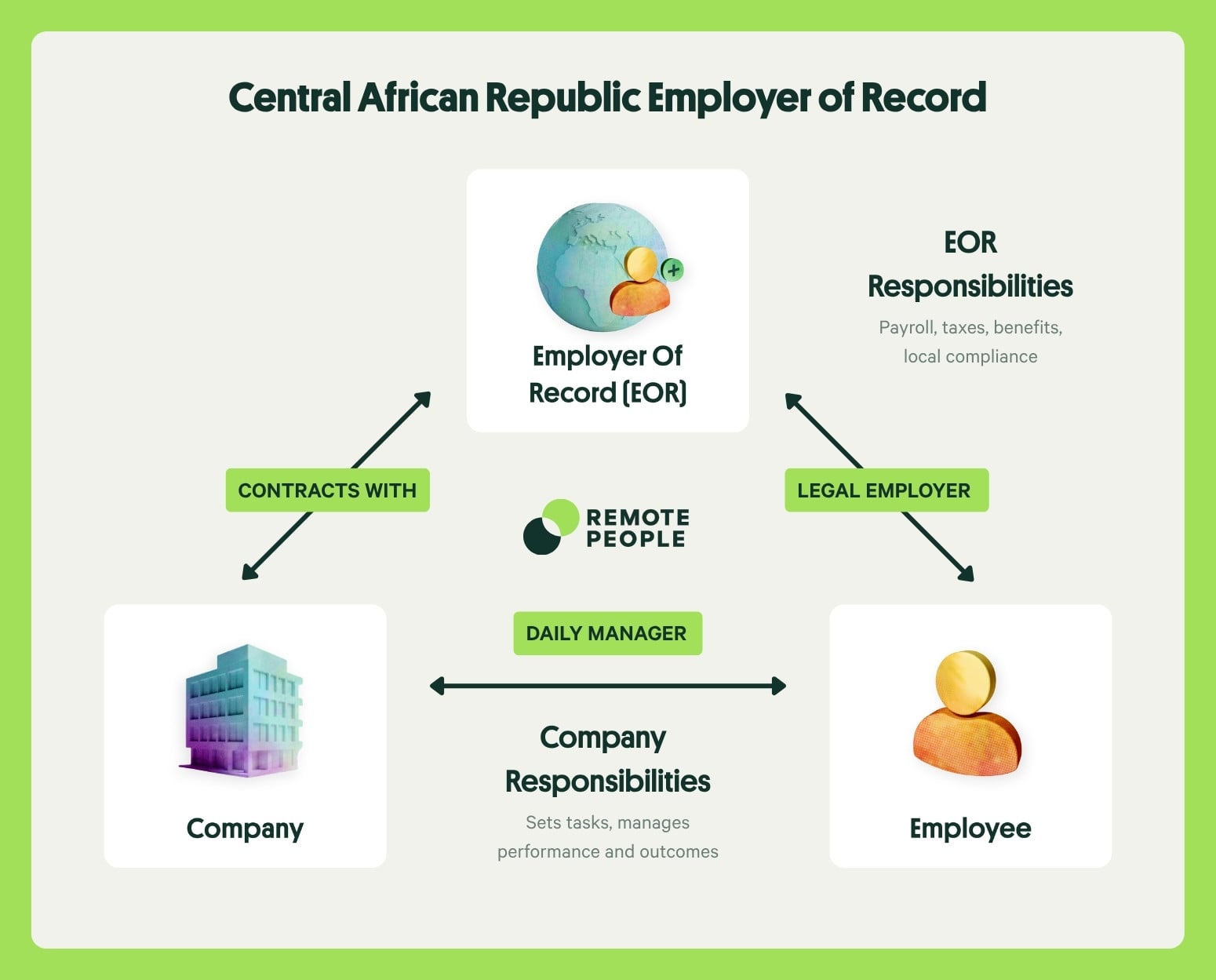
If you’d like to learn more about how Employer of Record (EOR) services work, read our What Is an Employer of Record (EOR)? guide for a complete overview of the model, its benefits, and when to use it.
If you’re comparing providers, our Best Employer of Record (EOR) Providers guide reviews the leading platforms to help you choose the right solution for your business.
Who Uses an EOR in Central African Republic?
Different types of organizations use EORs for different reasons. Here are the employers who benefit most:
- Multinational Corporations. Large international companies entering CAR without a local subsidiary can use an EOR to establish an immediate employment presence while headquarters focuses on strategic operations, avoiding the delay and expense of legal entity registration.
- Remote-First and Tech Companies. Startups and digital-native businesses hiring remote employees in CAR can leverage an EOR to manage payroll and compliance without building out local HR infrastructure or establishing permanent office space.
- NGOs and Development Organizations. Non-profit organizations operating in Central African Republic often use EOR services to hire local program staff while maintaining focus on mission delivery rather than employment administration.
- Consulting and Professional Services Firms. Firms placing consultants or project managers in CAR can use an EOR to handle all employment-related logistics, allowing their teams to concentrate on client deliverables and business development.
Typical Onboarding Timeline
Onboarding through an EOR in CAR typically takes 1–2 weeks and follows this step-by-step process:
- Initial Consultation and Needs Assessment (Days 1–2): You provide employee details, intended start date, salary, and role. The EOR confirms your hiring requirements and explains obligations under the Labour Code.
- Employee Documentation Collection (Days 3–5): The prospective employee submits required documents: valid passport, proof of residence, tax identification number, health insurance details, and vaccination records (including yellow fever certificate).
- Employment Contract Drafting and Review (Days 6–8): The EOR prepares an employment agreement compliant with CAR law, specifying probation duration, salary, benefits, and termination terms. Contract is reviewed and signed by both parties.
- Work Permit Application and Processing (Days 9–28): The EOR submits the work permit application to the relevant authority. Standard processing takes 4–6 weeks. For certain roles or nationalities, expedited processing may be available.
- CNSS Registration and Social Security Setup (Days 15–20): Simultaneously, the EOR registers the employee with CNSS, obtains a social security number, and establishes the contribution account.
- System Setup and First Payroll Preparation (Days 20–25): The EOR configures payroll systems, establishes bank account linkage for salary disbursement, and prepares the first payroll cycle.
- Employee Start Date and First Payment (Day 30+): Once the work permit is approved and all systems are active, the employee begins work. The first salary payment occurs on the agreed schedule (typically end of first month or on a fixed payroll date).
Hire in Central African Republic
A francophone CEMAC workforce, predictable 21% employer contributions, and the OHADA legal framework make the Central African Republic a manageable hire for companies expanding into Central Africa.
We handle French-language employment contracts, payroll, IRPP withholding, CNSS registration, and full Central African compliance.
No local entity needed. Your team can start in days.
Employment Laws and Regulations in Central African Republic
Employment Contracts
Employment contracts in CAR are governed by the Labour Code (Loi n° 09-004 du 29 janvier 2009) and form the legal foundation of any employment. Every employment arrangement; permanent or temporary; must be in a written contract signed by both parties. The contract should cover job title, duties, salary, probation length, hours, leave, and how to end the relationship. For foreign workers, it must also spell out visa and work permit status. The Labour Code treats different worker types differently: daily workers, salaried employees, supervisory staff, and managers each have their own probation periods, leave rules, and legal protections. Collective agreements for specific sectors can add extra protections and benefits on top of the legal minimums. Contracts must be in French or a language the employee understands, and both parties should keep a copy. An EOR ensures contracts meet current law and include the right provisions for taxes and social security.
Working Hours and Overtime
CAR’s Labour Code sets clear rules for hours, rest time, and overtime pay. The standard week is 40 hours; typically 8 hours a day, 5 days a week. Employees get at least 10 hours of rest between shifts and one full day off per week (usually Sunday). Overtime is paid at premium rates: hours 41–48 pay 125% of regular rate; hours beyond 48 pay 150%. Night work (10 PM–5 AM) pays 150%. Work on your rest day or a public holiday pays 150% or 200% respectively. These premiums protect worker wellbeing and ensure people are fairly compensated for the extra time.
Central African Republic overtime and premium pay rates · Per Loi n° 09-004 du 29 janvier 2009 |
||
Work Scenario |
Applicable Rate |
Premium / Notes |
|---|---|---|
Standard weekday hours (1–40 per week) |
100% of regular rate |
No premium |
Weekday overtime (41st–48th hour) |
125% of regular rate |
+25% premium |
Weekday overtime (beyond 48th hour) |
150% of regular rate |
+50% premium |
Night work (10 PM–5 AM) |
150% of regular rate |
+50% premium |
Work on weekly rest day |
150% of regular rate |
+50% premium |
Work on public holiday |
200% of regular rate |
+100% premium |
Night work on rest day or holiday |
200% of regular rate |
+100% premium |
Statutory Employee Benefits
Beyond leave, CAR law requires several statutory benefits. The main one is CNSS enrollment, which covers retirement, work injuries, and family allowances. You also need to provide or arrange health insurance, though the exact level may be in a collective agreement or your policy. Work injury insurance is mandatory and covers medical costs, rehabilitation, and pay replacement if someone is hurt on the job or gets an occupational illness. Family allowances (funded through your contributions) give extra income to workers with dependents. The Labour Code also requires you to maintain safe working conditions, allow reasonable rest, and ban child and forced labor. Provide protective equipment, follow health and safety standards. An EOR manages all these benefits correctly, gets your money to CNSS on time, and keeps you compliant with workplace rules.
Recent Regulatory Updates (2026)
As of 2026, CAR still operates under the 2009 Labour Code, with DGID and CNSS providing guidance on how rules are applied. The recent trend is toward digital compliance; electronic payroll reporting is now required, and you must file CNSS contributions online instead of on paper. Employers are expected to keep digital records. The labour ministry has discussed updating the minimum wage to match inflation, but any change needs a government decree. You should stay on top of announcements from DGID and CNSS about tax rates, social security ceilings, or new deadlines. An EOR tracks these changes automatically and keeps you informed.
Work Permits and Visas in Central African Republic
Work Permit Requirements
Who Needs a Work Permit
All foreign workers in CAR need a work permit before they start. This applies to everyone; whether they work for a local company, a multinational, or an EOR; across all sectors (private, public, nonprofits, even diplomatic). CAR citizens don’t need one. Some ECCAS members (the Central African regional group) may get breaks on permit requirements, but most foreign workers need the standard permit. Without one, you face fines, deportation, and loss of the job. An EOR handles the permit applications and paperwork for you, making sure everything’s in place before day one.
Eligibility and Required Documents
To get a work permit in CAR, you submit an application to the Ministry of Labour or immigration authority with supporting paperwork. You’ll need a passport valid for at least 6 months, a completed permit form, passport photos (2–4 copies), an employment contract or job offer, health insurance proof, a yellow fever vaccination certificate, health screening results, and an invitation letter from your employer explaining the job, how long it’s for, and why you need it. Some jobs or sectors need extra documents like professional credentials or trade licenses. Your home country might have reciprocal requirements or need to verify your visa eligibility through official channels. The immigration department in Bangui processes most applications, though some embassies abroad may also accept them.
Processing Time and Validity
Work permits typically take 4–6 weeks, depending on how complete your documentation is, whether you’re a specialist or general worker, and how busy the immigration office is. You can request faster processing in some cases, but expect to pay extra. Once approved, the permit is good for up to 1 year (and renewable) or for the length of your contract, whichever is shorter. It’s either stamped in your passport or issued as a separate document. It shows your employer, job title, and how long you can stay and work.
Renewal Process
Before a permit expires, you need to start the renewal process. Renewals follow the same steps as the initial application, but you might need fewer documents if nothing about the employee has changed. Submit renewal requests at least 30 days before expiration to avoid losing legal work authorization. An EOR tracks renewal deadlines and makes sure new permits are processed before the old ones expire, so there’s no gap in authorization.
Common Visa Types for Foreign Workers
CAR has several visa categories for visitors and workers. The type you get determines how long you can stay, whether you can work, and how to renew it. You need to know which category applies to you and make sure your visa matches your work permit.
Central African Republic work visa types for foreign workers · 2026 |
||||
Visa Type |
Maximum Validity |
Work Authorization |
Typical Purpose |
Notes |
|---|---|---|---|---|
Temporary Work Visa |
Up to 1 year (renewable) |
Yes, with valid work permit |
Employment contracts, temporary assignments |
Standard for most foreign workers; requires work permit |
Permanent Work Visa |
Long-term or permanent |
Yes, with valid work permit |
Long-term assignments, skilled professionals |
Harder to obtain; requires evidence of skills/experience |
Specialist/Expert Visa |
Up to 1 year (renewable) |
Yes, with valid work permit |
Technical experts, consultants, advisors |
Streamlined for high-skilled roles; requires credentials |
Business Visa |
Up to 3 months |
No, not for employment |
Business meetings, negotiations, training |
Does NOT permit employment; only for short-term visits |
Tourist Visa |
Up to 3 months |
No, not for employment |
Tourism, cultural exchange |
Does NOT permit employment; violation results in deportation |
You must have the right visa paired with a valid work permit. A tourist or business visa doesn’t allow work; if you work on either one, you face fines, deportation, and future entry bans. The Temporary Work Visa is most common for jobs and is valid for your contract length or up to 1 year, renewable. Specialist roles may qualify for the Specialist/Expert Visa, which can be faster. An EOR coordinates visa and permit applications together so you have full authorization on day one.
How an EOR Handles Work Permits
An EOR in CAR handles everything about work permits and visas for you and your employees; collecting documents, preparing applications, submitting them to immigration, tracking progress, and telling you when there’s news or if you need more paperwork. The EOR has relationships with immigration and labour ministry officials, so applications move smoothly and questions get answered fast. By taking on permits, the EOR saves you from learning the bureaucracy and cuts the risk of rejection from incomplete paperwork. The EOR also watches permit expiration dates and starts renewals ahead of time, so there’s no gap in legal authorization. You can focus on running your business knowing your employees’ legal status is solid.
Payroll, Taxes, and Social Security in Central African Republic
Employer Contributions
In CAR, you must contribute to several mandatory social security funds through CNSS (national social security). These are calculated as percentages of each employee’s gross salary and paid monthly. The total is 21% of gross salary, split across five programs: old-age pension (4%), work injury insurance (3%), family allowances (12%), the Manpower National Fund (1.1%), and Professional Training (0.9%). These are separate from income tax and add up to real cost. There’s a monthly cap of 600,000 XAF for old-age pension contributions; anything above that isn’t taxed for pensions; but other contributions may apply to the full salary. For example, an employee earning 800,000 XAF gets old-age contributions only on 600,000 XAF, but the other contributions still apply. An EOR calculates all this automatically and sends the money to CNSS by the 15th of the next month.
Central African Republic employer social security contributions · 2026 rates |
|||
Contribution Program |
Contribution Rate |
Monthly Ceiling |
Purpose |
|---|---|---|---|
Old-Age Pension (Retraite) |
4% |
600,000 XAF |
Retirement income for eligible employees |
Work Injury Insurance (AT) |
3% |
No ceiling |
Medical costs and income replacement for workplace injuries |
Family Allowances (Allocations Familiales) |
12% |
No ceiling |
Supplementary income to employees with dependents |
Manpower National Fund (FNM) |
1.1% |
No ceiling |
Employment and skills development |
Professional Training (Formation Professionnelle) |
0.9% |
No ceiling |
Worker training and skills advancement |
Total Employer Contribution |
21% |
Partial (old-age only) |
All-inclusive social security |
Employee Contributions
Employees also pay into social security; it’s withheld from their salary. The main employee payment is the old-age pension contribution at 3% of gross salary, up to the 600,000 XAF ceiling. An employee earning 800,000 XAF monthly gets 3% taken out on 600,000 XAF only (18,000 XAF), not the full amount. Salary above the ceiling isn’t taxed for pensions. The employer withholds these contributions and sends them to CNSS. Employees don’t pay for work injury, family allowances, or training; those are the employer’s responsibility. The employee contribution comes out before income tax is calculated, which lowers the tax bill. An EOR handles all the withholding and makes sure the net pay is right.
Central African Republic employee payroll deductions · 2026 monthly withholdings |
|||
Contribution Program |
Contribution Rate |
Monthly Ceiling |
Paid By |
|---|---|---|---|
Old-Age Pension (Retraite) |
3% |
600,000 XAF |
Employee |
Total Employee Contribution |
3% |
600,000 XAF |
Employee |
Work Injury, Family Allowances, FNM, Training |
– |
– |
Employer only |
Income Tax
CAR uses a progressive income tax called IRPP (administered by DGID). It’s calculated yearly on taxable income; gross salary minus social security contributions. You withhold tax monthly and send it to DGID, then reconcile at tax time. The tax year is the calendar year (January–December). Higher earners pay higher rates. Tax brackets are in annual amounts, so you have to multiply monthly salary by 12 before applying them. An employee making 100,000 XAF monthly (1,200,000 XAF yearly) pays no tax on the first 378,000 XAF, then 8% on the next portion, and so on. An EOR calculates the right monthly withholding so the total is correct by year end; no under– or over–withholding.
Central African Republic income tax brackets · 2026 |
|||
Annual Taxable Income Range (XAF) |
Tax Rate |
Tax on This Bracket |
Cumulative Tax Example |
|---|---|---|---|
0 – 378,000 |
0% |
Tax-free threshold |
0 XAF |
378,001 – 1,680,000 |
8% |
Up to 104,160 XAF on this bracket |
104,160 XAF at 1,680,000 income |
1,680,001 – 3,360,000 |
15% |
Up to 252,000 XAF on this bracket |
356,160 XAF at 3,360,000 income |
3,360,001 – 5,040,000 |
28% |
Up to 470,400 XAF on this bracket |
826,560 XAF at 5,040,000 income |
5,040,001+ |
40% |
40% on amount exceeding 5,040,000 |
Continues at 40% thereafter |
Payroll Cycle
Payroll in CAR is monthly, usually paid on a fixed date like month-end, the 25th, or 30th. The date goes in your contract and you use it consistently. Most employers use bank transfers, though cash and other agreed methods work too. You must pay in XAF (Central African CFA franc). Hourly or piece-rate workers might get paid biweekly or per project. Records must show gross salary, social security contributions (both sides), tax withholding, any allowances or deductions, and net pay. Keep records for three years and make them available to DGID and CNSS. An EOR keeps digital records, pays on time, and files all required paperwork with the authorities on schedule.
13th Month Salary and Bonus Pay
CAR doesn’t require a 13th month bonus by law. Unlike some countries, the Labour Code doesn’t mandate extra pay in December. But you can offer a 13th month bonus, profit sharing, or performance bonuses if you want. If you do, spell it out clearly in the contract or policy and apply it consistently. If you promise a bonus in writing, it’s binding; you must pay it. Some sectors may have bonus rules in collective agreements. An EOR tracks bonus commitments and makes sure they’re paid on time with accurate records.
Cost of Hiring Through an EOR in Central African Republic
An EOR in CAR means you skip setting up a company, registering with social security, and building payroll systems in-house. That convenience comes with a service fee you need to factor in. Knowing your full cost; salary, employer contributions, and the EOR fee; helps you make smart hiring choices and budget accurately.
EOR Service Fees
EOR fees in CAR range from $300–$600 per employee monthly, depending on the provider, service quality, and volume discounts. The lower end ($300–$400) covers basic payroll and standard compliance. The higher end ($500–$600) adds extras like a dedicated account manager, fast onboarding, deep HR advice, or complex pay structures. Many providers use tiered pricing; fees drop as your headcount grows. For example, you might pay $500 per employee for 1–5 hires but $400 per employee for 6–15. The fee usually covers payroll, tax filing, social security, benefits, compliance, and basic HR support. Legal advice, training programs, or unusual severance situations cost extra.
Total Employment Cost Breakdown
Your total monthly cost is the salary plus employer contributions (21% of salary) plus the EOR fee. Take a $2,500 USD salary: employer contributions are $525 (21% of $2,500), plus a typical $400 EOR fee, and you’re at $3,425 USD total. That’s 137% of the base salary; a big jump that reflects the mandatory social security and the cost of using an EOR.
Central African Republic employer cost example · USD 2,500 gross · 2026 |
||||
Employer Cost |
Amount (USD) |
% of Gross |
XAF Equiv. |
Notes |
|---|---|---|---|---|
Gross Salary |
$2,500.00 |
100% |
1,500,000 |
Base monthly compensation |
CNSS Old-Age Pension (Retraite) |
$100.00 |
4% |
60,000 |
Employer contribution |
CNSS Work Injury (AT) |
$75.00 |
3% |
45,000 |
Employer contribution |
CNSS Family Allowances (AF) |
$300.00 |
12% |
180,000 |
Employer contribution |
Manpower Development Fund (FNM) |
$27.50 |
1.1% |
16,500 |
Employer contribution |
Professional Training Fund (FPC) |
$22.50 |
0.9% |
13,500 |
Employer contribution |
EOR Service Fee |
$400.00 |
16% |
240,000 |
Monthly administration & compliance |
Total Monthly Cost |
$3,425.00 |
137% |
2,055,000 |
Full employer burden |
Source: SSA.gov – Central African Republic Social Security and RemotePeople – Payroll Tax Guide. Figures converted at 1 USD ≈ 600 XAF, April 2026. |
||||
Central African Republic statutory leave entitlements · Per Loi n° 09-004 du 29 janvier 2009
So an employee at $30,000 USD yearly ($2,500 monthly) costs you $41,100 USD per year with contributions and EOR fees included. Hire more people and volume discounts kick in, but the 21% contribution rate stays fixed by law. Income tax withholding is separate; it comes out of the employee’s pay, not an extra employer cost, but it does reduce what they take home.
Benefits of Using an EOR in Central African Republic
Using an EOR gives you real operational, financial, and compliance wins when entering or expanding in CAR. Instead of figuring out how to set up a subsidiary, register with multiple agencies, and build payroll systems, an EOR gets you into the market fast with less risk and lower costs. Here’s why multinationals and remote-first companies use EORs in CAR.
- Rapid deployment and market entry: An EOR can onboard your first employee within 1–2 weeks, compared to 3–6 months required to establish your own legal entity. This speed is critical for time-sensitive projects, responding to client needs, or testing market viability without long-term capital commitment.
- Full compliance responsibility: The EOR assumes all statutory obligations including payroll tax filing with DGID, social security registration and contribution remittance to CNSS, employment law compliance under the Labour Code, and maintenance of required payroll records. Your organization is insulated from regulatory penalties and audits that can arise from missed filings or incorrect withholding.
- Predictable and transparent costs: Unlike building an internal HR and payroll team (which requires recruitment, training, software licenses, and ongoing management), EOR costs are fixed and per-employee. You can forecast headcount costs with precision and avoid unexpected administrative expenses. No hidden compliance costs or surprise tax adjustments.
- Local expertise and regulatory knowledge: EOR providers in Central African Republic employ compliance specialists, tax accountants, and HR professionals who stay current with labour law changes, tax code updates, and administrative requirements. This expertise prevents costly misclassifications, missed deductions, and non-compliance risks that would otherwise fall on your organization.
- Flexibility and scalability: You can hire one remote worker or build a team of 50 without establishing a permanent legal structure. Employees can be added or removed without complex administrative wind-down, and the EOR adjusts service scope based on your team size. This is especially valuable for project-based teams or rapidly evolving operations.
- Risk mitigation and liability protection: The EOR is the legal employer and assumes responsibility for employment disputes, wrongful termination claims, and labour law violations. While you retain control over work assignments and performance management, the EOR’s status as legal employer shields your organization from many employment-related liabilities.
- Improved employee experience and retention: EOR platforms typically offer professional payroll administration, timely salary payments, clear benefit statements, and structured leave management. Employees receive transparent documentation of their compensation and contributions, fostering trust and professionalism compared to informal or inconsistent payment arrangements.
Termination and Offboarding in Central African Republic
CAR law sets rules for ending employment; notice periods and when severance is due. You need to understand these because if you skip notice or severance obligations, you can face lawsuits and bills. An EOR handles the procedures and paperwork, but you should know the legal rules.
Notice Periods
The Labour Code sets notice periods for terminations by either side. How long depends on how long the employee has been with you and their job level. During notice, the employment stays active; the person still gets paid, benefits, and legal protections. You can’t cut the notice period on your own, but both sides can agree in writing to skip it. Notice is counted in calendar days and must be in writing.
Central African Republic statutory notice periods by position level · Per Loi n° 09-004 du 29 janvier 2009 |
|||
Position Level / Duration |
Notice Period |
During Probation |
Notes |
|---|---|---|---|
Less than 6 months service |
8 days |
None |
Shortest notice period; applies to new hires |
6 months – 1 year service |
1 month |
None |
Transitions to longer notice once probation complete |
More than 1 year service |
3 months |
N/A |
Standard notice for established employees |
Managerial / Supervisory roles |
3 months |
None |
Minimum for management-level positions regardless of tenure |
Notice starts the day you hand it over and ends on the last work day. During notice, the employee can take paid leave or keep working depending on what you need. You and the employee can agree to cut or drop the notice if you both sign off. Employees must give notice too when they quit; if they don’t, you can claim damages for the sudden exit. An EOR tracks notice math, ensures you hit legal minimums, and keeps records of notice dates.
Severance Pay
CAR doesn’t require severance pay across the board. The Labour Code doesn’t have a standard severance formula based on years of work. But severance is due in two cases: first, if the contract or a collective agreement says so, and second, if a court finds you terminated someone without good reason. In unjustified terminations, courts can order you to pay severance as compensation, though the amount isn’t set; it depends on the situation.
Central African Republic severance pay schedule by years of service · Per Loi n° 09-004 du 29 janvier 2009 |
|||
Years of Service |
Statutory Severance |
Contractual / Negotiated |
Notes |
|---|---|---|---|
1 year |
No statutory requirement |
Per contract terms (if agreed) |
Only due if contract specifies |
3 years |
No statutory requirement |
Per contract terms (if agreed) |
Court-ordered if termination unjustified |
5 years |
No statutory requirement |
Per contract terms (if agreed) |
Court-ordered if termination unjustified |
10 years |
No statutory requirement |
Per contract terms (if agreed) |
Court-ordered if termination unjustified |
Calculation Method
With no set formula, you usually negotiate severance during contract drafting or follow industry norms for your sector. Common options are salary multiples (e.g., 1–3 months per year of service), a one-time lump sum, or a combo. You might agree to one week of pay per year (as a floor) with more for senior roles. Once you negotiate it, spell it out clearly in the contract and apply it the same way to everyone in that job class. An EOR calculates and pays severance according to your agreement when someone leaves.
Caps and Exceptions
CAR has no severance cap; you can negotiate any amount. In practice, though, it’s limited by what your contract says or what a court thinks is fair if termination is ruled unjustified. Gross misconduct, insubordination, theft, and similar just-cause firing don’t trigger severance. Employees who resign don’t get severance unless the contract says they do. An EOR ensures you pay full severance according to your contract and keeps the math right.
Grounds for Termination
Terminations under CAR law fall into two types: for-cause (misconduct, poor performance, business closure) or without cause (with notice and possible severance). For-cause includes serious misconduct like theft, violence, refusal to follow orders, safety violations, or recklessness that puts others at risk. For-cause firings don’t need notice or severance. Terminations without cause require you to give statutory notice and may trigger severance if your contract says so. If a court rules that a termination was unjustified, it can order you to rehire the person, pay back lost wages, or pay severance as damages. An EOR documents why you’re firing someone, makes sure you follow notice rules, and handles the administrative wind-down.
EOR vs. Other Hiring Models in Central African Republic
When entering CAR, you have choices beyond an EOR. You can set up your own company, hire independent contractors, or work with a PEO (Professional Employer Organization). Each has pros and cons. Knowing your options helps you pick the best structure for your needs.
EOR vs. Setting Up a Local Entity
Setting up your own subsidiary or branch in CAR gives you full control but costs a lot upfront, involves legal work, and requires ongoing management. Here’s how an EOR compares to owning your own entity.
Central African Republic EOR vs local entity comparison · Setup time, cost, risk and best-fit |
||
Factor |
Employer of Record |
Own Entity |
|---|---|---|
Setup time |
1–2 weeks |
3–6 months |
Upfront cost |
$0 |
$5,000–$15,000 |
Ongoing cost |
$300–$600/employee/month |
$8,000–$15,000/year maintenance |
Local partner required |
No (EOR is the local entity) |
Yes |
Social insurance registration |
Handled by EOR |
You manage it |
Payroll & tax filing |
Handled by EOR |
You manage it (or outsource) |
Best for team size |
1–15 employees |
15+ employees |
Scale down / exit |
Easy – no entity to unwind |
Costly – legal dissolution required |
Government contracts |
Not eligible |
Eligible (requires local entity) |
Source: World Bank – Central African Republic Business Environment and RemotePeople – Employer of Record Solutions |
||
Your choice depends on team size, timing, and how committed you are to CAR. For 1–15 remote hires in CAR, an EOR gets you compliant fast without the overhead of owning an entity. If you’re planning 20+ employees, a physical office, dealings with local government, or government bids, your own entity may make more sense long-term, despite higher upfront costs. You hit break-even around 15 employees, where per-employee EOR costs ($400–$600/month) start to match the per-person cost of keeping a company running ($8,000–$15,000/year ÷ employees). An EOR also gives flexibility; grow or shrink without the costs of shutting down an entity. That’s why pilots and market tests work well with EORs.
EOR vs. Hiring Independent Contractors
Another option is hiring workers as independent contractors; they invoice you instead of getting a salary. Contractors look cheaper and more flexible, but misclassifying someone as a contractor when they’re really an employee carries big legal risk in CAR. Plus, you get less control, stability, and IP rights than with employees.
Central African Republic EOR vs independent contractors · Compliance, cost, and risk |
||
Factor |
EOR (Full-Time Employee) |
Independent Contractor |
|---|---|---|
Legal relationship |
Employee of the EOR |
Self-employed, no employment relationship |
Compliance risk |
Low – EOR ensures local labour law compliance |
High – misclassification risk if relationship resembles employment |
Payroll & tax |
EOR handles withholding, contributions, filings |
Contractor invoices you; they handle their own taxes |
Benefits & leave |
Statutory benefits, paid leave, social security |
No entitlement to employee benefits |
IP protection |
Stronger – employment contract assigns IP by default |
Weaker – requires explicit IP assignment clause |
Termination |
Subject to local notice periods and severance |
Contract can be ended per agreement terms |
Best for |
Long-term, core team roles |
Short-term projects, specialized tasks |
Cost structure |
Salary + employer contributions + EOR fee |
Contractor fee (typically higher gross, lower total cost) |
Source: WIPO Lex – Loi n° 09-004 du 29 janvier 2009 and RemotePeople – Central African Republic Hiring Guide |
||
Contractors look cheap; no employer contributions, no benefits, you pay per invoice. But CAR labour authorities look hard at contractor deals. If the setup looks like employment (fixed schedule, you control how they work, they only work for you, ongoing), courts can reclassify them as an employee retroactively. Then you owe back contributions, severance, and penalties. Plus, contractors give you less control and don’t commit like employees do. They’re not right for core team, secret work, or jobs that need training. For long-term core team members, an EOR structure is safer, protects your IP better, and cuts misclassification risk.
EOR vs. PEO
A PEO (Professional Employer Organization) is different from an EOR in one key way: a PEO works with companies that already own a legal entity in the country. The PEO doesn’t become the legal employer; instead, you share employer duties; you keep a lot of the employer role and the PEO handles HR. This suits companies already operating there who want to outsource HR. An EOR is for companies without a local entity.
Central African Republic EOR vs PEO comparison · Legal employer, liability, and setup |
||
Factor |
Employer of Record (EOR) |
PEO |
|---|---|---|
Legal employer |
EOR is the legal employer |
You remain the legal employer (co-employment) |
Local entity required |
No – the EOR is the local entity |
Yes – you must have your own entity in Central African Republic |
Best for |
Companies without a local entity |
Companies that already have a local entity |
Compliance liability |
EOR assumes compliance responsibility |
Shared liability between you and the PEO |
Setup time |
1–2 weeks |
Depends on your entity setup (weeks to months) |
Control over HR policies |
EOR manages within local law framework |
More direct control, PEO advises |
Typical use case |
Market entry, small remote teams, testing new markets |
Established local operations needing HR outsourcing |
CAR doesn’t have a mature PEO system like you’d find in bigger markets. PEOs in Africa focus mostly on larger economies with established HR outsourcing. If you already operate in CAR through a subsidiary or branch, you could negotiate co-employment or payroll outsourcing with a local HR firm. If you’re new to CAR, an EOR is simpler, faster, and cheaper.
Public Holidays in Central African Republic
CAR has 12 public holidays yearly. Most businesses shut down and employees get paid leave. If you need someone to work on a holiday, you usually pay extra (double pay or time off instead); though the Labour Code doesn’t mandate a specific multiple. You need to account for holidays when you schedule work, do payroll, and plan projects. Workers on holidays get extra pay based on contracts or collective agreements.
Central African Republic public holidays · 2026 calendar year |
||
Date |
Holiday Name |
Type |
|---|---|---|
January 1 |
New Year’s Day |
National |
March 29 |
Boganda Day |
National |
April 6 |
Easter Monday |
Religious |
May 1 |
Labour Day |
International |
May 14 |
Ascension Day |
Religious |
May 25 |
Whit Monday |
Religious |
June 30 |
General Prayer Day |
National |
August 13 |
Independence Day |
National |
August 15 |
Assumption Day |
Religious |
November 1 |
All Saints’ Day |
Religious |
December 1 |
Republic Day |
National |
December 25 |
Christmas Day |
Religious |
The mix of national, religious, and international holidays reflects CAR’s culture and history. The multiple religious holidays show the large Christian population. National holidays mark key moments in the country’s past. EOR providers track holidays automatically so your employees don’t lose pay. When someone works a holiday (voluntary or required), you must pay them extra; usually 50–100% more; per the contract or collective agreement.
How to Get Started with an EOR in Central African Republic
Hiring your first employee through an EOR in CAR is straightforward. It’s a five-step process that takes 1–2 weeks from your first call to the first paycheck; much faster than any other hiring model.
- First, select an EOR provider. Research EOR platforms with established operations in Central African Republic, verified compliance expertise, and transparent pricing. Confirm they handle all statutory obligations including CNSS registration, DGID tax filing, and payroll processing. Request references from other organizations and review service-level agreements carefully.
- Second, prepare employment documentation. Work with the EOR to draft an employment contract in French (or local language if applicable) that complies with Central African Republic Labour Code. Include salary, position, benefits, termination clauses, confidentiality provisions, and any bonus or severance arrangements. The EOR will guide compliance and suggest standard provisions.
- Third, submit employee information and onboarding. Provide the EOR with candidate details including full legal name, passport/ID number, date of birth, address, banking information for salary transfer, and tax identification if available. The EOR registers the employee with CNSS, obtains a social security number, and initiates DGID tax withholding setup.
- Fourth, review and execute contracts. Obtain the candidate’s signature on the employment contract and ensure both parties retain copies. The EOR files the signed contract with relevant authorities. Confirm that the candidate has received a copy and understands all terms, especially notice periods and termination conditions.
- Fifth, activate payroll and benefits. Coordinate the start date with the EOR. Confirm that salary payments, deductions, and contributions are configured correctly in their payroll system. Arrange any company equipment, access credentials, or onboarding materials needed for day one. The EOR will disburse first salary on the agreed payroll cycle.
After your first hire, additional employees move faster; usually 3–5 business days each because the paperwork and processes are already set up. To get started, contact your EOR through their website or reach out to RemotePeople’s CAR team at https://remotepeople.com/contact/ to talk through your hiring needs and budget.
Where companies hiring in the Central African Republic expand next
Teams operating in the Central African Republic typically extend into neighboring Central African markets with overlapping regulatory and linguistic frameworks. Many companies add an EOR partner in the Republic of the Congo first, drawing on overlapping Central African regulatory frameworks. Cameroon follows as aligned Central African labor norms, while a team in Gabon offers shared Central African workforce dynamics. Operations in the Democratic Republic of the Congo is often the fourth step, valued for the regional Central African talent pool.
Frequently Asked Questions
Total monthly cost per employee includes the gross salary, mandatory employer contributions (21% of gross), and the EOR service fee ($300–$600). For example, a $2,500 USD monthly salary results in approximately $3,425 USD total monthly cost. The EOR fee component typically ranges from 16–24% of gross salary depending on provider and team size.
The entire onboarding process takes 1–2 weeks from initial contact to first salary payment. This includes contract drafting, CNSS registration, DGID tax setup, and payroll configuration. This speed is one of the primary advantages of an EOR compared to establishing your own legal entity, which takes 3–6 months.
Yes, the EOR assumes primary responsibility for compliance with the Labour Code, including statutory notice periods, severance obligations (where applicable), leave entitlements, and termination procedures. The EOR is the legal employer and assumes corresponding liability for compliance violations. Your organization retains responsibility for day-to-day management and performance evaluation.
While contractor arrangements are possible, they carry significant misclassification risk in Central African Republic. If labour authorities determine that a contractor relationship exhibits employment characteristics (regular schedule, direction and control, exclusivity), you may face retroactive claims for unpaid contributions, severance, and penalties. Contractors are best reserved for short-term, specialized projects rather than ongoing core team functions.
Termination requires compliance with statutory notice periods (8 days to 3 months depending on tenure) and may trigger severance if specified in the contract or if a court finds the termination unjustified. The EOR manages all procedural requirements, tracks notice periods, calculates severance if due, and handles offboarding. Just cause terminations (gross misconduct) do not require notice or severance.
Yes, non-Central African Republic nationals typically require work permits issued by the Ministry of Labor. The EOR can provide guidance on work permit requirements and timelines, though the sponsorship process ultimately involves government agencies. Work permit requirements may vary based on nationality, role, and bilateral agreements between your home country and Central African Republic. Consult with the EOR regarding specific permit needs early in the hiring process.
Employees are entitled to statutory social security benefits (old-age pension, work injury coverage, family allowances), paid annual leave (minimum 21 days), paid public holidays, maternity/paternity leave, and statutory health and safety protections. Organizations may offer additional voluntary benefits (health insurance, transportation allowances, training) to attract and retain talent. The EOR ensures all statutory benefits are provided and contributions are remitted correctly.
Technically, an EOR can hire employees even if your organization has a local entity, as the EOR becomes the legal employer. However, if you have already established your own legal entity, you may find that using the entity directly (with payroll outsourcing if needed) or engaging a PEO (if available) is more efficient. Discuss your specific situation with EOR providers to determine the best structure for your organizational goals.
Employer of Record in
Employer of Record in
Democratic Republic of the Congo
Employer of Record in
Employer of Record in
Employer of Record in
Employer of Record in
Employer of Record in
Employer of Record in