
 Recruit
Employer of Record (EOR) in Gabon
-
 Drew Donnelly
- Published
- September 21, 2026
RemotePeople’s employer of record in Gabon lets you hire employees in Gabon through the CNSS system. We handle CNSS social security registration, mandatory pension contributions, and family benefits enrollment.
Hire in Gabon — book a free 30-minute demo
Tell us what you need. You'll get a tailored, transparent proposal within 24 hours, plus a free call to walk through it.
Tell us about your company
So we can match you with a specialist who knows your market — and unlock volume pricing tiers.
* All fields are required.
Where and when are you hiring?
Tell us the geography and timing and we'll quote each country line by line, with onboarding timelines.
* All fields are required.
Help us beat your current setup
We'll benchmark your current deal and send a line-by-line proposal in 24 hours — showing exactly where we cut cost, time, or risk. After you submit, you can book a call to walk through it together.
* All fields are required.
Thanks! Your proposal is on its way.
Expect a tailored, line-by-line proposal in your inbox within 24 hours. In the meantime…
Want to walk through it together?
Book a free 30-minute call with one of our specialists. We'll explain every line, answer your questions, and tailor the proposal further if you need.
No obligation. Pick a time that works for you.








- Hire in Gabon — book a free 30-minute demo
- Tell us about your company
- Where and when are you hiring?
- Help us beat your current setup
- Thanks! Your proposal is on its way.
- How an Employer of Record Works in Gabon
- Employment Laws and Regulations in Gabon
- Work Permits and Visas in Gabon
- Payroll, Taxes, and Social Security in Gabon
- Cost of Hiring Through an EOR in Gabon
- Benefits of Using an EOR in Gabon
- Termination and Offboarding in Gabon
- EOR vs. Other Hiring Models in Gabon
- Public Holidays in Gabon
- How to Get Started with an EOR in Gabon
- Where companies hiring in Gabon expand next
- Frequently Asked Questions
- Related EOR Destinations

Start hiring in Gabon
Let RemotePeople handle payroll, compliance, and HR admin worldwide so you can focus on building your team.

Imagine you’ve identified top talent in Gabon for your growing company, but the prospect of establishing a legal entity, working through complex labour regulations, and managing CNSS pension contributions seems overwhelming. An employer of record in Gabon solves this problem entirely. Gabon’s economy, buoyed by oil revenues and a growing services sector, offers significant hiring opportunities for companies targeting Central African markets.
The country’s young, educated workforce is increasingly sought after by international organisations. However, Gabon’s Labour Code presents genuine compliance challenges: mandatory social security registration through the CNSS (Caisse Nationale de Sécurité Sociale), health insurance via CNAMGS (Caisse Nationale d’Assurance Maladie et de Garantie Sociale), work permit sponsorship requirements, and strict employment contract standards all demand careful handling. By partnering with an employer of record in Gabon, you can access this talent pool immediately, remain fully compliant with Gabon’s employment laws, and scale your team without the overhead of entity establishment.
How an Employer of Record Works in Gabon
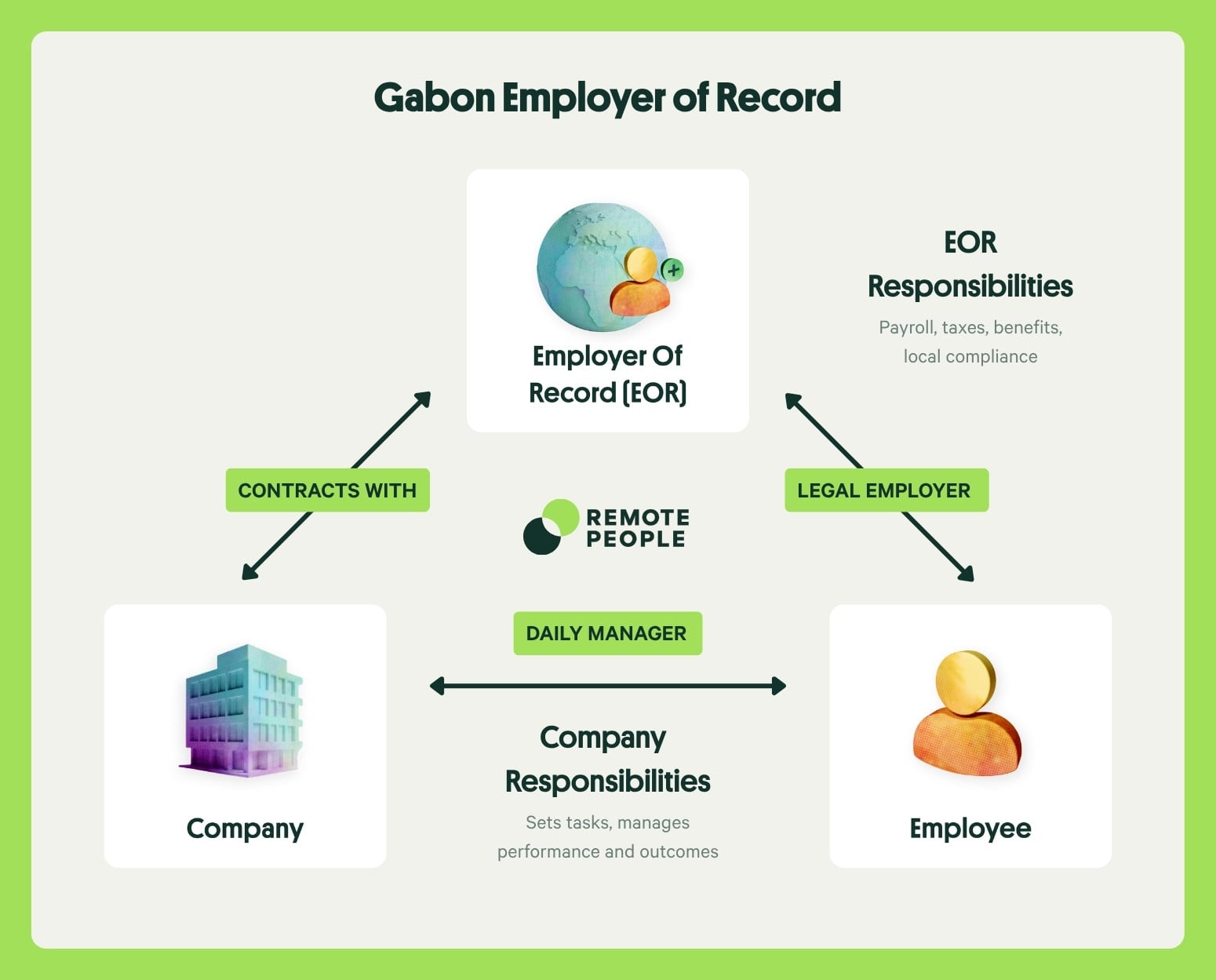
If you’d like to learn more about how Employer of Record (EOR) services work, read our What Is an Employer of Record (EOR)? guide for a complete overview of the model, its benefits, and when to use it.
If you’re comparing providers, our Best Employer of Record (EOR) Providers guide reviews the leading platforms to help you choose the right solution for your business.
Who Uses an EOR in Gabon?
Various scenarios make an employer of record in Gabon the optimal choice for hiring:
Companies use an EOR in Gabon for several reasons. Some are testing the market before committing to a full legal entity, hiring one or two employees to validate demand before scaling. Others are building remote teams across multiple countries and need a single provider to handle compliance in each jurisdiction.
Startups and SMEs use an EOR to avoid the cost and complexity of entity registration, while larger enterprises use it for speed when they need to onboard talent quickly for a project or contract. Companies sponsoring foreign nationals also rely on an EOR to navigate work permit requirements and immigration compliance.
Typical Onboarding Timeline
The EOR onboarding process in Gabon follows these milestones:
The onboarding timeline is fast. In the first week, the EOR drafts the employment contract, collects employee documentation, and initiates registration with CNSS and CNAMGS. By the second week, contract signing is complete, social security registration is confirmed, and the employee can begin work.
Payroll setup and first salary processing typically occur within the first month. If a work permit is required for a foreign national, the permit application runs in parallel and may take 3–5 months for final approval, though the employee can often begin work under a provisional arrangement while the permit is processed.
Hire in Gabon
Low employer social contributions (20.1% total), a young, French-speaking workforce, growing services sector, and strategic position as a Central African hub make Gabon an attractive market for international hiring.
We handle employment contracts, payroll, tax withholding, and full Gabon compliance.
No local entity needed. Your team can start in days.
Employment Laws and Regulations in Gabon
Employment Contracts
Employment in Gabon is governed by the Labour Code (Loi n° 022/2021 du 19 novembre 2021), supervised by the Ministry of Labour and Employment (Ministère du Travail et de l’Emploi). A written employment contract is mandatory for all employees and must specify job title, compensation, duration, probation terms, and notice periods. Contracts exist in two forms: fixed-term contracts (CDDs) set for a defined period (renewable but limited to 24 months cumulatively for the same role) and indefinite-term contracts (CDIs) with no expiry date.
All contracts must be drafted in French, the official language of employment documentation in Gabon. The contract forms the legal foundation for the employment relationship and is enforceable by labour tribunals. An EOR ensures contracts reflect current Labour Code provisions and sectoral collective agreements applicable to the industry.
Working Hours and Overtime
The standard working week in Gabon is 40 hours across five days, with an eight-hour daily limit. Articles 195 and 196 of the Labour Code define these maximums.
Employees are entitled to 24 consecutive hours of rest per week, typically on Sunday, which cannot be reduced except by collective agreement. Night work, defined as labour between 21:00 and 06:00, is permitted but regulated; employees in night roles are entitled to a 20% wage premium and must not exceed eight consecutive hours.
Overtime beyond the standard 40 hours is compensated at premium rates and capped at 20 hours per week. Hours beyond 60 per week are prohibited except in cases of force majeure.
Work during public holidays is compensated at 200% of the regular rate, with compensatory rest required. The following table outlines overtime and premium pay:
Gabon overtime and premium pay rates · Per Labour Code (Loi n° 022/2021) | |||
Hour Type | Rate Multiplier | Weekly/Daily Cap | Legal Reference |
|---|---|---|---|
Standard overtime (41st–48th hour) | 125% of regular hourly rate | 20 hours per week maximum | Articles 195–196 |
Extended overtime (49th–60th hour) | 150% of regular hourly rate | Per collective agreement | Articles 195–196 |
Night work (21:00–06:00) | Set by collective agreement; minimum 20% | 8 consecutive hours maximum | Articles 202–204 |
Public holiday work | 200% of regular rate | Compensatory rest required | Decree 727/PR/MTEFP |
Weekly rest day work (typically Sunday) | 150% of regular rate | Compensatory rest mandatory | Article 220 |
Source: WIPO Lex Labour Code and WageIndicator Gabon Overtime | |||
Management employees and certain supervisory roles may be exempt from strict hour limits under collective agreements, but overtime compensation still applies. Exemptions must be explicitly stated in the employment contract and are narrowly construed. An EOR tracks all hours worked and ensures compensation complies with these minimums, preventing underpayment claims and labour inspectorate penalties.
Minimum Wage
Gabon’s national minimum wage (SMIG – Salaire Minimum Interprofessionnel Garanti) is set at XAF 150,000 per month. This figure has remained unchanged since 2010, despite inflation and cost-of-living increases. The SMIG applies to all sectors and job categories unless a higher wage is mandated by a sectoral collective agreement.
For domestic workers and agricultural labourers, different minimums may apply. An employer of record in Gabon ensures all salaries meet or exceed the SMIG and adjusts compensation when employees transition between sectors with higher minimums. For current minimum wage details and sectoral variations, refer to RemotePeople’s Gabon minimum wage page.
Probation Period
The Labour Code permits probation periods of varying lengths based on job classification. For management-level positions, probation is up to six months.
For technicians, supervisors, and skilled workers, probation is three months. For other employees, probation is one month.
Probation terms must be specified in the employment contract in writing. During probation, either party may terminate the employment relationship with reduced notice (typically one week) or no notice, depending on the contract.
At probation’s conclusion, the employee transitions to permanent status automatically unless explicitly terminated. An EOR uses probation strategically to assess employee performance and ensure cultural fit before committing to indefinite employment. For detailed probation rules by job category, see Gabon probation period guidelines.
Leave Entitlements
Gabon’s Labour Code mandates generous leave provisions across multiple categories, all of which an employer of record must administer accurately. Leave balances accrue and are tracked throughout the employment term.
Failure to provide statutory leave or proper payment during leave can result in labour tribunal claims, penalties, and enforcement orders. The following subsections detail each leave category.
Annual Leave
Employees are entitled to a minimum of 24 working days of annual leave per year. Annual leave accrues month-by-month and may accumulate if not taken, though employers may require leave to be taken within the year or following year depending on operational needs. Seniority bonuses apply: employees with 5–10 years of tenure receive an additional 2 days, and those with over 10 years receive an additional 3 days.
During annual leave, the employee is paid at their regular rate. If employment terminates before all leave is exhausted, outstanding leave balances are paid out at full salary value. Leave must be scheduled with reasonable notice, and employers may not deny leave requests except during critical operational periods defined by collective agreement.
Sick Leave
Employees may take paid sick leave for up to six months without losing their job. For the first three days, the employee receives no pay but may not be discharged. From day four onward, the CNSS (Caisse Nationale de Sécurité Sociale) provides 50% of the employee’s salary, with the employer covering the remaining 50% unless the collective agreement provides otherwise.
Sick leave requires medical documentation; employers may request an independent medical exam if absence extends beyond 14 consecutive days. CNSS provides the payment once a claim is approved and processed.
Maternity Leave
Female employees are entitled to 14 weeks of maternity leave: six weeks before the expected delivery date and eight weeks after. Maternity leave is paid at 100% of salary by the CNSS, not by the employer. The employee must notify the employer at least 30 days before the expected delivery date, providing a medical certificate.
Upon return from maternity leave, the employee is restored to her original position or an equivalent role with no loss of seniority or benefits. Pregnancy-related dismissals are prohibited under Gabon law.
Paternity Leave
Male employees are entitled to 10 days of paid paternity leave upon the birth of a child. Paternity leave is paid at 100% of salary by the employer and must be taken within a specified window around the birth date. Paternity leave is considered part of annual leave in some collective agreements and separate in others; the specific collective agreement applicable to the sector determines the treatment.
Other Statutory Leave
Employees may take up to 10 working days per year for family events, including marriage (three days), the birth of a child (two days), death of a spouse or child (three days), and death of a parent, sibling, or grandparent (one day). These days are paid at the regular rate and require appropriate documentation. Jury duty and military service are also grounds for leave, with provisions varying by the specific circumstance.
Gabon statutory leave entitlements · Per Labour Code (Loi n° 022/2021) | ||
Leave Type | Duration | Eligibility and Notes |
|---|---|---|
Annual leave | 24 working days per year | Accrues monthly. Seniority bonus: +2 days (5–10 years), +3 days (10+ years). Unused leave paid on termination. |
Sick leave | Up to 6 months | First 3 days unpaid. Days 4+: 50% paid by CNSS, 50% by employer (unless collective agreement higher). Medical certificate required. |
Maternity leave | 14 weeks (6 pre-natal, 8 post-natal) | 100% paid by CNSS. Employee must notify employer 30 days in advance. Medical certificate required. Dismissal during pregnancy prohibited. |
Paternity leave | 10 working days | 100% paid by employer. Taken around birth date. Timing must comply with collective agreement. |
Marriage leave | 3 working days | 100% paid. Marriage certificate required. Applies to employee or spouse. |
Death/bereavement leave | 1–3 working days | 100% paid. Duration varies by relationship: spouse/child 3 days, parent/sibling/grandparent 1 day. Death certificate required. |
Birth of child leave | 2 working days | 100% paid. Birth certificate required. Employee or spouse eligible. |
Jury duty | Variable | Paid leave for court summons. Employer may not penalise. Requires court documentation. |
Source: WIPO Lex Labour Code and WageIndicator Gabon | ||
Statutory Employee Benefits
Beyond salary, Gabon’s Labour Code and social security statutes mandate employer and employee contributions to several benefit programmes:
CNAMGS health insurance covers medical, dental, and optical services for employees. Both employer and employee contribute, with a total rate of 6.1% of salary. CNSS pension insurance provides mandatory retirement savings at a combined rate of 7.5% (employer 5%, employee 2.5%), capped at XAF 1,500,000 monthly salary.
Family allowances through the CNSS support employee dependents at an employer rate of 8%, also capped at XAF 1,500,000. Work injury and occupational illness insurance covers on-the-job injuries at a base employer rate of 3%, ranging from 1–6% depending on industry risk classification. See the Payroll, Taxes, and Social Security section for a complete breakdown of contribution rates and ceilings.
These are mandatory programmes; an employer cannot opt out, and employees cannot waive their participation. An EOR manages all contributions, ensuring compliance with contribution caps and remittance deadlines.
Recent Regulatory Updates (2026)
The Labour Code amendment (Loi n° 022/2021 du 19 novembre 2021) took effect in November 2021, modernising employment law and aligning Gabon with international labour standards. Key updates include clearer provisions on fixed-term contracts, enhanced protection against arbitrary dismissal, and expanded maternity and paternity benefits. In March 2025, the CNSS initiated internal consultations on potential pension reform, including possible adjustments to contribution rates and retirement age eligibility; no legislative changes have been enacted as of April 2026, but employers should monitor CNSS communications for updates.
The minimum wage has remained static at XAF 150,000 since 2010, and no government review is currently scheduled. An EOR stays informed of all amendments and automatically applies changes to employment contracts and payroll systems.
Work Permits and Visas in Gabon
Work Permit Requirements
Who Needs a Work Permit
All foreign nationals, citizens of countries other than Gabon, must obtain a work permit (Autorisation de Travail) before commencing employment. Gabon does not extend work permit exemptions based on citizenship, bilateral agreements, or regional memberships; EU, CEMAC (Economic Community of Central African States), or other regional citizenship does not waive the requirement.
The Gabonese government implements strict local workforce prioritisation and applies quota limits to foreign hiring: approximately 10% of management positions, 15% of technical positions, and 2% of operational positions may be filled by foreign nationals in enterprises above certain size thresholds. The EOR manages these quotas and labour market testing requirements on your behalf.
Eligibility and Required Documents
To obtain a work permit, the prospective employee must provide a full application package to the Ministry of Labour and Employment (through the EOR or directly). Required documents include a written employment offer from the employer (either you or the EOR, depending on the sponsor model), proof of employer registration or Gabonese entity status, results of a labour market test demonstrating no qualified Gabonese candidate is available, a valid passport (minimum six months remaining validity), relevant educational and professional qualifications, a medical certificate attesting fitness to work, a police clearance certificate from the employee’s home country, and proof of housing arrangements in Gabon.
Some sectors require additional certifications or background checks. The EOR compiles and submits all documents, following up with the Ministry and DGDI until approval.
Processing Time and Validity
Work permit processing typically requires 6–8 weeks for preliminary approval and 3–5 months for final authorisation and receipt of the physical permit card. Processing times can extend longer during periods of high application volume or policy reviews. An initial work permit is typically valid for two years.
The permit is employer-specific; if the employee changes employers, a new permit application is required. The employee should not commence work until the permit is approved and in hand; commencing without a valid permit exposes both the employer and employee to penalties and deportation risk.
Renewal Process
Work permits are renewable for successive two-year periods. Renewal applications must be submitted 60–90 days before the current permit expires.
The renewal process is generally faster than initial permitting, often requiring 4–8 weeks. An EOR monitors expiration dates and initiates renewals proactively, preventing lapses that could interrupt employment.
Common Visa Types for Foreign Workers
Gabon operates a dual-lock visa system: the work permit (Autorisation de Travail) is issued by the Ministry of Labour, while the residence permit (Carte de Séjour) is issued by the Directorate General of Immigration (DGDI). Both are required for legal employment and residency. The following table outlines the principal visa types and sponsorship pathways available to foreign workers:
Gabon work visa types for foreign workers · 2026 | ||||
Visa Type | Duration | Best For | Path to Residency | Processing Time |
|---|---|---|---|---|
Autorisation de Travail (Long-term) | 2 years, renewable | Permanent or long-term employment (executives, specialists, technicians) | Can lead to permanent residency after 3–5 years of continuous work permits | 3–5 months |
Autorisation Provisoire de Travail (Short-term) | Up to 90 days | Temporary assignments, consulting projects, training, conferences | No; requires return to home country or conversion to long-term | 6–8 weeks |
Intra-Company Transfer Visa | 2 years, renewable | Internal transfers of employees from other Gabon offices or multinational assignments | Not typically designed as a pathway to permanent residency | 3–5 months |
Investor/Entrepreneur Visa | 2 years, renewable | Business owners investing in Gabon; company directors and founders | May lead to permanent residency after demonstrating sustained business operation | Varies; typically 4–8 weeks |
Special Economic Zone Permit | 2 years, renewable | Workers in Nkok Free Economic Zone or Mandji Shipyard Zone | Limited; designed for zone-specific employment only | Varies by zone authority |
Source: RemotePeople Gabon Work Visa and Directorate General of Immigration (DGDI) Gabon | ||||
The Autorisation de Travail and Carte de Séjour are distinct documents but are applied for concurrently through an EOR sponsor. The employment contract and labour market test satisfy requirements for both permits. For further details on work visa options and requirements, visit RemotePeople’s Gabon work visa page.
How an EOR Handles Work Permits
An EOR serves as the official sponsor for the Autorisation de Travail and Carte de Séjour, submitting applications on your behalf and the employee’s behalf. The EOR prepares the employment contract (which forms the legal basis for the work permit), conducts the labour market test if required, compiles all supporting documents, and files the complete application with the Ministry of Labour and DGDI. The EOR monitors application status, responds to information requests from government agencies, and coordinates receipt of the final permit.
In some cases, the employee may need to visit the DGDI office for biometric capture or an in-person interview; the EOR advises on timing and requirements. The entire process runs parallel to employment commencement in most cases, though the employee should not commence work before permit approval to mitigate risk. The timeline referenced in H3 1.4 accounts for permit processing delays, which can extend total onboarding to 3–5 months for foreign nationals.
Payroll, Taxes, and Social Security in Gabon
Employer Contributions
Employers in Gabon are required to contribute to several mandatory social security and benefit programmes. These contributions are calculated as a percentage of the employee’s gross salary and are paid separately by the employer (not deducted from the employee’s wages). The following table outlines employer contribution rates and ceilings:
Gabon employer social security contributions · 2026 rates | ||
Contribution | Rate | Notes |
|---|---|---|
Family allowances (CNSS) | 8.0% | Capped at monthly salary of XAF 1,500,000 (contribution on earnings above this is zero) |
Retirement insurance (CNSS pension) | 5.0% | Capped at monthly salary of XAF 1,500,000 |
Work injury and occupational illness (CNSS) | 3.0% | Base rate; varies 1–6% by industry risk classification (agriculture, construction, mining assessed higher) |
Health insurance (CNAMGS) | 4.1% | No ceiling; applied to full salary |
Total employer burden | 20.1% | Of gross salary (up to salary cap) |
Source: PwC Gabon Tax Summaries and CNSS Gabon | ||
Employers may not pass these contributions to employees; they are the sole responsibility of the employer. Failure to remit contributions on time results in penalties assessed by CNSS and CNAMGS. An EOR calculates these rates correctly, applies salary caps, and submits employer contributions monthly by the statutory deadline (usually the 15th or 20th of the following month, depending on the fund).
Employee Contributions
Employees in Gabon have mandatory deductions withheld from their gross salary for social security and income tax. These deductions reduce take-home pay and are remitted to government agencies by the employer (EOR). The following table outlines employee deductions:
Gabon employee payroll deductions · 2026 monthly withholdings | ||
Deduction | Rate | Notes |
|---|---|---|
Pension (CNSS retirement) | 2.5% | Capped at monthly salary of XAF 1,500,000 |
Health insurance (CNAMGS) | 2.0% | Capped at monthly salary of XAF 2,500,000 |
Complementary Tax on Salaries (TCTS) | 5.0% | Applied only to salary above XAF 150,000/month (the SMIG); therefore, employees earning exactly the minimum wage pay zero TCTS |
Total social security withholding (before IRPP) | Up to 9.5% | IRPP is calculated on income after these deductions (see Income Tax section) |
Source: PwC Gabon Income Tax and Direction Générale des Impôts Gabon | ||
These deductions are withheld before income tax calculation. An employee earning XAF 500,000 per month, for example, would have approximately XAF 40,000 withheld for CNSS pension (2.5%) and XAF 10,000 for CNAMGS health (2%), plus XAF 17,500 for TCTS (5% on the XAF 350,000 above the minimum wage), totalling XAF 67,500 in social contributions. Income tax (IRPP) would then be calculated on the remaining taxable income.
Income Tax
Gabon imposes a progressive personal income tax (IRPP – Impôt sur le Revenu des Personnes Physiques) on employees’ earned income. The tax is calculated annually and withheld monthly from payroll by the employer. The tax applies to income after the deductions listed in the Employee Contributions section (CNSS, CNAMGS, TCTS) have been removed.
A 20% professional expenses deduction is also is applied to gross income before the tax brackets are applied, reflecting unreimbursed work-related costs. The following table outlines the tax brackets for 2026:
Gabon income tax brackets · 2026 | |
Annual Taxable Income (XAF) | Tax Rate |
|---|---|
0 – 1,500,000 | 0% |
1,500,001 – 1,920,000 | 5% |
1,920,001 – 2,700,000 | 10% |
2,700,001 – 3,600,000 | 15% |
3,600,001 – 5,160,000 | 20% |
5,160,001 – 7,500,000 | 25% |
7,500,001 – 11,000,000 | 30% |
Above 11,000,000 | 35% |
Source: PwC Gabon Tax Summaries and Direction Générale des Impôts | |
Gabon applies a family quotient system: taxpayers with dependents (spouse, children) receive additional tax allowances that reduce taxable income. An employee with a spouse and two children, for example, may receive a combined family quotient deduction of approximately XAF 1,200,000 annually, lowering their taxable income and therefore their tax liability.
An EOR accounts for family quotients when calculating monthly income tax withholding, ensuring accuracy and preventing overpayment. Monthly withholding is provisional; employees file annual tax returns by March 31st of the following year, and any differences are settled then.
Payroll Cycle
Payroll in Gabon operates on a monthly cycle. Salaries are paid by the 30th of the month to which they relate (e.g., January salary paid by January 30th). Payment must be made by bank transfer to the employee’s designated bank account; cash payment is discouraged and may raise compliance concerns.
Each employee receives an itemised pay slip (bulletin de paie) detailing gross salary, all deductions (CNSS, CNAMGS, TCTS, IRPP), net pay, and employer contributions for reference. The EOR maintains pay slips for at least seven years.
By the 15th of the following month, the employer (EOR) must file a payroll summary with the Direction Générale des Impôts, detailing total wages paid, total taxes withheld, and TCTS amounts. CNSS and CNAMGS contributions must be remitted by their respective deadlines (typically the 15th or 20th). The EOR manages all of these processes automatically, ensuring on-time payment and regulatory filing.
13th Month Salary and Bonus Pay
A 13th month salary (prime de treizième mois) is not mandatory under Gabon’s Labour Code but has become a customary practice in many sectors and organisations, particularly in oil and services industries. When an employer provides a 13th month salary, it is typically one month’s base salary (excluding bonuses or commissions), paid annually at year-end (December) or in the months following. The 13th month salary is subject to income tax and all social security contributions, the same as regular salary.
Employers often condition the 13th month on the employee having worked the full year without extended leave. An EOR can administer 13th month payments if you choose to offer them, calculating the amount, withholding taxes, and processing the payment in accordance with your company policy and any sectoral collective agreement.
Cost of Hiring Through an EOR in Gabon
EOR Service Fees
EOR service fees in Gabon typically range from $300 to $600 per employee per month, depending on the complexity of the role, number of employees, contract duration, and the specific services included. A basic EOR engagement includes employment contract drafting, monthly payroll processing, tax withholding and filing, social security registration and contribution remittance, leave management, work permit sponsorship, and compliance reporting. Add-on services such as HR consulting, employee relations support, or multi-country consolidation may increase the fee.
An EOR provides transparent pricing; request a detailed proposal that breaks down fee components and specifies what is covered versus what incurs additional charges. Onboarding fees may apply if significant setup work is required (e.g., new CNSS account registration or complex work permit applications), though many EORs include basic onboarding in their standard service fee.
Total Employment Cost Breakdown
To illustrate the full cost of hiring an employee in Gabon through an EOR, consider a practical example. Assume you are hiring a manager with a gross monthly salary of XAF 500,000 (approximately $833 USD at an exchange rate of XAF 600 = $1 USD). The following table breaks down the employer’s total monthly cost, including salary, all mandatory contributions, and the EOR service fee:
Gabon employer cost example · USD 833 gross · 2026 | ||
Employer Cost | Amount (USD) | % of Gross |
|---|---|---|
Gross salary | $833 | 100.0% |
Family allowances (CNSS) – 8.0% | $67 | 8.0% |
Retirement insurance (CNSS) – 5.0% | $42 | 5.0% |
Work injury (CNSS) – 3.0% | $25 | 3.0% |
Health insurance (CNAMGS) – 4.1% | $34 | 4.1% |
Subtotal: salary + contributions | $1,001 | 120.1% |
EOR service fee (estimated $400/month) | $400 | 48.0% |
Total monthly cost to employer | $1,401 | 168.1% |
Source: PwC Gabon Tax Summaries and RemotePeople | ||
In this example, to employ someone at a XAF 500,000 gross salary, the employer’s total monthly outlay is approximately $1,401 USD ($833 salary + $168 social contributions + $400 EOR fee). The employee’s take-home pay would be XAF 500,000 minus their own deductions (approximately XAF 45,000–55,000 in CNSS, CNAMGS, TCTS, and IRPP, depending on family situation), resulting in net pay of roughly XAF 445,000–455,000 (approximately $742–758 USD). This comparison highlights the value of an EOR: you pay a transparent service fee and avoid the cost of establishing a local legal entity, hiring local HR staff, or managing payroll and tax compliance directly.
For small teams or market testing, the EOR model is significantly more cost-efficient than entity setup. For teams of 15+ employees, you may evaluate the cost-benefit of transitioning to a local entity; an EOR can advise on the economics and facilitate a transition if desired.
Ready to hire in Gabon? Get started with RemotePeople by requesting a customised proposal and exploring pricing options tailored to your team size and needs. Contact us today.
Benefits of Using an EOR in Gabon
An employer of record in Gabon offers substantial advantages for companies entering the market, scaling a team, or hiring foreign nationals. The EOR model reduces legal and compliance risk, accelerates hiring timelines, and provides cost certainty. The following benefits address the key challenges of direct employment in Gabon:
- Speed to market: Onboard employees within 1–2 weeks through an EOR, compared to 2–4 months required to establish a local legal entity, obtain tax registration, and set up operational infrastructure. This acceleration is critical for competitive hiring and market responsiveness.
- Compliance assurance: An EOR stays current with all amendments to Gabon’s Labour Code, CNSS regulations, and tax requirements, automatically applying changes to employment contracts and payroll systems. You avoid the risk of unintentional non-compliance and the penalties that result.
- Cost efficiency: Avoid the cost of entity registration (minimum capital requirements typically XAF 1,000,000+), legal entity maintenance, local accountancy, and HR infrastructure. An EOR’s fixed monthly fee is often far lower than the all-in cost of direct employment, particularly for teams below 20 people.
- Local expertise: An EOR maintains deep knowledge of Gabon’s employment regulations, including sectoral collective agreements, regional practices, labour market norms, and government agency relationships. French-language contract drafting and CNSS/CNAMGS filings are executed with expertise, reducing errors and delays.
- Flexibility and scalability: Scale your team up or down without entity restructuring or legal complexity. If you later decide to establish a local entity, an EOR can facilitate a smooth transition of existing employees and operations.
- Risk mitigation: Employment disputes, regulatory violations, and termination claims can expose employers to significant liability. An EOR assumes contractual and statutory employment liability, protecting your organisation from direct employment law exposure and providing legal indemnification within the scope of the EOR agreement.
An employer of record in Gabon is the optimal staffing solution for companies entering the market, testing market fit, hiring remote teams, or sponsoring foreign nationals. By partnering with an experienced EOR, you gain immediate access to Gabon’s growing workforce, remain fully compliant with all employment regulations, and preserve capital and management bandwidth for core business activities. Whether you are hiring your first Gabonese employee or scaling a team of 20+, an EOR provides the legal framework, local expertise, and operational support to succeed in this dynamic Central African market.
Termination and Offboarding in Gabon
Employment termination in Gabon is governed by the Labour Code (Loi n° 022/2021) and is a highly regulated process. Unlike some jurisdictions where at-will employment is standard, Gabon requires employers to follow strict procedures for both notice periods and severance calculations. The termination process applies to all employment types, whether full-time or fixed-term, though the specific requirements vary based on tenure and grounds for dismissal.
Understanding these requirements is essential to avoid penalties, which can include significant compensation awards and reputational damage. Both employers and employees must observe statutory notice periods unless a severance payment in lieu is provided. The Labour Code distinguishes between just-cause dismissal (faute lourde) and without-cause termination, with vastly different financial and procedural consequences.
Notice Periods
Notice periods under Gabon’s Labour Code are determined by an employee’s tenure with the organization. Both the employer and the employee are required to observe these statutory periods unless a formal agreement to pay in lieu of notice is reached. The notice period serves as a transition window during which the employee can seek alternative employment while the employer can recruit and train a replacement.
Payment in lieu of notice is permitted under the Labour Code and is common in practice. The notice period is calculated in calendar days, and both parties must provide written notification to activate the notice period. Articles 64-66 of the Labour Code establish the statutory framework for all notice calculations.
Gabon statutory notice periods by tenure · Per Labour Code (Loi n° 022/2021) | |||
Tenure | Notice Period | During Probation | Notes |
|---|---|---|---|
Less than 1 year | 15 days | Shorter per contract | Calendar days |
1–3 years | 1 month | N/A | Calendar days |
3–5 years | 2 months | N/A | Calendar days |
5–10 years | 3 months | N/A | Calendar days |
10–15 years | 4 months | N/A | Calendar days |
15–20 years | 5 months | N/A | Calendar days |
20–30 years | 6 months | N/A | Calendar days |
Economic dismissal | 3 months minimum | N/A | Regardless of tenure |
Source: WIPO Lex Labour Code and WageIndicator Gabon | |||
Beyond statutory notice periods, there are three primary termination scenarios in Gabon: just-cause termination (faute lourde), mutual agreement, and fixed-term contract expiration. Just-cause termination allows immediate dismissal without notice or severance, but the burden of proof rests entirely with the employer and must be documented thoroughly.
Mutual agreement termination occurs when both parties consent to end the employment relationship and can agree on adjusted notice periods or severance amounts outside statutory minimums. Fixed-term contracts automatically terminate at their expiration date without requiring formal notice, though employers must still calculate and pay any accrued severance if the fixed term is not renewed and the employee has served more than three months.
Severance Pay
Severance pay (indemnité de licenciement) is a mandatory financial benefit owed to any employee dismissed without serious misconduct (faute lourde). Gabon’s Labour Code does not impose a minimum service requirement before severance eligibility begins; all dismissed employees are entitled to severance calculated from their first day of employment, provided the termination is not for just cause. Severance is meant to compensate for loss of employment and provide a financial cushion during the transition period.
The severance calculation is governed strictly by the Labour Code and cannot be reduced by individual contract terms or company policy. The amount is calculated as a percentage of the employee’s average monthly gross salary over the preceding 12 months, multiplied by years of service, with the percentage increasing based on tenure brackets.
Gabon severance pay schedule by years of service · Per Labour Code (Loi n° 022/2021) | |||
Years of Service | Severance Amount | Base Salary | Notes |
|---|---|---|---|
1 year | XAF 100,000 ($167) | 20% × XAF 500,000 × 1 | Average of last 12 months gross |
3 years | XAF 300,000 ($500) | 20% × XAF 500,000 × 3 | First 5 years at 20% |
5 years | XAF 500,000 ($833) | 20% × XAF 500,000 × 5 | First 5 years at 20% |
10 years | XAF 1,625,000 ($2,708) | (20% × 5 + 25% × 5) × XAF 500,000 | Years 6–10 at 25% |
Source: WIPO Lex Labour Code and WageIndicator Gabon | |||
Calculation Method
The severance formula in Gabon uses the employee’s average monthly salary from the 12 months immediately preceding the termination notice. This base salary is then multiplied by a tenure-based percentage and the number of complete years worked. For the first five years of service, the rate is 20% per year; for years six through ten, the rate increases to 25% per year; and for any service beyond ten years, the rate is 30% per year.
The calculation methodology must reference the employee’s gross salary, including all regular pay and recurring allowances, but excluding one-time bonuses or irregular payments. Once the total severance amount is calculated, it must be paid in full within 30 days of the termination date, either as a lump sum or in installments if agreed in writing by both parties.
Caps and Exceptions
Gabon’s Labour Code does not impose a statutory cap on severance pay, meaning that employees with very long tenure can receive substantial severance awards. Severance is forfeited entirely if the employee is dismissed for faute lourde (serious misconduct such as theft, violence, or willful insubordination), or if they are still within their probation period.
During probation, which typically lasts 90 days for most positions, neither party owes severance if the relationship is terminated; only notice period requirements apply. For fixed-term employees, if the fixed term expires and is not renewed, the employee receives an end-of-contract indemnity (indemnité de fin de contrat) calculated using the same formula, provided the contract lasted more than three months.
Grounds for Termination
Termination in Gabon requires valid legal grounds. Just-cause dismissal (faute lourde) includes actions such as theft, fraud, insubordination, violence or threats toward coworkers or supervisors, habitual negligence in work performance, repeated unauthorized absences, or violation of confidentiality obligations. Without-cause dismissal is permitted for redundancy due to economic downturn, organizational restructuring, or role elimination; the employee must receive the full statutory notice period and severance.
Gabon’s Labour Code also provides strong protections for certain categories of employees, including pregnant women (cannot be dismissed during pregnancy or for one year postpartum except for faute lourde), union members and workplace representatives (protected from retaliation), employees with disabilities, and protections against discrimination based on race, ethnicity, religion, or gender. Violation of these protections can result in automatic reinstatement orders or additional compensation.
When dismissing an employee without just cause, the employer must follow a formal procedure: conduct a preliminary meeting (entretien préalable) with the employee to explain the reasons and allow them to respond, provide a five-day reflection period after this meeting, and then deliver written termination notice within 48 hours following the reflection period. Failure to follow this procedure constitutes irregular dismissal and exposes the employer to a penalty of three months’ salary in addition to all severance obligations.
EOR vs. Other Hiring Models in Gabon
Hiring in Gabon can be accomplished through multiple structural models, each with distinct legal, financial, and operational implications. Understanding the differences between an Employer of Record (EOR), establishing your own local entity, engaging independent contractors, and using a Professional Employer Organization (PEO) is critical for selecting the right approach for your business. This section compares these options across key dimensions including setup time, cost, compliance responsibility, and scalability.
For most companies entering the Gabon market with small to medium-sized remote teams, an EOR is the fastest and lowest-risk option. For larger, long-term operations, establishing a local entity may eventually become cost-effective. Contractors are suitable for specialized, short-term projects where employment classification risks are minimal.
Each model has legitimate use cases, and many companies use a hybrid approach to balance speed, cost, and control.
EOR vs. Setting Up a Local Entity
The most common alternative to an EOR is establishing your own Société à Responsabilité Limitée (SARL) in Gabon. The table below compares key factors including setup timeline, cost structure, and operational responsibility to help you determine which model fits your business needs and Gabon market strategy.
Gabon EOR vs local entity comparison · Setup time, cost, risk and best-fit | ||
Comparison | Employer of Record | Own Entity |
|---|---|---|
Setup time | 1–2 weeks | 2–4 months |
Upfront cost | $0 | $5,000–$15,000 |
Ongoing cost | $300–$600/employee/month | $10,000–$25,000/year maintenance |
Local partner required | No (EOR is the local entity) | No (SARL requires min XAF 1,000,000 capital) |
Social insurance registration | Handled by EOR | You manage it |
Payroll and tax filing | Handled by EOR | You manage it (or outsource) |
Best for team size | 1–15 employees | 15+ employees |
Scale down / exit | Easy, no entity to unwind | Costly, legal dissolution required |
Government contracts | Not eligible | Eligible (requires local entity) |
Source: RemotePeople and PwC Gabon | ||
The choice between an EOR and establishing your own legal entity in Gabon depends primarily on team size, budget, timeline, and long-term business strategy. An EOR is the clear choice for companies in the initial phase of market entry, with fewer than 15 employees, or those operating on a trial basis. The EOR model eliminates the complexity of company registration, obtaining tax identification numbers, opening business bank accounts, and maintaining ongoing compliance with the Ministry of Labour and the tax authorities.
With an EOR, hiring can begin within 1–2 weeks, allowing you to test product-market fit and build your team quickly. The monthly fee of $300–$600 per employee covers all compliance, payroll, and administrative overhead, making budgeting straightforward and predictable.
Establishing your own Société à Responsabilité Limitée (SARL), the standard corporate structure in Gabon, requires registering with the Trade Registry, publishing in the official journal, obtaining a tax registration number (Numéro d’Impôt), and registering all employees with the CNSS and CNAMGS social insurance systems. This process typically takes 2–4 months and involves significant upfront costs. Once established, however, your annual compliance and payroll outsourcing costs may be $10,000–$25,000, which becomes competitive when you have 20+ employees.
A local entity provides direct control over hiring, IP ownership, and company policies, and it is essential if you plan to bid for government contracts or engage in regulated activities. The entity also signals commitment to the Gabon market, which can strengthen relationships with customers and partners.
The breakeven analysis suggests that if you anticipate maintaining a Gabon team for more than 2–3 years and plan to grow beyond 15 employees, establishing a local entity becomes financially advantageous. However, if you anticipate scaling down or exiting Gabon, an EOR is far less costly to unwind, requiring only notification to the EOR provider, whereas dissolving a legal entity can take 6–12 months and cost $2,000–$5,000 in legal and administrative fees. Many companies use a hybrid approach: start with an EOR to hire core team members and validate the market, then transition to a local entity once the team reaches a stable size and long-term commitment is confirmed.
EOR vs. Hiring Independent Contractors
Gabon’s labour authorities apply strict classification tests to distinguish employees from independent contractors. Misclassification can trigger retroactive social security contributions, penalties, and forced employment status. The following comparison highlights the compliance, cost, and risk differences between the two models.
Gabon EOR vs independent contractors · Compliance, cost, and risk | ||
Comparison | EOR (Full-Time Employee) | Independent Contractor |
|---|---|---|
Legal relationship | Employee of the EOR | Self-employed, no employment relationship |
Compliance risk | Low, EOR ensures local labor law compliance | High, misclassification risk if relationship resembles employment |
Payroll and tax | EOR handles withholding, contributions, filings | Contractor invoices you; they handle their own taxes |
Benefits and leave | Statutory benefits, paid leave, social security | No entitlement to employee benefits |
IP protection | Stronger, employment contract assigns IP by default | Weaker, requires explicit IP assignment clause |
Termination | Subject to local notice periods and severance | Contract can be ended per agreement terms |
Best for | Long-term, core team roles | Short-term projects, specialized tasks |
Cost structure | Salary + employer contributions + EOR fee | Contractor fee (typically higher gross, lower total cost) |
Source: RemotePeople and ILO | ||
The decision between hiring through an EOR and engaging independent contractors hinges on the nature of the work, duration, and your risk tolerance. Independent contractors are ideal for discrete projects such as software development, graphic design, translation, or specialized consulting that is expected to last weeks to a few months.
Contractors operate as self-employed professionals, invoice you directly, and handle their own tax filings and social contributions. From a cost perspective, contractors may quote a higher daily or project rate than a full-time employee salary, but the total cost can be lower because you avoid employer contributions, benefits, and EOR administrative fees.
However, contractor misclassification is a significant legal risk in Gabon. If the working relationship exhibits characteristics typical of employment (fixed hours, regular work schedule, work performed at your premises or under your direct supervision, integration into your team, provision of equipment or tools), Gabon’s labour authorities may reclassify the contractor as an employee retroactively.
This can result in back-payment of employer social contributions, unpaid benefits, severance obligations, and penalties. To minimize misclassification risk, contractor engagements should be limited to clearly defined, short-term projects with clear deliverables, payment tied to deliverables rather than hours, and the contractor using their own tools and working autonomously. Always use written contracts that explicitly state the independent contractor status and include IP assignment clauses to protect your intellectual property rights.
For long-term, ongoing work or roles that are central to your business operations, an EOR hire is substantially safer and more straightforward. The EOR assumes compliance responsibility, handles all statutory obligations, and protects you from misclassification risk. If you need both full-time team members and specialized contractors, a hybrid approach is common: use an EOR for core team roles and contractor management service for short-term projects or specialized expertise.
EOR vs. PEO
The key distinction between an EOR and a PEO in Gabon is whether you need your own legal entity. An EOR serves as the legal employer, removing the entity requirement entirely.
A PEO co-manages HR functions but requires you to maintain your own registered company. The table below outlines the structural differences.
Gabon EOR vs PEO comparison · Legal employer, liability, and setup | ||
Comparison | Employer of Record (EOR) | PEO |
|---|---|---|
Legal employer | EOR is the legal employer | You remain the legal employer (co-employment) |
Local entity required | No, the EOR is the local entity | Yes, you must have your own entity in Gabon |
Best for | Companies without a local entity | Companies that already have a local entity |
Compliance liability | EOR assumes compliance responsibility | Shared liability between you and the PEO |
Setup time | 1–2 weeks | Depends on your entity setup (weeks to months) |
Control over HR policies | EOR manages within local law framework | More direct control, PEO advises |
Typical use case | Market entry, small remote teams, testing new markets | Established local operations needing HR outsourcing |
Source: RemotePeople and SHRM | ||
An Employer of Record (EOR) and a Professional Employer Organization (PEO) are often confused because both provide HR and payroll services, but they operate on fundamentally different legal models. In an EOR arrangement, the EOR becomes the legal employer of the workers, assuming full responsibility for payroll, benefits, tax compliance, and adherence to labour law. You, the client company, retain control over day-to-day work direction, performance management, and strategic decisions.
In a PEO model, you retain legal employer status while the PEO co-manages HR functions; this means you share compliance liability with the PEO. This distinction is important in Gabon because it affects which model is appropriate for your situation.
An EOR is the right choice if you do not yet have a legal entity in Gabon and want to hire quickly without setting up a company. The EOR is the legal employer on all payroll records, employment contracts are signed with the EOR, and you contract with the EOR as a client. You have no direct legal employment obligations.
This model is fast, low-risk, and ideal for market entry. A PEO, by contrast, requires that you already have your own entity in Gabon registered with the tax authorities and CNSS. The PEO then takes on administrative HR and payroll duties on your behalf while you remain the legal employer.
Gabon does not have a formalized PEO regulatory framework like some OECD countries, which means PEO arrangements are less common and typically involve direct contractual relationships with HR consultants or accounting firms rather than dedicated PEO providers.
For most companies entering Gabon without an existing legal entity, an EOR through a trusted EOR provider is the simpler and faster path. If you already have a Gabon company and simply want to outsource HR administration, you might explore a PEO or retained HR consulting services.
However, the distinction is less relevant in practice in Gabon because the EOR model is far more prevalent and easier to implement. Most remote companies successfully use an EOR for their entire Gabon team, from hiring through growth and eventual transition to a local entity if desired.
Public Holidays in Gabon
Gabon observes 12 statutory public holidays per year, a mix of fixed-date religious, secular, and cultural commemorations. Public holidays are mandatory non-working days for all employees, and work performed on a public holiday must typically be compensated at a premium rate (usually 100–150% of the regular daily rate) unless a replacement day off is granted. Employees who are required to work on a public holiday should receive written notice and appropriate compensation.
For payroll purposes, public holidays affect overtime calculations, leave accrual, and bonus payments, so accurate tracking is essential. This section provides the complete 2026 public holiday calendar for Gabon, allowing employers to plan payroll and staffing accordingly.
Gabon public holidays · 2026 calendar year | ||
Date | Holiday | Type |
|---|---|---|
January 1 | New Year’s Day | Fixed |
March 20 | Eid al-Fitr | Movable |
April 6 | Easter Monday | Movable |
April 17 | Women’s Day | Fixed |
May 1 | Labour Day | Fixed |
May 14 | Ascension Day | Movable |
May 25 | Whit Monday | Movable |
May 27 | Eid al-Adha | Movable |
August 15 | Assumption Day | Fixed |
August 17 | Independence Day | Fixed |
November 1 | All Saints’ Day | Fixed |
December 25 | Christmas Day | Fixed |
The movable Islamic holidays (Eid al-Fitr and Eid al-Adha) are estimated dates based on the Islamic lunar calendar. The exact dates may shift by one day depending on official moon sighting announcements by Gabon’s religious authorities. In payroll processing, it is prudent to confirm the exact dates with your payroll service or the EOR provider in late March and July, respectively.
These holidays are recognized throughout Gabon and are observed by most private and public sector employers. For companies with operations spanning multiple countries, Islamic holiday observance in Gabon may differ slightly from other jurisdictions due to local calendar variations.
How to Get Started with an EOR in Gabon
Implementing an EOR hiring solution in Gabon is a straightforward five-step process that typically takes 1–2 weeks from initial setup to the employee’s first day of work. The steps are designed to ensure compliance with Gabon’s labour law, CNSS registration, and all tax obligations while minimizing administrative burden on your side.
Each step requires coordination between you, the EOR provider, and relevant Gabon government agencies, but the EOR manages most of the direct interaction with authorities. By the end of the process, your employee will be fully registered, compliant, and ready to work.
- First, define your hiring needs by identifying the roles you need to fill, determining salary ranges and benefits (using information from the Gabon minimum wage guidelines as a baseline), and establishing your timeline. Decide whether you need immediate hiring (no work permit) or if the employee can work on a tourist visa while a work permit is being processed (3–5 months). Prepare job descriptions and any specific requirements.
- Second, choose an EOR provider with proven experience in Gabon. Verify that the provider has local presence, understands Gabon’s Labour Code and tax system, maintains proper CNSS registration, and offers transparent pricing with no hidden fees. Request references from other companies that have hired in Gabon through them and confirm their experience with work permit processing if needed.
- Third, work with the EOR to draft compliant employment contracts in French that align with Gabon’s Labour Code requirements. The contracts should specify tenure, salary, benefits, leave entitlements, and termination provisions in accordance with local law. Both you and the prospective employee will review and sign these contracts. At this stage, the EOR may also request identity documentation from the employee for CNSS and tax registration.
- Fourth, the EOR will register your employee with the CNSS (social security), CNAMGS (health insurance), and Gabon’s tax authorities to obtain an IRPP identification. The EOR may also sponsor a work permit (Autorisation de Travail) and residence card (Carte de Séjour) if applicable. These registrations typically take 1–2 weeks for CNSS/CNAMGS and 3–5 months for work permits if requested.
- Fifth, once all registrations are complete and the employee is ready to start, the EOR will initiate payroll setup, configure tax withholding, and process the first salary payment. From this point forward, the EOR manages all ongoing payroll, statutory deductions, benefits administration, compliance reporting, and termination procedures. You focus on managing the employee’s performance and work output.
The entire process requires minimal direct involvement from you beyond defining hiring needs and reviewing employment contracts. An experienced EOR handles all compliance complexity, reducing your risk and freeing your team to focus on business operations.
If you are ready to begin hiring in Gabon, contact RemotePeople today to discuss your staffing needs and receive a customized proposal. With an EOR partnership, you can build your Gabon team confidently, knowing that every legal and administrative requirement is being met.
Where companies hiring in Gabon expand next
Teams operating in Gabon typically extend into neighboring Central African markets with overlapping regulatory and linguistic frameworks. After building a team in Gabon, employers often look to an EOR partner in Cameroon for the regional Central African talent pool, then the Republic of the Congo for overlapping Central African regulatory frameworks. A team in France follows with the Francophone talent corridor, and operations in Ivory Coast typically closes the regional footprint via shared French-speaking workforce dynamics.
Frequently Asked Questions
EOR pricing in Gabon typically ranges from $300–$600 per employee per month as a flat fee, covering payroll, tax compliance, social insurance registration, and administrative support. This fee is separate from the employee's salary and does not vary based on salary level, making budgeting simple and predictable. Some EOR providers may charge slightly higher fees if work permit sponsorship or complex benefits are required (RemotePeople EOR pricing).
Hiring can begin within 1–2 weeks if the employee works on a standard visa (usually a tourist or business visa). If you require the employee to hold a formal work permit (Autorisation de Travail) and residence card (Carte de Séjour), the timeline extends to 3–5 months as the permit application and approval process is lengthy. Most companies start with the faster 1–2 week pathway and apply for work permits in parallel if needed (Gabon work visa details).
Yes. A reputable EOR assumes responsibility for ensuring full compliance with Gabon's Labour Code, CNSS social security registration, CNAMGS health insurance enrollment, IRPP tax identification, and all payroll withholding obligations. The EOR files all required reports with government agencies and maintains records to meet audit requirements. However, you should still verify the EOR's track record and request references to confirm their compliance performance.
You, the client company, own all intellectual property created by the employee. This is established through the employment contract, which includes a standard IP assignment clause stating that any work product, inventions, code, documents, or creative materials developed during employment are the property of your company. The EOR does not claim IP ownership; the contract is drafted to explicitly assign all rights to the client company (you), not the EOR.
Yes. An experienced EOR can sponsor work permits (Autorisation de Travail) and residence cards (Carte de Séjour) on behalf of your employee. This involves submitting documentation to the Ministry of Labour and Immigration, paying government fees, and managing the application timeline. Work permit processing typically takes 3–5 months. The EOR will coordinate with you and the employee to gather required documents and track progress through the approval process (Gabon work permit guide).
If you prefer to engage independent contractors for short-term projects or specialized tasks, RemotePeople offers contractor management services alongside EOR solutions. You can our contractor platform, which handles contractor vetting, invoicing, and compliance verification. This approach is suitable for project-based work and allows you to scale up or down without employment obligations. Many companies use a combination of EOR for core team roles and contractors for specialized work.
Yes. If you later establish your own legal entity in Gabon and want to transition an EOR employee to your payroll, this process is feasible. The EOR will terminate the employment relationship with appropriate notice and severance, after which the employee can be hired directly by your entity. Both parties must consent to the transition, and the employee's tenure and benefits must be properly documented for continuity. The EOR can provide guidance on this transition process to ensure all compliance requirements are met.
Employer of Record in
Employer of Record in
Democratic Republic of the Congo
Employer of Record in
Employer of Record in
Employer of Record in
Employer of Record in
Employer of Record in
Employer of Record in




