
 Recruit
Employer of Record (EOR) in the Democratic Republic of the Congo
-
 Drew Donnelly
- Published
- September 21, 2026
Hire employees in the Democratic Republic of the Congo without setting up a local entity. RemotePeople handles Labour Code compliant contracts, INSS registration, IPR withholding, and expatriate work cards so you can build your DRC team in days, not months.
Hire in Democratic Republic of the Congo — book a free 30-minute demo
Tell us what you need. You'll get a tailored, transparent proposal within 24 hours, plus a free call to walk through it.
Tell us about your company
So we can match you with a specialist who knows your market — and unlock volume pricing tiers.
* All fields are required.
Where and when are you hiring?
Tell us the geography and timing and we'll quote each country line by line, with onboarding timelines.
* All fields are required.
Help us beat your current setup
We'll benchmark your current deal and send a line-by-line proposal in 24 hours — showing exactly where we cut cost, time, or risk. After you submit, you can book a call to walk through it together.
* All fields are required.
Thanks! Your proposal is on its way.
Expect a tailored, line-by-line proposal in your inbox within 24 hours. In the meantime…
Want to walk through it together?
Book a free 30-minute call with one of our specialists. We'll explain every line, answer your questions, and tailor the proposal further if you need.
No obligation. Pick a time that works for you.








- Hire in Democratic Republic of the Congo — book a free 30-minute demo
- Tell us about your company
- Where and when are you hiring?
- Help us beat your current setup
- Thanks! Your proposal is on its way.
- How an Employer of Record Works in the DR Congo
- Employment Laws and Regulations in the DRC
- Work Permits and Visas in the DRC
- Payroll, Taxes, and Social Security in the DRC
- Cost of Hiring Through an EOR in the DRC
- Benefits of Using an EOR in the DRC
- Termination and Offboarding in the DRC
- EOR vs. Other Hiring Models in the DRC
- Public Holidays in the DRC
- How to Get Started with an EOR in the DRC
- Where companies hiring in the Democratic Republic of the Congo expand next
- Frequently Asked Questions
- Related EOR Destinations
Start hiring in Democratic Republic of the Congo
Let RemotePeople handle payroll, compliance, and HR admin worldwide so you can focus on building your team.

An employer of record in the Democratic Republic of the Congo is the fastest compliant way to hire local or expatriate staff without incorporating a subsidiary in Kinshasa or Lubumbashi. The DRC is Africa’s second-largest country by area, home to more than 100 million people, and its economy is anchored by cobalt, copper, and the Inga hydropower corridor. The trade-off is regulatory complexity: the 2002 Labour Code, mandatory registration with the Institut National de Sécurité Sociale (INSS), the progressive Impôt Professionnel sur les Rémunérations (IPR), the INPP training levy, and Ministry of Labour work permit procedures all apply from the first hire. An employer of record in the DRC removes that setup burden by becoming the legal employer of your staff, handling payroll, social contributions, tax withholding, and compliance, while you direct the day-to-day work.
This guide covers how an EOR works in the DRC, the statutory framework employers must follow, tax and social security contributions for 2026, the total cost of hiring, work permit rules for expatriates, termination procedures, and a comparison with setting up your own entity or hiring contractors. All monetary amounts are shown in USD for easy comparison with other markets.
How an Employer of Record Works in the DR Congo
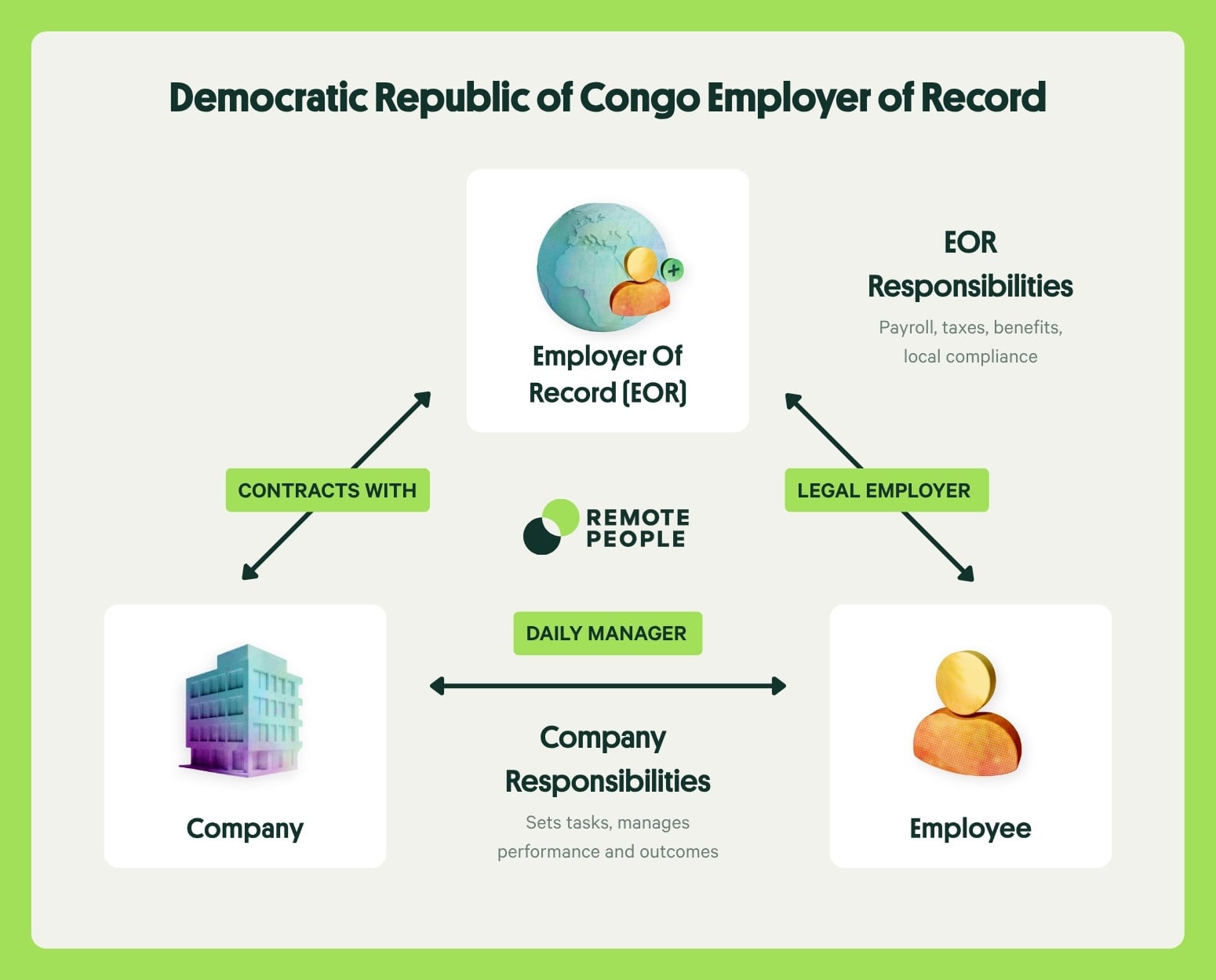
If you’d like to learn more about how Employer of Record (EOR) services work, read our What Is an Employer of Record (EOR)? guide for a complete overview of the model, its benefits, and when to use it.
If you’re comparing providers, our Best Employer of Record (EOR) Providers guide reviews the leading platforms to help you choose the right solution for your business.
Who Uses an EOR in the DRC?
Any company that wants to place a small team on the ground in the DRC without the cost and lead time of setting up a local entity is a candidate for an EOR. The typical use cases include testing the DRC as a growth market before committing to incorporation, hiring one to fifteen employees where a subsidiary does not make financial sense, bringing on a country manager or regional sales lead, and retaining a Congolese citizen who would otherwise leave a remote role because of contractor classification risk. Mining, NGO, energy, and telecoms projects also use an EOR in the DRC as a compliance buffer between the client and a high-friction regulatory environment.
Typical Onboarding Timeline
Most EOR providers can onboard a Congolese citizen within one to two weeks. Expatriate hires take longer because the work card and residence permit must clear the Ministry of Labour and the Direction Générale de Migration before the employee can legally start.
- First, sign the EOR service agreement and provide employee details, salary, and job description. This takes 1 to 2 business days.
- Second, the EOR drafts a Labour Code compliant employment contract in French and sends it to the employee for signature. This takes 2 to 3 business days.
- Third, the EOR registers the employee with INSS, INPP, and the tax authority and sets up the payroll file. Registration takes 5 to 10 business days depending on whether the dossier clears through Kinshasa or a regional office.
- Fourth, payroll is configured, the INSS number is issued, and the employee begins work with their first full month of coverage.
- Fifth, for expatriates, the work card application is filed in parallel. Expect an additional 4 to 8 weeks before the card is issued, followed by 2 to 4 weeks for the visa and residence permit.
Hire Employees in the DR Congo Without a Local Entity
RemotePeople handles Labour Code compliant contracts, INSS registration, IPR withholding, and expatriate work cards so you can build your Congolese team in days, not months. Get a clear quote with no setup fees and no local entity required.
Employment Laws and Regulations in the DRC
Employment in the Democratic Republic of the Congo is governed by the Labour Code, Law No. 015/2002 of 16 October 2002, together with its implementing decrees, sector collective agreements, and the social security framework under Law No. 16/009 of 15 July 2016 on the general social security scheme. The Ministry of Labour, Employment and Social Welfare is the primary regulator, and the Institut National de Sécurité Sociale administers pensions, family benefits, and occupational risk coverage.
Employment Contracts
Every employment relationship in the DRC must be documented in a written contract, and the law presumes the contract is indefinite unless a fixed-term contract has been agreed in writing. The contract must specify the parties, job title, workplace, basic salary, working hours, probationary period, and duration. Contracts are drafted in French because it is the official administrative language under the Constitution. Fixed-term contracts are generally capped at two years with renewal limits; beyond that threshold, a worker is automatically deemed to hold an indefinite contract under Article 40 of the Labour Code.
Working Hours and Overtime
The standard workweek in the DRC is 45 hours, typically spread across 5 or 6 days, per Article 119 of the Labour Code. Daily working hours cannot exceed 9 hours, and night work attracts a premium. Any work above the weekly ceiling counts as overtime and is limited by ministerial order.
Overtime is compensated at a premium based on the hour band. The first 6 overtime hours per week are paid at 130% of the regular hourly rate, and hours beyond that ceiling are paid at 160%. Night work (between 6 p.m. and 6 a.m.) attracts a 60% premium, and work performed on Sundays or public holidays is paid at 200% of the regular rate. Overtime must be authorized in advance by the employer and recorded in the payroll register.
Working time in the DRC is governed by the Labour Code, Law No. 015/2002, which caps the standard workweek at 45 hours (nine hours per day) and sets mandatory premiums for hours worked beyond schedule, at night, or on rest days. Overtime requires prior authorisation from the labour inspectorate and may not exceed 18 hours per week in most sectors.
Democratic Republic of the Congo overtime and premium pay rates · Per Labour Code Law No. 015/2002 | |||
Hour Type | Rate Multiplier | Weekly or Daily Cap | Notes |
|---|---|---|---|
Daytime overtime (first 6 hours) | 130% of hourly rate | Up to 6 hours per week beyond 45 | Applies Monday to Saturday on weekdays beyond standard schedule |
Daytime overtime (after the first 6 hours) | 160% of hourly rate | Maximum 18 hours of overtime per week | Requires labour inspectorate authorisation for sustained overtime |
Night work (22:00 to 05:00) | 150% of hourly rate (+50% minimum premium) | Applies per shift worked at night | Premium applies whether the shift is overtime or part of the standard schedule |
Weekly rest day or Sunday work | 200% of hourly rate | Permitted only with worker consent and ministry authorisation | Worker is entitled to a compensatory rest day within the same week |
Public holiday work | 200% of hourly rate | Authorised only for essential services | In addition to the regular holiday pay for the day |
Minimum Wage
The minimum wage in the DRC is 21,500 CDF per day (the Salaire Minimum Interprofessionnel Garanti, or SMIG), which translates to approximately $240 per month at the April 2026 exchange rate. The new floor was set by a ministerial decree signed on 30 May 2025 and took effect from the January 2026 payroll, replacing the 14,500 CDF daily floor that had applied since February 2025. The rate applies to all non-agricultural workers and is accompanied by a statutory annual increment of at least 3% per year of uninterrupted service. Sector-specific collective agreements frequently set higher floors, particularly in mining, banking, and telecoms.
Probation Period
The probation period in the DRC is capped at one month for unskilled workers and six months for skilled or managerial staff under Article 43 of the Labour Code. The probation clause must be in writing and signed before the employment contract takes effect. Either party may terminate the contract during probation without notice and without severance, provided written notice is given on the day of termination. After probation ends, full statutory protections apply.
Leave Entitlements
Congolese employees accrue paid leave at the rate of one working day per month of continuous service for workers over 18, which produces a minimum of 12 working days per year. Workers under 18 accrue 1.5 days per month. Additional seniority days are added for long-service employees, and statutory leave also covers sickness, maternity, bereavement, and public holidays. The sections below summarize each statutory leave category, followed by a comparison table.
Annual Leave
Employees accrue one working day of paid leave per month of actual service under Article 140 of the Labour Code, producing 12 working days after a full year. Workers under 18 years of age accrue 1.5 days per month. Seniority adds 1 extra day every 5 years of continuous service with the same employer. Annual leave must be taken within the reference year, is paid at the employee’s full salary including regular allowances, and cannot be replaced by a cash payment except at the end of the employment relationship.
Sick Leave
Employees unable to work because of illness must provide a medical certificate issued by an approved practitioner. Short-term sick leave is paid at two-thirds of the employee’s salary for up to six months, with the employer covering the benefit. INSS steps in for long-term disability under the invalidity pension branch once the statutory waiting period has elapsed. An employer may suspend the contract for prolonged illness but cannot terminate on that ground until 6 months have passed without recovery.
Maternity Leave
Female employees are entitled to 14 weeks of maternity leave, with 6 weeks taken before the expected delivery date and 8 weeks taken after, per Article 130 of the Labour Code. The leave is fully paid at the average salary of the last 3 months, with the employer advancing the amount and INSS reimbursing a portion through the family benefits branch. Maternity leave is available to employees who have completed at least 6 months of service. During maternity leave, the employer cannot terminate the employee except in narrowly defined cases of serious misconduct.
Paternity Leave
Congolese labour law grants fathers 2 working days of paid paternity leave around the birth of a child, as part of the broader family event leave allowance provided under the Labour Code. Many large employers in the mining and banking sectors add 3 to 5 days of specific paternity leave by internal policy, and most EORs follow the higher standard for recruitment reasons.
Other Statutory Leave
Beyond annual, sick, and maternity leave, Congolese workers are entitled to several additional statutory categories including short family event leave for births, marriages, and deaths, training leave when the course benefits the role, and paid time off for the 10 days listed in the public holidays section. Trade union representatives are also entitled to paid time off to attend official union training.
DRC statutory leave entitlements · Per Labour Code Law No. 015/2002 | ||
Leave Type | Duration | Eligibility & Notes |
|---|---|---|
Annual leave | 1 day/month (12 days/year) | Full pay; +1 day per 5 years of seniority; under-18 workers accrue 1.5 days/month |
Sick leave | Up to 6 months | Paid at two-thirds of salary; INSS covers long-term invalidity |
Maternity leave | 14 weeks (6 pre + 8 post) | Full pay; requires 6 months of service; INSS reimburses a portion |
Paternity leave | 2 working days | Part of family event leave; often extended by internal policy |
Family event leave | Up to 4 days/event | Births, marriages, deaths of close family members |
Public holidays | 10 days in 2026 | Paid; work on a public holiday attracts a 200% premium |
Training leave | By agreement | Granted for training directly relevant to the employee’s role |
Source: DRC Labour Code 015/2002 and PwC DRC Other Taxes | ||
Statutory Employee Benefits
Employees in the DRC are entitled to a package of mandatory benefits funded primarily through INSS. Every employer must register new hires with INSS within 8 days of the start date and pay monthly contributions covering three benefit branches: pensions (retirement, invalidity, survivors), family benefits (maternity and child allowances), and occupational risks (workplace accident and occupational disease). Retirement benefits activate at age 60 with at least 180 months of contributions under the 2016 social security law, and workers gain access to the public health system through the family benefits branch.
In addition to INSS, employers pay a 3% INPP training levy (Institut National de Préparation Professionnelle) for small firms, 2% for mid-sized, and 1% for large enterprises, plus a 0.2% ONEM contribution (Office National de l’Emploi) for the employment fund. Most white-collar employers layer on a private health insurance plan in the DRC because public hospital coverage is limited outside Kinshasa. Transport allowances, housing allowances, and meal vouchers are also common in sectors like mining and telecoms. The contribution rate details are broken down in the payroll section below.
Recent Regulatory Updates (2026)
The biggest payroll change in recent years was the doubling of the minimum daily wage in early 2025, followed by a further rise to 21,500 CDF per day effective January 2026. Together, these moves lifted the statutory floor by more than 200% in 12 months and triggered sector-wide collective bargaining reviews, particularly in retail, services, and domestic work.
The Social Security Law No. 16/009 of 15 July 2016 continues to govern INSS administration, with Decree n°18/041 of 24 November 2018 fixing the current 13% total INSS employer rate split across pensions, family benefits, and occupational risks. The IPR progressive scale set out in the General Tax Code remains unchanged for 2026, with brackets capped by the 30% effective rate ceiling on taxable salary.
Work Permits and Visas in the DRC
Every non-Congolese national who wants to take up paid employment in the DRC needs a work visa and permit before they can lawfully start work. The process involves three parallel tracks: the work card (carte de travail pour étranger) issued by the Ministry of Labour, the entry visa obtained from a Congolese embassy abroad, and the residence permit (carte de résident) issued after arrival by the Direction Générale de Migration. The EOR coordinates all three.
Work Permit Requirements
Who Needs a Work Permit
All foreign nationals require a work card regardless of their country of origin. Congolese law gives preference to local candidates under Article 2 of the Labour Code, so the employer must document the recruitment effort before hiring a foreigner in a role that a qualified Congolese worker could fill. Certain positions classified as reserved for Congolese citizens cannot be held by expatriates at all.
Eligibility and Required Documents
The employer (or the EOR acting on behalf of the client) files the work card dossier with the Ministry of Labour through the Commission Nationale de l’Emploi des Étrangers. Required documents typically include the signed employment contract, a copy of the employee’s passport, certified copies of academic and professional qualifications, a recent medical certificate issued in the DRC, a criminal record extract translated into French, a CV, and the employer’s trade register excerpt. Documents originating abroad must be legalized or apostilled and translated by a certified translator.
Processing Time and Validity
The work card is normally processed in 4 to 8 weeks at the Ministry of Labour, provided the file is complete. The initial work card is issued for up to 2 years and is tied to the specific employer and position that sponsored the application. Including the consular visa step and the residence permit application after arrival, the full process from job offer to legal start date typically runs 3 to 5 months. Delays usually come from missing legalized documents, sector-specific vetting, or scrutiny of expatriate quotas in regulated industries such as mining.
Renewal Process
Work cards must be renewed before expiry, and renewal applications should be submitted at least 60 days in advance. The renewal dossier is similar to the initial application and requires an updated medical certificate, criminal record extract, and proof that the employee has been compliant with tax, IERE expatriate tax, and INSS obligations during the previous term. Employees may continue to work while the renewal is pending if the application was filed before the original card expired.
Common Visa Types for Foreign Workers
The key immigration categories for foreign hires in the DRC include the établissement (long-stay) visa issued to expatriates whose work card has been approved, the ordre de mission visa used for short missions, the intra-company transfer category for employees of multinationals moved to a related Congolese entity, and the business visa used for consulting trips that do not involve paid employment in-country. Citizens of the Southern African Development Community (SADC) benefit from simplified procedures at certain border posts but still need a work card to take up employment.
Democratic Republic of the Congo work visa types for foreign workers · 2026 | ||||
Visa Type | Duration | Best For | Leads to Long-Term Residence? | Processing |
|---|---|---|---|---|
VETS (Visa d’Établissement de Travail Spécifique) | Up to 12 months | Initial work visa to regularise a new hire or short-term specialist | No, non-renewable at VETS category | 2 to 3 months |
VET (Visa d’Établissement de Travail) | 12 to 24 months, tied to work card | Long-term expatriate hires on multi-year assignments | Yes, renewable and convertible to permanent residence | 2 to 3 months |
VSR (Visa Sortie/Retour) | Matches VETS or VET term | International travel during the work visa term | N/A, companion exit/re-entry visa | Issued alongside VETS or VET |
Visa d’Établissement Permanent | Renewable long-term status | Expatriates settled in DRC after prior VET tenure | Yes, issued by the Direction Générale de Migration | 8 to 12 weeks after eligibility |
Visa d’Affaires (Business Visa) | 30 days, multiple entry | Business meetings, investor trips, feasibility studies | No, does not permit paid local employment | 1 to 2 weeks |
Ordre de Mission | Up to 3 months | Short missions by staff of a foreign employer | No, not a substitute for a work card | 1 to 2 weeks |
How an EOR Handles Work Permits
An EOR acts as the local sponsor for the work card because it is the legal employer of the expatriate in the DRC. The EOR files the Ministry of Labour dossier, coordinates with the consular post abroad, and handles the residence permit after arrival. The expatriate supplies the personal documents (passport, medical certificate, criminal record) and attends the biometric appointment at the Direction Générale de Migration. Because the EOR is the employer on record, the card is tied to the EOR’s name rather than the client’s foreign entity, which matters on exit and on card renewals.
Using an EOR also extends the onboarding timeline shown earlier. A Congolese citizen can start within 1 to 2 weeks, but an expatriate hire should plan for 3 to 5 months from offer to first day. Clients hiring for immediate-start roles usually prioritize Congolese candidates and use the EOR’s contractor management solution as a bridge for expatriates already in-country under another status.
Payroll, Taxes, and Social Security in the DRC
A full overview of payroll tax in the DRC is published separately; this section summarises the core rates, ceilings, and filing rules that govern monthly compliance for EOR payroll.
Employer Contributions
Employers in the DRC pay a combined statutory burden of approximately 16.2% of gross salary for a standard white-collar hire, split across INSS pension, INSS family benefits, INSS occupational risks, the INPP training levy, and the ONEM employment fund. INSS contributions are calculated on the full gross salary without a ceiling under the 2016 social security regime. Small businesses face a 3% INPP rate, mid-sized enterprises 2%, and large firms 1%, which reduces the total employer cost for larger operations.
DRC employer social security contributions · 2026 rates | ||
Contribution | Rate | Notes |
|---|---|---|
INSS family benefits | 6.50% | Covers family allowances and maternity reimbursement |
INSS pension | 5.00% | Employer share of the retirement, invalidity, and survivor branch |
INSS occupational risks | 1.50% | Workplace accident and occupational disease cover |
INPP training levy | 3.00% | 3% for small firms, 2% mid-sized, 1% large enterprises |
ONEM employment fund | 0.20% | Funds national employment programs |
Total employer burden | 16.20% | Standard white-collar baseline; lower INPP for larger firms |
Source: PwC DRC Other Taxes and INSS DRC | ||
Employee Contributions
Employees pay a 5% INSS pension contribution on gross salary, on top of the progressive IPR personal income tax described in the next section. The employee contribution applies to the full gross salary without a ceiling under the 2016 social security regime.
DRC employee payroll deductions · 2026 monthly withholdings | ||
Deduction | Rate | Notes |
|---|---|---|
INSS pension | 5.00% | Employee share of the pension branch; no ceiling |
Personal income tax (IPR) | 3% to 40% | Progressive; capped at 30% of taxable salary; see brackets below |
IERE expatriate tax | 25% | Applies to expatriates only; 12.5% reduced rate for mining first 10 years |
Total social contribution floor | 5.00% | Before IPR and IERE (for expatriates) |
Source: PwC DRC Individual Tax and INSS DRC | ||
Income Tax
The DRC’s personal income tax (Impôt Professionnel sur les Rémunérations, or IPR) is calculated on a progressive scale with four brackets, applied to taxable income after subtracting INSS employee contributions. The total IPR cannot exceed 30% of taxable salary, which effectively caps the marginal burden for high earners. Termination indemnities are taxed at a flat 10% rate, casual employees at 15%, and expatriates pay the IERE expatriate tax at 25% (reduced to 12.5% for qualifying mining companies during the first 10 years of operation). The table below shows the annual brackets converted to USD at the April 2026 exchange rate.
DRC income tax brackets (IPR) · 2026 | |
Annual Taxable Income (USD) | Tax Rate |
|---|---|
$0 to $838 | 3% of taxable income |
$839 to $9,306 | 15% of the amount above $838, plus $25 |
$9,307 to $18,612 | 30% of the amount above $9,306, plus $1,295 |
Over $18,612 | 40% of the amount above $18,612, plus $4,087 (capped at 30% of taxable salary) |
Beyond the IPR progressive scale, expatriates are subject to the Impôt Exceptionnel sur la Rémunération des Expatriés (IERE), a 25% employer-paid surcharge on expatriate remuneration that drops to 12.5% for mining-sector employers during the first 10 years of their project. All USD amounts in the bracket table are approximate conversions at $1 = 2,321 CDF (April 2026 rate).
Payroll Cycle
Congolese payroll runs on a monthly cycle, with salaries paid in Congolese francs by bank transfer or mobile money into an account held in the employee’s name. Pay slips must be issued in French and must show gross pay, each line item deduction, and net pay.
IPR personal income tax and INSS contributions must be filed and paid by the 15th of the month following the pay period. Annual tax declarations are due by 31 March of the following year. Employers who fail to remit INSS on time face penalty interest and, in severe cases, criminal liability under the 2016 social security law.
13th Month Salary and Bonus Pay
The DRC does not impose a statutory 13th month salary on private-sector employers. The Labour Code is silent on the matter, and no decree mandates an annual bonus in the way seen in neighbouring Central African jurisdictions. However, many large employers in mining, banking, and telecoms pay a customary end-of-year bonus, and some sector collective agreements make it contractually binding within the signatory industries. When a 13th month is paid voluntarily, it is subject to the same IPR and INSS treatment as regular salary.
Cost of Hiring Through an EOR in the DRC
EOR Service Fees
EOR service fees in the DRC typically run $300 to $600 per employee per month for a standard white-collar role. The fee covers employment contract drafting, monthly payroll, INSS and IPR filings, pay slip issuance, leave tracking, insurance administration, and compliance monitoring. Work card sponsorship for expatriates may attract additional one-off fees of $750 to $2,000 to cover the Ministry of Labour dossier, residence permit handling, and IERE expatriate tax registration.
Total Employment Cost Breakdown
The table below shows the total monthly cost of hiring an employee on a gross salary of $1,200 per month through an EOR in the DRC. All figures are in USD and based on the standard office-based occupational risk rate and the 3% INPP rate used for small private employers.
DRC employer cost example · $1,200/month gross · 2026 | ||
Employer Cost | Amount (USD) | % of Gross |
|---|---|---|
Gross salary | $1,200.00 | 100.00% |
INSS family benefits | $78.00 | 6.50% |
INSS pension | $60.00 | 5.00% |
INSS occupational risks | $18.00 | 1.50% |
INPP training levy | $36.00 | 3.00% |
ONEM employment fund | $2.40 | 0.20% |
EOR service fee (est.) | $400.00 | 33.33% |
Total monthly cost | $1,794.40 | 149.53% |
Source: PwC DRC Other Taxes and INSS DRC | ||
The statutory employer burden on a $1,200 gross salary is $194.40, or 16.20% above gross. Adding a typical $400 EOR service fee takes the total to $1,794.40 per month, which is 49.53% above the gross salary. Mid-sized and large firms pay a lower INPP rate (2% or 1%), which cuts the statutory burden to 15.20% or 14.20% respectively. All USD amounts are approximate conversions at $1 = 2,321 CDF (April 2026 rate).
Ready to hire in the DRC? Contact our team for a full cost quote. RemotePeople handles employment contracts, INSS registration, payroll, tax withholding, and full DRC compliance. No local entity needed.
Benefits of Using an EOR in the DRC
The single biggest reason to use an EOR in the DRC is speed. Incorporating a Congolese subsidiary usually takes 3 to 6 months and involves the Guichet Unique de Création d’Entreprise, the trade register, the tax office, and INSS registration. An EOR can onboard a Congolese citizen in 1 to 2 weeks because the legal entity already exists. For companies that want to pilot the market, support a single project, or hire a regional lead, that time saving is decisive.
Compliance risk is the second reason. The DRC’s Labour Code is detailed and enforceable, and foreign employers who try to handle payroll informally often run into trouble with INSS or the tax authority. An EOR carries that compliance responsibility on its own books, which means the client is insulated from INSS assessments, back tax claims, and labour court judgments that come from paperwork errors. Termination, in particular, is an area where the EOR’s local expertise pays off, because wrongful dismissal claims in the DRC can result in significant damages awarded by the Tribunal du Travail.
Cost efficiency also matters for smaller teams. Running a Congolese subsidiary carries fixed costs (office, accountant, auditor, statutory auditor, legal representative) that can exceed $25,000 per year even without any employees. An EOR replaces that fixed cost with a per-employee fee, so the total cost scales cleanly with headcount.
Finally, the employee experience is often better under an EOR. The employee receives a proper Congolese contract, INSS benefits, pay slips in local currency, and access to the public healthcare scheme, which is hard to match when paying a remote worker as a contractor from abroad.
Termination and Offboarding in the DRC
Notice Periods
The Labour Code sets statutory minimum notice periods based on the employee’s length of service. Under Article 64, the baseline notice period is 14 days, and this increases by 7 days for each full year of service with the same employer. Notice must be given in writing, and either party may pay in lieu of serving out the notice period. During the notice period, employees are entitled to one paid day per week to look for a new job.
Minimum notice under Articles 64 and 65 of the Labour Code, Law No. 015/2002, scales with both the employee’s category and completed years of service. Employer-initiated notice is longer than employee-initiated notice, and the employer may pay in lieu of notice at a rate equal to the full remuneration the worker would have earned during the unserved period.
Democratic Republic of the Congo statutory notice periods by position level · Per Labour Code Law No. 015/2002 | |||
Position Level | Notice Period (Employer) | During Probation | Notes |
|---|---|---|---|
Workers (ouvriers and employés) | 14 days base, plus 7 days per completed year of service | 3 days written notice | Article 64 category; covers front-line and clerical staff |
First-line supervisors (agents de maîtrise) | 1 month base, plus 9 days per completed year of service | 3 days written notice | Minimum monthly notice even below one year of tenure |
Senior managers (cadres de direction et de collaboration) | 3 months base, plus 16 days per completed year of service | 3 days written notice | Applies to department heads and above |
Employee-initiated resignation | Half of the applicable employer notice period | Immediate, with written notice | Article 65; notice in writing to the employer |
Severance Pay
Severance in the DRC is indemnity-based rather than a per-year accrual. Under Article 63 of the Labour Code, Law No. 015/2002, lawfully dismissed indefinite-term workers receive a tenure-tiered indemnity, while abusive dismissal triggers separate damages set by the Labour Court. All amounts are calculated on average monthly salary over the last 12 months of employment and are taxed at a flat 10% IPR rate.
Democratic Republic of the Congo severance pay schedule by years of service · Per Labour Code Law No. 015/2002 | |||
Years of Service | Severance Amount | Base Salary | Notes |
|---|---|---|---|
Up to 5 years | Approximately 6.5 weeks of salary | Average monthly salary over the last 12 months | First-tier indemnity for redundancy or dismissal without serious misconduct |
5 to 9 years | Proportional between 6.5 and 14 weeks | Average monthly salary over the last 12 months | Scales upward with each completed year of service |
10 or more years | Approximately 14 weeks of salary | Average monthly salary over the last 12 months | Second-tier cap under the statutory redundancy schedule |
Abusive dismissal (any tenure) | Up to 36 months of last remuneration | Last remuneration at termination | Article 63; damages set by the Labour Court considering tenure, age, and service |
Calculation Method
Severance pay is mandatory for employees dismissed for any reason other than serious misconduct, provided they have completed a qualifying period of continuous service. The formula is tenure-based: approximately 6.5 weeks of the average monthly salary for employees with up to 5 years of service, and up to 14 weeks for employees with 10 or more years of service. The average monthly salary used in the formula includes base pay plus regular allowances and is calculated over the last 12 months of employment. Severance indemnities are taxed at a flat 10% rate under the IPR rules.
Caps and Exceptions
Severance is not payable in cases of serious misconduct (faute lourde) as defined by Article 72 of the Labour Code, such as theft, gross insubordination, or violence. Fixed-term contracts that reach their natural expiry date do not attract severance, and employees dismissed during the probation period are also ineligible. Collective agreements may set higher severance rates than the Labour Code minimum, and the EOR applies whichever is more favourable to the employee.
Grounds for Termination
An employer may terminate an indefinite-term contract for economic reasons or for a personal reason linked to the employee’s conduct or capability. Both categories require written notice, a statement of the reasons in the termination letter, and, for economic dismissals affecting 10 or more employees, consultation with the labour inspectorate under Article 78. Dismissal for serious misconduct must be preceded by an internal disciplinary hearing where the employee has the right to present a defence. Protected categories, including pregnant employees, those on maternity leave, and worker representatives, enjoy additional protection and cannot be dismissed except in narrowly defined cases approved by the labour inspectorate.
EOR vs. Other Hiring Models in the DRC
EOR vs. Setting Up a Local Entity
Choosing between an Employer of Record and setting up your own legal entity in Democratic Republic Of The Congo comes down to timeline, upfront cost, ongoing administrative burden, and how quickly you can scale up or wind down. The table below lays out both paths side by side across setup time, cost, compliance risk, and flexibility so you can match the right model to the size and duration of your Democratic Republic Of The Congo hiring plan.
DRC EOR vs local entity comparison · Setup time, cost, risk and best-fit | ||
Comparison | Employer of Record | Own Entity |
|---|---|---|
Setup time | 1 to 2 weeks | 3 to 6 months |
Upfront cost | $0 | $5,000 to $20,000 |
Ongoing cost | $300 to $600 per employee per month | $20,000 to $40,000 per year maintenance |
Local partner required | No (EOR is the local entity) | Not legally required, often useful for market knowledge |
Social insurance registration | Handled by EOR | You manage it |
Payroll and tax filing | Handled by EOR | You manage it (or outsource) |
Best for team size | 1 to 15 employees | 15+ employees |
Scale down or exit | Easy, no entity to unwind | Costly, legal dissolution required |
Government contracts | Not eligible | Eligible (requires local entity) |
Source: DRC Labour Code 015/2002 and PwC DRC Corporate Updates | ||
Setting up a Congolese subsidiary makes sense when the projected headcount is large enough to absorb the fixed costs and when the business model requires a local entity (for example, bidding on public mining tenders or holding a regulated licence). For everyone else, the EOR route is materially faster and cheaper.
The break-even point is usually around 15 to 20 employees. Below that, the EOR’s per-employee fee is lower than the fixed overhead of running a subsidiary. Above that threshold, the subsidiary economics start to make sense, and many companies transition from an EOR to their own entity once they cross it. The EOR handover can usually be completed in 2 to 3 months.
Another factor is risk tolerance. Setting up an entity exposes the parent company to full local liability, including any historical INSS or tax assessment against the subsidiary. The EOR model caps that risk because the EOR is the employer of record and carries the compliance obligation. For companies testing the DRC for the first time, that insulation is valuable, particularly given the operating environment in the eastern provinces.
EOR vs. Hiring Independent Contractors
Classifying a Democratic Republic Of The Congo-based worker as an independent contractor rather than an employee can expose you to back-taxes, unpaid social contributions, and reclassification penalties if the working relationship looks like employment in practice. The table below contrasts EOR employment with contractor engagement across legal relationship, tax and benefits treatment, IP ownership, and misclassification risk so you can pick the right model role by role.
DRC EOR vs independent contractors · Compliance, cost, and risk | ||
Comparison | EOR (Full-Time Employee) | Independent Contractor |
|---|---|---|
Legal relationship | Employee of the EOR | Self-employed, no employment relationship |
Compliance risk | Low, EOR ensures Labour Code compliance | Higher, misclassification risk if the relationship resembles employment |
Payroll and tax | EOR handles IPR withholding, INSS, and filings | Contractor invoices you; they handle their own taxes |
Benefits and leave | Statutory benefits, paid leave, INSS coverage | No entitlement to employee benefits |
IP protection | Stronger, employment contract assigns IP by default | Weaker, requires explicit IP assignment clause |
Termination | Subject to Labour Code notice and severance | Contract can be ended per agreement terms |
Best for | Long-term, core team roles | Short-term projects, specialized tasks |
Cost structure | Salary + employer contributions + EOR fee | Contractor fee (typically higher gross, lower total cost) |
Source: DRC Labour Code 015/2002 and PwC DRC Tax Summary | ||
Hiring independent contractors in the DRC is only appropriate in some cases, such as short-term project work, specialized consulting, or roles where the worker has genuine autonomy over how and when they deliver. For long-term or full-time roles, contractor classification is the wrong tool because Congolese labour courts can reclassify the relationship as employment if the worker is economically dependent on one client, reports to that client’s management, and follows company processes.
The consequences of misclassification in the DRC are concrete. The client may owe back INSS contributions, back-dated IPR, penalty interest on both, plus severance if the worker was dismissed without following the Labour Code procedure. The labour inspectorate can also open an enforcement action independently of the worker’s own claim.
For roles that truly are project-based, the cleanest option is to use a contractor management solution rather than a direct invoice arrangement. RemotePeople’s contractor hiring solution handles compliant contractor agreements, payments, and classification reviews for Congolese freelancers, which keeps the flexibility of a contractor relationship while managing the misclassification risk.
EOR vs. PEO (Professional Employer Organization)
EORs and PEOs both simplify international hiring, but only an EOR becomes the legal employer of record in Democratic Republic Of The Congo — a critical distinction when you don’t have a local entity of your own. The table below maps the practical differences across legal employer status, entity requirement, liability allocation, and scope of coverage.
DRC EOR vs PEO comparison · Legal employer, liability, and setup | ||
Comparison | Employer of Record (EOR) | PEO |
|---|---|---|
Legal employer | EOR is the legal employer | You remain the legal employer (co-employment) |
Local entity required | No, the EOR is the local entity | Yes, you must have your own entity in the DRC |
Best for | Companies without a local entity | Companies that already have a local entity |
Compliance liability | EOR assumes compliance responsibility | Shared liability between you and the PEO |
Setup time | 1 to 2 weeks | Depends on your entity setup (weeks to months) |
Control over HR policies | EOR manages within Labour Code framework | More direct control, PEO advises |
Typical use case | Market entry, small remote teams, testing new markets | Established local operations needing HR outsourcing |
Source: PwC DRC Tax Summary and INSS DRC | ||
The DRC does not have a formal PEO regulatory framework comparable to the US co-employment model. The concept exists in practice because large domestic HR firms offer payroll and administration outsourcing services to companies that already have a Congolese entity, but the legal employer remains the client company. This is the key distinction: an EOR replaces the need for a local entity, while a PEO complements one.
For foreign companies without a Congolese subsidiary, the EOR route is the only practical option because a PEO assumes you already have a company in-country. Once a client has incorporated and grown past the EOR break-even point, moving to a PEO-style payroll outsourcing arrangement can make sense because it lowers the per-employee overhead while keeping the entity active for tendering and regulatory purposes.
Compliance liability is the other major difference. Under an EOR, the provider is on the hook for INSS, tax, and Labour Code compliance. Under a PEO arrangement, the client company remains on the hook and the PEO only advises and executes, which means the client must still have internal capacity to review the local advice.
Public Holidays in the DRC
Democratic Republic Of The Congo observes a defined set of official public holidays on which most private-sector employers must give staff a paid day off (TimeAndDate DR Congo Holidays 2026). The table below lists the statutory holidays employers need to build into payroll calendars and leave planning for the year, along with the date rule for each.
DRC public holidays · 2026 calendar year | ||
Date | Holiday | Type |
|---|---|---|
1 January | New Year’s Day | National |
4 January | Martyrs of Independence Day | National |
16 January | Laurent-Désiré Kabila Assassination Anniversary | National |
17 January | Patrice Lumumba Assassination Anniversary | National |
6 April | Simon Kimbangu Memorial Day | Religious |
1 May | Labour Day | National |
17 May | Liberation Day | National |
30 June | Independence Day | National |
1 August | Parents’ Day | National |
25 December | Christmas Day | Religious (Christian) |
The DRC observes 10 paid public holidays in 2026, weighted toward national commemoration days that mark the country’s struggle for independence and its post-colonial leadership. Work performed on a public holiday attracts a 200% premium, and payroll for the holiday month must reflect the paid day whether or not the employee worked. The government occasionally announces additional one-off holidays through the Ministry of Labour; these are published in the Journal Officiel and must be honoured by all private-sector employers.
How to Get Started with an EOR in the DRC
- First, define the role, gross salary, and projected start date for your Congolese hire and share the brief with the EOR provider.
- Second, receive and review the full cost quote, including statutory contributions, the EOR service fee, and any work card costs for expatriates.
- Third, sign the EOR service agreement and send the employee’s personal details, identification documents, and qualifications.
- Fourth, the EOR drafts the employment contract, sends it for signature, registers the employee with INSS and the tax authority, and sets up payroll.
- Fifth, the employee begins work. You manage their day-to-day output while the EOR handles monthly payroll, filings, leave tracking, and ongoing compliance.
Ready to get started? RemotePeople operates as your employer of record across the Democratic Republic of the Congo, with local payroll, INSS filings, and a dedicated account team that knows the Labour Code. Check our pricing for a transparent per-employee fee and launch your DRC team in days.
Where companies hiring in the Democratic Republic of the Congo expand next
Teams operating in the Democratic Republic of the Congo typically extend into neighboring Central African markets with overlapping regulatory and linguistic frameworks. After building a team in the Democratic Republic of the Congo, employers often look to Cameroon for aligned Central African labor norms, then hiring in Gabon for shared Central African workforce dynamics. An EOR partner in the Central African Republic follows with the regional Central African talent pool, and the Republic of the Congo typically closes the regional footprint via overlapping Central African regulatory frameworks.
Frequently Asked Questions
EOR services in the DRC typically cost between $400 and $700 per employee per month as a flat service fee, reflecting the higher administrative complexity of operating in the DRC. On top of that, you pay the employee's gross salary plus mandatory employer contributions of approximately 16.2% (INSS pension, family benefits, occupational risks, INPP training levy, and ONEM fund). The INPP rate varies by company size: 3% for small firms, 2% mid-sized, and 1% for large enterprises.
An EOR can onboard a Congolese citizen within 1–2 weeks, covering contract drafting, INSS registration, and payroll setup. Expatriate hires take longer because a work card (carte de travail pour étranger) must clear the Ministry of Labour (4–8 weeks), followed by a visa and residence permit from the Direction Générale de Migration (2–4 weeks). Plan on 2–3 months total for a foreign national.
Yes. The EOR is the legal employer in the DRC and takes full responsibility for compliance with the Labour Code (Law No. 015/2002), INSS social security contributions, IPR income tax withholding, the INPP training levy, and the ONEM employment fund. All contracts are drafted in French as required by law, and the EOR maintains the statutory employee register required by the Ministry of Labour.
Yes. The EOR handles the full work card application process with the Ministry of Labour, including the foreign worker identity card (carte de travail pour étranger), the residence permit through the Direction Générale de Migration, and renewals. Renewal applications should be submitted at least 60 days before the card expires. The EOR ensures all supporting documentation, medical certificates, and criminal record extracts are in order.
Employers contribute approximately 16.2% of gross salary for a standard white-collar hire. This includes INSS family benefits (6.50%), INSS pension (5.00%), INSS occupational risks (1.50%), INPP training levy (3.00% for small firms), and ONEM employment fund (0.20%). INSS contributions are calculated on the full gross salary without a ceiling under the 2016 social security regime.
The national minimum wage in the DRC is set by government decree and varies by sector. Employers must comply with both the national floor and any applicable sector collective agreement rates. Salaries are typically denominated in Congolese francs but many international employers benchmark against USD equivalents. The EOR ensures all compensation meets or exceeds the applicable minimum.
Yes, but the DRC Labour Code requires proper notice and severance. Termination without cause requires notice periods based on tenure and employee category, plus severance calculated under the Labour Code's tenure-based formula. The EOR handles the full termination process including final pay calculation, INSS deregistration, and issuance of the statutory certificate of employment to avoid compliance penalties.
No. An EOR already has a registered entity in the DRC with active INSS, INPP, and tax registrations. You can hire employees without incorporating a subsidiary in Kinshasa or Lubumbashi, avoiding months of setup time and significant upfront costs. The EOR model is especially valuable in the DRC given its high regulatory complexity.
Employer of Record in
Employer of Record in
Employer of Record in
Employer of Record in
Employer of Record in
Employer of Record in
Employer of Record in
Employer of Record in