
 Recruit
Employer of Record in the Republic of the Congo (Congo-Brazzaville)
-
 Drew Donnelly
- Published
- September 22, 2026
RemotePeople’s employer of record in Republic of the Congo lets you hire employees in Republic of the Congo without navigating complex Congolese employment regulations. We handle CNSS social security contributions, INPP pension fund payments, and IPR income tax withholding.
Hire in Republic of the Congo — book a free 30-minute demo
Tell us what you need. You'll get a tailored, transparent proposal within 24 hours, plus a free call to walk through it.
Tell us about your company
So we can match you with a specialist who knows your market — and unlock volume pricing tiers.
* All fields are required.
Where and when are you hiring?
Tell us the geography and timing and we'll quote each country line by line, with onboarding timelines.
* All fields are required.
Help us beat your current setup
We'll benchmark your current deal and send a line-by-line proposal in 24 hours — showing exactly where we cut cost, time, or risk. After you submit, you can book a call to walk through it together.
* All fields are required.
Thanks! Your proposal is on its way.
Expect a tailored, line-by-line proposal in your inbox within 24 hours. In the meantime…
Want to walk through it together?
Book a free 30-minute call with one of our specialists. We'll explain every line, answer your questions, and tailor the proposal further if you need.
No obligation. Pick a time that works for you.








- Hire in Republic of the Congo — book a free 30-minute demo
- Tell us about your company
- Where and when are you hiring?
- Help us beat your current setup
- Thanks! Your proposal is on its way.
- How an Employer of Record Works in Republic of the Congo
- Employment Laws and Regulations in Republic of the Congo
- Work Permits and Visas in Republic of the Congo
- Payroll, Taxes, and Social Security in Republic of the Congo
- Cost of Hiring Through an EOR in Republic of the Congo
- Benefits of Using an EOR in Republic of the Congo
- Termination and Offboarding in Republic of the Congo
- EOR vs. Other Hiring Models in Republic of the Congo
- Public Holidays in Republic of the Congo
- How to Get Started with an EOR in Republic of the Congo
- Where companies hiring in the Republic of the Congo expand next
- Frequently Asked Questions
- Related EOR Destinations

Start hiring in Republic of the Congo
Let RemotePeople handle payroll, compliance, and HR admin worldwide so you can focus on building your team.

Hiring in Republic of the Congo with an Employer of Record (EOR) streamlines international expansion by handling payroll, taxes, and compliance. An EOR manages all legal obligations, allowing you to focus on building your team. The Republic of the Congo uses the Central African CFA franc (XAF) and is a member of CEMAC and OHADA, creating a structured but complex employment framework that requires specialized knowledge to navigate.
How an Employer of Record Works in Republic of the Congo
An Employer of Record (EOR) in Republic of the Congo is the official legal employer for your international hires, taking on all compliance, payroll, and statutory duties. This arrangement lets you hire talent without establishing a local entity, reducing time and administrative burden. EORs handle everything from employment contracts in French to tax filings with the Direction Générale des Impôts et des Domaines (DGID), allowing you to scale quickly in new markets.
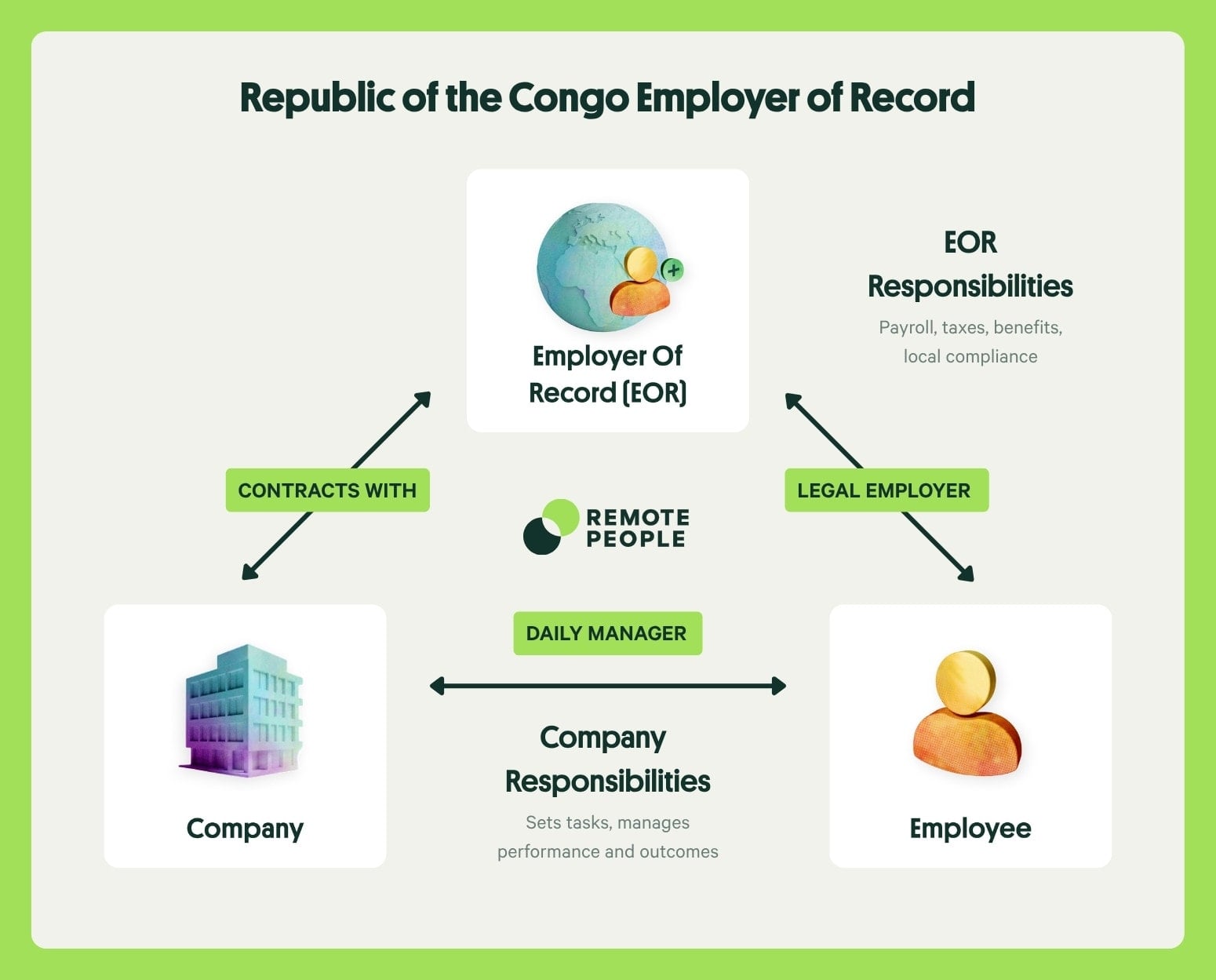
If you’d like to learn more about how Employer of Record (EOR) services work, read our What Is an Employer of Record (EOR)? guide for a complete overview of the model, its benefits, and when to use it.
If you’re comparing providers, our Best Employer of Record (EOR) Providers guide reviews the leading platforms to help you choose the right solution for your business.
Who Uses an EOR in Republic of the Congo?
Multinational firms, startups, and mid-sized companies use EORs to hire in Republic of the Congo without a local subsidiary. Companies entering the market for the first time benefit from outsourcing compliance, particularly given the CEMAC currency framework and OHADA business law harmonization. Tech firms, consulting companies, and service providers commonly use EORs to rapidly expand in Central Africa.
Companies testing the market before full incorporation find an EOR cost-effective, avoiding lengthy entity registration and ongoing corporate overhead. Larger enterprises also use EORs for flexible staffing, scaling roles without subsidiary expense, or hiring specialized talent on a project basis.
Typical Onboarding Timeline
- First, you submit employee information, job descriptions, and proposed salary. This takes 1–2 business days.
- Second, the EOR drafts the employment contract in French, then gets employee sign-off. This takes 3–5 business days.
- Third, the EOR registers the employee with tax authorities (DGID) and social security (CNSS), handling work permits for non-citizens if needed. Registration takes 5–10 business days, depending on complexity.
- Fourth, the first payroll cycle begins, with payment processed monthly for the prior month’s work. The employee receives their first salary with all statutory deductions.
- Fifth, the EOR sends you a monthly portal dashboard with payroll summaries, deductions, and compliance status. You maintain regular contact with your EOR account team for ongoing adjustments and queries.
Hire in Republic of the Congo
Access to skilled French-speaking talent, CFA franc stability via the EUR peg, and a strategic Central African location make Republic of the Congo an attractive hiring destination.
We handle employment contracts, payroll, tax withholding, and full Republic of the Congo compliance.
No local entity needed. Your team can start in days.
Employment Laws and Regulations in Republic of the Congo
Republic of the Congo’s employment framework is governed primarily by Loi n° 45-75 du 15 mars 1975 (the Labour Code), as amended by subsequent legislation including Loi 6-96 of March 6, 1996. The Ministry of Labour and Social Security oversees enforcement, and compliance with the Labour Code is mandatory for all employers. Non-compliance carries penalties ranging from fines to operational restrictions. The law applies to all employment relationships in the country regardless of employee nationality.
Employment Contracts
Loi n° 45-75, the Labour Code of Republic of the Congo, requires all employment relationships to be documented in a written contract signed by both employer and employee. The contract must specify job title, location, compensation, working hours, and duration (fixed-term or indefinite). It must be drafted in French and include probation terms if applicable. Both parties must receive signed copies for their records.
Working Hours and Overtime
The standard workweek in Republic of the Congo is 35 to 40 hours spread across five to six days. Any hours beyond the standard weekly hours are classified as overtime and must be compensated at premium rates under the Labour Code. The specific calculation depends on the type of overtime worked.
Work between certain hours qualifies for premium compensation. First-tier overtime (typically the first 6 hours per week above standard) receives a 30% premium on the regular hourly rate. Second-tier overtime (hours beyond the first 6) receives a 60% premium. Work during the weekly rest day is compensated at 100% premium (double time). Night work and work on public holidays also command premium rates.
Republic of the Congo overtime and premium pay rates · Per Loi n° 45-75 |
|||
Hour Type |
Rate Multiplier |
Weekly/Daily Cap |
Notes |
|---|---|---|---|
Weekday Overtime (First 6 hours) |
130% (1.3x base rate) |
6 hours per week |
Additional hours beyond standard workweek |
Weekday Overtime (Second tier) |
160% (1.6x base rate) |
As agreed |
Hours beyond first 6 overtime hours per week |
Weekly Rest Day Work |
200% (2x base rate) |
As needed |
Full double-time compensation on rest day |
Public Holiday Work |
200% (2x base rate) |
Full day |
Double-time pay for work on statutory holidays |
Employees cannot be required to work more than 10 hours per day on average. Overtime is typically voluntary but can be required in urgent situations. Overtime compensation must be calculated and paid separately from regular salary to ensure clear accounting of premium payments.
Minimum Wage
Republic of the Congo’s national minimum wage (SMIG–Salaire Minimum Interprofessionnel Garanti) stands at XAF 70,400 per month as of January 2025, established by government decree. This rate applies to all workers and is the legal floor for compensation across all sectors and industries. Employers must ensure all salaries meet or exceed this threshold to remain compliant with the Labour Code.
Probation Period
New employees in Republic of the Congo serve probation periods that vary by job category. For unskilled labor and general positions, the maximum probation period is one month. For skilled workers and specialized positions, the probation period may extend up to six months with mutual agreement between employer and employee. During probation, employees are entitled to all statutory benefits and protections (including leave, contributions, and social security) but can be terminated more easily without the full notice period required after probation ends. Either party may terminate during probation with minimal notice unless the employment contract specifies otherwise.
Leave Entitlements
Republic of the Congo’s statutory leave framework is comprehensive, covering annual leave, sick leave, maternity leave, paternity leave, and family leave. Each category has specific accrual rules, payment rates, and eligibility conditions. Employers must track entitlements carefully and ensure employees take their statutory leave within prescribed timeframes.
Annual Leave
Employees accrue a minimum of 26 working days of paid annual leave per year after completing one year of service. During the first year, employees receive a pro-rata allocation based on months worked. Annual leave must be taken within the calendar year or by agreement and is paid at the employee’s regular salary rate. Unused leave is generally forfeited unless the employer agrees otherwise or leaves are deferred to the next year with written consent.
Sick Leave
Employees are entitled to paid sick leave for the first two months of illness, at 100% of regular salary upon presentation of a medical certificate. For extended illness beyond two months, compensation reduces to 50% of salary for months three through twelve. Medical documentation is required to authorize sick leave absences. After twelve months of continuous sick leave, the employee may be terminated under disability or incapacity provisions.
Maternity Leave
Female employees are entitled to 15 weeks of paid maternity leave, typically split into six weeks before childbirth and nine weeks after delivery. This leave may be adjusted per medical recommendation and is compensated at 100% of regular salary. During maternity leave, the employee receives full salary and maintains all employment rights and benefits. The employee’s job is protected and must be available upon return.
Paternity Leave
Male employees receive a total of two days of paid paternity leave at full salary following the birth of a child, typically to be taken within 30 days of the child’s birth. This provision recognizes the importance of paternal presence during early family moments. Paternity leave is compensated at the employee’s regular rate and does not reduce annual leave balances.
Other Statutory Leave
Employees are entitled to eight days of paid leave for family-related matters including marriage, death of a close relative, or family emergencies upon provision of supporting documentation. Military service obligations and study leave are also protected under the Labour Code, with specific terms varying by circumstance. Religious observance leave is recognized in limited circumstances per employer policies and local practice.
All leave entitlements are required by law and must be documented carefully. The EOR tracks accrual, ensures payment at proper rates, and manages carryover rules per the Labour Code.
Republic of the Congo statutory leave entitlements · Per Loi n° 45-75 |
||
Leave Type |
Duration |
Eligibility & Notes |
|---|---|---|
Annual Leave |
26 working days minimum per year |
After 1 year of service; pro-rata in year 1; 100% salary; must be taken within calendar year |
Sick Leave (Months 1-2) |
Up to 2 months |
100% salary; requires medical certificate |
Sick Leave (Months 3-12) |
Months 3-12 of continuous absence |
50% salary; after 12 months, termination may occur for incapacity |
Maternity Leave |
15 weeks (6 pre-delivery + 9 post-delivery) |
100% salary; job protection; adjustment possible per medical recommendation |
Paternity Leave |
2 days paid |
100% salary; must be taken within 30 days of birth |
Family Leave |
8 days |
For marriage, death of close relative, or family emergencies; 100% salary; documentation required |
Military Service Leave |
As required by law |
Job protection; specific terms vary per legal obligation |
Study Leave |
As agreed with employer |
For professional development; may be paid or unpaid per agreement |
Statutory Employee Benefits
Republic of the Congo requires employers to contribute to CNSS (Caisse Nationale de Sécurité Sociale), the national social security system, which provides pension, family allowance, and occupational risk benefits. These are mandatory contributions funded through employer and employee payroll deductions.
- First, Pension (PVID Branch): Employer contributes 8% of gross salary; employee contributes 4%. The pension fund provides retirement benefits at age 60 (women) or 65 (men) based on contribution history and years of service.
- Second, Family Allowances: Employer contributes 10.03% of gross salary to fund family support benefits including child allowances and maternity/paternity support.
- Third, Occupational Accident & Disease Insurance: Employer contributes 2.25% of gross salary to cover workplace injury and occupational disease benefits, providing medical treatment and income replacement for affected employees.
- Fourth, Health Coverage: CNSS provides mandatory health insurance coverage through the public system. Many employers coordinate supplementary private health insurance for senior staff or provide additional coverage beyond the statutory minimum.
- Fifth, Statutory Ceiling: Social security contributions are calculated on salary up to a monthly ceiling set by CNSS; salaries exceeding the ceiling pay contributions only on the ceiling amount.
Recent Regulatory Updates (2026)
As of 2026, Republic of the Congo’s core employment framework remains largely stable, with the Labour Code (Loi n° 45-75) as amended continuing to govern employment relations. The minimum wage (SMIG) was updated to XAF 70,400 per month effective January 2025. CNSS contribution rates remain consistent at employer 20.28% total and employee 4% for pension branch, with no major legislative changes announced for 2026.
The country’s membership in CEMAC (Central African Economic and Monetary Community) and OHADA (African business law harmonization organization) continues to influence employment law harmonization. Employers should monitor official government communications from the Ministry of Labour and Social Security for any updates to rates, compliance requirements, or administrative procedures.
Work Permits and Visas in Republic of the Congo
Non-Congolese employees hired through an employer of record in Republic of the Congo require work permits to legally work in the country. The work permit process is managed by the Ministry of Interior and involves immigration, labour, and security clearances. Processing times vary, though legally the ministry must decide within 15 days; in practice, applications typically take 4–6 weeks to complete. Understanding visa categories and work permit requirements is essential for international hiring.
Work Permit Requirements
Who Needs a Work Permit
All non-Congolese citizens need a work permit before starting work in Republic of the Congo. The permit ties the employee to a specific employer and position. Citizens of CEMAC member states may have simplified procedures, but work authorization is still required. The employer (or EOR on their behalf) must sponsor the application and demonstrate that the position requires a foreign national’s specialized skills.
Eligibility and Required Documents
To sponsor a work permit, employers must provide a job description, employment contract in French, proof of recruitment efforts showing no qualified local candidates were available, and the applicant’s qualifications and experience documentation. The employee submits a police clearance, medical examination results, valid passport, and application forms. Educational credentials must be certified or translated into French by an authorized translator. A job offer letter showing position, salary, and start date strengthens the application. All documents require official seals and signatures; translations must be notarized.
Processing Time and Validity
Legally 15 days, but expect 4–6 weeks due to background checks and ministry coordination. Once granted, the permit is valid for one year and ties the employee to the sponsoring employer. Extensions require renewed applications before expiration.
Renewal Process
Renew the permit by submitting the same basic documents plus updated medical exams and police clearance at least 60 days before expiration. If an employee changes employers, the new employer must file a new application. Start renewal procedures well in advance to avoid work authorization gaps.
Common Visa Types for Foreign Workers
Republic of the Congo offers several visa categories for foreign workers, though not all permit employment. The main categories for employment are work permits and work visas tied to specific employers. Other visa types (tourist, business, residence) have limited or no employment authorization.
Republic of the Congo work visa types for foreign workers · 2026 |
||||
Visa Type |
Duration |
Best For |
Leads to Residency? |
Processing Time |
|---|---|---|---|---|
Standard Work Permit |
1 year (renewable) |
Employees with employer sponsorship; regular full-time employment |
Renewable indefinitely; leads to long-term residency with continuous renewal |
4–6 weeks |
Temporary Work Permit |
3–12 months |
Short-term projects, contract workers, specialist assignments |
No; temporary only |
2–4 weeks |
Skilled/Specialist Permit |
1–2 years |
Technical experts, specialized professionals, expatriate managers |
Renewable; may lead to residency with multiple renewals |
4–8 weeks |
Business Visa |
30–90 days |
Business travel, consultants, short-term assignments |
No; does not permit local employment |
1–2 weeks |
Residence Visa |
1–3 years |
Long-term residency; work only with accompanying work permit |
Yes; renewable for long-term residency |
4–8 weeks |
Tourist visas, transit visas, and student visas are also available but do not permit employment. Employees working on tourist or business visas without proper work permits face penalties and legal consequences.
How an EOR Handles Work Permits
An EOR manages the entire work permit process, compiling all required documentation and coordinating with the Ministry of Interior on the applicant’s behalf. They track application status, provide updates, and ensure all compliance requirements are met. If a permit is denied, the EOR advises on alternatives or appeals. They proactively initiate renewals before expiration to prevent work authorization gaps. The EOR updates payroll and compliance records to reflect current permit status and handles any changes in employment that might require permit modifications.
Payroll, Taxes, and Social Security in Republic of the Congo
Republic of the Congo’s payroll system, managed by the employer of record on your behalf, combines employer and employee contributions to social security, progressive income tax, and statutory deductions. The system is monthly, with salaries paid in Central African CFA francs (XAF) by bank transfer. Understanding the contribution rates, tax brackets, and compliance requirements is essential for accurate payroll management and regulatory adherence.
Employer Contributions
Employers must contribute to the CNSS (Caisse Nationale de Sécurité Sociale) system, which covers pensions, family allowances, and occupational accident insurance. The total employer contribution rate is 20.28% of gross salary, comprising three branches: 8% for the PVID pension fund, 10.03% for family allowances, and 2.25% for occupational accident and disease insurance. These contributions are mandatory and apply universally across all sectors and employee categories.
Republic of the Congo employer social security contributions · 2026 rates |
||
Contribution Type |
Rate |
Notes |
|---|---|---|
Pension (PVID Branch) |
8% |
Gross monthly salary; funds retirement benefits |
Family Allowances |
10.03% |
Gross monthly salary; supports family benefits |
Occupational Accident & Disease |
2.25% |
Gross monthly salary; covers workplace injuries and occupational diseases |
Total Employer Contribution |
20.28% |
Combined rate on gross salary; subject to CNSS ceiling |
Employee Contributions
Employees contribute 4% of gross salary to the CNSS pension (PVID) fund, deducted from each paycheck. They also pay progressive income tax (IRT, or “Impôt sur le Revenu du Travail”) calculated on monthly income according to tax brackets set by the Direction Générale des Impôts et des Domaines (DGID). The employee’s net pay is calculated by subtracting both CNSS and income tax from gross salary.
Republic of the Congo employee payroll deductions · 2026 monthly withholdings |
||
Withholding Type |
Rate |
Notes |
|---|---|---|
CNSS Pension (PVID) |
4% |
Gross salary; mandatory social security contribution |
Income Tax (IRT) |
0%–40% (progressive) |
Varies by income bracket; calculated monthly per tax brackets |
Total Employee Deductions |
4% + IRT |
Combined deductions from gross salary before payment |
Income Tax
Republic of the Congo uses a progressive income tax system with rates ranging from 0% to 40%, depending on the taxpayer’s income bracket. Tax is calculated on each month’s earnings independently, with no annual aggregation. Income below a statutory threshold is exempt from tax; income in higher brackets faces graduated rates applied to the excess over each threshold.
Republic of the Congo income tax brackets · 2026 |
|
Monthly Income (XAF) |
Tax Rate on Income in Bracket |
|---|---|
Up to 1,000,000 |
0% (exempt) |
1,000,001–3,000,000 |
10% on amount above 1,000,000 |
3,000,001–6,000,000 |
15% on amount above 3,000,000 |
6,000,001–12,000,000 |
20% on amount above 6,000,000 |
Over 12,000,000 |
30%–40% on amount above 12,000,000 |
For example, an employee earning XAF 2,000,000 monthly would owe 0% on the first XAF 1,000,000, plus 10% on the XAF 1,000,000 between the first and second million, totaling XAF 100,000 in income tax before any other deductions.
Payroll Cycle
Payroll in Republic of the Congo is monthly, with salaries paid in XAF by bank transfer to employee accounts. Employers must process payroll by the end of the calendar month or per contractual agreement. Tax withholding is remitted to DGID on a monthly basis, typically within 15 days of payroll processing. Social security contributions (CNSS) are submitted on a monthly schedule, with employers responsible for both employer and employee portions. Pay slips must be provided to employees showing gross salary, all deductions, and net payment. All records must be maintained for at least five years for audit purposes.
13th Month Salary and Bonus Pay
A 13th month salary or annual bonus is not legally mandated in Republic of the Congo but is a common practice in many formal employers and industries. If provided, the 13th month is typically calculated as one full month’s salary (equal to the employee’s regular monthly compensation) and paid around year-end, usually in December. Pro-rata rules apply for employees who join mid-year or leave before year-end. The key distinction is that bonuses are “voluntary” unless explicitly stated in the employment contract or collective agreement, in which case they become mandatory. When a 13th month is contractually promised, the employer must pay it on schedule or face legal consequences.
Cost of Hiring Through an EOR in Republic of the Congo
EOR Service Fees
EOR service fees in Republic of the Congo typically range from $300 to $600 per employee per month, depending on the level of support required, the complexity of the role, and the service provider. Fees usually cover payroll processing, tax withholding and filing, social security administration, employment contract preparation, leave management, and basic compliance support. Premium services such as dedicated account management, 24/7 support, or specialized industry expertise may command higher fees. Some providers charge flat monthly fees; others use tiered pricing based on employee count or salary level.
Total Employment Cost Breakdown
When budgeting for a hire in Republic of the Congo, the total monthly cost includes the employee’s gross salary, employer social security contributions (20.28%), and the EOR service fee. The following table illustrates a cost example for a typical hire.
Republic of the Congo employer cost example · USD 2,500 gross · 2026 |
||
Line Item |
Amount (USD) |
% of Gross |
|---|---|---|
Gross Salary |
$2,500 |
100% |
Employer CNSS Contributions (20.28%) |
$507 |
20.28% |
EOR Service Fee (monthly) |
$400 |
16% |
Total Monthly Cost |
$3,407 |
136.28% |
Exchange rate: 1 USD ≈ 655.957 XAF (January 2026). This example assumes a mid-range EOR fee; actual costs will vary based on salary level, benefits provided, and service tier selected.
Ready to hire in Republic of the Congo? Get started with RemotePeople–we handle employment contracts, payroll, tax withholding, and full Republic of the Congo compliance. No local entity needed.
Benefits of Using an EOR in Republic of the Congo
Using an EOR in Republic of the Congo offers significant advantages for companies expanding in Central Africa. An EOR eliminates the need to establish a costly local entity, reducing administrative overhead and accelerating market entry. Compliance is handled by experts familiar with the Labour Code, CNSS requirements, and DGID procedures, reducing legal and financial risk. The EOR absorbs payroll complexity, including multi-branch social security contributions and progressive income tax calculations.
- Sixth, Speed to Market: Onboard employees in 1–2 weeks without the weeks or months required to register a local entity, allowing you to start executing projects immediately.
- Seventh, Compliance Assurance: An EOR ensures adherence to Loi n° 45-75, CNSS requirements, and tax law, reducing penalties, fines, and operational disruptions from regulatory missteps.
- Eighth, Cost Efficiency: Avoid incorporating a separate subsidiary with its own accounting, legal, and administrative costs. EOR fees are typically lower than maintaining a local entity, especially for small teams.
- Ninth, Local Expertise: EORs employ specialists who understand Republic of the Congo’s specific regulations, labour practices, and government procedures, providing guidance that prevents costly errors.
- Tenth, Flexibility to Scale: Easily add or remove employees without entity-level overhead changes, adapting your team size to business needs without long-term commitments.
- Risk Mitigation: Transfer employment-related legal and compliance risk to the EOR, protecting your company from wrongful termination claims, wage disputes, and regulatory penalties.
- Employee Experience: Professional payroll processing, on-time salary payment, and proper benefits administration enhance employee satisfaction and retention, supporting your team’s productivity and morale.
Termination and Offboarding in Republic of the Congo
Notice Periods
In Republic of the Congo, statutory notice periods ensure both employers and employees have adequate time to transition. Notice requirements differ based on who is initiating the termination and how long the employee has worked. Per Loi n° 45-75, the base notice period is 14 working days, which increases with tenure. Notice can be provided in writing and must specify the termination date clearly. Notice periods can be paid in lieu (the employee receives payment instead of working the notice period), subject to contractual and legal terms.
Republic of the Congo statutory notice periods by position level · Per Loi n° 45-75 |
|||
Position Level / Tenure |
Notice Period (Working Days) |
During Probation |
Notes |
|---|---|---|---|
Less than 6 months |
14 working days |
Minimal notice (per contract) |
Base notice for new employees without extended service |
6 months–1 year |
14 working days |
N/A |
Notice does not increase until one year of service |
1–3 years |
21 working days (14 + 7) |
N/A |
Increases by 7 working days per year of service |
3–5 years |
28 working days (14 + 14) |
N/A |
Continues to increase with each additional year |
5+ years |
35+ working days (14 + 21+) |
N/A |
Seven additional working days per year of service beyond 5 years |
During a probation period, either party may terminate with minimal notice (usually per the employment contract, which may specify 1–3 days). After probation, the full notice period applies. Exceptions apply for just-cause termination (serious misconduct), which may allow immediate dismissal without notice, though procedural requirements must still be met. Mutual agreement to terminate can waive or shorten notice periods if both parties consent in writing.
Severance Pay
In Republic of the Congo, severance is owed when an employee is terminated without just cause (after the probation period ends) or when the employment relationship ends due to redundancy, company closure, or incapacity. Loi n° 45-75 establishes a mandatory severance formula based on years of service and base salary. Severance is not owed for termination during probation, for just-cause dismissal (serious misconduct), or for resignation. The severance calculation uses the employee’s base salary (typically gross monthly salary, including fixed allowances but excluding bonuses) multiplied by a rate that depends on tenure.
Republic of the Congo severance pay schedule by years of service · Per Loi n° 45-75 |
|||
Years of Service |
Severance Amount |
Base Salary Definition |
Notes |
|---|---|---|---|
1 year |
1 month’s base salary |
Gross monthly salary including fixed allowances |
Minimum severance after probation ends |
3 years |
3 months’ base salary |
Gross monthly salary including fixed allowances |
One month per year of service |
5 years |
5 months’ base salary |
Gross monthly salary including fixed allowances |
One month per year of service |
10 years |
10 months’ base salary |
Gross monthly salary including fixed allowances |
One month per year of service; cumulative total |
Calculation Method
The statutory formula is one month of base salary per year of service. For example, an employee with 5 years of service earning XAF 500,000 per month receives XAF 2,500,000 (5 months × 500,000) in severance. The base salary includes gross monthly compensation and fixed allowances but excludes bonuses, overtime premiums, and variable pay. Pro-rata calculations apply for employees who have not completed a full year in their current tenure tier.
Caps and Exceptions
Republic of the Congo’s labour law does not impose a maximum severance cap; severance is owed in full per the formula above regardless of tenure length. Exceptions apply: no severance is due during probation, for just-cause termination (gross negligence, theft, violence, repeated policy violations after warning), for employee resignation, or for employment terminated by mutual consent. Fixed-term contracts may have different severance rules per the contract terms, but statutory minimums still apply.
Grounds for Termination
Employers in Republic of the Congo may terminate employees for just cause (serious misconduct) or without cause (economic reasons, redundancy). Just-cause grounds include theft, violence, repeated policy violations after documented warning, gross negligence, or breach of confidentiality. Just-cause dismissal typically does not require notice and may not require severance, though proper investigation and documentation are required. Termination without cause (reduction in force, business closure, restructuring) requires notice and severance per the Labour Code. Employees in protected categories (pregnant women, disabled workers, union representatives) have additional protections and higher procedural requirements for termination.
EOR vs. Other Hiring Models in Republic of the Congo
EOR vs. Setting Up a Local Entity
Choosing between an EOR and establishing a local subsidiary in Republic of the Congo involves weighing speed, cost, control, and long-term strategy. An EOR is the faster, lower-cost option for market entry; a local entity provides greater control and is suitable for permanent presence and government contracts.
Republic of the Congo EOR vs local entity comparison · Setup time, cost, risk and best-fit |
||
Factor |
Employer of Record |
Own Entity |
|---|---|---|
Setup Time |
1–2 weeks |
4–12 weeks |
Upfront Cost |
$0 (minimal onboarding) |
$2,000–$10,000 (registration, legal, accounting setup) |
Ongoing Cost |
$300–$600 per employee per month |
$800–$2,000 per month (accounting, compliance, corporate overhead) |
Local Partner Required |
No (EOR is the local entity) |
Yes (must register locally; may require local director/agent) |
Social Insurance Registration |
Handled by EOR |
You register directly with CNSS |
Payroll & Tax Filing |
Handled by EOR |
You manage or outsource; full responsibility on you |
Best for Team Size |
1–15 employees |
15+ employees |
Scale Down / Exit |
Easy–terminate agreement and offboard; no entity to unwind |
Costly–legal dissolution and wind-down required; lingering tax/compliance obligations |
Government Contracts |
Not eligible–EOR cannot bid on government contracts |
Eligible if properly registered; opens government procurement opportunities |
For companies testing the market or building small teams, an EOR avoids subsidiary overhead and allows rapid iteration. For established operations with 15+ employees or a need to bid on government contracts, a local entity becomes cost-justified and operationally necessary.
EOR vs. Hiring Independent Contractors
Many companies consider hiring independent contractors to avoid employment overhead. However, this strategy carries significant risks in Republic of the Congo, where strict labour law tests determine employment status. Misclassification can result in back taxes, penalties, and forced reclassification to employee status.
Republic of the Congo EOR vs independent contractors · Compliance, cost, and risk |
||
Factor |
EOR (Full-Time Employee) |
Independent Contractor |
|---|---|---|
Legal Relationship |
Employee of EOR; you control work direction and schedule |
Self-employed; independent business relationship; contractor controls methods |
Compliance Risk |
Low–EOR ensures Labour Code adherence; misclassification risk eliminated |
High–labour authorities may reclassify as employee; penalties and back taxes apply |
Payroll & Tax |
EOR withholds tax and CNSS; files all returns; no contractor tax complexity |
Contractor invoices you; contractor handles own taxes; you may face audit if contractor non-compliant |
Benefits & Leave |
Statutory benefits, paid leave, social security, CNSS coverage |
No entitlement to employee benefits, leave, or social security through you |
IP Protection |
Stronger–employment contract assigns IP to employer by default |
Weaker–requires explicit written IP assignment clause; ownership ambiguous without it |
Termination |
Subject to Labour Code notice periods and severance; procedural requirements |
Contract ends per agreement terms; no statutory notice or severance owed |
Best For |
Long-term, core team roles; ongoing operational support; predictable work |
Short-term projects, specialized tasks, temporary assignments; clear project scope |
Cost Structure |
Salary + employer contributions (20.28%) + EOR fee ($300–$600/month) |
Contractor fee (typically higher gross rate but no employer contributions; can be cost-effective for short-term work) |
Republic of the Congo’s labour authorities apply strict tests for contractor status: if you control when, where, and how the work is performed, or if the relationship appears indefinite, the person may be deemed an employee regardless of the contract label. For core team members or long-term roles, an EOR eliminates misclassification risk and ensures compliance.
EOR vs. PEO (Professional Employer Organization)
While PEO and EOR both handle payroll and compliance, they differ fundamentally in legal structure and applicability in Republic of the Congo. A PEO requires you to have an existing local entity; an EOR is the legal employer and requires no entity setup.
Republic of the Congo EOR vs PEO comparison · Legal employer, liability, and setup |
||
Factor |
Employer of Record (EOR) |
PEO |
|---|---|---|
Legal Employer |
EOR is the legal employer; you direct day-to-day work |
You remain the legal employer (co-employment arrangement) |
Local Entity Required |
No–the EOR is the local entity |
Yes–you must have your own entity in Republic of the Congo |
Best For |
Companies without a local entity; market entry; testing new markets |
Companies that already have a local entity; HR outsourcing for established operations |
Compliance Liability |
EOR assumes primary compliance responsibility for employment law, payroll, taxes |
Shared liability between you and the PEO; you retain legal employer obligations |
Setup Time |
1–2 weeks (no entity registration needed) |
Depends on entity setup (weeks to months if entity doesn’t exist yet) |
Control over HR Policies |
EOR manages HR policies within local law framework; you direct work and strategy |
More direct control over HR policies; PEO advises but you decide |
Typical Use Case |
Market entry, small remote teams, testing new markets, rapid scaling without entity overhead |
Established local operations needing HR outsourcing; existing entity with existing employees |
In Republic of the Congo, PEO services are less common than EOR services because most companies entering the market have no existing entity. An EOR is the practical choice for rapid market entry; a PEO becomes relevant only if you have already registered a local subsidiary and want to outsource HR operations for existing employees.
Public Holidays in Republic of the Congo
Republic of the Congo observes statutory public holidays that affect payroll, scheduling, and compliance. Employees are typically entitled to paid time off on public holidays; if work is required on a holiday, double-time compensation applies. The following table lists the principal holidays observed in 2026.
Republic of the Congo public holidays · 2026 calendar year |
||
Date |
Holiday |
Type |
|---|---|---|
January 1 |
New Year’s Day |
National |
March 8 |
International Women’s Day |
National |
April 10 (movable) |
Easter Friday |
Religious (movable) |
May 1 |
Labour Day |
National |
August 15 |
Assumption of Mary |
Religious |
November 1 |
All Saints’ Day |
Religious |
November 15 |
National Sovereignty Day |
National |
December 25 |
Christmas Day |
Religious |
Note: Exact dates for movable religious holidays (such as Easter) shift annually. Check the official government calendar for confirmation each year. If a public holiday falls on a weekend, employers may be required to provide a substitute day off or premium pay; this varies by collective agreement. Employees working on public holidays typically receive double-time compensation in addition to the holiday pay.
How to Get Started with an EOR in Republic of the Congo
Expanding your team into Republic of the Congo is straightforward with an EOR. Follow these steps to onboard your first employee and begin operations.
- Define Your Role and Salary: Clarify the job title, responsibilities, required skills, and proposed monthly salary in USD. Research local salary benchmarks for similar roles using local job boards and employment guides. Ensure the salary meets or exceeds the statutory minimum wage (XAF 70,400) and aligns with local market rates.
- Partner with an EOR Provider: Select an EOR provider with proven experience in Republic of the Congo, CNSS expertise, and positive client references. Discuss service scope, fees, timelines, and support levels. Confirm they handle all payroll, tax, social security, and compliance functions you require.
- Submit Employee Information and Documentation: Provide the EOR with the candidate’s personal information, employment contract details, job description, and salary. The EOR will compile and submit required documentation to DGID (tax authority) and CNSS (social security) for registration and work permit application (if non-citizen).
- Review and Finalize Employment Contract: The EOR drafts a French-language employment contract specifying job title, location, working hours, salary, benefits, leave entitlements, termination terms, and any probation period. Review the contract with the candidate, make any necessary adjustments, and obtain signed copies from both parties.
- Complete Payroll Setup and Begin Work: Once the contract is signed and registrations are complete, the EOR sets up payroll processing, benefits enrollment, and compliance tracking. The employee begins work on the agreed start date and receives their first salary on the scheduled payroll date with all statutory deductions properly withheld and remitted.
Where companies hiring in the Republic of the Congo expand next
Teams operating in the Republic of the Congo typically extend into neighboring Central African markets with overlapping regulatory and linguistic frameworks. After building a team in the Republic of the Congo, employers often look to Cameroon for shared Central African workforce dynamics, then hiring in Gabon for the regional Central African talent pool. An EOR partner in the Central African Republic follows with overlapping Central African regulatory frameworks, and the Democratic Republic of the Congo typically closes the regional footprint via aligned Central African labor norms.
Frequently Asked Questions
The statutory minimum wage (SMIG) is XAF 70,400 per month as of January 2025. This floor applies to all workers regardless of industry or skill level. Employers must ensure all salaries meet or exceed this amount.
Employers contribute 20.28% of gross salary to CNSS, comprising 8% for pensions (PVID), 10.03% for family allowances, and 2.25% for occupational accident insurance. These contributions are mandatory and calculated on all salary up to the CNSS ceiling.
Typical onboarding takes 1–2 weeks. The process includes contract drafting (3–5 days), government and social security registration (5–10 days), and payroll setup. Work permits for non-citizens may add 4–6 weeks to the timeline.
Yes. All non-Congolese citizens must obtain a work permit before working in Republic of the Congo. The EOR handles the application process, including documentation, government coordination, and compliance tracking.
No, a 13th month bonus is not legally required by the Labour Code. However, it is common practice in many formal employers. If promised in the employment contract or collective agreement, it becomes mandatory and must be paid on schedule.
The base notice period is 14 working days, which increases by 7 working days for each year of service. For example, an employee with 3 years of service requires 21 working days' notice. During probation, notice requirements are minimal and determined by the employment contract.
Employer of Record in
Employer of Record in
Democratic Republic of the Congo
Employer of Record in
Employer of Record in
Employer of Record in
Employer of Record in
Employer of Record in
Employer of Record in




