
 Recruit
Employer of Record in South Africa
-
 Drew Donnelly
- Published
- September 22, 2026
RemotePeople’s employer of record in South Africa lets you hire employees in South Africa with UIF and COIDA expertise. We handle Unemployment Insurance Fund contributions at 1 percent, Compensation for Occupational Injuries and Diseases assessments, and Skills Development Levy at 1 percent.
Hire in South Africa — book a free 30-minute demo
Tell us what you need. You'll get a tailored, transparent proposal within 24 hours, plus a free call to walk through it.
Tell us about your company
So we can match you with a specialist who knows your market — and unlock volume pricing tiers.
* All fields are required.
Where and when are you hiring?
Tell us the geography and timing and we'll quote each country line by line, with onboarding timelines.
* All fields are required.
Help us beat your current setup
We'll benchmark your current deal and send a line-by-line proposal in 24 hours — showing exactly where we cut cost, time, or risk. After you submit, you can book a call to walk through it together.
* All fields are required.
Thanks! Your proposal is on its way.
Expect a tailored, line-by-line proposal in your inbox within 24 hours. In the meantime…
Want to walk through it together?
Book a free 30-minute call with one of our specialists. We'll explain every line, answer your questions, and tailor the proposal further if you need.
No obligation. Pick a time that works for you.








- Hire in South Africa — book a free 30-minute demo
- Tell us about your company
- Where and when are you hiring?
- Help us beat your current setup
- Thanks! Your proposal is on its way.
- How an Employer of Record Works in South Africa
- Ready to Hire Your First Employee in South Africa?
- Employment Laws and Regulations in South Africa
- Work Permits and Visas in South Africa
- Payroll, Taxes, and Social Security in South Africa
- Cost of Hiring Through an EOR in South Africa
- Benefits of Using an EOR in South Africa
- Termination and Offboarding in South Africa
- EOR vs. Other Hiring Models in South Africa
- Public Holidays in South Africa
- How to Get Started with an EOR in South Africa
- Where companies hiring in South Africa expand next
- Frequently Asked Questions About Hiring in South Africa
- Related EOR Destinations

Start hiring in South Africa
Let RemotePeople handle payroll, compliance, and HR admin worldwide so you can focus on building your team.

An employer of record (EOR) in South Africa is the fastest legal route to hire staff without opening a local entity — onboarding takes one to two weeks, and employer overheads add roughly 5% of gross salary (UIF 1%, SDL 1%, and COIDA at an industry-risk rate, typically under 2%) on top of payroll.
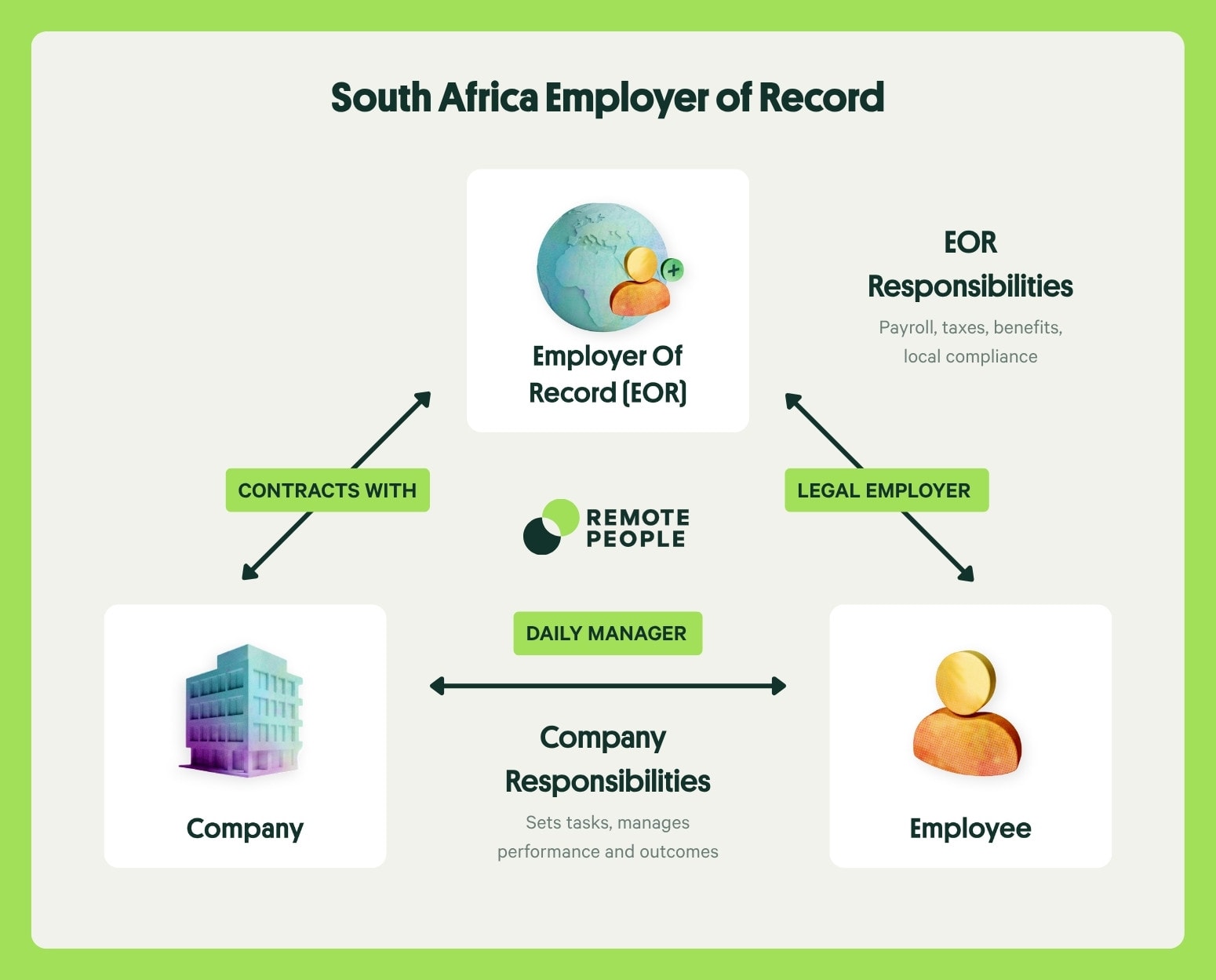
South Africa combines the continent’s deepest talent pool, English as a business language, and a mature legal system anchored in the Basic Conditions of Employment Act 75 of 1997. For companies looking to hire employees in South Africa, setting up a local subsidiary typically takes two to four months and involves CIPC company registration, a SARS income tax number, UIF and Compensation Fund enrolment, B-BBEE classification, and sector-specific licences. An employer of record in South Africa removes that overhead. The EOR acts as the legal employer on paper, running monthly PAYE through SARS, remitting UIF, SDL, and COIDA, issuing BCEA-compliant contracts, and managing onboarding, leave, and termination while your company directs the employee’s day-to-day work.
This guide walks through how an employer of record South Africa arrangement operates in practice: the BCEA and Labour Relations Act framework, the 2026/2027 SARS income tax brackets, the R30.23 national minimum wage effective 1 March 2026, the post-Van Wyk parental leave regime, statutory notice and severance under sections 37 and 41 of the BCEA, the 12 public holidays, Critical Skills and General Work Visas, and how EOR compares with setting up an entity, hiring contractors, or using a PEO.
How an Employer of Record Works in South Africa

If you’d like to learn more about how Employer of Record (EOR) services work, read our What Is an Employer of Record (EOR)? guide for a complete overview of the model, its benefits, and when to use it.
If you’re comparing providers, our Best Employer of Record (EOR) Providers guide reviews the leading platforms to help you choose the right solution for your business.
Who Uses an EOR in South Africa?
An employer of record in South Africa fits a specific set of scenarios where entity setup is not worth the cost, time, or compliance overhead. Common use cases include:
- Testing the South African market: Companies evaluating whether the country justifies a subsidiary can hire one or two employees through an EOR, gather commercial evidence, and only incorporate if the business case holds up after six to twelve months.
- Hiring a small remote team: Organisations that need one to fifteen employees in Johannesburg, Cape Town, Durban, or Pretoria rarely recover the cost of a CIPC-registered entity plus annual audit, B-BBEE verification, and SARS reconciliations. An EOR delivers a compliant hire in one to two weeks.
- Rapid onboarding: Where a role must start within two weeks, only an EOR can absorb the SARS, UIF, and Compensation Fund registration steps fast enough to meet the start date.
- Hiring foreign nationals: The EOR sponsors Critical Skills Work Visa, General Work Visa, and Intra-Company Transfer Visa applications with the Department of Home Affairs, which removes the need for the hiring company to register its own South African entity as a sponsor.
- Winding down or exiting: Deregistering a South African company with CIPC and closing its SARS, UIF, and COIDA files typically takes six to twelve months. An EOR arrangement can be ended in weeks with far lower legal and audit costs.
For any of these scenarios, the EOR is the faster, lighter alternative to incorporation. For companies planning 15 or more South African hires and a long-term operational presence, a local entity usually becomes the better economic choice over a three to five year horizon once fixed compliance costs are amortised across a bigger headcount.
Typical Onboarding Timeline
Most EOR providers can onboard a South African citizen or permanent resident in one to two weeks once the signed service agreement, employee details, and salary are confirmed. The stages are:
- EOR agreement and employee details: 1–2 days to sign the service agreement and collect the employee’s South African ID, SARS tax number, bank confirmation letter, and proof of address.
- Employment contract drafting and review: 2–3 days to issue BCEA-compliant written particulars under section 29 and allow the employee to review before signing.
- SARS, UIF and Compensation Fund registration: 3–7 days to confirm the PAYE withholding setup on the SARS eFiling employer profile, register the employee with the UIF via uFiling, and confirm the COIDA classification.
- Payroll setup and benefits enrolment: 2–3 days to configure the monthly payroll, enrol the employee in any supplementary medical aid or retirement fund, and load banking details.
- Employee onboarding and first day: 1 day for the employee to start work once the contract is signed, the payroll record is active, and any onboarding equipment has been issued.
Work permit hires extend the timeline considerably. A Critical Skills Work Visa typically takes eight to twelve weeks from submission to issuance, while a General Work Visa can take three to five months due to the Department of Employment and Labour recommendation step. SAQA foreign qualification evaluation, police clearance certificates from every country the applicant has lived in for twelve months or more since age 18, and medical and radiological reports each add time and are listed in the Work Permits and Visas section below.
Ready to Hire Your First Employee in South Africa?
A deep talent pool, English-speaking workforce, and a mature legal framework anchored in the Basic Conditions of Employment Act make South Africa an attractive market for global teams.
We handle employment contracts, PAYE payroll, tax withholding, and full South Africa compliance.
No local entity needed. Your team can start in days.
Employment Laws and Regulations in South Africa
Employment Contracts
South African employment is governed primarily by the Basic Conditions of Employment Act 75 of 1997 (WIPO Lex) and the Labour Relations Act 66 of 1995 (WIPO Lex), supplemented by the Employment Equity Act 55 of 1998 and the National Minimum Wage Act 9 of 2018. The Department of Employment and Labour administers the framework, while unfair dismissal disputes are heard by the Commission for Conciliation, Mediation and Arbitration (CCMA) and, on appeal, by the Labour Court and Labour Appeal Court.
The BCEA does not require contracts to be in writing, but section 29 requires employers to issue written particulars of employment on or before the first day, covering the employer and employee details, job description, ordinary hours, remuneration, allowances, payment intervals, notice, leave entitlements, and any deductions. In practice a signed written contract is the only defensible approach: the written particulars become the reference point for any later CCMA referral. Fixed-term contracts are permitted, but section 198B of the LRA deems any fixed-term contract of more than three months with an employee earning under the BCEA threshold (R254,371.67 per year from 1 April 2025 per the Department of Employment and Labour notice) to be indefinite unless the employer can justify the fixed term. English is the default working language for commercial employment, but the contract can be in any of South Africa’s 11 official languages where the parties agree.
Working Hours and Overtime
Under section 9 of the BCEA (WIPO Lex), the statutory workweek is a maximum of 45 ordinary hours, distributed as nine hours per day over five days or eight hours per day over six days. Employees are entitled to a daily rest of 12 consecutive hours, a weekly rest of at least 36 consecutive hours that must include a Sunday unless otherwise agreed, and a meal interval of at least one hour after five continuous hours of work. Overtime must be agreed in writing and is capped by section 10 at 10 hours per week and three hours per day, with a ceiling of 12 hours of work in total per day.
The overtime framework below is drawn directly from sections 10, 16, and 18 of the BCEA. The rates apply to all employees earning below the BCEA earnings threshold. Senior managerial employees, sales staff who travel, and employees working fewer than 24 hours per month fall outside the overtime and Sunday-work provisions under section 6. A company hiring through an EOR inherits these rates automatically, so there is no way to contract out of the 1.5x weekday floor below the threshold.
South Africa overtime and premium pay rates · Per Basic Conditions of Employment Act 75 of 1997 | |||
Hour Type | Rate Multiplier | Weekly/Daily Cap | Notes |
|---|---|---|---|
Weekday overtime | 1.5× hourly wage | 3 hours/day, 10 hours/week | Section 10; must be agreed in writing; max 12 hours total per day including ordinary time |
Sunday work (ordinary Sunday worker) | 1.5× hourly wage | 10 hours/week overall OT cap | Section 16(1); applies if Sunday is part of the employee’s ordinary schedule |
Sunday work (non-Sunday worker) | 2× hourly wage | 10 hours/week overall OT cap | Section 16(2); applies if employee does not ordinarily work Sundays |
Public holiday work | 2× hourly wage, or the day’s pay plus 1× for the time worked | 10 hours/week overall OT cap | Section 18; employee receives whichever calculation is higher |
Night work (18:00–06:00) | Night allowance or reduced hours, plus 1.5× for OT | No specific night cap | Section 17; applies where the employee regularly works after 23:00 or before 06:00 |
Senior managerial employees, travelling sales staff, and employees who earn above the BCEA threshold of R254,371.67 per year are excluded from sections 9 through 18 by section 6, which means they do not receive overtime premiums by law. Overtime cannot be averaged across weeks to circumvent the 10-hour ceiling except by a collective agreement registered under section 11. Time off in lieu of overtime is permitted only where it is agreed in writing at the equivalent premium. Overtime is not counted in the calculation base for severance under section 41 unless it is a regular, contractual element of remuneration.
Minimum Wage
The National Minimum Wage Act 9 of 2018 sets the statutory floor, and the rate rises annually in March. From 1 March 2026 the national minimum wage is R30.23 per ordinary hour worked, gazetted in Government Notice No. R.7083 in Government Gazette Vol. 728 No. 54075 on 20 February 2026 (South African Government Gazette). The previous rate of R28.79 per hour applied from 1 March 2025. For a 45-hour workweek on a 52-week year this works out to approximately R5,895 per month at the new rate.
Sector wage schedules sit alongside the national floor and apply where they are higher. The 2026 gazette confirms the following sector-specific rates:
- Farm workers and domestic workers: R30.23 per hour from 1 March 2026, bringing both sectors in line with the general minimum wage.
- Expanded Public Works Programme workers: R16.62 per hour, roughly 55% of the general rate, reflecting the programme’s training and poverty-alleviation design.
- Learnership allowances: Minimum weekly stipends are set by NQF level in Schedule 2 of the gazette and range from R362.04 at NQF level 1 and below to R2,144.42 at NQF levels 5 to 8 with 260+ credits.
- Wholesale and retail sector: Area-based minima in Schedule 3 of the gazette, with Area A cashiers and salespersons at R30.23 per hour and rising differentials for supervisors and managers.
Probation Period
The BCEA does not prescribe a maximum probation period. South African employers commonly set probation at three to six months, tailored to the seniority of the role, and document the terms clearly in the written particulars of employment. The Code of Good Practice: Dismissal in Schedule 8 of the Labour Relations Act is the governing instrument: it states that the purpose of probation is to give the employer an opportunity to evaluate performance before confirming appointment, and that probation is not a licence to dismiss without cause. During probation the employer may terminate for poor performance, unsuitability, or misconduct only after a fair procedure that includes evaluation, feedback, counselling, and, where appropriate, an opportunity to improve. The notice periods in section 37 apply from day one, so a probationer with less than six months of service is still entitled to one week’s notice.
Leave Entitlements
Chapter 3 of the BCEA sets the statutory floor for paid time off in South Africa. The entitlements below are the minimum, and many employers offer more generous terms in the written particulars. Leave accrues from the first day of continuous employment rather than after the probation period, which is a common misconception among foreign employers hiring locally for the first time.
Annual Leave
Section 20 of the BCEA grants every employee at least 21 consecutive days of paid annual leave per annual leave cycle of 12 months, which works out to 15 working days for a 5-day workweek or 18 working days for a 6-day workweek. An alternative accrual of one hour for every 17 hours worked, or one day for every 17 days worked, is permitted by agreement. Annual leave cannot be paid out in cash while the employment relationship continues, must be paid at the employee’s full remuneration rate, and must be taken within six months of the end of the cycle in which it accrued unless the employee agrees to a later date.

Sick Leave
Under section 22 of the BCEA, employees are entitled to paid sick leave equal to the number of days they ordinarily work during a six-week period in each 36-month sick leave cycle. That works out to 30 working days for a five-day workweek and 36 days for a six-day week. During the first six months of employment, sick leave accrues at one day for every 26 days worked. A medical certificate from a registered practitioner is required for absences of more than two consecutive days or for absences on more than two occasions in an eight-week period. Sick leave is paid at full remuneration and is separate from the annual leave pool.
Maternity Leave
Section 25 entitles every female employee to at least four consecutive months of maternity leave, which may start four weeks before the expected delivery date or earlier on medical certification. The employee may not return to work for six weeks after the birth unless a medical practitioner certifies her fit. The BCEA does not require the employer to pay maternity leave salary, but the Unemployment Insurance Fund pays a maternity benefit of up to 66% of the employee’s remuneration subject to the R17,712 earnings ceiling (Department of Employment and Labour – UIF). Many employers top up the UIF payment to full salary as a contractual benefit. Dismissal on grounds related to pregnancy is an automatically unfair dismissal under section 187 of the Labour Relations Act.
Paternity Leave
The October 2025 Constitutional Court judgment in Van Wyk and Others v Minister of Employment and Labour (SAFLII) declared sections 25, 25A, 25B, and 25C of the BCEA unconstitutional because they discriminated between birth mothers, non-birthing co-parents, adoptive parents, and commissioning parents in surrogacy arrangements. Pending parliamentary amendment, the Court ordered a remedial regime: all parents are collectively entitled to four months and 10 days of parental leave that they may share as they choose, with the default being an equal split where parents cannot agree. This replaces the previous 10-day paternity leave under section 25A. The reform took effect immediately on 3 October 2025 and applies to any birth, adoption, or surrogacy that occurs on or after that date.
Other Statutory Leave
Section 27 of the BCEA grants three days of paid family responsibility leave per annual leave cycle for the birth of a child, the illness of a child, or the death of an immediate family member (spouse, parent, child, grandparent, sibling, or in-laws). The leave is available to employees who work for at least 24 hours a month and have been employed for at least four months. Beyond the BCEA, employees are entitled to paid time off on the 12 public holidays (see Table 4), to reasonable time off to vote in national and provincial elections, and to reasonable time off for jury service and compulsory military call-up where applicable.
The table below consolidates the statutory leave framework under the BCEA as it stands after the Van Wyk judgment. The key takeaway for foreign employers is that annual and sick leave accrue from day one of employment rather than after probation, and that parental leave is now a shared pool rather than a gender-specific entitlement.
South Africa statutory leave entitlements · Per Basic Conditions of Employment Act 75 of 1997 | ||
Leave Type | Duration | Eligibility & Notes |
|---|---|---|
Annual leave | 21 consecutive days (15 working days on a 5-day week) | Section 20; accrues from first day of employment; full pay |
Sick leave | 30 working days per 36-month cycle (5-day week) | Section 22; medical certificate for 2+ consecutive days; full pay |
Maternity leave | 4 consecutive months | Section 25; paid by UIF up to 66% of earnings; employer top-up optional |
Parental leave (post-Van Wyk) | 4 months + 10 days shared between parents | Interim regime from 3 October 2025; applies to all birth, adoptive, and commissioning parents |
Family responsibility leave | 3 days per annual leave cycle | Section 27; birth or illness of child, death of close family member |
Public holidays | 12 paid days per year | Public Holidays Act 36 of 1994; Monday substitution for Sunday holidays |
Voting and jury leave | Reasonable time off | Electoral Act 73 of 1998; Jury Act and Defence Act where applicable |
Statutory Employee Benefits
Beyond the BCEA leave framework and the UIF maternity benefit, South African employers must register with and contribute to several statutory benefit schemes. The rates are covered in detail in the Payroll, Taxes, and Social Security section, so this section focuses on what the benefit actually is and which fund it sits with.
- Unemployment Insurance Fund (UIF): A contributory scheme administered by the Department of Employment and Labour under the Unemployment Insurance Act 63 of 2001. Pays unemployment, illness, maternity, parental, and dependant’s benefits to qualifying contributors up to the R17,712 monthly earnings ceiling.
- Compensation for Occupational Injuries and Diseases (COIDA): An employer-funded scheme under the Compensation for Occupational Injuries and Diseases Act 130 of 1993. Pays medical expenses and loss-of-earnings benefits for work-related injuries and diseases. Assessment rates vary by industry risk class; the 2025/2026 minimum assessment is R1,621.
- Skills Development Levy (SDL): A 1% payroll levy payable to SARS on behalf of the 21 Sector Education and Training Authorities (SETAs), applicable to employers with an annual payroll above R500,000. Funds accredited learnerships and skills grants.
- Retirement cover: Not statutorily mandatory for private-sector employees, but most medium and large employers offer a provident or pension fund, often with employer matching. Any employer-sponsored retirement fund must be registered with the Financial Sector Conduct Authority.
- Medical aid: Not mandatory under the BCEA, but a standard benefit for professional and managerial roles. Schemes must be registered with the Council for Medical Schemes. The government continues to plan for a National Health Insurance system, but until implementation the private medical aid market sits alongside state healthcare.
- Group life and disability cover: Not statutorily mandatory but commonly offered as part of a retirement fund benefit structure.
An EOR handles the mandatory registrations (UIF, SDL, COIDA) automatically and can enrol the employee in any supplementary medical aid, provident fund, or group life product that the hiring company wants to offer as part of the package.
Recent Regulatory Updates (2026)
Three significant developments have shaped South African employment compliance in the 12 months leading up to publication. First, the Constitutional Court’s decision in Van Wyk and Others v Minister of Employment and Labour (case CCT 308/23, delivered 3 October 2025) invalidated the gender-specific parental leave regime in sections 25, 25A, 25B, and 25C of the BCEA and ordered an immediate interim remedy: four months and ten days of shared parental leave across all parents, including adoptive and commissioning parents. Parliament has 36 months to pass remedial legislation, so the interim regime will remain in force through much of 2026 and 2027.
Second, the National Minimum Wage rose from R28.79 to R30.23 per hour on 1 March 2026 under Government Notice No. R.7083 in Gazette No. 54075, a 5% adjustment recommended by the National Minimum Wage Commission on a CPI plus 1.5% basis. The same gazette aligned farm and domestic worker rates with the general rate for the first time, completing the phase-in that began in 2022.
Third, President Cyril Ramaphosa proclaimed the Compensation for Occupational Injuries and Diseases Amendment Act 10 of 2022 into operation in phases on 23 January, 1 February, and 1 April 2026 under Proclamation Notice 306 of 2026 (Government of South Africa). The amendments extend COIDA cover to domestic workers, introduce a statutory rehabilitation and return-to-work framework, empower compensation commissioners to impose administrative penalties, and change how employers report occupational diseases. Employers should expect a tightened compliance environment around injury-on-duty reporting and increased scrutiny of late submissions.
Work Permits and Visas in South Africa
Work Permit Requirements
Who Needs a Work Permit
Any foreign national who is not a South African citizen, permanent resident, or holder of a valid relative’s permit with work endorsement needs a work visa to be employed in South Africa. This applies whether the employer is a local entity or an EOR acting as the employer of record. South African citizens and permanent residents do not require authorisation. Citizens of Lesotho, eSwatini, and Zimbabwe may be eligible for special dispensation permits administered under bilateral arrangements, but these do not replace the need for employment authorisation. Tourists, business visitors, and holders of general visitor visas are expressly prohibited from working and cannot be placed on payroll without a change of status.
Eligibility and Required Documents
Applicants must submit to the Department of Home Affairs a passport valid for at least 30 days beyond the intended departure date, a signed employment contract or offer of employment, proof of qualifications evaluated by the South African Qualifications Authority (SAQA), police clearance certificates from every country the applicant has lived in for 12 months or more since age 18, a radiological and medical certificate, proof of medical aid cover, and, for the General Work Visa, a Department of Employment and Labour recommendation confirming the employer was unable to find a suitable South African citizen or permanent resident. Critical Skills applicants must show their occupation appears on the Critical Skills List published in Government Gazette Notice 245 of 2022 and must provide professional body registration or confirmation where the occupation requires it.
Processing Time and Validity
Critical Skills Work Visa applications typically process in eight to twelve weeks, though the Department of Home Affairs targets four weeks as a service standard on complete applications. General Work Visa applications take three to five months because of the additional Department of Employment and Labour certification step. Visas are issued for the duration of the employment contract up to a maximum of five years. Delays are most commonly caused by incomplete SAQA evaluations, police clearances still in transit, or changes in the Critical Skills List (Fragomen).
Renewal Process
Renewal applications must be lodged at a VFS Global centre at least 60 days before the current visa expires. The documentation set largely mirrors the initial application, with an updated employment contract, proof of continued employment, updated police clearance, and a current medical certificate. The employee may continue working on the existing visa while the renewal is under consideration, provided the application was lodged before expiry and a receipt is held. Late renewals risk an “undesirable” declaration under the Immigration Act 13 of 2002, which can trigger an entry ban.
Common Visa Types for Foreign Workers
The Department of Home Affairs issues several work visa categories under the Immigration Act 13 of 2002 and the 2025 points-based system for General and Critical Skills visas. The table below summarises the main options. An EOR can sponsor every category listed except the Business Visa, which requires a South African investment in the applicant’s own business, and the Corporate Work Visa, which is a facility for corporate employers meeting minimum-headcount thresholds.
South Africa work visa types for foreign workers · 2026 | ||||
Visa Type | Duration | Best For | Leads to APT? | Processing |
|---|---|---|---|---|
Critical Skills Work Visa | Up to 5 years | Occupations on the 2022 Critical Skills List | Yes (after 5 years) | 8–12 weeks |
General Work Visa | Duration of contract up to 5 years | Any role where SA talent is unavailable (DEL certification required) | Yes (after 5 years) | 3–5 months |
Intra-Company Transfer Visa | Up to 4 years, non-renewable | Transfers from a foreign parent or affiliate company | No | 4–8 weeks |
Business Visa | Up to 3 years, renewable | Foreign entrepreneurs investing in a SA business | Yes | 8–12 weeks |
Corporate Work Visa | Up to 3 years | Corporate applicants hiring multiple foreign nationals at once | No | 3–4 months |
Remote Work Visitor Visa | Up to 3 years | Digital nomads employed by a foreign employer earning R1m+ per year | No | 4–8 weeks |
Several visa categories do not permit employment and should not be confused with work visas:
- Visitor Visa (tourist): Issued for up to 90 days, does not allow employment of any kind.
- Study Visa: Allows part-time work of up to 20 hours per week only if the study institution endorses it.
- Transit Visa: Valid for passing through South Africa only; no work permitted.
How an EOR Handles Work Permits
An EOR is the sponsoring employer on the visa application and submits the Department of Employment and Labour recommendation (for General Work Visas), the SAQA-evaluated qualifications, and the employment contract to the Department of Home Affairs through VFS Global. The hiring company supplies the job specification, salary details, and the applicant’s original documents. The employee is responsible for personal documents such as police clearances, medical and radiological certificates, passport photographs, and a police clearance from any country in which they lived for more than 12 months since age 18. Work permit sponsorship extends the one to two week standard EOR onboarding by eight to twelve weeks for Critical Skills Work Visas and three to five months for General Work Visas, so hiring timelines should account for this in the offer letter. RemotePeople handles the full visa liaison as part of the EOR service, including lodgement, status tracking, and renewals.
Payroll, Taxes, and Social Security in South Africa
Employer Contributions
South African employers contribute to three statutory schemes on top of the gross salary. UIF is split equally with the employee at 1% each up to the R17,712 monthly earnings ceiling, producing a maximum employer UIF contribution of R177.12 per month. The Skills Development Levy is an employer-only charge at 1% of the full payroll, uncapped, payable by any employer whose annual payroll exceeds R500,000. COIDA is an employer-only annual assessment based on industry risk class and earnings; a typical office-based class 1 employer pays around 0.5% of remuneration up to the OID earnings ceiling (R597,328 for the 2025/2026 period per the Department of Employment and Labour notice), subject to a minimum assessment of R1,621 per year.
South Africa employer social security contributions · 2026 rates | ||
Contribution | Rate | Notes |
|---|---|---|
Unemployment Insurance Fund (UIF) | 1% | Capped at R17,712 monthly earnings = max R177.12/month; remitted via EMP201 |
Skills Development Levy (SDL) | 1% | Uncapped; payable only where annual payroll exceeds R500,000 |
COIDA (Compensation Fund) | ~0.5% (varies by industry class) | Annual assessment; min R1,621; capped at the OID ceiling of R597,328 per employee |
Typical total employer cost | ~2.5% | Class 1 office employer above R500k payroll; rises for higher-risk classes |
Employee Contributions
Employees contribute only to the UIF on the statutory side. The 1% UIF deduction applies to remuneration up to the R17,712 monthly ceiling, producing a maximum employee UIF deduction of R177.12 per month. Beyond that, PAYE is withheld from gross salary on a progressive scale (see the Income Tax section below), and any voluntary deductions such as medical aid, retirement fund contributions, or group life premiums are added per the employee’s instruction.
South Africa employee payroll deductions · 2026 monthly withholdings | ||
Deduction | Rate | Notes |
|---|---|---|
PAYE (income tax) | 18%–45% progressive | Withheld monthly on SARS tables; primary rebate R17,820 applied |
Unemployment Insurance Fund (UIF) | 1% | Capped at R17,712 monthly earnings = max R177.12/month |
Medical aid (voluntary) | Scheme-dependent | Paid via payroll where enrolled; medical tax credit offsets PAYE |
Retirement fund (voluntary) | 0%–27.5% of income | Tax-deductible up to 27.5% of taxable income or R350,000/year, whichever is lower |
Minimum statutory employee deduction | 1% UIF + PAYE | UIF capped at R177.12/month; PAYE varies with taxable income |
Source: SARS – Rates of Tax for Individuals and SARS – UIF | ||
Income Tax
South Africa levies a progressive income tax administered by the South African Revenue Service under the Income Tax Act 58 of 1962. The tax year runs from 1 March to the end of February. For the 2026/2027 tax year (1 March 2026 to 28 February 2027) the brackets below apply, with a primary rebate of R17,820 and an age-based tax threshold of R99,000 for taxpayers under 65 (SARS). Additional rebates of R9,765 (age 65+) and R3,249 (age 75+) raise the threshold further for older taxpayers.
South Africa income tax brackets · 2026/2027 | |
Taxable Income (ZAR) | Tax Calculation |
|---|---|
R1 – R245,100 | 18% of taxable income |
R245,101 – R383,100 | R44,118 + 26% of amount above R245,100 |
R383,101 – R530,200 | R79,998 + 31% of amount above R383,100 |
R530,201 – R695,800 | R125,599 + 36% of amount above R530,200 |
R695,801 – R887,000 | R185,215 + 39% of amount above R695,800 |
R887,001 – R1,878,600 | R259,783 + 41% of amount above R887,000 |
R1,878,601 and above | R666,339 + 45% of amount above R1,878,600 |
Payroll Cycle
Payroll in South Africa is typically monthly, with payment between the 25th and the last working day of the month into a local bank account. Weekly and fortnightly cycles are legal under section 32 of the BCEA, but they are rare outside of agriculture, hospitality, and retail. Salary must be paid in South African rand and by direct bank transfer. The employer must issue a payslip that shows gross earnings, PAYE, UIF, any voluntary deductions, and net pay. PAYE, UIF, and SDL are remitted to SARS on the EMP201 monthly declaration by the 7th of the following month, with a biannual EMP501 reconciliation due by 31 October (interim) and 31 May (final). COIDA assessments are lodged through the online Return of Earnings (W.As.8) by 31 May each year, with payment due 30 days after the assessment is issued.
13th Month Salary and Bonus Pay
South Africa does not impose a statutory 13th month salary. A year-end bonus (often called a “13th cheque”) is payable only where the employment contract, a collective agreement, or an established practice creates an enforceable right. Many South African employers offer a discretionary December bonus of between one-half and one month’s gross salary, but the BCEA and the Labour Relations Act do not require it. Where a bonus is promised in the contract it is fully taxable under SARS rules, subject to PAYE in the month paid, and reported on the employee’s IRP5 certificate at year-end. Sector-specific bargaining council agreements in metals, retail, and road freight may impose bonus obligations, so the EOR reviews the applicable main agreement before confirming the package.
Cost of Hiring Through an EOR in South Africa
EOR Service Fees
EOR service fees in South Africa typically range between $300 and $600 per employee per month, charged as a flat USD fee on top of the gross salary and statutory employer contributions. The fee covers payroll processing, PAYE and UIF remittance, SDL and COIDA administration, BCEA-compliant contract drafting, leave tracking, onboarding and offboarding, ongoing HR support, and statutory reporting. RemotePeople’s EOR service sits in the middle of this range, with the exact figure depending on salary band, headcount, and whether visa sponsorship is required.
Total Employment Cost Breakdown
The table below illustrates the total employer cost for a mid-market professional earning an all-in gross package of $5,000 per month in South Africa. The line items include UIF, SDL, and a Class 1 (office) COIDA assessment, plus the EOR service fee. This example assumes the employer’s annual payroll is above the

South Africa employer cost example · USD 5,000 gross · 2026 | ||
Employer Cost Line | Amount (USD) | % of Gross |
|---|---|---|
Gross monthly salary | $5,000.00 | 100.00% |
UIF (1%, capped at R17,712) | $9.60 | 0.19% |
Skills Development Levy (1% of payroll) | $50.00 | 1.00% |
COIDA (Class 1 office, ~0.5%) | $25.00 | 0.50% |
EOR service fee (flat) | $450.00 (est.) | 9.00% |
Total employer cost | $5,534.60 | 110.69% |
Figures converted at 1 USD ≈ R18.50, April 2026. The R17,712 UIF ceiling translates to roughly $957, so the 1% UIF contribution on a $5,000 salary is capped at $9.60 per month rather than the uncapped $50.
Total employer cost typically runs about 10–11% above the gross salary for a mid-market hire in South Africa, dominated by the EOR service fee rather than statutory contributions. Class 2 or Class 3 COIDA industries (construction, mining, manufacturing) add more, and any top-up medical aid or retirement contribution the hiring company chooses to fund sits on top of this baseline.
Benefits of Using an EOR in South Africa
Hiring in South Africa through an employer of record delivers concrete advantages over incorporation, especially for small teams, remote roles, and foreign-national hires that would otherwise require a full local setup. The benefits below are specific to the South African compliance environment following the Van Wyk judgment and the 2026 COIDA amendments.
- Speed to market: An EOR can place a South African citizen or permanent resident on compliant payroll in one to two weeks. Incorporating a local entity with CIPC, opening a SARS account, registering with UIF and COIDA, and completing B-BBEE assessment typically takes two to four months.
- Compliance assurance: The EOR carries the statutory employer obligations under the BCEA, the LRA, the Employment Equity Act, COIDA, and the Skills Development Act. Regulatory change, whether the Van Wyk parental leave reform, the COIDA amendments effective 2026, or the annual minimum wage gazette, lands on the EOR, not on your company.
- Cost efficiency versus a local entity: A CIPC-registered private company typically costs R50,000–R150,000 to set up and R80,000–R200,000 per year to maintain (audit, secretarial, payroll, tax return preparation). At $300–$600 per employee per month, an EOR is more cost effective for any team of fewer than 10–15 people.
- Local expertise: EOR providers maintain registered employment lawyers, tax practitioners, and CCMA advocates, which matters when an employee refers an unfair dismissal dispute or when SARS challenges a fringe benefit classification. The hiring company inherits this expertise without putting it on payroll.
- Flexibility to scale up or down: An EOR engagement can be ended in weeks with statutory notice and severance handled by the provider. A local entity requires deregistration with CIPC, tax clearance from SARS, final UIF and COIDA submissions, and, in practice, six to twelve months to wind up cleanly.
- Risk mitigation on CCMA referrals: The Commission for Conciliation, Mediation and Arbitration receives tens of thousands of unfair dismissal referrals every year. An EOR with local employment law capability absorbs the procedural workload and reduces the risk of an adverse arbitration award that would otherwise land on the hiring company.
- Employee experience: The employee receives a BCEA-compliant contract, registered UIF and COIDA cover, a compliant payslip with monthly PAYE, and access to South African statutory benefits such as UIF maternity pay without having to wait for a foreign employer to stand up a local payroll.
For foreign companies that want a presence in South Africa without taking on the full compliance burden, EOR delivers a predictable, low-overhead path to a compliant hire. Talk to our South Africa team about scope and pricing.
Termination and Offboarding in South Africa
Notice Periods
Section 37 of the BCEA sets statutory minimum notice periods that scale with length of service. Notice may be given by either the employer or the employee, must be in writing unless the employee is illiterate, and cannot be shorter than the statutory minimum even by agreement. Payment in lieu of notice is permitted where the employment contract provides for it. The notice floor below applies regardless of whether the employee is on probation, and runs from the day written notice is delivered.
South Africa statutory notice periods by length of service · Per BCEA section 37 | |||
Length of Service | Notice Period | During Probation | Notes |
|---|---|---|---|
Less than 6 months | 1 week | Same (1 week) | Section 37(1)(a); counted in calendar weeks |
6 months – 12 months | 2 weeks | n/a (probation usually ends) | Section 37(1)(b); for farm and domestic workers, 4 weeks after 6 months |
12 months or more | 4 weeks | n/a | Section 37(1)(c); applies to all sectors |
Farm and domestic workers (6+ months) | 4 weeks | n/a | Section 37(1)(b) special rule |
Collective dismissal (retrenchment) | Same service-based notice, plus section 189 consultation | n/a | LRA section 189A where 50+ employees are affected; facilitated process |
Notice is not required where the employer is dismissing for misconduct, incapacity, or another fair reason under Schedule 8 of the LRA and the employer follows the prescribed disciplinary procedure. Notice is also not required at the expiry of a fair fixed-term contract. Where the employee resigns with notice, the employer may elect to pay in lieu of notice and release the employee earlier.
Severance Pay
Section 41 of the BCEA requires the employer to pay severance equal to at least one week’s remuneration for each completed year of continuous service where the dismissal is based on the employer’s operational requirements (retrenchment) or where the contract ends under section 38 of the Insolvency Act 24 of 1936. Severance is not payable where the employee is dismissed for misconduct, incapacity, or at the end of a fixed-term contract, and is not payable where the employee unreasonably refuses an offer of alternative employment from the employer or a related party. The table below shows worked examples at four common tenure points.
South Africa severance pay schedule by years of service · Per BCEA section 41 | |||
Years of Service | Severance Amount | Base Salary | Notes |
|---|---|---|---|
1 year | 1 week’s remuneration | Gross weekly pay including regular allowances | Only for operational-requirements dismissal |
3 years | 3 weeks’ remuneration | Gross weekly pay including regular allowances | Unreasonable refusal of alternative role = no severance |
5 years | 5 weeks’ remuneration | Gross weekly pay including regular allowances | First R500,000 of severance is tax-free under SARS (lifetime cap) |
10 years | 10 weeks’ remuneration | Gross weekly pay including regular allowances | Plus notice pay; plus any ex gratia where agreed |
Calculation Method
The section 41 base is one week of the employee’s gross remuneration for each completed year of continuous service. “Remuneration” is defined in section 35 of the BCEA and a 2003 Ministerial Determination, and includes gross cash pay plus the cash value of regular allowances (housing, travel, cellphone) and the employer contribution to retirement and medical aid, but not overtime, ad-hoc bonuses, or expense reimbursements. Partial years of service are not counted under section 41, though many employers pay pro-rata as a matter of practice or collective agreement. See Table 13 above for worked examples at one, three, five, and ten years.
Caps and Exceptions
The BCEA does not impose a statutory cap on severance pay. SARS, however, applies a lifetime tax-free amount of R500,000 on severance benefits under section 1 of the Income Tax Act, so the first R500,000 of accumulated severance across an employee’s career is taxed at 0% and amounts above that are taxed at preferential retirement rates. Severance is not payable where the employee is dismissed for misconduct or incapacity, where a fair fixed-term contract has simply expired, or where the employee unreasonably refuses suitable alternative employment. Where a collective agreement, CCMA settlement, or contractual clause provides more than the section 41 floor, the higher amount applies.
Grounds for Termination
Schedule 8 of the Labour Relations Act recognises three fair reasons for dismissal: misconduct, incapacity (whether ill-health or poor performance), and operational requirements. Each requires its own substantive justification and a fair procedure. Misconduct dismissal requires a disciplinary hearing where the employee can answer the allegation; incapacity dismissal for poor performance requires evaluation, counselling, and an opportunity to improve; operational requirements dismissal requires the section 189 consultation process under the LRA. Automatically unfair dismissals under section 187 of the LRA include dismissals on grounds of pregnancy, trade union activity, whistleblowing under the Protected Disclosures Act 26 of 2000, and discrimination on any of the grounds listed in section 6(1) of the Employment Equity Act. Unfair dismissal claims go to the CCMA within 30 days, and discrimination and automatically unfair dismissal claims go to the Labour Court.
EOR vs. Other Hiring Models in South Africa
EOR vs. Setting Up a Local Entity
Setting up a South African subsidiary is the right choice for large-scale, long-horizon operations, but for most small teams and remote hires, the cost and time overhead is hard to justify. The table below compares an EOR engagement with a CIPC-registered private company in terms of setup, ongoing cost, compliance scope, and exit flexibility.
South Africa EOR vs local entity comparison · Setup time, cost, risk and best-fit | ||
Comparison | Employer of Record | Own Entity |
|---|---|---|
Setup time | 1–2 weeks | 2–4 months |
Upfront cost | $0 | $3,000–$8,000 (CIPC, legal, bank, SARS, B-BBEE setup) |
Ongoing cost | $300–$600/employee/month | $5,000–$12,000/year in audit, secretarial, tax, and payroll |
Local partner required | No (EOR is the local entity) | No (100% foreign ownership allowed; B-BBEE applies for most tenders) |
Social insurance registration | Handled by EOR (UIF, SDL, COIDA) | You manage it |
Payroll & tax filing | Handled by EOR (EMP201, EMP501, W.As.8) | You manage it, or outsource to a local payroll bureau |
Best for team size | 1–15 employees | 15+ employees with long-term presence |
Scale down / exit | Easy; no entity to unwind | Costly; CIPC deregistration, SARS clearance, 6 to 12 months |
Government contracts | Not eligible | Eligible (requires local entity and B-BBEE certificate) |
The break-even point typically sits at around 15 employees over a three to five year horizon. Below that, the EOR’s flat monthly fee beats the fixed compliance cost of a local entity. Above that, the entity’s zero-marginal-cost addition of each new hire begins to win. Hiring companies should also weigh intangible factors such as access to government procurement (which requires a South African entity and B-BBEE certification) and the ability to issue share options to employees, which is simpler through a local company.
EOR vs. Hiring Independent Contractors
Some companies search for a “contractor of record” in South Africa, hoping for a lighter-weight alternative to an EOR. South Africa’s misclassification risk is real. The BCEA and LRA both contain section 200A presumptions that treat a worker as an employee if any one of seven indicators applies (controlled by the company, hours set by the company, part of the company’s organisation, worked for 40+ hours per month for at least three months, economically dependent on the company, supplied with tools or equipment, works for only one client). A successful misclassification finding exposes the company to back-taxes on PAYE, UIF, SDL, and COIDA, plus an unfair dismissal claim if the contract is terminated, plus CCMA cost orders.
South Africa EOR vs independent contractors · Compliance, cost, and risk | ||
Comparison | EOR (Full-Time Employee) | Independent Contractor |
|---|---|---|
Legal relationship | Employee of the EOR | Self-employed, no employment relationship |
Compliance risk | Low; EOR ensures local labour law compliance | Elevated; BCEA and LRA section 200A presumption may reclassify |
Payroll & tax | EOR handles PAYE, UIF, SDL, COIDA, and filings | Contractor invoices you; handles provisional tax and VAT |
Benefits & leave | Statutory benefits, paid leave, UIF cover | No entitlement to employee benefits |
IP protection | Stronger; BCEA-compliant contract assigns IP by default | Weaker; requires explicit IP assignment clause and consideration |
Termination | BCEA section 37 notice and section 41 severance where applicable | Contract can be ended per agreement terms |
Best for | Long-term, core team roles | Short-term projects, specialised tasks |
Cost structure | Salary + employer contributions + EOR fee | Contractor fee (typically higher gross, lower total) |
Independent contractors work well in South Africa for short-term, specialised tasks where the contractor genuinely operates as an independent business with multiple clients, sets their own hours, supplies their own tools, and bears their own commercial risk. Long-running, full-time roles sitting inside the company’s structure almost always fall foul of the section 200A tests and should be structured as employment, either through an EOR or a local entity. RemotePeople also offers a contractor-of-record solution for South Africa for cases where engagement genuinely meets the independent-contractor profile.
EOR vs. PEO (Professional Employer Organization)
The EOR model and the PEO (Professional Employer Organisation) model sound similar but operate very differently in South Africa. An EOR becomes the legal employer of the employee and carries the statutory employer obligations. A PEO enters a co-employment arrangement where the client company remains the legal employer and the PEO provides HR and payroll services on top. South Africa does not have a formal statutory PEO framework the way some jurisdictions do; arrangements described as “PEO” in the local market are typically outsourced payroll bureaus rather than co-employers, so the comparison below is with the closest practical analogue.
South Africa EOR vs PEO comparison · Legal employer, liability, and setup | ||
Comparison | Employer of Record (EOR) | PEO |
|---|---|---|
Legal employer | EOR is the legal employer | You remain the legal employer (co-employment) |
Local entity required | No; the EOR is the local entity | Yes; you must have your own South African entity |
Best for | Companies without a local entity | Companies that already have a local entity |
Compliance liability | EOR assumes compliance responsibility | Shared liability between you and the PEO |
Setup time | 1–2 weeks | Depends on your entity setup (weeks to months) |
Control over HR policies | EOR manages within local law framework | More direct control, PEO advises |
Typical use case | Market entry, small remote teams, testing new markets | Established local operations needing HR outsourcing |
For foreign companies without a South African entity, an EOR is the only model that produces a compliant hire without incorporation. A PEO-style arrangement only makes sense once a local subsidiary is in place and the hiring company wants to outsource the administrative side of HR and payroll. The practical test is simple: if your company is not CIPC-registered and does not have a SARS PAYE number, you need an EOR rather than a PEO.
Public Holidays in South Africa
The Public Holidays Act 36 of 1994 recognises 12 official public holidays each year. Where a public holiday falls on a Sunday, the following Monday is observed under section 2(1) of the Act, which happens once in 2026 (National Women’s Day). The 2026 dates below are the gazetted observances and apply to all employees under the BCEA.
South Africa public holidays · 2026 calendar year | ||
Date | Holiday | Type |
|---|---|---|
Thursday, 1 January | New Year’s Day | Statutory |
Saturday, 21 March | Human Rights Day | Statutory |
Friday, 3 April | Good Friday | Statutory (religious) |
Monday, 6 April | Family Day | Statutory |
Monday, 27 April | Freedom Day | Statutory |
Friday, 1 May | Workers’ Day | Statutory |
Tuesday, 16 June | Youth Day | Statutory |
Monday, 10 August (observed) | National Women’s Day (falls on Sunday 9 August) | Statutory (Monday substitution) |
Thursday, 24 September | Heritage Day | Statutory |
Wednesday, 16 December | Day of Reconciliation | Statutory |
Friday, 25 December | Christmas Day | Statutory (religious) |
Saturday, 26 December | Day of Goodwill | Statutory |
An employee who ordinarily works on a public holiday is entitled to double pay under section 18 of the BCEA, or the regular daily pay plus the hours worked at the normal rate, whichever is greater. Employers should plan payroll cut-offs around the concentrated April (Good Friday, Family Day, Freedom Day) and December (Reconciliation, Christmas, Goodwill) public holiday clusters, which regularly compress the processing window.
How to Get Started with an EOR in South Africa
Moving from scoping to a compliant South African hire takes five clearly defined steps. Allow two to three business days for contracts and registrations where no work permit is required, and eight to twelve weeks where a Critical Skills Work Visa is needed.
- First, scope the role: Define the job description, salary band, start date, location (Johannesburg, Cape Town, Durban, Pretoria, or remote), and whether the candidate is a South African citizen or requires visa sponsorship. RemotePeople can sense-check the salary band against local market rates before issuing the offer.
- Second, sign the EOR service agreement: The agreement sets out the scope of service, the monthly fee, the payment cycle, and the allocation of IP, confidentiality, and termination rights between the hiring company and the EOR.
- Third, share the candidate details and issue the contract: Provide the candidate’s South African ID, SARS number, qualification copies, and bank confirmation. The EOR drafts the BCEA-compliant written particulars and the hiring company approves the final version before it goes to the employee.
- Fourth, complete statutory registration: The EOR registers the employee with SARS for PAYE, with the Department of Employment and Labour for UIF, and with the Compensation Fund for COIDA, and enrols the employee in any supplementary medical aid or retirement arrangement the hiring company wants to offer.
- Fifth, start payroll: The first full pay cycle runs on the next monthly pay date. The hiring company directs the day-to-day work, approves leave requests through the EOR platform, and receives monthly invoices that break out salary, statutory contributions, and EOR fee.
Ready to build your South Africa team? Contact RemotePeople and we will return a scoped proposal with timelines and pricing within two business days.
Where companies hiring in South Africa expand next
Employers with staff in South Africa often extend across Southern Africa, drawing on shared SADC labor frameworks and cross-border mobility. After building a team in South Africa, employers often look to operations in Botswana for SADC-wide hiring and compliance parity, then Mozambique for SADC labor framework alignment. Hiring in Zambia follows with shared SADC workforce mobility, and an EOR partner in Zimbabwe typically closes the regional footprint via aligned SADC labor rules.
Frequently Asked Questions About Hiring in South Africa
EOR services in South Africa typically cost between $300 and $600 per employee per month as a flat fee on top of the gross salary and statutory employer contributions. Total employer cost runs about 10-11% above the gross salary for a mid-market professional, dominated by the EOR fee because the UIF (1%, capped at R17,712), SDL (1%, payroll over R500,000), and COIDA (about 0.5% for office-based Class 1 employers) are relatively low. See Table 6 above for a full worked example at $5,000 gross (SARS).
For a South African citizen or permanent resident, one to two weeks from signed EOR agreement to first day of work. The stages are contract signature (1-2 days), BCEA-compliant written particulars (2-3 days), SARS, UIF and COIDA registration (3-7 days), and payroll setup (2-3 days). Critical Skills Work Visa hires add eight to twelve weeks, and General Work Visa hires add three to five months because of the Department of Employment and Labour recommendation step (Department of Home Affairs).
No. South African law does not impose a statutory 13th month salary or mandatory year-end bonus. A bonus is payable only where the employment contract, a collective agreement, or established practice creates an enforceable right. Many employers offer a discretionary December bonus of half to one month's salary, but this is a market convention rather than a BCEA requirement (Department of Employment and Labour).
For the 2026/2027 tax year (1 March 2026 to 28 February 2027), SARS applies progressive brackets starting at 18% on income up to R245,100, rising to 45% on taxable income above R1,878,600. A primary rebate of R17,820 produces a tax threshold of R99,000 for taxpayers under 65. Full bracket details appear in Table 3 above (SARS).
Yes. An EOR registered with the Department of Home Affairs can sponsor Critical Skills Work Visas, General Work Visas, and Intra-Company Transfer Visas for foreign nationals. The EOR submits the visa application, the SAQA-evaluated qualifications, and (for General Work Visas) the Department of Employment and Labour recommendation. Processing takes eight to twelve weeks for Critical Skills visas and three to five months for General Work Visas (Fragomen).
Under South African law, intellectual property created by an employee in the course of employment vests in the employer by default, and a standard BCEA-compliant employment contract assigns any residual IP to the client company (you), not the EOR. The EOR's service agreement contains a back-to-back IP assignment that transfers all work-product rights from the EOR to the client company. Independent contractors retain IP unless the contract contains an express assignment clause (Labour Relations Act (WIPO Lex)).
Section 37 of the BCEA sets the statutory floor: one week for employees with less than six months of service, two weeks for six to twelve months, and four weeks for twelve months or more. Farm and domestic workers with six or more months of service get four weeks. Notice must be in writing and cannot be shortened by agreement. Payment in lieu of notice is permitted where the contract provides for it (BCEA section 37 (WIPO Lex)).
It depends on the nature of the work and the degree of control you exercise. Long-term, full-time roles embedded in your operations should be structured as employment because section 200A of the LRA presumes employment where any one of seven control and dependence indicators applies, and misclassification exposes you to back-taxes, UIF and COIDA arrears, and CCMA claims. Short-term, project-based work with an independent specialist who sets their own hours and serves multiple clients can be structured as a contractor engagement. RemotePeople offers both an EOR solution and a contractor management solution for South Africa depending on which profile fits.
No. An employer of record lets you hire in South Africa without a local subsidiary. The EOR holds the SARS registration, UIF/SDL/COIDA enrolments, and B-BBEE classification, and signs the BCEA-compliant contract with the employee on your behalf, while your team keeps day-to-day direction of the work.
An employer of record in South Africa (EOR) hires the person as a full employee — running PAYE, UIF, SDL, and COIDA, and assuming BCEA, LRA, and NMW obligations. A so-called contractor of record only onboards, invoices, and pays an independent contractor, but leaves you exposed to the Labour Relations Act Section 200A presumption of employment if the relationship looks like full-time work. For long-term hires, an EOR is the safer model.