
 Recruit
Average Salary in Guinea
-
 Drew Donnelly
- Published
- September 21, 2026
- 5 ★ on G2








Let RemotePeople handle payroll, compliance, and HR admin worldwide so you can focus on building your team.
Guinea is emerging as a promising outsourcing destination. Employers considering hiring in the area may wonder, what is the average salary in Guinea? This insight ensures they know what to expect regarding human resource spending.
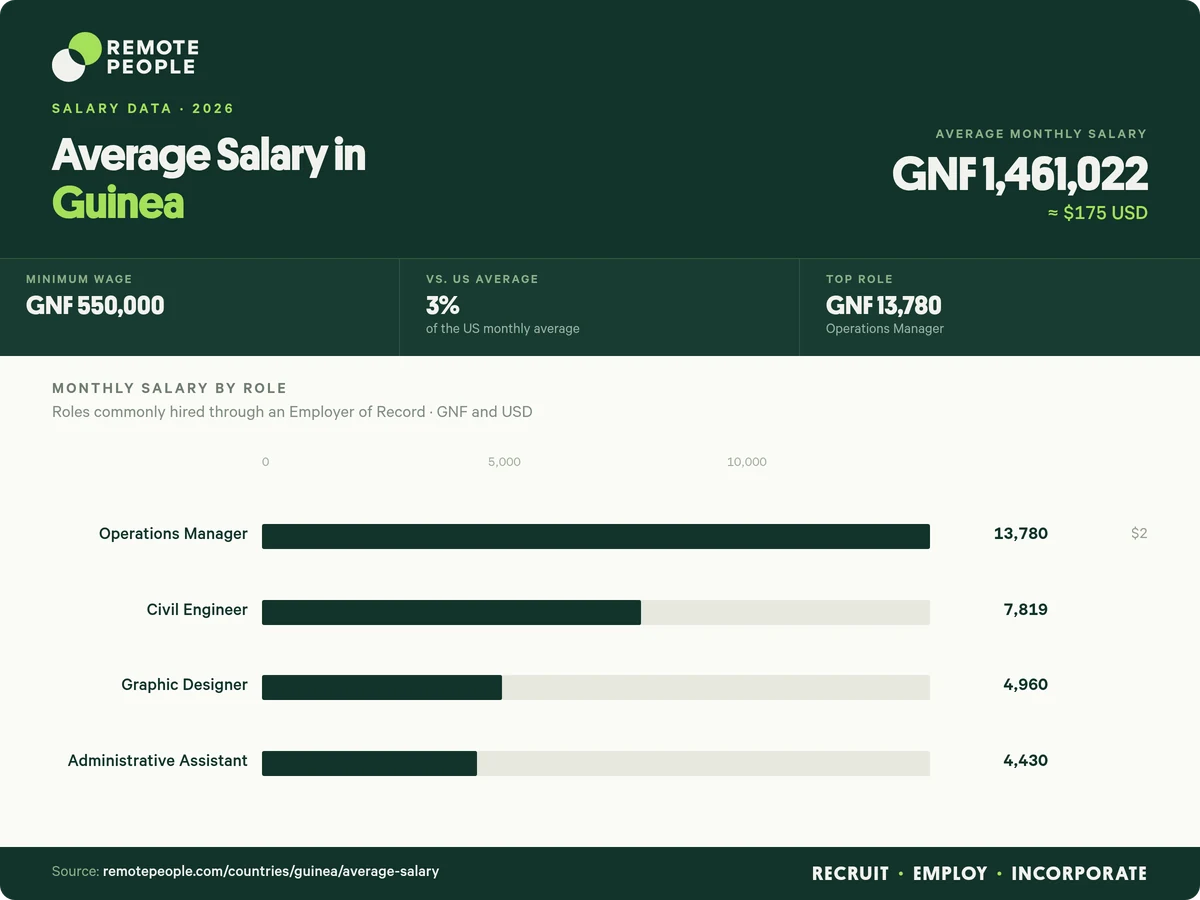
The average monthly salary in Guinea is 1,461,022 Guinean Francs (GNF) or USD 175. However, salaries vary depending on experience, industry, position, education, and location. Median salary and salary range are other factors to consider.
This article will explore all aspects of Guinean wages to prepare employers for remote hiring.
What is the Average Salary in Guinea?
Guinea average salary is 1,461,022 GNF, which is about $175. It is a low-middle-income country and one of the poorest countries in the world, even when considering purchasing power.
Median Income
Guinea’s median monthly income is $968,059, or about $116. Half the population earns less than this amount, and the other half earns more. Due to the country’s income inequality, the average salary is considerably higher.
Salary Range
Guinea’s monthly salaries range from 550,000 GNF (approximately $66) to 5,500,000 GNF (roughly $660). The country is plagued by wage inequality, and many people live in poverty.
Salary Comparison by Profession
Salaries can vary greatly, with skilled workers earning more than unskilled workers. This salary comparison chart reveals the earnings of common professions in the country.
Profession | Average Salary in USD |
|---|---|
Operations Manager | 13,780 |
Civil Engineer | 7,819 |
Graphic Designer | 4,960 |
Administrative Assistant | 4,430 |
Average Wage in Guinea by Education
Guinea is suffering from a lack of education. Many teachers are underqualified, and families lack the financial means to send their children to school. Gender inequality is another huge issue, as parents tend to prioritize boys’ education over girls’, feeling it is a better investment.
However, the few individuals who complete school have a chance of acquiring high-paying jobs in sectors like healthcare, finance, and technology.
Salary Comparison by Experience
Experience is another factor that impacts salaries in New Guinea. Workers with experience in their industry tend to earn more than entry-level workers. Individuals also become eligible for wages with more tenure at their positions.
Salary Comparison by Location
Location impacts salaries, with workers in urban regions earning higher wages than workers in rural areas due to a higher cost of living and proximity to larger companies that offer competitive wages. In Guinea, people living in or near Conakry will earn more than those living in the country’s villages and outskirts.
How Much is Minimum Wage in Guinea?
The minimum wage in Guinea is 550,000 GNF (approx. $66 Guinea minimum wage USD) monthly. The wages went into effect on June 1, 2022. The government may punish employers who pay lower wages.
Workers in the country are subject to a 48-hour workweek and a 10-hour workday. Overtime is paid at 130% to 160% of the regular salary. Employees are eligible for parental leave, sick leave, and vacation leave.
Average Salary in Guinea vs. the Rest of the World
You can better understand salaries in Guinea by comparing them to wages paid worldwide. The following charts compare Guinea earnings and wages in developed, developing, and undeveloped countries.
Guinea vs. Developed Countries
Country | Average Salary | Comparison to Average Guinea Salary |
|---|---|---|
United Kingdom | £3,000 (approx. $4,100) | − 2,243% |
United States | $5,220 | − 2,882% |
Norway | 50,000 NOK (approx. $4,700) | − 2,586% |
Germany | €4,300 (approx. $4,470) | – 2,454% |
Austria | €3,700 (approx. $4,050) | – 2,214% |
Guinea vs. Developing Countries
Country | Average Salary | Comparison to Average Guinea Salary |
|---|---|---|
Romania | 4,000 RON (approx. $835) | − 377% |
Russia | 73,700 RUB (approx. $700) | − 300% |
Albania | 83,330 ALL (approx. $860) | − 391% |
Kazakhstan | 342,000 KZT (approx. $645) | – 269% |
Ukraine | 18,000 UAH (approx. $500) | – 186% |
Guinea vs. Undeveloped Countries
Country | Average Salary | Comparison to Average Guinea Salary |
|---|---|---|
Thailand | 15,000 Baht (approx. $420) | – 140% |
Philippines | 15,000 PHP (approx. $265) | – 51% |
Vietnam | 7.5 million Dong (approx. $300) | – 71% |
Egypt | 14,317 EGP (approx. $284) | – 62% |
Pakistan | 60,000 PKR (approx. $210) | – 20% |
Guinea is a least developed country with a lower-middle-income economy, high poverty, corruption, and political instability. Its labor market lacks specialized workers and mainly relies on mining and agriculture.
Although the country may not be the best outsourcing destination due to its lack of skilled workers and undeveloped infrastructure, it has made progress over the years. In 2023, its GDP accelerated by 7.1%. It is also an excellent source of cost-effective labor.
What are the Most Common Outsourced Industries in Guinea?
Mining
Guinea offers various mineral resources, including bauxite, iron ore, uranium, gold, and diamonds. Companies may consider importing these products from Guinea or outsourcing mining operations to the country.
Agriculture
Agriculture plays a significant role in Guinea’s economy, employing about 84% of workers. The country produces a wealth of sugarcane, cassava, rice, corn, coconuts, coffee, and various fruits, nuts, and vegetables. Companies may source agriculture from the country or utilize Guinean workers for various agricultural processes.
Energy
Guinea boasts a strong energy sector focused on hydropower, which uses water to produce energy, and biomass, which uses plant and animal materials to produce energy. However, the country has untapped potential due to its underdeveloped infrastructure. International companies may consider utilizing its resources for clean energy maintenance, installation, and sales.
Conclusion
Although Guinea faces challenges due to a lack of development, it shows potential in its growth, natural resources, and low-cost labor. Employers who outsource to Guinea can take advantage of reduced human resource expenses while allowing workers to earn decent wages. The situation could benefit all parties.