Recruit
Employer of Record (EOR) in Grenada
-
 Drew Donnelly
- Published
- July 21, 2026
RemotePeople’s employer of record in Grenada lets you hire employees in Grenada with National Insurance Scheme enrollment. We handle 7% NIS contributions, monthly registration requirements, and statutory benefits administration.
Hire in Grenada — book a free 30-minute demo
No sales call required. Free 30-minute expert call if you want one.
Tell us about your company
So we can match you with a specialist who knows your market — and unlock volume pricing tiers.
* All fields are required.
Where and when are you hiring?
Tell us the geography and timing and we'll quote each country line by line, with onboarding timelines.
* All fields are required.
Help us beat your current setup
We'll benchmark your current deal and send a line-by-line proposal in 24 hours — showing exactly where we cut cost, time, or risk. After you submit, you can book a call to walk through it together.
* All fields are required.
Thanks! Your proposal is on its way.
Expect a tailored, line-by-line proposal in your inbox within 24 hours. In the meantime…
Want to walk through it together?
Book a free 30-minute call with one of our specialists. We'll explain every line, answer your questions, and tailor the proposal further if you need.
No obligation. Pick a time that works for you.








- Hire in Grenada — book a free 30-minute demo
- Tell us about your company
- Where and when are you hiring?
- Help us beat your current setup
- Thanks! Your proposal is on its way.
- How an Employer of Record Works in Grenada
- Employment Laws and Regulations in Grenada
- Work Permits and Visas in Grenada
- Payroll, Taxes, and Social Security in Grenada
- Cost of Hiring Through an EOR in Grenada
- Benefits of Using an EOR in Grenada
- Termination and Offboarding in Grenada
- EOR vs. Other Hiring Models in Grenada
- Public Holidays in Grenada
- How to Get Started with an EOR in Grenada
- Where companies hiring in Grenada expand next
- Frequently Asked Questions
- Related EOR Destinations

Start hiring in Grenada
Let RemotePeople handle payroll, compliance, and HR admin worldwide so you can focus on building your team.

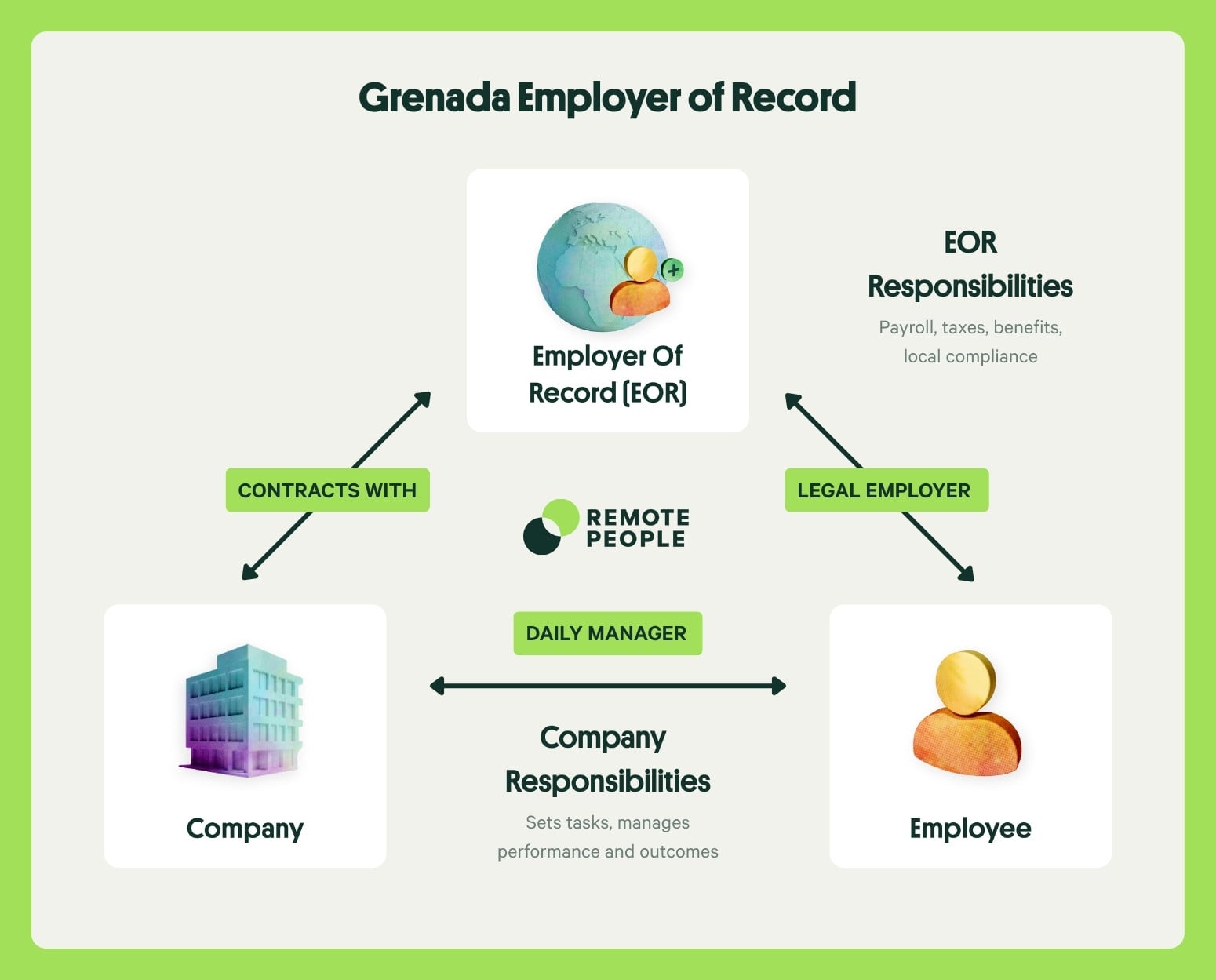
Grenada offers an attractive labor market for companies seeking to expand into the Caribbean with lower employment costs and a stable regulatory framework. For companies looking to hire employees in Grenada, establishing a local legal entity and managing payroll compliance independently presents significant administrative and financial challenges. An employer of record in Grenada serves as your local legal employer, handling all compliance, payroll, taxes, and statutory obligations while you focus on managing your team’s performance and output.
Using an EOR in Grenada eliminates the need to register a subsidiary, navigate complex local labor laws, or hire a dedicated local HR and finance team. Instead, the EOR becomes the official employer on contracts and tax filings, while you retain operational and management control over your employees. This model reduces time-to-hire from months to weeks, minimizes legal and compliance risk, and provides full transparency into employment costs before you commit to expansion.
This guide explains hiring through an EOR in Grenada in 2026: employment laws, work permits, payroll, costs, and how the EOR model stacks up against alternatives. Whether you’re testing a new market, building a distributed team, or scaling operations, you’ll find the data and frameworks needed to make informed decisions about Grenadian employment.
How an Employer of Record Works in Grenada
What Is an Employer of Record?
Who Uses an EOR in Grenada?
EOR services work best for companies in specific situations and growth stages. Here’s where an EOR adds the most value.
Companies entering a new market find an EOR valuable when Grenada is a new territory and they lack local infrastructure. An EOR allows them to test demand, validate business models, and build a team without long-term capital commitment or the overhead of establishing a legal entity.
Startups and scale-ups often lack the resources to hire a local HR manager, accountant, or legal advisor. An EOR provides all three functions in one service, keeping fixed costs low during early growth. Remote-first and distributed teams spanning multiple countries use an EOR to manage each country’s employment law independently without per-country entity setup. Companies hiring specialized talent in Grenada’s tourism, agriculture, or financial services sectors also benefit, as an EOR handles the legal framework while the company focuses on the hire’s technical contribution.
Typical Onboarding Timeline
The onboarding process from initial engagement to the employee’s first paycheck typically spans 1–2 weeks, making EOR hiring significantly faster than establishing a local entity or hiring an independent contractor with full compliance setup.
During the first two days, you provide the EOR with candidate information and required documents including identification, tax residency certificate, and references. You and the candidate agree on employment terms. On days three and four, the EOR drafts the employment contract according to Grenada’s Employment Act, incorporates your role-specific terms, and sends the contract for candidate signature.
In the second half of the first week, the EOR registers the employee with the National Insurance Scheme, enrolls them in any agreed benefits such as health insurance, and sets up payroll with correct tax withholding codes. During the second week, the employee begins work. The EOR runs the first payroll cycle, confirms all deductions and contributions are correct, and provides the employee with a payslip and benefits summary. The entire process from document submission to first working day typically takes five to eight business days for local hires.
Hire in Grenada
Lower employer costs (7% NIS contributions), a stable regulatory framework, English-speaking workforce, and access to skilled Caribbean talent make Grenada an ideal market for companies expanding their regional presence.
We handle employment contracts, payroll, tax withholding, and full Grenada compliance.
No local entity needed. Your team can start in days.
Employment Laws and Regulations in Grenada
Employment Contracts
Employment contracts in Grenada are governed by the Employment Act, No. 14 of 1999 (Cap. 89), which establishes minimum legal standards for all written agreements between employers and employees. The law applies to all employers in Grenada with one or more employees, with limited exceptions for family-run businesses. All contracts must be in writing and provide clarity on salary, duties, work hours, and termination conditions.
The law mandates that contracts specify the job title, place of work, rate of pay, payment frequency, hours of work, and notice period required for termination. Contracts can include reasonable confidentiality, non-compete, and intellectual property assignment clauses, though non-compete enforceability is determined by common law principles of reasonableness.
The contract must be provided to the employee before work begins, and a copy must be retained by the employer for at least 6 years. If a contract is silent on a particular term (e.g., leave entitlements), the statutory minimums under the Employment Act apply by operation of law.
Working Hours and Overtime
Grenada’s Employment Act establishes a standard 40-hour work week for most roles, with variations by industry. Different sectors have different maximum weekly hours, and all employees are entitled to a minimum 11 consecutive hours of rest per 24-hour period.
Grenada overtime and premium pay rates · Per Employment Act (Cap. 89) | |||
Hour Type | Rate Multiplier | Weekly/Daily Cap | Notes |
|---|---|---|---|
Standard work week | 1.0x (regular rate) | 40 hours/week (most sectors); 44 hours/week clerical, shop, catering | No overtime compensation at standard rate |
Overtime (weekdays) | 1.5x regular hourly rate | Beyond standard hours per week | Tracked weekly; paid on regular cycle |
Sunday work | 2.0x regular hourly rate | Any work on Sunday | Double pay applies regardless of hours worked |
Public holiday work | 2.0x regular hourly rate | Statutory public holidays (approx. 14 per year) | Or compensatory day off at 2x pay if negotiated |
Rest periods | No compensation | Minimum 11 consecutive hours per 24 hours | Mandatory requirement; unpaid rest time |
Source: Employment Act, Cap. 89 and OCHA Labour Law Resources | |||
Overtime is typically compensated on a weekly or monthly basis. Employers must track all overtime hours. Some sectors like security and domestic work have extended standard hours (60 hours per week) with different overtime provisions negotiated via collective agreement. An EOR ensures accurate tracking and compliance with premium rates.
Minimum Wage
Grenada’s minimum wage is set by the Minister of Labour and updated periodically via Minimum Wages Orders. The current minimum wage, effective January 1, 2024, applies to 19 separate worker categories with defined floor wages. The general minimum wage floor is XCD 1,200 per month or XCD 60 per day.
Specific categories include agricultural workers (XCD 60/day), construction laborers and helpers (XCD 60–65/day), store clerks (XCD 1,200/month), and domestic workers (XCD 9.20/hour). The minimum wage applies equally to both citizens and foreign workers. For the latest rates and category breakdowns, see our minimum wage in Grenada guide. Employers must pay at least the applicable minimum for the worker’s job category. If a contractual wage is below the statutory minimum, the minimum applies by operation of law.
Probation Period
Probation periods in Grenada are capped by the Employment Act and vary by skill level. Unskilled workers can be on probation for a maximum of 1 month; skilled or professional workers up to 3 months. The period may be extended by collective agreement if specified before the initial probation expires.
During probation, either party can terminate without notice or cause if the probation period is stated in the contract. Once probation ends, statutory notice and severance rules apply. Probation is common for new hires in roles where fit is uncertain, but not mandatory – both parties can waive it.
Leave Entitlements
Annual Leave
All employees in Grenada are entitled to paid annual leave after 12 months of continuous service. Year one: 2 weeks (10 working days). Year two and beyond: 3 weeks (15 working days). Leave accrues daily and is paid at regular rate. Employees cannot be forced to waive leave, but may carry over unused leave if the contract permits it.
Leave timing is decided by the employer in consultation with the employee. While employers aren’t required to pay out accrued leave upon termination (unless the contract specifies), it’s a common practice. An EOR tracks accrual automatically and ensures compliance with carry-over and payout rules.
Sick Leave
Employees are entitled to 14 days of paid sick leave per year after 12 months of service. Sick leave is paid at regular rate and accrues at approximately 1.17 days per month. Employers may require a medical certificate for absences exceeding 2 consecutive days or patterns of absence. Unused sick leave does not carry over and cannot be paid out at termination.
Maternity Leave
Female employees are entitled to 3 months of unpaid maternity leave after 18 months of service. Leave can be taken a maximum of 3 times in a career with 2-year intervals between periods. During maternity leave, the employment relationship is suspended – not terminated – and benefits and seniority are retained. Health insurance continuation during unpaid leave varies by plan.
Paternity Leave
Grenada’s Employment Act does not provide a statutory right to paternity leave. Employers may voluntarily offer it as a benefit. Some provide 1–2 days of paid bereavement or personal leave for childbirth-related purposes, but there’s no legal requirement and it varies by employer.
Other Statutory Leave
Bereavement leave (usually 1–3 days) upon death of an immediate family member is determined by company policy or collective agreement, not statute. Marriage leave is similarly non-statutory but common as a contractual benefit (1–3 days). Public holidays are paid days off and don’t count against annual leave. Work on public holidays receives 2x pay or compensatory time off at 2x pay.
Grenada statutory leave entitlements · Per Employment Act (Cap. 89) | |||
Leave Type | Duration | Pay Status | Eligibility (service required) |
|---|---|---|---|
Annual leave (Year 1) | 2 weeks (10 working days) | Paid | After 12 months continuous service |
Annual leave (Year 2+) | 3 weeks (15 working days) | Paid | From year 2 onwards |
Sick leave | 14 days per year | Paid | After 12 months; medical certificate may be required |
Maternity leave | 3 months (unpaid) | Unpaid | After 18 months; max 3 times, 2-year intervals |
Paternity leave | Not statutory | At employer discretion | Not defined by law |
Bereavement leave | 1–3 days (employer/contract-dependent) | Paid | Upon death of immediate family |
Public holidays | Statutory public holidays (approx. 14 per year) | Paid day off; 2x pay if required to work | All employees |
Source: Employment Act, Cap. 89 and Grenada Labour Authority | |||
Statutory Employee Benefits
Grenada requires employer contributions to the National Insurance Scheme (NIS), the country’s social security system covering retirement, disability, survivors’ benefits, and work injury. Private health insurance, life insurance, and supplemental pensions are not mandated but are common contractual benefits among competitive employers. NIS is the primary statutory benefit obligation.
Additional non-statutory benefits include transportation allowances, meal subsidies, phone allowances, professional development, and bonuses. These are increasingly common among employers competing for talent in professional roles. Christmas bonuses and 13th-month salaries are traditional in some industries but not required by law.
Recent Regulatory Updates (2026)
As of 2026, the Employment Act (Cap. 89) and Labour Relations Act (Cap. 157A) remain Grenada’s primary employment laws with no major changes in the past 12 months. NIS contribution rates continue their scheduled increase. The combined employer and employee rate is 13% as of 2025, scheduled to reach 16% by 2031. Minimum wage orders are updated periodically; the current order took effect January 1, 2024, with next review expected in 2026 or 2027.
No new employment taxes were introduced in 2025, and territorial taxation remains in place – only Grenada-source income is taxed. The Inland Revenue Division focuses on compliance and audit activities without announced changes to tax brackets or allowances for 2026. Monitor Ministry of Labour announcements for minimum wage, work permit, and contribution updates.
Work Permits and Visas in Grenada
Work Permit Requirements
Who Needs a Work Permit
Foreign nationals must obtain a work permit before commencing employment. Grenadian citizens and CARICOM members with valid Skills Certificates may be exempt from some requirements, though CARICOM still requires documentation and Labour Department notification. All other foreign workers need a formal work permit sponsored by the employer.
Eligibility and Required Documents
Work permit applications require proof that the position was advertised locally for a minimum of 3 consecutive weeks in a local newspaper or the Ministry of Labour’s job portal. This ensures local jobseekers can apply before a foreign national is hired.
After the 3-week period expires, the employer can apply for the work permit. See our work visa requirements guide for details.
Required documents include a passport valid for 6+ months, completed application form, evidence of the 3-week advertisement, employment contract, employer business registration, and medical certificate if required. Some positions or nationalities may require additional screening such as character references or background checks.
With an EOR, these administrative tasks are handled automatically – the EOR coordinates with the Labour Department and manages all deadlines and documentation.
Processing Time and Validity
Processing typically takes 3–5 weeks after submission with complete documents. Processing may be expedited for critical sectors like healthcare, hospitality, or financial services, or for candidates with specialized skills in short supply.
Once approved, the work permit is valid for 1 year and is tied to both employer and position. It’s not portable – job changes require a new permit.
Renewal Process
Work permits must be renewed annually. Renewal is simpler than initial application if the employee continues in the same role: submit renewal form, evidence of continued employment, and updated documentation (passport copy, medical certificate if required).
Submit renewals 4–6 weeks before expiration to avoid authorization gaps. The process typically takes 2–4 weeks. An EOR monitors deadlines and manages renewals on your behalf.
Common Visa Types for Foreign Workers
Grenada issues several visa and permit categories under the Immigration Act for foreign nationals seeking employment. The table below summarizes the main permit types, their eligibility criteria, typical duration, and processing requirements.
Grenada work visa types for foreign workers · 2026 | ||||
Visa Type | Duration | Best For | Leads to APT? | Processing |
|---|---|---|---|---|
General Work Permit | 1 year, renewable annually | Foreign nationals with job offer from Grenadian employer | No (annual renewal only) | 3–5 weeks |
Investor’s Work Visa | 1–5 years | Foreign investor or business owner establishing a Grenadian business | Yes (after 5 years) | 4–8 weeks |
Self-Employed Work Visa | 1 year, renewable | Self-employed professionals or freelancers | No | 3–5 weeks |
Digital Nomad Visa | Up to 1 year | Remote workers employed by foreign companies | No | 2–4 weeks |
CARICOM Skills Certificate | Varies (typically 2 years) | Citizens of CARICOM member states with skilled trades | Yes (free movement) | 1–2 weeks |
How an EOR Handles Work Permits
An EOR assumes full responsibility for work permits, documentation, and compliance. The EOR acts as official sponsor, ensures the 3-week advertisement requirement, prepares all documentation, submits to the Labour Department, and tracks renewals. For a full breakdown of permit categories and requirements, see our Grenada work visa guide.
The EOR bears liability risk if applications are rejected or authorization expires. Most EOR contracts include indemnification protecting you if renewals are missed. The EOR manages Labour Department communication, follows up on document requests, and notifies you of outcomes. For international companies building teams, this eliminates the need for in-country administrative expertise.
Payroll, Taxes, and Social Security in Grenada
Employer Contributions
Employers must contribute to the National Insurance Scheme (NIS), covering retirement, disability, survivors’ benefits, work injury, and unemployment insurance. As of 2025, the employer rate is 7% of insurable earnings, calculated on gross wages up to XCD 1,200 per week (XCD 5,200 per month). Earnings above this cap are not subject to additional NIS.
Grenada employer social security contributions · 2026 rates | ||
Contribution Type | Rate | Cap / Notes |
|---|---|---|
National Insurance Scheme (NIS) | 7% of insurable earnings | Max insurable earnings: XCD 5,200/month or XCD 1,200/week |
Income tax withholding | Employee pays; employer withholds | Based on progressive brackets (see employee table) |
Statutory benefits cost | Included in NIS premium above | Covers pension, disability, death, and work injury |
Other payroll deductions | 0% (no other mandatory employer costs) | Health insurance, life insurance are voluntary/contractual |
Typical total employer cost on USD 1,850 gross salary: 7% NIS = XCD 350, plus EOR service fee | ||
Employee Contributions
Employees have two main deductions: employee NIS contributions and income tax. Employee NIS is 6% of insurable earnings on the same capped base as employer contributions (max XCD 5,200 per month). Income tax is withheld based on progressive brackets and personal allowance.
Grenada employee payroll deductions · 2026 monthly withholdings | ||
Deduction Type | Rate or Amount | Notes |
|---|---|---|
NIS contribution (employee) | 6% of insurable earnings | Capped at XCD 5,200/month (approx. XCD 312 max per month) |
Income tax withholding | 0–28% (see tax brackets table) | Based on annual gross minus XCD 36,000 personal allowance |
Combined typical withholding | 6% NIS + 0–28% income tax | Total net take-home varies by salary level |
Voluntary deductions | Variable (health, pension, etc.) | If employee consents; must be authorized in writing |
Source: NIS Grenada and Inland Revenue Division | ||
Income Tax
Grenada uses territorial taxation – only income earned in-country is taxed. Non-residents and residents are taxed differently, but foreign employees working in Grenada are subject to tax on Grenadian employment income. The personal allowance is XCD 36,000 per year, with progressive tax on income above that threshold.
Grenada income tax brackets · 2026 | ||
Taxable Income Range (annual) | Tax Rate | Cumulative Tax Example |
|---|---|---|
XCD 0 – XCD 36,000 | XCD 0 (personal allowance) | Tax-free |
XCD 36,001 – XCD 60,000 | 10% on taxable income in this bracket | Max XCD 2,400 at XCD 60,000 income |
XCD 60,001+ | 28% on taxable income above XCD 60,000 | XCD 2,400 + 28% of amount above XCD 60,000 |
Grenada has no capital gains, inheritance, or net worth taxes. Personal income tax is the primary direct tax, with no additional health or education taxes.
Employers must withhold income tax on a pay-as-you-earn (PAYE) basis and remit amounts to the Revenue Division monthly. An EOR calculates correct withholding based on salary, maintains PAYE compliance, and files all required returns.
Payroll Cycle
Payroll cycles are typically monthly, though some use bi-weekly for hourly or shift workers. Pay is made via direct deposit to the employee’s account. Employers must provide payslips at or shortly after payment, showing gross salary, deductions (NIS, income tax), net pay, and other relevant information. Payroll records must be retained for 6 years for audit purposes.
An EOR manages payroll on a fixed schedule (e.g., monthly 15th or 25th), ensuring correct withholding calculations, on-time statutory payments, and consistent documentation. The EOR coordinates with your preferred payment method and handles currency conversion for multi-currency operations.
13th Month Salary and Bonus Pay
A 13th-month bonus is not mandated by law but is common in professional and competitive sectors. Some employers provide a full month’s salary in December; others a smaller discretionary amount. The practice varies by industry and employer size.
For professional roles, a 13th-month bonus is increasingly expected. Since no law requires it, make sure it’s clearly stated in the employment agreement if promised.
Cost of Hiring Through an EOR in Grenada
EOR Service Fees
EOR service fees typically range from XCD 1,000 to XCD 1,500 per employee per month (approximately USD 370–555), depending on provider, role complexity, location, and volume. Larger teams (10+) may negotiate lower fees. Additional services such as work permit sponsorship, visa processing, or specialized compliance may incur extra charges or be bundled in the base fee.
Most EOR providers offer transparent, all-inclusive pricing with no hidden charges. The monthly fee covers payroll processing, tax compliance, NIS registration, leave management, statutory reporting, employee support, and basic HR consulting. Some offer tiered pricing (base fee plus percentage of payroll) or volume discounts.
When evaluating EOR costs, compare the total monthly expense (salary + employer contributions + EOR fee) rather than the EOR fee alone, as this reflects your true employment cost.
Total Employment Cost Breakdown
Total hiring cost includes gross salary, employer NIS contributions (7% capped at insurable earnings), and the EOR service fee. For a typical professional hire at XCD 5,000 per month gross, total monthly cost is approximately XCD 6,430, representing a 28.6% increase over gross.
Grenada employer cost example · USD 1,850 gross · 2026 | ||
Cost Component | Amount (USD) | Percentage of Gross |
|---|---|---|
Employee gross salary | 1,850 | 100% |
Employer NIS contribution (7%) | 130 | 7.0% |
EOR service fee (est. $400) | 400 | 21.6% |
Total monthly employer cost: $2,380 (128.6% of gross) | ||
The largest cost component after salary is the EOR service fee, covering payroll, compliance, and support. NIS adds 7% but is capped – hiring multiple employees above the cap reduces proportional NIS cost.
For businesses building teams in Grenada, EOR costs are competitive versus managing HR independently. An EOR eliminates the need for a local accountant, HR manager, or legal advisor, which would cost $1,100–1,850 per month.
Interested in learning more about EOR costs and how they scale with your team size? Contact our team for a customized cost estimate.
Benefits of Using an EOR in Grenada
- Rapid market entry without local infrastructure: Establish a team in 1–2 weeks without registering a subsidiary, obtaining local tax ID, or setting up accounting. The EOR handles entity-level logistics so you focus on hiring and business development.
- Full legal compliance and risk mitigation: The EOR is the legal employer and assumes primary liability for labor law compliance, wage disputes, wrongful termination, and regulatory violations. You retain operational control while the EOR manages legal exposure and Employment Act (Cap. 89) compliance.
- Transparent, predictable employment costs: Know exact monthly costs upfront with all-inclusive pricing. No surprise tax bills, social security adjustments, or hidden costs – the EOR fee covers payroll, withholding, contributions, and compliance.
- Simplified work permit and visa sponsorship: The EOR sponsors work permits, manages the 3-week job advertisement requirement, handles Ministry of Labour applications, and tracks renewals. You avoid navigating Grenada’s immigration procedures independently.
- Expert local knowledge and regulatory updates: EOR providers maintain government relationships, monitor employment law and tax changes, and proactively advise of new compliance obligations. This reduces the risk of inadvertent violations.
- Flexible scaling without long-term commitment: Hire one employee or fifty without permanent entity commitment. If you exit, there’s no entity to dissolve, no registration fees, and no residual liability – simply offboard employees and end your contract.
- Consolidated payroll and HR across multiple countries: For distributed teams, an EOR in Grenada integrates with EOR services elsewhere, providing a single payroll platform, unified employee data, and simplified cross-jurisdictional reporting.
Termination and Offboarding in Grenada
Notice Periods
Notice periods in Grenada are graduated by length of service and mandated by the Employment Act. Employers and employees must provide written notice at least the required period in advance. These periods apply equally to all employees unless the contract specifies a longer period (contracts may extend but not shorten statutory notice).
Grenada statutory notice periods by position level · Per Employment Act (Cap. 89) | ||
Length of Service | Notice Period Required | Notes |
|---|---|---|
During probation (up to 3 months) | None (either party may terminate without notice) | Probation must be in the contract; applies during the probation period only |
Less than 1 month service | 1 working day | Calculated from date of notice |
1 month to 3 months service | 1 week (7 calendar days) | Notice must be in writing |
3 months to 1 year service | 2 weeks (14 calendar days) | Notice must be in writing and dated |
1 year to 5 years service | 1 month (30 calendar days) | Notice must be in writing |
5 or more years service | 2 months (60 calendar days) | Longest notice period; notice must be in writing |
Source: Employment Act, Cap. 89 and Grenada Labour Authority | ||
Notice must be in writing and clearly state the termination date and reason if applicable. During the notice period, the employee typically continues working and receiving full pay and benefits. Employers may place an employee on “notice pay” or “paid leave” instead, paying out the notice period without requiring work – this is a discretionary management decision.
Severance Pay
Severance pay is required if an employee with 1+ years of service is terminated without cause (including redundancy, restructuring, or business closure). The amount is 1 week’s wages per completed year of service. Severance is not required for misconduct terminations (theft, violence, insubordination) or voluntary resignation.
Calculation Method
Severance is calculated using average weekly wage (typically last 4 weeks of salary ÷ 4) multiplied by years of service. Example: An employee earning XCD 5,000/month (approximately XCD 1,154/week) terminated after 4 years receives XCD 1,154 × 4 = XCD 4,616. This is paid as a lump sum in addition to accrued annual leave (if contractually owed).
Caps and Exceptions
The Employment Act doesn’t cap severance – amounts are based on years of service and weekly wages. Severance is not payable for less than 1 year of service and is waived for misconduct terminations or probation terminations. An EOR calculates severance correctly, ensures payment by the final day of employment, and handles final payroll and offboarding.
Grenada severance pay schedule by years of service · Per Employment Act (Cap. 89) | ||
Years of Continuous Service | Severance Multiple | Example (XCD 1,154/week wage) |
|---|---|---|
Less than 1 year | No severance due | XCD 0 |
1 year | 1 week’s wages | XCD 1,154 |
2 years | 2 weeks’ wages | XCD 2,308 |
3 years | 3 weeks’ wages | XCD 3,462 |
5 years | 5 weeks’ wages | XCD 5,770 |
10 years | 10 weeks’ wages | XCD 11,540 |
Grounds for Termination
The Employment Act doesn’t require “cause” for termination – employers can terminate for redundancy, restructuring, poor fit, or management decision. However, termination without cause for employees with 1+ years of service requires severance. Misconduct terminations (theft, violence, insubordination, gross breach) don’t require severance, but the misconduct must be documented and the termination cannot be arbitrary or discriminatory.
Termination cannot be based on protected grounds: race, color, ethnicity, gender, pregnancy, family status, religion, political affiliation, or union membership. Discriminatory termination results in legal damages and reinstatement orders. An EOR ensures compliant termination procedures, proper documentation, correct severance calculation, and protection from wrongful termination or discrimination claims.
EOR vs. Other Hiring Models in Grenada
EOR vs. Setting Up a Local Entity
Choosing between an EOR and a local entity depends on team size, growth plans, and long-term commitment. Both models have distinct advantages and trade-offs.
Grenada EOR vs local entity comparison · Setup time, cost, risk and best-fit | ||
Comparison | Employer of Record (EOR) | Local Entity (Subsidiary) |
|---|---|---|
Setup time | 1–2 weeks | 3–6 months |
Upfront cost | $0 (no entity registration) | USD 5,000–15,000 (legal, incorporation, tax setup) |
Ongoing cost | USD 300–600/employee/month (EOR fee) | USD 8,000–15,000/year (accounting, compliance, corporate governance) |
Local partner required | No (EOR is the local entity) | Yes (local legal counsel and registered agent) |
Social insurance registration | Handled by EOR | You manage it (or outsource) |
Payroll & tax filing | Handled by EOR | You manage it (or outsource) |
Best for team size | 1–15 employees | 15+ employees or long-term presence |
Scale down / exit | Easy; no entity to unwind | Costly; legal dissolution required |
Government contracts | Not eligible (EOR is not your company) | Eligible (requires local entity) |
Source: RemotePeople EOR Solutions and Grenada Labour Authority | ||
Choose an EOR if you’re testing a new market, building a remote team, or scaling to 15+ over time – you avoid capital commitment and can pivot quickly. Choose a local entity if you’re hiring 15+, establishing an office, bidding on government contracts, or committing long-term (5+ years). Fixed costs of a local entity spread across more employees, reducing per-employee cost as you scale.
EOR vs. Hiring Independent Contractors
Some companies consider contractors to avoid employment compliance. However, misclassification carries significant legal and financial risk with limited practical benefit. If you hire contractors in Grenada, ensure you meet local classification requirements.
Grenada EOR vs independent contractors · Compliance, cost, and risk | ||
Comparison | Employee via EOR | Independent Contractor |
|---|---|---|
Legal relationship | Employee of EOR (you control work and method) | Self-employed; no employment relationship |
Compliance risk | Low; EOR ensures local labor law compliance | High; misclassification risk if relationship resembles employment |
Payroll & tax | EOR handles withholding, contributions, filings | Contractor invoices you; they handle their own taxes |
Benefits & leave | Statutory benefits, paid leave, social security | No entitlement to employee benefits |
Intellectual property | Stronger; employment contract assigns IP by default | Weaker; requires explicit IP assignment clause |
Termination | Subject to statutory notice and severance | Ends per contract terms; no severance required |
Best for | Long-term, core team roles | Short-term projects, specialized tasks, external experts |
Cost structure | Salary + employer contributions + EOR fee | Contractor fee (typically higher gross, lower total cost) |
Source: Employment Act, Cap. 89 and Contractor Compliance Guide | ||
Contractors work for short-term, specialized projects (consultant, designer, developer). If you hire someone for ongoing core work under your direction integrated into your team, the relationship qualifies as employment under the Employment Act. Contractor misclassification results in claims for unpaid benefits, back taxes, and damages. An EOR is the compliant way to hire ongoing team members.
EOR vs. PEO
A Professional Employer Organization (PEO) differs from an EOR. A PEO requires an existing local entity; the PEO then co-employs your workers and you share employment responsibilities. An EOR is the sole legal employer and requires no pre-existing local entity.
Grenada EOR vs PEO comparison · Legal employer, liability, and setup | ||
Comparison | Employer of Record (EOR) | Professional Employer Organization (PEO) |
|---|---|---|
Legal employer | EOR is the legal employer | You remain the legal employer (co-employment) |
Local entity required | No; EOR is the local entity | Yes; you must have your own entity in Grenada |
Best for | Companies without a local entity | Companies that already have a local entity |
Compliance liability | EOR assumes compliance responsibility | Shared liability between you and the PEO |
Setup time | 1–2 weeks | Depends on your entity setup (weeks to months) |
Control over HR policies | EOR manages within local law framework | More direct control; PEO advises |
Typical use case | Market entry, small remote teams, testing new markets | Established local operations needing HR outsourcing |
Grenada has no formal PEO framework and doesn’t recognize co-employment under local law. To use a PEO, you’d first establish a local entity, then engage a PEO to co-manage HR. This adds complexity and cost versus an EOR. For most companies entering Grenada without an existing entity, an EOR is simpler, faster, and more cost-effective.
Public Holidays in Grenada
Grenada observes approximately 14 public holidays per year – a mix of national, religious, and cultural celebrations. Public holidays are paid days off unless business requires work. Work on public holidays receives 2x pay or compensatory time at 2x pay. Public holidays don’t count against annual leave.
Grenada public holidays · 2026 calendar year | ||
Date | Holiday Name | Type |
|---|---|---|
January 1 | New Year’s Day | National |
February 7 | Independence Day | National |
April 3 | Good Friday | Religious |
April 6 | Easter Monday | Religious |
May 1 | Labour Day | National |
May 25 | Whit Monday | Religious |
June 4 | Corpus Christi | Religious |
August 3 | Emancipation Day | National (first Monday in August) |
August 10 | Carnival Monday | National |
August 11 | Carnival Tuesday | National |
October 25 | Thanksgiving Day | National |
December 25 | Christmas Day | National/Religious |
December 26 | Boxing Day | National |
Source: Grenada Labour Authority and Parliament of Grenada | ||
Some holidays are fixed (January 1, December 25); others vary by year (Easter, Whit Monday). An EOR tracks all holidays and ensures employees are paid for them, work is compensated at 2x rate, and payroll reflects holiday entitlements. This is critical for 24/7 operations like hospitality, healthcare, and security where holiday work is common.
How to Get Started with an EOR in Grenada
Hiring through an EOR is straightforward and takes fewer than two weeks. Here’s how to get started:
- Define the role. Specify position title, responsibilities, qualifications, salary range, and location. EOR providers have standard job posting templates aligned with Grenadian labor market expectations.
- Select an EOR provider. Evaluate based on local expertise, compliance track record, customer support, and all-in pricing. Request a cost estimate for your role and salary.
- Post the role and recruit. The EOR posts to local boards and media as required. You conduct interviews and select your candidate. The 3-week job advertisement runs in parallel, so hiring can begin before the full 3 weeks expire.
- Execute contract and work permit application. The EOR drafts an Employment Act-compliant contract. You and the candidate sign it, then the EOR applies for work permit on your behalf. This typically takes 3–5 business days.
- Set up payroll and begin employment. The EOR enrolls the employee in NIS, sets up payroll, confirms banking information, and processes the first paycheck. Employment begins on the signed start date, usually within 10 business days of contract signing.
Ready to expand your team to Grenada? Get in touch with our team to start the hiring process today.
Where companies hiring in Grenada expand next
Employers with operations in Grenada often extend across the Caribbean and nearby US-adjacent markets. Most teams start with Jamaica — shared Caribbean labor and trade norms. Hiring in the Bahamas typically follows, with CARICOM mobility and shared Caribbean business practices. An EOR partner in Trinidad and Tobago is a natural addition for aligned CARICOM employment frameworks, and the Dominican Republic completes the regional picture with CARICOM-wide workforce portability.
Frequently Asked Questions
No. Foreign companies can hire in Grenada provided they meet work permit and employment law requirements. An EOR becomes the legal employer and handles all regulatory obligations for you.
Professional roles in Grenada typically cost 40–60% less than equivalent US salaries when fully loaded. A professional earning XCD 5,000/month (USD 1,850) costs approximately USD 2,380 total monthly with EOR fees and contributions – substantially lower than US rates.
Yes, the Employment Act allows it. For employees with 1+ years of service, you must pay severance (1 week’s wages per year) and provide statutory notice (1 day to 2 months depending on tenure). Termination cannot be for discriminatory reasons. An EOR ensures proper notice and severance.
No. The work permit process is straightforward and takes 3–5 weeks. The main requirement is 3-week local job advertisement before applying. An EOR manages the entire process including advertising and Ministry of Labour applications.
Female employees are entitled to 3 months of unpaid maternity leave after 18 months of service. The employment relationship is paused but not terminated. Upon return, the employee is restored to the same or equivalent role with retained seniority and benefits. An EOR tracks entitlements and processes returns correctly.
Contractors work for short-term, specialized projects. If the relationship involves ongoing work under your direction integrated into your team, it qualifies as employment. Misclassification results in claims for unpaid benefits, back taxes, and damages. An EOR is the compliant way to hire ongoing team members.
With an EOR, exit is simple: terminate employees with proper notice and severance, pay final wages, and end the contract. No entity to dissolve, no registration fees, no residual liability. A local entity requires legal dissolution, taking weeks and costing thousands.
No, it is not required by law. However, it is increasingly common in professional roles and often expected by skilled candidates. Health insurance costs USD 50–150/employee/month depending on the plan. Some employers include a health allowance in salary instead.
Employer of Record in
Employer of Record in
Employer of Record in
Employer of Record in
Employer of Record in
Employer of Record in
Employer of Record in
Saint Vincent and the Grenadines
Employer of Record in