
 Recruit
Employer of Record (EOR) in Antigua and Barbuda
-
 Drew Donnelly
- Published
- July 21, 2026
RemotePeople’s employer of record in Antigua and Barbuda lets you hire employees in Antigua and Barbuda and remain fully compliant. We handle 8% employer contributions to the Antigua and Barbuda Social Security Board, registration requirements within 7 days of hiring, and mandatory health and pension benefits.
Hire in Antigua and Barbuda — book a free 30-minute demo
No sales call required. Free 30-minute expert call if you want one.
Tell us about your company
So we can match you with a specialist who knows your market — and unlock volume pricing tiers.
* All fields are required.
Where and when are you hiring?
Tell us the geography and timing and we'll quote each country line by line, with onboarding timelines.
* All fields are required.
Help us beat your current setup
We'll benchmark your current deal and send a line-by-line proposal in 24 hours — showing exactly where we cut cost, time, or risk. After you submit, you can book a call to walk through it together.
* All fields are required.
Thanks! Your proposal is on its way.
Expect a tailored, line-by-line proposal in your inbox within 24 hours. In the meantime…
Want to walk through it together?
Book a free 30-minute call with one of our specialists. We'll explain every line, answer your questions, and tailor the proposal further if you need.
No obligation. Pick a time that works for you.








- Hire in Antigua and Barbuda — book a free 30-minute demo
- Tell us about your company
- Where and when are you hiring?
- Help us beat your current setup
- Thanks! Your proposal is on its way.
- How an Employer of Record Works in Antigua and Barbuda
- Employment Laws and Regulations in Antigua and Barbuda
- Work Permits and Visas in Antigua and Barbuda
- Payroll, Taxes, and Social Security in Antigua and Barbuda
- Cost of Hiring Through an EOR in Antigua and Barbuda
- Benefits of Using an EOR in Antigua and Barbuda
- Termination and Offboarding in Antigua and Barbuda
- EOR vs. Other Hiring Models in Antigua and Barbuda
- Public Holidays in Antigua and Barbuda
- How to Get Started with an EOR in Antigua and Barbuda
- Where companies hiring in Antigua and Barbuda expand next
- Frequently Asked Questions
- Related EOR Destinations

Start hiring in Antigua and Barbuda
Let RemotePeople handle payroll, compliance, and HR admin worldwide so you can focus on building your team.

Hire employees in Antigua and Barbuda without setting up a local entity. RemotePeople handles payroll, contracts, tax compliance, and benefits so you can build your Antigua and Barbuda team in days, not months.
An employer of record in Antigua and Barbuda lets you hire employees and independent contractors without incorporating a subsidiary. Antigua and Barbuda offers significant advantages for employers: zero personal income tax on residents, a currency pegged to the US dollar ensuring stable exchange rates, a workforce fluent in English, and membership in the Caribbean Community (CARICOM) providing access to skilled regional talent.
However, establishing a compliant payroll requires navigating the Labour Code (Cap. 27), registering with the Antigua and Barbuda Social Security Board (ABSSB), enrolling employees in the Medical Benefits Scheme, and managing work permits for non-citizens. An employer of record handles every administrative burden, from contract drafting to statutory contributions, so you can focus on building your team.
How an Employer of Record Works in Antigua and Barbuda
What Is an EOR?
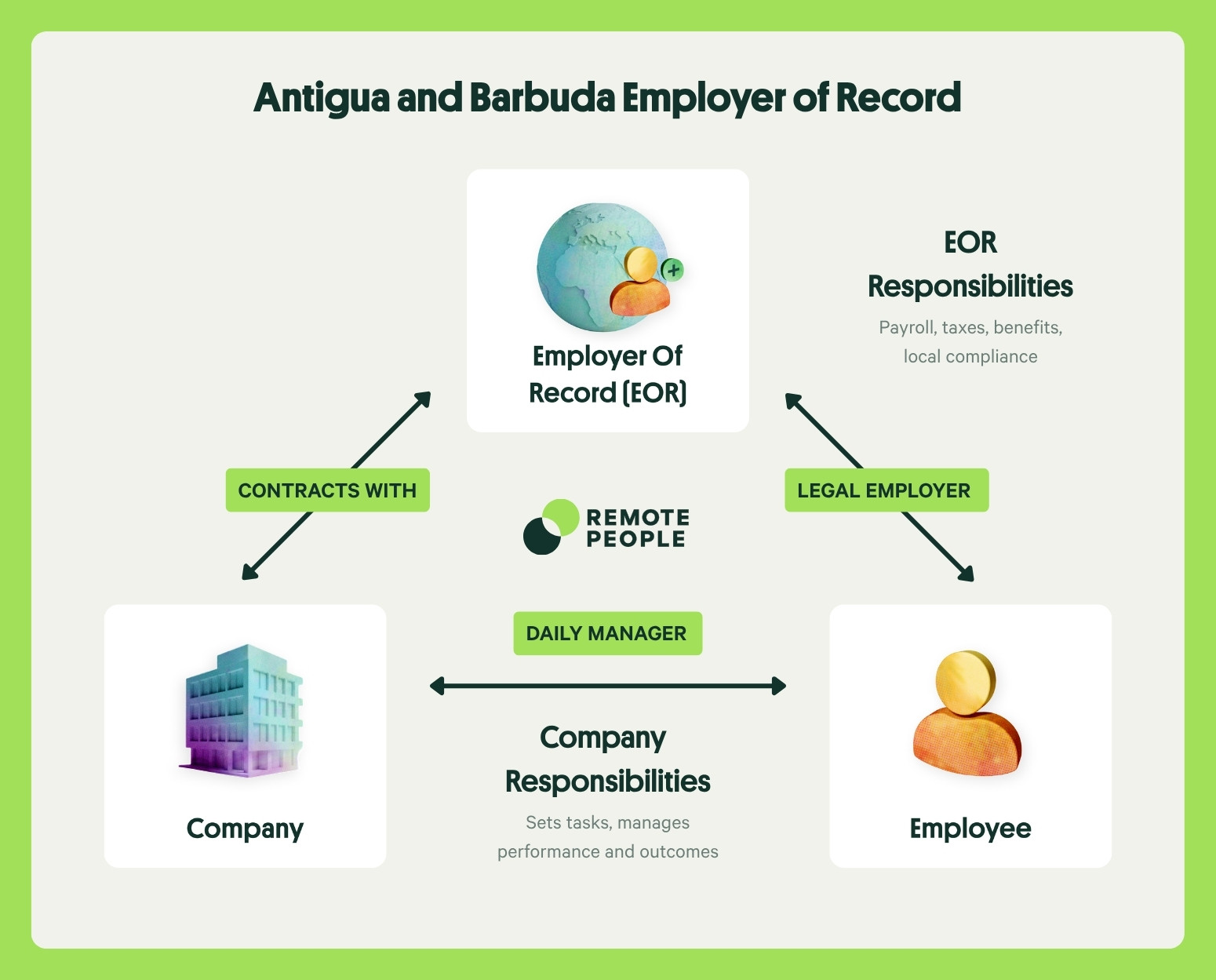
Who Uses an EOR in Antigua and Barbuda?
Companies testing the Caribbean market without establishing a permanent entity benefit from rapid deployment without incorporating costs or infrastructure investment. Small teams of one to fifteen employees use an EOR to avoid the overhead of hiring a local HR manager, reducing operational complexity while maintaining full legal compliance.
International organizations hiring remote workers in Antigua and Barbuda choose an EOR to secure work permits for non-CARICOM citizens, as the EOR manages the sponsorship process and maintains government relationships. Risk reduction is critical: an EOR shields your company from employment law violations, incorrect benefit calculations, and regulatory penalties while providing expertise in a jurisdiction where local knowledge is essential.
Typical Onboarding Timeline
- First: EOR agreement execution and client onboarding (1-2 days)
- Second: Employment contract drafting and employee review (2-3 days)
- Third: ABSSB and Medical Benefits Scheme registration (3-7 days)
- Fourth: Payroll system setup and bank account linkage (2-3 days)
- Fifth: Employee starts work and receives first pay cycle (1 day)
The entire process typically completes in one to two weeks for local hires. Work permit applications for foreign nationals extend this timeline by two to six weeks depending on government processing capacity and document completeness.
Hire in Antigua and Barbuda
Zero personal income tax, a US dollar-pegged currency, English-speaking workforce, and CARICOM regional talent access make Antigua and Barbuda a compelling base for Caribbean expansion.
We handle employment contracts, payroll, tax withholding, and full Antigua and Barbuda compliance.
No local entity needed. Your team can start in days.
Employment Laws and Regulations in Antigua and Barbuda
Employment Contracts
The Labour Code (Cap. 27) requires employers to provide a written statement of contract terms within 14 days of employment commencement. Contracts may be fixed-term up to three years (following the 2019 amendment), but employers must justify the fixed term based on operational needs; indefinite contracts are presumed unless a genuine reason for fixed duration exists. Required terms include job title, compensation, working hours, place of work, leave entitlements, grounds for termination, and dispute resolution procedures.
Working Hours and Overtime
The standard working week in Antigua and Barbuda is 40 hours with a maximum of 48 hours, as established under Section 39(3) of the Labour Code (Cap. 27). Overtime compensation is paid at 150 percent of the regular hourly rate for work on regular business days and 200 percent on Sundays and public holidays. Employees are entitled to 24 consecutive hours of rest per week, typically Sunday, unless operational requirements demand an alternative arrangement in writing.
Under Section C24 of the Labour Code (Cap. 27), the statutory workweek is capped at 48 hours across six days, with a standard eight-hour workday. Section C26 sets a minimum premium of 150 percent of the basic hourly wage for any hour worked beyond the daily or weekly threshold, and Section C15(2) requires an additional 150 percent on top of regular public-holiday pay for hours worked on gazetted holidays. Employees may not be compelled to work more than 12 hours in a day or 72 hours in a week.
Antigua and Barbuda overtime and premium pay rates · Per Labour Code Cap. 27 |
|||
Hour Type |
Rate Multiplier |
Weekly or Daily Cap |
Notes |
|---|---|---|---|
Standard hours |
100% (base wage) |
8 hrs/day, 48 hrs/week |
Normal workday, six days per week (Section C24(2)) |
Weekday overtime |
150% minimum |
Max 12 hrs/day, 72 hrs/week total |
Applies to hours beyond 8/day or 48/week (Sections C26 and C27) |
Weekly rest day |
150% minimum |
24 consecutive hours rest required per 7 days |
Employee consent required; Section C24(1) |
Public holiday work |
150% premium plus regular holiday pay |
Not applicable |
Full holiday pay preserved and 150% per hour worked on top (Section C15(2)) |
Minimum Wage
Antigua and Barbuda minimum wage increased to $4.26 USD per hour effective April 1, 2026. The previous rate of $3.33 USD per hour was in effect from January 1, 2025. The government has announced a phased increase toward $4.81 USD per hour as wage policy evolves. All employees, regardless of sector, are entitled to this minimum unless a collective agreement specifies higher rates.Probation Period
Employment may commence with a maximum probation period of three months, during which standard termination procedures apply but reduced notice requirements may be negotiated. Extension of probation beyond three months requires a collective agreement or union consent; unilateral extension by the employer is prohibited.
During probation, either party may terminate with 24 hours written notice. Probation does not exempt the employer from paying statutory benefits or complying with minimum wage or leave entitlements.
Leave Entitlements
Antigua and Barbuda law mandates multiple forms of paid and unpaid leave. Entitlements vary based on length of service, type of leave, and specific circumstances.
Annual Leave
Employees earn 12 working days of annual leave per year after completing probation. This increases to 21 working days per year after five years of continuous service.
Alternatively, employees accrue one day per month. Leave may not be forfeited; unused days carry forward or must be paid if employment terminates.
Sick Leave
Employees receive 12 days of paid sick leave per year at full pay. Medical certificates may be required after three consecutive days of absence. Extended sick leave up to 26 weeks is available with medical certification; pay during extended leave is coordinated with Social Security sickness benefits and may be reduced if benefits overlap.
Maternity Leave
Female employees are entitled to 13 weeks of maternity leave (six weeks before expected delivery, seven weeks after), coordinated with Social Security maternity benefits which provide 60 percent of normal salary. A minimum of 12 months service is required. Upon return from maternity leave, the employee resumes her previous role or equivalent position.
Paternity Leave
No statutory paternity leave entitlement exists under the Labour Code (Cap. 27). Some paternity leave is available through union collective agreements, ranging from three to ten days, but this is negotiated rather than mandatory. Employers may voluntarily offer paternity leave as a competitive benefit.
Other Statutory Leave
Bereavement leave of three days is granted for the death of an immediate family member (spouse, child, parent) and one day for other relatives, provided the employee has completed six months of service. Marriage leave is not a statutory entitlement but may be negotiated through collective agreements. Public holidays total 11 days in 2026 and are paid leave; work on a public holiday requires 200 percent overtime compensation.
Antigua and Barbuda statutory leave entitlements |
||
Leave Type |
Duration |
Eligibility & Notes |
|---|---|---|
Annual Leave | 12 working days per year; 21 days after 5 years service | Accrues at 1 day per month; paid at regular rate; unused leave carries forward or is paid on termination |
Sick Leave | 12 days per year at full pay; extended to 26 weeks with medical certification | Medical certificate required after 3 consecutive days; extended leave may be coordinated with Social Security benefits |
Maternity Leave | 13 weeks (6 before delivery, 7 after) | 60% pay via Social Security; 12 months service required; resumes previous role upon return |
Paternity Leave | Not statutory | Available only through collective union agreements (typically 3-10 days); voluntary employer benefit |
Bereavement Leave | 3 days (immediate family); 1 day (others) | Requires 6 months service; applies to spouse, child, parent (3 days) or other relatives (1 day) |
Public Holidays | 11 days in 2026 | Paid leave; work on public holiday requires 200% overtime compensation |
Source: Labour Code (Cap. 27) and ABSSB maternity benefits | ||
Statutory Employee Benefits
Antigua and Barbuda mandates several employee benefits administered through statutory institutions. All employees must enroll in the Medical Benefits Scheme, which provides healthcare coverage funded by a 3.5 percent contribution from both employer and employee (total 7 percent of wages).
The Antigua and Barbuda Social Security Board administers the pension system, with contributions currently set at 16 percent of wages in the private sector (employer and employee combined). The ABSSB also manages sickness benefits (paid at 60-100 percent of salary depending on duration) and maternity benefits (60 percent of salary for 13 weeks).
No mandatory private health insurance is required beyond the Medical Benefits Scheme. Workplace injuries and occupational diseases are covered under the Workmen’s Compensation Act 2014, which provides medical care, disability benefits, and death benefits to injured workers.
Employers must maintain workers’ compensation insurance through licensed insurers. Life insurance, disability insurance beyond statutory workers’ compensation, and retirement savings above the mandatory pension are optional employer benefits often offered competitively.
Recent Regulatory Updates (2026)
The minimum wage increased to $4.26 USD per hour effective April 1, 2026, reflecting ongoing government efforts to align compensation with rising living costs. The Social Security contribution rate for private sector employees increased to 16 percent effective January 1, 2025, reflecting adjustments to the pension system.
Retirement pension age moved from 60 to 65 years effective January 1, 2025, aligning with longer workforce participation. These changes are formalized under Statutory Instruments 2016 No. 60 and No. 61 and are enforced by the ABSSB.
Work Permits and Visas in Antigua and Barbuda
Work Permit Requirements
Who Needs a Work Permit
Citizens of CARICOM member states may be exempt from work permit requirements under the CARICOM Single Market and Economy (CSME) agreement, allowing free movement and employment within member nations. All non-CARICOM foreign nationals require a work permit regardless of skill level or employment duration. Employers must advertise the position locally before hiring a foreign national, demonstrating that no qualified local candidate is available.
Eligibility and Required Documents
Work permit applicants must submit a valid passport with sufficient remaining validity, curriculum vitae with professional qualifications, educational certificates, a police certificate of good conduct from the country of origin, an employment offer letter signed by the employer or EOR, proof that the position was advertised locally (job listings or advertisements), and a medical certificate confirming fitness to work. The Ministry of Labour reviews all documents to assess whether the foreign worker fills a genuine skills gap.
Processing Time and Validity
Work permit applications typically require two to six weeks for government processing, though this varies based on application completeness and Ministry of Labour capacity. An approved work permit is initially valid for 12 months and may be renewed for additional 12-month periods. The initial 12-month validity applies to all non-CARICOM workers unless a shorter duration is specifically granted based on contract terms.
Renewal Process
Work permit renewal requires updated certificates from the Antigua and Barbuda Social Security Board confirming employer and employee contributions are current, the Medical Benefits Board confirming scheme payments are up to date, and the Board of Education confirming any applicable education-related compliance. These certificates confirm the employee has maintained legal status and is not in arrears on statutory contributions.
Common Visa Types for Foreign Workers
Antigua and Barbuda offers several work authorization pathways for foreign nationals, each suited to a different employment arrangement. The Department of Immigration administers most routes, while the Labour Department processes work permit applications under the Labour Code, Cap. 27. A Cabinet decision effective February 2026 centralized work permit approvals with a 21-day processing target and a mandatory 14-day local advertisement period.
Antigua and Barbuda work visa types for foreign workers · 2026 |
||||
Visa Type |
Duration |
Best For |
Leads to Residency? |
Processing |
|---|---|---|---|---|
Temporary Work Permit |
12 months, renewable |
Most foreign employees, non-CARICOM |
Yes, after five or more years of lawful residency |
Target 21 days under 2026 centralized system (previously 4 to 6 weeks) |
Permanent Work Visa |
Indefinite |
Senior hires, investors, long-term employees |
Yes, pathway to permanent residency |
6 to 12 weeks |
CARICOM Skills Certificate |
Indefinite |
Qualified CARICOM nationals (graduates, teachers, nurses, artisans) |
Yes, facilitated free-movement status |
4 to 8 weeks |
Up to 24 months |
Remote workers earning USD 50,000+ per year |
No, distinct from the work permit track |
2 to 4 weeks; USD 1,500 single-applicant fee |
|
Learn more about work visas in Antigua and Barbuda.
How an EOR Handles Work Permits
An EOR sponsors work permit applications on behalf of the employer, submitting all required government documentation and managing communication with the Ministry of Labour. The EOR confirms that statutory contributions are current and that required certificates from the Social Security Board, Medical Benefits Board, and Board of Education are obtained and filed.
The employer directs the employee’s work and performance management, while the EOR maintains government relationships, renews permits before expiration, and ensures compliance with permit conditions. Including work permit processing typically extends the onboarding timeline by two to six weeks beyond standard employee setup.
Payroll, Taxes, and Social Security in Antigua and Barbuda
Employer Contributions
Employers in Antigua and Barbuda must contribute to two mandatory schemes: the Antigua and Barbuda Social Security Board (ABSSB) and the Medical Benefits Scheme (MBS). These contributions are deducted from payroll each month and remitted to the government. The combined employer burden represents a fixed percentage of gross or insurable earnings.
Antigua and Barbuda employer social security contributions · 2026 rates |
||
Contribution |
Rate |
Notes |
|---|---|---|
Social Security |
9% |
Of insurable earnings up to $2,407 USD per month |
Medical Benefits Scheme |
3.5% |
Of gross earnings, ages 16-59 |
Total Employer Burden |
12.5% |
Combined mandatory contribution rate |
Source: ABSSB contribution rates and MBS contribution rates | ||
Employee Contributions
Employees also contribute to both mandatory schemes through payroll withholding. The payroll tax structure is progressive by age for Medical Benefits, with younger workers contributing a higher percentage. Both contributions are capped at the same insurable earnings ceiling as the employer side.
Antigua and Barbuda employee payroll deductions · 2026 monthly withholdings |
||
Deduction |
Rate |
Notes |
|---|---|---|
Social Security |
7% |
Of insurable earnings up to $2,407 USD per month |
Medical Benefits Scheme |
3.5% |
Ages 16-59; 2.5% for ages 60-69; 0% age 70+ |
Total Employee Deductions |
10.5% |
Combined mandatory deduction (standard rate) |
Source: ABSSB contributions FAQ and MBS contribution rates | ||
Income Tax
Antigua and Barbuda does not levy a personal income tax on employment earnings. This represents a significant advantage for remote workers and expatriate employees, as salaries are not subject to withholding at the national level. Non-resident individuals, however, face a 12.5% withholding on dividends, interest, and royalties sourced in Antigua and Barbuda.
Antigua and Barbuda income tax brackets · 2026 |
|
Taxable Income or Category |
Tax Rate or Treatment |
|---|---|
Employment income (all brackets) |
0% (no personal income tax) |
Non-resident dividend/interest/royalties |
12.5% withholding |
Corporate income |
25% |
Unincorporated business (first $18,519 USD) |
0% |
Unincorporated business ($18,519–93,593 USD) |
2x ABST liability |
Unincorporated business (over $92,593 USD) |
25% |
Source: IRD tax brackets and IRD corporation tax rates | |
Payroll Cycle
Monthly payroll is the standard practice in Antigua and Barbuda, with payments issued on a fixed date each month. Bank transfer is the required method for most employees, ensuring a documented record of payment for compliance purposes. Employer contributions and employee deductions to Social Security and Medical Benefits Scheme must be remitted within 14 days after the end of the month; late payments incur a 10% surcharge.
All payments are denominated in the local currency, which is pegged to the US Dollar at a fixed rate. This eliminates currency volatility for international employers, and all amounts in this guide are shown in USD.
13th Month Salary and Bonus Pay
A 13th month salary or annual bonus is not mandated under Antigua and Barbuda labour law. Employers may offer discretionary bonuses, performance-based payments, or year-end bonuses, but these are at employer discretion. If bonuses are provided, they count as insurable earnings and are subject to the same 9% employer Social Security contribution and 7% employee Social Security deduction.
Cost of Hiring Through an EOR in Antigua and Barbuda
EOR Service Fees
EOR service fees in Antigua and Barbuda typically range from $300 to $600 per employee per month, charged in USD. This flat fee covers contract drafting, statutory compliance, payroll administration, registration with the Antigua and Barbuda Social Security Board and Medical Benefits Scheme, benefits administration, and ongoing HR support. Visit RemotePeople pricing for current rates and package details.
Antigua and Barbuda employer cost example · $1,200/month gross · 2026 |
||
Employer Cost Component |
Amount (USD) |
% of Gross Salary |
|---|---|---|
Gross Salary |
$1,200 |
100% |
Social Security Contribution (9%) |
$108 |
9% |
Medical Benefits Scheme (3.5%) |
$42 |
3.5% |
EOR Service Fee (estimated) |
$400 |
33.3% |
Total Monthly Cost to Employer |
$1,750 |
145.8% |
Source: ABSSB rates and MBS rates | ||
The total cost to the employer is $1,750 per month for a $1,200 gross salary, reflecting the combined statutory burden (12.5%) plus the EOR service fee. All amounts shown are in USD. The low statutory contribution burden (12.5%) is a direct result of Antigua and Barbuda’s absence of personal income tax, meaning employers pay no income tax withholding on behalf of employees.
When compared to jurisdictions with income tax, the total cost structure in Antigua and Barbuda is highly competitive. An employer in the United States, for example, would pay 7.65% in payroll taxes (Social Security and Medicare) plus potential state income tax withholding, health insurance premiums, and workers’ compensation insurance. Antigua and Barbuda’s flat 12.5% combined contribution is both transparent and significantly lower than most developed markets.
The EOR service fee of $300-$600 per employee per month accounts for administrative overhead, legal compliance, insurance, and ongoing support. Small teams (1-5 employees) benefit most from this model, as the per-employee fee remains constant regardless of team size. For larger teams (15+ employees), a direct employment model or local entity setup may become more cost-effective.
Benefits of Using an EOR in Antigua and Barbuda
An EOR eliminates the need to establish a local company, which saves months of legal setup, government registration fees, and local infrastructure costs. Your team can begin work within 1-2 weeks, allowing for rapid market entry and faster time-to-productivity. This speed is particularly valuable for pilot projects, temporary expansions, or testing demand before committing to permanent operations.
Compliance and legal risk are fully managed by the EOR, which assumes responsibility for adherence to the Labour Code of Antigua and Barbuda, Social Security registration, Medical Benefits Scheme enrollment, payroll tax filing, and all statutory withholding and remittance obligations. The EOR handles employment contracts in compliance with local law, reducing your exposure to misclassification claims, unpaid wage disputes, or government penalties. Your internal teams can focus on business growth rather than regulatory navigation.
An EOR also provides local expertise and continuity. The EOR maintains relationships with government agencies (Antigua and Barbuda Social Security Board, Medical Benefits Scheme, Inland Revenue Department), understands labor law updates, and manages year-end filings and statutory audits.
Employees benefit from a stable, compliant employer, which strengthens retention and engagement. The EOR typically offers optional employee benefits packages beyond statutory minimums, such as health insurance top-ups or professional development support, enhancing your employer brand without direct administrative burden.
For international teams, an EOR provides currency stability (the local currency is pegged to USD) and centralized payroll across multiple geographies. You receive a single invoice in USD, simplifying multi-country accounting and tax reporting. The EOR absorbs the complexity of local banking, currency conversion (if applicable), and statutory remittance timing, allowing you to manage global talent seamlessly.
Termination and Offboarding in Antigua and Barbuda
Notice Periods
Notice periods in Antigua and Barbuda are tenure-based, as mandated by the Labour Code. Employers must provide written notice according to the employee’s length of service: one day if employed less than one month, one week for 1-2 years, two weeks for 2-5 years, three weeks for 5-10 years, and four weeks for 10 or more years. Employees may resign with the same notice periods.
If the employer and employee agree, notice periods may be shortened or waived. Alternatively, the employer may pay the employee their regular wages in lieu of notice rather than requiring them to work the notice period.
Antigua and Barbuda statutory notice periods by length of service · Per Labour Code Cap. 27 |
|||
Length of Service |
Notice Period |
During Probation |
Notes |
|---|---|---|---|
Less than one month |
One day |
24 hours |
Minimum statutory notice; Section C9 |
One month to two years |
One week |
24 hours |
Post-probation baseline |
Two to five years |
Two weeks |
24 hours |
Tenure-based tier |
Five to ten years |
Three weeks |
24 hours |
Extended tenure tier |
Ten years or more |
Four weeks |
24 hours |
Maximum tenure tier under the Labour Code |
Severance Pay
Antigua And Barbuda’s labour code entitles eligible employees to severance pay when an indefinite contract ends without cause, typically rising with years of service (Labour Code, Cap. 27 (Sections C40 to C43)). The table below lays out the statutory severance schedule so finance teams can budget end-of-service liabilities before a termination date is set.
Antigua and Barbuda severance pay schedule by years of service · Per Labour Code Cap. 27 |
|||
Years of Service |
Severance Amount |
Base Salary |
Notes |
|---|---|---|---|
1 year |
2 weeks of basic wage |
Latest basic wage at termination |
Tier 1 (2 weeks per year for years 1–5) |
3 years |
6 weeks of basic wage |
Latest basic wage at termination |
Tier 1 applied linearly (3 × 2 weeks) |
5 years |
10 weeks of basic wage |
Latest basic wage at termination |
Tier 1 ceiling (5 × 2 weeks) |
10 years |
25 weeks of basic wage |
Latest basic wage at termination |
Tier 1 (10 weeks) plus Tier 2 (5 × 3 weeks) |
15 years |
45 weeks of basic wage |
Latest basic wage at termination |
Tier 1 (10) plus Tier 2 (15) plus Tier 3 (5 × 4 weeks) |
Calculation Method
Severance is calculated on a tiered, tenure-based formula under the Labour Code. For the first five years of employment, severance equals two weeks’ pay per year of service; for years six through ten, three weeks’ pay per year; and for year eleven and beyond, four weeks’ pay per year. All calculations use the employee’s latest basic wage at the time of termination, excluding bonuses or allowances.
Caps and Exceptions
Antigua and Barbuda law does not set an explicit statutory cap on severance pay; the tiered formula applies without a maximum limit. Severance is not due if the employee is terminated for gross misconduct (theft, violence, repeated insubordination after warning), voluntarily resigns, or is terminated during a probationary period (typically the first 90 days). Redundancy and retrenchment due to business closure or restructuring trigger full severance obligations.
Grounds for Termination
Termination for just cause (gross misconduct) requires no notice period or severance and no advance warning, provided the misconduct is documented. Termination without cause (redundancy, business closure, or poor fit) requires both written notice (per tenure) and full severance payment. Antigua and Barbuda labour law protects employees from dismissal on grounds of trade union membership, pregnancy, race, colour, creed, or political opinion.
EOR vs. Other Hiring Models in Antigua and Barbuda
Choosing between an Employer of Record and setting up your own legal entity in Antigua And Barbuda comes down to timeline, upfront cost, ongoing administrative burden, and how quickly you can scale up or wind down. The table below lays out both paths side by side across setup time, cost, compliance risk, and flexibility so you can match the right model to the size and duration of your Antigua And Barbuda hiring plan.
Antigua and Barbuda EOR vs local entity comparison · Setup time, cost, risk and best-fit |
||
Comparison |
Employer of Record |
Own Entity |
|---|---|---|
Setup time |
1-2 weeks |
3-6 months |
Upfront cost |
$0 |
$10,000-$25,000 |
Ongoing annual cost |
$300-$600/employee/month |
$8,000-$15,000 maintenance + payroll processing |
Local partner required |
No; EOR is the local entity |
Yes; requires local legal counsel and/or agent |
Social insurance registration |
EOR handles all registration |
You register and manage |
Payroll and tax filing |
EOR handles all payroll, withholding, and remittance |
You manage or hire local payroll processor |
Best for team size |
1-15 employees |
15+ employees or long-term operations |
Scale down or exit |
Easy; no entity to dissolve |
Costly and time-consuming; requires legal dissolution |
Government contracts |
Not eligible for government contracts |
Eligible; requires entity registration with government |
Source: EOR solutions overview and RemotePeople pricing | ||
The EOR model is ideal for companies entering Antigua and Barbuda without a pre-existing legal presence. An EOR can onboard employees within 1-2 weeks with zero upfront cost, whereas establishing a local company requires 3-6 months, $10,000-$25,000 in legal, registration, and setup fees, and ongoing relationships with local accountants and compliance advisors. For teams smaller than 15 employees or initiatives with uncertain tenure, the EOR approach is significantly faster and cheaper.
Setting up your own local entity becomes cost-effective once you reach 15-20 employees, at which point the fixed annual entity maintenance costs ($8,000-$15,000) spread across a larger payroll base and reduce the per-employee overhead. A local entity also provides eligibility for government contracts, which some businesses require. However, if you later decide to exit the market, dissolving a local company is legally complex and costly, whereas an EOR relationship can be terminated cleanly with no entity to wind down.
Many companies use a hybrid approach: hire their first 5-10 employees through an EOR to validate the market, then transition to a local entity once operations stabilize and headcount grows. An experienced EOR can facilitate this transition and support the migration of contracts to your new entity.
Antigua and Barbuda EOR vs independent contractors · Compliance, cost, and risk |
||
Comparison |
EOR (Full-Time Employee) |
Independent Contractor |
|---|---|---|
Legal relationship |
Employee of the EOR; you are the client |
Self-employed individual; no employment relationship |
Compliance risk |
Low; EOR ensures labour law compliance |
High; misclassification risk if relationship resembles employment |
Payroll and tax |
EOR withholds contributions, files all tax forms |
Contractor invoices you; they handle their own taxes |
Benefits and leave |
Full statutory benefits, paid leave, social security coverage |
No entitlement to employee benefits or leave |
Intellectual property |
Stronger; employment contract assigns IP to you by default |
Weaker; requires explicit IP assignment clause in contract |
Termination |
Subject to notice periods and severance obligations |
Can be ended per contract terms; more flexibility |
Best for |
Long-term roles, core team members, ongoing work |
Short-term projects, specialized tasks, specific deliverables |
Cost structure |
Salary + 12.5% contributions + EOR fee = $1,750/month for $1,200 salary |
Contractor fee typically 30-50% higher per hour than comparable employee |
Source: EOR solutions and Contractor solutions | ||
Misclassification risk is the primary concern when comparing employees to contractors in Antigua and Barbuda. The Antigua and Barbuda Labour Code and Social Security Board use a substance-over-form test to determine employment status: if the relationship includes ongoing direction, control, provision of tools, a regular schedule, or integration into the business, the individual may be classified as an employee regardless of the contract title. Reclassifying a contractor as an employee retroactively can result in back-payment of Social Security contributions, Medical Benefits Scheme premiums, and statutory severance.
Independent contractors are appropriate for short-term, project-based work with clear deliverables and minimal ongoing direction. Examples include graphic design for a specific campaign, software audits, translation services, or consulting engagements with defined end dates. The contractor bears their own tax and insurance burden and is not entitled to benefits or paid leave.
For ongoing roles, teams, or functions core to your business, the EOR employment model is lower-risk and clearer. For contractor solutions, visit RemotePeople contractor hiring.
Antigua and Barbuda EOR vs PEO comparison · Legal employer, liability, and setup |
||
Comparison |
Employer of Record (EOR) |
PEO |
|---|---|---|
Legal employer |
EOR is the legal employer of record |
You remain the legal employer (co-employment model) |
Local entity required |
No; EOR is the local entity |
Yes; you must have your own local company |
Best for |
Market entry without local presence; greenfield hiring |
Established local operations needing HR outsourcing |
Compliance liability |
EOR assumes full compliance responsibility |
Shared liability between you and the PEO |
Setup time |
1-2 weeks |
Dependent on your entity setup; weeks to months |
Control over HR policies |
EOR manages HR within local law constraints |
You retain more direct control; PEO advises and supports |
Typical use case |
Market entry, small teams, proof-of-concept, testing demand |
Established subsidiaries needing HR administration offload |
The fundamental difference between an EOR and a PEO lies in legal employer status. With an EOR, the service provider is the legal employer; your company is the client, and there is no co-employment liability. With a PEO, you remain the legal employer, and the PEO handles administration under a co-employment arrangement, meaning both parties share compliance risk.
An EOR requires no pre-existing local entity, making it ideal for companies entering Antigua and Barbuda for the first time. A PEO assumes you already have a registered company in-country and are looking to outsource HR administration while retaining employment control. Antigua and Barbuda has no formal PEO regulatory framework comparable to the United States, so PEO relationships are typically structured as service agreements and require careful legal drafting to clarify liability boundaries.
Choose an EOR if you have no local presence and want to minimize setup time and legal complexity. Choose a PEO if you have already incorporated a local entity and want to offload payroll, benefits, and compliance administration while retaining operational control over your subsidiary.
Public Holidays in Antigua and Barbuda
Antigua And Barbuda observes a defined set of official public holidays on which most private-sector employers must give staff a paid day off (Time and Date 2026 holidays). The table below lists the statutory holidays employers need to build into payroll calendars and leave planning for the year, along with the date rule for each.
Antigua and Barbuda public holidays · 2026 calendar year |
||
Date |
Holiday |
Type |
|---|---|---|
January 1 |
New Year’s Day |
National |
April 3 |
Good Friday |
National |
April 6 |
Easter Monday |
National |
May 4 |
Labour Day |
National |
May 25 |
Whit Monday |
National |
August 3 |
Carnival Monday |
National |
August 4 |
Carnival Tuesday |
National |
November 1 |
Independence Day |
National |
December 9 |
V.C. Bird Day |
National |
December 25 |
Christmas Day |
National |
December 26 |
Boxing Day |
National |
Source: Time and Date 2026 holidays and Antigua Newsroom | ||
Antigua and Barbuda observes 11 public holidays across the calendar year, which fall on regular weekdays or weekends. On public holidays, employees are entitled to their regular wages even if they do not work. If an employee is required to work on a public holiday, they must be paid double time (2x their regular hourly rate) for hours worked, in addition to their holiday pay.
For payroll planning, note that Carnival Monday and Carnival Tuesday in early August, as well as Easter-related holidays in spring, affect scheduling and operations. An EOR will track all public holidays and ensure correct holiday pay calculations and double-time payments when work is required.
How to Get Started with an EOR in Antigua and Barbuda
Hiring your first employee through an EOR in Antigua and Barbuda involves five straightforward steps:
- First, choose an EOR provider such as RemotePeople and sign a service agreement. Review the pricing, scope of services, and termination terms to ensure they align with your business needs.
- Second, provide the EOR with employee details (name, address, citizenship, tax ID if applicable), the job title, job description, and proposed salary. The EOR will validate compliance with the minimum wage and local regulations.
- Third, the EOR drafts an employment contract in English that complies with the Antigua and Barbuda Labour Code, including notice periods, severance provisions, benefits, and confidentiality terms. You and the employee both sign the contract.
- Fourth, the EOR registers the employee with the Antigua and Barbuda Social Security Board (for pension and unemployment insurance) and the Medical Benefits Scheme (for healthcare contributions). This typically takes 3-5 business days.
- Fifth, the employee begins work, and payroll processing starts. The EOR deducts contributions each month, remits them within 14 days, and provides you with payroll reports and invoices in USD.
The entire process, from agreement to first day of work, takes 1-2 weeks. Contact RemotePeople today to discuss your hiring needs and receive a customized proposal with no obligation.
Where companies hiring in Antigua and Barbuda expand next
Employers with operations in Antigua and Barbuda often extend across the Caribbean and nearby US-adjacent markets. Many companies add hiring in the Dominican Republic first, drawing on shared Caribbean labor and trade norms. An EOR partner in Jamaica follows as CARICOM mobility and shared Caribbean business practices, while the Bahamas offers aligned CARICOM employment frameworks. A team in Trinidad and Tobago is often the fourth step, valued for CARICOM-wide workforce portability.
Frequently Asked Questions
EOR service fees are typically $300 to $600 per employee per month, charged in USD. This is a flat fee, not a percentage of salary. In addition, you pay the statutory employer contributions of 9% for Social Security and 3.5% for Medical Benefits Scheme, totalling 12.5% of gross earnings. For a $1,200 monthly salary, the total employer cost is approximately $1,750 per month (salary + contributions + EOR fee).
Most hires are completed within 1-2 weeks from contract signing to the employee's first day. If a work permit is required (for non-Antigua and Barbuda citizens), the timeline may extend to 4-6 weeks, depending on immigration processing times.
No. The EOR serves as your local legal entity and employer of record. You do not need to register a company or maintain local infrastructure. This is the primary advantage of the EOR model for market entry.
EORs primarily offer full-time employee solutions. For independent contractors, RemotePeople's contractor solution provides compliance support and payment processing for short-term, project-based work.
Intellectual property (IP) created by your employees in the course of their employment belongs to the client company (you), not the EOR. The employment contract includes standard IP assignment clauses that transfer all work product, inventions, and creative works to the client company (you).
The statutory minimum wage as of April 2026 is $4.26 USD per hour. For details on minimum wage requirements and how to comply with minimum wage regulations, consult the Antigua and Barbuda Inland Revenue Department or your EOR.
Antigua and Barbuda does not levy personal income tax on employment earnings. This is a unique advantage compared to most jurisdictions. However, employees still contribute 10.5% through mandatory Social Security (7%) and Medical Benefits Scheme (3.5%) deductions. Non-resident individuals face a 12.5% withholding on dividends, interest, and royalties.
Mandatory employee benefits include Social Security and Medical Benefits Scheme contributions, annual paid leave (minimum 12 working days), sick leave (12 days per year), maternity leave (13 weeks for mothers), and severance pay upon termination without cause. The EOR ensures all statutory benefits are provided and properly documented.
Employer of Record in
Employer of Record in
Employer of Record in
Employer of Record in
Employer of Record in
Employer of Record in
Employer of Record in
Saint Vincent and the Grenadines
Employer of Record in




