
 Recruit
Employer of Record (EOR) in Barbados
-
 Drew Donnelly
- Published
- July 21, 2026
RemotePeople’s employer of record in Barbados lets you hire employees in Barbados with full compliance support. We handle National Insurance Scheme contributions of 12.75% on insurable earnings capped at BBD 5,280 monthly, Resilience and Regeneration Fund contributions of 0.25%, and statutory benefits.
Hire in Barbados — book a free 30-minute demo
No sales call required. Free 30-minute expert call if you want one.
Tell us about your company
So we can match you with a specialist who knows your market — and unlock volume pricing tiers.
* All fields are required.
Where and when are you hiring?
Tell us the geography and timing and we'll quote each country line by line, with onboarding timelines.
* All fields are required.
Help us beat your current setup
We'll benchmark your current deal and send a line-by-line proposal in 24 hours — showing exactly where we cut cost, time, or risk. After you submit, you can book a call to walk through it together.
* All fields are required.
Thanks! Your proposal is on its way.
Expect a tailored, line-by-line proposal in your inbox within 24 hours. In the meantime…
Want to walk through it together?
Book a free 30-minute call with one of our specialists. We'll explain every line, answer your questions, and tailor the proposal further if you need.
No obligation. Pick a time that works for you.








- Hire in Barbados — book a free 30-minute demo
- Tell us about your company
- Where and when are you hiring?
- Help us beat your current setup
- Thanks! Your proposal is on its way.
- How an Employer of Record Works in Barbados
- Employment Laws and Regulations in Barbados
- Work Permits and Visas in Barbados
- Payroll, Taxes, and Social Security in Barbados
- Cost of Hiring Through an EOR in Barbados
- Benefits of Using an EOR in Barbados
- Termination and Offboarding in Barbados
- EOR vs. Other Hiring Models in Barbados
- Public Holidays in Barbados
- How to Get Started with an EOR in Barbados
- Where companies hiring in Barbados expand next
- Frequently Asked Questions
- Related EOR Destinations

Start hiring in Barbados
Let RemotePeople handle payroll, compliance, and HR admin worldwide so you can focus on building your team.

Barbados offers a stable, English-speaking workforce with low business costs and straightforward currency management thanks to its fixed USD peg. The island’s tourism, financial services, and technology sectors have created a labour pool familiar with international operations. However, hiring in Barbados requires navigating the Employment Rights Act 2012, National Insurance Scheme registration, work permits for non-citizens, and statutory benefit obligations. An employer of record in Barbados removes the need to set up a local company while ensuring every hire stays fully compliant with labour law.
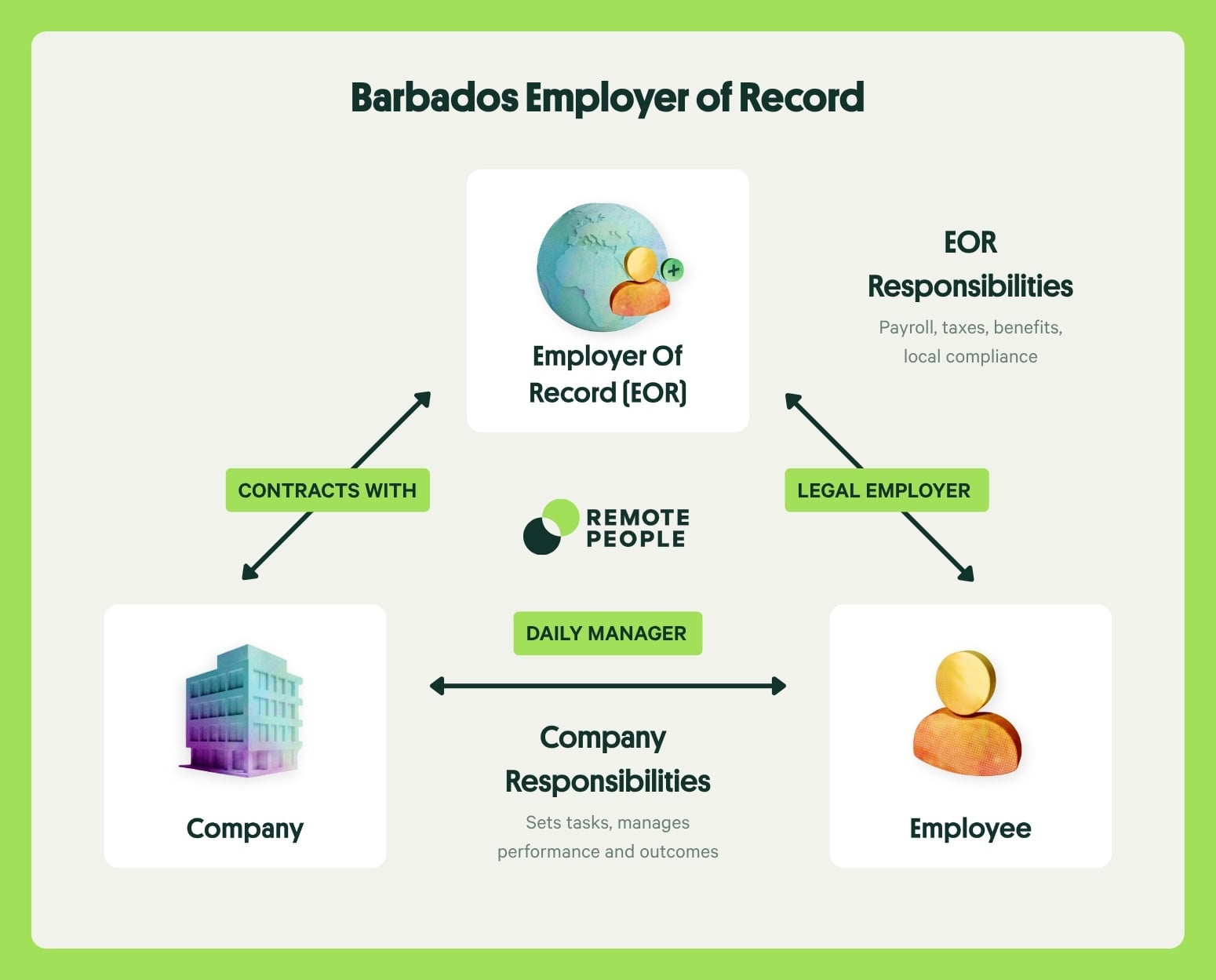
An employer of record acts as the legal employer on paper, handling employment contracts, NIS registration, payroll processing, statutory benefits, and terminations. You retain full operational control over the employee’s work and performance. The EOR model is especially valuable in Barbados because it eliminates months of company incorporation, local bank account setup, and HR infrastructure investment. You can onboard compliant employees in days rather than months.
How an Employer of Record Works in Barbados
What Is an EOR?
Who Uses an EOR in Barbados?
Companies typically use an EOR in Barbados to test market expansion before committing to a full legal entity, to hire small teams of one to 15 people without the cost and time of incorporation, or to onboard a single high-value hire in days. The model suits businesses in tourism, financial technology, customer support, software development, and business services where Barbados has a strong talent pool. Startups entering the Caribbean market, established firms building local teams, and multinational companies piloting regional operations all use EORs to avoid 4–6 months of entity setup and $15,000–$30,000 in upfront incorporation costs.
Typical Onboarding Timeline
Onboarding a Barbadian employee through an EOR typically takes one to two weeks:
- First, you sign the EOR service agreement and provide the employee’s personal details and banking information (1–2 days).
- Second, the EOR drafts a compliant employment contract and sends it to you and the employee for signature (2–3 days).
- Third, the EOR registers the employee with the National Insurance Scheme and sets up payroll in their banking system (2–5 days).
- Fourth, benefits are enrolled, tax withholding is configured, and the payroll schedule is finalized (1–2 days).
- Fifth, the employee begins work and receives their first pay on the next monthly payroll cycle.
If the hire is a non-Barbadian requiring a work permit, add 4–8 weeks for standard long-term permit processing. Short-term permits (up to 11 months) process in the same timeframe. CSME skilled nationals holding a Barbados Accreditation Council certificate are exempt from work permits and complete onboarding in just 1–2 weeks with no permit delays.
Hire in Barbados
With a 2:1 BBD/USD currency peg, English-speaking workforce, and CARICOM market access, Barbados is an ideal hub for regional and remote hiring.
We handle employment contracts, payroll, NIS contributions, tax withholding, and full Barbados compliance.
No local entity needed. Your team can start in days.
Employment Laws and Regulations in Barbados
Employment Contracts
All employment relationships in Barbados are governed by the Employment Rights Act 2012, administered by the Ministry of Labour. Written employment contracts are standard practice and mandatory for fixed-term roles, though the Act recognises indefinite contracts may be oral if fully compliant. Every contract must specify job title, compensation, working hours, leave entitlements, notice periods, and termination conditions. All contracts must be written in English, the official business language of Barbados.
Working Hours and Overtime
The standard workweek in Barbados is 40 hours per week. Employees are entitled to at least two rest days per week, typically Saturday and Sunday. Work beyond 8 hours in a single day or 40 hours in a week constitutes overtime, compensated at 1.5 times the ordinary rate for regular weekday overtime and 2.0 times the ordinary rate for work performed on a rest day or public holiday.
Barbados does not prescribe a universal statutory overtime rate through the Employment Rights Act 2012. Overtime is instead governed by sector-specific Wages Council orders and the Shops Act 2015-30, which set premium pay rates for retail and service workers. The standard working week is 40 hours across most sectors, and individual employment contracts typically extend these rates to other industries by reference.
Barbados overtime and premium pay rates · Per Shops Act 2015-30 and Wages Council orders | |||
Hour Type | Rate Multiplier | Weekly or Daily Cap | Notes |
|---|---|---|---|
Standard hours | 1.0x | 40 hours per week, 8 hours per day | Excludes meal breaks; one-hour meal break mandatory after 4.5 hours worked |
Weekday overtime (beyond 40 hours) | 1.5x (time and a half) | No statutory weekly cap on overtime | Applies to hours exceeding 40 in a week under Shops Act and most Wages Council orders |
Public holiday or scheduled rest day | 2.0x (double time) | Per Shops Act 2015-30 | Applies when an employee works a public holiday or a rostered day off |
Sector-specific rates (Wages Councils) | Varies by industry order | Sector-dependent | Retail, hospitality, and other sectors are set by separate Wages Regulation Orders; contract terms apply elsewhere |
Managerial and supervisory staff | Not statutorily entitled | Contract-based | Overtime eligibility for senior staff is typically agreed in writing in the employment contract |
Minimum Wage
The national minimum wage in Barbados is $5.36 per hour, effective January 21, 2026. Security guards have a higher sectoral minimum of $5.83 per hour. The government has implemented a 2% automatic annual increase indexed to the maximum insurable earnings ceiling, with full reviews conducted every three years by the Ministry of Labour. Unlike most Caribbean jurisdictions, Barbados has no regional wage variations; the rate applies uniformly across all sectors and islands.
Probation Period
The Employment Rights Act 2012 does not establish a mandatory statutory probation period in Barbados. In practice, most employers include a 3-month probationary clause in the written contract, though up to 6 months is common. Importantly, continuous employment for purposes of calculating severance, notice periods, and leave entitlements includes the probation period from day one. Employers may terminate during probation with shorter contractual notice, but NIS contributions apply from the very first day of work.
Leave Entitlements
Barbados law provides a baseline of statutory leave entitlements under the Employment Rights Act 2012 and the Family Leave Act 2025, covering paid annual leave, sick leave, maternity leave, and paternity leave. Leave accrues only after specified qualifying service periods.
Annual Leave
Employees are entitled to 3 weeks paid annual leave. Leave accrues throughout the year and must be taken; it does not carry forward unless the employer agrees. Unused leave at year-end is forfeited.
Sick Leave
6 days paid sick leave. Employers may require a valid medical certificate for absences exceeding two consecutive days. The first day of absence does not require documentation. Sick days do not roll over into the next year.
Maternity Leave
Female employees are entitled to 14 weeks paid maternity leave, structured as a minimum of 6 weeks before the expected delivery date and 8 weeks after birth. Eligibility requires 12 months of continuous service with the same employer. The National Insurance Scheme pays a maternity benefit of 100% of average insurable weekly earnings divided by 6 per day; employers continue to meet the statutory leave obligation. Employees cannot be dismissed on grounds of pregnancy.
Paternity Leave
3 weeks paid paternity leave. Paternity leave can be taken as a continuous block or split: at least 2 weeks within the first 3 months of the child’s birth and the remaining 1 week before the child reaches 6 months of age. Employees may claim paternity leave once per 12-month period, and the NIS provides the benefit in line with maternity benefit calculations.
Other Statutory Leave
- Public holiday leave: 12 paid public holidays per year (see the public holidays table below).
- Study leave: Under the Shops Act, shop workers may take unpaid leave to attend day classes for educational advancement; general employees have no statutory study leave entitlement.
- Bereavement leave: Not statutorily mandated, though many employers offer 1–3 days discretionarily.
Leave Entitlements Summary
Barbados’s labour code codifies every statutory leave type employers must grant, from annual leave to maternity, sick, and other protected absences (Employment Rights Act 2012). The table below summarises each statutory leave category with duration and eligibility so payroll and HR can plan accruals and cover without missing a mandatory entitlement.
Barbados statutory leave entitlements · Per Employment Rights Act 2012 | ||
Leave Type |
Entitlement |
Eligibility |
|---|---|---|
Annual Leave | 3 weeks (after 1 year); 4 weeks (after 5 years) | 12 months continuous service |
Sick Leave | 6 days per calendar year | 12 months continuous service |
Maternity Leave | 14 weeks paid (6 weeks pre, 8 weeks post) | 12 months continuous service |
Paternity Leave | 3 weeks paid (new in 2025) | No service period; once per 12 months |
Public Holidays | 12 paid holidays per year | All employees |
Source: Employment Rights Act 2012 and Family Leave Act 2025 | ||
Statutory Employee Benefits
Barbados law mandates participation in the National Insurance Scheme, funded by employer and employee contributions.
NIS covers sickness benefits, maternity and paternity benefits, invalidity pensions, old-age contributory pensions, employment injury benefits, unemployment benefits, and survivor pensions.
Employees with 12 months of contributions gain access to non-contributory benefits such as old-age pensions at age 67 (or 60 with 30+ years of contributions). The scheme is integrated and funded through single payroll deductions; there are no separate insurance premiums for employees. Public healthcare is subsidized through NIS contributions for Barbadian citizens and permanent residents; foreign workers and expats must arrange private health insurance. For details on how statutory benefits apply to your hires, see the Barbados employee benefits guide.
Recent Regulatory Updates 2026
Barbados passed several labour law changes in 2025 and 2026. The Family Leave Act (2025) extended maternity leave from 12 to 14 weeks and introduced 3 weeks of statutory paid paternity leave, making Barbados the first CARICOM nation with paid paternity entitlements.
The minimum wage increased to $5.36 per hour in January 2026, with automatic 2% annual increases now indexed to movements in the maximum insurable earnings ceiling. The NIS insurable earnings ceiling rose to $2,680 per month on January 1, 2026, affecting both contribution calculations and benefit caps.
On April 1, 2025, the Resilience and Regeneration Fund contribution (formerly the Catastrophe Fund) increased from 0.1% to 0.25% for employees and introduced a 0.25% employer contribution, dedicated to climate adaptation and disaster recovery. The Welcome Stamp digital nomad visa programme has been extended through December 31, 2026, allowing remote workers to reside in Barbados with a one-year renewable visa.
Work Permits and Visas in Barbados
Work Permit Requirements
Who Needs a Work Permit
Non-Barbadian citizens require a work permit to be legally employed in Barbados, with one important exception. CARICOM skilled nationals. These include citizens of CARICOM member states (such as Jamaica, Trinidad and Tobago, Guyana, and the other 11 CARICOM nations) who hold recognized professional credentials in designated skill categories. Exemption holders can work immediately upon arrival with no permit fee or processing delay.
Eligibility and Required Documents
Work permit applications are sponsored by the employer on behalf of the employee. The employer must demonstrate that no resident or Barbadian national is capable and willing to fill the position, typically through a labour market test. Required documents include a completed work permit application form, proof of employment offer, the employee’s passport copy, police clearance, proof of financial stability, and evidence of professional qualifications or work experience. The employer or an authorized immigration representative submits the application to the Department of Immigration.
Processing Time and Validity
Standard work permit processing takes 4–8 weeks and 1–2 weeks for short-term permits (valid up to 11 months). Short-term permits suit temporary contracts, consultants, and project-based assignments. Long-term permits are renewable and ideal for permanent hires and management roles.
Renewal Process
Long-term work permits may be renewed before expiry with updated employment documentation, proof of continued employment, and a renewal fee. Renewal applications are submitted to the Department of Immigration at least 30 days before the permit expires. The renewal process typically takes 3–5 weeks. Employees should apply early to avoid lapses in legal employment status.
Common Visa Types for Foreign Workers
Barbados offers several work-authorising visa pathways administered by the Barbados Department of Immigration under the Immigration Act Cap. 190. Options range from sector-specific work permits to the Welcome Stamp for remote workers employed abroad. CARICOM nationals with recognised qualifications may work without a permit under the CSME Skilled National regime.
Barbados work visa types for foreign workers · 2026 | ||||
Visa Type | Duration | Best For | Leads to Long-term Residency? | Processing |
|---|---|---|---|---|
Short-term Work Permit | Up to 11 months | Project or seasonal assignments for non-Barbadian staff | No | 4 to 6 weeks |
Long-term Work Permit | Up to 3 years, renewable | Permanent non-CARICOM hires sponsored by a local or foreign employer | Yes, after continuous renewal and eligibility review | 4 to 8 weeks |
CARICOM Skills Certificate (CSME) | Indefinite while qualification is valid | CARICOM nationals with a BAC-recognised qualification | Yes, eligible for CSME free movement rights | 2 to 4 weeks at the BAC |
Barbados Welcome Stamp | 12 months, renewable | Remote workers earning USD 50,000+ employed by a company outside Barbados | No, residency not conferred | Within 7 working days |
Special Entry and Reside Permit (SERP) | Up to 5 years or indefinite for qualifying applicants | High-net-worth individuals with substantial investment in Barbados | Yes, a direct path to long-term residency | 6 to 12 weeks |
Immigrant Status | Permanent | Spouses of Barbadians and long-term residents | Yes, confers permanent residency | 12 to 24 weeks |
How an EOR Handles Work Permits
When you hire through an EOR in Barbados, the EOR manages the entire work permit process on your behalf.
For CSME-exempt employees, the EOR verifies the BAC certificate, confirms exemption status, and completes onboarding without permits.
For non-exempt hires, the EOR prepares all documentation, submits the application to the Department of Immigration, and tracks processing. The EOR renews long-term permits before expiry so employment stays legal without interruption. This eliminates the compliance burden on your end. For more information on work permits and visa pathways, see the Barbados work visa guide.
Payroll, Taxes, and Social Security in Barbados
Employer Contributions
Employers hiring in Barbados owe mandatory contributions on top of gross salary, funding social security, health, pensions, and other statutory schemes (NIS Contribution Rates). The table below lists the employer-side contribution rates so you can calculate the true all-in cost of each hire.
Barbados employer social security contributions · 2026 rates | ||
Contribution Component |
Rate |
Basis |
|---|---|---|
National Insurance Scheme (NIS) | 12.75% | Up to $2,680/month ceiling |
Health Service Contribution | 1.50% | Up to $2,680/month ceiling |
Resilience & Regeneration Fund | 0.25% | Gross earnings (no ceiling) |
Total Employer Contributions | 14.50% | Capped and uncapped items |
Source: NIS Contribution Rates and 2026 Earnings Ceiling | ||
Employee Contributions
Alongside income tax, employees in Barbados pay statutory payroll deductions that fund social security, health cover, and other state schemes (NIS Contribution Rates). The table below summarises the employee-side contribution rates payroll must withhold from gross pay each month.
Barbados employee payroll deductions · 2026 monthly withholdings | ||
Deduction Component |
Rate |
Basis |
|---|---|---|
National Insurance Scheme (NIS) | 11.10% | Up to $2,680/month ceiling |
Health Service Contribution | 1.00% | Up to $2,680/month ceiling |
Resilience & Regeneration Fund | 0.25% | Gross earnings (no ceiling) |
Total Employee Deductions | 12.35% | Capped and uncapped items |
Source: NIS Contribution Rates and 2026 Earnings Ceiling | ||
Income Tax
Personal income tax in Barbados is levied on a progressive basis, with the rate rising as taxable income crosses statutory thresholds (PwC Barbados Taxes). The table below sets out the current income-tax brackets that apply to resident employees so you can model net-of-tax compensation before making an offer.
Barbados income tax brackets · 2026 | |
Taxable Income (USD) |
Tax Rate |
|---|---|
$0 – $25,000 | 12.5% |
Above $25,000 | 28.5% |
Personal allowance: $12,500. Union members: additional $180 annual allowance (retroactive to 2024). Source: PwC Barbados Taxes and BRA PAYE Guide | |
Payroll Cycle
Employers run payroll monthly in Barbados, typically on a fixed calendar date (e.g., last business day of the month).
Pay is transferred to employee bank accounts by electronic transfer.
Employers must remit all NIS contributions and health service contributions to the National Insurance Scheme by the 15th monthly. Income tax (PAYE) must be remitted to the Barbados Revenue Authority. Late remittance incurs penalties and interest. An EOR handles all monthly payroll processing, withholding, and statutory remittance on your behalf.
13th Month Salary and Bonus Pay
A 13th-month bonus or 14th-month salary is not legally required. Employers are not expected to provide this benefit, and no statutory obligation exists. Some employers voluntarily offer Christmas bonuses or performance bonuses, but these are entirely discretionary and not part of standard compensation packages. Employees receive no entitlement to a 13th month unless explicitly provided in the individual employment contract.
Cost of Hiring Through an EOR in Barbados
EOR Service Fees
EOR service fees in Barbados typically range from $300 to $600 per employee per month, depending on the complexity of the hire, benefits package, and EOR provider. Fees cover employment contract drafting, payroll administration, statutory remittances, benefits administration, work permit sponsorship (where applicable), and compliance support. Some providers charge flat monthly fees; others use tiered models based on salary. An EOR fee replaces the cost of hiring in-house HR staff, accountants, and immigration specialists, typically a much larger investment for small teams.
Total Employment Cost Breakdown
The all-in cost of employing someone in Barbados goes well beyond gross salary. The table below walks through a realistic cost build-up for a typical hire, layering mandatory employer social contributions, statutory benefits, and payroll taxes on top of base pay so finance teams can budget accurately before an offer goes out.
Barbados employer cost example · $1,200/month gross · 2026 | ||
Cost Component |
Rate/Amount |
Monthly Cost |
|---|---|---|
Employee Gross Salary | 100% | $1,200.00 |
Employer NIS (12.75%) | 12.75% | $153.00 |
Employer Health Service (1.5%) | 1.50% | $18.00 |
Employer Resilience Fund (0.25%) | 0.25% | $3.00 |
Subtotal: Employer Contributions | 14.50% | $174.00 |
EOR Service Fee | Flat monthly | $400.00 |
Total Monthly Cost to Employer | 147.83% | $1,774.00 |
All USD amounts are approximate conversions at the official peg of $1 USD = BBD 2.00, maintained by the Central Bank of Barbados since 1975. Employee takes home approximately $1,052 after NIS, health, resilience fund, and PAYE tax withholdings. Source: NIS Contribution Rates and BRA PAYE Guide | ||
In this example, the total employer cost is $1,774.00 per month, approximately 48% above the gross salary of $1,200 (see Barbados average salary). The employer contribution to statutory schemes (NIS, health, resilience fund) is $174.00 (14.5%). The EOR service fee of $400 covers all administrative, compliance, payroll processing, and statutory remittance obligations. Contact us to discuss your specific hiring needs and exact costs.
Benefits of Using an EOR in Barbados
An EOR eliminates the 4–6 month incorporation timeline and $15,000–$30,000 upfront cost of setting up a local legal entity in Barbados. You hire your first employee in days rather than months. The EOR bears all legal employment obligations, from contract compliance to statutory remittance deadlines, reducing your exposure to penalties and labour disputes. Barbados law changes and NIS updates are managed by compliance specialists at the EOR, not your finance or HR team.
Using an EOR also provides cost efficiency through shared infrastructure. Instead of hiring dedicated payroll and HR staff or paying accountants to manage PAYE and NIS filings, you pay a fixed monthly fee that covers everything. For companies with fewer than 15 employees, this model is far cheaper than in-house administration. An EOR also gives you flexibility to scale: if you decide to exit Barbados, you wind down employment cleanly without winding down a legal entity.
Finally, an EOR handles all work permit sponsorship and immigration compliance, navigating Barbados Department of Immigration requirements on your behalf. If you later decide to transition to a local subsidiary, the EOR can support the handoff, or you can continue using the EOR model as you grow.
Termination and Offboarding in Barbados
Notice Periods
Notice periods in Barbados depend on the employee’s length of service and payment frequency.
For hourly, daily, or weekly paid employees, statutory notice periods. For monthly paid employees, 1 month’s notice is required if the employee has worked 1 or more years. Notice periods are set out in the Employment Rights Act 2012 and cannot be waived. During the notice period, the employee continues to work and receive full pay.
Statutory notice periods in Barbados are set by section 22 of the Employment Rights Act 2012, which scales minimum notice with length of continuous service. Employees with less than one year of service are not covered by the statutory minima. Employers may pay in lieu of notice, and notice requirements differ for weekly-paid and monthly-paid staff.
Barbados statutory notice periods by length of service · Per Employment Rights Act 2012 | |||
Length of Service | Notice (Weekly Paid) | Notice (Monthly Paid) | Notes |
|---|---|---|---|
Under 1 year | No statutory minimum | No statutory minimum | Employees under one year are not protected by ERA 2012 unfair dismissal provisions |
1 to under 2 years | 1 week | 1 month | Monthly-paid employees receive at least one month at every tier |
2 to under 5 years | 2 weeks | 1 month | Pay in lieu of notice is permitted at the employer’s option |
5 to under 10 years | 4 weeks | 1 month | Applies to most weekly-paid clerical and operational roles |
10 to under 15 years | 6 weeks | 1 month | Mid-tenure employees covered by extended notice requirements |
15 years or more | 10 weeks | 1 month | Long-serving employees receive the highest statutory notice tier |
Severance Pay
Severance in Barbados is governed by the Severance Payments Act Cap. 355A and administered through the National Insurance Scheme Severance Fund. An employee must have 104 weeks of continuous service to qualify, and the schedule uses three weekly-wage multipliers depending on years in each tier. Service beyond 33 years is not counted, and the weekly wage used in the calculation is capped at the NIS maximum insurable earnings ceiling.
Barbados severance pay schedule by years of service · Per Severance Payments Act Cap. 355A | |||
Years of Service | Severance Multiplier | Worked Example | Notes |
|---|---|---|---|
1 to 10 years (first tier) | 2.5 weeks per year of service | 5 years at BBD 1,000/week = 12.5 weeks = BBD 12,500 | Minimum 104 weeks of continuous service required to qualify |
11 to 20 years (second tier) | 3 weeks per year of service | 15 years at BBD 1,000/week = (10 x 2.5) + (5 x 3) = 40 weeks = BBD 40,000 | Multiplier applies only to years in the second tier; prior years remain at 2.5 weeks |
21 to 33 years (third tier) | 3.5 weeks per year of service | 25 years = (10 x 2.5) + (10 x 3) + (5 x 3.5) = 72.5 weeks | Service beyond 33 years does not accrue additional severance |
Weekly wage cap (2026) | BBD 1,238 per week | Equal to the NIS maximum insurable earnings ceiling | Based on the average weekly wage over the 104 weeks before termination |
Dismissal for cause or probation | Not payable | N/A | Gross misconduct dismissals and termination during probation are excluded |
Calculation Method
Severance is payable under the Severance Payments Act to employees with at least 2 years of continuous service (104 weeks). The formula is based on length of service: 2.5 weeks of basic weekly pay for each year of service during years 1–10; 3 weeks per year during years 11–20; and 3.5 weeks per year during years 21–33. The maximum severance entitlement is capped at 33 years of service. Severance is calculated using the employee’s average weekly wages over the last 104 weeks but is capped at the maximum insurable earnings ($619 per week or $2,680 per month as of 2026).
Caps and Exceptions
Severance is not payable if the employee is terminated for misconduct, resigns voluntarily, or enters a mutual separation agreement. Employees must claim severance within one year of termination. Employers remit severance to the Severance Payments Fund, which reimburses employers under certain conditions or pays employees directly.
Grounds for Termination
Employers may terminate for cause (breach of contract, misconduct, absenteeism, insubordination) or without cause (redundancy, restructuring, business closure). Terminations for cause do not trigger severance obligations. Terminations without cause require notice and, if the employee has 2+ years of service, severance pay. Summary dismissal (immediate termination without notice) is only permissible for gross misconduct such as theft, violence, or serious breach of confidentiality and must be documented thoroughly to defend against severance claims.
EOR vs. Other Hiring Models in Barbados
EOR vs. Setting Up a Local Entity
Choosing between an Employer of Record and setting up your own legal entity in Barbados comes down to timeline, upfront cost, ongoing administrative burden, and how quickly you can scale up or wind down. The table below lays out both paths side by side across setup time, cost, compliance risk, and flexibility so you can match the right model to the size and duration of your Barbados hiring plan.
Barbados EOR vs local entity comparison · Setup time, cost, risk and best-fit | ||
Comparison |
EOR |
Local Entity (Ltd./Inc.) |
|---|---|---|
Setup Time | 1–2 weeks | 4–6 months |
Upfront Cost | Minimal ($0–$500) | $15,000–$30,000 |
Ongoing Annual Cost (5 employees) | $18,000–$36,000 (EOR fees) | $8,000–$15,000 (annual compliance, tax, audit) |
Local Bank Account | EOR maintains account | You open and manage |
Payroll & NIS | EOR handles all | You manage or hire accountant |
Legal Employer (Contracts, Termination) | EOR is legal employer | You are legal employer |
Work Permit Sponsorship | EOR sponsors | You sponsor |
Exit/Winding Down | Simple; no entity dissolution | Costly; requires formal dissolution, tax filings |
Eligible for Government Contracts | No (EOR is third party) | Yes (you are registered entity) |
Best For | Startups, pilots, 1–15 employees, test markets | 15+ employees, long-term commitment, bid for contracts |
Source: EOR operational experience and Barbados corporate registration (Ministry of Commerce). All costs in USD. | ||
An EOR is ideal for companies testing a market, hiring fewer than 15 employees, or wanting to avoid months of incorporation. You pay higher per-employee costs but avoid large upfront capital and compliance overhead. A local entity is better suited for long-term operations with 15+ employees, if you plan to bid for government contracts (which often require local company registration), or if you intend to grow substantially in Barbados. For most startups and remote hiring pilots, an EOR delivers faster time-to-hire and lower risk.
EOR vs. Hiring Independent Contractors
Classifying a Barbados-based worker as an independent contractor rather than an employee can expose you to back-taxes, unpaid social contributions, and reclassification penalties if the working relationship looks like employment in practice. The table below contrasts EOR employment with contractor engagement across legal relationship, tax and benefits treatment, IP ownership, and misclassification risk so you can pick the right model role by role.
Barbados EOR vs independent contractors · Compliance, cost, and risk | ||
Comparison |
EOR (Employee) |
Independent Contractor |
|---|---|---|
Legal Status | Employee; employer obligations apply | Self-employed; contractor responsible for own taxes |
Statutory Benefits | Annual leave, sick leave, maternity/paternity, NIS | None required by law |
Work Hours | 40/week standard; overtime rules apply | Flexible; no legal hour limits |
Employer NIS/Health Costs | 14.5% of wages | None (contractor self-insures) |
Control & Direction | Employer directs work, methods, hours | Contractor sets own methods and schedule |
Contract Duration | Indefinite or fixed-term; notice required to end | Project-based; can end without notice per agreement |
Misclassification Risk | None if properly structured | High; Barbados labour authorities scrutinize arrangements |
Total Monthly Cost ($1,200 gross equivalent) | $1,774 (with EOR fee) | $1,200–$1,500 (no benefits; contractor may invoice above) |
Best For | Core team; ongoing, role-based work | Project work, temporary assignments, specialist consulting |
Source: Employment Rights Act 2012 and RemotePeople Contractor Solutions. Misclassification occurs if a contractor is treated as an employee (directed, supervised, integrated into org structure). Barbados authorities may reclassify and assess back NIS contributions and penalties. | ||
Contractors appear cheaper upfront because you avoid NIS contributions and benefits.
However, Barbados labour authorities carefully scrutinise worker classification.
If a contractor is integrated into your team, supervised, assigned hours, and treated like an employee, the Ministry of Labour may reclassify them as an employee and assess back NIS contributions, penalties, and interest. The risk is high for ongoing roles. Contractors suit true project-based work, short-term specialist assignments, or supplementing your core team. For regular, role-based hiring, an EOR or local entity is legally safer. If you need contractor solutions, independent contractor solutions in Barbados with proper structuring and compliance documentation.
EOR vs. PEO
EORs and PEOs both simplify international hiring, but only an EOR becomes the legal employer of record in Barbados — a critical distinction when you don’t have a local entity of your own. The table below maps the practical differences across legal employer status, entity requirement, liability allocation, and scope of coverage.
Barbados EOR vs PEO comparison · Legal employer, liability, and setup | ||
Comparison |
EOR |
PEO (Professional Employer Org) |
|---|---|---|
Legal Employer | EOR is sole legal employer | Shared co-employment; both PEO and client are employers |
Liability | EOR bears all employment liability | Shared liability between PEO and client |
Regulatory Framework (Barbados) | Established under Employment Rights Act 2012 | No formal PEO regulatory framework in Barbados |
Setup Complexity | Simple; EOR already registered locally | Complex; PEO partnerships are rare in Caribbean |
Control over Employee | You maintain full operational control | Shared control; PEO handles HR, benefits, payroll |
Cost | $300–$600/employee/month | Typically higher; varies widely |
Best For | Clear-cut hiring relationships | Not recommended in Barbados (limited legal framework) |
Source: Barbados labour law research and EOR/PEO operational models. Barbados does not have a formal regulatory framework for PEO arrangements, making PEO partnerships uncommon and complex. | ||
A Professional Employer Organisation (PEO) is a rare model in Barbados because there is no formal regulatory framework for co-employment relationships. PEOs work well in mature markets with established liability rules and insurance structures, but Barbados labour law does not recognise PEO-style arrangements. An EOR is the clear, legal model for outsourced employment in Barbados. The EOR is the sole legal employer, bearing all obligations and liability, and you maintain full control over the work and performance of the employee.
Public Holidays in Barbados
Barbados observes a defined set of official public holidays on which most private-sector employers must give staff a paid day off (timeanddate.com Holidays 2026). The table below lists the statutory holidays employers need to build into payroll calendars and leave planning for the year, along with the date rule for each.
Barbados public holidays · 2026 calendar year | ||
Holiday |
Date 2026 |
Day of Week |
|---|---|---|
New Year’s Day | January 1 | Thursday |
Errol Barrow Day | January 21 | Wednesday |
Good Friday | April 3 | Friday |
Easter Monday | April 6 | Monday |
National Heroes Day | April 28 | Tuesday |
Labour Day (May Day) | May 1 | Friday |
Whit Monday | May 25 | Monday |
Emancipation Day | August 1 | Saturday |
Kadooment Day | August 3 | Monday |
Independence Day | November 30 | Monday |
Christmas Day | December 25 | Friday |
Boxing Day | December 26 | Saturday |
Barbados observes 12 public holidays per year. Employees are entitled to paid leave on all statutory holidays.
If a public holiday falls on a weekend (Sunday or Saturday), the following Monday is observed as a substitute holiday. Work performed on a public holiday is compensated at double the ordinary rate (2.0 times). An EOR automatically tracks public holidays and ensures correct payroll coding and scheduling so that employees are paid correctly on these days.
How to Get Started with an EOR in Barbados
Getting started with an EOR in Barbados takes just a few straightforward steps:
- First, contact your EOR provider and request a service agreement. Share your hiring timeline, the number of employees you plan to hire, salary expectations, and any specific roles or skill requirements.
- Second, once the agreement is signed, provide your employee’s personal information, including full name, date of birth, email, phone number, home address, banking details for payroll, and a copy of their passport or national ID.
- Third, the EOR drafts a compliant employment contract, reviews it with you, and sends it to the employee for signature. This typically takes 2–3 days.
- Fourth, the EOR registers the employee with the National Insurance Scheme and configures payroll in their banking system. They also enrol the employee in any benefits programmes and set up tax withholding (2–5 days).
- Fifth, the employee officially starts work on the agreed date and receives their first salary on the next monthly payroll cycle, typically within 30 days of onboarding.
If you are hiring a non-Barbadian national, add 4–8 weeks for work permit processing, or ask your EOR about expedited pathways such as the CSME skilled national exemption or Welcome Stamp digital nomad visas. Contact RemotePeople today to start your Barbados hiring journey.
Where companies hiring in Barbados expand next
Employers with operations in Barbados often extend across the Caribbean and nearby US-adjacent markets. Teams frequently add a team in Jamaica for CARICOM-wide workforce portability; operations in the Bahamas often follows for shared Caribbean labor and trade norms; Trinidad and Tobago is a common next step, offering CARICOM mobility and shared Caribbean business practices; and hiring in the Dominican Republic rounds out the regional footprint with aligned CARICOM employment frameworks.
Frequently Asked Questions
Employer of Record in
Employer of Record in
Employer of Record in
Employer of Record in
Employer of Record in
Employer of Record in
Employer of Record in
Saint Vincent and the Grenadines
Employer of Record in




