Recruit
Employer of Record in Trinidad and Tobago
-
 Drew Donnelly
- Published
- July 24, 2026
RemotePeople’s employer of record in Trinidad and Tobago lets you hire employees in Trinidad and Tobago with NIS expertise. We handle National Insurance System contributions at approximately 8.4 percent employer share, statutory leave management, and maternity benefit administration.
Hire in Trinidad and Tobago — book a free 30-minute demo
No sales call required. Free 30-minute expert call if you want one.
Tell us about your company
So we can match you with a specialist who knows your market — and unlock volume pricing tiers.
* All fields are required.
Where and when are you hiring?
Tell us the geography and timing and we'll quote each country line by line, with onboarding timelines.
* All fields are required.
Help us beat your current setup
We'll benchmark your current deal and send a line-by-line proposal in 24 hours — showing exactly where we cut cost, time, or risk. After you submit, you can book a call to walk through it together.
* All fields are required.
Thanks! Your proposal is on its way.
Expect a tailored, line-by-line proposal in your inbox within 24 hours. In the meantime…
Want to walk through it together?
Book a free 30-minute call with one of our specialists. We'll explain every line, answer your questions, and tailor the proposal further if you need.
No obligation. Pick a time that works for you.








- Hire in Trinidad and Tobago — book a free 30-minute demo
- Tell us about your company
- Where and when are you hiring?
- Help us beat your current setup
- Thanks! Your proposal is on its way.
- How to Hire Employees in Trinidad and Tobago
- Trinidad and Tobago EOR vs Legal Entity in Trinidad and Tobago
- Using an Employer of Record in Trinidad and Tobago
- How Much Does a Trinidad and Tobago EOR Cost?
- Employment and Labor Laws in Trinidad and Tobago
- Payroll and Employment Taxes in Trinidad and Tobago
- Work Permits and Visas in Trinidad and Tobago
- Time Off and Leave in Trinidad and Tobago
- Employee Benefits in Trinidad and Tobago
- Terminations and Severance in Trinidad and Tobago
- Expand into Trinidad and Tobago Easily with RemotePeople’s Employer of Record (EOR) Solution
- Where companies hiring in Trinidad and Tobago expand next
- Frequently Asked Questions
- Related EOR Destinations

Start hiring in Trinidad and Tobago
Let RemotePeople handle payroll, compliance, and HR admin worldwide so you can focus on building your team.

Trinidad and Tobago, a dynamic Caribbean nation, is quickly becoming a top destination for global companies. Known for its cost-effective labor and expertise in key industries such as oil, gas, and manufacturing, the country provides access to a skilled, English-speaking workforce. As a strategic hub for both Caribbean and Latin American markets, it offers significant advantages for businesses expanding internationally. While companies also consider opportunities in neighboring nations like Jamaica, Barbados, Guyana, The Bahamas, and Suriname, Trinidad and Tobago stands out for its strong economy and business-friendly environment.
This guide provides essential information on how an Employer of Record (EOR) can simplify hiring in Trinidad and Tobago, from general hiring practices to employee benefits administration. We’ll also explain how RemotePeople can streamline the process through our comprehensive EOR services.
What Is an EOR?
How to Hire Employees in Trinidad and Tobago
There are generally three ways to hire employees in Trinidad and Tobago:
Setting Up a Local Entity
Establishing a local entity in Trinidad and Tobago gives you full control over hiring new workers in this country. However, this involves a lengthy registration process with the Companies Registry in Trinidad and Tobago, plus various requirements such as a local registered address, Tax IDs, National Insurance Registration, and compliance with the Board of Inland Revenue.
This route of employment is best for larger companies or businesses looking for long-term hiring in this country.
Working with an Employer of Record (EOR)
An EOR provider can be a useful choice if companies are looking to test the market when hiring in Trinidad and Tobago.
Employer of Record providers act as the legal employer on your behalf, ensuring workers are hired compliantly and handling tasks around benefit administration, payroll, and compliance with local labor laws.
Hiring Independent Contractors
Flexible workers may be appealing to companies that carry out project-based work. This allows them to hire workers on a short-term basis, without the need to provide all benefits that PAYE employees are entitled to.
However, companies must ensure workers are classified correctly to avoid any legal issues with the misclassification of contracted staff.
Trinidad and Tobago EOR vs Legal Entity in Trinidad and Tobago
It’s important for companies to weigh up the pros and cons of either working with an EOR provider or setting up a legal entity in Trinidad and Tobago. These may vary depending on the type of company, budget, and preferred level of control over the hiring process.
An EOR can help you outsource the hiring process, taking pressure off of the businesses and allowing you to focus on sales and growth. Using an EOR can also reassure you that local labor laws governed by the Ministry of Labour and the National Insurance Board are being fully adhered to.
Companies that choose to set up a legal entity generally set up a Limited Liability Company (LLC) and must go through formal processes via the Companies Registry. While basic government filing fees are fairly affordable (between TT$220 – TT$300), there are various other costs, such as legal support, administrative staff, and accounting, that can make establishing a legal entity expensive.
Hire in Trinidad and Tobago
An English-speaking, energy-experienced workforce with NIS/GATE contributions, Trinidad and Tobago Minimum Wages Act, and local compliance.
We handle employment contracts, payroll, social contributions, and full Trinidad and Tobago compliance.
No local entity needed. Your team can start in days.
Using an Employer of Record in Trinidad and Tobago
An Employer of Record acts on behalf of your company as the legal employer for workers in Trinidad and Tobago, taking on key hiring responsibilities and ensuring full compliance with local labor laws.
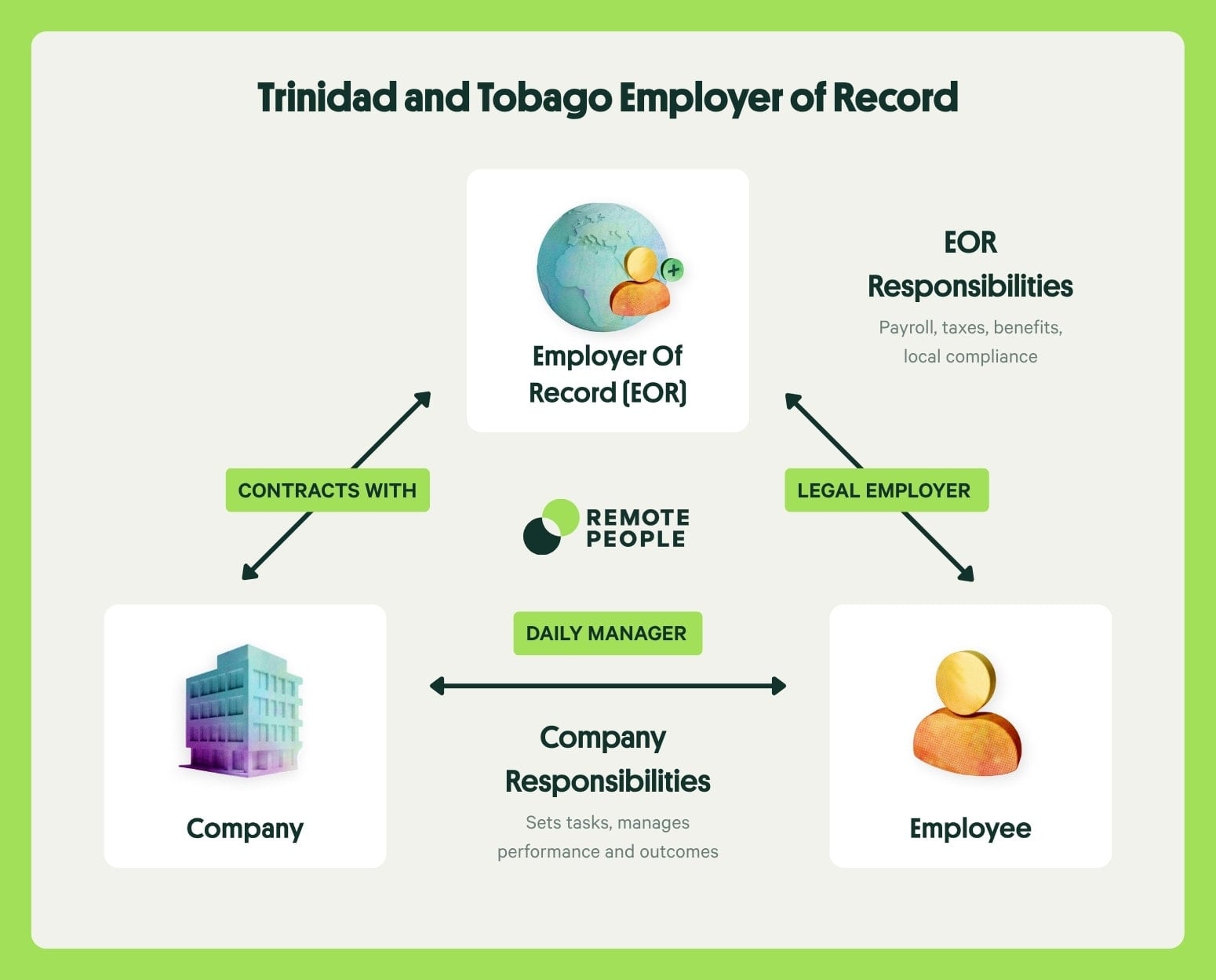
An EOR in Trinidad and Tobago would handle the following tasks:
- Employment contracts: EOR providers can help draft employment contracts to ensure compliance with labor laws in Trinidad and Tobago, including the Industrial Relations Act.
- Payroll processing: They can handle payroll processing tasks such as salary calculations, deductions, and national insurance contributions.
- Tax and social contributions: Involving an EOR with tax and social contributions can ensure your company is filed with the Inland Revenue Division and National Insurance Board to make sure all taxes and contributions are made correctly and on time.
- Compliance with labor regulations: An EOR can help maintain compliance with local labor laws regarding working hours, leave entitlement, etc.
- Benefits administration: EORs also manage benefit compliance, including sick leave, severance pay, overtime compensation, and parental leave.
How Much Does a Trinidad and Tobago EOR Cost?
The cost of a Trinidad and Tobago EOR can vary based on the level of services your business requires from an EOR.
Most EORs charge a setup fee of between $500 – $2,000, with ongoing costs starting from around $250 per employee, depending on seniority and salary level.
There are also optional services that EORs offer, such as enhanced healthcare packages that companies can pick and choose which they’d like to offer their workers.
Despite these fees, EOR can still be the more cost-effective choice when employing people in Trinidad and Tobago.
Employment and Labor Laws in Trinidad and Tobago
Companies should always adhere to local labor laws when hiring in Trinidad and Tobago, familiarizing themselves with laws around employment contracts, taxes, and benefits.
We’ve included below an overview of what businesses need to know before embarking on their hiring journey.
Key Contract Requirements
Employers must follow the steps below when hiring in Trinidad and Tobago:
- Job offer and acceptance: Employers must issue new employees with a formal offer, including salary, job description, and start date. This must be accepted before employment can commence.
- Written employment contract: It’s advised, although not legally required, to provide employees with a written contract explaining the expectations that the role requires, plus working hours, benefits, and rules around termination.
- Registration with tax authorities: Businesses must register new workers with the Board of Inland Revenue (BIR) and the National Insurance Board (NIB) to ensure contributions are made correctly.
- Work permit compliance: Non-national employees must have a valid work permit from the Ministry of National Security before they can start work.
- Employee rights disclosure: New workers should be informed of their rights as per the Industrial Relations Act, as well as all relevant labor laws.
- Health and safety compliance: A safe, fair working environment must be maintained, as per the Occupational Safety and Health Act.
- Non-discrimination: Workers must be protected from discrimination in regards to race, gender, religion, and disability. There are no individual anti-discrimination acts in Trinidad and Tobago; however, many constitutional protections and laws protect workers from discrimination.
- Onboarding: Welcome your new workers to the team by informing them of any workplace procedures, and consider providing them with a company handbook.
Working Hours
Workers in Trinidad and Tobago typically work 40 hours per week, which is spread over 5 days. Employees usually work 8 hours per day, inclusive of rest breaks.
Overtime
| Overtime Hours | Pay Rate |
|---|---|
| First 4 hours | 1.5× normal hourly rate |
| Next 4 hours | 2× normal hourly rate |
| Hours thereafter | 3× normal hourly rate |
Social Security Contributions
Effective January 5, 2026, the total NIS contribution rate increased to 16.2% of insurable earnings (up from 13.2%). The employer pays two-thirds (10.8%) and the employee pays one-third (5.4%). A further 3% increase is scheduled for January 2027, bringing the total rate to 19.2%. The maximum monthly insurable earnings are capped at TT$13,600 (Class XVI).
Employers must remit these payments to the National Insurance Board (NIBTT) by the 15th of every month to avoid penalties.
Probation Periods
There is no statutory maximum probation period in Trinidad and Tobago, but common practice is 3–6 months. Probation terms must be stated in the employment contract. During probation, shorter notice periods typically apply.
Payroll and Employment Taxes in Trinidad and Tobago
It’s important that employers follow the payroll and employment tax rules when hiring in Trinidad and Tobago. We’ve included below summaries on key points regarding payroll cycles, minimum wages, bonus payments, and tax contributions.
Payroll Cycle
Employers in Trinidad and Tobago tend to pay their employees monthly. This may differ for seasonal or temporary workers.
Minimum Wage
The national minimum wage in Trinidad and Tobago is TTD 20.50 per hour, effective January 1, 2024 (increased from TTD 17.50). For a standard 40-hour workweek, this equates to approximately TTD 3,553 per month. This is a government-mandated minimum wage, and employers may face penalties for non-compliance.
All monetary amounts are in Trinidad and Tobago dollars (TTD). As of 2026, 1 USD ≈ 6.78 TTD. The TTD is effectively pegged to the USD through a managed float.
Bonus Payments
There is no statutory right to bonus payments of 13-month bonuses in Trinidad and Tobago. However, some businesses will offer bonuses as a supplementary benefit in line with employees’ performance.
Employer Tax Contributions
Employers must make contributions to the National Insurance Board (NIBTT). As of January 5, 2026, the total contribution rate is 16.2% of an employee’s insurable earnings, with employers covering about two-thirds (10.8%). These contributions fund social security benefits like sickness, maternity, and injury coverage.
Employers also withhold the Health Surcharge and PAYE tax from wages, but these aren’t direct employer costs. However, employers who fail to remit PAYE and Health Surcharge by the 15th of the following month face a penalty of 25% of the deduction or TTD 40 (whichever is greater), plus interest at 20% per annum from the due date.
In addition, companies must pay the Green Fund Levy, a tax on their monthly revenue.
| Contribution Type | Employer Rate | Details |
|---|---|---|
| National Insurance (NIS) | 10.8% | Applied to “insurable earnings” up to a monthly cap of TTD 13,600. |
| Health Surcharge | 0% | Paid entirely by the employee; employer only manages the withholding. |
| Green Fund Levy | 0.3% | A tax on the company’s gross sales/revenue, not individual salaries. |
Employers are legally required to maintain separate insurance for work-related injuries; premiums vary by industry risk level.
Employee Payroll Contributions
Employee payroll contributions are mandatory deductions that fund national social security, healthcare services, and public infrastructure. For 2026, these amounts are calculated based on specific income thresholds and recently updated phased contribution rates.
Employers are legally required to remit these total payments to the National Insurance Board (NIBTT) and the Board of Inland Revenue (BIR) by the 15th day of the following month.
| Deduction Type | Rate / Amount | Threshold / Cap |
|---|---|---|
| NIS (Social Security) | 5.4% | Capped at TTD 13,600 monthly |
| Health Surcharge (Higher) | TTD 8.25 weekly | For earnings over TTD 470 monthly |
| Health Surcharge (Lower) | TTD 4.80 weekly | For all other non-exempt employees |
| Income Tax (PAYE) | 25% | Only on earnings above TTD 7,500 monthly |
Income Tax
Income tax rates in Trinidad and Tobago are progressive. Earnings up to TTD 1,000,000 per year are taxed at 25%, while income above this threshold is taxed at 30%. Residents benefit from a personal allowance of TTD 90,000 per year, which reduces taxable income. Additionally, 70% of NIS contributions can be deducted when calculating tax, effectively lowering the tax burden. Non-residents are taxed on Trinidad and Tobago–sourced income at the applicable income tax rates.
Residents, ordinarily resident, or domiciled persons in Trinidad and Tobago are taxed on worldwide income, regardless of whether such earnings are remitted to Trinidad and Tobago. This rule also affects expatriate employees who may have income from other jurisdictions.
Pension System
The pension system in Trinidad and Tobago is split into 3 pillars:
- Public Pension System: The primary pension system, administered by the National Insurance Board. Entitles workers to an old-age pension provided that they have made a minimum of 750 contributions throughout their working life.
- Private Pension Plans: Occupational pension schemes offered by larger employers, regulated by the Central Bank of Trinidad and Tobago. Usually voluntary, with tax-deductible contributions.
- Personal Pension Plans: Generally used by self-employed workers or those seeking additional savings for retirement.
Tax Compliance and Payroll Reporting
Businesses operating in Trinidad and Tobago must keep timely payroll records to ensure that contributions towards National Insurance are made efficiently. Income tax must be deducted from workers’ wages and remitted to the Board of Inland Revenue before the 15th of the following month.
Penalties may be incurred if PAYE remittances or filings are incorrect/late, and may lead to audits and even legal implications if data is stored insecurely.
Work Permits and Visas in Trinidad and Tobago
Foreign nationals working in Trinidad and Tobago must have an approved work permit, managed by the Ministry of National Security.
This involves registering for a TTBixLink ID, which individuals can apply for online via the Work Permit E-Service. Permits are valid for up to 3 years, with the processing times taking between 6 – 10 weeks.
Time Off and Leave in Trinidad and Tobago
Mandatory Leave Entitlements
Most sectors in Trinidad and Tobago entitle their employees to 14 days of annual leave once they have completed 1 year of continuous service.
There are no set laws that entitle workers to annual leave; however, this has developed as a general practice.
Public Holidays
Trinidad and Tobago observes a variety of public holidays, giving workers time off to celebrate cultural, religious, and national events. In 2026, employees are entitled to paid leave on official public holidays, which include nationally recognized days as well as widely observed cultural celebrations.
- New Year’s Day (Jan 1)
- Carnival Monday & Tuesday (Feb 16–17)
- Eid al‑Fitr (Mar 20)
- Spiritual Baptist Liberation Day (Mar 30)
- Good Friday (Apr 3)
- Easter Monday (Apr 6)
- Indian Arrival Day (May 30)
- Corpus Christi (Jun 4)
- Labour Day (Jun 19)
- African Emancipation Day (Aug 1)
- Independence Day (Aug 31)
- Republic Day (Sep 24)
- Divali (Nov 8–9)
- Christmas Day (Dec 25)
- Boxing Day (Dec 26)
Under the Public Holidays and Festivals Act, if a public holiday falls on a Sunday, the following Monday is observed as the holiday. In 2026, this applies to Divali.
Holidays on a Saturday, such as Indian Arrival Day, Emancipation Day, and Boxing Day, are not automatically moved to Monday unless a special presidential proclamation is issued.
Carnival Monday & Tuesday are cultural observances and widely observed closures but they are not official national holidays under government proclamations.
Sick Leave
Employees in Trinidad and Tobago are entitled to 14 days of paid sick leave once they have completed 12 months of continuous service. Workers must provide a medical certificate to be eligible for sick leave with pay.
Maternity Leave
Female employees are entitled to a maximum of 13 weeks of paid maternity leave, which is usually taken as 6 weeks before birth and 7 weeks after birth. Workers’ jobs must be protected throughout pregnancy and maternity leave.
Paternity Leave
There is no statutory legislation for paternity leave in Trinidad and Tobago; however, some employers will provide this as a supplementary employee benefit.
Parental Leave
There is no statutory right to parental leave in Trinidad and Tobago, other than maternity leave.
Bereavement and Jury Duty
There is no right to bereavement leave in Trinidad and Tobago. However, it is commonly granted at the discretion of the individual employer.
If an employee is called for jury duty, they are legally obligated to attend. There are no statutory laws around whether employers should pay employees while on jury duty.
Employee Benefits in Trinidad and Tobago
In addition to mandatory employee benefits, businesses are encouraged to offer employees supplementary benefits to attract skilled workers and improve staff retention rates.
This includes private health insurance, supplementary pension plans, and flexible working.
Employers must abide by local tax rules when offering additional benefits by reporting benefits to the local revenue service each year.
To summarize, employers are legally required to offer the following benefits:
- Public holidays
- Sick leave
- Maternity leave
Examples of supplementary benefits they may offer include:
- Performance bonuses
- Private insurances
- Additional training
- Flexible working
- Transport, food, or housing allowances
Terminations and Severance in Trinidad and Tobago
Ending an Employment Contract
Employment may be ended for valid reasons; however, the process must be in line with the Industrial Relations Act and Employment Standards. Some common reasons for termination include:
- Redundancy due to restructuring
- Gross misconduct
- Poor performance
- Breach of contract
- Business closure/financial issues
- Medical incapacity
- Legal issues
Notice Periods
The general notice period for employees with one year or more of service is one month.
If employees have worked for the employer for less than one year, their notice period is usually less or even no notice in some cases.
Severance Pay
| Length of Service | Severance Pay Entitlement |
|---|---|
| 1 – 5 years | 2 weeks’ pay for each year of service |
| Over 5 years | 3 weeks’ pay for the fifth and subsequent years of service |
Expand into Trinidad and Tobago Easily with RemotePeople’s Employer of Record (EOR) Solution
There are many reasons why companies would choose to hire in Trinidad and Tobago. Working with an Employer of Record can make the hiring process significantly easier, reducing financial costs and administrative burden while ensuring all workers are hired legally and compliantly.
RemotePeople offers EOR services tailored to Trinidad and Tobago’s labor laws and employment practices. We act as the legal employer on your behalf, managing contracts, payroll, tax contributions, and compliance—so you can focus on growing your team and business with confidence.
Contact RemotePeople to see how we can help support your business expansion into Trinidad and Tobago.
Where companies hiring in Trinidad and Tobago expand next
Employers with operations in Trinidad and Tobago often extend across the Caribbean and nearby US-adjacent markets. After building a team in Trinidad and Tobago, employers often look to Barbados for CARICOM-wide workforce portability, then a team in the Dominican Republic for shared Caribbean labor and trade norms. Operations in Jamaica follows with CARICOM mobility and shared Caribbean business practices, and the Bahamas typically closes the regional footprint via aligned CARICOM employment frameworks.
Frequently Asked Questions
Using an Employer of Record in Trinidad and Tobago allows businesses to enter the market quickly without the complexities of establishing a local entity. It helps mitigate risks related to legal compliance, payroll management, and taxation, letting companies focus on growth while the EOR ensures adherence to local labor laws and employment regulations.
An EOR in Trinidad and Tobago manages payroll processing, including calculating employee salaries, deductions, and social security contributions. The EOR ensures compliance with the National Insurance Scheme (NIS) and other statutory deductions, including tax filings with the Board of Inland Revenue (BIR).
Yes, businesses can hire foreign employees in Trinidad and Tobago, but they must ensure that the employee holds a valid work permit issued by the Ministry of National Security. The work permit process can take between 6 to 10 weeks to complete. The employee must also register with the Board of Inland Revenue and National Insurance Board for tax and social security purposes.
An Employer of Record (EOR) ensures compliance with Trinidad and Tobago’s labor laws by handling key administrative tasks such as payroll processing, tax deductions, benefits management, and adherence to statutory employee rights. The EOR keeps up to date with local regulations, ensuring that businesses comply with minimum wage laws, overtime compensation, and mandatory benefits like sick leave and severance pay. By acting as the legal employer, the EOR assumes responsibility for ensuring all local labor laws are followed, reducing the risk of fines or penalties for your company.
Yes, an EOR in Trinidad and Tobago can assist businesses in hiring expatriates by managing the complexities of work permits and ensuring that the necessary visas and legal documentation are in place. The EOR handles the registration process with the Ministry of National Security for work permits and ensures that expatriate employees comply with the country’s labor laws, such as tax registration and social security contributions. This allows companies to focus on their business operations while the EOR ensures that foreign employees are hired compliantly.
Using an Employer of Record (EOR) in Trinidad and Tobago offers several advantages over direct hiring:
- Speed and Efficiency: An EOR can onboard employees quickly without the need to set up a local entity, saving your company significant time in compliance processes.
- Reduced Risk: The EOR handles all local labor law compliance, ensuring that your company adheres to all statutory requirements such as payroll taxes, benefits, and employee rights, minimizing legal risks.
- Cost-Effective: For businesses that don’t need a long-term presence or are testing the market, an EOR can be more affordable than establishing a full local entity, especially considering setup and operational costs.
Yes, an Employer of Record in Trinidad and Tobago can manage the process of employee terminations and severance in compliance with local laws. The EOR ensures that all terminations are conducted legally, including proper documentation, adherence to notice periods, and payment of severance pay if applicable. If an employee is terminated without valid cause, the EOR will calculate the appropriate severance according to the Retrenchment and Severance Benefits Act. By outsourcing this responsibility to the EOR, businesses can avoid potential legal issues related to wrongful termination claims.
Employer of Record in
Employer of Record in
Employer of Record in
Employer of Record in
Employer of Record in
Employer of Record in
Employer of Record in
Saint Vincent and the Grenadines
Employer of Record in